ISSN (Online): 2409-4285 www.IJCSSE.org Page: 259-265
Volunteering in Systems Development: A Case Study
Daniel Lima1 and Giovani Disperati2
1, 2 Lato Sensu Postgraduate in Information Systems Management, Federal Institute of Science, Education and Technology of São Paulo, Guarulhos, São Paulo, Brazil
1[email protected], 2[email protected]
ABSTRACT
Understanding what motivates and demotives professionals is a challenge for project leaders, especially when it comes to volunteering. Although studies with development teams in companies or open source projects present important motivational factors, it is still necessary to differentiate these professionals from volunteers. Therefore, this case study brought together a team of developers to work on a volunteer project for the Legion of Mary, an association linked to the Catholic Church, to identify the group's motivations and demotivations during the development of the project. Through interviews, training, questionnaires and meetings, it was observed that, in a team of volunteers, motivational factors such as the possibility of acquiring knowledge, helping the institution, ease with technology or time to dedicate to the project contribute to the beginning, permanence or giving up voluntary work.
Keywords: Motivation, Volunteer Work, Legion of Mary, Information Technology.
1. INTRODUCTION
Motivation has been the subject of studies for many years, especially in the areas of psychology and the humanities. According to Rogers et al. (1997) [14], “motivation is an inner feeling, it is an impulse that someone has to do something”. According to Marques (2016) [10], the meaning of volunteer is related to one's ability to decide or choose something. In the general context, when it comes to volunteering, it is understood as the performance of a social work and free. As a result, the motivations between paid work in a company and volunteer work become different.
McConnell (1998 ) [11], says “every organization knows that motivation is important, but only a few do something about it” . In the context of software engineering, Beecham et al. (2007) [4], indicate some motivations, such as rewards and incentives, career path, working in a successful company, variety of work, recognition, among others. These incentives are valid when looking at the context of a private company; however, from the perspective of volunteer work, such motivations may not be the same.
There are several studies relating motivations in open source development teams, such as França and Ribeiro (2012) [6], which presents characteristics of open source communities and synthesizes motivating factors; the study by Bonaccorsi and Rossi (2012) [3], in which motivational factors are presented from the economic point of view; and also the study by Hertel et al. (2003) [7], exploring the reasons why professionals dedicate so much time to “free” projects based on the development of the Linux kernel. However, there are still differences between volunteer work and work in an open source software team. According to Stallman (2002) [16], the development of an open source software is connected to the free software assumptions, namely that everyone has the freedom to run, modify and distribute the software. In developing voluntary software, these assumptions will not necessarily be used, as it will not always be free software. For example, a volunteer team may choose to use proprietary (non-open source) software for development, only asking the institution to fund license costs.
Although the studies on motivation in team development and motivation in team open source software, still is necessary to know what are the reasons that a development team has to undertake a volunteer project. Voluntary work in Brazil is defined by Law 9.608 / 1998 [ 9 ], which states:
In this context, the present case study consisted of a field research carried out from a voluntary project for the development of a software system for the Legion of Mary, aiming to investigate the motivational factors that influenced the developers during the implementation of the project.
2. MATERIAL AND METHODS
2.1 Delimitation of voluntary work and staff
recruitment
The context was chosen Senatus Our Lady of Aparecida, with headquarters in São Paulo, Brazil, currently responsible for the areas of the states of São Paulo, Mato Grosso and Mato Grosso do Sul. According to 2019 annual planning [13], the Senatus of São Paulo has 3 Regiae, 66 Comitia, 5 Curiae and 10 praesidia affiliated directly.
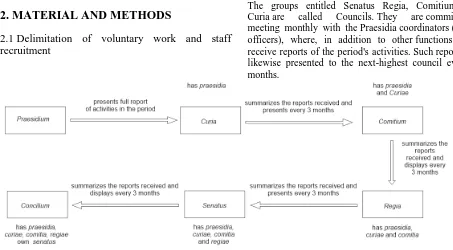
The groups entitled Senatus Regia, Comitium and Curia are called Councils. They are committed to meeting monthly with the Praesidia coordinators (called officers), where, in addition to other functions, they receive reports of the period's activities. Such reports are likewise presented to the next-highest council every 3 months.
Fig. 1. Reporting flow of Praesidia and Councils of the Legion of Mary
Everything in the report is done manually, by reading the notebooks in the case of praesidia, or the reports presented in the case of councils, and transcribing the activities. This is costly and time consuming, and often leaves it to the writer of the report to understand what should or should not be part of it. In this sense, a management system of these activities would bring great advantages.
Moraes et al. (2018) [1 2 ] describes:
The Management Information Systems (MIS), in turn, facilitate the decision making of managers (executives), based on updated data, from a global perspective
(CARMO; PONTES, 1999). Already, Knowledge
Management (KM) becomes essential for the proper handling of technology with a view to market strategy and internal organization of the company. It seeks to understand the characteristics of the competitive environment and the collective and individual needs of the organization, reflecting the coordination of efforts at the operational and strategic level (TERRA, 2014).
For the development of this system, a team of information technology professionals who were part of the Legion of Mary was assembled, because it would be necessary to know the structure of the organization. In order to have a diversity of members, the following invitations were made:
1. public invitation at an official event of Senatus of São Paulo, for approximately 100 people, where 2 people accepted;
2. public invitation at a
monthly Senatus meeting of São Paulo, for approximately 60 people, where no one accepted;
3. individual invitations where everyone accepted.
2.2 Interview
At this meeting the project proposal was presented and explained that it would be carried out on a voluntary basis, in which everyone agreed. They were then asked to introduce themselves and answer the following questions in an orderly manner:
1) What is your degree or, if not, what area do you study in?
2) What is the current occupation?
3) What experience in the area? Do you have knowledge in systems development?
4) Why did you want to be part of the team? What are the expectations of contribution / gain?
2.3 Meetings
With the team members gathered, it was agreed that the study period would be approximately one year from that date, and that the meetings would take place fortnightly and would be online. The technologies to be used (programming language, database, version control, etc.) were also defined.
2.4 Team Training
Due to the low technical knowledge of some members, we conducted a little training, in order to, besides technically capacitating, analyze if this would be a motivating factor. This training consisted of: a) setting up the work environment; b) run a test system and explain each of the functionalities created; c) create a database and explain the commands; d) configure a version control.
2.5 Questionnaire
About 8 months after the first meeting, a questionnaire was applied to participants, with questions divided into 2 parts: the first part for members who dropped out of the project, and the second part for members who continued until the end of the study. The purpose of this questionnaire was to verify what led some members to drop out of the team and what motivated and demotivated other members during the work.
3. RESULTS
In the first meeting, we conducted an interview with the team members, with the objective of knowing the participants and their expectations. From the responses, we observed that most participants have a degree in information technology (IT) and work in the field, including some with professional experience for over a year (Fig. 2A-B). On the other hand, two of the team members are not IT professionals. Of these, one works in an uncorrelated area, and the other is a student (Fig. 2A-B). In line with the profile of academic background, we
have that most staff have experience in IT; however, they limit this experience to the academic context (Fig. 2C). In the interview, we also questioned the reasons that led them to accept to be part of the team. As shown in figure 2D, the answers included: acquiring knowledge and / or experience in systems development, personal development, contributing to this research, learning a new technology, learning to work in a team, and helping the institution (Legion From Maria).
0 1 2 3
Not graduated
Other IT over 1 year ago
IT less than 1 year ago What is the area of academic education?
0 1 2 3 4
IT Other Unemployed
What is the current occupation?
0 1 2 3
Academical (only)
Low High
What experience in the area?
(A)
Fig. 2. Professional profile of the volunteer team.
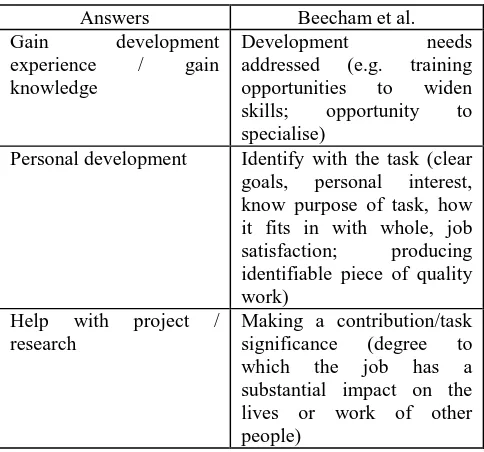
From the answers, it is noted that the three most answered items corroborate what Beecham et al. (2007) [4] present about studies on motivation in software engineering, where it is possible to relate the experience gained with the need for development (the which includes the opportunity to specialize), personal development with identifying with the task (including personal recognition) and assisting in the project with making a contribution, as shown in table 1:
Table 1: Comparison of initial motivations with the study by Beecham et al.
Answers Beecham et al.
Gain development experience / gain knowledge
Development needs
addressed (e.g. training opportunities to widen skills; opportunity to specialise)
Personal development Identify with the task (clear goals, personal interest, know purpose of task, how it fits in with whole, job satisfaction; producing identifiable piece of quality work)
Help with project / research
Making a contribution/task significance (degree to which the job has a substantial impact on the lives or work of other people)
At the very first meetings, two members gave up their participation in the project. When asked why they had given up, they argued that they were unable to attend meetings due to other commitments. Regarding the reasons that would motivate them to return to the project, they highlighted the possibility of applying the learning in the professional context and the possibility of reconciling the schedules.
From the members who persisted, we could see that they were unfamiliar with the technology and therefore made them less dedicated to the project. It is important to point out that although the members indicate theoretical knowledge, they were not prepared to apply it in the context of volunteer work. This fact may be related to the study by Santoso and Putra (2017) [15], in which they warn about the gaps between undergraduate curricula and labor market requirements, especially in the technology industry, highlighting the there must be a strong connection between academia and the professional. This fact became very clear during the meetings, as over time the tasks that each participant was to present became more difficult to deliver. In order to verify if the technical capacity was a factor that could motivate or demotivate the volunteers, we performed a little technical training.
As a result, after the training, we observed greater participation of members in the project, who even presented some prototypes of the activities previously requested. Abdullah et al. (2014) [1] demonstrated that even when basic training improves creativity and innovation in small and medium enterprises, where, among other benefits, those pointed out by Arthur et al. [2]: increased efficiencies in processes and Increased capacity to adopt new technologies, skills, methods and processes.
In the questionnaire, applied about eight months after the interview, we asked about how long each volunteer dedicated to the project per week. As shown in Figure 3, volunteers spent more time developing the system during the first few weeks of the study, decreasing their dedication throughout the project. Despite this, they did not give up on volunteer work.
0 1 2 3
Why did you want to be part of the team?
Fig. 3. Graph of dedicated time, in weekly hours, of team members
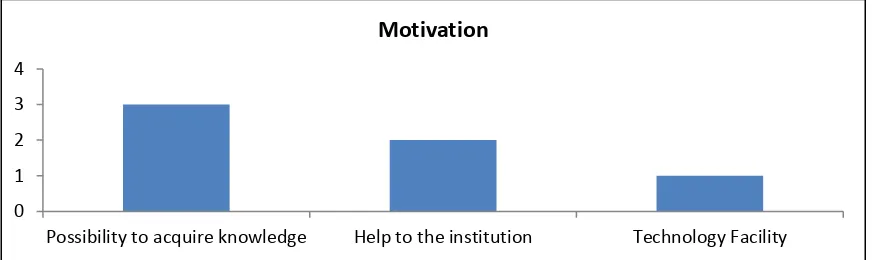
Then, when asked about motivational factors that led them to continue in the project, participants mentioned motivations already indicated at the beginning of the
study, and also included the ease of technology employed in the project (Fig. 4).
Fig. 4. Graph about team motivation during the project
In this regard, we can associate the positive contribution of technical training to the motivation of volunteers, as they were not familiar with the technologies used at the beginning of the study.
For this reason, we asked the team to analyze their previous knowledge, comparing it to those acquired during the volunteer work, assigning a value of none,
regular, medium, good or great. This value should be based on experience within the project in the following areas: programming language, database, Model-View-Controller (MVC), agile methodologies, institution. 0
1 2 3
1h maximum 3h maximum 5h maximum Only in the first weeks
Time dedicated in hours / week
0 1 2 3 4
Possibility to acquire knowledge Help to the institution Technology Facility
Motivation
0 1 2 3
Programming language
Database MVC Agile Methodologies Institution
Knowledge before starting the project
None
Regular
Medium
Good
Fig. 5. Technical knowledge before and after starting volunteer work
Comparing the graphs, it is possible to observe that the participants acknowledged having acquired technical knowledge during the execution of the volunteer work. As an example, in programming language, where there was regular prior knowledge, it was classified as average knowledge of the subject; in agile methodologies, classified as medium knowledge by two volunteers, it was considered by the participants as an area where they had medium and good knowledge. This comparison is important for what to demonstrate the impact of training.
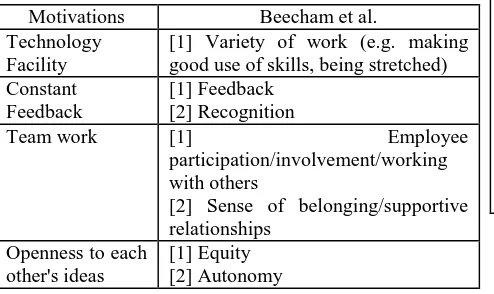
Other aspects explored in the present case study were observed during team meetings to discuss project development. Through them, facts that were not included in the questionnaire were observed. For example, we note that meetings provide constant feedback, teamwork, and openness for dialogue and exchange of ideas among volunteers, contributing to improvements in activities. Beecham et al. (2007) [4] also present these items as motivators for teams, as shown in table 2 :
Table 2: Comparison of motivations observed in meetings with the study by Beecham et al.
Motivations Beecham et al.
Technology Facility
[1] Variety of work (e.g. making good use of skills, being stretched) Constant
Feedback
[1] Feedback [2] Recognition
Team work [1] Employee
participation/involvement/working with others
[2] Sense of belonging/supportive relationships
Openness to each other's ideas
[1] Equity [2] Autonomy
França (2009) [5] in his study of motivations for software teams of members drawn up a table with the motivations of 235 professionals, sorted by relevance. This table is presented below, highlighting the motivations observed in this paper. It is possible to observe that of the 20 motivations presented in the table, 10 are also observed in this study, showing that even though the sampling is different, the same characteristics can be found.
Table 3: Based on França (2009) with the motivations in members of software team.
Problem solving Challenging job Exercise of creativity
Comprehensive exercise of personal skills Work with other people
Experimenting with new things Work in successful companies Participation in decision making
Good practice exercise Software Engineering Meaning of Work
Balance between personal and professional life Identification with the task
Empowerement
Participation in the entire project life cycle Career Development
Autonomy
Rewards and Financial Incentives Individual Feedback
Constant change in work routine Technical specialization
4. CONCLUSION
This study sought to identify which factors motivate a systems development team in a volunteer project through a case study with members participating in the Legion of 0
1 2 3
Programming language
Database MVC Agile Methodologies Institution
Knowledge before starting the project
None
Regular
Medium
Good
Mary, an association linked to the Roman Apostolic Catholic Church.
The results pointed to a relationship between motivation and technical-personal improvement, in addition to the bond with the institution, which arouses the interest of members in helping it. On the other hand, the main factor related to the demotivation of participants was the difficulty in being able to reconcile personal schedules with volunteer work.
Although this study followed the scientific method, it is not possible to state that these are the only motivational or demotivational factors present in a systems development volunteer team, as the motivations may vary for each individual and under different circumstances or projects. . Therefore, other studies on the subject are still needed to have a deeper knowledge about motivational factors in volunteering, favoring the development of strategies that promote the permanence of participants, highlighting the contribution of technical training as a positive motivational factor for volunteers. Thus, the results shown here are important for mentoring developers and project leaders who want to work with volunteer teams.
Acknowledgments
The authors thank everyone who volunteered to collaborate on this project; to the officers of the Legion of Mary, Senatus of Sao Paulo, who allowed this case study; and to the reviewers of this article who contributed to its quality.
REFERENCES
[1] Abdullah , N.H, Ping , LL, Wahab , E., Shamsuddin , A. , Perception on Training and Employee Innovativeness: An Evidence from Small Firms. Proceedings of the 2014 IEEE ICMIT, 2014.
[2] Arthur, WJ, Bennett, WJ, Edens, PS, Bell, ST, Effectiveness of training in organizations: A metaanalysis of design and evaluation features. Journal of Applied Psychology, 88 (2), pp 234-245, 2003. [3] Bonaccorsi, Andrea; Rossi , Cristina (2002): Why open
source software can succeed, LEM Working Paper Series, No. 2002/15, Scuola Superiore Sant'Anna, Laboratory of Economics and Management (LEM), Pisa , 200 .
[4] Beecham, S., Baddoo, N., Hall, T., Robinson, H., Sharp, H., Motivation in Software Engineering: A systematic literature review. Information and Software Technology, 50, 2007.
[5] França, A., A study of motivation for members of software development teams. Master dissertation presented at the Federal University of Pernambuco, 2009.
[6] França, A., Ribeiro, D., Open Source: What's behind the motivation of developers. Software Engineering Magazine, 51, 2012.
[7] Hertel, G., Niedner , S., Hernnmann , S. (2003); Motivation of software developers in Open Source projects: an Internet-based survey of contributors to the Linux kernel. Research Policy 32, 2003.
[8] Legion of Maria . Official Manual of the Legion of Mary. Sao Paulo. 1996.
[9] Law regarding volunteering in Brazil - http://www.planalto.gov.br/ccivil_03/leis/l9608.htm , accessed on 18/09/2019.
[10]Marques, M., The motivations for volunteering. Exploratory study in a sample of polytechnic higher education students . Master's dissertation presented at the Department of Communication and Business Sciences of the Coimbra School of Education, 2016. [11]McConnell, S., Problem programmers, Software, IEEE
Software March / April 1998.
[12]Moraes, J. P., Sagaz, S. M., Santos, GL, Lucietto, DA , Information Technology, management information systems and knowledge management with a view to creating competitive advantages: literature review. Vision Magazine, Hunter / SC, v. 7, no. 1, Jan. / Jul. 2018.
[13]2019 Annual Planning of the São Paulo Senatus,
available at
https://senatus.org.br/pdfs/planejamento_2019_complet o.pdf, accessed 09/18/2019.
[14]Rogers, S., Ludington, J., Graham, S. Motivation & learning: A teacher's guide to building excitement for learning & igniting the drive for quality. 3rd Ed. Evergreen: Peak Learning Systems, 1997.
[15]Santoso, H . B. Putra , P . O., Bridging the Gap between IT Graduate Profiles and Job Requirements: A Work in Progress. 7th World Engineering Education Forum (WEEF), 2017.