Volume 2, Issue 9 (August 2012), PP. 17-27
CBR based Performance Evaluation on FSR, DSR,STAR-LORA,
DYMO Routing Protocols in MANET
Y.Ramesh
1, Usha Ch
2, Jagadish Gurrala
31,2
Department of CSE, Aditya Institute of Technology and Management, JNTU, TEKKALI, INDIA
3Department of CSE, Anil Neerukonda Institute of Technology and Sciences, AU, Sangivalasa, Visakhapatnam, INDIA
Abstract—For last one decade lot of researchers were conducted extensive work on performance evaluation among routing for tremendous rise in technological advancement.In these protocols, Routing process is a tedious job due to changing its topology over time. Since Mobile ad hoc network is a set of independent nodes move freely throughout network, to which all of them are created for the purpose of data transfer with limited battery backup. We need efficient routing protocol is needed to guide signals from source to destination through number of hops within time and several routing strategies has been proposed in last decade for ad-hoc network. In this paper, we leave efficient routing strategy to public to determine and extract efficiency from thoroughly perform simulations and comparative analysis of specified proactive type routing protocols and specified reactive type routing protocols with few nodes using Qual-Net Simulator and summarizes the results.
Keywords— DSR,DYMO,STAR-LORA,FSR, Routing Strategies
I.
INTRODUCTION
In past ten years, several researchers have conducted comparative study and performance evaluation[1][2][3] among several routing protocols with respect to performance metrics over nodes ranges from 50 to 200 were deployed in MANET. In the twenty first century there have been a lot of articles are published regarding routing protocols in the field of wireless mobile ad hoc networks using ns2 simulator and Qualnet simulator5.0.2. But there is missing in practicality in real world and really useful for public. In this paper we leave efficient routing strategy to public from obtaining results through[18] comparative study between proactive type Fisheye State Routing Protocol (FSR), proactive type Source Tree Adaptive Routing protocol(STAR) and Reactive type Dynamic Source Routing(DSR) and Reactive type Dynamic MANET On demand Routing Protocol(DYMO) are analyzed and presented and left to implementers whatever ease of routing technology is available in which how packets are delivered without Access Point. With this paper to explores the impact of QoS[22] metrics such as throughput, average end to end delay and average jitter on routing between nodes where we applied under Constant Bit Rate(CBR) client server traffic conditions using QualNet 5.0.2 simulator[13]. To show the performance efficiency in terms of plotting graphs represents that X axis indicates Node Count starting from 2 nodes to 12 nodes and Y axis indicates the Quality of Service metric by using simulator only. The rest of this paper is organized as follows.
In section 2 brief introductions to various routing strategies and its literature survey has been presented. Section 3 briefly explores test scenarios between STAR,FSR and DSR,DYMO routing protocol using QualNet 5.0.2 network simulator for 2, 4, 8, 10, 12 stationary nodes. In section 3 related works about test cases is presented. Simulation environment and simulation setup used in the work and running a scenario is discussed in section 4. In section 5 the results of the performance evaluation are thoroughly discussed. Conclusion & Future work is given in section 6.
II.
LITERATURE
SURVEY
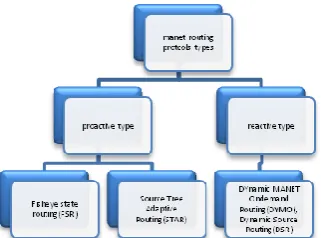
Figure 1 Classification of MANET routing protocols
2.1 Proactive Routing Strategy
Proactive Routing Strategy also called table driven, or data gram approach in packet switching network. It maintains routing table using the routing information learnt from neighbours on periodic basis. Main characteristics of these protocols include: distributed, shortest-path protocols, maintain routes between every host pair at all times, based on periodic updates of routing table and high routing overhead and consumes more bandwidth[4]. We are discuss comparative analysis between the following strategies in detail. Now we discuss the following kinds in this strategy.
1. Fisheye State Routing (FSR) [6]
2. Source Tree Adaptive Routing (STAR) [10]
2.1.1 Fisheye State Routing (FSR)
The FSR protocol[6] is the next generation technology of Global State Routing strategy(GSR). FSR maintains Entries of nearby nodes in the routing table are updated and exchanged with neighbours more frequently (to reduce the update message size).The accuracy of route increases as packets gets closer to the destination. The main drawback of FSR is as the mobility of remote nodes increases the accuracy of the routing information decreases.
2.1.2 Source -Tree Adaptive Routing (STAR)
The STAR protocol [10][11] is also called STAR – LORA(Least Overhead Routing Adaptive) based on the link state algorithm. Each router maintains a source tree, which is a set of links form a graph (V,E) containing the preferred paths to destinations. This protocol has significantly reduced the amount of routing overhead disseminated into the network by using a least overhead routing approach (LORA), to exchange routing information. It also support optimum routing approach (ORA) if required. This approach eliminated the periodic updating procedure present in the Link State algorithm by making update dissemination conditional. Each node keeps the state of subset of the links, i.e., the links of the source trees of other nodes and all of its links.The source tree of a node is the tree composed of all links that constitute the preferred routes to all destinations. STAR based on the trees reported by neighbours and the state of its links, each node builds a partial topology graph that is used to build the routing table. STAR is a scalable algorithm.
2.2 Reactive Routing Strategy
Reactive Routing strategy[4] are also called demand driven approach or virtual circuit approach in packet switching network. that find path as and when required. They maintain information about the active routes only. They performs route discovery phase before data transmission by flooding route request packet and destination node reply with route reply packet. A separate route maintenance procedure is required in case of route failure. Main Characteristics of these routing protocols are: determine routes as and when required, less routing overhead, source initiated route discovery and more route discovery delay. The following are used for this kind.
1. Dynamic MANET On-Demand Routing (DYMO) [7] 2. Dynamic Source Routing (DSR) [9]
2.2.1 DYnamic MANET On-Demand Routing (DYMO)
Dynamic MANET On-demand (DYMO)[7] routing protocol is a source initiated or reactive routing strategy in which multihop routing is built up between participating nodes that wish to communicate. The basic operations of the DYMO protocol are route discovery and route maintenance. During route discovery the originating node initiates dissemination of a Route Request (RREQ) throughout the network to find the target node. During this dissemination process, each intermediate node records a route to the originating node. When the target node receives the RREQ, it responds with a Route Reply (RREP) unicast toward the originating node. Each node that receives the RREP records a route to the target node, and then the RREP is unicast toward the originating node. When the originating node receives the RREP, routes have then been established between the originating node and the target node in both directions. During route maintenance, all nodes maintain their routes and monitor their links. When a packet is received for a route that is no longer available the source of the packet is notified. A Route Error (RERR) is sent to the packet source to indicate the current route is broken. Once the source receives the RERR, it re-initiates route discovery if it still has packets to deliver.
2.2.2 Dynamic Source Routing (DSR)
node which caches the source route that it has learned. The major components of DSR are “Route Discovery” and “Route Maintenance” which work together for determining and maintaining routes to arbitrary destinations [5]. It is designed to restrict the bandwidth consumed by control packets in ad hoc wireless networks by eliminating the periodic table-update messages required in the table-driven approach. A route is established by flooding Route Request packets in the network. [8].
III.
RELATED WORK
In this paper, we have taken two different scenarios[19]. In the first scenario, traffic pattern is taken as CBR Client and no. of nodes have been varied and performance comparisons have been made between STAR-LORA,FSR and DYMO,DSR protocol. In the second scenario, traffic pattern is taken as CBR Server have been varied and performance comparisons have been made between STAR-LORA,FSR and DYMO,DSR protocols.. The QoS can be defined as the manner that the service of delivery of packages is supplied and who can be characterized by various parameters of performance like, the throughput, the delay variation (jitter).
3.1 Test Scenario 1
In first scenario we have taken CBR Client as traffic pattern. Parameters are specified in table 1
Table 1: Parameters for Scenario 1
Parameter value
Terrain size 1500 X 1500
Number of nodes 2,4,6,8,12
Traffic type Constant Bit Rate client
Packet size 512
Mobility Random way
Speed 100 mps
Pause time 15,20,25
Simulation time 3000 sec
Routing protocol FSR,STAR-LORA,DYMO,DSR
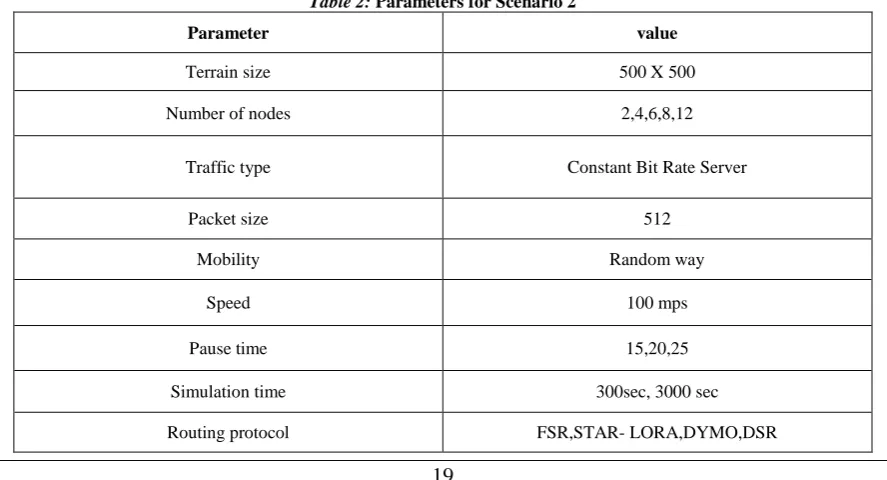
3.2 Test Scenario 2
In first scenario we have taken CBR Server as traffic pattern. Parameters are specified in table 2
Table 2: Parameters for Scenario 2
Parameter value
Terrain size 500 X 500
Number of nodes 2,4,6,8,12
Traffic type Constant Bit Rate Server
Packet size 512
Mobility Random way
Speed 100 mps
Pause time 15,20,25
Simulation time 300sec, 3000 sec
IV.
SIMULATION ENVIRONMENT
The Qualnet 5.0.2 simulator is used for the design of scenarios in graphical environment. To[15] give an idea of how (in terms of quantitative) the scenario performs it can be run using the QualNet Animator. Figure 2 shows the Animator with thepreviously designed scenario in action. On the right side you can enable or disable various types of animations. In the Layers tab animations for each of the 7 OSI layers can be enabled or disabled individually.
Figure 2 : Snap shot of QualNet5.0.2 Animator in Action
4.1 Experimental Setup
The study has been done to place require number of nodes changes dynamically on canvass plane as shown in Fig 3 and compare the efficiency of four different routing protocols, two of them are from proactive type and rest of them are reactive type in Mobile Ad hoc Networks. The tool used is QualNet5.0.2, the Quality of Service parameters are Throughput, Average End to End Delay and Average Jitter. The simulation using 2,4,6,8 and 12 nodes. The performance of all four routing protocols is carried out and results are compiled.
4.2 Performance Metrics
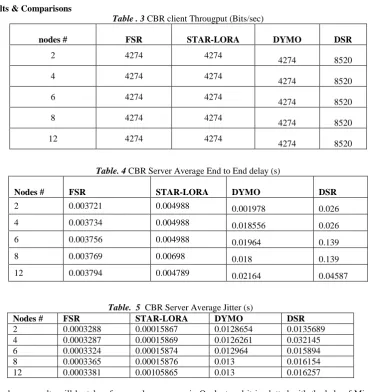
Now we are conducted extensive calculation on metrics based on terrain size. Hence terrain size varies, the corresponding metrics are rapidly changes while number of nodes are fixed. Here we perform rigorous experimental scenarios are deployed in QualNet simulator to generate graphs with suitable metrics. The following metrics are studied and applied to current scenarios as shown in table 3,4 and 5.
4.2.1 Average End To End Delay
It is the average time it takes a signal travel from process at source node service access point(SAP) to process at destination node service access point(done at SAP of transportation layer in TCP/IP protocol suite). This metric is calculated by subtracting time at which first packet was transmitted by source from time at which first data packet arrived to destination. This metric is significant in understanding the delay introduced by path discovery.
4.2.2 Throughput
The throughput of the protocols can be defined as total number of signalling elements travelled at a unit time. It is the amount of data per time unit that is delivered from one node to another via a communication link. The throughput is measured in bits per second (bit/s or bps).
4.2.3 Average Jitter
4.3 Results & Comparisons
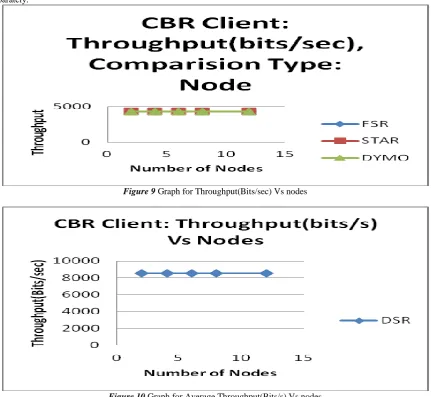
Table . 3 CBR client Througput (Bits/sec)
nodes # FSR STAR-LORA DYMO DSR
2 4274 4274
4274 8520
4 4274 4274
4274 8520
6 4274 4274
4274 8520
8 4274 4274
4274 8520
12 4274 4274
4274 8520
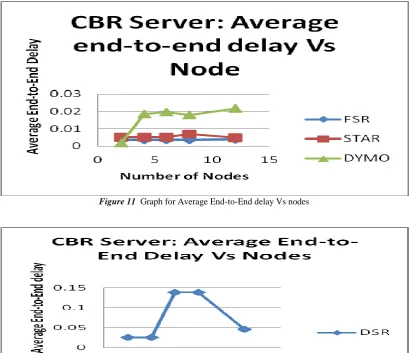
Table. 4 CBR Server Average End to End delay (s)
Nodes # FSR STAR-LORA DYMO DSR
2 0.003721 0.004988 0.001978 0.026
4 0.003734 0.004988 0.018556 0.026
6 0.003756 0.004988 0.01964 0.139
8 0.003769 0.00698 0.018 0.139
12 0.003794 0.004789 0.02164 0.04587
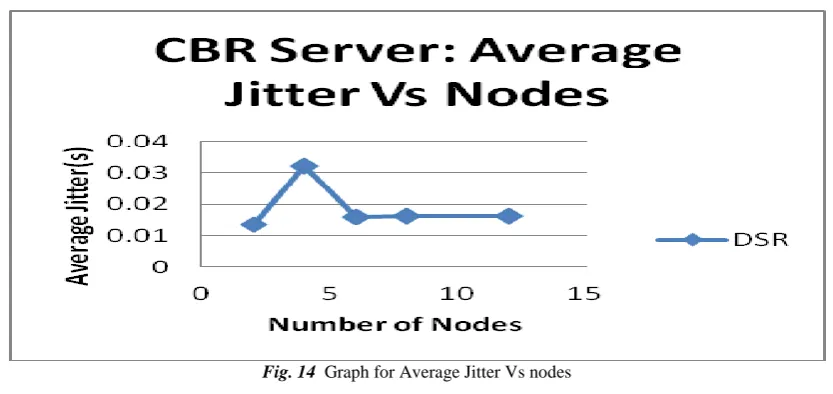
Table. 5 CBR Server Average Jitter (s)
Nodes # FSR STAR-LORA DYMO DSR
2 0.0003288 0.00015867 0.0128654 0.0135689 4 0.0003287 0.00015869 0.0126261 0.032145 6 0.0003324 0.00015874 0.012964 0.015894 8 0.0003365 0.00015876 0.013 0.016154 12 0.0003381 0.00105865 0.013 0.016257
Note: The above results will be taken from analyzer screen in Qualnet and it is plotted with the help of Microsoft Excel 2007 tool. Figures 5,6, 7,8,9 and 10 shown figures 0,5,10,15 in X axis instead of display figures 2,4,6,8,10 and 12 nodes on X axis in Qualnet experimentation. Readers can understood these numbering notations.
4.4 Running A Scenario
Figure 3 Number of control packets Vs node ID in Analyzer Window
Figure 4 Total packet sent Vs node ID in Analyzer
Figure 6 Fisheye Routing type No. of control packets transmitted Vs node ID in Analyzer Screen
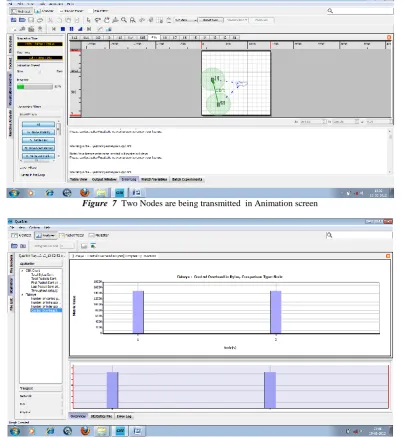
Figure 7 Two Nodes are being transmitted in Animation screen
V.
PERFORMANCE EVALUATION
The Qualnet 5.0.2 network simulator[14] has been used to analyze[16][17] the parametric performance of Source Tree Adaptive Routing Protocol (STAR), Fisheye State Routing Protocol (FSR), Dynamic Source Routing (DSR) and Dynamic MANET On demand Routing protocol (DYMO). The metric based evaluation is shown in Fig. 9 to Fig. 14.
5.1 Throughput
With the varying CBR data traffic the throughput is analyzed. The successful packet delivery at given nodes having number (ID) in an adhoc network is observed with increasing MAC based traffic load and mobility. It is found that DSR with least routing overhead uniformly performs better than FSR and STAR The performance is shown in figure 9 and 10. Therefore FSR,STAR and DYMO has been plotted in first graph and DSR is plotted in second and next graph because DSR values are beyond the values of Previous graph. Similarly in next sections 5.2 and 5.3 assumed to put graphs separately.
Figure 9 Graph for Throughput(Bits/sec) Vs nodes
Figure 10 Graph for Average Throughput(Bits/s) Vs nodes
5.2 Average End-To-End Delay
Figure 11 Graph for Average End-to-End delay Vs nodes
Figure 12 Graph for Average End-to-End delay Vs nodes
5.3 Average Jitter
Jitter, the variation of the packet arrival time, is an important metrics for any routing protocol. In this analysis it is found to vary. Initially it is low but for higher nodes ID than 12 it is high. The jitter for nodes 2,4,6,8 is high for both of the protocols due to larger distance between source and destination. In STAR it is due to limited no.of nodes as in FSR and DYMO, it is due to higher frequency of propagation. The jitter results are shown in fig. 13 and 14
Fig. 14 Graph for Average Jitter Vs nodes
VI.
CONCLUSION & FUTURE WORK
The performance evaluation of two proactive routing strategies(FSR,STAR) and two reactive routing strategies (DSR, DYMO) for stationary nodes are evaluated by varying the node density (2,4,6,8,12) using Qualnet 5.0.2network simulator. From these graphs it can be realised that reactive routing protocol DSR only are suited for applications where average jitter and throughput are in danger situation and FSR are suited for Average end to end delay. The worst drawback [15] of the QualNet animator is its extreme high CPU utilization and its implementation in Java which makes it run very slowly on most machines. In this paper we leaves to researchers to enhance our mission to run scenarios not only these tools usage. However there is scope of examination over strategies for better tomorrow. One of our future research works is to develop an proposed algorithm on routing strategy can work in Bandwidth on demand working environment like banking sector, high secure communication, education system using high end tools.
REFERENCES
[1]. M.Uma, G.Padmavathi, ”A Comparative Study and Performance Evaluation of Reactive Quality of Service Routing Protocols in Mobile Advhoc networks”, Journal of Theoretical and Applied Information Technology,
copyright 2005 – 2009.
[2]. Parma Nand, S.C. Sharma, “Comparative study and Performance Analysis of FSR, ZRP and AODV Routing Protocols for MANET”, 2nd International Conference and workshop on Emerging Trends in Technology (ICWET) 2011 Proceedings published by International Journal of Computer Applications® (IJCA).
[3]. Subramanya Bhat.M, et al.,“ A Performance Study of Proactive, Reactive and Hybrid Routing Protocols using Qualnet Simulator”, International Journal of Computer Applications (0975 – 8887) Volume 28– No.5, August 2011
[4]. Ravinder Ahuja, “Simulation based Performance Evaluation and Comparison of Reactive, Proactive and Hybrid Routing Protocols based on Random Waypoint Mobility Model”,International Journal of Computer Applications (0975 – 8887) Volume 7– No.11, October 2010.
[5]. D. Johnson and D. Maltz. “Dynamic source routing in ad hoc wireless networks”, In T. Imielinski and H. Korth, editors, Mobile computing, chapter 5. Kluwer Academic, 1996.
[6]. [6] G. Pei, M. Gerla, and T. W. Chen, “Fisheye State Routing in Mobile Ad Hoc Networks,” In Proceedings of the 2000 ICDCS workshops, Taipei, Taiwan, Apr. 2000.
[7]. http://moment.cs.ucsb.edu/pub/draft-ietf-manet-dymo- 02.html
[8]. Gergely Acs, Levente Buttyan and Istvan Vajda “ Provably Secure on-demand Source routing in Mobile Ad-Hoc Networks” Accepted for publication in the IEEE transactions on Mobile Computing, November 28, 2005
[9]. Josh Broch, David Johnson, and David Maltz. “The dynamic source routing protocol for mobile ad hoc networks for IPv4 IETF RFC 4728, Feb 2007.
[10]. J.J. Garcia-Luna-Aceves, C. Marcelo Spohn, Source-tree routing in wireless networks, in: Proceedings of the Seventh Annual International Conference on Network Protocols Toronto, Canada, October 1999, p. 273.
[11]. Parma Nand, S.C. Sharma, Rani Astya, “Traffic Load based Performance Analysis of DSR, STAR & AODV Ad hoc Routing Protocol”, International Journal of AdvancedComputer Science and Applications, vol 1 No 4, pp 58-62,Oct 2010.
[12]. Suresh Kumar, R K Rathy and Diwakar Pandey, ”Traffic pattern based performance comparison of two reactive routing protocols for ad hoc networks using NS2, © 2005-2009 IEEE.
[13]. Qualnet Simulator www.scalable-networks.com
[16]. Josh Broch, David A. Maltz, David B. Johnson, Yih-Chun Hu, and Jorjeta Jetcheva, “A Performance Comparison of Multi-Hop Wireless Ad Hoc Network Routing Protocols”, Proceedings of the Fourth Annual ACM/IEEE International Conference on Mobile Computing and Networking, Dallas-Texas, October 1998.
[17]. M. Scott Corson and Joseph Macker, “Mobile Adhoc Networking (MANET): Routing Protocol Performance Issues and Evaluation Considerations”,RFC2501, Request for Comments, January 1999.
[18]. Samir R. Das, Charles E. Perkins, and Elizabeth M.Royer, “Performance Comparison of Two On demand Routing Protocols for Ad Hoc Networks”, Proceedings of the IEEE Conference on Computer Communications INFOCOM), pages 3-12,Tel Aviv, Israel, March 2000.
[19]. Satyabrata Chakrabarti and Amitabh Mishra, “QoS Issues in Ad Hoc Wireless Networks”, IEEE Communications Magazine, February 2001.
[20]. Shigang Chen and Klara Nahrstedt, “Distributed Quality-of-Service Routing in Ad Hoc Networks”,IEEE Journal on Selected Areas in Communications,Vol. 17, No. 8, pp. 1488-1505, August 1999.
[21]. Songwu Lu, Vaduvur Bharghavan and R. Srikant,“Fair Scheduling in Wireless Packet Networks”,IEEE/ACM Transactions on Networking, Vol. 7, No.4, August 1999.