e-ISSN: 2278-7461, p-ISSN: 2319-6491
Volume 5 Issue 8 [Sep2016] PP: 13-17
Dominating Clique and Dominator Chromatic Number of a Prime Square
Dominating Graph
A. Sudhakaraiah
*, V. Raghava Lashmi
1, B. Narayana
2 *Department of Mathematics, S. V. University, Tirupati, Andhra Pradesh-517502, India
1Department of S&H (Mathematics), Vijaya Institute of Technology for Women, Vijayawada, A. P. - 521108,
India
2
Department of Basic Science and Humanities, St, Mary’s Women’s Engineering College, Guntur, A. P. India
Abstract:- The aim of this paper is to put forth some revelations regarding the domination parameters of prime square dominating graphs. Some special classes of prime square dominating graphs are chosen for this purpose and their dominating cliques and dominator chromatic numbers are determined.
Keywords: Prime square dominating graphs, dominating clique, independent set, domination number, dominator chromatic number
I.
INTRODUCTION
Let G be a graph with vertex set V (G) and edge set E (G). Unless specified, throughout the paper, the graph G(V, E) is a finite and connected graph. For graph theoretical terms, we refer to Harary [2] and for terms related to domination we refer to Haynes et al. [9].
Domination and the graph labeling are some of the important areas of research in graph theory. Labeling of a graph plays a vital role in graph theory. Seod M.A.and Youssef M.Z [8] and Joseph A. Gallian [5] deal with graph labeling besides many others. A labeling of a graph G is an assignment of distinct positive integers to its vertices. A graph is a prime square dominating graph, if the vertices of graph G are labeled with positive integers such that the vertex labeled with composite number c is adjacent to the vertex named with prime number p if and only if p2 divides c.
1. 1 Definition: A subset S of the vertex set V is a dominating set of the graph if every vertex not in S is adjacent to at least one vertex of the set S. The domination number of the graph G, denoted by γ (G), is the minimum number of vertices present in a dominating set.
Dominating sets have a wide range of applications in various fields, including communication theory and combinatorics
1. 2 Definition: A set of vertices is said to be an independent set if no two vertices of the set are adjacent.
1. 3 Definition: A graph coloring is a mapping f from set of vertices V (G) to the set of colors, say C. The coloring is a proper coloring if no two adjacent vertices are assigned with the same color. A k-coloring of G is a proper coloring of G that uses at most k colors.
1. 4 Definition: The chromatic number of G, χ(G), is the minimum number of colors required to properly color the graph. Dominator coloring of a graph is a proper coloring of a graph in which each vertex of the graph dominates every vertex of some color class. The dominator chromatic number of the graph G, 𝜒𝑑(G), is the
minimum number of colors needed for a dominator coloring of a graph.
Dominating Set and Coloring have a number of applications and this has led to the algorithmic study of numerous variants of these problems. A number of basic combinatorial and algorithmic results on DC have been obtained and a systematic study of dominator coloring problem from the perspective of algorithms and complexity
was initiated.
1. 5 Definition: A clique dominating set or a dominating clique is a dominating set that induces a complete subgraph. A clique dominated graph is a graph that contains a dominating clique.
Wolk [1] presents a forbidden subgraph characterization of a class of graphs which have a dominating clique of size one. The concept of clique domination in graphs is introduced by Cozzens and keheller [ 6 ]. Study of Clique Domination in P5 – free graphs is carried out by Basco [ 3 ] and bounds for clique domination
II.
CLIQUE DOMINATION IN PRIME SQUARE DOMINATING GRAPHS
2.1 THEOREM: Let the vertex set V = { 𝑣1, 𝑣2, 𝑣3,..., 𝑣𝑛}, n ≥ 2 of a prime square dominating graph G be
such that a vertex 𝑣𝑖, 1≤ i ≤ n is labeled with a prime number 𝑝1 and the remaining all vertices are labeled with
composite numbers 𝑐2, 𝑐3,... , 𝑐𝑛 such that 𝑝12 divides all the vertices labeled with composite numbers. Then G
is a prime square dominating graph having a dominating clique of size one
Proof: Let the vertex set V={ 𝑣1, 𝑣2, 𝑣3,…, 𝑣𝑛} of the prime square dominating graph G be labeled with
composite numbers and prime numbers satisfying the conditions mentioned in the theorem. Implies, vertex 𝑝1 is
adjacent to 𝑐𝑘∀ k = 2, 3, 4, …, n. As there is no other vertex labeled with prime, except 𝑝1,𝑐𝑘 is not adjacent to
any other vertex, except 𝑝1 for k = 2, 3, 4, ……, n. The singleton set S = { 𝑝1 } is a dominating set and
moreover it is a minimum dominating set. The subgraph induced by a single vertex is always complete. It follows that the induced subgraph < S > is a complete graph. The prime square dominating graph G has a dominating clique of size one.
2. 1. 1 Experimental problem: Consider the prime square dominating graph G with vertex set V ={3, 9, 18, 45, 63, }. It will be as shown in Fig. 1
Fig. 1. Prime Square Dominating Graph
The graph satisfies all the conditions stated in the above theorem for 𝑝1 = 3, 𝑐2= 9, 𝑐3= 18, 𝑐4= 45, 𝑐5= 63
and the order of the graph, n = 5. Clearly, minimum dominating set is S = {3}. The subgraph induced by S is also complete. Thus, S is the dominating clique of size one.
2. 2 THEOREM: Let the vertex set V = { 𝑣1, 𝑣2, 𝑣3,..., 𝑣𝑛}, n ≥ 4 of a prime square dominating graphG be
such that the vertices 𝑣𝑖 and 𝑣𝑗 ,1≤ i, j ≤ n and i≠j are labeled with a prime number 𝑝𝑖 and composite number
𝑐𝑗 respectively and let some of the remaining vertices be labeled with composite numbers and some with prime
numbers so that 𝑝𝑖2 divides all the composite numbers and all the squares of primes divide only 𝑐𝑗. Then G has
dominating clique of size two.
Proof: Let the vertex set V = { 𝑣1, 𝑣2, 𝑣3,………, 𝑣𝑛}, of a prime square dominating graph G be labeled with
composite numbers and prime numbers satisfying the conditions mentioned in the theorem.
By hypothesis, except 𝑝𝑖, the squares of all the other primes divide only one composite number 𝑐𝑗.
So, all the vertices labeled with primes, except 𝑝𝑖, are adjacent only to 𝑐𝑗. Moreover, all the composite numbers,
except 𝑐𝑗, are divisible only by 𝑝𝑖2. Vertex labeled with 𝑝𝑖 is adjacent to all the vertices labeled with composite
numbers and vertex labeled with 𝑐𝑗 is adjacent to all the vertices labeled with prime numbers. The set of
vertices S = {𝑝𝑖, 𝑐𝑗} is a dominating set. Implies, γ(G) ≤ 2. Furthermore, neither 𝑝𝑖 nor 𝑐𝑗can dominate the
entire set V - {𝑝𝑖 , 𝑐𝑗}. It follows that, γ (G) >1. It is obvious that γ (G) = 2 and the set {𝑝𝑖 , 𝑐𝑗} is the minimum
dominating set. Moreover, 𝑝𝑖 is adjacent to 𝑐𝑗. The induced subgraph ˂ S ˃ is complete and the set S is the
dominating clique with minimum cardinality two.
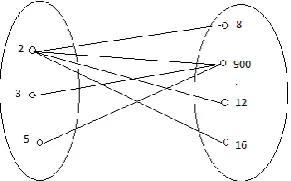
2. 2. 1 Experimental problem: Consider the prime square dominating graph with vertex set V = {2, 3, 5, 8, 900, 12, 16}. Prime square dominating graph in this case will be as shown in Fig. 2
Here 22 divides 8, 900, 12, 16 and 32 divides only 900. Also, 52 divide only 900. The vertices 𝑝𝑖 = 2 and 𝑐𝑗 =
900 satisfy all the conditions mentioned in the theorem. Hence, γ (G) = 2 and the minimum dominating clique is S = { 2, 900 }. The subgraph induced by the set S will be as shown in Fig. 3
Fig. 3. The induced subgraph, ˂ S ˃
2. 3 THEOREM: Let vertices of the vertex set V = { 𝑣1, 𝑣2, 𝑣3,..., 𝑣𝑛}, n ≥ 4 of a prime square dominating
graphG be labeled with prime numbers and composite number such that the square of every prime divides all composite numbers. Then G has dominating clique of size two and every subset of the vertex set V of order two consisting of a vertex labeled with prime and another vertex labeled with composite is a minimal dominating clique of the graph.
Proof: Let the vertex set V = { 𝑣1, 𝑣2, 𝑣3,………, 𝑣𝑛}, of a prime square dominating graph G be labeled with
composite numbers and prime numbers satisfying the conditions mentioned in the theorem. Partition the vertex set V into two disjoint subsets 𝑉1and 𝑉2, where 𝑉1is the set of all vertices labeled with prime numbers
𝑝1, 𝑝2, … , 𝑝𝑙 and 𝑉2 is the set of all vertices labeled with composite numbers 𝑐1, 𝑐2 , …, 𝑐𝑚, where l + m = n and
l, m ≥ 2.
The square of every prime number divides every composite number. Every vertex labeled with prime dominates all vertices labeled with composite numbers. Every subset of the vertex set, consisting of an element from 𝑉1 and another element from 𝑉2 is a dominating set. Implies, γ(G) ≤ 2. Neither a vertex labeled
with prime nor a vertex labeled with composite number alone can dominate all the remaining vertices. Implies, γ (G) > 1. It follows that, γ (G) = 2.
Let 𝑆𝑖𝑗 = { 𝑝𝑖, 𝑐𝑗 }, where 1 ≤ i ≤ l and 1 ≤ j ≤ m. Since l, m ≥ 2 , 𝑆𝑖𝑗 is a dominating set for each
possible value of i and j. Every vertex in V - 𝑆𝑖𝑗 is either labeled with a prime number or a composite number
and hence will be dominated by a vertex labeled with a composite number 𝑐𝑗 or by a vertex labeled with a
prime number 𝑝𝑖 accordingly. It follows that, the set 𝑆𝑖𝑗 is a dominating set for each possible value of i and j and
furthermore, 𝑝𝑖 dominates 𝑐𝑗 for all permissible values of i and j. Implies, the induced subgraph < 𝑆𝑖𝑗 > is a
compete graph. The sets { 𝑆𝑖𝑗 }, where 1 ≤ i ≤ l and 1 ≤ j ≤ m are all dominating cliques. Furthermore, γ (G) = 2.
Hence, every set { 𝑆𝑖𝑗 },where 1 ≤ i ≤ l and 1 ≤ j ≤ m is a smallest size dominating clique.
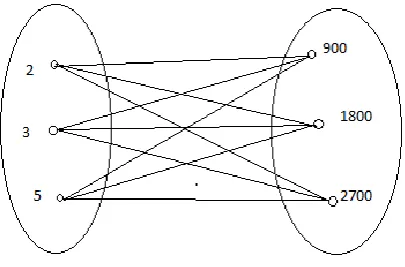
2. 3. 1 Experimental problem: Consider the prime square dominating graph with vertex set V = {2, 3, 5, 900, 1800, 2700}. Prime square dominating graph in this case will be as shown in Fig. 4. Here 22 ,
32 and 52 divide 900, 1800 and 2700 i.e., square of every prime divides every composite number. Hence, the sets {2, 900}, {2,1800}, {2, 2700}, {3, 900}, {3,1800}, {3, 2700}, {5, 900}, {5, 1800} and {5, 2700} are all
minimum dominating cliques.
III.
DOMINATOR CHROMATIC NUMBER OF SOME SPECIAL CLASSES
OF PRIME SQUARE DOMINATING GRAPHS
3. 1 Some Important Results:
1.For a connected graph G of order n, 2 ≤ 𝜒𝑑(G) ≤ n.
2. For any graph G, χ (G) ≤ 𝜒𝑑(G) [4].
3. Max {χ (G), γ (G) } ≤ 𝜒𝑑(G) ≤ χ (G) + γ(G) [7].
.
3. 2 Theorem: Let the vertex set V = { 𝑣1, 𝑣2, 𝑣3,..., 𝑣𝑛}, n ≥ 2 of a prime square dominating graph G be such
that a vertex 𝑣𝑖, 1≤ i ≤ n is labeled with a prime number 𝑝1 and the remaining all vertices are labeled with
composite numbers 𝑐2, 𝑐3,... , 𝑐𝑛 such that 𝑝12 divides all the vertices labeled with composite numbers. Then
the dominator chromatic number of the prime square dominating graph G is two.
Proof: It follows from theorem 3. 1 that the singleton set S = { 𝑝1 } is a dominating set and moreover, it is a
minimum dominating set. Implies, γ (G) = 1. The set of vertices labeled with composite numbers 𝑐2, 𝑐3,... , 𝑐𝑛 is
an independent set of vertices and can be colored with a single color. The vertex labeled with prime being adjacent to all the remaining vertices must be colored with a second different color. In this case, the prime square dominating graph G can be properly colored with two colors. It follows that, χ (G) ≤ 2. But for any connected graph, χ (G) ≥ 2. Therefore, χ (G) = 2 with two color classes 𝐶1 = { 𝑝1 } and 𝐶2 = { 𝑐2, 𝑐3,... , 𝑐𝑛 }.
Every vertex in 𝐶2 dominates the color class 𝐶1 and 𝑝1 dominates the entire color class𝐶2. Thus, every vertex
dominates an entire class. Therefore, 𝜒𝑑(G) ≤ 2. But for any graph G, 𝜒𝑑(G) ≥ χ (G) = 2. Accordingly, 𝜒𝑑(G) =
2.3. 2. 1 Experimental problem: Consider a prime square dominating graph as in the case of experimental problem 2. 1. 1. The graph satisfies all the conditions stated in the above theorem for 𝑝1 = 3, 𝑐2= 9, 𝑐3= 18,
𝑐4= 45, 𝑐5= 63. The set of vertices {9, 18, 45, 63 } is an independent set and can be colored with a single
color. Vertex labeled with 3 is adjacent to the vertices labeled with 9, 18, 45 and 63. So, 3 must be colored with a different color. Cearly, every vertex dominates an entire color class and furthermore, the graph G is a connected graph. Accordingly, 𝜒𝑑(G) = 2 with two color classes {3} and {9, 18, 45, 63}.
3.3 THEOREM: Let the vertex set V = { 𝑣1, 𝑣2, 𝑣3,..., 𝑣𝑛}, n ≥ 4 of a prime square dominating graph G be
such that the vertices 𝑣𝑖 and 𝑣𝑗 ,1≤ i, j ≤ n and i≠j are labeled with a prime number 𝑝𝑖 and a composite number
𝑐𝑗 respectively and let some of the remaining vertices be labeled with composite numbers and some with prime
numbers so that 𝑝𝑖2 divides all the composite numbers and all the squares of primes divide only 𝑐𝑗. Then the
dominator chromatic number of the prime square dominating graph G is three.
Proof: From theorem 2. 2, it is obvious that γ (G) = 2 and the set {𝑝𝑖, 𝑐𝑗} is the minimum dominating set. Color
the vertices labeled with 𝑝𝑖 and 𝑐𝑗 with colors 𝐶1′ and 𝐶2′ respectively. If possible, color one of the remaining
vertices with 𝐶1′. Two cases arise.
Case i: Vertex colored with 𝐶1′ may be vertex labeled with prime, say 𝑝𝑙, where l ≠ i, j and 1≤ l ≤ n. All the
squares of primes divide only 𝑐𝑗. By the definition of prime square dominating graph, it is clear that vertex
labeled with 𝑝𝑙does not dominate 𝑝𝑖 but dominates 𝑐𝑗. As there exists another vertex that dominates 𝑝𝑖, let that
vertex be the vertex labeled with 𝑐𝑚where m ≠ i, j, and 1≤ m ≤ n. The vertex 𝑐𝑚can be colored with 𝐶2′.
Therefore there exists a vertex labeled with prime number 𝑝𝑙that does not dominate the entire color class 𝐶2′.
Thus, the vertex 𝑝𝑙 neither dominates the color class 𝐶1′ nor the color class 𝐶2′. Another color is needed to color
the vertices. As a result, 𝜒𝑑(G) ≥ 3.
Case i: Vertex colored with 𝐶1′ may be vertex labeled with composite, say 𝑐𝑙, where l ≠ i, j and 1≤ l ≤ n. All the
squares of primes divide only 𝑐𝑗. By the definition of prime square dominating graph, it is clear that vertex
labeled with 𝑐𝑙does not dominate 𝑐𝑗 but dominates 𝑝𝑖. As there exists another vertex that dominates 𝑐𝑗, let that
vertex be the vertex labeled with 𝑝𝑚where m ≠ i, j, and 1≤ m ≤ n. The vertex 𝑝𝑚can be colored with 𝐶1′.
Therefore there exists a vertex labeled with composite number 𝑐𝑙that does not dominate the entire color class
𝐶1′. Thus, the vertex 𝑐𝑙 neither dominates the color class 𝐶1′ nor the color class 𝐶2′. Another color is needed to
color the vertices. As a result, 𝜒𝑑(G) ≥ 3. In both the cases, 𝜒𝑑(G) ≥ 3.
Except the vertices labeled with 𝑝𝑖 and 𝑐𝑗, color the remaining vertices with the color 𝐶3′. Then, every vertex
dominates an entire color class. The coloring is a dominator coloring.Thus, 𝜒𝑑(G) ≤ 3. Finally, it follows that
𝜒𝑑(G) = 3.3. 3. 1 Experimental problem: Consider a prime square dominating graph as in the case of
experimental problem 2. 2. 1. The vertices 𝑝𝑖 = 2 and 𝑐𝑗 = 900 satisfy all the conditions mentioned in the
theorem. Hence, γ (G) = 2. Color the vertex labeled with prime number 2 with the color 𝐶1′ and the vertex
Cearly, every vertex dominates an entire color class. In this case, the dominator chromatic number of the prime square dominating graph G is three with three color classes 𝐶1′ = {2}, 𝐶2′ = {900} and 𝐶3′ = {3, 5, 8, 12, 16}.
3. 4 THEOREM: Let vertices of the vertex set V = { 𝑣1, 𝑣2, 𝑣3,..., 𝑣𝑛}, n ≥ 4 of a prime square dominating
graph G be labeled with prime numbers and composite numbers such that the square of every prime divides every composite number. Then the dominator chromatic number of the prime square dominating graph G is two. Proof: Proceeding as in the case of theorem 3. 3, it follows that γ (G) = 2 and every set 𝑆𝑖𝑗= { 𝑝𝑖, 𝑞𝑗}, where 1 ≤
i ≤ l and 1 ≤ j ≤ m is a dominating set for each possible value of i and j. The sets of vertices { 𝑝1, 𝑝2, … , 𝑝𝑙 } and
{ 𝑐1, 𝑐2 , …, 𝑐𝑚 } are two independent sets of vertices. All the vertices can be properly colored with two colors.
As G is a connected graph, minimum two colors are needed to properly color a graph. Implies, χ (G) = 2. Let the set of all vertices { 𝑝1, 𝑝2, … , 𝑝𝑙 } be colored with 𝐶1′ and the set of all vertices { 𝑐1, 𝑐2 , …, 𝑐𝑚 } be colored with
𝐶2′. By hypothesis, the square of every prime divides every composite number. Every vertex labeled with prime
is adjacent to every vertex labeled with composite number. Every vertex in color class 𝐶1′ dominates an entire
class 𝐶2′ and every vertex in color class 𝐶2′ dominates an entire class𝐶1′. Every vertex dominates an entire color
class. Therefore,
𝜒𝑑(G) ≤ 2.
But for any graph G, 𝜒𝑑(G) ≥ χ (G) = 2. Accordingly, 𝜒𝑑(G) = 2.
3. 4. 1 Experimental problem: Consider a prime square dominating graph as in the case of experimental problem 2. 3. 1. Square of every prime divides every composite number. Hence, the sets {2, 900}, {2, 1800}, {2, 2700}, {3, 900}, {3, 1800}, {3, 2700}, {5, 900}, {5, 1800} and {2, 2700} are all minimal dominating sets. The sets {2, 3, 5} and {900, 1800, 2700} are independent sets and can be colored with two different colors 𝐶1′ and 𝐶2′. Every vertex in color class 𝐶1′ dominates every vertex in color class 𝐶2′. Thus, every vertex dominates an entire color class. In this case, the dominator chromatic number of the prime square dominating graph G is two with two color classes 𝐶1′ = {2, 3, 5}and 𝐶2′ = {900,1800, 2700}.
3. 5 THEOREM: If the dominator chromatic number of a prime square dominating graph is two, then every vertex labeled with prime number is adjacent to every vertex labeled with composite number.
Proof:Let𝜒𝑑(G) = 2. Among the two color classes, one color class contains vertices all labeled with primes and
another color class contains vertices all labeled with composite numbers. There exists two color classes such that every vertex in one color class dominates the other color class entirely. Thus, every vertex labeled with prime number is adjacent to every vertex labeled with composite number.
IV.
CONCLUSION
The findings associated to clique domination and dominator chromatic number of some special class of prime square dominating graphs are presented. In this paper, an approach to identify clique 2-domination in prime square dominating graphs is presented. This may result in opening up an avenue for many enthusiastic researchers in the field of prime square dominating graphs. In particular, in future, emphasis can be given on characterizing prime square dominating graphs with the property 𝜒𝑑(G) = 𝜒𝑑(𝐺 ), 𝜒𝑑(G) = χ (G), 𝜒𝑑(G) = γ (G)
and 𝜒𝑑(G) = χ (G) = γ (G ).
V.
ACKNOWLEDGEMENTS
Thanks are due to Dr. B. Maheswari of Sri Padmavati Mahila University for her valuable suggestions to improve the paper. The first and second authors would like to thank their respective managements and principals for their constant encouragement and support.
REFERENCES
[1] E. S. Wolk, A note on “ The comparability graph of a tree,” Proc. A mer. Math. Soc. 16 (1965), 17-20 [2] F. Harary, Graph Theory, Addison-Wesley, Reading, Mass, 1972.
[3] G. Basco and Z. Tuza, Dominating Cliques in P5 – free graphs, Period Math, Hungar. 21, 1990, 303 – 308.
[4] Gera, S. Horton, C. Rasmussen, Dominator colorings and safe clique partitions, Congressus numerantium
181, 19-32, 2006.
[5] Joseph A. Gallian, “A Dynamic Survey of graph labeling”, the electronic journal of combinatorics #D S 6, 2005.
[6] M. B. Cozzens and L. L. Kelleher, Dominating Cliques in graphs, Discrete Math, 86, 1990, 101 – 116. [7] R. M. Gera, On dominator colorings in graphs, Graph Theory Notes of New York- LII, 25-30, 2007 [8] Seod M.A.and Youssef M.Z., “On prime labeling of graphs”, Congr. Number.141(1999), 203-215. [9] T.W. Haynes, S.T. Hedetniemi and P.J.Slater, Fundamentals of Domination in