IJIRT 147787
INTERNATIONAL JOURNAL OF INNOVATIVE RESEARCH IN TECHNOLOGY506
Comparing various techniques of
Detection of facial
expression with the algorithm ID3( decision tree based)
Sonal S. Kankal
1, Prof.A.P. Mane
2 1Student of ME E&TC ,TPC’s College of Engineering, Osmanabad
2H.O.D. of E&TC Department ,TPCT’s College of Engineering, Osmanabad
Abstract- Identifying the feelings of others is additionally
basic in building up connections and in creating enthusiastic correspondence. Precise acknowledgment and elucidation of outward appearances help people choose when to put forth socially satisfactory expressions and give direction in deciding methodology or withdrawal techniques in interpersonal exchanges. Understanding feelings amid early adolescence relates decidedly to the advancement of versatile social conduct. This paper points of interest the ID3 arrangement calculation. Simply, ID3 fabricates a choice tree from a settled arrangement of illustrations. The subsequent tree is utilized to group future examples. The case has a few ascribes and has a place with a class (like yes or no). The leaf hubs of the choice tree contain the class name though a non-leaf hub is a choice hub. The choice hub is a property test with every branch (to another choice tree) being a conceivable estimation of the quality. In this paper we compare all techniques of FER with ID3 algorithm.
Index Terms- Facial Expression Recognition, Principle
component Analysis (PCA), Recognition Rate, Singular Value Decomposition (SVD), etc.
I. INTRODUCTION
This paper details the ID3 classification algorithm. Very simply, ID3 builds a decision tree from a fixed set of examples. The resulting tree is used to classify future samples. The example has several attributes and belongs to a class (like yes or no). The leaf nodes of the decision tree contain the class name whereas a non-leaf node is a decision node. The decision node is an attribute test with each branch (to another decision tree) being a possible value of the attribute. ID3 uses information gain to help it decide which attribute goes into a decision node. The advantage of learning a decision tree is that a program, rather than a knowledge engineer, elicits knowledge from an expert. Recognition of facial expression by
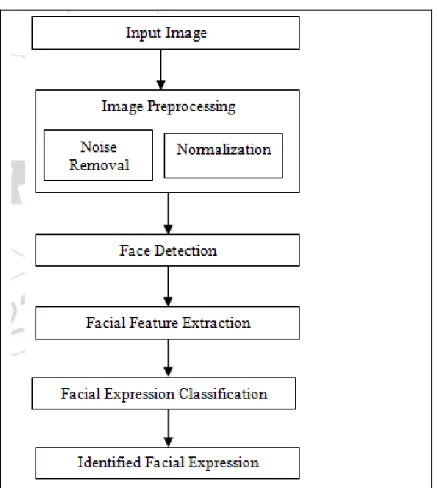
computer with high recognition rate is still a challenging task. Facial Expression Recognition usually performed in three-stages consisting of face detection, feature extraction, and expression classification. This paper presents a survey of the current work done in the field of facial expression recognition techniques with various face detection, feature extraction and classification methods used by them and their performance.
The primary need of Face Expression Recognition system is Face Detection which is used to detect the face. The next phase is feature extraction which is used to select and extract relevant features such as eyes, eyebrow, nose and mouth from face. It is very essential that only those features should be extracted from image that have highly contribution in expression identification. The final step is facial
IJIRT 147787
INTERNATIONAL JOURNAL OF INNOVATIVE RESEARCH IN TECHNOLOGY507
Fig. 2 Steps of facial expression recognitionexpression classification that classifies the facial expressions based on extracted relevant features. There are different methods of features extraction such as appearance based method,
Geometric based feature extraction method, extract feature information using shape, distance and position of facial components and appearance based feature extraction method uses appearance information such as pixel intensity of face image. After getting the features, classification methods are applied to recognize facial expression. However, the complexity of face processing in real life and even in the laboratory goes beyond passive viewing or matching tasks. Our knowledge about the processes underlying face recognition comes from behavioral studies that employ more complex testing paradigms than the relatively simple visual tasks that have established activation patterns in the fusiform gyrus— whether it should be designated as a special face-processing area or not. Typically, face recognition has been investigated by having subjects first learn a set of faces and then recognize them in a later testing session. Further, as we have seen, familiarity with faces is an important factor in face recognition.
II VARIOUS TECHNIQUES OF DETECTION OF SIX FACIAL EXPRESSIONS
A. Recognition of Facial Expression using Principal
Component Analysis and Singular Value
Decomposition:
Principal Component Analysis (PCA) is a statistical technique used for dimension reduction and recognition, & widely used for facial feature extraction and recognition. PCA is known as Eigen space Projection which is based on linearly Projection the image space to a low dimension feature space that is known as Eigen space. Many PCA-based face-recognition systems have also been developed in the last decade. However, existing PCA-based face recognition systems are hard to scale up because of the computational cost and memory-requirement burden. A 2-D facial image can be represented as 1-D vector by concatenating each row (or column) into a long thin vector. Let’s suppose we have M vectors of size N (= rows of image £ columns of image) representing a set of sampled images. pj’s represent the pixel values. xi = [p1,pN]T ; i = 1,...,M
The images are mean centered by subtracting the mean image from each image vector. Let m represent the mean image. M
m =1/MΣ xi i=1 And let wi be defined as mean centered image wi = xi –m Our goal is to find a set of ei’s which have the largest possible projection onto each of the wi’s.
Algorithm implemented as following
Step-1: Images which are inputted, given for the pre-processing
Step-2: Features are extracted and inputted to the classifier
Step-3: Then two images are compared and the required expression is detected or recognized. Advantages:
Excellent results are found by using this method. Singular Value Decomposition technique is used for image enhancement, localization and feature extraction. This algorithm works effectively on the different emotions. It is useful when the lager dataset is available and computation time will be less. Disadvantages:
IJIRT 147787
INTERNATIONAL JOURNAL OF INNOVATIVE RESEARCH IN TECHNOLOGY508
algorithm cannot eliminate this kind of objects andhave a problem to detect the correct expression.``
B. Automated Facial Expression Recognition System: Humans detect and interpret faces and facial expressions in a scene with little or no effort. Still, development of an automated system that accomplishes this task is rather difficult. There are several related problems: detection of an image segment as a face, extraction of the facial expression information, and classification of the expression (e.g., in emotion categories). A system that performs these operations accurately and in real time would form a big step in achieving a human-like interaction between man and machine. This paper surveys the past work in solving these problems. The capability of the human visual system with respect to these problems is discussed, too. It is meant to serve as an ultimate goal and a guide for determining recommendations for development of an automatic facial expression analyzer.
Algorithm:
Step-1: Video Processing
Step-2: Shape and Appearance Modeling Step-3: Expression Classification
Step-4: After the Expression Classification the algorithm offers operators with many real time outputs like reporting, trend analysis, snapshots and indicators. Advantages:
This algorithm will work on the Facial Action Coding System which able to recognize the various universal facial
expression effectively. It is also detect the presence of deception during any interview process and the mental status of any person.
Disadvantages:
It cannot detect the presence of deception directly which is actually used for further research.
C. Fuzzy rule based facial expression recognition: Algorithm:
Step-1: Input Video Step-2: Frame Extraction Step-3: Feature Point Extraction Step-4: FAP Extraction
Step-5: Fuzzification Step-6: Expression Detection Advantages:
The robustness of Fuzzy system will be the advantageous feature of this algorithm. This system is robust for the various fluctuations of the image processing results.
D. Facial expression recognition using neural network:
FER technique that utilizes decision tree with feed forward neural network (NN) based nodes. The first NN-based node of the decision tree is designated to separate one group of facial expressions with members “smile” and “surprise” from another group that contains “anger” and “sadness”. This node can reduce the confusion between the category members of the two groups. Two NN-based nodes that follow the first node are established for each group to separate their two members. As a result, the original recognition problem with four categories is divided into three sub problems, each having only two members to distinguish.
Algorithm:
Step-1: input image is obtained through webcam Step-2: optical flow method based face detection process
Step-3: image pre-processing
Step-4: Principle Component Analysis is performed Step-5: classification processing using feed forward artificial neural network
Advantages:
This algorithm will give the practical solution in constraint environment.
Disadvantages:
It will not work properly in the unconstraint environment.
IJIRT 147787
INTERNATIONAL JOURNAL OF INNOVATIVE RESEARCH IN TECHNOLOGY509
E. Facial expression recognition using 3-D facialfeature distances: Algorithm:
Step-1: Extraction of the characteristics distance vector as defined in table containing six characteristic distances is done.
Step-2: The distance vector classified based on neural network that is trained using back propagation algorithm.
Step-3: A sixth distance is used to normalize the first five distances.
Advantages:
This algorithm will provide reliable and valuable information. This algorithm has a higher recognition rate compare to 2D.
This algorithm will work better by using of Neural Network as a classifier.
Disadvantages:
In this algorithm there will be some confusion with the anger class and neutral class so recognition rate will be less of anger
class in this algorithm.
III. FACIAL EXPRESSION RECOGNITION USING ID3 ALGORITHM
Very simply, ID3 builds a decision tree from a fixed set of examples. The resulting tree is used to classify future samples. The example has several attributes and belongs to a class (like yes or no). The leaf nodes of the decision tree contain the class name whereas a non-leaf node is a decision node. The decision node is an attribute test with each branch (to another decision tree) being a possible value of the attribute. ID3 uses information gain to help it decide which attribute goes into a decision node. The advantage of learning a decision tree is that a program, rather than a knowledge engineer, elicits knowledge from an expert. Human outward appearance acknowledgment (FER) has pulled in much consideration as of late in light of its significance in acknowledging profoundly canny human machine interfaces. Outward appearance assumes vital part in insight of human feelings and outward appearance acknowledgment is the base of feelings comprehension.
A few FER techniques have been proposed. See for cases, and the references in that. The Facial Action Coding System (FACS) created by Paul Ekman and Wallace V. Friesen is the most generally utilized
and approved technique for measuring and depicting facial conduct. Ekman and Friesen characterized six essential feelings (joy, trouble, fear, disturb, shock, and outrage). Each of these six essential feelings relates to a one of a kind outward appearance. They characterized the facial activity coding framework (FACS), a framework created keeping in mind the end goal to empower outward appearance investigation through institutionalized coding of changes in facial movement. FACS comprises of 46 activity units (AU) which depict essential facial developments. It depends on muscle movement and portrays in detail the impact of every AU on face highlights.
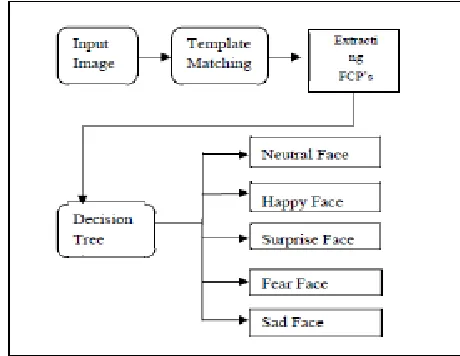
Subsequently, among the 46 AU that demonstrates the fundamental development of face muscles, aside from 5 Aus comparing to development of cheek, jaw and wrinkles, 41 AUs are specifically connected with development of eyes, eyebrows and mouth [10]. However every one of the 41 AUs are not really required for facial qualities focuses (FCP) computation. Accordingly we ascertain 30 FCP's. With a specific end goal to remove these 30 FCP's we firstly apply layout coordinating component to coordinate the eyes, eyebrows and mouth format. At that point we characterize these 30 FCP's to register the position and state of the distinctive parts of the face, for example, eyes, eyebrows and mouth. Utilizing these FCP's we process the distinctive parameters to be inputted in the choice tree calculation for perceiving diverse outward appearances. The proposed work which is being done .
IJIRT 147787
INTERNATIONAL JOURNAL OF INNOVATIVE RESEARCH IN TECHNOLOGY510
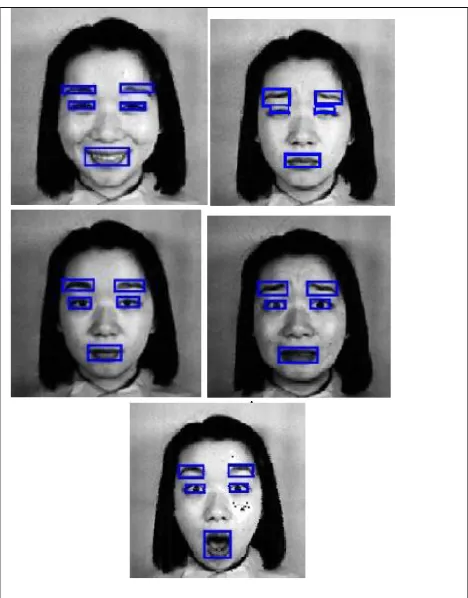
A. Template matching: -Layout coordinating is being done by making utilization of convolution and connection coefficients for the most noteworthy and immaculate coordinating. The coveted eyes, eyebrows and mouth format are being extract from the picture.
Steps:
Step 1: Send the respective image and it’s template as input to the template matching procedure.
Step 2: Convert the image and template into the gray scale by using rgb2gray().
Step 3: Find the convolution of the original image and mean of the template required to be matched.
Step 4: Then we find the correlation to get the highest matching of the template in the whole image
Step 5: Now, we find the four values, i.e. maximum of rows, maximum od columns, template height and template width to draw the bounding rectangles. The FCP's is being registered by knowing the upper left facilitate of every layout limited by rectangles. Also, by utilizing width and stature of the layout estimate.
Fig. 5 Template matching of the Different components
B. Example of ID3
Assume we need ID3 to choose whether the climate is amiable to playing baseball. Throughout 2
Fig. 6 Example of ID3
weeks, information is gathered to help ID3 manufacture a choice tree .The objective order is "should we play baseball?" which can be yes or no.
The climate characteristics are standpoint, temperature, mugginess, and wind speed. They can have the accompanying qualities:
outlook = { sunny, overcast, rain } temperature = {hot, mild, cool } humidity = { high, normal } wind = {weak, strong }
Examples of set S are: as shown in fig. 6
IV. ADVANTAGES OF ID3 ALGORITHM
This algorithm is robust to noise. It can handle disjunctive (OR’s) expressions. ID3 is completely expressive hypothesis space Easily interpretable (tree structure, if-then rules). This algorithm can be extended to real-valued attributes. In this target function has discrete output values. Algorithm in book assumes Boolean functions. ID3 Can be extended to multiple output values
V. CONCLUSION
IJIRT 147787
INTERNATIONAL JOURNAL OF INNOVATIVE RESEARCH IN TECHNOLOGY511
Use of ID3 in facial expression detection gives highesterror free results as compared with other methods
ACKNOWLEDGMENT
This is to acknowledged and thanks to all the individuals who played important role in shaping this paper. I would thankful to my guide Prof.A.P. Mane for his valuable guidance .
REFERENCES
P. Ekman and W. V. Friesen, Emotion in the Human Face. New Jersey: Prentice Hall, 1975.
T. Kanade, J. Cohn, and Y. Tian, .Comprehensive database for facial expression analysis,. in Proceedings of IEEE International Conference on Face and Gesture Recognition, March 2000, pp. 46.53. M. Pantic and L. J. M. Rothkrantz, .Expert system for automatic analysis of facial expressions,. Image and Vision Computing, vol. 18, no. 11, pp. 881.905, August 2000..., .Automatic analysis of facial expressions: The state of the art,. IEEE Transactions on Pattern Analysis and Machine Intelligence, vol. 22, no. 12, pp. 1424.1445, December 2000.
B. Fasel and J. Luettin, .Automatic facial expression analysis: A survey,. Pattern Recognition, vol. 36, no. 1, pp. 259.275, 2003
Y.Zhang and Q.Ji, .Active and dynamic information fusion for facial expression understanding from image sequences,. IEEE Transactions on Pattern Analysis and Machine Intelligence, vol. 27, no. 5, pp. 699.714, May 2005.
M. J. Lyons, S. Akamatsu, M. Kamachi, and J. Gyoba, .Coding facial expressions with Gabor wavelets,. in Proceedings of the Third IEEE International Conference on Automatic Face and Gesture Recognition, 1998, pp. 200.205.
M. J. Lyons, J. Budynek, and S. Akamatsu, .Automatic classi_cation of single facial images,. IEEE Transactions on Pattern Analysis and Machine Intelligence, vol. 21, no. 12, pp. 1357.1362, 19 G.Guo and C.R.Dyer, .Learning from examples in the small sample case: Face expression recognition,. IEEE Transactions on Systems, Man, And Cybernetics-Part B: Cybernetics, vol. 35, no. 3, pp. 477.488, June 2005. M. Matsugu, K. Mori, Y.Mitari, and Y. Kaneda, .Subject independent facial expression recognition with robust face detection using a convolutional neural
network,. Neural Networks, vol. 16, no. 5-6, pp. 555.559, June-July 2003.
M. Rosenblum, Y. Yacoob, and L. S. Davis, .Human expression recognition from motion using a radial basis function network architecture,. IEEE Transactions on Neural Networks, vol. 7, no. 5, pp. 1121.1138, September 1996.
L. Ma and K. Khorasani, .Facial expression recognition using constructive feedforward neural networks,. IEEE Transactions on Systems, Man, And Cybernetics-Part B: Cybernetics, vol. 34, no. 3, pp. 1588.1595, June 2004.
Y. Gao, M. Leung, S. Hui, and M. Tananda, .Facial expression recognition from line-based caricatures,. IEEE Transactions on Systems,