Lossy Image Compression Using Block Truncation Coding
With Region Based Segmentation Algorithm
1
Arjun Bariya,
2Dr. Anubhuti Khare
1,2Dept. of Electronics & communication Engineering, UIT, Bhopal, MP, India
Abstract
In the present era of communication system, the requirement of image storage and transmission for image processing are increasing exponentially. This is why; the need for better compression technology is in extremely demands. In this paper, a gray image & color image compression method using region based segmentation is proposed. This method having the advantages of BTC and quantization both. The BTC algorithm with quantization has some controlling parameters through which we can control the quality and compression of the image. The performance of the proposed method has been evaluated in terms of PSNR, MSE, Entropy & SSIM. The result of the proposed work is evaluated by comparing the performance with that of the existing methods.
Keywords
BTC, Compression, Quantization, Algorithm, Image Retrieval, Multimedia
I. Block Truncation Coding
Block truncation coding is one of the lossy coding techniques
applicable for Gray scale images. It reduces the file size but
loses some extent of original information of the image [9].
The significant advantages of this coding approach are low
computational complexity and high parallelism.
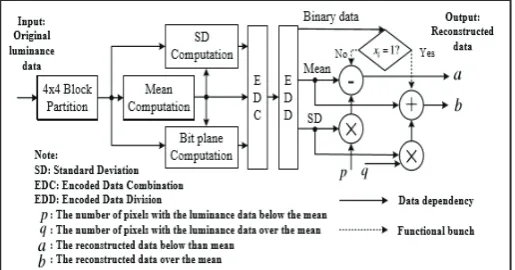
The basic idea of BTC is to perform moment preserving quantization for blocks of pixels. The input image is divided into non-overlapping blocks of pixels of sizes 4×4, 8×8 and so on. Mean and standard deviation of the blocks are calculated. Mean is considered as the threshold and reconstruction values are determined using mean and standard deviation. Then a bitmap of the block is derived based on the value of the threshold which is the compressed or encoded image. Using the reconstruction values and the bitmap the reconstructed image is generated by the decoder. Thus in the encoding process, BTC produces a bitmap, mean and standard deviation for each block. It gives a compression ratio of 4 and bit rate of 2 bits per pixel when a 4×4 block is considered. This method provides a good compression without much degradation on the reconstructed image. But it shows some artifacts like staircase effects or raggedness near the edges. Due to its simplicity and easy implementation, BTC has gained big interest in its further improvement and application for image compression.
The algorithm for BTC is as follows:
Step 1: Input a gray scale image of size M×N pixels and the dimension of the square block k by which the image is to be divided into non-overlapping blocks.
Step 2: Divide the image into various blocks, each of size k×k, value of k can be 4, 8, 16, and so on. Each block, W is represented as;
Step 3: calculate the mean and variance of gray level in block W
(1)
(2)
(3)
is the sample mean and the sample variance of image block is given by:
(4)
Step 4: Now the compressed bit map is obtained by
(5)
Step 5: The bit map B, μ and 1 are transmitted to the decoder.
The algorithm for decoder is as follows:
Step 1: Calculate a & b
(6)
(7) where p = No. of 0’s in the bit map and q = No. of 1’s in the bit map
Step 2: The reconstructed image Z can be obtained by replacing the element 1 in B with H and element 0 with L.
Fig. 1: Block Diagram of Block Truncation Coding
II. Proposed Work
In this proposed work lossy image compression has been implemented. For the implementation of Lossy image compression Block Truncation coding with region based segmentation has
been applied. In the first stage image of size 256×256 has been
and mean value of pixel of that block. On the basis of threshold based on above parameter we evaluate a bit map for the particular block. The process is applied on every block of the image. Thus obtained bit pattern or logic matrix with parameters is send to the decoder end. On the decoder end the image is decompressed on the basis of transmitted bit map information.
Step 1: Input a gray scale or color image of size 256×256 pixels and the dimension of the square block k by which the image is to be divided into non-overlapping blocks
Step 2: Image is segmented into different region using region based segmentation method.
Step 3: Divide the image into various blocks, each of size k×k, value of k can be 4, 8, 16, and so on. If image is overlapping corresponding to the block, there is zero padding.
Step 4: Find minimum value of the pixel, maximum value of the pixel & mean value of the pixel. Evaluate the Threshold using below formula for each region
(8)
Fig. 2: Flow Chart of the Implemented Work
Step 5: Now the compressed bit map for each region is calculated by
Where,
Step 6: The bit map B, minimum value of the pixel, maximum value of the pixel & mean value is sent to the decoder.
Step 7: Pixels in the image block W are then classified into two
ranges of values. The upper range is those Gray levels which are greater than T and lower range is those which are less than or equal to T.
The mean of higher range ( ) and the lower range ( ) are calculated using (9) and (10) respectively. Then these two values are used for reconstruction of the image.
(9)
(10)
Where p is the number of Gray value greater than T and q is the number of Gray value less than T.
Step 8: Decode bitmap block B with the reconstruction values and the lower range in such a way that the elements assigned 0 are replaced with and elements assigned 1 are replaced with
.
Then the decoded image block Z can be represented as,
Where,
III. Simulation Result
This paper has been implemented on the basis of above discussed algorithm using MATLAB simulator. First of all the work has been simulated on 4×4 block size then 8×8 and 16×16 block size for different input and reference images. Region based segmentation provides better quality in terms of MSE, PSNR and SSIM, which has been evaluated on the simulator. Finally the result has been compared with different existing method in the literature.
Simulation of Block truncation coding with Region based
•
segmentation for 4×4 block size
For the block size of 4×4, first the image (m×n) is divided in a block of size 4×4 then if there is any residue it is adjusted to fit in
this size. The algorithm is applied on this image and the image is compressed. The obtained image having comparable resolution
than the original image but the image size is reduced significantly.
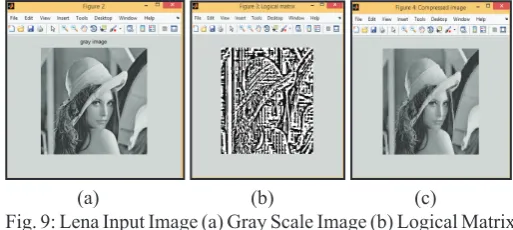
and converted to the Gray Scale Image, by applying the proposed algorithm image has been compressed.
(a) (b) (c)
Fig. 3: Lena Input Image (a) Gray Scale Image (b) Logical Matrix Image (c) Compressed Image
(a) (b) (c)
Fig. 4: Baboon Image (a) Gray Scale Image (b) Logical Matrix Image (c) Compressed Image
(a) (b) (c)
Fig. 5: Matlab Image (a) Gray Scale Image (b) Logical Matrix Image (c) Compressed Image
(a) (b) (c)
Fig. 6: Bike Input Image (a) Gray Scale Image (b) Logical Matrix Image (c) Compressed Image
(a) (b) (c)
Fig. 7: Books Input Image (a) Gray Scale Image (b) Logical Matrix Image (c) Compressed Image
Result Analysis for 4×4 Block Size
Table 1: Performance in Terms of MSE, PSNR, Entropy & SSIM for Different Image
Image Entropy of Original Image
Entropy of Compressed
Image MSE PSNR SSIM
Lena
Image 7.4543 7.3982 16.0643 81.8468 0.9965 Baboon
Image 7.2193 7.1572 32.2887 72.9427 0.9952 Matlab
Image 7.2925 7.2752 10.0519 87.7476 0.9983 Bike
Image 7.3514 7.3210 12.5983 85.4110 0.9962 Books
Image 6.9831 6.9563 13.7426 79.4591 0.9956
0 10 20 30 40 50 60 70 80 90
Lena
Image MatlabImage ImageBook
Entropy of Original Image Entropy of Compress ed Image MSE
PSNR
SSIM
Fig. 8: Graph for MSE, PSNR, ENTROPY & SSIM for different image of 4 ×4 block size
Simulation of Block Truncation Coding With Region
•
based Segmentation for 8×8 block size
Same approach as discussed for Block size 4×4, is adopted for block size 8×8. It is worth noting aspect to check the image dimension is
fitting the block size or not. The PSNR, MSE, SSIM & Entropy is
calculated based on the result. The result obtained in block size 8×8 is poor performance in terms of resolution but far better in terms of size. It is suggested that when image quality is comprisable this compression technique provides good performance in terms of storage capability. It is suggested to keep the block size of image less because increasing the number of order of block size will result poorer resolution of the image but compression ratio will be far better if we are increasing the number of block size.
(a) (b) (c)
(a) (b) (c)
Fig. 10: Baboon Input Image (a) Gray Scale Image (b) Logical Matrix Image (c) Compressed Image
(a) (b) (c)
Fig. 11: Matlab Input Image (a) Gray Scale Image (b) Logical Matrix Image (c) Compressed Image
(a) (b) (c)
Fig. 12: Bike Input Image (a) Gray Scale Image (b) Logical Matrix Image (c) Compressed Image
(a) (b) (c)
Fig. 13: Books Input Image (a) Gray Scale Image (b) Logical Matrix Image (c) Compressed Image
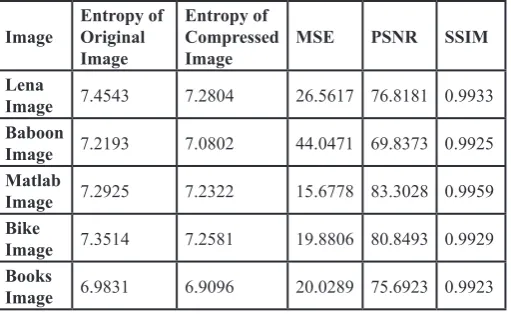
Result Analysis For 8×8 Block Size
Table 2: Performance in Terms of MSE, PSNR, ENTROPY & SSIM for Different Image
Image Entropy of Original Image
Entropy of Compressed
Image MSE PSNR SSIM
Lena
Image 7.4543 7.2804 26.5617 76.8181 0.9933 Baboon
Image 7.2193 7.0802 44.0471 69.8373 0.9925 Matlab
Image 7.2925 7.2322 15.6778 83.3028 0.9959 Bike
Image 7.3514 7.2581 19.8806 80.8493 0.9929 Books
Image 6.9831 6.9096 20.0289 75.6923 0.9923
0 10 20 30 40 50 60 70 80 90
Lena
Image MatlabImage ImageBook
Entropy of Original Image Entropy of Compress ed Image MSE
PSNR
SSIM
Fig. 14: Graph for MSE, PSNR, ENTROPY & SSIM for Different Image of 8 ×8 Block Size
Simulation of Block truncation coding with Region
•
based segmentation for 16×16 block size
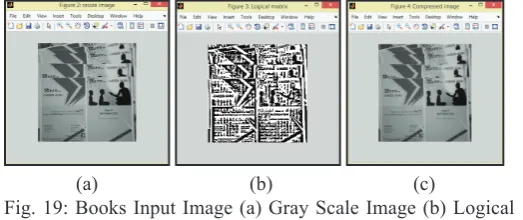
Methodology used to implement the BTC-PF Algorithm for block size 16×16 will be same as above discussed. This block size division criterion gives poor result than 4×4 o4 8×8 block size in terms of resolution but in terms of compression, compressed image size is smaller than 4×4 o4 8×8 block size.
(a) (b) (c)
Fig. 15: Lena Input Image (a) Gray Scale Image (b) Logical Matrix Image (c) Compressed Image
(a) (b) (c)
Fig. 16: Baboon Input Image (a) Gray Scale Image (b) Logical Matrix Image (c) Compressed Image
(a) (b) (c)
(a) (b) (c)
Fig. 18: Bike Input Image (a) Gray Scale Image (b) Logical Matrix Image (c) Compressed Image
(a) (b) (c)
Fig. 19: Books Input Image (a) Gray Scale Image (b) Logical Matrix Image (c) Compressed Image
Result Analysis For 16×16 Block Size
Table 3: Performance in terms of MSE, PSNR, ENTROPY & SSIM for different image
Image Entropy of Original Image Entropy of Compressed
Image MSE PSNR SSIM
Lena
Image 7.4543 7.0336 26.5617 76.8181 0.9933 Baboon
Image 7.2193 6.8710 44.0471 69.8373 0.9925 Matlab
Image 7.2925 7.0496 20.2815 80.7282 0.9947 Bike
Image 7.3514 6.9859 29.3751 76.9452 0.9883 Books
Image 6.9831 6.7030 20.0289 75.6923 0.9923
0 10 20 30 40 50 60 70 80 90 Lena
Image MatlabImage ImageBook
Entropy of Original Image Entropy of Compress ed Image MSE PSNR SSIM
Fig. 20: Graph for MSE, PSNR, ENTROPY & SSIM for different image of 16×16 block size
Comparative analysis of Proposed method with previous
•
method from Literature Survey
Proposed methodology is implemented using MATLAB simulator and their results are compared with the work in literature and following worth noting points are deduced:
Jayamol Mathews et al [10] in their work found PSNR for 512×512 image size as 33.62. For block size 8×8 and 16×16, Dr. Ghadah AI-Khafaji [11] found PSNR as 33.44, 32.21 & SSIM as 0.9491 & 0.9147. For block size 4×4, 8×8 and 16×16 Jing-Ming Guo et al. [12] found PSNR as 26.18, 23.26, 21.24. For block size 4×4 and8×8 Ki-Won Oh et al. [13] found MSE as 344 & 294.
Where as the proposed methodology shows better results than the previous work which can be seen from the above simulation result
IV. Conclusion
In this paper lossy image compression using Block Truncation Coding with region based segmentation has been performed using MATLAB simulator. Different block size taken for the implementation like 4×4, 8×8 & 16×16 and the image size is 256 ×256. The performance analysis has been carried out using MSE, PSNR & SSIM for different real and reference images. Result shows better improvement over the existing methodology.
References
[1] D. Huffman,"A method for the construction of minimum redundancy codes", Proceeding of the IRE, 40, pp. 1098 – 1101, 1952.
[2] W. Pratt,"Digital Image Processing", John Wiley and Sons, New York, 1978.
[3] E. J. Delp, O. R. Mitchell,“Image compression using block truncation coding,” IEEE Trans. Commun., Vol. 27, No. 9, pp. 1335–1342, Sep. 1979.
[4] I. H. Witten, M. N. Radford, J. G. Cleary,"Arithmetic coding for data compression", Communications of ACM, 60, pp. 520–540, 1987.
[5] A. Said, W. A. Pearlman,"A new, fast, and efficient image
codec based on set partitioning in hierarchical trees", IEEE Transactions on Circuits and System for Video Techniques, 6, pp. 243– 250, 1996.
[6] Y. Q. Shi, H. Sun,"Image and video compression for multimedia engineering: Fundamentals, algorithms, and standards", CRC Press, USA, 1999.
[7] T. Ebrahimi, C. A. Christopoulos, D. T. Lee,"Special issue introduction, jpeg 2000", Signal Processing: Image Communication, 17:1–144, 2002.
[8] P. Li, J. P. Allebach,“Tone-dependent error diffusion,” IEEE Trans. Image Process., Vol. 13, No. 2, pp. 201–215, Feb. 2004.
[9] R. Leonardi, J. R. Ohm,"Wavelet video coding - An overview (iso/iec jtc1/sc29/wg11 w7824). 2006.
[10] Jayamol Mathews, Madhu S. Nair, Liza Jo,“Modified BTC
Algorithm for Gray Scale Images using max-min Quantizer”, IEEE, 2013
[11] Dr. Ghadah AI-Khafaji,"The First International Conference of Electrical, Communication, Computer, Power and Control Engineering ICECCPCE’13", December 17-18, 2013 [12] Jing-Ming Guo, Yun-Fu Liu,“Improved Block Truncation
on image processing, Vol. 23, No. 3, March 2014.
[13] Ki-Won Oh, Kang-Sun Choi,"Parallel Implementation of Hybrid Vector Quantizer based Block Truncation Coding for Mobile Display Stream Compression, IEEE ISCE 2014. [14] Seddeq E. Ghrare, Ahmed R. Khobaiz,“Digital Image