Geo Image Classification Using Relevant Feedback
1
T Asha Latha,
2R Srinivas,
3K B Anusha
1,2,3Dept of CSE, Aditya Institute of Technology and Management, Tekkali, AP, India
Abstract
Image classification is a standout amongst the most difficult issues in computer research. The goal is to outline computerized image into one or a few marks. The information for preparing such complex models will comprise of preparing images having a place with various classes. The target will be to comprehend the different strategies to prepare the support vector machine to accomplish condition of the remote detecting images characterization demonstrations. We present profound taking in, a developing field of machine learning that goes for consequently learning highlight progressions and which has demonstrated late guarantees in vast scale computer research applications. The key knowledge is that intricate tactile inputs, for example, images with elements can be scholarly in an information driven way. Learning happens at every layer of the chain of command, utilizing a lot of information and restricting the tedious and problematic element designing stride of numerous customary computer frameworks. There are a few approaches to learn such components (in an administered, unsupervised and semi-regulated setting relying upon the measure of marked information), and there are a few models that can be utilized (probabilistic graphical models with progressive systems of inactive variables and various types of convolution neural systems). In this paper, we will clarify the fundamental thoughts behind these techniques, their qualities and shortcomings, and how they can be specific to vision applications.
Keywords
Classification, Support Vector Machines (SVMs), Remote Sensing, Machine Learning
I. Introduction
In this we present this paper introducing the basis on remote detecting and a survey on the last era of remote detecting sensors described by high geo-metrical and/or ghostly resolution and their applications to ecological checking. We likewise portray the most basic issues identified with the programmed examination and arrangement of the information gathered by these sensors, and also the general inspirations and destinations of this work. Moreover, we exhibit the particular issues considered in this exploration movement and the novel commitments of the theory. At last, the structure and association of this record is portrayed.
The programmed characterization of RS images is for the most part performed by utilizing regulated arrangement methods, which require the accessibility of marked examples for preparing the directed calculation. The sum and the nature of the accessible preparing tests are vital for acquiring exact arrangement maps. In any case, in numerous true issues the accessible preparing tests are insufficient for a sufficient learning of the classifier. Keeping in mind the end goal to enhance the data given as contribution to the learning calculation (and to enhance order air conditioning curacy) semi directed methodologies can be embraced to mutually misuse marked and unlabeled examples in the preparation of the classifier. Semi directed methodologies taking into account Support Vector Machines (SVMs) have been effectively connected to the order of multispectral and hyper otherworldly information, where the proportion between the quantity of preparing tests and
the quantity of accessible phantom channels is little. Be that as it may, an option and adroitly distinctive way to deal with enhance the measurement in the learning of a classifier is to iteratively extend the first preparing set by intelligent procedure that includes a boss. This methodology is referred to in the machine learning group as dynamic learning [7]-[9], and albeit hardly considered in the RS people group, can come about extremely valuable in various application areas. In dynamic learning: (1) the learning procedure over and over questions accessible unlabeled specimens to choose the ones that are relied upon to be the most enlightening for a viable learning of the classifier, (2) the boss (e.g., the client) names the chose tests collaborating with the framework, and (3) the learner redesigns the arrangement guideline by retraining with the upgraded preparing set. In this way, the superfluous and excess marking of non-enlightening examples is maintaineda strategic distance from, enormously lessening the naming cost and time. In addition, dynamic learning permits one to decrease the computational multifaceted nature of the preparation stage.
A. Overview on Remote Sensing Systems
With the words “Remote Sensing” (RS) we allude to an innovation fit to gather and to decipher data in regards to an article without being specifically in contact with the thing under scrutiny. Specifically, in this thesis we consider the utilization of RS images gathered by sensors on board on flying machines or rocket stages for watching and portraying the Earth surface. These sensors procure the vitality radiated and reflected from the Earth’s surface to develop aimage of the scene underneath the stage. Contingent upon the wellspring of the vitality required in the image securing, two primary sorts of RS imaging frameworks can be recognized:
Detached frameworks and 1.
Dynamic frameworks. 2.
Inactive (or optical) frameworks depend on the nearness of an outer light source, i.e., the sun. The sign measured by the sensor is: (1) the radiation originating from the sun, that is reflected by the Earth surface and going through the air lands to the sensor; and (2) the vitality discharged by the Earth itself, on account of its own temperature. The vitality measured by the sensor is generally gathered in a few unearthly groups (the phantom scope of every single band characterizes the ghostly resolution) and over a specific rudimentary zone (that characterizes the geometric resolution). After that, the measure is changed over into an ideal electric flag and recorded as advanced image. These sensors are typically called multispectral scanners. Sensors skilled to gather the radiation in several extremely contract phantom groups are called hyper spectral.
otherworldly images and specifically on the last era of sensors, which can give images portrayed by high geometrical/phantom resolution.
B. VHR Satellites Imaging Systems
VHR images got to be accessible (and prevalent) with the dispatch of business satellites like Ikonos and Quick bird, with on-board multispectral scanners portrayed by a geometrical resolution in the request of 1 m. These satellites can get four multispectral groups, in the unmistakable and close infrared ghostly ranges, and a panchromatic station with four time higher spatial resolution. These satellites speak to a huge change in the geometric resolution as for the mainstream Landsat satellites. To be sure, Landsat 7 (the last satellite of the Landsat program) gives seven multispectral groups in the obvious, close and warm infrared reaches with a geo-metric resolution of 30 m (aside from the warm infrared band that has a resolution of 60 m) and a panchromatic station with a spatial resolution of 15 m. The SPOT 5 satellite, the last propelled and working satellite of the SPOT system, can procure four multispectral groups in the scopes of noticeable, close, and mid infrared with a spatial resolution of 10 m (aside from the mid infrared band that has a resolution of 20 m) and a panchromatic band with a most extreme resolution of 2.5 m. As of late, another era of VHR satellite frameworks got to be accessible, i.e., GeoEye-1, World-View-1 and 2, which promote enhance the geometric resolution, furnishing a panchromatic station with a resolution littler that half meter. It is fascinating to note that the WorldView-2 satellite build the phantom resolution other than the geometric resolution, by giving eight stations rather than the normal four. Besides, in the following years the quality and the accessibility of this kind of information are going to further expand on account of the missions GeoEye-2 and Pleiades.
II. Related Work
The analyzed setting of this work joins three subjects; active learning, interactive media space and uproarious information. Amid the previous decade there have been numerous works investigating a subset of these themes, e.g. active learning in the sight and sound space (Wang and Hua, 2011), (Freytag et al., 2013) or active learning with uproarious information (Settles, 2009), (Yan et al., 2011), (Fang and Zhu, 2012) or even non-active gaining from boisterous information in the mixed media area (Chatzilari et al., 2012), (Raykar et al., 2010), (Yan et al., 2010), (Uricchio et al., 2013), (Verma and Jawahar, 2012), (Verma and Jawahar, 2013). In any case, it has been just as of late that established researchers began to examine the ramifications of substituting the human prophet with a less costly and less solid wellspring of explanations in the sight and sound area. There has been just a couple endeavors to join active learning with client contributed images and a large portion of them depend on either a human annotator or on the utilization of active crowdsourcing (i.e. an administration like the MTurk) and not on uninvolved crowdsourcing (i.e. the client gave labels that are commonly found in interpersonal organizations like flickr). In this course, the creators of (Zhang et al., 2011) propose to utilize flickr notes in the commonplace active learning structure with the reason for getting a preparation dataset for item confinement. In a comparable try, the creators of (Vijayanarasimhan and Grauman, 2011) present the idea of live realizing where they endeavor to consolidate active learning with crowdsourced marking. All the more particularly, as opposed to filling the pool of competitors with some canned dataset, the framework itself assembles potentially significant
images by means of catchphrase inquiry on flickr. At that point, it more than once studies the information to distinguish the examples that are most unverifiable as per the present model, and produces undertakings on MTurk to get the comparing comments. Then again, interpersonal organizations and client contributed substance are driving the greater part of the late research endeavors, chiefly in view of their capacity to offer more data than the insignificant image visual substance, combined with the possibility to become boundlessly. In this bearing, the creators of (Li et al., 2013) propose an answer for inspecting approximately labeled images to enhance the negative preparing set of an article classifier. The introduced methodology depends on the suspicion that the labels of such images can dependably figure out whether a image does exclude an idea, subsequently making social destinations a solid pool of negative cases. The chose negative examples are further inspected by a two stage examining procedure. Initial, a subset is haphazardly chosen and after that, the underlying classifier is connected on the staying negative specimens. The cases that are most misclassified are considered as the most instructive negatives and are at long last chosen to help the classifier. Our point in this work is to examine the degree to which the approximately labeled images that are found in informal organizations can be utilized as a dependable substitute of the human prophet with regards to active learning. Given that the prophet is not anticipated that would answer with 100% accuracy to the inquiries put together by the specific examining component, we hope to confront various ramifications that will scrutinize the adequacy of active learning in uproarious connection. In this viewpoint our work varies from the substantial collection of works that are found in the writing as in the vast majority of them seem, by all accounts, to be touchy in mark clamor. In the greater part of the works that don’t utilize a specialist as the prophet, MTurk is utilized rather to comment on the datasets. Be that as it may, albeit active crowdsourcing administrations like MTurk are nearer to master’s explanation (Nowak and R¨uger, 2010) as for commotion, they can’t be considered completely computerized. In this work we depend on information beginning from latent crowdsourcing (flickr images and labels) that albeit noisier, can be utilized to support a completely programmed active learning structure.
III. Support Vector Machine for the Classification of Remote Sensing Data
This section displays a broad and basic audit on the utilization of piece techniques and specifically of support vector machines (SVMs) for the characterization of remote detecting (RS) information. The section reviews the numerical detailing and the fundamental hypothetical ideas identified with SVMs, and talks about the inspirations at the premise of the utilization of SVMs in remote detecting. An audit on the primary uses of SVMs in arrangement of remote detecting is given, exhibiting a writing overview on the utilization of SVMs for the investigation of various types of RS images. What’s more, the latest methodological advancements identified with SVM-based arrangement strategies in RS are represented by concentrating on semi managed, space adjustment, and setting delicate methodologies. At long last, the most encouraging exploration bearings on SVM in RS are recognized and dis-cussed
helpful for operational applications. The current innovation brought about the meaning of various types of sensors for Earth perception taking into account distinctive standards and with various properties. In this setting, the testing properties of new genera-tion of sensors require the meaning of novel information investigation techniques. In this part we center our consideration on RS image order techniques, which are committed to decipher the elements that speak to the data present in the information in topical maps speaking to land spread sorts as indicated by the arrangement of an example acknowledgment issue. Specifically, we focus our consideration on directed arrangement calculations, which require the accessibility of named tests
We are given a training dataset of points of the form
Where the are either 1 or −1, each indicating the class to which the point belongs. Each is a -dimensional real vector. We want to find the “maximum-margin hyperplane” that divides the group of points for which from the group of points for which , which is defined so that the distance between the hyperplane and the nearest point from either group is maximized.
Any hyperplane can be written as the set of points satisfying
Maximum-margin hyperplane and margins for an SVM trained with samples from two classes. Samples on the margin are called the support vectors.
where is the (not necessarily normalized) normal vector to
the hyperplane. The parameter determines the offset of the hyperplane from the origin along the normal vector .
Computing the (soft-margin) SVM classifier amounts to minimizing an expression of the form
(2)
We focus on the soft-margin classifier since, as noted above, choosing a sufficiently small value for yields the hard-margin classifier for linearly classifiable input data. The classical approach, which involves reducing (2) to a quadratic programming problem, is detailed below. Then, more recent approaches such as sub-gradient descent and coordinate descent will be discussed.
A. Primal
Minimizing (2) can be rewritten as a constrained optimization problem with a differentiable objective function in the following way.
For each we introduce the variable
and note that if and
only if is the smallest nonnegative number satisfying
Thus we can rewrite the optimization problem as follows
This is called the primal problem.
By solving for the Lagrangian dual of the above problem, one obtains the simplified problem
This is called the dual problem. Since the dual minimization problem is a quadratic function of the subject to linear constraints, it is efficiently solvable by programming algorithms. Here, the variables are defined such that
.
Moreover, exactly when lies on the correct side of
the margin, and when lies on the margin’s
boundary. It follows that can be written as a linear combination of the support vectors. The offset, , can be recovered by finding an on the margin’s boundary and solving
B. SVM for the Classification
AVIRIS data set show that SVMs are more beneficial, yielding better results than other kernel-based methods, ensuring sparsity and lower computational cost.
C. Kernel Trick
Suppose now that we would like to learn a nonlinear classification rule which corresponds to a linear classification rule for the transformed data points Moreover, we are given a kernel
function which satisfies .
We know the classification vector in the transformed space satisfies
Where the are obtained by solving the optimization problem
The coefficients can be solved for using quadratic programming, as before. Again, we can find some index such that
so that lies on the boundary of the margin in the transformed space, and then solve
Finally, new points can be classified by computing
IV. Spatially Invariant Features for the Classification of Hyper spectral Images
The proposed approach goes for selecting a subset of the first arrangement of components that shows in the meantime high ability to segregate among the considered classes and high invariance in the spatial area of the examined scene. This methodology results in a more powerful characterization framework with enhanced speculation properties concerning standard element choice strategies. The component choice is proficient by characterizing a multiobjective basis capacity made up of two terms: (1) a term that measures the class detachability and (2) a term that assesses the spatial invariance of the chose highlights. To survey the spatial invariance of the component subset, we propose both a regulated technique (which expect that preparation tests obtained in two or all the more spatially disjoint regions are accessible) and a semi supervised strategy (which requires just a standard preparing set gained in a solitary territory of the scene and exploits unlabeled specimens chose in segments of the scene spatially dis-joint from the preparation set). The decision for the administered or semi supervised technique relies on upon the accessible reference information. The multi target issue is comprehended by a developmental calculation that gauges the arrangement of Pareto-ideal arrangements. Tests completed on a hyper spectralimage gained by the Hyperion sensor on a mind boggling range affirmed the adequacy of the proposed approach.
A. Background on Feature Selection in Hyper Spectral Images
The procedure of highlight resolution goes for decreasing the dimensionality of the first component space by selecting a compelling subset of the first elements, while disposing of the remaining measures. Note that this methodology is not quite the same as highlight change (extraction), which comprises in anticipating the first element space onto an alternate (for the most part lower dimensional) element space [9], [4], [8], [10]. In this section we center our consideration on highlight resolution, which has the critical point of preference to safeguard the physical importance of the chose highlights. Besides, highlight choice results in a more broad methodology than highlight change alone by considering that the components given as contribution to the element choice module can be connected with the first ghostly channels of the hyperspectral image and/or with measures that concentrate data from the first channels and from the spatial setting of every single pixel [5-6] (e.g. composition, wavelets, normal of gatherings of touching groups, subsidiaries of the otherworldly signature, and so on).
B. Semi Supervised Formulation of the Criterion Function (Invariance Term Estimation)
The accumulation of named preparing tests on two (or all the more) spatially-disjoint ranges from the site under scrutiny can be troublesome and/or extremely costly. This may bargain the materialness of the proposed directed technique in some genuine order applications. Keeping in mind the end goal to defeat this conceivable issue, in this area we propose a semi directed system to assess the invariance term characterized in (3.8), which does not require the accessibility of a disjoint preparing subset T2. Here, we just expect that a preparation set T1 is accessible and we consider an arrangement of unlabeled pixels U (subset of the first imageI) that ought to fulfill two prerequisites: (1) U contains tests of all the considered classes, and (2) tests in U ought to be taken from parts of the scene isolated from those on which the preparation tests T1 are collected. Where the superscripts s and s+1 allude to the estimations of the parameters at the s and s +1 emphasis, individually. The assessments of the factual parameters that depicts the classes appropriations in the disjoint territories are acquired beginning from the underlying estimations of the parameters and repeating the conditions up to union. A vital part of the EM calculation concerns its meeting properties. It is impractical to ensure that the calculation will meet to the worldwide most extreme of the log-probability capacity, in spite of the fact that joining to a nearby greatest can be guaranteed. An itemized depiction of the EM calculation is past the extent of this section, so we allude the peruser to the writing for a more point by point examination of such a calculation and its properties [3], [5]. The last gauges got at joining for each
V. Semi Supervised SVM Classifier Robust to Mislabeled
by the configuration of a semi managed methodology and the meaning of a novel logical term in the cost capacity connected with the learning of the classifier. With a specific end goal to survey the viability of the proposed CS4VM and to comprehend the effect of the tended to issue in genuine applications, In the examination we additionally contemplate the power to mislabeled preparing examples of some generally utilized managed and semi regulated grouping calculations (i.e., traditional SVM, dynamic semi administered SVM, Maximum Likelihood, and k-Nearest Neighbor). Results got on a high resolutionimage and on a medium resolutionimage affirm both the power and the viability of the proposed CS4VM concerning standard characterization calculations and permit us to infer intriguing conclusions on the impacts of mislabeled examples on various classifiers.
A. Ikonos Data Set
The first considered data set is made up of the first three bands (corresponding to visible wavelengths) of an Ikonos sub-scene of size 387 ´ 419 pixels (see fig. 4.4). The 4 m spatial resolution spectral bands have been reported to a 1 m spatial resolution according to the Gram-Schmidt pansharpening procedure [24]. The available ground truth (which included the information classes grass, road, shadow, small-aligned building, white-roof building, gray-roof building and red-roof building) collected on two spatially disjoint areas was used to derive a training set and a test set for the considered image (see Table 4.1). This setup allowed us to study the generalization capability of the systems by performing validation on areas spatially disjoint from those used in the learning of the classification algorithm. This is very important because of the nonsta-tionary behavior of the spectral signatures of classes in the spatial domain. Starting from the original training set, several data sets were created adding different percentages of mislabeled pixels in order to simulate noisy training sets as described in the previous section.
Fig.- Band 3 of the Ikonos image .
Table - Number of patterns in the training and test sets (Ikonos data set).
Class Number of patternsTraining Set Test Set
Building
Grass 63 537
Road 82 376
Small-aligned 62 200
White-roof 87 410
Gray-roof 65 336
Red-roof 19 92
Shadow 30 231
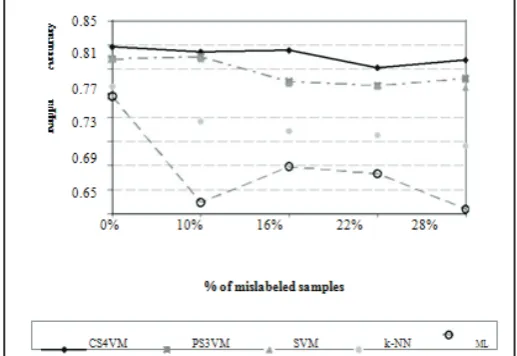
In the second set of experiments, several samples of the class “grass” were added to the original training set with the wrong label “road” in order to reach 10% and 16% of noisy pat-terns. In addition “white-roof building” patterns w ere included with label “grey-roof building” to reach 22% and 28% of noisy samples. The resulting classification problem proved quite critical, as confirmed by the significant decrease in the kappa accuracies yielded by the considered classification algorithms (see Fig. and Table). Nevertheless, also in this case, the context-based training of the CS4VM resulted in a significant increase of accuracy with respect to other classifiers. The kappa accuracy of the k-NN classifier dramatically decreased when the percentage of noisy patterns increased (in the specific case of 28% of mislabeled samples the kappa accuracy decreased of 35.1% with respect to the original training set). The ML decreased its accuracy of 10.1% with 10% of noisy patterns, but exhibited a more stable behavior with respect to the k-NN when the amount of noisy patterns was further increased. The standard SVM algorithm obtained accuracies higher than those yielded by the k-NN and ML classifiers, while the PS3VM classifier in general slightly improved the accuracy of the standard SVM. However, with 28% of noisy patterns, the kappa accuracy sharply decreased to 0.629 (below the performance of ML).
VI. Active Learning Methods for the Interactive Classification of Remote Sensing Images
This researches diverse clump mode dynamic learning procedures for the grouping of Remote Detecting (RS) images with Support Vector Machines (SVMs). This is finished by summing up to multiclass issues systems characterized for parallel classifiers. The examined procedures misuse distinctive inquiry capacities, which depend on the assessment of two criteria: vulnerability and differing qualities. The instability model is related to the certainty of the super-vised calculation in accurately characterizing the considered specimen, while the assorted qualities paradigm goes for selecting an arrangement of unlabeled examples that are as more various (inaccessible each other) as could reasonably be expected, in this way lessening the repetition among the chose tests. The blend of the two criteria results in the resolution of the conceivably most useful arrangement of tests at every cycle of the dynamic learning process. Also, we propose a novel inquiry work that depends on a part grouping method for surveying the assorted qualities of tests and another procedure for selecting the most educational agent test from every bunch. The explored and proposed procedures are hypothetically and tentatively contrasted and best in class techniques embraced for RS applications. This is expert by considering VHR multispectral and hyper phantom images. By this correlation we watched that the proposed strategy brought about better exactness concerning other researched and cutting edge techniques on both the considered information sets. Besides, we determined a few rules on the configuration of dynamic learning frameworks for the arrangement of various sorts of RS images.
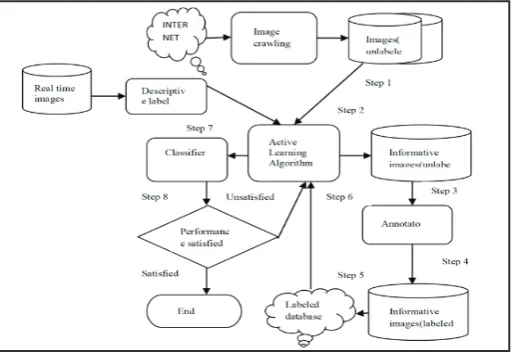
Algorithm 1: Active learning procedure
Train the classifier G with the initial training set T 1.
Classify the unlabeled samples of the pool U 2.
Repeat
3. Query a set of samples (with query function Q) from the pool U
4. A label is assigned to the queried samples by the supervisor S
5. Add the new labeled samples to the training set T 6. Retrain the classifier
Until a stopping criteria is satisfied.
VII. Results With Mislabeled Training Patterns Uniformly Added to All Classes
In the first set of experiments, different percentages (10%, 16%, 22%, 28%) of mislabeled patterns (with respect to the total number of samples) were uniformly added to all classes of the training set. The accuracy yielded on the test set by all the considered classifiers versus the percentage of mislabeled patterns are reported in Table 4.2 and plotted in Fig. 4.5. As one can see, with the original training set, the proposed CS4VM exhibited higher kappa coefficient of accuracy than the other classifiers. In greater detail, the kappa coefficient obtained with the CS4VM is slightly higher than the ones obtained with the standard SVM and the PS3VM (+1.6%), and sharply higher than those yielded by the k-NN (+6.6%) and the ML (+8%). This confirms that the semi supervised exploitation of contextual information of training patterns allows us increasing the classification accuracy (also if their labels are correct). In this condition, the PS3VM classifier did not increase the classification accuracy of the standard SVM. When mislabeled samples were added to the original training set, the accuracies obtained with ML and k-NN classifiers sharply decreased, whereas SVM-based classifiers showed to be much more robust to “noise” (by increasing the number of mislabeled samples the kappa accuracy decreased slowly). In greater detail, the kappa accuracy of the ML classifier decreased of 15.9% in the case of 10% of mislabeled samples with respect to the result obtained in the noise-free case, while the k-NN reduced its accuracy by 5.8% in the same condition. More generally, the k-NN classifier exhibited higher and more stable accuracies than the ML with all the considered amounts of noisy pat-terns. In all the considered trials, the proposed CS4VM exhibited higher accuracy than the other classifiers. In addition, with moderate and large numbers of mislabeled patterns (16%, 22% and 28%), it was more stable than the SVM and the PS3VM.
In the trials with noisy training sets the PS3VM classifier slightly
increased the accuracy obtained by the standard SVM.
Table- Kappa coefficient of accuracy on the test set with different percentages of mislabeled patternsadded uniformly to the training set (Ikonos data set).
% of
mislabeled Kappa Accuracy
patterns CS4VM PS3VM SVM k-NN ML
0 0.927 0.907 0.907 0.861 0.847
10 0.919 0.910 0.907 0.803 0.688
16 0.921 0.869 0.866 0.787 0.801
22 0.893 0.862 0.861 0.781 0.727
28 0.905 0.874 0.860 0.763 0.675
Fig. – Behavior of the kappa coefficient of accuracy on the test set versus the percentage of mislabeled training patterns uniformly distributed over all classes introduced in the training set (Ikonos data set).
In order to better analyze the results of SVM and CS4VM, we compared the average and the minimum kappa accuracies of the binary classifiers that made up the OAA multi-class architecture (It is possible to observe that the average kappa accuracy of the binary CS4VMs was higher than that of the binary SVMs, and exhibited a more stable behavior when the amount of noise increased. Moreover, the accuracy of the class most affected by the inclusion of mislabeled patterns in the training set was very stable with the proposed classification algorithm, whereas it sharply decreased with the standard SVM when large percentages of mislabeled patterns were included in the training set. This confirms the effectiveness of the proposed CS4VM, which exploits the contributions of the contextual term (and thus of contextual patterns) for mitigating the effects introduced by the noisy samples.
This behavior was strongly mitigated by the proposed CS4VM (which exhibited a kappa accuracy of 0.820 in the same conditions). Considering the behavior of the average kappa of the binary SVMs and CS4VMs that made up the OAA multi-class architecture (see Fig. 4.8), it is possible to note that the CS4VM always improved the accuracy of the standard SVM, and the gap between the two classifiers increased by increasing the amount of noisy samples. In the very critical case of 28% of mislabeled pat-terns, the context-based learning of CS4VM improved the average kappa accuracy of binary SVMs by 9.2%. Moreover, the kappa coefficient of the class with the lowest accuracy with the proposed CS4VM, even if small, was sharply higher than that of the standard SVM in all the con-sidered trials (see Table 4.5). This behavior shows that on this data set the proposed method al-ways improved the accuracy of the most critical binary classifier.
VIII. Proposed Approach
Notations. We use the following notations in this paper. We use xi ∈ Rd to denote the input feature vector of the ith instance, and yi∈ {1, ··· , K} to denote its class label. We use L and U to denote the index sets of the labeled and unlabeled instances respectively. Assuming we are initially given a set of labeled instances {(xi, yi)}i∈L and a large set of unlabeled instances {xi}i∈U , we aim to sequentially select the most informative instances from U to query and move them into the labeled set L such that a good classifier can be trained on instances indexed by L.
Fig. Proposed System Architecture
IX. Results
X. Conclusion
In this research activity we developed techniques and approaches that can significantly improve the capability to automatically analyze and extract information from VHR and hyper spectral images. We addressed several issues related to feature selection for hyper spectral images, classification of VHR and hyper spectral data, and the definition of a novel protocol for the accuracy assessment of thematic maps obtained by the classification of VHR images. Moreover, we addressed operational problems related to the classification of RS images in real conditions where often the available reference samples are few and not completely reliable. The proposed methodologies contribute to a more effective use of last generation of RS data in many real-world applications related to the monitoring and the management of environmental resources.
Following the direction towards a more effective exploitation of last generation of RS images in real applications, several issues remain open and need to be addressed in future developments. Here, we identify (among the others) the following topics of interest: 1) feature selection/extraction in the kernel space for robust and accurate classification of hyper spectral images with kernel methods (e.g., support vector machine); 2) feature extraction methods for the classification of VHR images based on thematic and geometric accuracy indices; 3) classification techniques capable to jointly exploit the information of panchromatic and hyper spectral bands acquired satellites sensors; 4) classification of multi-temporal series of VHR or hyperspectral images with active learning and domain adaptation techniques for an automatic update of land-cover maps.
References
[1] V. Ambati, S. Vogel, J. Carbonell,"Active learning and crowdsourcing for machine translation", In N. C. C. Chair), K. Choukri, B. Maegaard, J. Mariani, J. Odijk, S. Piperidis, M. Rosner, and D. Tapias, editors, Proceedings of the Seventh conference on International Language Resources and Evaluation (LREC’10), Valletta, Malta, may 2010. European Language Resources Association (ELRA). [2] S. Chen, J. Zhang, G. Chen, and C. Zhang. What if the
irresponsible teachers are dominating? a method of training on samples and clustering on teachers. In Proceedings of the 24th AAAI Conference on Artificial Intelligence. American Association of Artificial Intelligence, July 2010.
[3] O. Dekel and O. Shamir. Good learners for evil teachers. In Proceedings of the 26th Annual International Conference on Machine Learning, ICML ’09, pages 233–240, New York, NY, USA, 2009. ACM.
[4] O. Dekel and O. Shamir. Voxpopuli: Collecting high-quality labels from a crowd. In In Proceedings of the 22nd Annual Conference on Learning Theory, 2009.
[5] J. Deng, W. Dong, R. Socher, L.-J. Li, K. Li, and L. Fei-Fei. Imagenet: A large-scale hierarchical image database. In IEEE Conf. on Computer Vision and Pattern Recognition, pages 248 –255, June 2009.
[6] P. Donmez, J. Carbonell, and J. Schneider. A probabilistic framework to learn from multiple annotators with time-varying accuracy. In Proceedings of the SIAM International Conference on Data Mining (SDM 2010), pages 826–837, 2010.
2009. ACM.
[8] S. Ebert, M. Fritz, and B. Schiele. Ralf: A reinforced active learning formulation for object class recognition. In Computer Vision and Pattern Recognition (CVPR), 2012 IEEE Conference on, pp. 3626 –3633, june 2012.
[9] I. Guyon, B. Boser, V. Vapnik,"Automatic capacity tuning of very large vc-dimension classifiers", In Advances in Neural Information Processing Systems, 1993.
T Asha Latha Holds a B.Tech certificate in Computer Science Engineering from Pydah College of Engineering and Technology, Visakhapatnam. She is presently Pursuing M.Tech (CSE) department of computer science engineering from Aitam, Tekkali, Srikakulam, AP, India.
Rachakonda Srinivasis a Associate Professor in the Department of CSE at AITAM, Tekkali Srikakulam, AP. He received the M.C.A. in AU Vishakhapatnam, M.Tech in Computer Science and Technology from Andhra University, Visakhapatnam, A.P and India. His Current Research interests include Digital Image Processing, Computer Graphics, Data Structures, Design and analysis of Algorithms, Object Oriented Programming.