URIC ACID LEVELS AND THYROID STATUS
Department of Biochemistry
A R T I C L E I N F O
INTRODUCTION
Thyroid gland is a very important endocrine gland which secretes two major hormones - Thyroxine(T4), a prohormone and Triiodothyronine(T3), the biologically active form.
A tightly controlled feedback system exists between the thyroid gland, the hypothalamus and the pituitary gland called the Hypothalamo-pituitary-thyroid axis. Each step in the synthesis of thyroid hormones in the thyroid gland is regulated by Thyroid stimulating hormone (TSH) secreted by the pituitary thyrotrophs. Synthesis and secretion
controlled by Thyrotropin-releasing hormone (TRH) secreted by the hypothalamus. The function of these three glands is closely integrated resulting in maintenance of thyroid hormone concentration in the blood.
The prevalence of thyroid disorders have increased in the past few decades. Hypothyroidism and hyperthyroidism are the two primary pathological conditions that involve the thyroid glands.
Hypothyroidism is defined as a deficiency in thyroid hormone secretion and action. It is a common disorder affecting 2 to 15% of the population.
International Journal of Current Advanced Research
ISSN: O: 2319-6475, ISSN: P: 2319-6505,
Available Online at www.journalijcar.org
Volume 8; Issue 11 (C); November 2019
DOI: http://dx.doi.org/10.24327/ijcar.2019
Copyright©2019 Vishwanath H. L and Kavitha S
which permits unrestricted use, distribution, and reproduction in any medium, provided the original work is properly cited.
Article History:
Received 15th August, 2019 Received in revised form 7th September, 2019
Accepted 13th October, 2019
Published online 28th November, 2019
Key words:
Hypothyroidism, Hyperthyroidism, Euthyroid, Hyperuricemia, Gout
*Corresponding author: Kavitha S
Department of Biochemistry, Bangalore Medical College & Research Institute, Bangalore
URIC ACID LEVELS AND THYROID STATUS
Vishwanath H. L and Kavitha S*
Department of Biochemistry, Bangalore Medical College & Research Institute
A B S T R A C T
Review: Thyroid hormone plays an important role in body metabolism and thyroid disorders are common metabolic disorders in the general population. Deficiency or excess causes hypothyroidism and hyperthyroidism respectively. Thyroid disorders are known to affect kidney function and purine nucleotide metabolism.
Aim: This study was carried out to assess the impact of thyroid status on uric acid levels.
Methodology: The study was conducted on 100 subjects from Victoria Hospital and Bowring and Lady Curzon Hospital, attached to Bangalore Medical College and Research Institute, Bangalore. Thyroid function tests (T3, T4 and TSH) and serum uric acid levels were assayed in all the subjects. Based on TSH values, subjects were classified as Euthyroid, Hypothyroid and Hyperthyroid.
Results: In hypothyroid patients, T3 and T4 values were significantly lower than control group and TSH values were significantly higher than the c
patients, T3 and T4 values were significantly higher than the control group and TSH values were significantly lower than the control group. The levels of uric acid were significantly higher in both hypothyroid and hyperthyroid patients than the control group (p< 0.01).
Discussion: Our study compared uric acid levels in cases of thyroid disorders and euthyroid subjects and confirmed that thyroid disorders are associated with increased uric acid levels. Our study was in accordance with previous studies and emphasized the fact that thyroid status should be taken into account when evaluating cases of hyperuricemia.
Thyroid gland is a very important endocrine gland which Thyroxine(T4), a prohormone and Triiodothyronine(T3), the biologically active form.
A tightly controlled feedback system exists between the mus and the pituitary gland called thyroid axis. Each step in the synthesis of thyroid hormones in the thyroid gland is regulated by Thyroid stimulating hormone (TSH) secreted by the pituitary thyrotrophs. Synthesis and secretion of TSH is in turn releasing hormone (TRH) secreted by the hypothalamus. The function of these three glands is closely integrated resulting in maintenance of thyroid hormone
disorders have increased in the past few decades. Hypothyroidism and hyperthyroidism are the two primary pathological conditions that involve the thyroid
Hypothyroidism is defined as a deficiency in thyroid hormone ommon disorder affecting 2 to
Iodine deficiency in diet is the most common cause. Surgical removal or radioablation of the thyroid gland in the treatment of Grave’s disease, and Hashimoto thyroiditis are the other major causes.
Hyperthyroidism is defined as a hypermetabolic condition caused by excessive production of thyroid hormones. The incidence is fairly low 0.3 to 0.6%. Grave’s disease is the most common cause. Thyroiditis, Factitious thyrotoxicosis and excess iodine ingestion are the other main causes
Thyroid hormones have many important biological effects on growth, development, metabolism and
body functioning. One main role is in the growth and development of the kidney and in the maintenance of water and electrolyte homeostasis2.
Both hypothyroidism and hyperthyroidism affect renal blood flow, GFR, tubular function, elec
electrolyte pump function and kidney structure
direct effects on the kidney, myopathy and altered purine nucleotide metabolism in thyroid disorders can also influence serum uric acid values3. However, these changes in function in thyroid disorders are not permanent and are usually reversed with treatment2,3.
Uric acid (2,6,8-trihydroxypurine) is the major product of catabolism of the purine nucleosides adenosine and guanosine.
International Journal of Current Advanced Research
6505, Impact Factor: 6.614
www.journalijcar.org
2019; Page No.20508-20512
//dx.doi.org/10.24327/ijcar.2019.20512.4010
Vishwanath H. L and Kavitha S. This is an open access article distributed under the Creative Commons Attribution License, which permits unrestricted use, distribution, and reproduction in any medium, provided the original work is properly cited.
Bangalore Medical College
Research Institute, Bangalore
Thyroid hormone plays an important role in body metabolism and thyroid disorders are common metabolic disorders in the general population. Deficiency or excess causes hypothyroidism and hyperthyroidism respectively. Thyroid disorders are known to
ffect kidney function and purine nucleotide metabolism.
This study was carried out to assess the impact of thyroid status on uric acid levels. The study was conducted on 100 subjects from Victoria Hospital and Bowring and Lady Curzon Hospital, attached to Bangalore Medical College and Research Institute, Bangalore. Thyroid function tests (T3, T4 and TSH) and serum uric acid levels all the subjects. Based on TSH values, subjects were classified as
In hypothyroid patients, T3 and T4 values were significantly lower than control group and TSH values were significantly higher than the control group. In hyperthyroid patients, T3 and T4 values were significantly higher than the control group and TSH values were significantly lower than the control group. The levels of uric acid were significantly
patients than the control group (p< 0.01). Our study compared uric acid levels in cases of thyroid disorders and euthyroid subjects and confirmed that thyroid disorders are associated with increased uric ce with previous studies and emphasized the fact that thyroid status should be taken into account when evaluating cases of hyperuricemia.
Iodine deficiency in diet is the most common cause. Surgical radioablation of the thyroid gland in the treatment of Grave’s disease, and Hashimoto thyroiditis are the other
Hyperthyroidism is defined as a hypermetabolic condition caused by excessive production of thyroid hormones. The rly low 0.3 to 0.6%. Grave’s disease is the most common cause. Thyroiditis, Factitious thyrotoxicosis and excess iodine ingestion are the other main causes1.
Thyroid hormones have many important biological effects on growth, development, metabolism and maintenance of normal body functioning. One main role is in the growth and development of the kidney and in the maintenance of water
Both hypothyroidism and hyperthyroidism affect renal blood flow, GFR, tubular function, electrolyte homeostasis, electrolyte pump function and kidney structure2. Besides these direct effects on the kidney, myopathy and altered purine nucleotide metabolism in thyroid disorders can also influence . However, these changes in renal function in thyroid disorders are not permanent and are usually
trihydroxypurine) is the major product of catabolism of the purine nucleosides adenosine and guanosine.
Research Article
The daily synthesis rate of uric acid is approximately 400mg; dietary sources contribute another 300 mg. In humans, about 75% of uric acid excreted from the body is lost in the urine. Renal handling of uric acid is complex and involves four sequential steps: glomerular filtration, reabsorp
proximal convoluted tubule followed by secretion into the lumen of distal portion of proximal tubule and further reabsorption in the distal tubule1.
Increased levels of uric acid in the blood is called hyperuricemia and it can be due to increased
decreased excretion of uric acid or both. Asymptomatic hyperuricemia is elevated uric acid levels without clinical presentation and is frequently detected through biochemical screening. It is common and treatment is not necessary in most patients and the management is largely conservative at present4.
Whether complications develop depends both on the level and duration of hyperuricemia. Major complications of hyperuricemia include gout, urolithiasis and acute uric acid nephropathy. Besides these major disorders, hyperuricemia is also associated with cardiovascular disease, dyslipidemia, metabolic syndrome, preeclampsia and chronic kidney disease4. Although some of these associations are still under debate, growing evidence suggests the poss
relationship between hyperuricemia and these above conditions.
The association between hypothyroidism and hyperuricemia has been firmly established by several studies whereas the relationship between hyperthyroidism and hyperuricemia remains controversial3. Hence this study was undertaken to explore the association between thyroid status (both hyper and hypothyroidism) and uric acid levels.
MATERIALS AND METHODS
This study is a case control study conducted on 100 subjects referred for thyroid function testing in Bowring & Lady Curzon Hospital, attached to Bangalore Medical College and Research Institute, Bangalore.
Selection of Study Subjects
A total of 100 subjects (50 Euthyroid, 25 Hyperthyroid and 25 Hypothyroid) were selected for the study based on the following criteria:
Inclusion criteria
1. Both male and female subjects in the age group 20 years who were referred for thyroid function testing in Bowring and Lady Curzon Hospital, Bangalore
2. Fresh cases of primary hyperthyro hypothyroidism
Exclusion criteria
1. Known cases of thyroid disorder on treatment
2. Subjects with a history of Diabetes Mellitus, Hypertension, Renal failure, Nephropathy, Gout, Chronic inflammatory disease and malignancy
Controls: 50 healthy, age and sex matched euthyroid subjects
Based on TSH values, subjects were classified as Euthyroid, Hyperthyroid and Hypothyroid.
Controls: 50 Euthyroid subjects (TSH 0.4 - 6.2 mIU/l)
cid is approximately 400mg; dietary sources contribute another 300 mg. In humans, about 75% of uric acid excreted from the body is lost in the urine. Renal handling of uric acid is complex and involves four sequential steps: glomerular filtration, reabsorption in proximal convoluted tubule followed by secretion into the lumen of distal portion of proximal tubule and further
Increased levels of uric acid in the blood is called hyperuricemia and it can be due to increased formation or decreased excretion of uric acid or both. Asymptomatic hyperuricemia is elevated uric acid levels without clinical presentation and is frequently detected through biochemical screening. It is common and treatment is not necessary in tients and the management is largely conservative at
Whether complications develop depends both on the level and duration of hyperuricemia. Major complications of hyperuricemia include gout, urolithiasis and acute uric acid these major disorders, hyperuricemia is also associated with cardiovascular disease, dyslipidemia, metabolic syndrome, preeclampsia and chronic kidney . Although some of these associations are still under debate, growing evidence suggests the possibility of a true relationship between hyperuricemia and these above
The association between hypothyroidism and hyperuricemia has been firmly established by several studies whereas the relationship between hyperthyroidism and hyperuricemia . Hence this study was undertaken to explore the association between thyroid status (both hyper and
This study is a case control study conducted on 100 subjects for thyroid function testing in Bowring & Lady Curzon Hospital, attached to Bangalore Medical College and
50 Euthyroid, 25 Hyperthyroid and 25 for the study based on the
Both male and female subjects in the age group 20 - 50 years who were referred for thyroid function testing in Bowring and Lady Curzon Hospital, Bangalore
Fresh cases of primary hyperthyroidism and
Known cases of thyroid disorder on treatment
Subjects with a history of Diabetes Mellitus, Hypertension, Renal failure, Nephropathy, Gout, Chronic inflammatory disease and malignancy
and sex matched euthyroid subjects Based on TSH values, subjects were classified as Euthyroid,
6.2 mIU/l)
Cases: 50 subjects [25 Hyperthyroid (TSH < 0.4 mIU/l) and 25 Hypothyroid (TSH > 6.2 mIU/l)]
Collection of Blood Samples
Following selection of subjects and obtaining informed consent for the proposed study, clinical history was taken from subjects and findings noted down
about 5 ml of venous blood w
cubital vein by venepuncture, allowed to clot and centrifuged to separate the serum.
Sample Analysis
The separated serum was used for the analysis of the following parameters:
1. Thyroid function tests ( T3, T4, TSH) 2. S. Uric acid
Thyroid function tests were done on Eliscan using standard kits. Serum T3 and T4 were performed using competitive ELISA method and TSH by sandwich ELISA method.
Serum uric acid levels were determined on Beckman Coulter AU 480 autoanalyzer by Enzymatic method using standard kit.
RESULTS
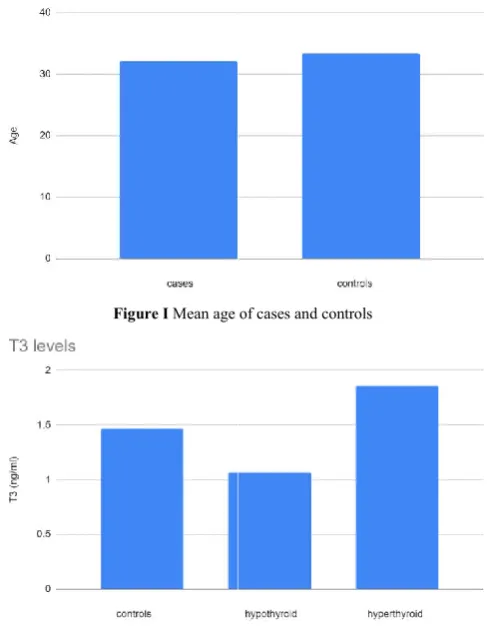
In this study, the study and control group were age and sex matched.
Figure I Mean age of cases and controls
Figure II Mean T3 levels in cases and controls
The mean age of the study group in years was 32.1 ± 1.52 and that of the control group was 33.4 ± 1.2 and the difference between the groups was not statistically different.
In hypothyroid cases, T3 and T4 values we
lower than the control group and TSH values were 25 Hyperthyroid (TSH < 0.4 mIU/l) and 25 (TSH > 6.2 mIU/l)]
Following selection of subjects and obtaining informed consent for the proposed study, clinical history was taken from subjects and findings noted down. Under aseptic conditions, about 5 ml of venous blood was obtained from the median cubital vein by venepuncture, allowed to clot and centrifuged
The separated serum was used for the analysis of the following
Thyroid function tests ( T3, T4, TSH)
Thyroid function tests were done on Eliscan using standard kits. Serum T3 and T4 were performed using competitive ELISA method and TSH by sandwich ELISA method.
Serum uric acid levels were determined on Beckman Coulter AU 480 autoanalyzer by Enzymatic method using standard kit.
In this study, the study and control group were age and sex
Mean age of cases and controls
Mean T3 levels in cases and controls
The mean age of the study group in years was 32.1 ± 1.52 and that of the control group was 33.4 ± 1.2 and the difference between the groups was not statistically different.
Uric Acid Levels And Thyroid Status
significantly higher than the control group with a p value < 0.01.
Figure III Mean T4 levels in cases and controls
Figure IV Mean TSH levels in cases and controls
Figure V Mean uric acid levels in cases and controls
In hyperthyroid cases, T3 and T4 values were significantly higher than the control group and TSH values were significantly lower than the control group with a p value < 0.01.
Mean uric acid levels were found to be significantly higher in both hypothyroid (4.76 ± 0.29 mg/dl) and hyperthyroid (4.2 ± 0.23 mg/dl) cases when compared to controls (3.84 ± 0.15mg/dl) with a p value < 0.01.
significantly higher than the control group with a p value <
Mean T4 levels in cases and controls
Mean TSH levels in cases and controls
Mean uric acid levels in cases and controls
In hyperthyroid cases, T3 and T4 values were significantly higher than the control group and TSH values were significantly lower than the control group with a p value <
Mean uric acid levels were found to be significantly higher in both hypothyroid (4.76 ± 0.29 mg/dl) and hyperthyroid (4.2 ± 0.23 mg/dl) cases when compared to controls (3.84 ±
Table I Comparison of thyroid function tests and uric acid levels in
cases and controls
** p < 0.01
Although mean uric acid levels were significantly higher in the cases compared to controls, only 1 (4%) hypothyroid patient and 1 (4%) hyperthyroid patient had h
> 6 mg/dl in females and >7 mg/dl in males).
Correlation of uric acid levels with different components of thyroid function tests (T3, T4 and TSH) were evaluated. There was no significant correlation between the different parameters.
Table II Correlation between thyroid function tests and serum uric acid levels in cases and controls
DISCUSSION
Our study evaluated uric acid levels in 50 subjects newly diagnosed with thyroid disorders (25 hypothyroid and 25 hyperthyroid) and compared it to that of euthyroid controls. We found that mean uric acid levels were significantly increased in both hyperthyroid and hypothyroid patients when compared to euthyroid controls.
Over the past few decades, several studies have been conducted to document the relationship between thyroid disorders and uric acid levels. From experimental studies in animals to several cross sectional surveys, retrospective analysis, interventional and follow
human population groups, scientists have tried to establish the relationship between thyroid status and uric acid levels.
Thyroid hormones affect both renal morphology and function. They are required for kidney growth and development thyroid deficiency results in decreased renal plasma flow and glomerular filtration rate and in impaired urinary concentration and dilution5.
Over the years several studies have demonstrated increased uric acid levels and even gout in hypothyroid patients Study done by Giordano et al
Comparison of thyroid function tests and uric acid levels in cases and controls
Although mean uric acid levels were significantly higher in the cases compared to controls, only 1 (4%) hypothyroid patient and 1 (4%) hyperthyroid patient had hyperuricemia (uric acid > 6 mg/dl in females and >7 mg/dl in males).
Correlation of uric acid levels with different components of thyroid function tests (T3, T4 and TSH) were evaluated. There was no significant correlation between the different
Correlation between thyroid function tests and serum uric acid levels in cases and controls
Our study evaluated uric acid levels in 50 subjects newly diagnosed with thyroid disorders (25 hypothyroid and 25 hyperthyroid) and compared it to that of euthyroid controls. We found that mean uric acid levels were significantly roid and hypothyroid patients when compared to euthyroid controls.
Over the past few decades, several studies have been conducted to document the relationship between thyroid disorders and uric acid levels. From experimental studies in cross sectional surveys, retrospective analysis, interventional and follow up studies in different human population groups, scientists have tried to establish the relationship between thyroid status and uric acid levels.
Thyroid hormones affect both renal morphology and function. They are required for kidney growth and development and thyroid deficiency results in decreased renal plasma flow and glomerular filtration rate and in impaired urinary concentration
hyperuricemia in hypothyroidism (33.3%) which was consistent with similar other studies done before9,10. According to them, hypothyroid hyperuricemia is due to a reduction in renal plasma flow and glomerular filtration secondary to thyroid hormone deficiency3. Several studies have documented elevated creatinine levels in hypothyroid patients which is proof that there is impairment in kidney function in hypothyroidism11,12. However these changes in kidney function in hypothyroidism are reversible and several studies have documented significant reduction in creatinine levels in hypothyroidism after treatment7,11,13,14. Another reason for increased uric acid levels in hypothyroidism is due to increased production due to myopathy associated with hypothyroidism3. Our study is in accordance with other studies exploring uric acid levels in hypothyroidism.
Several studies have compared the uric acid levels in subclinical and overt hypothyroid groups7,15,16. Tayal et al found that uric acid levels were significantly increased only in the overt hypothyroid group and they also found that uric acid levels had a significant negative correlation with serum T3 values in the overt hypothyroid group7. Kaur et al and Arora et al also found that uric acid levels were significantly increased only in the overt hypothyroid group and not in the subclinical hypothyroid group15,16.
While the association between hypothyroidism and hyperuricemia has been established, the relationship between hyperthyroidism and uric acid levels is still controversial. Only a few studies have examined uric acid levels in hyperthyroidism. Our study has found that uric acid levels are significantly higher in hyperthyroid subjects when compared to euthyroid controls. Several studies have also obtained similar results3,18,19,20.
In hyperthyroid cases, the increase in uric acid may be due to increased purine nucleotide turnover or secondary to the direct action of thyroxine on the kidney leading to decreased uric acid tubular excretion. Shirota et al have explained that hyperthyroid hyperuricemia is secondary to the direct action of thyroxine on the kidney, consisting in a decrease in uric acid tubular excretion, not corrected by an increase of creatinine clearance19 while Sato et al and Giordano et al suggest that hyperuricemia in hyperthyroidism is secondary to increased purine nucleotide turnover3,20. Giordano et al proved their hypothesis by showing that urinary uric acid levels were high in hyperthyroid patients with hyperuricemia3. However, some recent studies have reported that hyperthyroidism is not associated with significant elevation of serum uric acid while compared to controls21,22. Similarly the association between gout and hyperthyroidism is also controversial. Bruderer et al22 and See et al21 report a clinically relevant increased risk of developing incident gout in hyperthyroid patients while Giordano et al3 found no association between hyperthyroidism and gout.
In recent years, increased uric acid levels are found to be associated with cardiovascular disease23, hypertension24,25, dyslipidemia25, metabolic syndrome26, preeclampsia27 and chronic kidney disease28 and significantly increase morbidity and mortality.
CONCLUSION
In conclusion we agree with Tayal et al that thyroid function testing must be done for patients presenting with
hyperuricemia. In recent years, as more cases of asymptomatic hyperuricemia are being detected through biochemical screening, knowledge of reversible association between hyperuricemia and thyroid disorders can avoid unnecessary fear and additional investigations in thyroid disorder cases presenting with raised uric acid levels. Also treatment of thyroid disorders can help to reduce uric acid levels and decrease the morbidity and mortality associated with raised serum uric acid levels. However, larger studies evaluating the association between thyroid disorders and hyperuricemia need to be undertaken.
Limitations
We acknowledge several limitations in our study. Uric acid levels are largely influenced by the diet and lifestyle of patients and we did not take the diet and lifestyle into account in our study. Secondly, it is a cross sectional study and the patients were not followed up after treatment to document reduction in uric acid levels. Thirdly, patients were not divided into groups based on the severity of their thyroid disease and hence we are not able to comment on the association between severity of thyroid disorders and uric acid levels.
References
1. Burtis CA, Ashwood ER, Border BG, editors. Tietz Fundamentals of Clinical Chemistry. 5th edition. Pennysylvania: W. B. Saunders Company;2001; p. 2057 2. Kaptein EM, Quion-Verde H & Massry SG. Hemodynamic effects of thyroid hormone. Contrib Nephrol.1984; 41: 151-159.
3. Giordano N, Santacroce C, Mattii G, et al. Hyperuricemia and gout in thyroid endocrine disorders. Clin Exp Rheumatol.2001 Nov-Dec;19(6):661-5. 4. Dincer HE, Dincer AP, Levinston DJ. Asymptomatic
hyperuricemia: To treat or not to treat. Cleve Clin J Med.2002 Aug;69(8):594,597,600-602,605,608. 5. Katz AL , Emmanouel DS, Lindheimer MD. Thyroid
hormone and the kidney. Nephron.1975; 15: 223-9. 6. Yokogoshi Y, Saito S. Abnormal serum uric acid level
in endocrine disorders. Nippon Rinsho.1996 Dec; 54(12): 3360-3.
7. Tayal et al. Dynamic Changes in Biochemical Markers of Renal Function with Thyroid Status – A Study in Indian Population. Internet J Med Update.2009 July; 4(2): 36-41.
8. Dariyerli N, Andican G, Catakoglu AB, et al. Hyperuricemia in Hypothyroidism: Is It Associated with Post-Insulin Infusion Glycemic Response? Tohoku J Exp Med.2003 Feb; 199(2): 59-68.
9. Kuzzel WC, Schaffarzick RW, Naugler WE et al. Some observations on 520 gouty patients. J Chronic Dis. 1955; 2: 64-8.
10. Erickson AR, Enzenauer RJ, Nordstrom DM, Merenich JA. The prevalence of hypothyroidism in gout. Am J Med. 1994; 97: 231-4.
11. Kreisman SH, Hennessey JV. Consistent reversible elevations of serum creatinine levels in severe hypothyroidism. Arch Intern Med. 1999; 159: 79-82. 12. Den Hollander JG, Wulkan RW, Mantel MJ, et al.
Uric Acid Levels And Thyroid Status
13. Nakahama H, Sakaguchi K, Horita Y, et al. Treatment of severe hypothyroidism reduced serum creatinine levels in two chronic renal failure patients. Nephron.2001 Jul;88(3):264-7.
14. Schmid C, Brandle M, Zwimpfer C, Zapf J, Wiesli P. Effect of thyroxine replacement on creatinine, insulin-like factor 1, acid-labile subunit, and vasular endothhelial growth factor. Clin Chem. 2004; 50: 228-231.
15. Kaur V, Singh K, Verma M. Changes in biochemical markers of renal function in subclinical and overt hypothyroidism. Int J Bioassays. 2015;4:3799–802. 16. Arora S, Chawla R, Tayal D, Gupta VK, Sohi JS,
Mallika V. Biochemical markers of liver and kidney function are influenced by thyroid function-a case-controlled follow up study in Indian hypothyroid subjects. Indian J Clin Biochem. 2009;24:370–4. 17. Saini V, Yadav A, Arora MK, Arora S, Singh R,
Bhattacharjee J. Correlation of creatinine with TSH levels in overt hypothyroidism - a requirement for monitoring of renal function in hypothyroid patients? Clin Biochem. 2012;45:212–4.
18. Smyth CJ: Disorders associated with hyperuricemia. Arthritis Rheum. 1975; 18: 713-9.
19. Shirota T, Shinoda T , Yamada T, Aizawa T: Alteration of renal function in hyperthyroidism : increased tubular secretion of creatinine and decreased distal tubule delivery of chloride. Metabolism. 1992; 41: 402- 405. 20. Sato A , Shirota T, Shinoda T et al.: Hyperuricemia in
patients with hyperthyroidism due to Graves’ disease. Metabolism. 1995; 44: 207-11.
21. See L-C, Kuo C-F, Yu K-H, et al. Hyperthyroid and hypothyroid status was strongly associated with gout and weakly associated with hyperuricaemia. PLoS One. 2014;9(12):e114579.
22. Bruderer SG, Meier CR, Rick SS, Bodmer M. The association between thyroid disorders and incident gout: population-based case–control study. Dove Med Press. Apr 2017;9:205-215.
23. Gavin AR, Struthers AD. Hyperuricemia and adverse outcomes in cardiovascular disease: potential for therapeutic intervention. Am J Cardiovasc Drugs. 2003;3:309–314.
24. Kuwabara M, Niwa K, Nishi Y, et al. Relationship between serum uric acid levels and hypertension among Japanese individuals not treated for hyperuricemia and hypertension. Hypertens Res. 2014;37:785–789. 25. Alderman MH. Serum uric acid as a cardiovascular risk
factor for heart disease. Curr Hypertens Rep. 2001;3:184–189.
26. Zhu Y, Hu Y, Huang T, Zhang Y, Li Z, Luo C, Luo Y, Yuan H, Hisatome I, Yamamoto T, Cheng J. High uric acid directly inhibits insulin signalling and induces insulin resistance. Biochem Biophys Res Commun. 2014;447:707–714.
27. Lam C, Lim KH, Kang DH, Karumanchi SA. Uric acid and preeclampsia.Semin Nephrol. 2005 Jan;25(1):56-60.
28. Ramirez-Sandoval JC, Madero M. Treatment of hyperuricemia in chronic kidney disease. Contrib Nephrol. 2018; 192:135-146.
How to cite this article:
Vishwanath H. L and Kavitha S (2019) 'Uric Acid Levels and Thyroid Status', International Journal of Current Advanced Research, 08(11), pp. 20508-20512. DOI: http://dx.doi.org/10.24327/ijcar.2019.20512.4010