Abstract: A microcontroller based technique of generating a sine wave from the solar panel output is designed and implemented in this paper using a two-stage topology for a solar string inverter. This paper presents the development of a maximum power point tracking (MPPT) and control circuit for a single phase inverter using a pulse width modulation (PWM) IC. The attractiveness of this configuration is the elimination of a complex circuitry to generate oscillation pulses for transistor switches. The controller IC TL494 is able to generate the necessary waveforms to control the frequency of inverter through proper use of switching pulse. The DC to AC inversion is successfully achieved alongside the switching signals; the circuit produced inverter output of frequency nearly 50 Hz. The main objective of the proposed technique is to design a low cost, low harmonics voltage source inverter essentially focused upon low power electronic appliances using variable solar power as inputs.
Keywords: AC solar panels, DC-AC converters, MPPT charge controllers, PWM inverters, solar string inverters.
I. INTRODUCTION
a) Maximum Power Point Tracking (MPPT)When a solar PV module is used in a system, its operating point is decided by the load to which it is connected. Also, since solar radiation falling on a PV module varies throughout the day, the operating point of the module also changes throughout the day. Ideally under all operating conditions, one would like to transfer maximum power from a PV module to the load. In order to ensure the operation of PV modules for maximum power transfer, a special method called Maximum Power Point Tracking (MPPT) is employed in PV systems where, electronic circuitry is used to ensure that maximum amount of generated power is transferred to the load. The maximum power point tracking mechanism makes use of an algorithm and an electronic circuitry. The mechanism is based on the principle of impedance matching between load and PV module which is necessary for maximum power transfer. This impedance matching is done by using a DC to DC converter by changing the
duty cycle (d) of the switch.
Fig.2 (a) Flow chart of hill climbing method and (b) schematic diagram demonstrating how the operating point moves towards the maximum power point(MPP)
The power from the solar module is calculated by measuring the voltage and the current. This power is an input to the algorithm, which then adjusts the duty cycle of the switch, resulting in the adjustment of reflected load impedance according to the power output of PV module. For instance, the relation between the input
voltage (Vi) and the output voltage (Vo) and impedance of load (RL) reflected at the input side (Ri) of a buck type
DC to DC converter can be given as:
Vo = Vi x d
Ri = 𝑅𝐿 𝑑2
Where d is the duty cycle. By adjusting the duty cycle, Ri can be varied which should be same as the
impedance of solar PV module (RPV) in a given operating condition for maximum power transfer [15,16].
b) Inverter: A power inverter, is an electrical power converter that changes direct current (DC) to alternating current (AC); the converted AC can be at any required voltage and frequency with the use of appropriate transformers, switching and control circuits. In an inverter, dc power from the PV array is inverted to ac power via a set of solid state switches—MOSFETs or IGBTs—that essentially flip the dc power back and forth, creating ac power. Fig.3 shows basic H-bridge operation in a single-phase inverter. This solid state switching process is known as inversion [6].
Fig.3 An H-bridge circuit performs the basic conversion from dc to ac power.
The inverter will receive input of 12 V dc from the controller circuit and it will convert this to 230 V
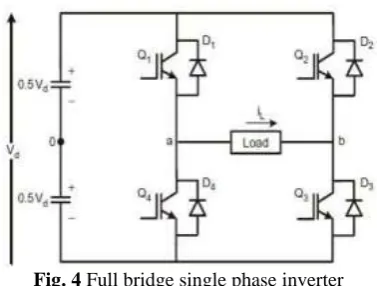
Fig. 4 Full bridge single phase inverter
The full bridge (single phase) inverter is built from two half bridges connected to form what is known as a full bridge or H-bridge inverter. Its arrangement is shown in figure 4. It comprises of DC voltage source, 4 power switches (usually bipolar junction transistors-BJTs, metal-oxide semiconductor field effect transistors-MOSFETs, insulated gate bipolar transistors- IGBTs or gate turned on transistors-GTOs) and the load.
To create a square-wave output voltage, the device pairs Q1Q3 and Q2Q4 are switched alternatively at a delay of 180 degrees. When Q1 and Q3 are ON with Q2Q4 OFF for a duration t, also with Q2Q4 ON and Q1Q3 OFF at t. Assuming there is a sinusoidal load current, the load will absorb power when Q1Q3 and Q2Q4 pairs are conducting alternatively whereas feed backing occurs when the diode pairs are conducting[22].
II. APPROACH AND METHOD
The block diagram for the circuit is as shown.
Fig.5 Block diagram for a solar power system
MPPT Circuit: The next step is to design and test the MPPT circuit. The voltage and the current output from the panel array have to be measured and the maximum power has to be supplied to the battery.
Fig.6 Schematic diagram for MPPT circuit Fig.7 MPPT circuit.
PGC D7 1N4148 R45 1K BAT_V R43 100K R23 0.1E/1W R24 1K J4 BAT 1 2 R22 3K3 LOAD+ +5V BATV R13 22K RX C13 0.1uF Y 18MHz LCD_D5 J9 CON4 12 3 4 D5 1N5408 J39 CON2 12 Q4 BC547 C30 0.1uF TX B_C Load_CNTRL R18 3K3 J7 CON2 1 2 R14 1K C2 0.1uF LOAD_CNTRL C7 1uF R31 1K
LCD1 LCD 16x2
Fig.8 Schematic diagram for inverter circuit Fig.9 Inverter circuit.
III. TESTING
The MPPT and Inverter circuit:The circuit of the MPPT is first tested with the help of a D.C. power supply. It is checked whether the voltage is passed to the battery to charge it. Finding it to work as required, it is then tested with solar panels. The regulator is also checked by varying the d.c. voltage. It shows the expected readings on the display.
Fig.10 a. Waveform of inverter output. b .Observation of Output on Hyper terminal.
The efficiency of the MPPT circuit is tested and found to be around 80%. It increases with the increase in intensity. The efficiency of the inverter is tested and found to be as much as 90%. It increases with increase in load.
IV. RESULTS AND ANALYSIS
The time required to charge the battery is tested. This is done first using an SMPS and then with the two solar panels. The efficiencies of the MPPT and inverter circuits are found to be around 90% and 79.9% respectively.
V. CONCLUSION
Trainers Textbook.
[2]. Dr. B.D.Sharma, Performance Of Solar Power Plants In India- Submitted To Central Electricity
Regulatory Commission New Delhi-February, 2011.
[3]. Deepak Kumar, Solar India and JNNSM, 1st November 2010.
[4]. International Finance Corporation, World Bank Group, ‘Utility Scale Solar Power Plants’, New Delhi
(India), February 2012.
[5]. Fritz Schimpf, Lars E. Norum- Grid connected Converters for Photovoltaic, State of the Art, Ideas for
Improvement of Transformerless Inverters- Norwegian University of Science and Technology, NTNU Department of Electrical Power Engineering.
[6]. James Worden and Michael Zuercher-Martinson, How Inverters Work, SOLARPRO, April/May, 2009.
[7]. AN2794 Application note Cd00201961.pdf
[8]. http://en.wikipedia.org/wiki/Wikipedia: CleanupTaskforce/String Inverter.
[9]. http://www.greenworldinvester.com / /topics/solar-renewable-energy-greeninvest/solar inverters/ (6th
July 2011).
[10]. Avinash H.N. and Palak Timbadiya, Global Energy National Institute, Overview of sustainable
renewable energy potential of India, 2010.
[11]. Dr. B.R. Gupta, Generation of Electrical Energy, S. Chand & Co. Ltd. New Delhi, Reprint 2010.
[12]. Prof H.P. Garg and Dr. J Prakash, Solar Energy-Fundamentals and applications, Tata McGraw-Hill
Publishing Company Limited, New Delhi, Eleventh Reprint, 2009.
[13]. Prof. Dr. Andrea Vezzini, BFH Bern, Switzerland, Institute for Energy and Mobility Research.
[14]. Angelina Tomova, TU Sofia, Grid Connected Pv Inverter Topologies An Overview, 07 April 2011,
Glasgow, UK
[15]. Chetan Singh Solanki, Solar Photo voltaics, PHI Learning Private Limited, July 2011.
[16]. Sachin Jain and Vivek Agarwal, A Single-Stage Grid Connected Inverter Topology Solar PV
Systems With Maximum Power Point Tracking, IEEE Transactions On Power Electronics, Vol. 22, No. 5, September 2007.
[17]. Søren Bækhøj Kjær, Design and Control of an Inverter for Photovoltaic Applications, Aalborg
University, DENMARK Institute of Energy Technology, January 2005.
[18]. A. A. Mamun, 1, M. F. Elahi M. Quamruzzaman, M. U. Tomal Design and Implementation of Single
Phase Inverter International Journal of Science and Research (IJSR), India Online ISSN: 2319-7064
[19]. Muhammad H. Rashid, Power Electronics, Circuits Devices and Applications, Third Edition, Published
by Dorling Kindersley (India) Pvt. Ltd., licensees of Pearson Education in South Asia.
[20]. Muhammad Ali Mazidi, Janice Gillispie Mazidi, Rolin D. McKinlay, The 8051 Microcontroller and
Embedded Systems, Second Edition, Published by Dorling Kindersley (India) Pvt. Ltd., licensees of Pearson Education in South Asia.
[21]. Dr. Amiya Kumar Rath, Alok Kumar Jagadev and Santosh Kumar Swain, Computer Fundamentals and
C programming, Scitech Publications, (India) Pvt. Ltd.
[22]. Omokere, E. S and Nwokoye, Evaluating the Performance of a Single Phase PWM Inverter Using
3525A PWM IC, International Journal of Engineering Research & Technology (IJERT), Vol. 1 Issue 4, June – 2012