Rhizomatic Explorations in Curriculum
Julie A. M. Smitka
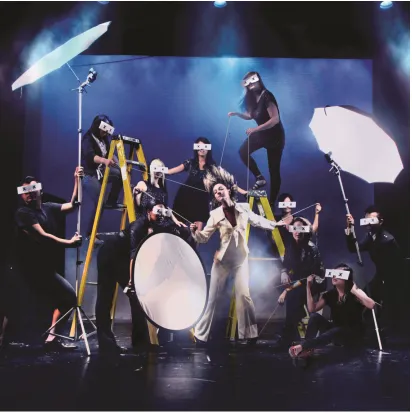
Peel District School BoardA visual and theatrical exercise anchored in the Grades 11 and 12 Ontario Curriculum for Media Arts and Interdisciplinary Studies was enacted and recorded as individual experiences of each participant. The event was re-mastered in a graphic representation that depicts the forces, pushes and pulls of curriculum and students’ needs which educators experience on a daily basis. Students participating in a co-educational public high school course were photographed alongside their yearbook advisor to examine the methodology of a/r/tography, embodiment and time/space/place during a staged photo shoot session. Participants, including the author, documented their experiences of this research creation event through written and photographic feedback. The basic findings resulted in the creation of the Dimension of the Mind Embodied (DOME), a new theory I coined that builds on Deleuze and Guattari’s (1987) concept of the rhizome.
Chaque participant à un programme d'études en arts des médias et études interdisciplinaires de l'Ontario pour les 11e et 12e années a interprété un exercice visuel et théâtral. L'évènement a été remasterisé en une représentation graphique illustrant tant les forces et les mouvements en opposition du programme d'études que les besoins des élèves auxquels font face les enseignants à chaque jour. On a photographié des élèves qui suivaient un cours dans une école secondaire publique mixte à côté d'un conseiller de sorte à étudier l'a/r/tographie, la concrétisation et le temps/l'espace/le lieu pendant une session de photos publique. Les participants, y compris l'auteur, ont documenté leurs expériences relatives à cet évènement de création en produisant de la rétroaction écrite et photographique. De ces résultats a découlé la création de Dimension of the Mind Embodied (DOME), une nouvelle théorie que j'ai inventée à partir du concept de rhizome de Deleuze et Guattari (1987).
In the Ontario Curriculum for Grade 11 Media Arts, students are required to “apply the creative process to create media art works, individually and/or collaboratively” ("The Ontario Curriculum: The Arts," 2010, p. 124). They must work individually and collaboratively to investigate “creative challenges” and “innovative ideas,” while using a means to track and record their creative process ("The Ontario Curriculum: The Arts," 2010, p. 124).
different perspective; how student and teacher interactions aid in the development and identification of one’s inner and outer self within the arts, a process that is so important in identifying embodied ways of knowing.
Student and teacher engagement in the classroom is essential to student development, knowledge, and understanding of curriculum content. To help illustrate my concept of engagement I referred to Deleuze and Guattari’s (1987) concept of the rhizome:
. . . the rhizome connects any point to any other point, and its traits are not necessarily linked to traits of the same nature; it brings into play very different regimes of signs, and even nonsign states. (p. 21).
My concept of engagement in relation to the rhizome required me, the art educator, to embody these rhizomatic traits as outlined by Deleuze and Guattari (1987) to adapt to the students’ creative artistic needs. An example of what this might look like is to provide students with an outlet to creative inquiry through role-playing and photography in the visual arts. Rhizomatic traits that occur during a role-playing activity include adapting to each other’s needs, expressions, and roles. In role playing with others, at first we may start from one point of departure, but the different roles/threads that unravel when engaged with each other in a role play, lead us into different directions when we respond to others; hence, these are rhizomatic interactions.
Through the methodology of a/r/tography, I took a more in-depth look into the arts in a classroom research event for the purpose of exploring a/r/tography, embodiment and time/space/place in relation to the individual, how the final graphic image was composed and presented in this article, and the technology used to create the final image. In terms of how a/r/tography is related to the rhizome, a/r/tography embodies the (a)rtist, the (r)esearcher, and the (t)eacher. As an artist/researcher/teacher each role in itself is rhizomatic as we search for an understanding to a particular set of questions. When searching for an answer, the a/r/tographer “connects any point to any other point.” In connecting the concept of the rhizome to the methodology of a/r/tography, rhizomatically, I question:
1. How students connect learning to understanding in the arts?
2. How do students embody the rhizomatic formulation of knowledge in the arts? 3. How do emotions that act as rhizomatic points of departure, help students learn to
understand through embodiment in the arts?
The conceptual framework for this study is grounded in (a) theories of the body and embodiment as highlighted by Gaudelius and Garoian (2007), Keifer-Boyd (2007) and Springgay (2008a, 2008b), (b) a/r/tography as specified by Springgay, Irwin, and Wilson Kind (2005), (c) the phenomenology of film as noted by Hansen (2004) and Weaver and Britt (2007), and (d) theories of Deleuze (1986) and Deleuze and Guattari (1987). As well, it is grounded in my mandate as a teacher to engage the students and to conform to the guidelines of the Grade 11 Ontario Curriculum for Media Arts (2010), and the Grades 11 and 12 Ontario Curriculum for Interdisciplinary Studies (2002).
discuss later. I outline the context of the research study, discuss my use of and intersection with arts-based methodologies, namely a/r/tography, and provide a theoretical discussion and analysis of the pilot project. In conclusion, I argue that the implications of this project have beneficial outcomes for teachers and students within the arts.
The Study
The objective of the classroom project was to engage students in a multisensory challenge in the development of a concept for the school yearbook page. The pilot project took place in an Ontario public high school yearbook course. Participants included seven Grade 11 students, three Grade 12 students, and the yearbook teacher (the author). In this particular school, students receive both Interdisciplinary Studies and Media Arts credits during their first year in the Grade 11 Yearbook course, and teaching is governed by that aspect of the curriculum. Students who wish to continue in Grade 12 receive two Interdisciplinary Studies course credits. The data and the final image that is presented in this manuscript was secured through school board informed consent for publication. All students, and parents of the students, secured and authorized permission for use of the final image, and the student written reflections.
Photographic data of the final image was collected using a digital Single Lens Reflex (SLR) camera set on a tripod to the continuous shooting mode to allow participants free movement and action during an onstage photo shoot for my advisor page in the school yearbook. Additionally, the students set up the stage, the remaining photographic equipment, and costuming. Several photographs of the group were taken in various combinations and poses to select the best image that described my experiences as an arts educator. Initially, seven students were photographed. The remaining three students were digitally inserted into the final image through the use of Photoshop, at a later date, as they were initially absent from class during the scheduled photo shoot. In addition, the students wore masks to minimize their vision to force them to tend to their sensory experiences during this exercise. I chose to obstruct their vision for two reasons:
1. I did not want the students to be identified as specific students. This was meant to be a marionette-based idea, in which the manipulators remain unidentifiable.
2. I wanted the students to attend to their other senses as a way to experience a space they were previously very familiar with in a different sense. I wanted to tune them into their
surrounding environment as a way to find out how they consider learning through the body in the arts.
The quoted embodied experiences presented in this article are the voices from all of the participants. Each student participant is identified by a pseudonym first name. We documented our experiences, through written reflections the following school day during our scheduled class period. The written descriptions were based on a series of questions posed by myself, the researcher-teacher. Questions specifically designed to draw in students’ attention to stimulate creativity included:
1. How did you feel when you were on stage?
4. How does the final image make you feel?
5. How do you see yourself and the rest of us in the final image? 6. How does the environment in the final image make you feel? 7. What were you thinking/feeling when you were behind the mask?
These questions were posed as a means to explore their embodied learning and understanding within prescribed arts and interdisciplinary studies curriculum.
Results
The final graphic image (Figure 1, Dancing Marionette) was intended, as the advisor’s page in the school yearbook to portray the polarization of forces of curriculum and the students' needs on the central figure—the teacher. It depicts an image of a teacher as a marionette being internally guided by her training and curriculum, and at the same time being manipulated externally by masked students. The students represented the forces of individual needs and
myself—the teacher—implementing the directives of the curriculum through innovative teaching skills demanded by each situation.
The summary of the students’ reflections indicated that they experienced a sense of embodiment during this exercise. Students reported feeling an embodied experience by being engaged to perform and project their expressions with their body while the masks obscured their eyes. “I felt like I engaged within the setting by removing myself from everything else and imagining how I would look from the camera’s perspective. I felt while I was posing . . . I had to reflect my emotion with my body’s movement rather than my facial expressions,” commented Shawn. Christine noted that she “used her body to answer and speak, rather than [using] words.”
They addressed their presence as molding into the space: “I felt very comfortable with my body within the space. With my costuming and how the scene was set up, I felt that I was definitely in an unfamiliar space, however, I was eager to mold into the space and become a part of that space,” noted Emily. “The photo shoot almost seemed unreal like I entered a photo world. The way everyone is dressed and the way we are positioned together almost seems like this is something that is a part of our natural lives. Within that environment, it was like we weren’t just a class, but we evolved and became something else,” stated Michelle. Behind the mask, Kelly commented that she “felt relaxed.”
They also reported on their own awareness the differentiation of their own embodiment and reality of the photo shoot: “The only thing that kept catching my eye was that the teacher was the only one moving. Her movement I found amusing and it kept bringing me back to reality,” noted Michelle. “Behind the mask, I felt odd and confused why everyone was laughing, so I removed my glasses and saw Ms. Smitka going wild!! . . . She looked not like herself. She looked more free and having fun,” commented Nathan. “Behind the glasses, I tried to very hard not to laugh . . . When I knew that the camera was about to flash, I mustered up all my strength to not smile (poker face!) and then I would immediately burst out laughing afterwards,” stated Sandra.
The experience of viewing oneself in the digital image from the perspective of the spectator was also reported:
Looking at the photo and at the expression on my face, I almost feel like it’s another version of myself . . . The lack of expression and the fact that I am unable to see my eyes makes me feel like it’s not myself and something in my heart almost makes me feel nervous and uneasy seeing myself in such a way (and seeing that photo). My positioning also adds a feeling of an opening gateway to myself that I’ve never seen before,” commented Michelle.
Lindsay mentioned: “When I look at the picture, I feel that it’s a fantasy . . . because of all the editing that Nathan did with the photograph. But because we are all in the picture, obviously it’s somewhat real. I think the fact that it’s both real life and fantasy makes it much more interesting.”
My own marionette experience surprised me: As the photo session progressed, there were times when on some level we all connected and embodied ourselves into one production. At the beginning we were separate entities/beings. As time transcended and we became more familiar with our space and with the bodily locations of each other, there was a flow of energies that seemed to pass over us. I was conscious of my actions, the silence from the students, and the reverberating clicks from the camera’s shutter while I was moving my head back and forth, trying to get my hair to fly up. These elements, combined with me rushing through as many different movements within the allocated time frame of the camera’s timed continuous shooting mode of 10 seconds, initiated laughter as I disconnected myself from my body and imagined what our dramatic performance might look like from a distance. I was aware that at any moment one of my colleagues, or a member of the administrative team might walk into the auditorium and wonder what these bizarre movements were that I was performing while my students stood there expressionless and quiet. I could also imagine what this strange dance may have looked like on the school’s surveillance cameras. Moreover, I was mindful that my students were most likely wondering what it was that I was doing. I knew they could hear my movements but could not see me, as I shuffled my feet around the stage floor.
Being sensitive to all these different images playing around in my head made me laugh. My laughter in turn sparked laughter from my students and their laughter ignited more laughter from me. When the camera had finished its 10 seconds of continuous shooting, we took a few minutes to reset the camera and get all our laughs and giggles out before we started another 10 seconds of continuous shooting. I had to fight with my emotions in order to keep a straight and expressionless face for the camera. Even just trying to hold back my outbursts of laugher made me recognize the emotional pushes and pulls I was experiencing within my own body during this performative scene.
Having a really good working relationship with this class prior to this event, made me more aware of seeing my students as co-creators in knowledge production. Prior to us first being photographed as a group, we tested different stage and photographic lighting scenarios and group positioning. Some of our initial shots did not turn out because the camera and speed lights were not synchronized properly. Working through these dilemmas together, I never would have expected to experience what this session provided us with individually and as a group. After checking the camera footage and seeing the exact image I wanted to use, I thanked the students and kindly asked them to help dismantle the lighting and camera equipment. To my surprise they wanted to continue taking pictures because they were having so much fun on stage. As I let them enjoy their time on stage, I photographed them jumping and laughing together. I myself had a student take some jumping shots of me. Because we all felt so comfortable with each other and had formed positive working relationships prior to this experience, we felt at ease expressing our emotions in our staged environment.
Discussion
In the sections that follow, I discuss various concepts from this study as they relate to a/r/tography, embodiment, and the Dimension of the Mind Embodied (DOME). My study addresses these concepts through an entangled perspective that embodies creative inquiry.
element that binds the arts together. Participating in the photo shoot provided me with the opportunity to increase my understanding of embodiment and body awareness, not only from a physical, emotional, and knowledge-constructed perspective, but also from the perspective of allowing myself the opportunity to do so for the purposes of trying to understand through experience how students might embody the curriculum themselves.
A/r/tography
From an a/r/tographical perspective, the image is a “coming together of art and graphy, or image and word . . . it is in the contiguous interaction and the movement between art and graphy that research becomes a lived endeavor” (Springgay, Irwin, & Wilson Kind, 2005, p. 900). In terms of the (a)rtist, (r)esearcher, (t)eacher with the “understanding that to live the life of an artist who is also a researcher and teacher is to live a contiguous life, a life that dialectically moves between connecting the three roles” (Springgay et al., 2005, p. 901). As the artist, the researcher and the teacher, I experience these shifts on a daily basis. Dancing Marionette attempts to illustrate those shifts. Being the artist I was the performer, as the researcher I was experiencing and looking for inquiry in a lived experience, and as a teacher I was searching through the curriculum to adapt to the needs of my students.
Embodiment
Embodiment according to Springgay (2008a) is the “concept of the body to be a flow of energies and surface intensities; a complex play of social and affective forces” (p. 1). Maurice Merleau-Ponty’s concept of embodiment is not of the materiality of the body but of the “flesh, which represents our embodied engagement with the world. For Merleau-Ponty, the flesh of the body is folded over and into the flesh of the world and the flesh of history” (as cited in Gaudelius & Garoian, 2007, p. 13). For the most part, the students all experienced some level of such involvement as outlined in the Results section. This flesh represents my understanding of the physical body to be an organism within the flesh. The body therefore becomes an organism within the flesh that embodies the space/place in the environment/the Other in which it is situated. I specifically refer to the Other as a person, place, or thing. This concept of the flesh further heightens concepts of a/r/tography and the rhizome. To understand the body as a flow of energies and surface intensities as Springgay (2008a) has stated, is to also understand a/r/tography and Merleau-Ponty’s concept of the “flesh” as energies and surface intensities as suggested by Springgay (2008a). These flows of energies and surface intensities affect one another and will always be changing, morphing, and evolving based on our experiences.
This experience speaks directly to Deleuze and Guattari’s (1987) concept of the rhizome. The flow of energies and surface intensities, as highlighted by Springgay (2008b) shows that the students’ embodiment becomes rhizomatic in nature as they tried to mold in and became a part of the space. This transformation and intermingling of intensities within the body and space suggests that I, the teacher-researcher, and my students, forever adapt and learn from our surroundings as rhizomatic ways of searching for meaning.
Looking at the image from a bodily experience, the image acts as an extension to the human body (Gaudelius & Garoian, 2007) for the photographer and the spectator. Vivian Sobchack suggests, “film, like humans, has its own embodiment that gives it a life-of-its-own. This life-of-its-own manifests itself through the camera for the filmmaker, and the projector for the spectator, and therefore is limited to an embodied vision as seen through a lens” (as cited in Gaudelius & Garoian, 2007, p. 23). To comment further on this point, although Dancing Marionette is a still photograph, so is film. Film is a series of still images that have been sequenced together at a rate generally of 24 frames per second. Expanding on Sobchack’s quote, Dancing Marionette embodies several different roles and perspectives. To begin with, there was no photographer. The camera was set up on a tripod and a continuous timer shot a series of images. The concept of no photographer, just a camera timer, did produce an interesting play on the embodiment of the photographer. Since there was no photographer, the camera takes on the embodiment of the Other, which captures the moment. In total, 92 different photos were taken before selecting the final image. The final printed image becomes an embodied space of pixels made up of light that have rendered a specific time/space/place. This image was selected because, apart from capturing what I feel as an arts educator, it was the only image that captured an instantaneous shot of my hair flying up and backward as a way of communicating movement, which is exactly what I was searching for.
For the spectator, the image documented the time/space/place that was captured. However, the spectator is also required to embody the image and its space, in order to:
1. Consider it as an image,
2. Shape it’s meaning through subject matter and the Elements and Principles of Design, 3. Understand what is happening, and
4. Reason/negotiate with it, which requires the first three points. This therefore requires the spectator to embody the image.
This notion of embodiment is tied back to the concept of the rhizome as highlighted by Deleuze and Guattari (1987), as a collection of dimensions. These dimensions are the foundations of the image itself and the experience and knowledge created by the participants and the spectator.
As an image, Dancing Marionette is actually a montage of images. Three of the students were photographed separately and then composited. The concept of the montage is a technique that “tricks the eye of the spectator in order to produce certain effects that encourage her/him to believe that [what] s/he sees is a product of one seamless camera view” (Weaver & Britt, 2007, p. 29). For Sobchack (1992), in her treatise on the phenomenology of film, she warns that the lived-body is in crisis: “If we are to understand how we understand the film experience, why it has significance for us, and why we care about it, we must remember that experience is located in the lived-body. Indeed, at this historical moment . . . the lived-body is in crisis” (p. 300).
As the spectator, I still become a part of the image by viewing and engaging with it, but for me this is a different relationship; a relationship that still requires me to embody the image, but on a slightly different level. Reflecting on my experience as the participant, I was in a particular time and space; my senses were heightened to adapt to the environment I was in with my students. As a spectator, I can only see, I cannot smell, feel, or hear the environment in the image for it is lost in time. Knowing that the image has been artificially altered does bring in ethical questions of producing something that is real versus something that has been altered from reality, especially when asking the viewer to engage with it. In order for the spectator to engage with the image, the spectator must demonstrate the ability of discernment. For the spectator, “discernment is a recognizing of the film editor’s selections and how those shed light onto some perspective of reality that may be novel. This act of recognition shapes the spectator’s identity in that s/he is responding to stimuli on various conscious and subconscious levels” (Weaver & Britt, 2007, p. 32). This is where the embodiment of the spectator must be noted. Once the spectator responds to the image on a conscious or subconscious level, and they have recognized what may be novel, will they embody the image?
The spectator’s role is a phenomenological relationship with film, suggesting that the film, or in this case the image, has a double nature (Weaver & Britt, 2007, p. 22). When we look at an image we inhabit two worlds . . . it is the world of our body’s relationships and experiences with the world beyond the image and the world of relationships that the image captures and reveals to spectators (Weaver & Britt, 2007, p. 23). As the artist, the researcher, and the teacher, the experiences I encountered when participating in the photo shoot were very different experiences when I stepped back and looked at the final image. During the actual process, I was aware of what was happening around me while we were on stage. My experience of seeing the end product as the spectator does bring back recollections of the event but not the real and true experiences I encountered when participating in the creation of the image. My act and experiences of participating was a one-time event. The camera has captured an element of those experiences but not the embodied experiences of being in that time/space/place. Those experiences have faded and even when I look at the image now, I remember bits and pieces, but the physical existence of myself with my students in that space has passed.
As the artist, the researcher, and the teacher, the image creates another world in which I became embodied once again, this time as the spectator. This experience is different and is not as powerful an experience when initially creating the image. “Cinema thus transposes, without completely transforming, those modes of being alive and consciously embodied in a world that count[s] for each of us as direct experience” (Sobchack, 1992, p. 4). In the role of the spectator, I have been transposed and transformed. I am no longer the person in the image for I have evolved and changed since the initial photo shoot. My students have also evolved and changed. At the initial photo shoot we were ourselves embodied in our own flesh and placed in a space. Now as time has transcended, our image became the Other. As spectators we became ourselves once again embodying a time/space/place that is different than the initial photo shoot. We have embodied the experience of participating in the act of creation, but now we embody a different perspective that calls upon and asks us to recollect on our experiences.
wave; then there is “awareness of the convergence” of the message, as the “wave reaches it[s] peak”; and finally comes the internalization or the force of the “wave as it crashes down” (p. 31). In addition, Weaver and Britt (2007) continue speaking of the spectator as having to actively participate in a representation of reality that requires the spectator to “add to or subtract from her/his identity” (p. 33).
Hansen (2004), in his theories of the digital image, notes that digital data is “polymorphous”; it cannot be bound for it “explodes the frame” (p. 35). More specifically this “untapped potential of the digital image is found in its expansion outside of any frame . . . and how the digital image is able to latch onto the human body as a supplement and demand more creatively and physically from any human individual who comes in contact with the digital image” (Weaver & Britt, 2007, p. 34). Weaver and Britt (2007) raise an interesting question: “If the digital image is marked by a frameless existence, and if technology is a supplement to the body, then what is the role of the body in the realm of digital images?” (p. 35). They note that for Hansen (2004a) this question can be understood as that of affectively. “Affectively; the capacity of the body to experience itself as ‘more than itself’ and thus to deploy its sensorimotor power to create the unpredictable, the experimental, the new” (Weaver & Britt, 2007, pp. 35-36).
Dimension of the Mind Embodied (DOME)
To experience the self as “more than itself” especially in technological images requires the spectator to take into consideration all the image has to offer and then morph that knowledge and the power of the image, and its meaning, into another dimension of thought. I developed the term the “Dimension of the Mind Embodied” (DOME) to describe this affect/effect. I consider the DOME to be the space within the human mind. My concept of the DOME is similar to that of Deleuze and Guattari’s (1987) rhizome except that unlike the rhizome, the DOME is an element within our mind that produces the visual concepts. As we experience events and occurrences through our physical body, the DOME, in this case, acts as a rhizome making connections to concepts and experiences and forever morphs and transitions them into new meanings. An example of this is the phenomenon of dreaming. As we dream we enter into a state of sub-consciousness. Our sub-conscious usually takes on different forms. When we wake, the meaning of our dreams sometimes puzzles us. I interpreted this as the rhizome within our mind, which jumps around back and forth between concepts and bodily experiences to try and form new meanings. The students experienced similar feeling during the exercise. The DOME is a form that houses the rhizome and where visual concepts are formed and created.
The DOME is another embodied way of being. It is different from the embodiment of flesh as I highlighted earlier and as described by Deleuze (1986). The DOME happens deeper within the flesh of being. It is the void within us that is filled with our physical and emotional experiences that have been stored in the space of the DOME. It shapes and articulates meaning in visual embodied forms. The space and movement of neurons and electrons within the DOME can be highlighted by Deleuze (1986) in his analysis of Henri Bergson’s thesis on movement:
This concept of movement pertains to my interpretation of how the enfleshed being embodies the digital image. The enactment of producing the physical digital image involved the movement of bodies within a specific time/space/place. I agree that during the creation of the image the time/space/place were homogeneous and the movement of myself and the students in the image were heterogeneous for our enfleshed bodies and our DOME, were in a state of flux, constantly transforming. It is only after, when the image is viewed by the spectator that the concept of space in the image becomes heterogeneous and infinitely divisible, and movement becomes homogeneous and fixed. In addition, having noted this, the spectator who is an enfleshed being in a time/place/space views the still image but embodies a space that is heterogeneous which in turn produces thoughts and concepts that are heterogeneous and in flux when interpreting the image.
It is important to note the differences between acts of cognition, imagining, and the DOME. Is the DOME the same as the cognitive process? Cognition is: “The mental faculty of knowing, which includes perceiving, recognizing, conceiving, judging, reasoning, and imagining” (Cognition. In The American Heritage® Stedman's Medical Dictionary, 2002). To imagine is “to form a mental image of (something not present)” (Imagine. In the Merriam-Webster's Medical Dictionary, n.d.). The DOME is different from cognition in that it houses all the lived, shared, felt experiences and the mental pictures we have taken from this world. It is where the soul has filled the recesses of our mind with our physical and emotional experiences that have been stored in the space of the DOME. It shapes and articulates meaning in visual embodied forms. The DOME does produce imagined events, which is similar to cognition, but what makes the DOME different from imagining is that it takes the shared, lived and felt experiences from our life, forms mental pictures of them, and stores them in the Dimensions Of the Mind that we have Embodied (Smitka, 2011).
Conclusion
The article presents the research study from the perspective of the researcher-teacher with additional analysis and evidence collected from the student reflections. The study is not an ethnographic study that collected and analyzed detailed, thick descriptions of student understandings. Rather, adopting a rhizomatic analysis, student reflections punctured teacher-researcher perceptions and theory in order to add an additional layer to the text. In other words, this paper highlights primarily my reflections and theoretical connections to the project; yet the students’ collaboratively produced an image and their responses to the questions help shape and inform my own reflective practice.
The theme of the exercise, during a production of a school yearbook advisor’s page, was an exploration and depiction of the pushes and pulls of the curriculum, of student needs, and school board mandates that challenge me daily as a visual arts teacher. Through collaboration and written reflections, the students were able to become a part of something that was much larger than anything they would experience if they were to have worked individually in this study.
The exercise truly engaged the students and opened avenues into self-examination and creativity. As an educator and participant I became acutely aware of the pushes and pulls of the demands placed upon me by the profession and the students’ needs. What has emerged from this study is the complexity of those forces and the new concept I developed, the DOME. Participating in this enactment provided the students and myself with the opportunity to experience our body within a space in relation to each other. Although we were separate from one another, there was a part of each of us that knew exactly where each of us was placed within that environment. Artistically, we will never be able to duplicate the experiences we encountered, for if we revisit that space and place the next time it will be different. In concluding, I hope to have provided a platform for new insights into thinking about teaching and learning within prescribed Arts and Interdisciplinary Studies curricula.
Acknowledgement
A special thank you to all my students, to my school and school board, my family, and to S.S.
References
Cognition. (2002). In The American Heritage® Stedman's medical dictionary. Retrieved from the Dictionary.com Web site: http://dictionary.reference.com/browse/cognition
Deleuze, G. (1986). Cinema 1: The movement-image (H. Tomlinson & B. Habberjam, Trans.). Minneapolis, MN: University of Minnesota Press.
Deleuze, G., & Guattari, F. (1987). A thousand plateaus: Capitalism and schizophrenia (B. Massumi, Trans.). Minneapolis, MN: University of Minnesota Press.
Eisner, E. (2002). The arts and the creation of mind. New Haven, CT: Yale University Press. Gaudelius, Y., & Garoian, C. (2007). Performing embodiment: Pedagogical intersections of art,
technology, and the body. In S. Springgay & D. Freedman (Eds.), Curriculum and the cultural body (pp. 3-19). New York, NY: Peter Lang.
Hansen, M. B. N. (2004). New philosophy for new media. Cambridge, MA: MIT Press.
Imagine. (n.d.). In Merriam-Webster's medical dictionary. Retrieved from the Merriam-Webster Web site: http://www.merriam-webster.com/medical/imagine
Keifer-Boyd, K. (2007). Body interfaces in curriculum. In S. Springgay & D. Freedman (Eds.), Curriculum and the cultural body (pp. 51-60). New York, NY: Peter Lang.
Smitka, J. A. M. (2011). Personal perspectives on embodiment. Unpublished manuscript.
Sobchack, V. (1992). The address of the eye: A phenomenology of film experience. Princeton, NJ: Princeton University Press.
Springgay, S. (2008a). An ethics of embodiment, civic engagement and a/r/tography: Ways of becoming nomadic in art, research and teaching. Educational Insights, 12(2) Retrieved from
http://www.ccfi.educ.ubc.ca/publication/insights/v12n02/articles/springgay/index.html Springgay, S. (2008b). Body knowledge and curriculum: Pedagogies of touch in youth and visual
culture. New York, NY: Peter Lang.
The Ontario curriculum, Grades 11 and 12: Interdisciplinary studies, 2002. (2002). Toronto, ON: Ministry of Education. Retrieved from
http://www.edu.gov.on.ca/eng/curriculum/secondary/interdisciplinary1112curr.pdf
The Ontario curriculum, Grades 11 and 12: The arts, 2010 (Rev. ed.). (2010). Toronto, ON: Ministry of Education. Retrieved from
http://www.edu.gov.on.ca/eng/curriculum/secondary/arts1112curr2010.pdf
Weaver, J. A., & Britt, T. D. (2007). Experiencing life hrough the body of film: The convergence of phenomenology and cultural curriculum studies. In S. Springgay & D. Freedman (Eds.), Curriculum and the cultural body (pp. 21-38). New York, NY: Peter Lang.