Abstract: For stable voltage on DC bus in DC network systems micro grid battery storage units and super capacitor unit are used
to assist the main sources of renewable energy (PV array and wind). To provide good service on demand the micro grid storage
system plays an important role. In this paper, there are five sources PV, wind, Battery, super capacitor and AC grid are operating
in both condition grid connected or islanding condition. Boost converter are used for increase the voltage of PV, wind, super
capacitor and battery units. The advantage of AC grid connection is that if hybrid storage units is not sufficient to provide voltage
to a DC bus, then the AC grid will also provide a voltage to the DC bus. Firstly, DC micro grid with grid connection and variable
loads are put forward. Secondly, study about its energy management and integration control system. Lastly, we focus on hybrid
energy storage system (HESS). specially the HESS topology.
Keywords— DC micro-grid, hybrid energy storage system (HESS), PV, wind.
I.INTRODUCTION
Nowadays, micro-grid is important part of intelligent power distribution system. At present scenario, the micro-grid classify in AC
micro-grid, DC micro-grid, AC and DC mixed micro-grid [1-3]. Compared with AC micro-grid, DC micro-grid are more attractive
because of their excellence in control complexity, reliability, efficiency and cost [4-5]. In DC micro-grid also reduce the numbers
of converter.The advantage of use DC micro-grid is no need to control the frequency and reactive power. The most important task
in DC micro-grid is the DC bus voltage control to maintain the power balance between power generation and power consuming [6].
However, the randomness of distribution energy sources (RESs) and instability of the loads create large range fluctuation in DC
bus voltage [7]. Therefore, the hybrid energy storage system (HESS) is necessity for DC micro-grid to overcome DC bus voltage
fluctuations and stable operation of the system. However, DC micro-grid structure, energy management integrated control
technology and hybrid energy storage system need to be further studied to realize it’s industry application. In this paper, DC
micro-grid with micro-grid connection and variable loads put forward. Then secondly, energy management and coordinated control technology
are studied. Lastly, we focus on energy storage system, especially the HESS technology.
II.STRUCTURE OF DC MICRO-GRID
Asea brown boveri (ABB) company first proposed DC micro-grid structure in 2008. The micro-grid includes PV, energy storage,
AC grid, a variety of converters and DC, AC loads.
Micro-grid run at two different mode one is island mode and another is grid-connected mode. In the island mode, there is no
guarantee of continued power supply of important loads when hybrid energy storage runs out in the rainy and windless weather.
Therefore, this types of micro-grid without controllable micro-source is not suitable to operate in long-term island operation of DC
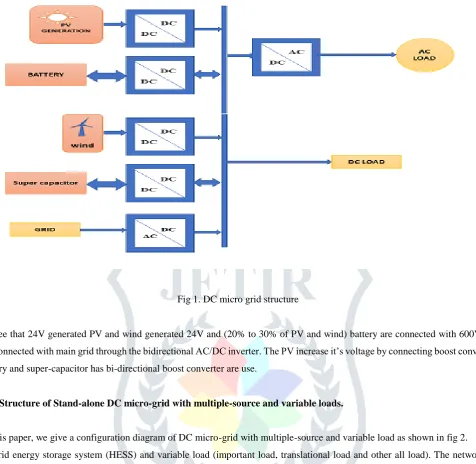
Fig 1. DC micro grid structure
We see that 24V generated PV and wind generated 24V and (20% to 30% of PV and wind) battery are connected with 600V DC
bus connected with main grid through the bidirectional AC/DC inverter. The PV increase it’s voltage by connecting boost converter.
Battery and super-capacitor has bi-directional boost converter are use.
A. Structure of Stand-alone DC micro-grid with multiple-source and variable loads.
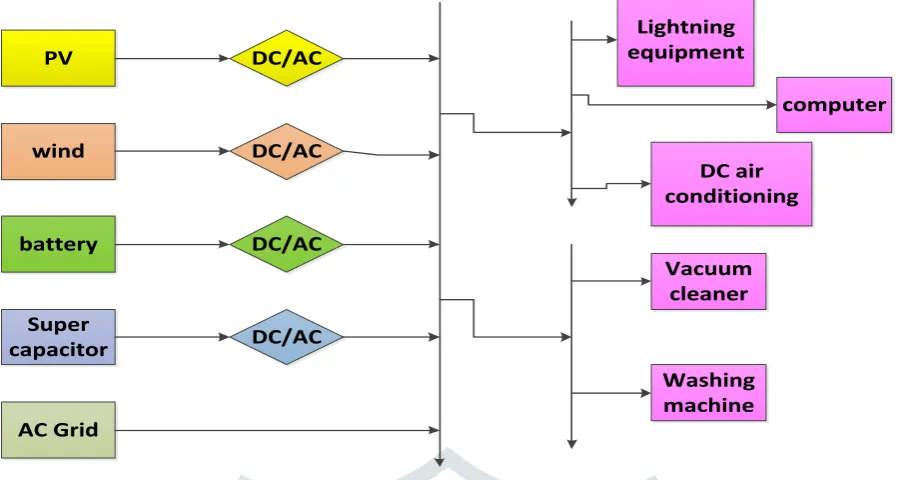
In this paper, we give a configuration diagram of DC micro-grid with multiple-source and variable load as shown in fig 2.
Hybrid energy storage system (HESS) and variable load (important load, translational load and other all load). The networking
with completely controllable battery and super capacitor can full use of PV and wind generation. Store excess energy and stabilize
power fluctuation. It is use to improve the stability of micro-grid operation and reliability of power supply. Grid connected system
composed of battery and super-capacitor can be connected to common DC bus via useful DC/DC converter. The DC bus can
directly supply power the DC load and indirectly supply power to the AC load through the DC/AC converter. Compared to AC
micro-grid, DC micro-grid is cheap. Based on this basic framework, we will simulate and optimize DC micro-grid system, also
AC Grid
Washing machine
Fig 2. Structure of stand-alone DC micro-grid with multiple source and variable load
2 ENERGY MANAGEMENT AND INTEGRATED CONTROL TECHNOLOGY.
A DC micro-grid system can operate both in grid connected mode and islanding mode. The system can take power from AC grid
when the DGs’ energy is surplus in addition to meeting the requirements of loads. If AC grid breaks down, the system can disconnect it. DGs and BSs can provide energy to loads at the same time. If the BSs’ energy is insufficient while DGs’ is sufficient. DGs can
translate power to BSs.
In liuguihua and li ming, 2013, is describe both modes grid connected mode and island mode management method [8]. In our
micro-grid which have PV and wind generation, battery and super-capacitor as a hybrid energy storage system (HESS) and AC micro-grid as a
source.
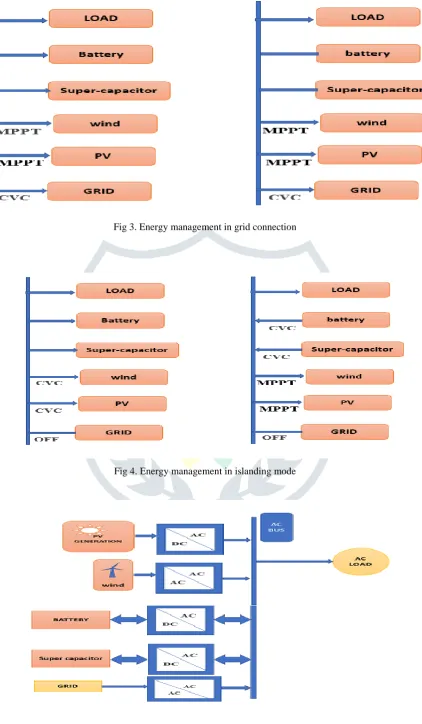
In grid connected mode, the DC bus voltage is controlled by the grid connected inverter/rectifier in CVC mode. DGs are always
running in MPPT mode. When the battery and super-capacitor are not sufficient to supply the load at time the rest power is charge
the battery and super-capacitor. When the battery and super-capacitor is able to supply to load and the not fully charged BSs and
SCSs (As shown in fig 3(a)), the rest energy sent to AC grid by grid connected inverter and BSs unit and SCSs are controlled at
discharging mode. If DGs’ energy is insufficient to supply to load and the BSs and SCSs is not fully charged (as show in fig 3(b)), the needed power is supplied by the rectifier from AC grid. If BSs’ and SCSs’ charging is completed, they should disconnect from
the DC bus as standbys for discharging when the DC micro-grid is working at is In islanding mode, the DC bus voltage is controlled
by the DGs or BSs or SCSs. The grid connected inverter/rectifier is always offline.
When the DG generating units operate at CVC mode and BSs need charging, the power balance among DGs. BSs and load should
Fig 3. Energy management in grid connection
Fig 4. Energy management in islanding mode
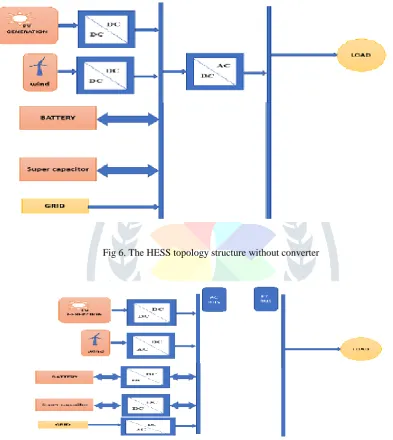
Fig 6. The HESS topology structure without converter
Fig 7. The HESS topology structure with converter
III.CONCLUSION:
DC Micro-grid structure, energy management, integrated control technology and hybrid energy storage system (HESS) are studied
and summarized in detail. in multiple source and variable load as well as its energy management and integrated control technology.
Lastly, we focus on hybrid energy storage system (HESS), specially, the HESS topology
REFERENCES
1. M. Singh,V.Khadkikar, A. Chandra,R. K. Varma, “Grid Interconnection of Renewable Energy Sources at the Distribution
2. K.D. Young, V.I. Utkin and U. Ozguner, “A control engineer's guide to sliding mode control”, IEEE transactions on control
systems technology, vol.7, no.3, pp.328-342, 199
3. M. A. Mahmud, H. R. Pota and M. J. Hossain, "Dynamic stability of three-phase grid-connected photovoltaic system
using zero dynamic design approach, "IEEE Journal of Photovoltaics, vol.2, no.4, pp. 564571, 2012.
4. X.H.Wu,S.K.Panda,andJ.X.Xu,“Analysis of the instantaneous power flow for three-phase PWM boost rectifier under
unbalanced supply voltage conditions”, IEEE Trans. Power Electron, vol. 23, no. 4, pp. 1679-1791, Jul. 2008.
5. Jie Zhang, “Simplified Variable band Hysteresis Current Control for Grid connected Inverter", IEEE Transactions on
power Delivery, Vol. 14,No. 3, July 2003.
6. Jos Rodriguez, Jorge Pontt, Csar A. Silva, Pablo Correa, Pablo Lezana, Patricio Cortes, and Ulrich Ammann. Predictive
current control of a voltage source inverter. Industrial Electronics, IEEE Transactions on, 54(1):495 –503, 2007.
7. H. Akagi, E. Watanabe, and M. Aredes. Instantaneous power theory and Applications to power conditioning. Wiley, 2007.
8. Swati sucharitapradhan, Member, IEEE, Raseswari Pradhan, Member, IEEE, “ Design of Sliding Mode Controller for
three phase Grid connected Photovoltaic System” In International Conference on Signal Processing Communication,
Power and Embedded System, IEEE, 2016.
9. Rutuja R. Patil, Member, IEEE and Prof. Suyog S. Hirve, Member, IEEE, “Space Vector Pulse Width Modulated Inverter
for Grid Coupled Photovoltaic System at Distribution Level”, In IEEE 2016.
10. M. A. Mahmud, Student Member, IEEE, H. R. Pota And M. J. Hussain, Member, IEEE, “Dynamic Stability of
Three-Phase Grid Connected Photovoltaic System Using Zero Dynamic Design Approach”, In IEEE journal of Photovoltaic,