1
Abstract—The PPP project is being implemented in the background of the rapid development of urbanization in China. However, it is difficult to balance the interests of both public and private sectors, which is an obstacle to the development of PPP projects. This paper classifies the equity structure of the PPP project by using the ownership concentration. And then it uses the theory of financial governance to analyze the impact of different equity structures on public and private interests in PPP projects. Next, it uses the cost savings to represent the public interest through a mathematical model. On the basis of satisfying the public interest, to satisfy the private sector's economic benefits by making the private sector not benefit less than the opportunity cost or the required remuneration, and finally the equity structure of the PPP project can balance the public and private interests. Finally, the model will be applied to a specific case which is proved to be practicable.This paper aims to reduce disputes between the public and private sectors in the PPP project and to protect the interests of both sectors, which makes the PPP project proceed smoothly.
Index Terms—PPP, equity structure, public and private interests, cost savings.
I. INTRODUCTION
China is in the rapid development of urbanization stage, the demand for infrastructure construction is very large. The public-private partnership model such as PPP project relieves the government's pressure on funding and gives opportunities to private sector’s development. At present, China's PPP project failure rate is high, there are many reasons, and one of the reasons is that the interests of the public sector and the private sector are not properly consistent [1]. Because public and private sectors demand for different interests, we need a reasonable equity structure to balance the interests of both public and private parties and improve the success rate of PPP projects.
Sheng Hetai, Wang Shouqing and Huang Shuo (2011) summed up the common types of PPP project shareholders based on the analysis of eight PPP projects, and pointed out that the government or the public sector can provide political and financial security for the project, but also bring the private sector the risk of loss of income [2]. Sun Hui, Fan Zhiqing and Shi Ye (2011) analyzed the influence of private sector’s price decision on that the government determines the optimal share of the private sector by means of game theory [3]. Yang Wen’an, Li Min (2015) suggested
Manuscript received July 10, 2017; revised March 12, 2018. This work was supported by the Fundamental Research Funds for the Central Universities under Project No.106112016CDJXY030003 and Chongqing Social Science Planning Project 2013PYGL28.
The authors are with the Chongqing University majoring in Technical Economy and Management, Chongqing China (e-mail: [email protected], [email protected], [email protected]).
that PPP project should reduce the government investment in condition that public sector is a relative shareholder, which can balance the power of the public and private sectors [4]. Jiang Chunxia and Zhou Guoguang (2016) takes the project cost as a criterion to establish an ownership structure model, compares the comprehensive cost of the PPP project with the traditional project, and obtains the proportion of the equity ratio of the social capital side [5]. Faruqi and Smit (1997) believed that if there are professional companies in PPP project’s shareholders, it can improve the operating efficiency [6]. Scharle (2002) pointed out that in the PPP project, the public sector represents the public interest, the private sector simply consider the company's risk interests [7]. Yescombe (2010) argued that short-term investors such as professional companies and long-term investors such as pure investors exist in an equity structure at the same time could reduce the cost of financing [8]. Deepak K. Sharma et al. (2010) argued that the public and private investors have different purposes in PPP project. When determining the equity structure, the public sector needs to be not only attractive to the private sector but also control the cost to protect their own interests [9].
From the perspective of research status, in the study of PPP project equity structure, the general goal is to minimize project costs or maximize the project income to determine the public or private ratio. This paper uses the cost savings formed by PPP model as the goal to construct the selection model of PPP project’s equity structure based on the balance of Public-Private interest and use the model to analyze a case.
II. THE INFLUENCE MECHANISM OF DIFFERENT
EQUITY STRUCTURE ON PUBLIC AND PRIVATE
INTERESTS IN PPPPROJECT
A. Classification of PPP Project’s Equity Structure
The equity structure of the PPP project is classified according to the special circumstances of PPP project and the ordinary company's equity structure.
According to the proportion of the largest shareholder, the PPP project equity structure is divided into two types: highly centralized equity structure and moderate centralized equity structure. Because there are not many types of shareholders in the PPP project, there is basically no decentralized equity structure [10]. Under the highly centralized equity structure, the equity structure is divided into two situations which are that public sector is the major shareholder and private sector is the major shareholder. The moderately centralized equity structure is a mixed type of public sector and private sector.
Study on Equity Structure of PPP Project Based on the
Balance of Public Private Interest
B. Influence Mechanism
The equity structure is the basis of the financial governance in PPP project companies. Through the financial governance ased on equity structure, to achieve the allocation of financial powers, and ultimately reflect the incentive and restraint roles of the financial governance. In the process, public and private interests are influenced.
Under the determined equity structure, through the allocation of shareholders to enjoy their own financial rights, the main purpose is to form the incentive and restraint mechanism within equity structure. , This mechanism can be understood as a mechanism about the balance of power, so as to achieve the balance of interests. In this mechanism about incentive and restraint methods, the usual incentive method is for small shareholders, the constraint method is for large shareholders.
1) The public sector is the major shareholder
The share of the private sector is small, so the benefits of private sector associated with the overall income of the
project are less relevant and lack incentives. The need for restraint is the public sector, which needs to be motivated is the private sector. The public sector should give the private sector some rewards that are positively related to project performance and strengthen the relevance of private sector earnings to the overall revenue of the project, which can motivate the private sector.
2) The private sector is the major shareholder
The private sector has a strong control over the PPP project, the public sector is a regulatory role. The private sector has been fully motivated by this equity structure, and the private sector needs more restraint to avoid its excessive pursuit of its own interests and disregard of social interests.
3) Both public and private sectors are main shareholders
The public sector needs to both constrain and motivate the private sector at the same time in order to reach a balance.
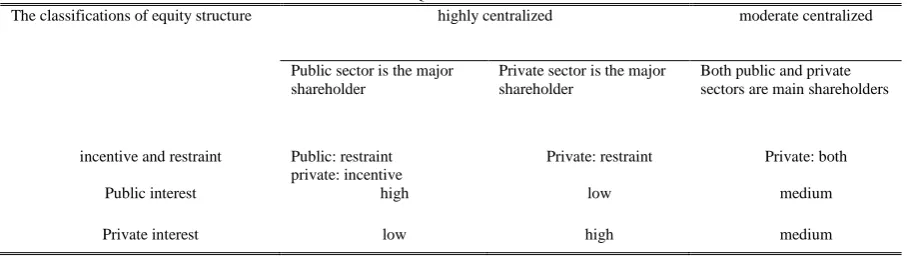
The Table I is the summary of the above analysis.
TABLE I: THE INFLUENCE MECHANISM OF DIFFERENT EQUITY STRUCTURE ON PUBLIC AND PRIVATE INTEREST IN PPPPROJECT
The classifications of equity structure highly centralized moderate centralized
Public sector is the major shareholder
Private sector is the major shareholder
Both public and private sectors are main shareholders
incentive and restraint Public: restraint private: incentive
Private: restraint Private: both Public interest high low medium Private interest low high medium
III. SELECTION MODEL OF PPPPROJECT’S EQUITY STRUCTURE
BASED ON THE BALANCE OF PUBLIC PRIVATE INTEREST
A. Public-Private Interest
The introduction of PPP projects in the area of infrastructure construction has largely relieved the public sector of financial pressure, at the right time, can also achieve higher productivity of the private sector. But at the same time, the private sector is mainly pursuing economic interests. Therefore, in the PPP project, in addition to the public interests, the economic interests can also influence the project. But the people who bear the economic interests of infrastructure projects are the social public users, which is contrary to the public interest. But the public sector can not over-suppress the interests of the private sector, because in the case of over-suppression, PPP project has lost the attractiveness for the private sector. In the absence of incentives, the private sector can’t play its own advantages in professional level, and even pursue short-term interests and ignore the overall interests of the project, thus undermining the public interest. So it can be seen in the PPP project, sometimes public and private interests are consistent, but sometimes conflict.
The PPP project provides a platform that integrates the advantages of the public sector in financing and the advantages of the private sector in high efficiency, which in
general reduces the total cost of the project. But the cost savings are based on the fact that the private sector has been motivated by the PPP project. Therefore, this paper will use PPP project’s cost savings compared with the traditional model to represent public interest, the greater the cost savings, indicating the greater public interests.
The economic benefits of the private sector are generally measured by indicators such as internal rate of return(IRR), net present value of the project(NPV), expected rate of return, and payback period. In order to ensure the interests of the private sector, the expected rate of return of private sector will be greater than the opportunity cost or the rate of return.
B. Some Assumptions of the Model
1)Assumption A
This model mainly discusses the PPP project’s construction and operation periods, the construction cost is mainly be put in the construction period, we use A to represent this initial input. The cost of operating period is divided into fixed cost and variable cost, fixed cost is amortization of A, the variable cost OM is the operation and maintenance cost of each period.
2)Assumption B
The financing cost of the public sector is lower than the private sector.
3)Assumption C
shareholding. K have to rise to a critical value, the private sector can be inspired to play their own technical and management advantages, improve their efficiency and save cost. In this paper, ε is the critical value , when k> ε, the PPP project can bring the cost savings.
4)Assumption D
In calculating the economic benefits of the private sector, the revenue used to deduct the cost are those that have been deducted from the principal and interest.
5)Assumption E
This paper does not consider the debt factor, so the initial investment A does not refer to the cost of the overall project input, but refers to the investment put by public and private sectors in the name of equity investment.
C.Build the Model
The following model notations are used in the remainder of this paper:
K = the private sector’s percentage of shareholding
T = the length of the operation period
A = the initial input by public and private sectors in the name of equity investment
F = the fixed cost in operating period
OM = the operation and maintenance cost in operating period
ε= the critical value that private sector can be inspired
S = if k> ε, OM=OM-S,S is the cost savings
V = regardless of whether the private sector can be motivated, V is always part of the OM
Rt = when time=t, the revenue deducted from the principal and interest
r = equity financing cost ratio
r1 = public sector’s financing cost rate r2 = private sector’s financing cost rate I = public and private sectors’ total inputs
r3 = the expected rate of return of private sector According to the assumptions, F is amortization of A,
A=F*1−(1+𝑟)−𝑡
𝑟 (1)
Since the duration of the PPP project is very long, so we assume that t ,so we can get
A= 𝐹𝑟 (2)
𝐹 = 𝐴 × 𝑟 (3)
According to assumption c,
𝑂𝑀 = 𝑆 + 𝑉(k≤ε) (4)
𝑂𝑀 = 𝑉 (k>ε) (5)
In the case of PPP projects, the total cost of equity investment put by the public and private sectors is:
IPPP = kF+OM
= kAr2 +(1-k)Ar1 +OM
(6)
If we use traditional model to build the infrastructure,
I traditional = Ar1 +OM
= Ar1 +S+V (7)
In this paper, we use cost savings to represent public interest, the ∆I is the cost savings,
∆I =I traditional – I ppp
=(Ar1+OM)-( kAr2+(1-k)Ar1 +OM) (8)
To satisfy the economic interest of private sector,
k (Rt-F-OM) ≥ r3 (9)
D.Analysis of the Model
In the above model, a model reflecting the public interest and economic interest is constructed. We will analyze the model combined with the classification of PPP project equity structure.
1)The public sector is the major shareholder
In the premise of that public sector is the major shareholder, we can judgment the k≤ε, in this kind of equity structure, the private can’t be motivated at all, at this time the project cost savings is limited,
IPPP =kAr2 +(1-k)Ar1 +OM
= kAr2 +(1-k)Ar1 +S+V (10) I traditional= Ar1 +S+V (11)
∆I = (Ar1 +S+V)-[kAr2 +(1-k)Ar1 +S+V]
= kA(r1 – r2 ) (12)
Because r1<r2, ∆I<0
The economic interest pursued by private sector, k
(Rt-F-OM), because k is low in this kind of equity structure, so we can judgment the economic interest in low.
In all, the overall cost savings from the private sector to the project isnot significant in this kind of equity structure, while the private sector's own economic interests are also low.
2)the private sector is the major shareholder
In this kind of equity structure, we can make sure that k>ε,
the private sector can be motivated,
IPPP= kAr2 +(1-k)Ar1 +OM
= kAr2 +(1-k)Ar1 +V (13) I traditional= Ar1 +S+V (14)
∆I = (Ar1 +S+V)- [kAr2 +(1-k)Ar1 +V]
= kA(r1 – r2 )+S
= S-kA(r2 - r1 ) (15)
If ∆I≤0, k≥ 𝑆
𝐴(r2−𝑟1), the public interest can’t be satisfied, so we don’t discuss this situation.
If ∆I>0, kA(r1 – r2 )+S > 0, k<
S
A(𝑟2−𝑟1), the public interest can be satisfied.
k>ε
K ,
k< 𝑆 𝐴(𝑟2−𝑟1)
from the two limitation factors, we can get 𝑆
𝐴(r2−𝑟1)≥ε (16)
k∈(ε,𝐴(𝑟2−𝑟1)𝑆 ) (17)
At this time,
∆I= S-kA(r2 - r1 ) (18)
So,
In the range of k, the greater the value of k is, the more favorable for private to maintain his or her own economic interests.
3)Both public and private sectors are main shareholders
In this kind of equity structure, we can’t determine the relationship between K and ε, so we have no idea whether private sector can be motivated. The classification is discussed below:
If k≤ε, we can refer to the situation that public sector is the major shareholder.
If k>ε, we can refer to the situation that private sector is the major shareholder.
IV. CASE STUDY
The case is a national road project, using PPP model to construct. The franchise period is 8 years, of which the construction period is 1.5 years and the operation period is 6.5 years. At the end of the franchise, the project is transferred to the government or its designated department. Because there are few charging mechanisms in the national road, the source of remuneration for the private sector is government subsidies. The entire project cycle is eight years, PPP project company end with the project.
The total capital of the PPP project is 300 million yuan. Among them: the registered capital is 100 million yuan, the city government invested 20 million yuan, occupying 20% in equity structure; Engineering Contracting Bureau invested 10 million, occupying 10% in equity structure; Industry fund invested 70 million, taking 70% in the equity structure. Both Engineering Contracting Bureau and Industry fund are belong to private sectors, so private sectors occupying 80% in equity structure.
The cost rate of public sector financing is 7.06%, while the private sector financing cost rate is 9%, and the private sector requires a rate of return of 12%. The fixed investment in the project during the operation period is 4.2 million yuan each year. According to the experts, the project saves 4.15 million yuan in operation period compared with the traditional model because of the introduction of social capital. From the investor's point of view, the total inflow cash after discounted is 50002 yuan, the total outflow cash after discounted is 36776 yuan.
According to the previous case background, you can get the parameters required in the following model:
A = 300 million
V = 4.2 million
K = 80%(k in unknown in the analysis below) r1 = 7.06%
r2 = 9%
t = 6.5 years
S = 4.15 million
r3 = 12%
All of the following calculations are in ten thousand
A=F*1−(1+𝑟)−𝑡
𝑟 (20)
F=A*1−(1+𝑟)𝑟 −𝑡 (21)
According to the above parameters, IPPP = kF+OM = kA* 𝑟2 1−(1+𝑟2)−𝑡+(1-k)A* r1 1−(1+𝑟1)−𝑡+OM = 400k+5900+OM (22)
I traditional = kF+OM = A* 𝑟1 1−(1+𝑟1)−𝑡+OM =6670 (23)
∆I = I traditional - Ippp = kA*( r1 1−(1+𝑟1)−𝑡− r2 1−(1+𝑟2)−𝑡)+S (24)
Since we are here to analyze the existence of cost savings in the equity structure, so the situation that public sector is the major shareholder could be excluded. In this case, from the production to operation, the main role is the private sector, the public sector is mainly from the early to ensure the smooth development of the project and later to ensure the realization of the interests of the private sector recovery, so in this case of PPP project, private sector can be adequately motivated. So we can refer that: k>ε, OM=V=420 (25)
∆I = I traditional – IPPP = 6670-(400k+5900+420) = -400k+350 (26)
In order to achieve the public interest, the cost savings ΔI must be greater than zero, ∆I > 0 (27)
k<87.5% (28)
k∈(ε,0.875) (29)
Calculate the revenue of the project based on the cash inflow and outflow from the investor's perspective, k*[(50002-36776)/36776]≥r3 (30)
k*[(50002-36776)/36776]≥12% (31)
k≥33.3% (32)
k∈(0.333, 0.875) (33)
because ∆I=-400k+350, when k=33.3%, ∆I can be maximized. At this time, ∆I= -400k+350 = -400*0.333+350 = 216.8 (34)
V. CONCLUSION
On the basis of relevant theories, this paper classifies the equity structure of PPP projects by using the concept of ownership concentration. Based on the theory of financial governance, we study the influence mechanism of different ownership structure on public and private interests in PPP project. And then establish a mathematical model of the selection of equity structure of PPP project based on the balance of interests between public and private. Through the above research, this paper has the following conclusions:
A. Conclusion 1
public and private sectors are the main shareholders.
B. Conclusion 2
In the situation that public sector is the major shareholder, the public sector needs to take additional incentives for the private sector to protect the economic interest of the private sector. In the situation that private sector is the major shareholder, the private sector is primarily constrained by the public sector, avoiding its excessive pursuit of economic interests and damaging the overall interests of the project. If the equity structure is under moderate centralized, the public sector is both motivating to ensure that the PPP project is attractive to the private sector and that the benefits of the private sector are justified by restraint.
C. Conclusion 3
This paper establishes a mathematical model for the selection of the equity structure of PPP projects based on the balance of public-private interests. The mathematical model can optimize the equity structure of PPP projects and satisfy the interests of both public and private parties.
REFERENCES
[1] Z. Yang, “Study on the present situation and challenges of public-private partnership model (PPP) in China,” Time Finance, vol. 2, pp.109-112, 2016.
[2] S. H. Tai, W. S. Qing, and H. Shuo, “PPP project company's equity structure and its application in a pension project,” Journal of
Engineering Management, vol. 4, pp. 388-392, 2011.
[3] S. Hui, F. Z. Qing, and S. Ye, “Study on optimal equity structure of expressway project under PPP mode,” Journal of Management
Engineering, vol. 1, pp. 154-156, 2011.
[4] Y. W. An and L. Min, “Study on equity structure allocation of PPP project in urban rail transit,” West China Communications Science
and Technology, vol. 12, pp. 94-98, 2015.
[5] J. C. Xia and Z. G. Guang, “Study on preparation and application of PPP project ownership structure model,” .Journal of Finance and
Economics, vol. 4, pp. 140-143, 2016.
[6] S. Faruqi and S. N. J. Karachi, “Light rail transit: A private finance proposal,” Journal of Engineering, Construction and Architecture
Management, vol. 3, no. 4, pp. 233-246, 1997.
[7] P. Scharle, “Public-private partnership(PPP) as a social game,”
Innovation: The European Journal of Social Science Research, vol. 3,
no. 15, pp. 227-252, 2002.
[8] E. R. Yescombe and J. C. Wang, “Project of finance and principles (project of finance),” Beijing: Tsinghua University Press, 2010. [9] D. K. Sharma, Q. B. Cui, and L. J. Chen, “ Balancing private and
public interests in public private partnership contracts through optimization of equity capital structure,” Journal of the
Transportation Research Board, no.1, pp. 60-66,2010.
[10] C. Fan, “Study on PPP project governance mechanism based on contract relationship,” Central South University, 2010.
You Siqi was born in 1995, in China. Her majored in financial management in the past 4 years. In Jun. 2017, she has just obtained her bachelor of management degree from School of Construction Management and Real Estate of Chongqing University, which is one of the best universities in China. Moreover, she will continue to pursue her master’s degree in Chongqing University to study the equity structure of PPP (public-private partnership).
During her life of undergraduate, she has been a financial intern in a real estate company. In addition, she did some research about equity structure of ordinary companies, which is good for her future research in PPP’s equity structure.
Ms. You has obtained some awards during her life of undergraduate: Prize of Comprehensive Scholarship three times, Outstanding Graduates of Chongqing University, etc.
Hou Wenhua obtained her master’s degree from School of Construction Management and Real Estate of Chongqing University in Dec. 2001, and got her doctorate from School of Economics and Business Administration of Chongqing University in Dec. 2012. She mainly studies on public project investment and financing.
She is the deputy director of Financial Management of Chongqing University, and she is one of the Journal of Cleaner Production (SCI) Reviewers. She has published some articles such as “W. H. Hou, X. Liu, and D. Q. Chen, “Finance-based scheduling for construction project in China with improved genetic algorithms,” Journal of Convergence
Information Technology, 2012, vol. 7”
Associate Prof. Hou, in 2010, "to enhance the city land reserve performance research" won the "Chongqing Development Research Award" third prize, In 2012, she was one of the Chongqing University advanced workers.
Zhang Yuqing is now a post graduate in the School of Construction Management and Real Estate of Chongqing University, which is one of the best universities in China. Ms. Zhang majored in financial management and minored in English during her college life; and now she majors in the Technical and Financial Management and focuses on the issues about PPP (public-private partnership).