Journal of Education Culture and Society No. 1_2018
173
The project of the self-assessment
descriptors for Czech as a second
language
Kateřina Šormová
Charles University,
Institute of Czech Language and Theory of Communication, Faculty of Arts nám. Jana Palacha 2, 116 38 Prague 1, Czech Republic
E-mail address: [email protected]
Abstract
Aim. The aim of the research is to evaluate the set of the self-assessment descriptors for Czech as a second language.
Methods. The subject of the study were 753 descriptors evaluated by 50 teachers and 640 students. They are analysed with the application od questionaires and con-trolled interviews. Pilot project tested the methodology to estabilish the difÞ culty level of descriptors and the ability level of learners.
Results. The analysis shows that some of the descriptors need to be reduced and some of them reformulated.
Conclusion. The analysis shows that many teachers are not sufÞ ciently informed on Czech as a second language, they evaluate the descriptors from the perspective of a for-eign language. Another Þ nding is the inexperience of many teachers with the language levels following the CEFR; they label words or grammatical elements as an inappropri-ate level, but their estiminappropri-ate is very often incorrect. The teachers mark sayings, proverbs and idioms as the most problematic. The students are often able to express the given meaning, but they are shy to speak in a foreign language.
Key words: Czech as a second language, self-assessment, descriptor, pilot study, CEFR
The issue of self-assessment is not yet an automatic part of language teaching. One of the pioneering projects in this area is the European Language Portfolio, which consists of three parts (Language Passport, Language Biogra-phy and Dossier). Part of the Language BiograBiogra-phy are self-assessment descrip-tors that continually record the student’s progress in that language.
better academic performance, helping them in development of critical skills for analysis of their own work.”
In our article, we will introduce a project for the creation of self-assessment descriptors for Czech as a second language, which is being developed by the National Institute of Education in Prague.
The issue of Czech as a second language
The self-assessment descriptors of the European Language Portfolio are suitable for the students who study a given language as a foreign language, but the situation of the users of Czech as a second language is different. The Czech Statistical OfÞ ce (The Czech Statistical OfÞ ce) states that in 2016, 493,000
foreigners lived in the CR based on permanent or long-term residence. In the school year 2015/2016, more than 86,000 foreigners studied at all types of scho-ols, of which more than 18,000 at basic schools (primary education) and more than 42,000 at higher education institutes. As Janovec and Rangelová state (Jano-vec, & Rangelová, 2006) the broadly conceived integration process includes a number of social, economic, general-cultural and psychological factors. From the perspective of linguistics, acquisition of the majority language seems to be the most important process, implying the achievement of a certain linguistic com-petence allowing the individual a successful realisation in the foreign-language milieu. In this process, a certain speciÞ c form of bilingualism is achieved in a
relatively short time, which is characterized by an imbalance of the knowledge of Czech in its function-style stratiÞ cation: the spoken language has the primary
position, the degree of acquisition of written Czech is negligible with almost half of the respondents and the vast majority speak of linguistic difÞ culties in ofÞ
-cial relations, espe-cially in written speeches (Janovec, & Rangelová, 2006). These foreigners have Czech in the position of not a foreign but a second language. The position of a second language is predominantly given by its importance in the life of a person; it is a language on which the user is existentially dependent. In children, it is the language of integration into school attendance; in adults it is the language that makes it possible to integrate into the social majority, so it is the language that is necessary for working in a given society.
The specific nature of the acquisition of Czech
as a second language
lingu-istic functions (greetings, thanking, a request…). In the Þ rst phase, instruction
of speaking and listening prevails over the instruction of reading and writing and the instruction of the basic lexis over the instruction of grammar.
Self-assessment in the didactics of a language
One of the important aspects in learning a foreign language is the ability of self-assessment. In the case of school instruction, self-assessment should become an integral component of teaching, where it should be a part of further discussion and work in class. It should be complemented by the assessment of the teacher or lecturer. Self-assessment helps pupils/students to become aware of their strengths and weaknesses and to regulate their further learning in an appropriate way. The evaluation of the teachers has a control importance for the pupil/student; it can also be motivational. The self-assessment descriptors encompass the descriptors of the speciÞ c skills which correspond to a givenlevel according to the CEFR. The descriptors form a uniform scale and are for-mulated clearly, concisely and positively (the goal is to name what the student knows how to do, not what he/she does not know how to do). The self-asses-sment descriptors can be used in various ways. Primarily for monitoring what advancements a given student is making in his/her study, but secondarily also for setting the teaching goals for the entire class and for harmonizing work with the textbook and with the European Language Portfolio (ELP).
The notion of the creation of the descriptors
1. The project lasted from June 2016 to January 2018. The creation of the descriptors was divided into four phases:a. analysis of existing descriptors from the ELP and other foreign projects, b. reformulation of existing descriptors and creation of new descriptors
with respect to the users of Czech as the second language, c. piloting of the descriptors,
d. processing the results of the piloting and Þ nal formulation of the descriptors.
In the initial analysis of the descriptors, three sources were mainly used (1) the existing general descriptors from the ELP, (2) the reference description of the Czech language for the purposes of the examination for permanent resi-dency, and (3) foreign portfolios and projects.
For the creation of new descriptors, four age categories and four levels of advancement were established (Table 1).
Table 1. Age categories.
Source: Author’s own work.
Each descriptor consists of four parts – the label of the level and skill, the body of the descriptor, the example and the options of the opportunities for self-assessment (Table 2).
Table 2. Composition of the descriptor.
Source: Author’s own work.
The descriptors vary not only by age but also by the language level for which they are intended. The descriptors for the age category 15-19 years are depicted in the table (Table 3).
Language level up to age 11 A1, A2, B1 11–15 years A1, A2, B1 15–19 years A1, A2, B1, B2 19+ years A1, A2, B1, B2 Age category
children
adults
Language level up to age 11 A1, A2, B1 11–15 years A1, A2, B1 15–19 years A1, A2, B1, B2 19+ years A1, A2, B1, B2 Age category
children
adults
Writing A1
I understand what I have to write in the form.
Name, surname, residential address, employment.
Yes. A little. Not yet.
Reading B1
I undertsand the texts, which describe the method (how to do something) in textbooks.
How I am to calculate the example. How I am to prepare a project for an hour of English.
Table 3. Descriptors for the age category 15-19 years.
Source: Author’s own work.
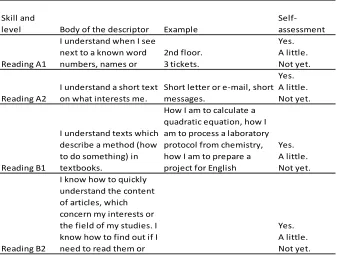
In the individual skills, three types of descriptors appear, descriptors aimed at general skills, specialized descriptors (focused on the school or work milieu) and compensation strategy. An example of the compensation strategies is pro-vided in the subsequent table (Table 4).
Table 4. Compensation strategies.
Source: Author’s own work. Skill and
level Body of the descriptor Example
Self-assessment
Reading A1
I understand when I see next to a known word numbers, names or
2nd floor. 3 tickets. Yes. A little. Not yet. Reading A2
I understand a short text on what interests me.
Short letter or e-mail, short messages.
Yes. A little. Not yet.
Reading B1
I understand texts which describe a method (how to do something) in textbooks.
How I am to calculate a quadratic equation, how I am to process a laboratory protocol from chemistry, how I am to prepare a project for English
Yes. A little. Not yet.
Reading B2
I know how to quickly understand the content of articles, which concern my interests or the field of my studies. I know how to find out if I need to read them or
Yes. A little. Not yet.
Skill and level Body of the descriptor Self-assessment
Reading B1
I know how to underline the parts in the text that I do not understand.
Yes. A little. Not yet.
Writing A1
When I write, I use previously learned phases or a dictionary.
Yes. A little. Not yet.
Speaking A1
I know how to say that I need something repeated.
Yes. A little. Not yet.
Listening B2
When listenings are hard for me, I focus on the main points.
2. The notion of the piloting of the descriptors
The piloting of the descriptors took place from September to December 2017 and was done in order to verify the formulations of the descriptors and their comprehensibility for the target group. The piloting had two phases – in the Þ rst phase a language diagnostic was conducted, on the basis of which
the language level of the engaged foreigners was set; in the second phase the descriptors were tested; this testing took place in cooperation with the teachers. The aim of the piloting was to verify (1) whether the descriptors correspond to the given language level and (2) whether the descriptors are comprehensible for the individual language levels and whether they reß ect the life reality of the
target group.
The questionnaires were broken down by age and language level, students
Þ lled in their questionnaires in each class, and the teacher Þ lled in a
question-naire based on the observation of the students and based on their own peda-gogical experience. The teachers also Þ lled in their own commentaries in the
questionnaire, which were the most important result of the piloting.
3. Research design
The selection of the sample took place using a stratiÞ ed sampling; pupils
and teachers from primary, secondary and tertiary schools were included in the piloting and also language schools were included.
Children and adults for whom Czech is a second language fell into the selec-ted sample of foreigners; for instance, Roma or Slovaks did not fall into our target group because the process of accepting Czech is usually different with them. In the case of the Slovaks, the kinship of the languages is so close that it would have inß uenced the piloting, in the case of the Roma it can be justiÞ ably assumed that
they usually speak a Roma ethnolect of Czech, which bears the structural
speci-Þ city of Slovak, Roma and Hungarian. For them, Czech is not usually a second
language but a Þ rst. Pupils from the 3rd Form (inclusively), hence from age 9,
with whom elementary literacy is already developed and who know how to read and write in the Latin alphabet, were included in the piloting.
A total of 35 schools and more than 50 teachers were involved in the piloting, who were responsible for testing the pupils and then evaluation of the question-naires with the descriptors. The total number of pupils tested was greater than 640. In Table 5, we see the distribution of the number of students at individual levels. According to our expectation, it was conÞ rmed that the low language
levels of A2 and A1 are also prevalent in the low age category (up to age 11). It is caused by two factors; the Þ rst is the short time of their stay in the Czech
Repu-blic, the second is the level of the cognitive abilities of children in the given age (a child at age 10 cannot read at level B2 even in their mother tongue, because they do not have a sufÞ cient level of developed reading skills), but level A2
Table 5. Number of descriptors
Source: Author’s own work.
4. The results of the piloting and the conclusions
The total number of the tested descriptors was 753, its division according to skills is shown in Table 6. The speaking skill shows a distinctly higher number of descriptors, which is caused by the fact that speaking has two more subcat-egories – the Þ rst aimed at independent oral speech and the second aimed at
oral interaction with a communication partner.
Table 6. Distribution of descrip tors
A1 A2 B1 B2
reading 46 44 38 18
writing 53 49 45 27
listening 58 56 56 23
speaking 72 64 62 42
Source: Author’s own work.
The goal is to Þ nish processing approximately half of the piloted
descrip-tors into their Þ nal form and publish them on our website. At the time of the
writing of this article, the results of the piloting were still not deÞ nitively
eva-luated; despite that, we can in this phase observe several tendencies.
a. Most commentaries by the teachers (approximately 70 %) monitor the language level, especially on the lexical level. It shows that many teachers are not sufÞ ciently informed in Czech as a second language,
they evaluate the descriptors from the perspective of a foreign langu-age. The vocabulary of a second language is distinctly deeper and more speciÞ c than that of a foreign language, specialised phrases from many
areas appear (health condition, communication with ofÞ ces,
communi-cation with the school, social life).
b. Some commentaries of the teachers suggest the use of synonymous phrases, thanks to which the formulations of the descriptors will be simpler and clearer.
c. Another Þ nding is the inexperience of many teachers with the language
levels following the CEFR; they label words or grammatical elements at an inappropriate level, but their estimate is very often incorrect. d. The teachers marked the descriptors which contain facts not related with
the life experiences of their students (e.g. young students who are still studying do not have experience from a work environment). An intere-sting and repeated Þ nding is the fact that students do not use dictionaries.
A1 A2 B1 B2
to age 11 26 47 2
11-15 years 8 21 37
15-19 years 40 71 44 51
e. In several cases, the teachers describe that the descriptors are similar in meaning and thus are duplicated.
f. Some examples are evaluated as misleading and recommended for reformulation.
g. The teachers mark sayings, proverbs and idioms as the most problematic.
h. An interesting comment is that students are often able to express the given meaning, but they are too shy to speak in a foreign language. i. The teachers consistently state that there is usually a signiÞ cant
diffe-rence between the level reached in listening versus speaking, as well as reading versus writing.
References
1. Brychová, A., Janíková, V., & Sladkovská, K. (2012). Evropské jazykové portfolio v praxi [The European Language Portfolio in Practice]. Praha: NÚV. Retrieved from: http://elp.ecml.at/ LinkClick.aspx?Þ leticket=aKwqQUzIr8s%3D&tabid=2844&language=en-GB.
2. Cvejnová, J. (Ed.). (2016). ReferenĀní popis Āeštiny pro úĀely zkoušky z Āeského jazyka pro trvalý pobyt v ÿR - úrovnď A1, A2 [Reference description of Czech for the purposes of the exami-nation of the Czech language for permanent residence in the CR - Levels A1, A2]. Praha: Národní ústav pro vzdďlávání. Retrieved from: http://www.nuv.cz/uploads/Publikace/ referencni_popis_08122016.pdf.
3. Janovec, L., & Rangelová, A. (2006). Language integration of members of minorities. Lidé mďsta, (8)1, 140–156. Retrieved from: http://lidemesta.cz/archiv/cisla/8-2006-1/recova-inte-grace-prislusniku-minorit.html.
4. Little, D., & Perclová, R. (2001). European Language Portfolio. Guide for Teachers and Teacher Tra-iners. [European Language Portfolio. Guide for Teachers and Teacher Trainers]. Strasbourg: Council of Europe, Modern Languages Division.
5. Sharma R., Jain A., Gupta N., Garg S., Batta M., & Dhir Shashi K. (2016). Impact of self-asses-sment by students on their learning. International Journal of Applied and Basic Medical Research, (6) 3, 226–229.
6. SpoleĀný evropský referenĀní rámec pro jazyky – jak se uĀíme jazykĪm, jak je vyuĀujeme a jak v jazy-cích hodnotíme [Common European Framework of Reference for Languages, how we teach them and how we evaluate them in languages]. (2002). Olomouc: Univerzita Palackého. 7. The Czech Statistical OfÞ ce. Data – poĀet cizincĪ. Retrieved December 9, 2017, from https://