87
INTERACTIVE LEARNING MODELLS
OF THE E-LEARNING IN THE HIGHER
EDUCATION
Lenke Tóthné Parázsó Eszterházy Károly College, Eger, Hungary E-mail: [email protected]
Abstract
The nature of the interactive teaching learning process is approached from various perspectives. First, I will talk about the nature of multimodel interactions in the eLearning teaching learning processes with system-atic approach. Second, I would like to present the effi ciency of using the Interactive Study System. • Third, the structured, programmed features of on-line educational materials, the visualisation of media elements, the simulation, the possibilities of testing and improving effi ciency offers the introduction and application of modern electronic examination methods.
Key words: e-learning, interactive teaching material, interactional level, problem-solving thinking, cognitive skill, individual learning situation.
Introduction
In the traditional instructional methods the multimedia computer as an “intelligent teaching tool” yields a more effective elaboration of the learning material by providing proper material and mental backgrounds. The need for a high-level expertise gradually lays stress upon the fl exible teach-ing process, which develops problem-solvteach-ing abilities. The pictures complete the written words, the diagrams give possibilities for setting all of those in front of us which the worldly description could present only with a whole series of statements. The rapid changes in the attitudes of our pres-ent world, in agreempres-ent with the previous assumption and due to technical changes, accelerated the development of the decentered independent teaching forms, subverting the monopoly of traditional education. The emphasis on knowledge communication is removed to developing the basic abilities, attitudes and competence. Studying the computer solutions helps the students have a profound insight in the given problem, improves their decisive abilities and takes them nearer to the fi nal, problem solving thinking in the given situation.
Theoretical refl ections and consequences
88 Table 1. The student-content interactions of the traditional education.
Level Student-content interaction
1 Passive, one-way: the teacher’s one-way contact with the students, in which the students passive interaction is typical. (frontal teaching learning process).
2 Active, two-way: in the course of student research and simulated actions the user may manipulate the object in order to achieve his goals, i.e. the student proceeds on the pre-determined elaboration path.
3 Simulation, problem-solving objective: the student elaborates the range of exercises and the research movements in an optional order (group or individual teaching learning process).
4 Operations in the microworld: the student has the possibility to work in the intelligent tutorial program, where he gets into a constructive context with the microworld of the environment.
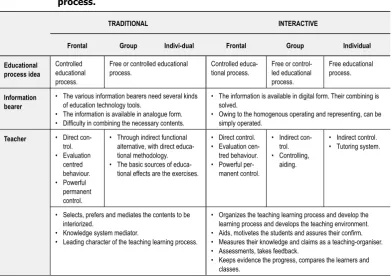
The computer aided communication created new interaction possibilities. Interactive teaching learning is built on continuous communication and co-operation, during which the roles of the teacher and the student are altered in the process. The student’s activity grows, the role of the teacher becomes latent. Creating the adequate study environment achieved an eminent role, and is determined by the mediums and the attitudes to them in space and time, which effects the teacher-student relationship. The elements and pedagogical characteristics of the traditional and the interactive teaching-leaning process are summarised in Table 2.
Comparative chart
Table 2. Comparative table of the traditional and interactive teaching learning process.
TRADITIONAL INTERACTIVE
Frontal Group Indivi-dual Frontal Group Individual
Educational process idea
Controlled educational process.
Free or controlled educational process.
Controlled educa-tional process.
Free or control-led educational process. Free educational process. Information bearer
The various information bearers need several kinds •
of education technology tools.
The information is available in analogue form. •
Diffi culty in combining the necessary contents. •
The information is available in digital form. Their combining is •
solved.
Owing to the homogenous operating and representing, can be •
simply operated.
Teacher • Direct con-trol. Evaluation • centred behaviour. Powerful • permanent control.
Through indirect functional •
alternative, with direct educa-tional methodology. The basic sources of educa-•
tional effects are the exercises.
Direct control. • Evaluation cen-• tred behaviour. Powerful per-• manent control. Indirect con-• trol. Controlling, • aiding. Indirect control. • Tutoring system. •
Selects, prefers and mediates the contents to be •
interiorized.
Knowledge system mediator. •
Leading character of the teaching learning process. •
Organizes the teaching learning process and develop the •
learning process and develops the teaching environment. Aids, motivetes the students and assures their confi rm. •
Measures their knowledge and claims as a teaching-organiser. •
Assessments, takes feedback. •
Keeps evidence the progress, compares the learners and •
89
TRADITIONAL INTERACTIVE
Frontal Group Indivi-dual Frontal Group Individual
Student • Passive re-ceptor. Relationship •
among stu-dents is loose.
Active receptor. •
Loose relationship among •
groups, but members are dependent on each other and division of labour is typical.
Passive recep-• tor. Relationship • among students is loose. Active recep-• tor. Loose relation-• ship among groups, but members are dependent on each other and division of labour is typical.
Active receptor. •
Seeking help from •
each other, dis-cussing matters. The student •
programs. He himself sets •
the working envi-ronment. May prepare a •
program for a given matter. Teacher-student inter-action Synchronous. Synchro-nous, Asynchro-nous.
Asynchronous. Synchronous. Synchronous, Asynchronous.
Asynchronous.
Environment System mediator. System establisher. Situational studying.
Situational, system mediator.
Situational studying environment.
Motivation Sanctions. Demotivating, frustrating, dis-couraging effects.
With ceasing of compulsory character, students identify them-selves with constructive function forms.
Employing and connecting stu-dents` needs in the functional system.
Compulsory char-acteristics. Connecting in stu-dent’s functional system.
Employing and applying students` needs. No compulsory character.
Creative function solving possibility.
Teaching material
According to syl-labus, presented by the teacher.
Problem solving, experiment, knowledge mediated by simula-tion.
Digitally elaborated medium of the teacher.
Drill and practice. Tutorial aid.
Multimedia dialogue system. Management.
Effectively • Corrects written faults of indirect effects. Save students • from making errors.
Indirect training process is ef-fective:
In independence, •
In self-managing ability, i.e. in •
developing autonomy. They learn from their errors. •
Owing to direct type of controlling, serves demonstra-tive aims, low effectiveness.
Effective in situational learning: Independence.
•
Elaboration of directing, self-•
controlling ability. They learn from their errors. •
Continuation of research activities. •
Problems Overregulat-ing and strong bondage has demotivating ef-fects. Decreases effectiveness.
Students are not under strong teacher regulation, therefore this does not always s result in reinforcing incentives or attitude forms.
Regulation and strong bondage has demotivating effects.
There is a •
big danger of deferring. Teacher’s • corresponding pressure has no effect. Students feel • isolated; their self-picture is insecure. On virtual semi-•
nars students did not carry out the task in time. Students did not •
feel the pressure of achievement.
Evaluation Selective evalu-ation.
There is no selective evaluation system.
Selective evalu-ation.
Project type evaluation. •
Portfolio. •
Evaluation is orientation and not cor-•
rection.
Role of me-dium Illustration. Teaching aids for group experi-ments and task solving. Sequencing • workout of teaching material. Self-control, • practice. Teacher’s demon-stration.
Presents the teaching material, asks •
questions. Evaluates responses. •
Provides new material or exercises •
90 The typical classroom, where teacher and students are at the same place and time together, the relationship of teacher and students is synchronous. The students take part in the training course frontally, in-groups or individually. The planner of the teaching learning process, i.e. the teacher’s relationship with the students loosens from frontal teaching towards the dominance of the individual elaborating of teaching material. In the latter case the teacher and student does not operate with each other directly, the communication is asynchronous. According to Salomon’s (1999) view, the work done by computer technology tools is under students’ control in the fi rst place, and not the teachers’, particularly when it is in group work. Application of computers makes learning possible to turn into an active, constructive process directed by students. The researchers of Newcastle university (Kibby, 2000) pointed out that the instructor role stimulates or keeps up students’ attention, organizes the learning process, presents information, evaluates the students and provides advising: supports and encourages. The teachers’ role is to weigh during the planning of on-line teaching learning process which method of communicating teaching material will be the most suitable, and which stage of knowledge should the students acquire with the help of the computer. The teacher has to notice the silent and unwilling students and help them through diffi culties. Tuovinen (2000) emphasized that where the teacher does not meet the students in person, he plays a very important role in the inter-action-taking place between them. The interaction between student and teaching material is always synchronised, but the frequent time delay in the teacher-student interaction may cause complica-tions. Generally the more the feedback is overdue, the less effective the education is. According to theoretical researches the asynchronous information exchange is less desirable. Thought in everyday practice, delays resulting from the characteristics of today’s communication techniques, for example, (e-mail, newsgroups) may have certain advantages. In case of complex tasks the participants have enough time to understand and elaborate the problem and compose the response. Therefore during planning and application of the medium the synchronous and asynchronous interaction possibilities must be applied in consciousness in order to increase effi ciency. Analysing the interactive strategies, two interaction levels resulted in the following theoretical consideration.
Table 3. Interactions of the student-content in interactive education (an extended variable of Tuovinen’s chart).
Level Student multimedia interaction
1 Passive, two-way control. The students are condemned to have passive interaction and may infl uence the learning process in only a small part of the multimedia.
2 Students can proceed in multimedia according to hierarchical choices.
3 Up-to-date control of information: certain information in the program can be updated by the programmer.
4 Construction with components: the user can manipulate the objects to reach his goals.
5 Taking part in simulation: the user carries out a simulated operation in digital environment.
6 The programmer provides hypermedia links for the sources of information, among which the user can navigate at will.
7 With operation in the microworld, it is becoming possible for the student to work in an intelligent, task orientated program, experiencing the microworld of the actual digital environment.
91
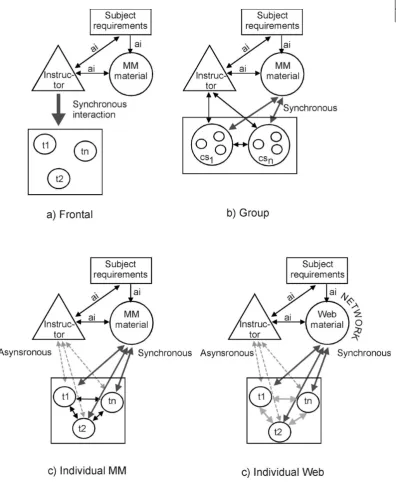
Figure 1. Models of interactive teaching learning process.
In the Media Information Institute of Karoly Eszterhazy College continuous development can be discovered, which still goes on at an accelerated pace. With modernising the contents of the training and increasing the number of students, the claims are getting higher, and simultaneously the time may be spent on a given teaching unit is diminishing. The task can be realised with the applying modern communication technical possibilities. One intention of the examination is: how to make the marketable high-level
92 The examination was carried out in fi ve groups. In the control group the traditional class work was achieved together with the possibility of individual simulated practice. All students cold take part in this examination who put himself down for the “Photo techniques in education” course. Grouping the students was made by adapting to their individual timetable. The groups were usually consisted of students majoring in different subjects.
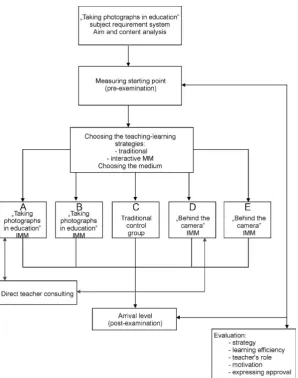
The examination happened with traditional and interactive teaching methods in accordance with the process designated in fi gure 1. During preparation, according to syllabus requirements, accurate subject material analysis was done by taking the applied medium into consideration.
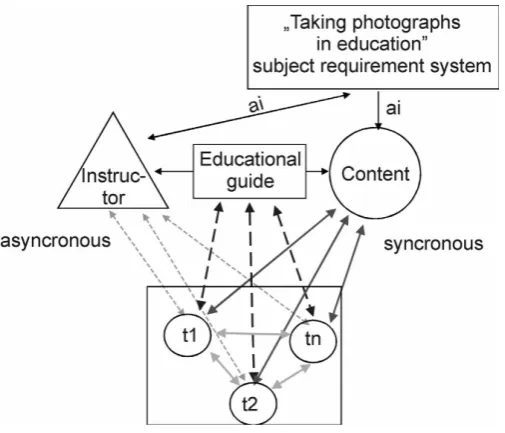
In traditional class work, according to ‘Taking photos in education’ course, students acquired the appropriate content categories on the given intellectual system with the help of electronic pre-sentation (OHP, VCR) and demonstrative cameras. In the case of the interactive individual teach-ing learnteach-ing process the students cold examine the two interactive educational software through the server of EKC in the IMM computer room either with or without the possibility of consulting an instructor (The “Behind the Camera” and “Taking photos with normal camera”).
Since the sequences of the applied multimedia instruction software are not programmed in respect, of education and not differentiated according to the starting knowledge, the students. Were aided with a study guide in the proposed sequence of the process. The questions arising and await-ing for a response durawait-ing the examination: how does the structure of the IMM material infl uence the applied strategy? How can the individual teaching strategy be carried through in educating great numbers?
The illustration below demonstrates the interactive relationships during the examination:
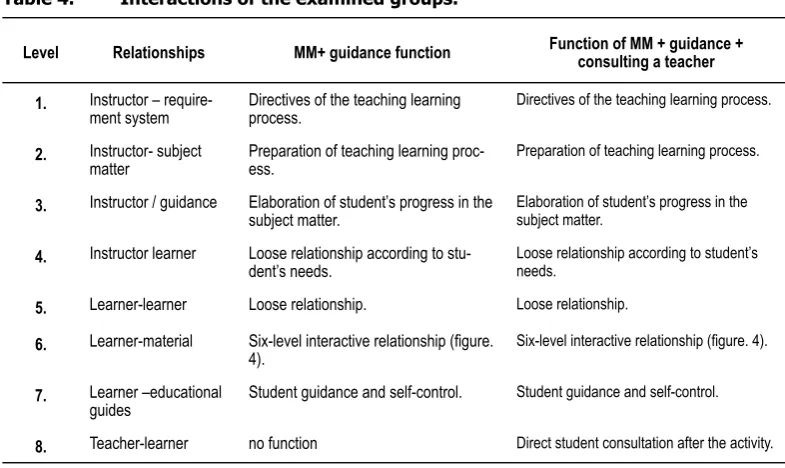
93 The interactive levels of the applied interactive strategies:
Table 4. Interactions of the examined groups.
Level Relationships MM+ guidance function Function of MM + guidance + consulting a teacher
1. Instructor –
require-ment system Directives of the teaching learning process. Directives of the teaching learning process.
2. Instructor- subject
matter Preparation of teaching learning proc-ess. Preparation of teaching learning process.
3. Instructor / guidance Elaboration of student’s progress in the
subject matter. Elaboration of student’s progress in the subject matter.
4. Instructor learner Loose relationship according to
stu-dent’s needs. Loose relationship according to student’s needs.
5. Learner-learner Loose relationship. Loose relationship.
6. Learner-material Six-level interactive relationship (fi gure.
4). Six-level interactive relationship (fi gure. 4).
7. Learner –educational
guides Student guidance and self-control. Student guidance and self-control.
8. Teacher-learner no function Direct student consultation after the activity.
I would like to observe in addition that the functions of the instructor-student and teacher-student are not the same, because according to the principles of the traditional strategy, the relationship be-tween teacher and student clears up the content parts of the study material and organizes them with applying demonstrative components if needed.
Table 5. Division of students according to their branches.
N %
Humane branches 24 24,7
Language branches 39 40,3
Science branches except biology 14 14,4
Branches with biology 20 20,6
Total 97 100
94
Figure 3. The process table of examination.
In traditional class work, according to ‘Taking photos in education’ course, students acquired the appropriate content categories on the given intellectual system with the help of electronic presentation (OHP, VCR) and demonstrative cameras. In the case of the interactive individual teaching learning process the students cold examine the two interactive educational software through the server of EKF in the IMM computer room either with or without the possibility of consulting an instructor. The results of the groups taken in the table 6.
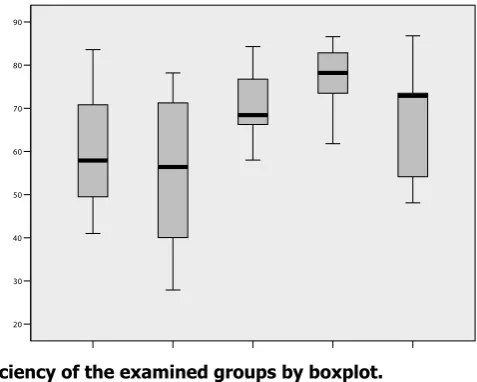
95 The Figure 4 demonstrates the results of the 5 investigated groups according to effi ciency:
90
80
70
60
50
40
30
20
Figure 4. Effi ciency of the examined groups by boxplot.
The box-plot curve illustrates the interquartile range of groups considered effective by the students, the minimum and maximum attitude results are also shown on the media line. (Figure 3) It is clear that several methods combined and applied together ( Traditional “a” and”b”, control group “c”, with the IMM “d” and “e”) resulted in symmetrical division among the students. The assymetric dispersion of the curve shows that this type of evaluation is the most favourable one among the students older than twenty-eight years of age. Computer supported evaluation is a characteristic answer variant over the age of twenty-six, and its assymetric dispersion is moving towards the older age group.
Results, consequences
The interactive teaching materials can only be applied effi ciently if carefully prepared. In case the route of IMM is not programmed, it is suitable for training only with a guide. Beyond the sequence of elaboration, the study guide should contain self-controlling questions, exercises with solutions and feedback guidance. Adding emphasized facts, concepts and contexts as studying aids will increase the effi ciency of mastering. Another effi ciency increasing factor can be adding a practice book to the elaboration of the programs, which directs the student in making notes of the important facts.
The teacher’s role is complex:
With full knowledge of the training object and the content requirement, by analysing the •
choice of the medium, the teacher should decide which strategy to use. The preparation of the IMM-teaching from the student’’ side is partly latent. For the teacher, it is demanding a long time and careful professional preparation to provide a suitable studying environ-ment and prepare the guides and the suppleenviron-mentary material. During IMM education, the teacher – as a tutor – immediately responses on the arising problem, which can be, used as cultivating experience in the further preparatory work. During consulting, the teacher completes and systematises the study material in knowledge of the subject matter require-ments and the weak points in the applied IMM teaching software. The teacher plays the role of a personal feedback in the teaching learning process.
The study environment: a computerised special classroom providing separate places of •
work with MM + earphone devices, where the subject material (securing economical usage of the media) must be forwarded to the students by the local network.
The encyclopaedia enclosed with the guidance made the students constantly interpret and •
compare the concepts during using the foreign and Hungarian texts at the same time. Teacher consulting has a productivity increasing effect, since it puts the misunderstand-•
96 • The videoclips integrated in the texts, the simple groups showing the principle operation and effects, the several simulation and self-controlling exercises, altogether resulted in higher achievement. Detailed task analysis shows which of the listed media elements and to what extent they infl uenced effi ciency. (This exceeds the limits of this article).
Separate analysis is needed to examine the achievement of the groups elaborating the •
electronic textbook, since despite of the highest starting point, they performed in the last two places. Several factors can be listed as reasons for this:
Considering the 220 word entries on the CD, the students did not get the printed version •
of the Hungarian encyclopaedia with the guide. In lack of language diffi culties (owing to studying in the foreign language) the students were not or just rarely compelled to use the encyclopaedia directly.
The guide enclosed with the CD marked out the optimal learning route, but students made •
the opportunity to wander from it in curiosity. In the multimedia striving for content com-pleteness this caused an effect of students wandering on such territories that did not appear in our measured parameters. Because of compensation of the lost time during wandering, the acquisition of information, according to the syllabus instructions probably became more perfunctory.
In presenting the notions and processes discussed in the chapters of the MM instruction •
material, being consecutive is not always effective. The often-crammed screen contents diminish the effi ciency of processing visual information, the essence is lost among the details.
In case the too simple simulation exercises appear on a small surface of the screen, the •
results of the accomplished tasks can be observed with diffi culty. The regulating function of man-machine interactive relationship can only succeed in a restricted way, since it does not give suffi cient explanation for the quality of the `prepared` picture. The absence of self-controlled simulative exercises cannot be compensated with the teacher’s guiding questions.
Summary
The results of the examination show that the application of IMM study material is not incident with the signifi cant increase of acquisition effi ciency. Structural setting up and programming of study material, representing media elements, simulation, and the possibility of testing, reinforcing productivity, regulate the effective acquiring in complicated interaction. The guides planned with considering these interactions and consulting a teacher improve effectiveness, but cannot eliminate the insuffi ciencies originally present in the IMM material. The requirements experts and educators of the 21st century should meet that it is necessary for both teachers and students to acquire new knowledge and competences.
Conclusion
In my paper I make a comparative analysis of the theoretical features and practical applications of the interactive learning-teaching strategies.
My propositions and hypotheses concentrate on the applicability of multimedia in the interactive learning-teaching strategies. I analyse the different kinds of classroom interactions which are demon-strated by some models. In the pedagogical survey based on the theoretical fi ndings I will examine the possibility of an integrative application of these models, meeting both the content and the cogni-tive elements of the curriculum. Compared with traditional educational methods I will try fi nd those pedagogical factors that infl uence the interactive effectivity and success of the applied strategies. I investigated the development in the student’s problem-solving thinking and cognitive skills; the role of teacher expectations and student vocation. While doing so, I elaborated on the pedagogical elements creating individual learning situations.
97 all in a complex relationship infl uencing the effective acquisition of the curriculum materials.
The results prove that those instructions and consultations that take interactional processes into consideration increase effi ciency but they can’t fi ll in the existing gaps. The experiences gained from this study can be useful guides for designing and making an educational material for correspondence, in which successful learning depends upon well-planned student books and media materials based on systematic curriculum, in which the necessary interactional levels and processes have a signifi cant place.
References
Bábosik, I. (1996). A nevelés elméletének és gyakorlatának fejlődési tendenciái a XX. században. The develops tendency of the Education’s theory and practice). In: Új Pedagógiai Szemle, 5. sz. pp. 3-21.
Biszterszky, E. (1985). A programozott oktatás tapasztalatai a felsőoktatásban. (The experiences of the programmed
education) In: Tanulmányok a neveléstudomány köréből 1979-1984. Budapest, Akadémiai Kiadó, pp 273-286.
Forgó S, Hauser, Z., Kis-Tóth, L., Koczka, F. (1997). Informatika a tanügyigazgatásban. (The information sci-ence in the conduct of the teaching). OKKER Kiadó. p 96
Gavriel Salomon (1999). What Does the Design of Effective CSCL – Require and how do we study its effects. URL: http//www-SCS195.indiana. edu/CSC 195/outlook/62_Salomon. 1999. 1–2. p. Html.
Hauser, Z., Kis-Tóth, L. (1996). Informatika + Technika (Information science+Technich). In: Módszertani Lapok, OKSZI, Budapest. 1. évf. 1-2. sz. pp. 37-43.
Mary Kibby. Teaching Learning on-line URL: http//www.newcastle.edu.au./department/so/interact. 2. p. Htm Sajtos László, Mitev, A. (2007). SPSS kutatási és adatelemzési kézikönyv. Alinea Kiadó
Lenke Tóthné Parázsó. (2001). Interactive teaching-learning strategies. PhD dissertation (BME).
Lenke Tóthné Parázsó, Elek Elemérné. Interaktív tanítási-tanulási stratégiák vizsgálata a multimédiával való oktatásban (The investigation of interactive teaching learning strategies in the training with the multimedia). In:
Agria Média’98. Eger, pp. 355-366.
Tuovinen, J. E. (2000). Multimedia Distance Education Interactions. In: Educational Media International, Vol. 37, No.1, march, pp.16-24.
Петрушков, Ю.С., Богданов, Д.И., Гнатюк, С.П., Золтан, Х., КишТотЛ., ЛенкеПаражоТ. (2004). Ана -лизструктуры иэффективностисовременныхинформационныхтехнологий (СИТ) вучебномпро -цессе. I. СтруктураСИТнафакультетефотографииитехнологиирегистрирующихматериаловСанкт -Петербургскогоуниверситетакиноителевидения. Проблемы развитиятехникиитехнологиикинои телевидения. (társszerző). In: Сборникнаучныхтрудов. Выпуск 17. Санкт-Петербург, рр. 201-205. Гнатюк, С.П., Золтан, Х., КишТотЛ., ЛенкеПаражо, Т. (2004). Анализструктурыиэффективности использованиясовременныхинформационныхтехнологий (СИТ). II. ОценкаэффективностиСИТ. In: Сборникнаучныхтрудов. Выпуск 17. Санкт-Петербург, рр. 205-209.
Лихачев, А.Б., Ильин, Н.Н., Гнатюк, С.П., Золтан, Х., КишТот, Л., ЛенкеПаражо, Т. (2004). Анализ структурыиэффективностииспользованиясовременныхинформационныхтехнологий (СИТ) вучебном процессе. III. Cистемаобучениянаосновепрограммнойсреды MATLAB. In: Сборникнаучныхтрудов.
Выпуск 17. Санкт-Петербург, рр. 209-213.
Adviced by Laima Railienė, Siauliai University, Lithuania
Lenke Tóthné Parázsó Professor at Esterhazy Karoly College, Eger, Hungary. Phone: 00-36-36-520400/2243 and 2072
E-mail: [email protected]