Gomari Chethana et al. J Sci Res Pharm, 2017;6(10):130-135
World Inventia Publishers
Journal of Scientific Research in Pharmacy
http://www.jsrponline.com/
Vol. 6, Issue 10, 2017 ISSN: 2277-9469
USA CODEN: JSRPCJResearch Article
RP-HPLC METHOD DEVELOPMENT AND VALIDATION FOR THE SIMULTANEOUS ESTIMATION OF IBUPROFEN
AND TRAMADOL IN BULK AND TABLET DOSAGE FORM
Gomari Chethana *, RV. Valli Kumari, N. Srinivas, Gudibandi Phani C. Reddy
Department of Pharmaceutical Analysis, Malla Reddy Institute of Pharmaceutical Sciences, Maisammaguda, Secunderabad - 500014, Telangana State, INDIA.
Received on: 29-09-2017; Revised and Accepted on: 24-10-2017
ABSTRACT
I
buprofen a propionic acid derivative, which is regarded as a prototype for non-steroidal anti-inflammatory drug (NSAID) with antipyretic and analgesic properties and Tramadol an opiate receptor agonist which is used as narcotic analgesic. The proposed study is to develop Accurate, precise, simple and reliable method for the simultaneous estimation of the Ibuprofen and Tramadolin Tablet Dosage Form. Mobile phase with0.1% Orthophospharic acid (OPA) Buffer:Acetonitrile at the ratio 45:55was run through Standard Discovery 250 x 4.6 mm, 5column at a rate of 1ml/min. at Temperature 25°C and Optimized wavelength was 243nm. Retention time of 2.274min and 2.844min and %RSD of 1.5%and 0.5% and % Recovery of 100.0% and 99.84% were obtained for Ibuprofen and Tramadol respectively. The Limit of Detection (LOD) and Limit of quantification (LOQ) values obtained from regression equations of Ibuprofen and Tramadol were 0.55, 1.67 and 0.19, 0.56respectively. Regression equation of Ibuprofen is y = 2858x+18866, and y = 11050x + 3876 of Tramadol. Retention times and run time were decreased and the Recovery percentage was high which indicates Accuracy of Method, so the method was precise and reliable which is also economical that can be apt to be adopted in regular Quality control test in Industries.KEYWORDS: Ibuprofen, Tramadol, O-phthaldialdeyde, Reliable, Simultaneous.
INTRODUCTION
I
buprofen [1-6] a propionic acid derivative with IUPAC name2-[4-(2-methylpropyl)phenyl]propionic acid as illustrated in (Figure-1), which is regarded as a prototype for non-steroidal anti-inflammatory drug (NSAID) with antipyretic and analgesic properties. Ibuprofen was believed to exhibits its pharmacological effect by non-selective inhibition of Cyclooxygenase (COX) an enzyme responsible for synthesis of prostaglandins in Arachidonic acid pathway. As prostaglandins are the key hormones that are responsible for pain and inflammatory pathway progression, the inhibition of COX enzymes blocks synthesis of prostaglandins and inhibits pain and inflammatory modulation. Ibuprofen was the most common drug prescribed for pain and inflammatory diseases, apart from its Gastro Intestinal ulcer formation it stood as the most prescribed among NSAID drug. From the metabolism data of ibuprofen the protein binding was 90-99% with a half-life of 2-4 hours and mostly eliminated through urine. There are other propionic acid NSAID derivatives but still Ibuprofen was the most acceptable in terms of efficacy and lesser adverse effects.
Tramadol [7-11] a narcotic opiate receptor agonist with IUPAC
name (1R, 2R)-2-[(dimethylamino) methyl]-1-(3-methoxyphenyl) cyclohexan-1-ol as illustrated in (Figure-2), commonly used as adjuvant to NSAID for treating pain related disorders and marketed with brand name of ConZip as extended release dosage form. The usage of Tramadol is not limited to adjuvant to NSAID but also used as post-operative, acute musculoskeletal and arthritic pain. Tramadol acts
*Corresponding author:
Gomari Chethana
Department of Pharmaceutical Analysis, Malla Reddy Institute of Pharmaceutical Sciences, Maisammaguda, Secunderabad - 500014, Telangana State, INDIA.
* E-Mail: [email protected]
through opioid receptors in particular OP3 pain receptor which inhibits the release of nociceptive neurotransmitters like substance-p, GABA, Dopamine and Noradrenaline which are responsible for pain transmission in CNS, the inhibition by tramadol was believed to be at the Adenylyl cyclase and cAMP cascade of opiate receptors.
Fig. 1: Chemical Structure of Ibuprofen
Fig. 2: Chemical Structure of Tramadol
From the review of Literature it was revealed that several analytical methods have been reported in spectrophotometry on Ibuprofen and Tramadol [12-17] individually or in combination. But the
MATERIALS AND METHODS
Chemicals and Reagents:
Ibuprofen and Tramadol pure drugs (API) were obtained from RANKEM- Mumbai and tablets containing Ibuprofen-400mg,Tramadol-50mg(IBUDOL- Stedman Pharmaceutical Pvt Limited- Chennai) was purchased from local Pharmacy store. Allthechemicals andsolvents like Distilled water, Acetonitrile, Phosphate buffer, Methanol, Potassium dihydrogen orthophosphate buffer, Ortho-phosphoric acid are from RANKEM- Mumbai.
Instruments and Chromatographic Conditions:
Electronics Balance-Denver, PH meter -BVK enterprises, India,
Ultra sonicator-BVK enterprises, WATERS HPLC 2695 SYSTEM equipped with quaternary pumps, Photo Diode Array detector and Auto sampler integrated with Empower 2 Software was used for LC peak integration and Data processing. UV-VIS spectrophotometer PG Instruments T60 with special bandwidth of 2mm and 10mm and matched quartz cells integrated with UV-win 6 Software was used for measuring absorbance of Ibuprofen and Tramadol solutions. The mobile phase used was 0.1% Orthophospharic acid (OPA) Buffer: Acetonitrile at the ratio 45:55was run through Standard Discovery 250 x 4.6 mm, 5column at a rate of 1ml/min. for 10 min at Temperature 25°C and Optimized wavelength was 243nm at the injection volume of 10L.
Preparation of Solvents and Solution: Diluent:
Diluent was selected Based on the solubility of the drugs, Acetonitrile and Water in the ratio of 50:50 were taken as diluent.
Preparation of buffer:
Preparation of OPA Buffer (pH 5.4): 1.36gm of Potassium dihydrogenortho-phosphate accurately weighed in a 1000ml of volumetric flask and about 900ml of milli-Q water added sonicated for degassing and finally make up the volume with water and the pH was adjusted to 5.4 with dil. Orthophosphoric acid solution.
Preparation of Mobile Phase:
Mobile phase was prepared my mixing 0.1% Orthophospharic acid (OPA) Buffer: Acetonitrile in the ratio of 45:55 and sonicated using ultrasonic bath to degas and subjected to vacuum filtration with 0.45
Millipore poly vinyl difluoride filter.
Preparation of Standard stock solutions:
Accurately about 40mg of Ibuprofen and 5mg of Tramadol weighed individually and transferred into two 10 ml volumetric flasks.3/4th volume of diluent was added and sonicated for 10 minutes.
Final volume was made up with diluents and labeled as Standard stock solution 1and 2(4000µg/ml Ibuprofen and500µg/ml of Tramadol).
Preparation of Standard working solutions (100% solution):
Accurately about1ml from each stock solution was pipette out and transferred into a 10ml volumetric flask and the final volume was made up with diluent. (400 µg/ml of Ibuprofen and 50µg/ml of Tramadol).
Preparation of Sample stock solutions:
Average weight of each tablet was weighed by taking five tablets, then the weight equivalent to 1 tablet was transferred into a 100ml volumetric flask and sonicated for 25 min by adding 50ml of diluent, further the final volume was made up with diluent and filtered by HPLC filters. (4000 µg/ml of Ibuprofen and 500 µg/ml of Tramadol).
Preparation of Sample working solutions (100% solution):
Accurately 1ml of filtered sample stock solution was transferred to volumetric flask of 10ml and the final volume was made up with diluent (400µg/ml of Ibuprofen and 50µg/ml of Tramadol).
Method Validation:
As per ICH guidelines the method was validated and the parameters like Linearity, Specificity, Accuracy, Precision, Limit of Detection (LOD) and Limit of Quantitation (LOQ) were assessed.
Linearity:
The evaluation of Linearity was measured by analysing standard solutions in the concentration range of 100-600µg/ml for Ibuprofen and 12.5-75µg/ml for Tramadol and the calibration curve was plotted respectively.
Specificity:
It is the ability of analytical method to measure the response of the analyte and have no interference from other extraneous components and well resolved peaks are obtained.
Accuracy:
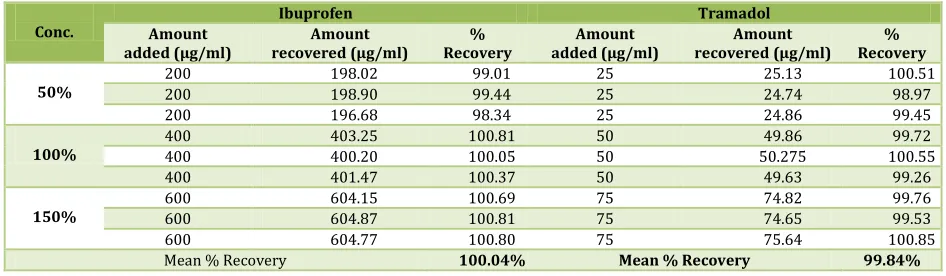
Percentage Recovery was the Representative value for Accuracy and the determination of accuracy was proceeded by adding known amounts of each analyte at corresponding three concentration levels (50, 100, 150%) of the labelled claim to the excipients of Ibuprofen and Tramadol.
Three determinations were performed at each concentration levels and the recovered analyte was used to determine the % Recovery.
Precision:
Precision is an Analytical validation method which was commonly expressed as Standard Deviation (SD). The Repeatability was executed by estimation of the response of Ibuprofen (400µg/ml) and Tramadol (50 µg/ml) and by making repeated mixture of drugs injections for six time on the same day which determines the intra-day precision. The intermediate precision (Inter-Day) was determined by injecting same concentration of drug mixture six times on three different days and the results are expressed as Relative Standard Deviation.
Limit of Detection (LOD) and Limit of Quantification (LOQ):
The LOD and LOQ of standard Ibuprofen and Tramadol were determined by using the formula based on the calibration curve and the standard deviation of the response and the slope.LOD and LOQ were calculated by using equations, LOD =3.3 σ/S and LOQ =10 σ/S, where σ
=Standard deviation, S= slope of the calibration curve.
Robustness:
Small deliberate changes in method like Flow rate, mobile phase ratio, and temperature are madeto validate the Robustness of the method. Robustness conditions like Flow minus (0.9ml/min), Flow plus (1.1ml/min), mobile phase minus, mobile phase plus, temperature minus (25°C) and temperature plus (35°C) was maintained and samples were injected in duplicates.
System Suitability:
By preparing standard solutions of Ibuprofen (400ppm) and Tramadol (50ppm) the system suitability parameters were determined, the solutions were injected six times and the parameters like peak tailing, resolution and the USP theoretical plate count were assessed to check whether the results complies with Recommended limits.
Assay of Ibuprofen and Tramadol:
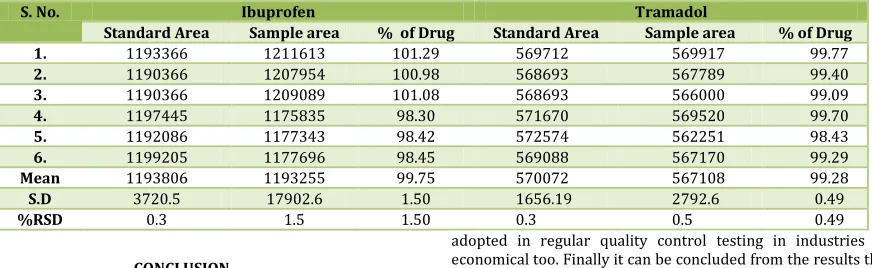
IBUDOL a Marketed Product bearing the label claim Ibuprofen 400mg and Tramadol 50mg was used to perform assay by utilizing the method developed and under the optimized chromatographic conditions. Sample solutions were injected in to the HPLC system and scanned at 244 nm from which the % of drug was estimated.
RESULTS AND DISCUSSIONS
Optimization of Chromatographic Conditions:
resolution and minimum tailing effect for Ibuprofen and Tramadol, the optimized chromatogram was obtained as shown in (Figure-3).
Validation:
Linearity was established for Ibuprofen (100-600µg/ml) and Tramadol (12.5-75µg/ml) at six different concentrations each were injected in a duplicates and average areas were determined and linearity equations were obtained asy =2858x + 18866 for Ibuprofen and y = 11050x + 3876forTramadol, Correlation coefficient (R2) was
determined as 0.999 for the two drugs. The Linearity calibration curves were plotted as shown in (Figure-4&5) for Ibuprofen and Tramadol respectively. Retention times of Ibuprofen and Tramadol were 2.274min and 2.844min respectively. Where no interfering peaks in blank and placebo at retention times of these drugs were not found in this method. So this method holds its specificity. Three levels of Accuracy samples 50%, 100%, 150% were prepared and Triplicates of injections were given for each level of accuracy and mean %Recovery was obtained as 100.0% and 99.84% for Ibuprofen and Tramadol respectively were shown in (Table-2).% RSD was calculated from the corresponding peaks obtained by injecting six times a known concentration of Ibuprofen and Tramadol, the repeatability was obtained as 1.5% and 0.5% respectively for Ibuprofen and Tramadol and the % RSD for intermediate Precision
was obtained as 0.2% for both Ibuprofen and Tramadol, Low % RSD values indicates that the method developed was precise as shown in (Table-3). The LOD and LOQ values were evaluated based on Relative standard deviation of response and slope of the calibration curve Ibuprofen and Tramadol. The detection limit values were obtained as 0.55 and 0.19 and Quantitation limit were fund to be 1.67 and 0.56 for Ibuprofen and Tramadol Respectively as given in (Table-4).
Robustness of the method to study the effect of Robustness conditions like Flow minus 0.9ml/min, Flow plus 1.1ml/min, mobile phase minus40B:60A, mobile phase plus50B:50A, temperature minus 25°C and temperature plus 35°C was maintained and samples were injected in duplicates. %RSD was within the limit as shown in (Table-5). The system suitability parameters like Retention time, Resolution, USP plate count and peak asymmetry or Tailing evaluated to check whether the results complies the prescribed limits and shown in (Table-6). The assay of the marketed product IBUDOLbearing the label claim Ibuprofen 400mg and Tramadol50mg was used to perform assay and the Average % of drug was found to be 99.75 and 99.28% for Ibuprofen and Tramadol respectively the results were shown in (Table-7) and the chromatograms for Ibuprofen and Tramadol standard drugs and Tablet dosage forms were shown in (Figure-6, 7) Respectively.
Fig. 3: Optimized Chromatogram of Ibuprofen and Tramadol
Fig. 6: Standard Chromatogram of Ibuprofen and Tramadol
Fig. 7: A Typical Chromatogram of Ibuprofen and Tramadol Tablet Dosage Form
Table No. 1: Optimized Chromatographic Conditions
Parameter Condition
RP-HPLC WATERS HPLC 2695 SYSTEM equipped with
quaternary pumps with PDA detector
Mobile phase 45% OPA (0.1%):55% Acetonitrile
Flow rate 1ml/min
Column Discovery C8 (4.6 x 250mm, 5µm)
Detector wave length 244 nm
Column temperature 25°C
Injection volume 10L
Run time 10 min
Diluent Water and Acetonitrile in the ratio 50:50
Retention Time Ibuprofen-2.274min and Tramadol-2.844min
Theoretical Plates Ibuprofen-4030 and Tramadol-4470
Table No. 2: Accuracy results of Ibuprofen and Tramadol
Conc. Amount Ibuprofen Tramadol
added (µg/ml) recovered (µg/ml)Amount Recovery% added (µg/ml)Amount recovered (µg/ml)Amount Recovery%
50% 200 200 198.02 198.90 99.01 99.44 25 25 25.13 24.74 100.51 98.97
200 196.68 98.34 25 24.86 99.45
100% 400 400 403.25 400.20 100.81 100.05 50 50 50.275 49.86 100.55 99.72
400 401.47 100.37 50 49.63 99.26
150% 600 600 604.15 604.87 100.69 100.81 75 75 74.82 74.65 99.76 99.53
600 604.77 100.80 75 75.64 100.85
Table No. 3: Precision Results of Ibuprofen and Tramadol
S.No Repeatability Intermediate precision
Area of Ibuprofen Area of Tramadol Area of Ibuprofen Area of Tramadol
1. 1211613 569917 1217840 543251
2. 1207954 567789 1222581 543324
3. 1209089 566000 1222805 545378
4. 1175835 569520 1217604 543452
5. 1177343 562251 1216384 542080
6. 1177696 567170 1216772 542564
Mean 1193255 567108 1785910 543342
S.D 17902.6 2792.6 2912.2 1128.2
%RSD 1.5 0.5 0.2 0.2
Table No. 4: LOD and LOQ values of Ibuprofen and Tramadol
Molecule LOD LOQ
Ibuprofen 0.55 1.67
Tramadol 0.19 0.56
Table No. 5 Robustness Data of Ibuprofen and Tramadol
S. No. Condition %RSD of Ibuprofen %RSD of Tramadol
1 Flow rate (-) 1.1ml/min 0.5 0.4
2 Flow rate (+) 1.3ml/min 0.1 0.5
3 Mobile phase (-) 35B:65A 0.4 0.4
4 Mobile phase (+) 45B:55A 0.1 0.2
5 Temperature (-) 25°C 0.1 0.1
6 Temperature (+) 35°C 0.3 0.3
Table No. 6: System Suitability Parameters Results of Ibuprofen and Tramadol
S. No. Ibuprofen Tramadol
Inj RT(min) USP Plate
Count Tailing RT(min) USP Plate Count Tailing Resolution
1 2.281 3907 1.20 2.840 4338 1.31 3.4
2 2.284 4116 1.20 2.846 4571 1.31 3.5
3 2.284 4116 1.20 2.846 4571 1.31 3.5
4 2.286 4097 1.21 2.848 4487 1.31 3.5
5 2.286 3987 1.21 2.848 4493 1.29 3.6
6 2.288 3982 1.19 2.850 4363 1.29 3.5
Table No. 7: Assay Results of Ibuprofen and Tramadol
S. No. Ibuprofen Tramadol
Standard Area Sample area % of Drug Standard Area Sample area % of Drug
1. 1193366 1211613 101.29 569712 569917 99.77
2. 1190366 1207954 100.98 568693 567789 99.40
3. 1190366 1209089 101.08 568693 566000 99.09
4. 1197445 1175835 98.30 571670 569520 99.70
5. 1192086 1177343 98.42 572574 562251 98.43
6. 1199205 1177696 98.45 569088 567170 99.29
Mean 1193806 1193255 99.75 570072 567108 99.28
S.D 3720.5 17902.6 1.50 1656.19 2792.6 0.49
%RSD 0.3 1.5 1.50 0.3 0.5 0.49
CONCLUSION
A
new Accurate, Precise, Simple and reliable method for the simultaneous estimation of the Ibuprofen and Tramadol in Tablet Dosage Form has been developed. The method developed was validated and was found to be sensitive, accurate, precise and reliable for the analysis of Ibuprofen and Tramadol in Bulk and Tablet dosage forms. The Results obtained were within the prescribed limits of ICH Guidelines and shown accuracy and preciseness of the method developed. As the Retention times were decreased and that run time was less the method can be effectivelyadopted in regular quality control testing in industries which is also economical too. Finally it can be concluded from the results that the method developed was simple and accurate with robust and reliability as added values to the method.
REFERENCES:
1. https://en.wikipedia.org/wiki/Tramadol.
2. http://www.rxlist.com/jardiance-drug/overdosage-contraindications.html.
4. IUPAC. Compendium of Chemical Terminology, 2nd ed. (The Gold Book). PAC69, 1137 (1997). Glossary of terms used in computational drug design (IUPAC Recommendations.
5. Benoit Viollet, Bruno Guigas, Nieves Sanz Garcia, Jocelyne Leclerc, Marc Foretz, and Fabrizio Andreelli. Cellular and molecular mechanisms of Ibuprofen: An overview, Clincal Science (London),
2012;122(6):253–270.
6. Steele John W, Faulds Diana, Goa Karen L. Ibuprofen. Drugs & Aging. 1993;3(6):532–555. doi:10.2165/00002512-199303060-00007.
7. Authors unspecified: Schedules of controlled substances: placement of Tramadol into schedule V. Final rule. Fed Regist
2005;70(144):43633-5. [PubMed:16050051] 8. https://www.drugs.com/tramadol.html
9. https://en.wikipedia.org/wiki/Tramadol
10. Terashima H, Hama K. Effects of a new aldose reductase inhibitor on various tissue in vitro. J Pharamacol Exp Ther 1984;229:226–230. 11. Ramirez, Mary Ann, Borja, Nancy L. Ibuprofen: An Aldose Reductase
Inhibitor for the Treatment of Diabetic Neuropathy. Pharmacoth
2008;28(5):646-655. Doi:10 .1592/phco.28.5.646.
12. Chandani Patel et al. Simultaneous estimation of ibuprofen and carisoprodol in synthetic mixture by hptlc method. Int J Life Sci and Rev 2011.
13. Bashir alsirawan et al. Development and validation of a simple hplc method for the determination of ibuprofen sticking onto punch faces. Int J Pharma and Pharma Sci 2013.
14. Gnana Raja M. Simultaneous, Stability Indicating Method Development and Validation for Related Compounds of Ibuprofen and Paracetamol Tablets by RP-HPLC Method. 2012.
15. ICH, Validation of analytical procedures: Text and Methodology. International Conference on Harmonization, IFPMA, Geneva, 1996. 16. Deepti Jain, Raman N. Kachave et al. Simultaneous Estimation of
Tramadol Hydrochloride, Paracetamol, Domperidone By RP-HPLC In Tablet Formulation. J Liq Chromat and Rel technol 2010;33(6). 17. Satish N. Patel et al. Development and Validation of RP-HPLC Method
for Simultaneous Estimation of Tramadol Hydrochloride and Diclofenac Sodium in Synthetic Mixture Asian J Res Chem 2013;6(4).
How to cite this article:
Gomari Chethana et al. RP-HPLC METHOD DEVELOPMENT AND VALIDATION FOR THE SIMULTANEOUS ESTIMATION OF IBUPROFEN AND TRAMADOL IN BULK AND TABLET DOSAGE FORM. J Sci Res Pharm 2017;6(10):130-135.