1
Decision Making in the Connected Learning
Environment (CLE)
Anas Belahcen
1,*, Mounia Abik
2and Rachida Ajhoun
31 ENSIAS, Mohammed V University, Rabat, Morocco, [email protected] 2 ENSIAS, Mohammed V University, Rabat, Morocco, [email protected]
3 ENSIAS, Mohammed V University, Rabat, Morocco, [email protected]
Abstract
In the last years, we have witnessed to an increasingly heightened awareness of the potential benefits of a challenging and promising educational research area : Adaptive Learning [1]. It has become one of the central technologies in education [2] and was recently named, by Gartner, as the number one strategic technology to impact education in 2015 [3]. In fact, adaptive learning systems become more accessible to educational institutions, corporations, and individuals, however, the challenges encountered are more structural and operational rather than technological [4]. While a lot of research has focused on development and evaluation of technological aspects [5], serious questions remain about the motivation of learners [6],[7] and also the design of the content (or domain) model [8],[9] including the learner's autonomy issues [9],[10],[11] and the lack of the learner's control [9],[12],[13].
In order to overcome those challenges, we propose CLE “Connected Learning Environment” which is an ubiquitous learning environment [14] that provide to the learners of this generation a learning environment adapted to their expectations and their lifestyle habits and stimulate also their motivation. As a pedagogical approach, CLE adopts the connectivism [15] and take advantage from its benefits (adaptation to the current technological advances [16], management of learning in communities [17], openness with respect to external resources[18], etc.) and adapts this approach in a formal context even though the connectivism was conceived as an informal pedagogical approach [19][20].
CLE introduces a new pedagogical process including four phases detailed later (Knowledge construction, Decision making, Validation, Evaluation) and the knowledge construction phase is characterized by the collaboration and communication between heterogeneous communities composed of humans and smart objects [14]. However, the ability to distinguish relevant information among the knowledge constructed by the actors is a vital point. As part of this article, we focus on the decision making process. To do this, a comparison is made between C4.5 [21] decision tree and MLP [22] neural network on the same data set using the same performance measures in order to take a decision on the relevance of knowledge constructed by the CLE actors.
Keywords: Ubiquitous Learning Environment, Adaptive Learning, Connectivism, CLE, Knowledge Construction, Decision Making.
Received on 08 October, 2015, accepted on 23 February, 2016, published on 10 March, 2016
Copyright © Y2016 A. Belahcenet al., licensed to EAI. This is an open access article distributed under the terms of the Creative Commons Attribution licence (http://creativecommons.org/licenses/by/3.0/), which permits unlimited use, distribution and reproduction in any medium so long as the original work is properly cited.
doi: 10.4108/eai.28-10-2015.151118
*Corresponding author. Email: [email protected]
on
e-Learning
Research
Article
EAI Endorsed Transactions on
e-Learning
102015 - 03 2016|Volume3|Issue9|e1
Anas Belahcen, Mounia Abik and Rachida Ajhoun
2
1. Introduction
In the last years, we have witnessed to an increasingly heightened awareness of the potential benefits of a challenging and promising educational research area : Adaptive Learning [1]. In fact, many factors contributed to the increasing feasibility of adaptive learning systems and led to its market adoption such as the evolution of digital and mobile technologies [23], developments in data analytics [24], large volumes of data collected during the student learning [9], proliferation of free educational content [25], diversity in the access media [26] as well as other economic drivers [24]. As a result, adaptive learning has become one of the central technologies in education [2] and was recently named, by Gartner, as the number one strategic technology to impact education in 2015 [3].
Adaptive learning system can be defined as a technology based environment [27] that focuses on the learner motivation [6] and provides the right instruction, at the right time, about the right thing [28] by designing learning experiences [29] adapted to the particular abilities, goals, and learning styles of learners [9],[27]. In addition, adaptive environments guarantee effective learning [30], reduce the drop-out rates [31], engage learners [30], increase their motivation [6][7], personalize instruction [4], adapt to the pace of learners [32] and improve learner outcomes and/or speed of achieving those outcomes [4]. In fact, the adaptive learning systems are built on three main components [4],[33],[34].
Content or domain model : It refers to a model that identify the structure of the appropriate content to be learned which means the way the specific topic, or content domain, is structured, with thoroughly detailed learning outcomes and a definition of tasks that need to be learned [9],[34].
Learner model : This model may comprise such elements as learner goals for the course and current domain knowledge, as well as other elements such as cognitive and meta-cognitive ability, and non-cognitive factors such as motivation level, learning style, or preference for medium of learning [9],[4].
Instructional model : This model determines how a system selects specific content for a specific student at a specific time. In other words, it puts together the information from the learner model and content model to, ideally, generate the learning feedback or activity that will be most likely to advance the student’s learning [4],[33].
As a matter of fact, adaptive learning systems become more accessible to educational institutions, corporations, and individuals, however, the challenges encountered are more structural and operational rather than technological [4]. While a lot of research has focused on development and
evaluation of technological aspects [5], serious questions remain about the design of the content (or domain) model [8],[9] including the (1) learner's autonomy issues [9],[10] where most of the adaptive environments don't create a class culture that supports and cultivates the student autonomy and don't give students choice over their learning sequences [11] and also (2) the lack of student's control [9],[12] where many adaptive learning systems do not allow the same degree of control to the student over the design of their course [13]. In addition to the content model, another controversial aspect is reflected in the learner model : the motivation of the learners [6],[7]. Actually, the motivation of this new generation called also generation Z or C [35],[36] is a crucial point because those learners arrive today with new requirements and lifestyle habits which affect their needs, requirements and expectations in terms of education.
In order to overcome those challenges, we propose CLE “Connected Learning Environment” which is an ubiquitous learning environment [14] conceived by our research team LeRMA "Learning and Research in Mobile Age." This ecosystem considers all the points mentioned earlier, provide to the learners of this generation a learning environment adapted to their expectations and their lifestyle habits and stimulate their motivation. As a pedagogical approach, CLE adopts the connectivism [15] and take advantage from its benefits (adaptation to the current technological advances [16], management of learning in communities [17], openness with respect to external resources[18], etc.) in a formal context even though the connectivism was conceived as an informal pedagogical approach [19][20].
CLE introduces a new pedagogical process including four phases detailed later (Knowledge construction, Decision making, Validation and Evaluation) and this process is characterized by the collaboration and communication between heterogeneous communities composed of humans and smart objects [14]. Through this process, CLE reconsiders the content or domain model and improve and develop the learners autonomy by involving them into the pedagogical process and allowing them research and participate into the construction of knowledge. CLE re-examine also the role of the teacher where this actor is considered as a moderator rather than a monopolist. That way, the environment gives more control to the learners with respect to the knowledge management. In fact, CLE extends the traditional adaptive learning environments and focuses on the content or domain model by introducing a new way of educational knowledge management by considering the participation of all the actors (humans and smart objects) and focuses also on the learner model by increasing the creativity, innovation, competitiveness, responsibility, autonomy and the spirit of discovery of learners.
Through CLE, we consider the various roles of our ecosystem actors (learner, smart object, teacher...) in the
EAI
European Alliance for InnovationEAI Endorsed Transactions on
e-Learning
3 knowledge construction process. This process occurs through collaboration and communication between heterogeneous communities composed of humans and smart objects. However, the ability to distinguish relevant information among the knowledge constructed by the actors is a vital point. As part of this article, we focus on the decision making process. To do this, a comparison is made between C4.5[21] decision tree and MLP [22] neural network on the same data set using the same performance measures in order to take a decision on the relevance of knowledge constructed by the CLE actors.
This paper is organized as follows: The first section describes the connectivism, our environment CLE with its main actors and its functional architecture. The second part introduces the communication between actors which is based on the SOA layer of CLE. The third section presents the pedagogical layer with the different phases : knowledge construction, decision making, validation and evaluation. The fourth section focuses on the knowledge construction process and the last part describes the decision making process.
2. CLE : Connected Learning Environment
CLE is an ubiquitous learning environment [14] that extends the traditional adaptive learning environments by introducing a new way of educational knowledge management that considers the participation of all the environment actors (humans and smart objects). In fact, CLE focuses on the content and learner models and provide to this generation a learning ecosystem adapted to their expectations and their lifestyle habits by increasing the creativity, innovation, competitiveness, responsibility, autonomy and spirit of discovery of the learners. Besides, the biggest challenge considered by CLE is to ensure all these points in a formal, organized and structured context.
The pedagogical approach of CLE must be adapted to the current technological advances [16], guarantee management of learning in communities [17] and openness with respect to external resources [18]. According to George Siemens and Stephen Downes, the connectivism is a more refined version of the behaviourism, cognitivism, and constructivism [37],[38] which is adapted to the digital world and the technological advances already familiar to the generation Z [39]. However, CLE adopts the connectivism [15] in a formal context even though the connectivism was conceived as an informal pedagogical approach [19][20]. In the next section, we present the connectivism as well as the proposed environment CLE by introducing its actors and its functional architecture.
2.1. Connectivism
Based on technological advances and more precisely on Web 2.0, a new pedagogical approach emerged called
connectivism. It is defined as the integration of principles explored by chaos, network, and complexity and self-organization theories where knowledge can reside outside of ourselves (within an organization, a database, a smart object…), and where the learning is focused on connecting specialized information sets. This approach was proposed by George Siemens and Stephen Downes and is based on eight principles [15]:
Learning and knowledge rests in diversity of opinions.
Learning is a process of connecting specialized nodes or information sources.
Learning may reside in non-human appliances.
Capacity to know more is more critical than what is currently known.
Nurturing and maintaining connections is needed to facilitate continual learning.
Ability to see connections between fields, ideas, and concepts is a core skill.
Currency (accurate, up-to-date knowledge) is the intent of all connectivist learning activities.
Decision-making is itself a learning process. Choosing what to learn and the meaning of incoming information is seen through the lens of a shifting reality.
The Web has become an informational ecosystem composed of nodes connected to each other through links. The main idea of connectivism is that learning and intelligence don’t lie only in individuals but also in these groups of nodes. However, Web 2.0 alone is not efficient to access in a smart way these distributed networks and where the ability to learn becomes more and more important [40]. In the U-Learning [41], pedagogical challenges line with the objectives of the connectivism because learning can take place without the learner, through technology (e.g. smart objects) and also because the U-Learning focuses on the connection between human with other devices. To meet the objectives outlined by the connectivism, we take advantage from new technologies by providing a learning environment called CLE. In the next section, we detail our environment, its main actors and its functional architecture.
2.2. Architecture : Layers and Main actors
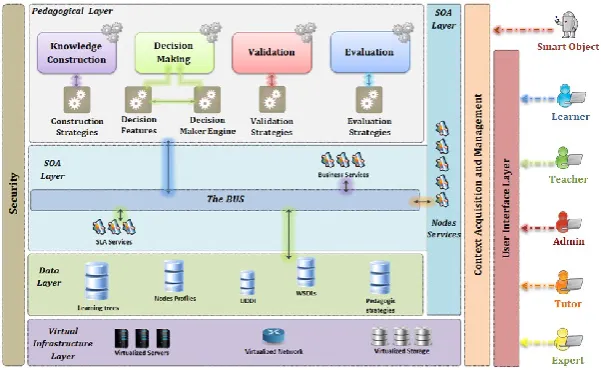
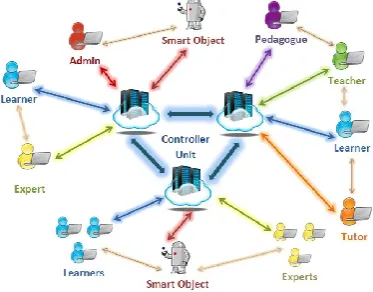
CLE is an ubiquitous learning environment that adopts the connectivism as a pedagogical approach in the formal context and aims to provide to this generation a learning ecosystem adapted to their expectations and their lifestyle habits. CLE also considers the role of all the actors in the pedagogical process without neglecting the role the teacher. The functional architecture of our environment CLE is a layered model shown in the Figure 1.
EAI
European Alliance for InnovationEAI Endorsed Transactions on
e-Learning
Anas Belahcen, Mounia Abik and Rachida Ajhoun
4
Figure 1. Functional architecture of CLE
Main Actors
In CLE, all the actors are considered as nodes and each actor has a key role in the ecosystem. The main actors can be classified into three main categories :
Humans : The first category of actors contains five players : Learner, Teacher, Expert, Tutor and Administrator.
The Learner is considered as one of the most important actors in the environment. Besides acquiring new knowledge (process of learning), this actor is involved with the others (Smart object, Expert…) in the knowledge construction process which is detailed later.
Teacher : Following the environment vision, the teacher is considered as a moderator and organizer more that a knowledge monopolist and transmitter. Also, this actor (1) elaborates the learning strategies such as the objectives, the prerequisites, etc. (2) makes the learning contents and resources available (3) handles the pedagogic scenarios and (4) validates the knowledge proposed by the other actors (Humans and smart objects).
The Expert collaborates with other actors in the environment and provide his expertise in the knowledge construction. This actor can be a teacher, a pedagogue a tutor, an engineer or a business manager, etc.
Tutor : In an ubiquitous learning ecosystem, we cannot overlook the role that the tutor plays. The tutor monitor, support, supervise, assist and advise learners [42], [43].
The Administrator’s role is to (1) maintain the controller unit functional (third category of actors) and
(2) and also to add new smart objects to the ubiquitous environment.
Smart objects : In a learning environment such as CLE, the role of smart objects [44] can’t be overlooked because they are considered as a key element in every ubiquitous environment [45]. The smart object in CLE is characterized by five features: (1) Unique identification [46], (2) Able to communicate, search, select and exchange information with peers and also with humans [47], (3) Associated to a local memory in order to store its knowledge [48], (4) Ability to provide services to the other actors [49] and (5) classified into one or more categories according to its area of expertise; e.g., the learners in the chemistry class access to the smart objects classified into organic chemistry or
nuclear chemistry categories while the learners in the
mathematics class access to categories in relationship with the math’s field such as algebra or statistics. Through this classification, all the actors of the environment can search, select, communicate and exchange information with the smart objects based on their needs. The smart objects in CLE participate in the knowledge construction process by offering their expertise and can be in a library, a museum, an academic resource center, etc.
Controller Unit: The third category of actors is a cloud infrastructure [50],[51]. It acts as an intermediary for communications between all the nodes of CLE and contains all the data for the proper functioning of the environment.
Layers
As shown in the figure 1, the functional architecture of our environment CLE is a layered model composed of seven layers :
EAI
European Alliance for InnovationEAI Endorsed Transactions on
e-Learning
5 Virtual infrastructure Layer: In order to solve issues related to concurrence between the different nodes of our environment, optimization and control of resources and costs. This layer represents a virtualised cloud infrastructure which has three main components: storage, processing, and networks [52]. Through this layer, we provide an environment that benefit from the advantages of virtualisation such as flexibility and performance and thus to ensure better availability, large flexibility and higher quality of service [53].
Data Layer: This Layer includes the contents, data and storage spaces necessary for the proper functioning of our learning environment. In other words, it includes the actors’ profiles, data related to SOA (WSDL, UDDI), pedagogic data (scenarios, strategies, learning contents, learning trees) and personal and collaborative spaces.
SOA Layer: As an ubiquitous learning environment, CLE faces several challenges regarding (1) the interoperability of actors, devices and communication protocols [54], (2) scalability to deal with the growth of consumers, devices, applications, and space coverage [55] and (3) adaptation of service/content depending on users’ services needs [56]. Through the SOA layer, we guarantee these points [57], [58], [59] and we ensure effective communication between the different heterogeneous actors of CLE based on services (where each actor is represented by a set of services). This Layer is detailed in the third section.
Security: This Layer manages security and includes features such as the confidentiality, access management and resources permissions [60].
Pedagogical Layer: The pedagogical layer represents the essence of our environment. This layer has four main phases which are : Knowledge construction, decision making, validation and evaluation. The modules of the layer are detailed in the fourth section.
Context Acquisition and Management: As an ubiquitous learning environment, CLE should provide context management to meet challenges such as mobility, network and terminal... This layer manages the context to provide appropriate services for different profiles: the CLE nodes (profiles, preferences ...), environment profile (location, sensors ...), terminal profile (size, type, memory, OS ...) and the network profile (type, speed, quality of service ...) [61], [62].
User Interface Layer: This layer provides various access points to the human nodes accessing our environment (Learner, Teacher, Administrator, Expert and Tutor) as shown in the figure 1, however, smart objects are linked directly to the context acquisition and management layer since they are plugged via their services. UIL in CLE has
several characteristics: It is distributed [63] secure [64], effective [65], easy to use [66], interactive [67] and adaptable [68].
CLE as conceived requires the management of communication and interaction between its actors in order to allow better construction and circulation of knowledge. To solve this issue and enable active communication between the different actors of our environment, we focus on its SOA layer where communication will be based on services and where each node is represented by a set of services. In the next section, we introduce the ESB based communication that has been used to solve this issue.
3. SOA Based Communication
As an ubiquitous learning environment, CLE faces several challenges regarding (1) the interoperability of actors, devices and communication protocols [54], (2) scalability to deal with the growth of consumers, devices, applications, and space coverage [55] and (3) adaptation of service/content depending on users’ services needs [56]. Through the SOA layer, we guarantee these points [57], [58], [59] and we ensure effective communication between the different heterogeneous actors of CLE based on services (where each actor is represented by a set of services).
3.1.
Communication in CLE
From a comparison already done in [69], the bus topology seems the most appropriate for our environment because it offers several mechanisms such as: Information processing, protocols conversion, events management, workflow... and it also solves the issues of flexibility and extensibility. As an implementation of the bus architecture, we opted to use an ESB in the SOA layer of CLE. That ESB includes the actors’ services, the business services, SLA services for a better quality of service and the bus will be used for connectivity, routing, processing and conversion…Through this proposition, we ensure a better communication between heterogeneous communities composed of humans, smart objects and controller unit in order to ensure an efficient knowledge construction.
3.2.
Proposed Architecture of the ESB
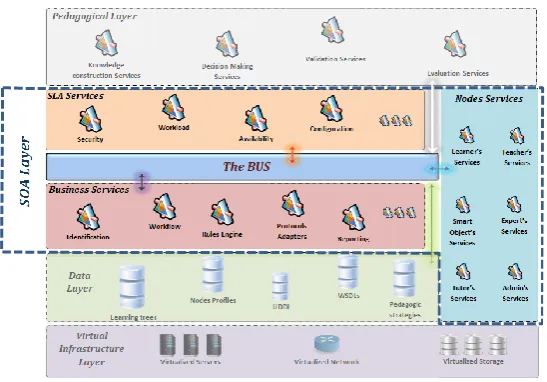
In order to ensure effective interactions between our nodes or actors in the CLE environment, we opted to use an ESB in its SOA layer. Our architecture includes four main layers as shown in Figure 2.
EAI
European Alliance for InnovationEAI Endorsed Transactions on
e-Learning
Anas Belahcen, Mounia Abik and Rachida Ajhoun
6
Figure 2. Functional architecture of the ESB
User services : This layer includes the main services of our architecture. These are the business components of the environment.
Each user will have a set of services.
Each service has a WSDL file that describes its methods...
Each service is added in our UDDI.
All services are intra-accessible via the bus.
All services access the database through the bus.
BUS : The bus acts as a broker between the various services. This means that all the interactions between services pass through the bus. These interactions can be based on events or messages. The bus is also responsible for:
All the environment actors can connect easily to their services. After the log in, the learner automatically accesses the services in order to add suggestions, collaborate with others…
All communications between nodes are ensured by managing priorities through the information routing mechanisms. For example, communication between smart object and learner will be favoured over a communication between administrator and tutor.
Regardless of the technology with which the node communicates with its services, there is a protocol conversion. For example, regardless of the manner in which the smart object communicates with the bus, the leaner will not feel the difference.
Through the workflow, we have a better management of events. That is to say, there is a process to follow.
The audit, traceability, administration and supervision are important points provided to the administrator of the environment to better handle it.
SLA services: The SLA (Service Level Agreement) services are designed for a better quality of service, it includes: Security (confidentiality, authorization, and identification), availability, management of workload…
Business services : The business services are used to ensure the proper functioning of the ESB such as: Rules Engine, Protocols Adapters, Identification, Security, Reporting.
The ESB in our environment will ensure better availability, a wide flexibility through the cloud infrastructure. It also allows better management through business services and better quality of service with the SLA layer. As long as the communication is effective between the actors in our environment, we focus on the pedagogical process : the knowledge construction based on the participation of the various actors, the exploitation of this knowledge by selecting the most relevant suggestions, validation of these suggestions by the teacher and finally the evaluation of the CLE actors.
4. Pedagogical layer
The pedagogical layer represents the essence of our environment. Its objective is to provide a pedagogical process adapted to the expectations and habits of this generation, consider the role of all the actors and increase the motivation, creativity, innovation, competitiveness, responsibility, autonomy and spirit of discovery of the learners and the biggest challenge would be to ensure all these issues within a formal and structured context. This layer is represented by a process composed of four main
EAI
European Alliance for InnovationEAI Endorsed Transactions on
e-Learning
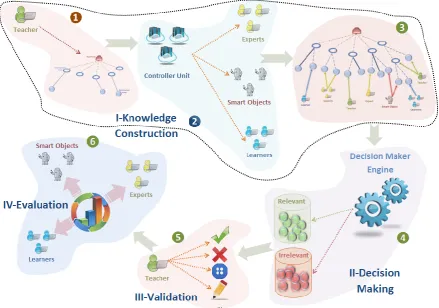
7 phases : (1) Knowledge construction based on the participation of the various nodes in the environment (2) a decision making engine that determines the relevance of that knowledge, (3) the teacher’s validation of that knowledge which cannot be neglected, and finally (4) the evaluation of the different nodes of our environment CLE. In the figure 3, we present the different phases of the pedagogical process.
Knowledge construction : The first phase in our process is the knowledge construction. In this phase, we introduce a way that is based on the participation of the various nodes. This phase aims to integrate all CLE actors (humans, smart objects) and stimulate their motivations. This phase is composed of several steps: (1) the teacher adds the first arboresence of the course and specify the learning strategies shown in the pedagogical layer of CLE (such as the objectives, the prerequisites, targeted groups of actors, etc.) ; (2) the controller unit notifies those targeted groups of actors. Those actors will participate in the knowledge construction ; (3) The groups of actors collaborate and add their suggestions into the tree (course) generated by the teacher… In the next section, we will detail each step of this phase.
Decision making : The decision making represents a critical point in the connectivism because it figures among its characteristics. After the collaboration and the addition of
the suggestions by the actors, a decision making engine selects the most relevant ones. As a result, the suggestions of the actors will be separated into two groups (relevant and irrelevant). The Decision making engine is described in the last section.
Validation : After the selection of the most relevant suggestions by the decision making engine, the teacher will have at its disposal several ways to validate these suggestions (Acceptance, refusal, modification ...). After the validation of the teacher, the course (learning tree) will be updated. Thus, in our learning environment CLE, the teacher has another role which is regulation and a moderation instead of an information transmission.
Evaluation : The last phase in our process is the evaluation of the CLE actors. In our environment, the evaluation should be considered because all the actors participate in the knowledge construction process. It is based on several features such as the level of trust of the actors which is calculated based on the number of relevant and irrelevant suggestions of each actor. After having a global view of the pedagogical process and its different phases, we present in the next section the first part of the pedagogical process: The knowledge construction with a focus on its different stages.
Figure 3. CLE : Pedagogical Process
EAI
European Alliance for InnovationEAI Endorsed Transactions on
e-Learning
8
5. Knowledge Construction
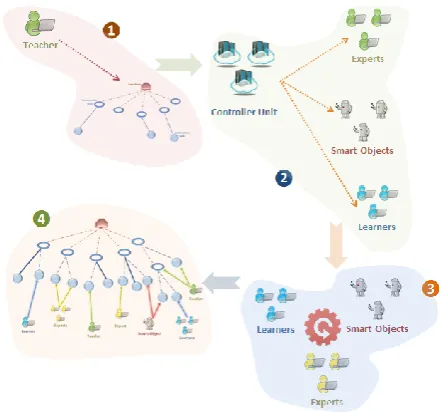
The first phase of our pedagogical process is the knowledge construction. In this phase, we introduce a way that is based on the participation of the various nodes (humans and smart objects). The knowledge construction is divided into four major steps as shown in the Figure 4:
Figure 4: Knowledge Construction phases
The four steps are :
1. Addition of the first arboresence of the course (learning tree) by the teacher based on learning strategies in the pedagogical layer of CLE such as the objectives, the prerequisites, the targeted groups of actors, etc.
2. Notification of the targeted groups of actors, those actors will participate in the knowledge construction.
3. Acquisition of knowledge by the actors already notified.
4. Collaboration and addition of knowledge which occurs in the form of suggestions in the learning tree. Those suggestions will be the inputs of the decision making engine in order to be validated.
Before starting the description of the various stages, we present in the following the learning tree generated by the teacher which represent the course which is considered as the base for the construction of knowledge.
5.1.
Learning Tree
The learning tree represents the base for the construction of knowledge. This is the first tree being generated by the teacher and all the actors participate and
update this tree structure. In order to schematize the learning tree, IMS Learning Design (IMS-LD) [70] has been used. It is a specification for a metalanguage which enables the modelling of learning processes and does not mandate a specific pedagogical approach and the C level was chosen because it supports collaborative events through notifications between the various parts. As part of the learning process, each actor in the environment contributes to the construction of knowledge that occurs in the form of a hierarchical learning tree as shown in the Figure 5.
Figure 5: The Learning Tree
The teacher adds the learning tree and (1) specifies the pedagogical strategies such as: objectives, prerequisites, and (2) also the actors responsible of adding new knowledge (groups of learners, categories of smart objects, experts…), and (3) creates the first hierarchical tree model. The various tree nodes can be classified into two categories:
Container node: It can be the root element or an intermediate node. The last one may include another intermediate nodes or information nodes. The intermediate node can be added either by the teacher or by another actor as a suggestion (that will be validated by the teacher). Based on the IMS-LD scheme, the container node is defined as an activity structure.
Information node: Information nodes are equivalent to leaves in a tree. They can be added by smart objects, learners or experts or by the teacher. Based on the IMS-LD scheme, the information node is defined as a learning activity. In the next section, we detail this knowledge construction process and its various steps.
5.2.
Knowledge construction process
As shown in the figure 4, the knowledge construction process is composed of four steps. In this section, we detail each of these parts.
Creation of the leaning tree model
First of all, the teacher adds the first learning tree model in order to be filled by the actors and specifies several features (Figure 6):
EAI
European Alliance for InnovationEAI Endorsed Transactions on
e-Learning
102015 - 03 2016|Volume3|Issue9|e1
9 Figure 6: The First Learning Tree Model
Targeted groups: The teacher specifies the audience: groups of learners, categories of smart objects and experts... Those actors will be able to view and add suggestions.
Visibility of nodes: For each intermediate node in the learning tree, the teacher has the possibility to show it to audiences or to hide it. We can use this feature based on the learning objectives (e.g.: pedagogical progression).
Filling time: When an intermediate node is created, the teacher specifies the time required for filling. This means that beyond that time, the targeted groups cannot add anymore their suggestions.
Objectives: For the root element and for each intermediate node, the creator adds its objectives which describe the intended outcome for the targeted groups.
Prerequisites: For the root element and for each intermediate node, the creator adds its prerequisites which are the entry-requirements, such as any pre-knowledge needed.
Notification of actors
After the addition of the first learning tree model, the controller unit broadcasts this information to the targeted groups (Figure 7).
Figure 7: Notification of actors
Those actors already specified by the tree’s creator can view the learning tree and add their suggestions in the form of information nodes or as learning activities following the IMS-LD specification.
Acquisition, collaboration and creation of suggestions
After the notification of the concerned actors, the suggestions formulation can be achieved through two scenarios:
Individual actor : A single user creates the suggestion and adds it to the learning tree: learner, smart Object, Expert, Teacher…
Multiple actors : Multiple actors collaborate through their collaborative spaces in order to create there suggestions.
After the addition of learning tree by the teacher and the notification of all the actors from the controller unit, the actors can either add there suggestions as information nodes or as intermediate nodes if they judge that it meets the pedagogical objectives, propose to modify an existent node or propose to delete a node if they judges that it’s obsolete (see Figure 8). In the case of the smart object, once it is notified from the controller unit, it searches its database to see if there is a match between the objectives added in the learning tree and its knowledge.
Figure 8: Addition of suggestions
After describing the knowledge construction phase of the pedagogical process, the next section introduces the exploitation of this knowledge through the decision making engine for the selection of the most relevant suggestions.
EAI
European Alliance for InnovationEAI Endorsed Transactions on
e-Learning
Anas Belahcen, Mounia Abik and Rachida Ajhoun
10
6. Decision Making
After filling the learning tree with the various suggestions produced by the actors of our environment individually or collaboratively, the goal is to move to the second phase of the learning process and make a decision on these suggestions (learning activities) to determine whether they are relevant or not. The goal at the end is to facilitate the task for the teacher who created the first tree by displaying these suggestions divided into two groups: relevant and irrelevant (Figure 9). From that point, we enable the teacher to move to the third phase of the pedagogical process which is the validation of these suggestions through several options (acceptance, refusal, modification). In this section, we present the used dataset, the features of the various tree nodes, the performance measures and finally the experimental results.
Figure 9: Decision Making Engine
The decision making mechanism is done using two well known supervised learning algorithms : MLP Neural Network and C4.5 decision tree. There are several reasons why we opted to use supervised learning :
Our objective is to classify the suggestions into two classes which means it is classification oriented, which is, in the terminology of machine learning, is considered as an instance of supervised learning. [71] The corresponding unsupervised procedure is known as clustering [71] where try to find correlations that we are not interested in.
In our case, the categories or classes are known in advance which are relevant and irrelevant. In unsupervised learning, they are not, and the learning process attempts to find appropriate categories.
In the unsupervised learning, we are unable to generalize and to take a decision on a new unknown pattern which is very important in our case. In other words, using supervised learning, the learning algorithm will adapt itself with the training data (impossible in the unsupervised case) and will be able to take a decision on new unknown patterns.
Two popular classification algorithms with different logic and implementations are used: MLP which is a back propagation neural network and C4.5 decision tree which
is an extension of the basic ID3 algorithm. The goal, at the end, is to compare these algorithms and to measure the performance of our approach on the same dataset using the accuracy, the recall, the precision and the F-measure which are standards performance measures in Information Retrieval and Machine Learning.
6.1.
The Used Dataset
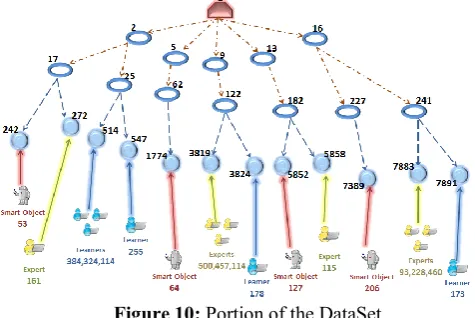
In order to simulate the environment and prove the foundation of the approach, the dataset used in the decision making process has to be very large with a high number of nodes in the learning tree and also a high number of actors (learners, smart objects, experts), otherwise, the results can't be satisfying using a dataset with a small number of patterns [72]. The Figure 10 shows a portion of the dataset containing a learning tree and three categories of actors.
Figure 10: Portion of the DataSet
In fact, the unique solution to have a large dataset with a high number of nodes is to use synthetic data. This data is generated by reproducing the original data's statistical properties [73] and this solution become an appealing alternative when there's an issue in the availability of representative data [74]. Nevertheless, the adopted approach is to generate a partially [75] synthetic data set comprising two phases :
On one hand, the first phase is the creation of all the nodes (tree nodes and actors) with respect to the features. The generation of those features will be within a defined range for each feature. That way, we guarantee the creation of all the nodes and the definition of all the features is presented in the next section.
One the other hand, the second phase is the labelling of the suggestion nodes which represents the more critical point. After the creation of all the nodes, the human expert process and assign for each suggestion node the appropriate label : Relevant or
EAI
European Alliance for InnovationEAI Endorsed Transactions on
e-Learning
11 irrelevant.(The data set is partially synthetic because the target column is generated with the human expertise that judges, process, and assigns the nodes already created in the first phase).
At the end, this generated dataset reflects the original data and is perfectly adapted to our case because there's a need of a high number of nodes and there's an issue in availability of representative data. In the future works, the original data will be used when the number of nodes of the environment will be enough in order to get a more clearer view on the results.
In the generated dataset, the total number of nodes in our environment is 9391 including : (1) the learning tree that contains 7891 nodes including 241 structural nodes (activity structure), e.g. node 9, and node 241... and also includes 7650 suggestion nodes (learning activity), e.g. node 242, node 7891... and (2) three categories of actors including 500 learners, 500 experts and 500 smart objects. The dataset was divided into training set, validation set and test set and the validation set was used to avoid over-fitting and the goal is to make a decision on the suggestion nodes (learning activity). The training set represents 70% of the data set and contains 5492 nodes, the validation set represents 15% and contains 876 nodes and the test set represents 15% and contains 876 nodes.
6.2.
The Used Features
CLE is characterized by using several heterogeneous nodes : structure node, suggestion node and actor node. In this section, we propose for each type of node its various features. It should be noted that the features listed below does not represent an exhaustive list which means that the teacher or the pedagogue can propose other features if they consider that it is necessary. For this reason, we separated between the decision making engine and the features in the pedagogical layer of CLE (see Figure 1).
Features of the suggestions
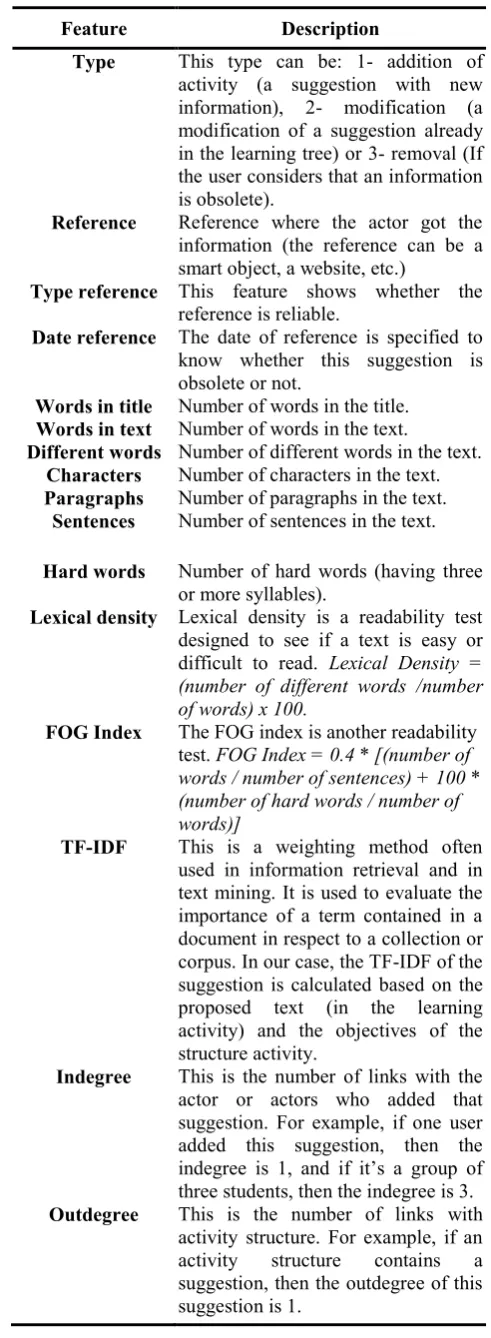
In our vision of the environment, the suggestions or learning activities can belong to one of the following types: Text, video, image, link to a resource, mixed content, etc. In our dataset, we used only the text in order to demonstrate the foundation of our approach. Suggestions or learning activities are characterized by several features listed in the table below:
Table 1. Features of suggestions
Feature Description
Type This type can be: 1- addition of activity (a suggestion with new information), 2- modification (a modification of a suggestion already in the learning tree) or 3- removal (If the user considers that an information is obsolete).
Reference Reference where the actor got the information (the reference can be a smart object, a website, etc.)
Type reference This feature shows whether the reference is reliable.
Date reference The date of reference is specified to know whether this suggestion is obsolete or not.
Words in title Number of words in the title. Words in text Number of words in the text.
Different words Number of different words in the text. Characters Number of characters in the text. Paragraphs Number of paragraphs in the text.
Sentences Number of sentences in the text.
Hard words Number of hard words (having three or more syllables).
Lexical density Lexical density is a readability test designed to see if a text is easy or difficult to read. Lexical Density = (number of different words /number of words) x 100.
FOG Index The FOG index is another readability test. FOG Index = 0.4 * [(number of words / number of sentences) + 100 * (number of hard words / number of words)]
TF-IDF This is a weighting method often
used in information retrieval and in text mining. It is used to evaluate the importance of a term contained in a document in respect to a collection or corpus. In our case, the TF-IDF of the suggestion is calculated based on the proposed text (in the learning activity) and the objectives of the structure activity.
Indegree This is the number of links with the actor or actors who added that suggestion. For example, if one user added this suggestion, then the indegree is 1, and if it’s a group of three students, then the indegree is 3. Outdegree This is the number of links with
activity structure. For example, if an activity structure contains a suggestion, then the outdegree of this suggestion is 1.
EAI
European Alliance for InnovationEAI Endorsed Transactions on
e-Learning
Anas Belahcen, Mounia Abik and Rachida Ajhoun
12
Features of the activitiy structure
According to the IMS-LD specification, each activity structure is characterized by a set of objectives. The features of these nodes are the indexes of the objectives keywords. The indegree and outdegree of the activity structure are also taken into account.
Features of the actors
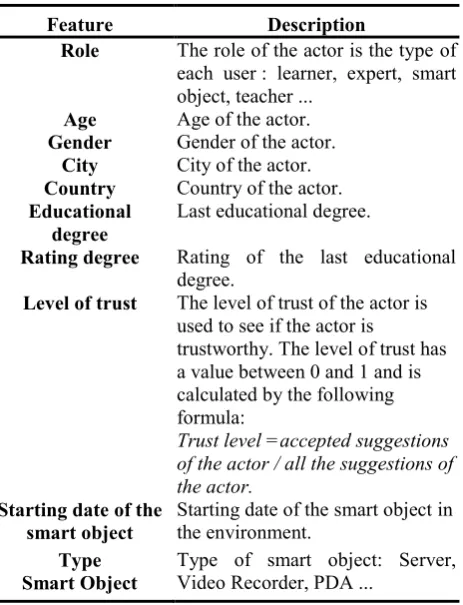
The features of the actors are extracted from their profiles and are characterized by:
Table 2. Features of actors
Feature Description
Role The role of the actor is the type of each user : learner, expert, smart object, teacher ...
Age Age of the actor.
Gender Gender of the actor.
City City of the actor.
Country Country of the actor.
Educational
degree Last educational degree.
Rating degree Rating of the last educational degree.
Level of trust The level of trust of the actor is used to see if the actor is
trustworthy. The level of trust has a value between 0 and 1 and is calculated by the following formula:
Trust level =accepted suggestions of the actor / all the suggestions of the actor.
Starting date of the smart object
Starting date of the smart object in the environment.
Type
Smart Object Type of smart object: Server, Video Recorder, PDA ...
The features of the actors are heterogeneous since they have different profiles. For example, smart objects have the online publication date but not age, gender... The level of trust, meanwhile is generic for all the actors ... These features are retrieved from the nodes profiles of our environment and do not represent an exhaustive list.
6.3. Evaluation metrics
The evaluation of the approach relies on a set of performance measures used in Machine Learning and Information Retrieval. Let us consider this confusion matrix:
Table 3. Confusion Matrix
TN represents the number of relevant patterns that were correctly classified.
FP represents the number of relevant patterns that were incorrectly classified as irrelevant.
FN represents the number of irrelevant patterns that were incorrectly classified as relevant.
TP represents the number of irrelevant patterns that were correctly classified.
The adopted measures are the Accuracy, the Precision, the Recall and the F-Measure. The formulas of these measures are listed below:
6.4.
Experimental results
After constructing the dataset with its various features, we present in this section the results obtained using two well known algorithms that are MLP Neural Network and C4.5 Decision Tree. The reason why we selected these supervised learning algorithms is their possibility to generalize for unknown patterns afterwards. The inputs of each suggestions are constructed based on 3 parts. For each suggestion, we collect (1) the features of the proposal itself, (2) the features of the activity structure containing this suggestion and (3) the features of the actor who proposed. The Figure 11 shows the construction of the vector of each suggestion.
Prediction
Relevant Irrelevant
True Label
Relevant True Negative (TN) False Positive (FP)
Irrelevant False Negative (FN) True Positive (TP)
EAI
European Alliance for InnovationEAI Endorsed Transactions on
e-Learning
13 Figure 11: Features of the suggestion
The table below shows the obtained results with the accuracy, the recall, the precision and the F-measure.
Table 4. Experimental Results
Classifier Accuracy Recall Precision F-Measure
MLP 80.05% 0.8020 0.8000 0.8010
C4.5 80.53% 0.7920 0.8140 0.8030
The MLP and C4.5 have been empirically evaluated on our dataset using WEKA [76] which is a machine learning software. From the table above, we see that the results are about the same performance on all measures. Through those experiments, we can use both the MLP neural network and the C4.5 decision tree to select the most relevant suggestions constructed by the actors in CLE which is the most crucial point in our environment.
7. Conclusion and Future Work
In this article, we presented our environment CLE, its functional architecture, its pedagogical approach and its main actors with a focus on the communication and collaboration between them. Then, we introduced the pedagogical process of CLE, its various stages. The decision making was discussed at the end by presenting the dataset, the features of the various nodes and the classification was performed using two well known supervised learning algorithms : The MLP and C4.5.
As a proof of concept, the implementation of the environment CLE was divided into several parts : (1) The first one is the definition of the profiles of all the users : (1.1) The IMS-LIP [77] specification was used to define the profiles of the learners as well as (1.2) other specific XML [78] files that were generated in order to define the profiles of the smart objects including the identification, the categories, the description, etc. [14]. (2) The second part is the IMS-LD specification that was used to schematise the learning trees which represent the courses (3) and the third one is the adoption of Open ESB [79] Services to manage the communication between the actors of the environment [69]. (4)The last part is to take advantage of Weka [76] in the decision making process
by using the MLP and C4.5 algorithms. In the future works, (1) we're going to work on the management of the workflow, the gathering all the implemented parts into the CLE environment and the design of the interactive user interface. Besides, (2) we’re going to consider all the possibilities in order to increase the accuracy of the decision making mechanism.
8. References
[1] Alexandros Paramythis and Susanne Loidl-Reisinger, Adaptive Learning Environments and e-Learning Standards, Electronic Journal on e-Learning Volume 2 Issue 1 (February 2004) 181-194
[2] Bill Bilic, What is Adaptive Learning?, May 26, 2015 Link : http://www.brightspace.com/blog/what-is-adaptive-learning/#.Vl3DC3aKH4Z
[3] Gartner Highlights the Top 10 Strategic Technologies Impacting Education in 2015, Link: http://www.gartner.com/newsroom/id/2994417 [4]
http://snapwiz.com/wp-content/uploads/2014/03/DVx_Adaptive_Learning_W hite_Paper.pdf
[5] Meg Coffin Murray and Jorge Pérez, Informing and Performing: A Study Comparing Adaptive Learning to Traditional Learning, 2015
[6] Increasing Student Achievement with Adaptive Learning Technology underwritten by Tech & Learning Survey Results, Link : http://resource-
center.newbay-media.com/resource_center/assets/tle/NewBayPlus_Dr eambox_WhitePaper_EDT_V2.pdf
[7] C Midgley, Goals, goal structures, and patterns of adaptive learning
[8] Mohammad Alshammari, Rachid Anane, Robert J. Hendley Adaptivity in E-Learning Systems
[9] Michael A. Madaio, Cybernetic Autonomy: An Analysis And Critique Of Adaptive Learning Systems, 2015
[10]Hense, J., & Mandl, H. (2012). Learning" in" or" with" Games? Quality Criteria for Digital Learning Games from the Perspectives of Learning, Emotion, and Motivation Theory. International Association for Development of the Information Society.
[11]Poellhuber, B., Chomienne, M., & Karsenti, T. (2008). The effect of peer collaboration and collaborative learning on self-efficacy and persistence in a learner-paced continuous intake model. International Journal of E-Learning & Distance Education, 22(3), 41-62 [12]Helix Education (2013). Introducing a whole new way
of teaching and learning. Accessed 12/18/14. http://www.helixeducation.com/resources/white-papers/
[13]Radich, J. (2013). Technology and interactive media as tools in early childhood programs serving children from birth through age 8.
[14]A.Belahcen et al, «Knowledge construction in the connectivist learning environment CLE », Antalya, Turkey, 10-12 October (2013).
[15]G.Siemens et al, « Connectivism: A Learning Theory for the Digital Age », (2004) [Online]. www.elearnspace.org/Articles/connectivism.htm
EAI
European Alliance for InnovationEAI Endorsed Transactions on
e-Learning
Anas Belahcen, Mounia Abik and Rachida Ajhoun
14 [16]Leslie Vaughan Flynn, Learning Theory And Its
Application To The Use Of Social Media In Medical Education
[17]M Saadatmand et al, Participants' perceptions of learning and networking in connectivist MOOCs, 2014
[18]R Lipkowsky Learning-a Connectivism Inspired Social Media Learning Environment, 2015
[19]Stephen Downes : Connectivism and Connective Knowledge
[20]Anna Sokolovskaya : Connectivist Knowledge Building, Collaborative Learning, and Social Presence in a Connectivist Massive Open Online Course: A Study of PLENK2010
[21]Quinlan, J. R. « C4.5: Programs for Machine Learning », Morgan Kaufmann Publishers, (1993), http://www.rulequest.com/Personal/
[22]Rumelhart, D, et al, « Learning Internal Representations by Error Propagation », Parallel Distributed Processing: Explorations in the Microstructure of Cognition, (1986).
[23]C.Vincenza et al, The silent reading supported by adaptive learning technology: Influence in the children outcomes, 2014
[24]Newman, A., Learning to Adapt: A Case for Accelerating Adaptive Learning in Higher Education, 2013
[25]D.Feinleib Big Data Opportunities in Education, 2015 [26]CC Chen et al, The Learning Style-Based Adaptive
Learning System Architecture, 2015
[27]Deborah Teasley , Adaptive Learning: Definition, History & Methodology, Link : http://resource-
center.newbay-media.com/resource_center/assets/tle/NewBayPlus_Dr eambox_WhitePaper_EDT_V2.pdf
[28]Knewton Adaptive Learning Building the world’s most powerful education recommendation engine
Link:
https://www.knewton.com/wp- content/uploads/knewton-adaptive-learning-whitepaper.pdf
[29]Dror Ben-Naim - Adaptive Learning 2015 Summary https://gallery.mailchimp.com/a0bfd06f7048875bba39 206eb/files/Dror_Ben_Naim_ALS_Summary.pdf [30]Jan Papousek and Radek Pelanek , Impact of Adaptive
Educational System Behaviour on Student Motivation http://www.fi.muni.cz/~xpelanek/publications/aied15. pdf
[31]M Al-Omari, A Proposed Framework to Support Adaptivity in E-learning Systems, 2015
[32]Adaptive learning : apprendre à l’ère numérique, 2015 Link : http://sydologie.com/2015/09/adaptive-learning/ [33]MP Eibenová, Adaptive learning processes in a process-oriented Learning management system, 2015 [34]KR Premlatha, Learning content design and learner
adaptation for adaptive e-learning environment: a survey 2015
[35]M.Törőcsik et al, « How Generations Think: Research on Generation Z », Acta Universitatis Sapientiae, Communication, 1 (2014) 23–45.
[36]Grail Research, « Consumers of Tomorrow Insights and Observations About Generation Z », November (2011).
[37]Claire David, « Béhaviorisme vs connectivisme : L'apport des environnements informatiques pour l'apprentissage humain dans l'hexagone », <hal-01134067>, (2015).
[38]Ireland, T. « Behaviorism, Cognitivism, Constructivism & Connectivism », (2007).
https://ci484-learning-technologies.wikispaces.com/Behaviorism,+Cognitivis m,+Constructivism+%26+Connectivism
[39]N.Thota, « Connectivism and the Use of Technology/Media in Collaborative Teaching and Learning », (2015).
[40]M.Abik et al, « IMPACT OF TECHNOLOGICAL ADVANCEMENT ON PEDAGOGY », Turkish Online Journal of Distance Education- TOJDE, January (2012).
[41]B.Cope , « Ubiquitous Learning », University of Illinois Press , (2010).
[42]Joung-Souk Sung Design of VR/AR Learning on Ubiquitous Environment
[43]Ekaterina Gilman Towards User Support in Ubiquitous Learning Systems
[44]Simone Cirani, Marco Picone, Pietro Gonizzi, Luca Veltri, and Gianluigi Ferrari, IoT-OAS: An OAuth-Based Authorization Service Architecture for Secure Services in IoT Scenarios
[45]Giancarlo Fortino, Antonio Guerrieri, Wilma Russo, Claudio Savaglio Integration of Agent-based and Cloud Computing for the Smart Objects-oriented IoT [46]Goran D. Putnik 1 Leonilde R. Varela Carlos Carvalho
Cátia Alves Vaibhah Shah Hélio Castro Paulo Ávila Smart Objects Embedded Production And Quality Management Functions
[47]H. Tschofenig et al Architectural Considerations in Smart Object Networking
[48]Nicolas Anciaux Saliha Lallali Iulian Sandu Popa Philippe Pucheral, A Scalable Search Engine for Mass Storage Smart Objects
[49]Patrick Santos, Joao Casal, Jo ˜ ao Santos, Luis Varandas, Tiago Alves, Carlos Romeiro, Sergio Lourenco : A Pervasive System Architecture for Smart Environments in Internet of Things Context
[50]Huber Flores et al, Computational Offloading or Data Binding? Bridging the Cloud Infrastructure to the Proximity of the Mobile User
[51]J.A. Pascual et al Towards a Greener Cloud Infrastructure Management using Optimized Placement Policies
[52]A.Belahcen et al, « L’apport de la virtualisation et du Cloud computing dans le domaine de l’apprentissage », JoDIC (Journées Doctorales Informatiques) à l'EMI, (2012)
[53]A.Belahcen et al, « C-MADAR Learning: cloud based learning environment » IEEE Engineering Education – EDUCON, (2012).
[54]Feng Wang, Liang Hu, Jin Zhou, and Kuo Zhao, “A Data Processing Middleware Based on SOA for the Internet of Things,” Journal of Sensors, vol. 2015, Article ID 827045, 8 pages, 2015. doi:10.1155/2015/827045
[55]Gang Pan Pervasive Service Bus: Smart SOA Infrastructure for Ambient Intelligence
[56]Irene Y.L. Chen, Ubiquitous Provision of Context Aware Web Services
[57]Carlos O. Rolim Towards a Ubiquitous Service-Oriented Architecture for Urban Sensing
[58]Koichi Egami Ubiquitous Cloud: Managing Service Resources for Adaptive Ubiquitous Computing [59]IDOUGHI Djilali An SOA based ubiquitous
computing system design framework
EAI
European Alliance for InnovationEAI Endorsed Transactions on
e-Learning
15 [60]C Bodei, Formalising security in ubiquitous and cloud
scenario
[61]A.Elhamdaoui et al « Contextual adaptability platform for mobile and ubiquitous learning: a step towards a pervasive learning environment » International Journal of Digital Information and Wireless Communications. [62][62] JY Kim, Context awareness for
Smart Ubiquitous Networks
[63] [63] R Tesoriero Distributed user interfaces in public spaces using RFID-based panels
[64]AK Mandal Mobile communication device display with graphical user interface comprising security and privacy advisor screens
[65]Syaamantak Das A Proposed Systematic User-Interface Design Framework for Synchronous and Asynchronous E-Learning Systems
[66]C Hintermüller et al Brain Neural Computer Interface for Everyday Home Usage
[67]CT Marshall, Systems and methods for presenting an interactive user interface
[68]PA Akiki Adaptive model-driven user interface development systems
[69]A.Belahcen et al, « ESB Based Communication In the Connectivist Learning Environment (CLE) » - ISKO Maghreb - Marrakech Morocco - November (2013). [70]IMS-LD : IMS Learning Design specification :
http://www.imsglobal.org/learningdesign/
[71]Alpaydin, Ethem (2010). Introduction to Machine Learning. MIT Press. p. 9. ISBN 978-0-262-01243-0. [72]S Graf, Kinshuk, Supporting teachers in identifying
students' learning styles in learning management systems: an automatic student modelling approach [73]Definition of the Information Quality Glossary , Link:
https://definedterm.com/synthetic_data
[74]Yaling Pei et al, A synthetic data generator for clustering and outlier analysis
[75]H Quick et al, Generating partially synthetic geocoded public use data with decreased disclosure risk using differential smoothing, 2015
[76]WEKA: Waikato Environment for Knowledge Analysis, www.cs.waikato.ac.nz/~ml/weka
[77]IMS Learner Information Package Specification, Link : http://www.imsglobal.org/profiles/index.html [78]Extensible Markup Language Link :
www.w3schools.com/xml
[79]Open ESB Link : www.open-esb.net/
EAI
European Alliance for InnovationEAI Endorsed Transactions on
e-Learning