Keywords
Highlights
Abstract
Graphical abstract
34
Research Paper
Received 2017-03-18 Revised 2017-06-09 Accepted 2017-06-15 Available online 2017-06-15
Mixed Matrix Membranes PEBA
Polyethylene glycol Carbon nanotubes Gas mixture
• PEBA/PEG/CNT MMMs have been successfully fabricated via solution casting method • Good CNT dispersion in PEBA polymer has been achieved
• Presence of ether groups in PEG improved CO2 permeability and selectivity Mixed Gas test showed the negative eff ect of plasticization
• Incorporation of both CNT and PEG enhanced separation performance of PEBA membrane
Eff ect of Ethylene Oxide Functional Groups in PEBA-CNT Membranes on CO
2/CH
4Mixed
Gas Separation
1 Separation Processes Research Group (SPRG), Department of Engineering, University of Kashan, Kashan, Iran 2 Energy Research Institute, University of Kashan, Ghotb-e-Ravandi Ave., Kashan, Iran
Morteza Asghari
*,1,2, Morteza Afsari
1Article info
© 2018 MPRL. All rights reserved.
* Corresponding author at: Phone: +98 315 591 2427; fax: +98 315 591 2424 E-mail address: [email protected] (M. Asghari)
DOI: 10.22079/jmsr.2017.61016.1131
1. Introduction
Environment protection, decrease in heat capacity, and increase in corrosion of pipelines are some main reasons for elimination of acidic gasses (CO2, H2S) from natural gas [1,2]. Recently membrane technology
has attracted the attention of many scientists toward gas separation fi eld
by using various types of membranes, including organic and inorganic
membranes. Mixed Matrix Membranes (MMMs) are a type of membrane
that cover benefi cence of both organic and inorganic membranes [3,4]. In
general, addition of inorganic fi llers to polymer has two opposite eff ects and
the optimum point of nanoparticle loading should be chosen [5,6].
First studies on MMM was carried out by using zeolite as fi ller in
Journal of Membrane Science & Research
journal homepage: www.msrjournal.com
Poly (ether-block-amide) /poly (ethylene glycol)/ carbon nanotubes mixed matrix membranes have been successfully fabricated using solvent evaporation method to determine the eff ect of ethylene oxide groups on the performance of fabricated membranes. The eff ects of CNTs (2-8 wt%) and PEG (up to 50 wt%) were investigated in both single and mixed gas test setup in diff erent temperature and pressure. Finally the membranes were structurally characterized using Scanning Electron Microscopy, X-Ray Diff raction, Fourier Transform Infrared Spectroscopy, and Atomic Force Microscopy. Results showed that addition of carbon nanotubes enhanced the gas separation performance of membranes and presence of ether groups in poly ethylene glycol improved the CO2 permeability. Membrane containing 8 wt % carbon nanotubes and 50 wt% poly ethylene glycol showed the best performance with CO2/CH4 selectivity and CO2 permeability of 45 and 302, respectively, at 14 bars operating pressure. Moreover, mixed gas permeation experiments were carried out and results showed dramatic decrease in CO2 selectivity due to membrane plasticizing. The permeability of CO2 in mixed gas test for membrane containing 50 wt% polyethylene glycol and 8 wt% carbon nanotubes was 193 with CO2/CH4 selectivity of 19 at ambient enviroenment. Furthermore, membranes fabricated by 6 and 8 wt% carbon nanotubes and 50 wt% polyethylene glycol placed above Robeson’s trade-off line. The eff ect of temperature on performance of fabricated membranes was fi nally investigated. Results showed an increase in permeability and decrease in selectivity for all membranes.
http://www.msrjournal.com/article_25854.html
DOI: http://www.msrjournal.com/article_25854.html
polymeric matrix. Hennepe and co-workers used zeolite based MMM in pervaporation and gas separation experiences. Results showed that addition of NaX and AgX zeolite particles to PDMS increased both selectivity and permeability of ethane/ethylene mixture [7]. Some researchers also used brilliant properties of carbon nanotubes (CNT) like the high aspect ratio, excellent mechanical, thermal and electrical properties to enhance the performance of polymeric membranes [5,8,9].
Line and Freeman investigated the effect of different precursors for fabrication of membranes for CO2 elimination from gas mixtures. According
to this report, polymers which contain ethylene oxide (EO) functions showed good CO2 separation performance [10]. PEBA is a thermoplastic copolymer
comprised of polyamide groups as its hard segments and polyether groups, like PEO, as its soft segments. Presence of ether oxide segments can enhance the efficiency of PEBA-based membranes for separation of high polarity gasses like CO2[11,12].
For the same reason, addition of PEG can improve CO2 permeation
through membranes. PEG polymer has ability to solve acidic gasses and have good CO2 affinity. This property caused recent research goes toward using
PEG/polymer membrane for CO2 separation. literature review have shown
good CO2 permeability and selectivity and sufficient mechanical stability for
these membranes [13,14]. Studies on effect of CO2 on PEG showed that
moving chains of PEG polymer enhance the solubility of CO2 in
polymers.Some studies showed that CO2 has high solubility tendency into low
molecular weight PEG due to presence of ether groups which are more polar and attract polar molecules [15,16]. Computer studies of Garzón revealed that difference in electronegativity of C and O atoms causes specific interactions between CO2 molecules, which has quadric polar moment, by ether links in
PEG structure [17]. Studies on membranes composed of poly ethers like poly(ethylene glycol) diacrylate (PEGda) or poly(propylene glycol) diacrylate (PPGda) satisfied this explanation and showed high CO2 selectivity and
permeability [18]. Also Wang et al. studied on the effect of different PEGs on structure and performance of PEBA MMM and revealed that crystallinity of membranes can be improved by using high molecular weight PEG [13].
By noticing to superb advantageous of PEBA polymer and PEG and CNT additives, a broad study about the important factors which effect on separation performance of MMMs is necessary [19]. To the best of our knowledge, there is no published result in the open literature that have focused on the optimized percentage of additives and on the behavior of interaction of poly ether groups and gases in different pressure and temperature condition. This research was focused on fabrication of membranes comprised of PEBA, CNT, and PEG in different percentages for separation of CO2 from natural gas. In this work, effect of different factors
such as percentage of CNT and PEG in polymer matrix and also influences of temperature and pressure on CO2 selectivity and permeability were
investigated. Additionally in order to surveying characteristics of membranes, permeation test and structural analysis were carried out in both single and mixed gas setup.
2. Experimental
2.1. Materials
There are some available grads of PEBA like 1657, 6100 and 1205 but 1657 type showed good efficiency for CO2/CH4 separation [20]. In this work,
PEBAX 1657 was chosen for continuous phase of MMM and purchased from ARKEMA Company. Ethanol was supplied by Merc. In order to diminish crystallinity of membrane, low molecular weight PEG was used as dispersed phase (PEG200) [13,21]. PEG 200 was bought from LOBA Chemie. CNT used in this study was multi wall carbon nanotubes (MWNTs) and were bought from Notrino with 10-20 nm diameter, 30 μm length, and 200 m2/g
surface area. CO2 and CH4 cylinders were supplied from Roham Gas Co. with
purity of 99.99%.
2.2. Membrane preparation
2.2.1 Neat PEBA polymeric membrane
PEBA is a hydrophilic polymer and it should be placed into oven at 60 oC
to remove the whole of adsorbed solvent and moisture. Water-ethanol mixture by volumetric proportion of 30/70 was identified as best solvent, so polymer was added to water/ethanol solvent to prepare 8 wt% (polymer based) solution [22–24]. Solution was stirred at temperature of 75 oC for 4 hr and
then put in ultrasonic bath for 15 minutes. Solution was cast on the glass plate, using 200 micrometer casting knife, to produce a flat thin membrane. The final thicknesses of membranes are about 60 micrometer, evaluated using precise micrometer.
2.2.2 Mixed Matrix Membranes:
CNTs were added to solvent and placed in to ultrasonic bath for 1 hr to acquire high dispersed CNT. Then polymer was gradually added to it and stirred at 75 oC for 4 hr. Prepared solution was casted on smooth glass plate
and then dried in room temperature for 3 hr. Remained solvent has been evaporated overnight in oven at 60 oC.
For manufacturing of PEBA/PEG membrane, PEG was added to solvent and stirred for 2 hr. Then, like previous section, polymer was gradually added to it.
In this study, MMMs by different loading of CNTs and PEG were produced. To produce PEBA/CNT/PEG MMM, desired amount of PEG and CNTs were added to solvent and stirred for 4hr. Then, polymer was added to obtain a homogenous solution. Solution was casted and dried in ambient condition like previous samples.
2.3. Membrane characterization
A number of characterization methods have been applied on prepared membranes to determine quality and structure of membranes: XRD analysis was carried out to determine structure of membrane using Ni-filtered Cu Ka radiation by a Philips-X’pertpro, X-ray diffractometer. SEM images were taken to describe morphology of MMMs and dispersion of nano particles. LEO-1455VP which was fitted with an energy dispersive X-ray spectroscopy was used to get SEM images. In order to discovering polymeric bonds and presence of functional groups, Nicolet Magna-550 spectrometer recorded Fourier transform infrared (FTIR) spectra in KBr pellets at room temperature in the range of 400–4000 cm-1 and resolution of 4 cm-1 for each spectrum and
finally Samples in dimensions of 10 μm × 10 μm were taken for AFM analyzing. AFM analysis was conducted using tapping mode of NT-MDT Solver P47 (The Moscow, Russia) with a spatial resolution of ~2 nm in z direction, and used to find surface morphology of membranes.
2.4. Gas separation experiments
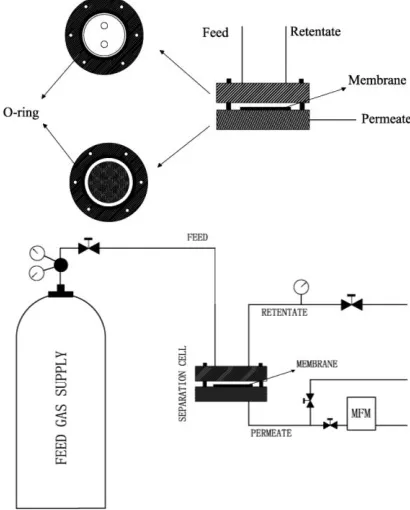
Permeation tests were carried out in a stainless steel cylindrical module with effective diameter of 30.86 cm2. Figure 1 shows schematic of module
and permeation test setup. The permeation tests of gases was carried out in pressure range of 6-14 bar and temperature range of 25 to 40 oC, and data was
measured using simple soap flow meter for single gas setup. For mixed gas permeation test, permeability was evaluated by gas chromatography setup (Varian CP-3800, column PORAPAK Q).
CO2 and CH4 gases with proportion of 50-50 were entered into a cylinder
to prepare homogenous mixed gas.
In this study both single and mixed gas tests were carried out and permeation of gasses was measured in different pressures. In steady state conditions, permeability and selectivity were calculated from following correlation [25].
(1)
(2)
which PA is permeability (barer), T0 and T are standard and ambient
temperature (K), P0and P are standard and ambient pressures (cm Hg), Q is
volumetric flow rate (cm3/s), L is membrane thickness (cm), A is effective
membrane area (cm2), and P is pressure difference in two sides of
membrane (cm Hg). α AB is ideal selectivity of A respect to B.
Gasses used in this research were CO2 and CH4 which have kinetic
diameter of 3.3 Å and 3.8 Å, respectively. Chemical structure of PEBA compound and PEG200 are depicted in Figure 2.
(a)
(b)
Fig. 2. Chemical structure of (a) PEBAX 1657 [26], and (b) PEG 200.
Table 1
Details of produced membranes.
Membrane code Membrane composition
Neat PEBA
C2 PEBA/CNT 2% wt.
P50 PEBA/PEG 50% wt.
P10C2 PEBA/PEG 10%wt./CNT 2% wt.
P20C2 PEBA/PEG 20%wt./CNT 2% wt.
P30C2 PEBA/PEG 30%wt./CNT 2% wt.
P40C2 PEBA/PEG 40%wt./CNT 2% wt.
P50C2 PEBA/PEG 50%wt./CNT 2% wt.
P50C4 PEBA/PEG 50%wt./CNT 4% wt.
P50C6 PEBA/PEG 50%wt./CNT 6% wt.
P50C8 PEBA/PEG 50%wt./CNT 8% wt.
In order to investigate the effect of PEG and CNT, various membranes with different percentage of PEG and CNTs were produced. Details of produced samples are tabulated in Table 1. Additionally some efforts have been done to produce membranes containing more than 50 wt% PEG, but they didn’t have adequate strength and mechanical stability, especially in high pressures. All experiments repeated to ensure accuracy and repeatability of membranes.
3. Results and discussion
3.1. XRD
XRD results for the neat and MMM membrane with 50% PEG and 2% CNT are shown in Figure 3. A broaden peak can be observed in the range of 15o to 25o degree which shows integration of both hard and soft parts of
copolymer [27]. According to this figure, polymer has semi–crystalline structure which shows interconnection of hard part of polymer (polyamides) with soft parts. Neat PEBA polymer has some peaks in 2θ = 21o and 23 o with
intensity of 380 and 416, respectively [28]. These peaks describe strong hydrogen bonding between polyamide chains. Therefore additions of CNT and PEG weakened these hydrogen bonds and decreased intensity of peaks in 21o, which means crystallinity of MMM decreased relative to neat PEBA
[29].
Fig. 3. XRD spectra for neat polymer and MMM.
Additionally, graph showed peak value of 23oreached to value of 501,
which this increase could be attributed to elaboration of membrane crystallinity by addition of CNTs [13].
3.2. SEM
In order to prepare samples for SEM image, samples were placed in liquid nitrogen to prepare defect-free cross sections. Figure 4 shows SEM images for neat and MMM membranes with different CNT and PEG loadings. In general, SEM images show absolutely dense morphology without any defect for all neat and MMMs and, therefore, qualify effectiveness of production procedures.
Compatibility between CNT and PEBA are shown in Figure 4 for both 2% and 8% CNT loading (ii-iv). These images specifically show that no CNT aggregations were found in PEBA/PEG/CNT membranes. Figure 4d shows PEBA/PEG MMM which contains 50% PEG.
(a) (b) (c) (d)
3.3. FTIR
Molecular structure of polymers was investigated by FTIR to ensure about structure of polymer and exploring any defects which may be produced during production steps in thermal operations, ultrasonic bath or casting step. Literature revealed that addition of nanoparticles or additives could improve performance of membrane when a powerful interaction between polymer and nanoparticles was formed [30].
FTIR results for neat and blended membrane samples are shown in
Figure 5. Peaks located in1109 cm -1 and 1733 cm-1, respectively, represent –
C-O- and –C=O stretching vibration bonds. The absorption bands in 1637 and 3302 cm-1 show H-N-C=O and N-H bonds of PA structure. Wavenumbers
of 2869 and 2930 cm-1 belong to symmetric and asymmetric aliphatic groups
(-C-H) which their intensity attenuated after addition of PEG and CNTs. This change can be attributed to physical interaction between polymer and CNTs [31]. C=O group is detectable in wavenumber of 1657 cm-1. Ether groups
(C-O-C) can be detected at 1040 cm-1. Obtained results, definitely, show that
membrane production made no destruction in structure of polymer.
Fig. 5. FTIR results of neat PEBA membrane.
Furthermore C-O-H bonds, relevant to PEG polymer can be observed in 1544 cm-1and 1259 cm-1. In 1540 cm-1 peaks of O=C-NH could be also
observed, therefore in this area intensity of peaks is stronger. Also peaks at 1039 cm-1 belongs to ether groups of both PEG and PEBA.
Comparison between neat and MMMs revealed that position of peaks for some groups slightly has changed, which suggest existence of some interactions between PEBA polymer and PEG or CNTs. Shifting he peaks of –N-H and –C=O to lower wave numbers in MMM indicates that addition of PEG enhanced H-bond formation. Also position of C-O-C ether groups shifted to lower wave numbers and could be deduced that H-bond was formed between PEG and PA segments and therefore good interaction between PEG and PEBA has formed [32].
Presence of CNT can shift peaks in 1100 cm-1 to lower frequency. High
intensity of peaks in this wavenumber can suggest the good physical blending and chemical stability of matrix and additive polymers. By comparing the graphs, it is also revealed that MWCNT may influence on the C-O and C-H stretching vibration of EO segments through hydrogen bonding interaction
[31].
Furthermore peaks of 1463 cm-1 can be attributed to existence of
MWCNTs, although CNTs are black bodies and in FTIR test they can adsorb most of IR lights and therefore derived spectrum is not clearly reliable to detect them and FTIR spectrum may have some noise.
3.4. AFM
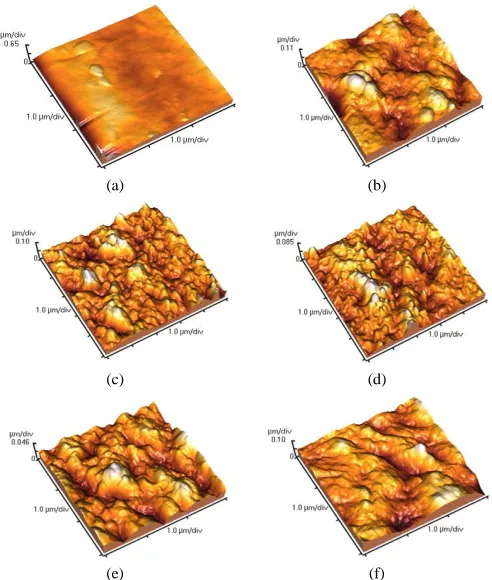
Topography of membrane surface can be significantly explored using AFM technique. Figure 6 shows AFM results for different membranes. Samples in dimensions of 10 μm×10 μm were taken for AFM analyzing.
As figures show, surface rippling increased with PEG and CNT loading which could be attributed to the formation of bonding between polymer and additives, as previously shown in FTIR spectra results. The formation of H-bonds decreases the fluidity of polymer dope in the stage of solvent evaporation and, as a result, the roughness of surface of MMMs respect to neat ones dramatically increased. Therefore surface area of membranes increased and, consequently, the permeability of membranes increased. Good adhesion between polymer and CNT are revealed in AFM results.
(a) (b)
(c) (d)
(e) (f)
Fig. 6. Surface morphology of membranes obtained by AFM: (a) neat PEBA, (b) MMM with 2% CNT and 10% PEG, (c) MMM with 2% CNT and 50% PEG, (d) MMM with 8% CNT and 50% PEG, (e) MMM with 50% PEG, and (f) MMM with 2% CNT.
3.5. Single Gas Permeability and Selectivity experiments
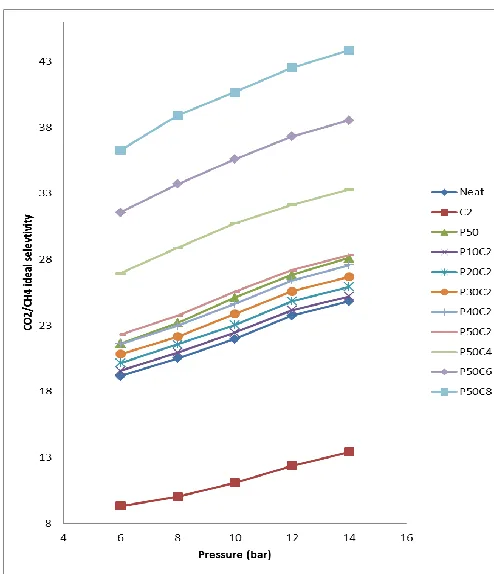
An efficient membrane should have high value of both selectivity and permeability [33]. Figures 7 and 8 show permeability and selectivity trends of prepared membranes versus pressure. Results show that the CO2 permeability
and the CO2/CH4 selectivity for all membranes increased with PEG and CNT
loading and pressure increment. While permeability of CO2 for the neat
membrane is less than 105 barrer, addition of CNT or PEG enhanced the permeability to about 200 barrer. This value rises to over 302 barrer when both CNT and PEG were added to the polymer, as shown in Figure 7.
CNT has a good affinity to adsorb CO2, so by increase in CNT lading its
permeability and selectivity increases. Also CO2 adsorption on CNTs
increases by pressure and, therefore, the CO2 selectivity increases. By
addition of CNT as filler, small accumulations are formed by gathering some CNT particles. Addition of more CNTs leads to reach to critical point of filler loading, which is called Percolation Threshold [21]. For PEBA/CNT MMM, this value estimated to be 8 wt% of CNT. According to Figure 7, the CO2
permeability versus pressure increases by lower rate for the neat polymeric membrane and the PEBA/PEG MMM relative to CNT containing membranes. In general, PEBA/CNT/PEG MMMs by 50% loading of PEG and 8% loading of CNT give highest permeability value, equal to 302 barrer, whereas the CO2 permeability for neat polymeric membrane reached to 105
barrer. MMM with presence of solo CNT showed the permeability of 211, and membrane with PEG showed permeability of 191 under the best condition.
As be observed in Figure 8, the PEBA/PEG membrane showed higher increment rate of selectivity relative to other samples. The highest CO2/CH4
selectivity belongs to PEBA/PEG/CNT by 50% PEG and 8% CNT loading, with value of more than 43. This value for the neat membrane was 25 and for the CNT containing membrane was 13.
Considering the C2 membrane, which fabricated with only 2 wt% CNT, reveals that it has relatively high CO2 permeability and low selectivity. This
trait could be attributed to some defects on this membrane. It shows that weak adhesion of polymer-CNT made some cracks in membrane structure and this defect caused increasing the permeability and decreasing the CO2/CH4
of membranes decreases with PEG loading and, therefore, the CO2 interaction
with EO unit increases and the CO2 permeability rises. Also, PEG polymer
increases free volume of copolymer and, as a result, diffusion coefficients of membrane increases. Experimental results satisfy this description very well.
Fig. 7. CO2 permeability results of neat and different MMMs.
Fig. 8. CO2/CH4 selectivity for manufactured membranes.
As mentioned earlier, AFM results showed that addition of additives increases the surface area of the membranes and consequently enhance the gas permeability. Also, FTIR results in Figure 5 revealed that by addition of PEG and CNTs, interaction between the polymer and additives increased and this result demonstrates that no voids were formed between PEBA, PEG, and CNTs during blending. This description was experimentally verified as are shown in Figures 7 and 8.
Figure 9 shows the position of fabricated membranes in upper bound curve drawn by Robeson in 2008 and 1991 and comparison of the best prepared membranes by previous studies. Membranes fabricated by addition of CNTs from 2 to 8% with loading of 50% PEG gave points above Robeson's trade off curve (2008) and it can be concluded that they can be applied in commercial scale. As could be observed in Figure 9, the neat membrane has very low selectivity due to its rubbery characteristics and is not suitable for industrial usage. However, incorporation of PEG or CNT enhanced the selectivity of fabricated membranes: MMM uses the beneficence of high permeability of polymeric matrix and high selectivity of nanofillers and therefore membranes could place above the Robeson line.
Fig. 9. Position of produced MMM in Robeson's trade off curve.
3.6. Mixed gas tests
Lots of studies have carried out about gas separation processes in single gas test mode. Although single gas tests gain adequate data to evaluate the performance and efficiency of fabricated membranes, but real gas separations are performed in mixed conditions. To obtain more accurate results and discovering the effect of different parameters like gas interactions and plasticization, mixed gas test have been carried out in this study.
A gas mixture was prepared by mixing 50% CO2 and 50% CH4 in
pressure of 12 bar. To determine the effect of temperature on the membranes performance, mixed gas experiments were carried out at the temperature range of 298-313 K. Gas fluxes for this mixture in different membranes are shown in Figure 10.
Fluxes for all samples increased with temperature, although membranes which contain both CNT and PEG showed more rapid increment rate. These results have coincidence with loosens of polymer chains in upper temperatures. Like single gas test data, the PEBA/PEG/CNT membrane sample with 50% PEG and 8% CNT showed greatest permeation value, which was about 193 barrer. This value for the neat membrane was 131 under the best conditions. Also, the permeability values for PEBA/CNT (C2) and PEBA/PEG (P50) membranes were 16 and 158, respectively.
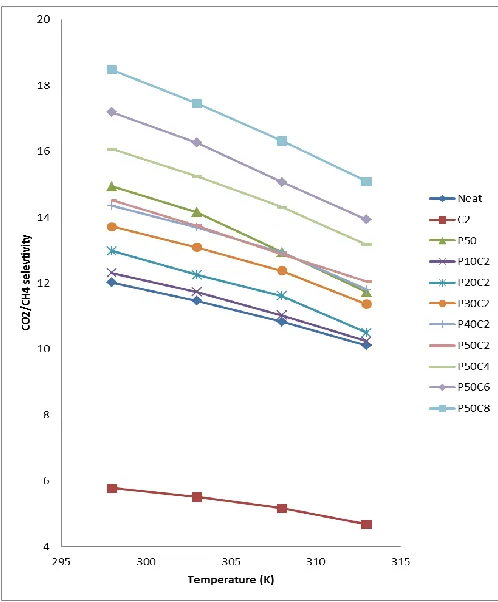
Selectivity values of different membranes in mixed gas feed are shown in
Figure 11. Selectivity for all samples decreased versus the temperature and PEBA/PEG MMM with 50% PEG showed the most rapid rate. Also, PEBA/PEG/CNT by 50% PEG and 8% CNT showed greatest selectivities in the mixed gas test mode. This change could be attributed to the CO2
interactions by the MMM segments. Temperature increment causes the weakness of CO2 interactions by the EO groups and carbon parts of
membrane, but it does not have such a powerful impact on the CH4
interaction. Therefore, temperature increments can diminish the CO2/CH4
selectivity.
Figure 12 shows the comparison of CO2 permeability in two studied
conditions: Mixed gas and single gas test modes. It is obvious that the CO2
permeability in the mixed gas is lower than that of the single gas results. Relative to single gas results, the CO2 permeation in mixed gas condition
increment. This change could be attributed to the plasticization effect, which causes polymer swelling and increase in membrane free volume and the CO2
permeability.
Fig. 10. CO2 Permeability in mixed gasses for all manufactured membrane.
Fig. 11. CO2/CH4 selectivity vs. temperature for all samples in mixed gas feed.
Fig. 12. CO2 permeability comparison for both mixed and single gas test.
4. Conclusions
By noticing to the remarkable properties of PEBA, which recognized in previous studies (e.g., good permeability and selectivity, chemical resistivity and its price) it was chosen as an adequate polymer for membrane production. This type of membrane could be used for removal of acidic gases from natural gas or flue gas streams. MWCNT and PEG200 were selected to improve efficiency of membrane. Results revealed that CNT loading in the range of 2 to 8 wt.% could have positive effect and PEG percentages between 10-50% shows superb results in gas separation. Best results have gained in MMM with 8wt% loading of CNT and 50wt% loading of PEG. Selectivity increased by addition of both CNT and PEG. Mixed gas test showed that plasticization affected on the MMM performance and decreased the CO2 selectivity.
Temperature increased the permeability for all membranes but decreased the CO2 selectivity.
5. Acknowledgments
The authors are grateful to Energy Research Institute at University of Kashan for supporting this work.
References
[1] S. Alexander Stern, Polymers for gas separations: the next decade, J. Membr. Sci. 94 (1994) 1–65
[2] P.D. Sutrisna, J. Hou, H. Li, Y. Zhang, V. Chen, Improved operational stability of Pebax-based gas separation membranes with ZIF-8: A comparative study of flat sheet and composite hollow fiber membranes, J. Membr. Sci. 524 (2017) 266–279.
[3] M.N. Nejad, M. Asghari, M. Afsari, Investigation of carbon nanotubes in mixed matrix membranes for gas separation: a review, ChemBioEng Rev. 3 (2016) 276-298.
[4] K. Li, H. Liang, F. Qu, S. Shao, H. Yu, Z. shuang Han, X. Du, G. Li, Control of natural organic matter fouling of ultrafiltration membrane by adsorption pretreatment: Comparison of mesoporous adsorbent resin and powdered activated carbon, J. Membr. Sci. 471 (2014) 94–102.
[5] D. Zhao, J. Ren, Y. Wang, Y. Qiu, H. Li, K. Hua, X. Li, J. Ji, M. Deng, High CO2
separation performance of Pebax®/CNTs/GTA mixed matrix membranes, J. Membr.
Sci. 521 (2017) 104–113.
[6] B. Freeman, Y. Yampolskii, Membrane gas separation, John Wiley and Sons, Ltd., West Sussex, UK, 2010.
[7] H.J.C. te Hennepe, D. Bargeman, M.H.V. Mulder, C.A. Smolders, Zeolite-filled silicone rubber membranes, J. Membr. Sci. 35 (1987) 39–55
[8] S.M. Fatemi, M. Foroutan, Review on carbon nanotubes and carbon nanotube bundles for gas/ion separation and water purification studied by molecular dynamics simulation, Int. J. Environ. Sci. Technol. 13 (2015) 457–470.
[9] H. Susanto, A.M. Samsudin, N. Rokhati, I.N. Widiasa, Immobilization of glucose oxidase on chitosan-based porous composite membranes and their potential use in biosensors, Enzyme Microb. Technol. 52 (2013) 386–392.
[10] H. Lin, B.D. Freeman, Materials selection guidelines for membranes that remove CO2 from gas mixtures, J. Mol. Struct. 739 (2005) 57–74.
[11] E.I. Unuabonah, B.I. Olu-Owolabi, K.O. Adebowale, Competitive adsorption of metal ions onto goethite–humic acid-modified kaolinite clay, Int. J. Environ. Sci. Technol. 13 (2016) 1043–1054
[12] I. Khalilinejad, H. Sanaeepur, A. Kargari, Preparation of poly(ether-6-block amide)/PVC thin film composite membrane for CO2 separation: effect of top layer
[13] S. Wang, Y. Liu, S. Huang, H. Wu, Y. Li, Z. Tian, Z. Jiang, Pebax-PEG-MWCNT hybrid membranes with enhanced CO2 capture properties, J. Membr. Sci. 460
(2014) 62–70.
[14] N. Azizi, T. Mohammadi, R.M. Behbahani, Synthesis of a new nanocomposite membrane (PEBAX-1074/PEG-400/TiO2) in order to separate CO2 from CH4, J.
Nat. Gas Sci. Eng. 37 (2017) 39–51.
[15] V.I. Bondar, B.D. Freeman, I. Pinnau, Gas transport properties of poly(ether-b-amide) segmented block copolymers, J. Polym. Sci. Part B Polym. Phys. 38 (2000) 2051–2062.
[16] K. Okamoto, M. Fujii, S. Okamyo, H. Suzuki, K. Tanaka, H. Kita, Gas permeation properties of poly(ether imide) segmented copolymers, Macromolecules 28 (1995) 6950–6956.
[17] B. Garzo, L.F. Rull, Computer simulation of vapor-liquid equilibria of linear dipolar fluids: Departures from the principle of corresponding states, J. Chem. Phys. 102 (1995) 7204–7215.
[18] N.P. Patel, M.A. Hunt, S. Lin-Gibson, S. Bencherif, R.J. Spontak, Tunable CO2
transport through mixed polyether membranes, J. Membr. Sci. 251 (2005) 51–57.
[19] Y. Labreche, Functionalized polymeric membranes for CO2 capture, J. Membr. Sci.
Res. 2 (2016) 59–65
[20] S. Sridhar, T.M. Aminabhavi, S.J. Mayor, M. Ramakrishna, Permeation of carbon dioxide and methane gases through novel silver-incorporated thin film composite pebax membranes, Ind. Eng. Chem. Res. 46 (2007) 8144–8151.
[21] A. Car, C. Stropnik, W. Yave, K. V. Peinemann, PEG modified poly(amide-b-ethylene oxide) membranes for CO2 separation, J. Membr. Sci. 307 (2008) 88–95.
[22] H.W. Yen, Z.H. Chen, I.K. Yang, Use of the composite membrane of poly(ether-block-amide) and carbon nanotubes (CNTs) in a pervaporation system incorporated with fermentation for butanol production by Clostridium acetobutylicum, Bioresour. Technol. 109 (2012) 105–109.
[23] T. Wu, N. Wang, J. Li, L. Wang, W. Zhang, G. Zhang, S. Ji, Tubular thermal crosslinked-PEBA/ceramic membrane for aromatic/aliphatic pervaporation, J. Membr. Sci. 486 (2015) 1–9.
[24] S. Liu, G. Liu, X. Zhao, W. Jin, Hydrophobic-ZIF-71 filled PEBA mixed matrix
membranes for recovery of biobutanol via pervaporation, J. Membr. Sci. 446 (2013) 181–188.
[25] H. Cong, J. Zhang, M. Radosz, Y. Shen, Carbon nanotube composite membranes of brominated poly(2,6-diphenyl-1,4-phenylene oxide) for gas separation, J. Membr. Sci. 294 (2007) 178–185.
[26] J.P. Sheth, J. Xu, G.L. Wilkes, Solid state structure-property behavior of semicrystalline poly(ether-block-amide) PEBAX® thermoplastic elastomers,
Polymer 44 (2002) 743–756.
[27] S. Wang, Y. Liu, S. Huang, H. Wu, Y. Li, Z. Tian, Pebax–PEG–MWCNT hybrid membranes with enhanced CO2 capture properties, J. Membr. Sci. 460 (2014) 62–
70.
[28] S.G. Lovineh, M. Asghari, G. Khanbabaei, CO2 permeation through
poly(amide-6-b-ethylene oxide)-nanosilica membranes, Appl. Surf. Sci. 318 (2014) 176–179.
[29] S. Liu, G. Liu, J. Shen, W. Jin, Fabrication of MOFs/PEBA mixed matrix membranes and their application in bio-butanol production, Sep. Purif. Technol. 133 (2014) 40–47.
[30] K. Nath, Z.B. Maroulis, D.S. George, Membrane separation processes, Food Process Des. 8 (2008) 336-338.
[31] X. Zheng, Q. Xu, Comparison study of morphology and crystallization behavior of polyethylene and poly(ethylene oxide) on single-walled carbon nanotubes, J. Phys. Chem. B. 114 (2010) 9435–9444.
[32] M. Asghari, A. Mahmudi, V. Zargar, G. Khanbabaei, Effect of polyethyleneglycol on CH4 permeation through poly(amide-b-ethylene oxide)-based nanocomposite
membranes, Appl. Surf. Sci. (2014) 218–222.
[33] N.N. Li, A.G. Fane, W.S.W. Ho, T. Matsuura, Advanced membrane technology and applications, John Wiley and Sons, Ltd., West Sussex, UK, 2008.
[34] Y. Li, T.-S. Chung, Molecular-level mixed matrix membranes comprising Pebax®
and POSS for hydrogen purification via preferential CO2 removal, Int. J. Hydrogen
Energ. 35 (2010) 10560–10568.