728
High speed area efficient polynomial multiplication
architecture for Ring-LWE and SHE cryptosystems
Lakshmi.S1 and Deepa N R2 1
PG Scholar, Department of Electronic and communication Engineering, Federal Institute of Science & Technology, Angamali, India. Email: [email protected]
2
Assistant Professor, Department of Electronic and communication Engineering,Federal Institute of Science & Technology, Angamali, India. Email:[email protected]
Abstract : In ring-learning with errors (ring-LWE) encryption and "somewhat" homomorphic encryption (SHE) cryptosystems polynomial multiplication is the basic and most time consuming exhausting operation. In this paper, for the design of the area efficient polynomial multiplier a fast Fourier transform (FFT) is used.. To simplify the control of the architecture a constant geometry FFT datapath is used in the computation. The contribution of this work is three-fold. First, parameter sets that supports both an efficient modular reduction design and the security requirements for ring-LWE encryption and SHE are calculated. Second, a versatile pipelined architecture accompanied with an improved dataflow are proposed to obtain a high-speed polynomial multiplier. Third, the proposed architecture supports polynomial multiplications for different lengths and moduli.
Keywords– Cryptography, FFT, Field -Programmable Gate Array (FPGA), Negative wrapped convolution, Number Theoretic Transform, Pipelined Architecture, Polynomial multiplication, Ring-LWE,SHE
1. Introduction
729
In this paper, versatile pipelined hardware architecture is designed for the high-speed polynomial multiplication. The target of our work is to facilitate users‘ efficient design of cryptosystems like ring-LWE and SHE. In our work, the fast Fourier transform (FFT) with line arithmetic complexity and parallel inter-stage computation, is exploited in the design of such polynomial multiplier. The main contributions of this paper are as follows:
Parameter set selection method which supports both efficient modular reduction and the security requirement for ring-LWE encryption and SHE are analyzed and provided;
A generic high speed pipelined architecture along with an improved dataflow are designed to exploit the parallelism in polynomial multiplication;
The proposed parameterized architecture supports the computation of polynomial multiplication for different lengths and moduli, in this paper, the fast Fourier transform (FFT), is exploited in the design of a high-speed polynomial multiplier. A constant geometry FFT datapath is used in the computation to simplify the control of the architecture [8]. The contribution of this work is three-fold. First, parameter sets which support both an efficient modular reduction design and the security requirements for ring-LWE encryption and SHE are provided. Second, a versatile pipelined architecture accompanied with an improved dataflow is proposed to obtain a high-speed polynomial multiplier. Third, the proposed architecture supports polynomial multiplications for different lengths and moduli.
2. Polynomial multiplication
Suppose a(x) and b(x) are two polynomials. The multiplication of a(x) and b(x) by using the school-book algorithm is calculated as
2.1 Polynomial Multiplication Over Finite Field
Ideal lattices, which define ideals in the ring Zp[x]/f(x) for some irreducible polynomial f(x) of degree n , are good tools for the construction of various cryptographic schemes. Here, we focus on the commonly used case in Which f(x)≡xn+1 , is a power of 2, and is a prime number with p≡1 mod 2n
[4] . It can simplify the polynomial [1] multiplication as
In mathematics, a finite field or Galois field (so-named in honor of Évariste Galois) is a field that
contains a finite number of elements. The most common examples of finite fields are given by the
integers mod p when p is a prime number. The number of elements of a finite field is called its order. A
finite field of order q exists if and only if the order q is a prime power pk .
2.2 Polynomial Multiplication Using FFT
Polynomial multiplication in Zp using FFT is more efficient than normal cyclic convolution. One way to do this is by zero padding, Let w be the primitive 2n-th root of unit in Zp,and let the coefficients are a=(a0,a1,....an-1 ),b=(b0,b1,....bn-1 ) then a•b=IFFT( FFT(a)⟐FFT(b) ) but complexity can be reduced
730
It can be seen that FFT and IFFT can be computed with complexity O(n logn) while the point wise multiplications can be computed with complexity O(n),thus the FFT multiplication have linearithmetic complexity of O(nlogn).
3. Parameter selection for efficient modular reduction
Parameter selection is done as per the restrictions given below [1], p should be a prime number
n is a power of 2,p should satisfy p≡1 mod 2n
In order to meet the security requirements of LWE and SHE ,for parameter sets with same n, new p should have same bit size as original one
p should be a number with low hamming weight as the result of previous work we select the parameters that is the length of the polynomial and prime number for the modular reduction
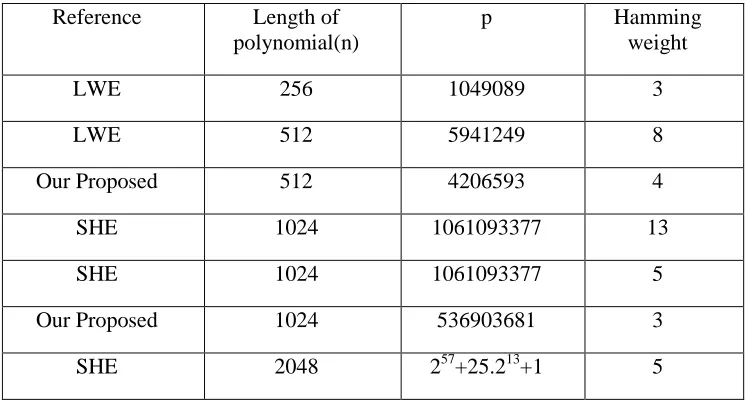
For ring - LWE encryption, the parameter sets which can provide medium and long term security are n=512, p=5941249
In SHE the parameter sets n=1024,p=1061093377 and n=2048,p=257+25.213 +1 are chosen In our paper we are proposing a p which have same bit length as earlier one, and not altering n Thus hamming weight reduced the proposed values are given in the table .By selecting different P values for same n resulted in reduced hamming weight which is a desired quality. By using these parameter sets the multiplier design is improve.
Table 1: Previous and Proposed parameter values
Reference Length of
polynomial(n)
p Hamming
weight
LWE 256 1049089 3
LWE 512 5941249 8
Our Proposed 512 4206593 4
SHE 1024 1061093377 13
SHE 1024 1061093377 5
Our Proposed 1024 536903681 3
SHE 2048 257+25.213+1 5
4. Pipelined architecture for FFT multiplication
4.1 FFT Basics
A fast Fourier transform (FFT) algorithm computes the discrete Fourier transform (DFT) of a sequence, or its inverse. Fourier analysis converts a signal from its original domain (often time or space) to a representation in the frequency domain and vice versa. An FFT rapidly computes such transformations
731
to reduce the complexity of computing the DFT from O(n ) , which arises if one simply applies the definition of DFT, to O(n log n) , where n is the data size. The DFT is obtained by decomposing a
sequence of values values into components of different frequencies. This operation is useful in many
fields (see discrete Fourier transform for properties and applications of the transform) but computing it directly from the definition is often too slow to be practical. An FFT is a way to compute the same resultmore quickly: computing the DFT of N points in thenaive way, using the definition, takes O(N2) arithmeticaloperations, while an FFT can compute the same DFT in only O(N log N) operations. This huge improvement made the calculation of the DFT practical; FFTs are of great importance to a wide variety of applications, from digital signal processing and solving partial differential equations to algorithms for quick multiplication of large integers [8].
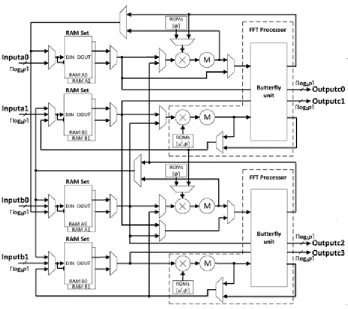
4.2 Pipelined Architecture
Fig .1 Pipelined Architecture for FFT Multiplication
5. Proposed Algorithms
5.1 Algorithm For Finding FFT
Let w be a primitive n-th root of unity in Zp.
Let w-1 be the inverse number of w such that ww-1≡ 1 mod p.
Let a=(a0,a1,...an-1) be the coefficient vector of degree n [1] Input: a, w, w-1, n, p.
Output: FFT nw(a).
1. 1: a←Order_reverse(a).
732
3. 3: for j = 0 to n/2 – 1
4. 4: Pij ← [ j / 2 log 2 n – 1 – i ] ×2 log 2 n – 1 – i 5. 5: Aj ← a2 j + a2j+1 wPij mod p
6. 6: Aj+(n/2) ← a2 j - a2j+1 wPij mod p
7. 7: end for
8. 8 if ≠ log2 n – 1
9. 9: a ← A
10. 10: end if
11. 11: end for 12. 12: return A
In the algorithm
‗w‘ is the primitive n-th root of unity
For example primitive nth root of unity of n=23 (that is 8) is 2 Order_reverse(a) Is a function for bit reversal operation It works according to the FFT datapath
Fig.2 Butterfly datapath for n=16
5.2 Algorithm for Polynomial Multiplication
An algorithm for polynomial multiplication is given below
Let w be a primitive n-th root of unity in Zp and φ2 ≡ w mod p.
Let a = (a0, a1, ....an-1), b=(b0,...bn-1) and c=(c0,...cn-1)
be the coefficient vectors of degree n polynomials a(x), b(x), and c(x), respectively,
where ai, bi, ci ϵ Zp , i=0,1,2,3...n-1.
Input : a, b, w, w-1, φ, φ-1, n, n-1, p.
733 2: for i=0 to n-1
3: ai ← ai φi mod p
4: bi ← bi φi mod p
5 end for
6: A ← FFT nw(a). 7: B ← FFT nw(b). 8: fori=0 to n-1
9: Ci = Ai Bi mod p
10:end for
11: c = IFFT nw(C) 12: for i=0 to n-1 13: ci ← ci φ-i mod p
14: end for
15: return c
Using FFT, one can compute the cyclic convolution efficiently. It is obvious that the computation would become more efficient if we can compute the polynomial multiplication by using FFT. One way to achieve this goal is by zero padding [1].FFT of a polynomial can be found using butterfly structure. Two polynomials can be multiplied by point wise multiplication of their FFTs [9].
6. Results and Simulations
Polynomial multiplication results for n=256
a=2x32+x21+3x13+4x2+1 b=4x43+3x2+1
c=8x75+4x64+12x56+16x45+4x43+6x34+2x32+3x23+x21+9x15+3x13+12x4+7x2+1
Inputs
734
Fig.4 Output of polynomial multiplier (n=256)
Polynomial multiplication results for n=1024 a=6x435+2x14+3x2+1
b=3x320+2x3+1
18x755+12x438+6x435+6x334+9x322+3x320+4x17+2x14+6x5+2x3+3x2+1
Inputs
Fig.5 Inputs of polynomial multiplier(n=1024)
735
Fig.6 Outputs of polynomial multiplier(n=1024)
7.Conclusion
A high-speed pipelined design for FFT multiplication is presented for efficient implementation of ring-LWE and ―somewhat‖ homomorphic encryption cryptosystems. Parameter selection restrictions and an efficient selection method are analyzed and provided. The simulation results of the proposed multipliers on ModelSim Pe5.5 show that our architecture gives correct value of polynomial multiplication. The results also show that the selected new parameters support efficient modular reduction design, which improves the performance of the whole FFT multiplier. Future works will exploit the full usage of pipelined architecture.
REFERENCES
[1] Donald Donglong Chen, Frederik Vercauteren,Sujoy Sinha Derek Pao, (january 2015)―High-Speed Polynomial Multiplication Architecture for Ring-LWE and SHE cryptosystems‖IEEE transactions on circuits and systems—i: regular papers, vol. 62, no. 1,
[2] Oded Regev, ―The Learning with Errors Problem‖
[3] Vadim Lyubashevskyy Chris Peikertz Oded Regevx (June 25, 2013) On Ideal Lattices and Learning with Errors Over Rings
[4] Daniel J Costello,―Coding for Reliable Digital Transmission and Storage‖ [5] William Stallings, ―Cryptography and network security‖
[6] M. Rückert and M. Schneider,( 2010) ―Estimating the security of lattice-based cryptosystems,‖ Cryptology ePrint Archive rep. 2010/137
[7] K. Lauter, M. Naehrig, and V. Vaikuntanathan, (2011)―Can homomorphic encryptiobe practical?,‖ in Proc. 3rd ACM Workshop Cloud Comput.Security, , ser. CCSW ‘11, pp. 113 124.
[8] Lyubashevsky, D. Micciancio, C. Peikert, and A. Rosen,( 2008) ―SWIFFT: A modest proposal for FFT hashing,‖ in Fast Software Encryption, K. Nyberg, Ed. Berlin/Heidelberg,Germany: Springer, vol. 5086,ser. Lecture Notes in Computer Science, pp. 54–72.