
© Global Society of Scientific Research and Researchers http://ijcjournal.org/
3D Internet
Melvin Thomas
a*, Gireesh Singh Thakurathi
b, Haresh Savlani
c, Vipul Sankhe
daThadomal Shahani Engineering College, 802, Ruby, Nirmal lifestyle, LBS marg, Mulund West, Mumbai
400080, India
bThadomal Shahani Engineering College, A-103, Hitesh Apts., Asalpha, N.P. Road, Ghatkopar West,
Mumbai-400084, India
c
Thadomal Shahani Engineering College, D-304, Crown Vasant Marvel, Borivali (East), Mumbai – 400066,
India
dThadomal Shahani Engineering College, C/704 Dheeraj Diamond, Chincholi Link Road, Malad West,
Mumbai-400064, India
aEmail: [email protected]
bEmail: [email protected]
cEmail: [email protected]
dEmail: [email protected]
Abstract
Internet, today has become an integral part of our lives. The World Wide Web which initially was a small and
non-interactive data storage service is now huge and priceless. Present activities being partially or completely
linked with the virtual world can be optimized to a higher level. Every activity associated with our daily life is
mapped and related to some entity in the digital world. The world has seen vast advancements in Internet and in
3D stereoscopic displays. Time has come merge the two to deliver a new level of experience to the users. 3D
Internet is an idea which is yet to be implemented and requires browsers having the property of depth perception
and artificial intelligence. If this property is incorporated then the idea of Internet of things can become a reality
which is also discussed in this paper. In this paper we have discussed the features, possible setup methods,
applications, and advantages and obstacles faced in the implementation of 3D Internet. Through this paper we
intend to provide a clear idea about 3D Internet and the possible benefits associated which clearly are worth the
amount of financial investment required for its implementation.
---
Keywords: Internet; 3d; depth perception; Internet of things; augmented reality; applications.
1.Review of Literature
The Internet we are familiar with is filled with web pages, images and graphics that have a 2D existence. The
time has come to upgrade the Internet itself to a much sophisticated, interactive and ubiquitous network. Ample
amount of research has already been done on this topic. Research indicates that it is possible to implement 3D
Internet but the hardware requirements and cost associated with it will make the evolution difficult. The
advantages, security, technical obstacles and applications of 3D Internet have already been discussed in many
previously published papers. In spite of all this, it has not been achieved yet. It becomes clear from this very
fact, that there is a need for more research on this topic. This paper covers the traditional sections such as
History of the web, applications, advantages of 3D Internet along with our solutions, current status and some
unique concepts like depth perception with artificial intelligence, 3D Internet and IoT, 3D Internet and
Augmented Reality.
2.Introduction
About 42.4% of the world's population uses the Internet. According to the International Telecommunication
Union about 3.2 billion people, or almost half of the world's population, will be using the Internet by the end of
2015. In total, about 80% of households in developed countries and 34% in developing countries will have
Internet access [1]. The World Wide Web which initially was a small and non-interactive data storage service is
now constantly developing into an interactive virtual space which is starting to provide its users many facilities.
The Internet which we currently use completely lacks 3D experience. But the day to day activities of our lives
occur in a 3D world, and then limiting ourselves to 2 dimensional activities on the Internet doesn't make any
sense. The websites which are now available on the Internet are in 2D and they contain just written matter and
images. Such websites are added to the Internet daily. Thus in order to compete, existing technology has to be
upgraded where such written matter and images will be replaced with 3D models which will facilitate user
interaction and provide a real life experience. 3D Internet is a virtual environment where the user can experience
the real world scenarios. It can broaden the user's scope about how he perceives the world. It can be an effective
and convenient new way for us to reach out all the users like businessmen, customers and students.
3.History of Web
This segment states the different stages the Internet has gone through. Web 1.0, 2.0 and 3.0 are the three
sections which describe the development and improvement of Internet over the ages.
3.1.Web 1.0
This was the first model of Internet. People could only read content online provided by a small number of
developers. Users couldn't upload or provide their content to other peers at this stage. This can be simply termed
as “read only” form of Internet. Web 1.0 had many limitations and restrictions which had been fixed later by
3.2.Web 2.0
Early web could only be used to retrieve information from the Internet but with the introduction of web 2.0
users could upload their content as well. Internet finally gave users the opportunity to provide their individual
contributions to the world. Social networking sites like Orkut and Facebook began at this stage. People could
now add their profiles to such websites. Blogs and forums were now a common part of the digital world.
Figure 1: Web 1.0, Web 2.0, Web 3.0 [2]
3.3.Web 3.0
Web 3.0 is not yet fully developed. In the above two versions of web, information was mainly generated by
people. In web 3.0 raw data is processed and converted to information by the Internet itself. It will provide the
users with related suggestions and recommendations based on their Internet activities that will be useful to the
user. Web 3.0 comprises of online integrated gaming, live educational and business presentations and avatar
representation. It is basically a real time creative web [3].
Figure 2: Development of Computer User Interface [4]
4.3D Internet
be interactive and real time 3D graphics all delivered through the web. It is the simulation of a 2D web page in
true to life graphics. Sections of Internet that we use today come under the category of web 2.0 and web 3.0. The
next form of Internet takes user interaction and 3D experience to a whole new level. This type is often so lively
that it is considered as virtual reality. 3D Internet can be visualized as a virtual world. People who are active in
the virtual world are more interested and active in the digital world than in real life. It can be termed as the
combination of:
• Passiveness of television • Vastness of web
• Networking like in the social media • Stereoscopic experience of 3D movies
But as we can see Television is a passive source whereas 3D Internet is engaging and interactive. An example of
such a virtual world can be “Second Life”. The people in this world are called as residents. The residents are
capable of doing the following things:
• Participate in social events
• Distance attendance to meetings and educative classes • Meeting new people
• Participate in virtual commerce • Trying new products
• Participate in brand experience which is like the real world
3D Internet has the live broadcasting property of television with the copious content of the Internet. The
disadvantages of the current Internet can be given as follows:
• Wastage of time due to mouse movements • Less interactive web pages
• Less Efficient i.e. slow speed of working
• Ineffective representation of certain images and 3D graphics
Thus we can see the current technology is highly futile. It needs a replacement or an upgrade in the coming
time. The solution to these shortcomings can be covered in 3D Internet. A detailed description of the various
applications with the help of this technology has been mentioned.
5.Current Status
A significant innovation is taking place globally, from which a few points are highlighted here:
• the NSF Future Internet Design (FIND) and GENI programs (www.nets-ind.net & http://www.geni.net/)
• China Science and technology Network (www.cstnet.net.cn)
• In Japan the AKARI Architecture Design Project (akariproject.nict.go.jp/eng/overview.html)
• Korea implementing 3D Internet (http://fif.kr/fiw2007/presentations/architecture_tschoi.pdf)
In the SIGGRAPH Computer Graphics conference companies like Mozilla, Google and Opera announced the
WebGL, which can be used to build in 3D graphics into a homepage without any separate external plug-in [5].
6.Technical necessities and Obstacles
Along with the benefits, obstacles such as present network speed, hardware limitations and cost factors also
come with 3D Internet. These hurdles obstruct the evolution of traditional Internet to 3D Internet.
Figure 3: Internet Speeds in 2015 [6]
6.1.Internet Speed
Internet Speed is one of the major obstacles for the full implementation of 3D Internet. These are in terms of
limitation of bandwidth. As 3D Internet requires high end graphics and models, the requirement of high
bandwidth is mandatory. The report by “Akamai Technologies” named as the state of the Internet in 2015 shows
that the world average Internet speed is 5.1 M bit/s[7]. This report shows that there are very few countries with
high speed Internet while others lack the necessary speed for 3D Internet. Thus, even though some countries do
have good speed, most of them can't support 3D Internet. Due to which complete implementation of this
6.2.Hardware
The current Internet which we use is 2D thus it requires a normal screen. When we move from 2D to 3D
Internet, we will also have to move from our traditional screens to ones that are compatible to render 3D
graphics. We will also require separate tools to view these 3D images. Moreover rendering of such high end
models requires high usage of RAM and GPU. Thus upgrading to this technology requires an overall upgrade of
the present system around the world..
6.3.Cost
As we see in above two points, it can be concluded that the cost involved in the overall implementation is high,
which may discourage the masses.
7.Solutions 7.1.Speed
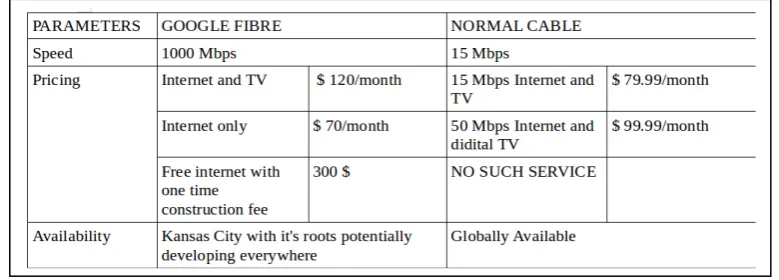
Presently, India ranks 130th in providing broadband connections. The answer to the average broadband Internet
speed problem is Google Fiber. [8]Google Fiber provides a lightning speed of 1 gigabit per second (1,000
Mbit/s) which is about 100 times faster than the current speeds. It has already laid its roots in some cities with a
vision of expanding worldwide.
Table 1: Differences between Google fiber and normal cable
7.2.Hardware
The best solution to hardware implications is to use a Vision Station. Vision Station provides a 180 degrees ultra
wide view of 3D visual world, providing a terrific 3D experience over the Internet at a cost much lower than the
multi- projector systems and other hardware devices implementing 3D graphics [9].
8.Applications
The world is moving into a digital era. Our day to day activities are getting digitalized and Internet is at the
listed below.
8.1.Education
By implementing 3D Internet in education, people can have a better understanding of the subject. They can view
lectures and experiments in a 3D manner that will help them learn more efficiently than the traditional approach.
One such example can be that the Medical professionals can view operations in 3 dimensions, distance
education will be valued, illustrative and demonstrative tutorials shall be more effective.
8.2.Real Estate
3D Internet can drastically change the real estate industry. Customers can view the property they are interested
in online with a stereoscopic view. They will get a basic idea of the area and locality they are going live in even
before its complete construction. This will ease the selection process of property to a great extent.
8.3.Social Interaction
The current generation has a much more active online social life as compared to real life. Addition of 3D to
social networking can revolutionize our digital world. Video calls can be more interactive and appealing. 3D
chat spaces can be introduced to social media. Personal interaction won't be limited to real world. People unable
to meet on regular basis can interact online.
8.4.Tourism
It is important to choose the right destination to spend holidays which can be much easier after the
implementation of 3D Internet. Tourists can have a sample 3D view of the desired locations and later decide
which destination has to be visited. They can have a short demo of the place they are about to visit and decide if
it’s worth investing on the trip.
8.5.Entertainment
Online 3D games, 3D movies, etc. won't be a dream anymore. All this can be achieved using 3D Internet. Users
won't be compelled to go to a multiplex for experiencing a 3D movie. Gamers can enjoy 3D online games at
home and can easily connect with their friends. Live action sports will be more interesting.
8.6.E-commerce
Online Shopping can be more realistic and reliable with the employment of 3D Internet. Concept like Online
Shopping Malls and Stores can be implemented so that the users can visit virtual malls from Internet. Vicarious
feeling of shopping can be fulfilled by consumers by sitting at home. It will be a benefit to both, the buyer and
the seller as the basic necessity to meet at a common trading place will be eliminated completely while the
8.7.Spiritualism
People can visit their desired holy place without actually traveling to the destination. Religious organizations
can plan meetings at a selected time covering devotees of a specified region and 3D Internet will maintain the
experience of the trip and cut the cost and traveling time on the other hand. 3D avatars and first person view will
make it easy for users to devote time to their religion.
8.8.Culture
3D Internet will open gates to art forms that don't exist at today's date. Artists can portray their artwork to the
whole world in an entirely new fashion. Just as 2D art has a ton of different forms such as paintings, drawings,
photography, mixed media, craft, etc. 3D art will also create a new genre of creative forms, something that can't
be imagined as of now due to the absence of a 3D platform and human brain's limited scope to 2D imagination.
9.Advantages
Every aspect of human life is now linked with the digital world or 2D Internet. Businessmen and potential
investors can use this as their advantage to attract more consumers or visitors to market their products. By
adding 3D effects to the normal web, we can increase the productivity of various fields.
9.1.Participants experience virtual world
Several virtual world environments have already been produced where users can experience a false but
appealing reality. This experience can be improved tremendously with advanced hardware which can produce
3D outputs. This entire process translates to experiencing a virtual world having its own applications such as
social interaction, education, entertainment in actual 3D just like our day to day activities instead of 2D.
9.2.Participant has control over entire virtual space
3D Internet allows the user to enter into a virtual space which enables him to interact with several others. This
virtual space can be completely controlled by the user accessing it. This includes the movement of the user,
changes of directions, entering/exiting structures etc.
9.3.Participants can choose to engage with an offering
The user can have a choice whether to accept or reject the communication or interaction requests that are user
gets in this virtual world.
9.4.Better understanding of concepts
3D Internet provides a layout or a base for improvising the understanding of several concepts. Certain concepts
can’t be understood directly from 2D monitors as they require visualization of 3D objects. 3D Internet provides
9.5.Replicates real life
3D Internet provides the user an experience which is very similar to real life. Users will experience real life
situations in this virtual world. Avatars will play a key role in revolutionizing the future Internet. It will change
the way in which people tend to interact with each other. Conversations, rendezvous and other private meetings
will move from real world to virtual as it will be more promising, secure and private.
9.6.Efficiency
3D Internet when implemented can improve the overall efficiency by reducing the mouse movements. People
would no longer have to manually enter data via keyboard and other time consuming input devices.
10.Glimpse into 3D Virtual World
3D Internet is yet to achieve it's full potential but virtual world's like “Second Life” have made an attempt to
avail 3D features to traditional Internet. Second life is a 3D world created by Linden Lab where everyone the
user meets is a real person and every place the user visits is created by developers [10]. The platform also
provides users with Oculus Rift which helps the user experience the 3D effect. Using this hardware, the user can
enjoy a full panoramic view of the virtual world. It has features like head tracking and motion sensing, users no
longer suffer from 2D boxed visions on their regular LED/LCD displays. Linden Lab has taken care that their
stereoscopic view of second life doesn't leave the users with motion sickness, thanks to the motion tracking
features and fast response to minute movements. Users can choose between first person and third person view.
First person view will make the experience more realistic as people can see the world from their avatar's
perspective.
11.3D Internet Meets the Internet of Things (IoT)
Today's Internet is not limited to our laptops, smart phones and tablets. Everything (living and non-living)
having a distinct IP address, which can be identified uniquely can be considered to be a part of this massive
network [11] (eg. People using heart implants that can be monitored via Internet are also considered to be a part
of IoT).Various embedded systems are now accessed via Internet and are capable of data transfer and this idea is
termed a IoT(Internet of Things). Electronic appliances, lights in household and commercial environment,
speakers, vending machines, cars, thermostats, security systems are all examples objects that fall in the scope of
Internet of Things for now. In future IoT can be combined and largely benefited by the onset of 3D Internet.
Avatars in 3D Internet would be more realistic and could be considered as the spitting image of the user himself.
Imagine buying a new car, clothing, footwear, smart phone, etc. in near future. People would no longer need a
test drive to judge if the car will satisfy their needs. The user can fit their avatar inside the car model to see if it
is spacious enough and fulfills other specific requirements using 3D Internet. They could also control the vehicle
in real world without leaving their room with the help of IoT and view the test drive in 3D. Thus with the
12.Augmenting Reality with 3D Internet
Abbreviated as AR, AugmentedReality is a type of virtual reality that aims to duplicate the world's environment
in a computer [15]. An augmented reality system generates a composite view for the user that is the combination
of the real scene viewed by the user and a virtual scene generated by the computer that augments the scene with
additional information [15]. The virtual scene generated by the computer is designed to enhance the user's
sensory perception of the virtual world they are seeing or interacting with [15]. The goal of Augmented Reality
is to create a system in which the user cannot tell the difference between the real world and the virtual
augmentation of it [15]. Several augmented reality software have already surfaced. However these applications
are only created for devices that produce 2D output. When we think of our surroundings, we think in 3D, we
experience the world in 3D, so augmenting the world and showing the output in 3D makes more sense. If 3D
Internet is implemented several devices having 3D displays will surface and developers will start creating
augmented reality applications for such devices. Such devices will produce much more realistic view of the
reality that we are trying to augment. The function of the software will remain same in both the cases, but
because we are receiving a 3d view, it will be much more realistic. Also it will help us understand the
augmentation clearly. In short, we will be augmenting reality and it will be in 3d, so the result after
augmentation must also be 3d. For example consider an application which allows user to view them while trying
different clothes out. A camera records the user and projects it on a screen where user can browse through
several clothes. The computer automatically adjusts the clothes on screen according to the positioning of the
person. A 2D output like this gives us a general idea about how the clothes will look on you. On the other hand a
3D output will give a more detailed view, explaining how the dress will look in real life. 3D Internet will cause a
lot of applications like these to be developed, shared and used. 3D Internet will prove to be a backbone for
improving current AR experience.
13.Methods of Implementation
13.1 Software Approach
1) Depth perception with artificial intelligence
Figure 5 and Figure 6 shows the conversion of 2D images into 3D using algorithms but here we discuss the
conversion of webpages, graphics and images using artificial intelligence. Imagine a browser that can think, a
browser that doesn’t need inputs all the time like the present browsers that we use. A browser smart enough to
understand the difference between two colors, difference between the depth of two objects. Such a browser is
capable enough to understand a still image that is being displayed on the screen, if the objects in it are near the
observer or away from it. For example when we see the motion of a bullet on screen, the still image of this
bullet is on the basis of the x and y co-ordinates. Now the same motion of the same bullet on a browser capable
of perceiving depth it can estimate the z coordinate of the moving bullet and display it appropriately. Due to
which the user viewing this motion can experience a 3D effect on screen. As browsers are becoming more and
more self-adaptive and responsive to the client's needs, users need not worry about general problems like screen
resolution, platform dependency, etc. Similarly a 3D web browser may in-cooperate an additional feature of
storing estimated depth or elevation of a selected entity. These values will be entered by the person hosting the
website or the browser can be self-reliant and give the necessary depth to this entity based on its estimation.
Artificial intelligence must be incorporated for the latter implementation. This parameter will decide the extent
to which the user on the client end may experience the 3D effect. The hardware required to implement such
ideas may need some thought process. Such a browser will give the developers and website creators a new
functionality that can be adjusted as desired to give their content the exact level of 3D effect as required to make
their content more interactive and entertaining.
2) WebGL
Making a dream of 3D graphics on Internet can become a reality by using WebGL which stands for Web
graphics library [13]. It is a JavaScript library for displaying interactive 2d and 3d content on the compatible
web browser without any use of plugins. It has been derived from OpenGL ES (Embedded Systems) 2.0.
WebGL is capable of transforming the static visual variables of shape, size, texture, color, value, orientations
and overall presentation of information into 3D virtual space providing a rich 3d graphics experience on the
browser. WebGL provides a delightful experience and function as a great data visualization tool that can turn
normal data into a compelling virtual story. Major browser vendors Apple (Safari), Google (Chrome), Mozilla
(Firefox), and Opera (Opera) are working on WebGL [14] .
B. Hardware Approach
1) 3D lens
The benefits of this idea will be similar to that of a normal lens over a 3D glass. But this idea is abstract and
2) Anaglyph Glasses
It consists of glasses of chromatically opposite colors (eg. Cyan and Red).When used as a pair of glasses they
send two separate images to the viewer to create a stereoscopic image.
3) Polarized Glasses
By projecting two images simultaneously, one horizontally and other vertically polarized, one can produce 3D
effects.
4) Shutter Glasses
Stereoscopic image can also be created by blocking the view of one eye at a time and repeating this at very fast
rates.
14.Conclusion
In this paper we have discussed the general idea, history, future prospects, current status, benefits,
implementation methods and restrictions involved in revolutionizing the present quality of Internet. We can see
that 3D Internet is the future as it will surely change the way we perceive Internet today. The advantages and
applications clearly surpass the cost associated with the implementation. The need of a ubiquitous and
intelligent Internet can surely be fulfilled by 3D Internet. Businessmen and interested investors are aware of the
true potential of the user friendly, interactive, productive and addictive market side of it. But due to many
obstacles like Internet bandwidth, hardware, cost factors and lack of research it isn't easy to implement. At this
point the society has the capability to evolve the digital world to a much more versatile and intriguing version
but it does need a lot of research and the required financial support for becoming a reality.
References
[1] Miniwatts Marketing Group, “Internet USAGE STATISTICS”, Internet world stats, June 30
2015.Available : http://www.internetworldstats.com/stats.htm [Accessed : September 20,2015].
[2] Michael Moreyne: Business strategies for mobile and IT services, 'Web 3.0 - The Semantic Web', 2015.
[Online]. Available: http://www.moreyne.com/web-3-0-the-semantic-web/ [Accessed: 17- Oct- 2015].
[3] Mrs. G. Sumalatha, Mr. S. Bharathiraja, E.(2013). “A survey on 3d Internet in web 3.0”. IJECS volume 2
issue 3 March 2013 pg. 593-598.
[4] P. Patil, '3D Internet', Slideshare.net, 2013. [Online]. Available:
http://www.slideshare.net/prasadpa3954/3d-internet-27320866 [Accessed: 17- Oct- 2015].
[5] Peter Baranyi, 10th International Symposium of Hungarian Researchers on Computational Intelligence
and Informatics 229 , 3D Internet for Cognitive Info-Communication , pg 231-232.
[6] State of the Internet, 'Akamai State of the Internet | Q2 2015 Report | Connectivity, Trends', 2015.
[Online]. Available:
[7] Akamai, "State of Internet Report Q2 2015",Akamai, 2015. Available:
https://community.akamai.com/docs/DOC-4389 [Accessed: September 20, 2015].
[8] Richa Lall, "Google Fiber," My Venture, December 28, 2014. Available:
http://myventure.in/google-fiber-services-1gbps-Internet-speed-coming-soon/ [Accessed: September 20, 2015].
[9] Virtual Realities, "Vision Station" vrealities , 2015. Available:
https://www.vrealities.com/products/featured/visionstation [Accessed: September 20, 2015].
[10] Linden Labs, "About",Second Life, 2015. Available: http://secondlife.com/whatis [Accessed: September
20, 2015].
[11] Laurence Cruz, "When the Internet goes 3D", Cisco Newsroom | The Network , 2013. Available:
http://newsroom.cisco.com/feature-content?type=webcontent&articleId=1129025 [Accessed: September
20, 2015].
[12] The Irish Times, 'Augmented reality is more than just a gimmick', 2015. [Online]. Available:
http://www.irishtimes.com/business/media-and-marketing/augmented-reality-is-more-than-just-a-gimmick-1.1764034 [Accessed: 17- Oct- 2015].
[13] Mozilla Foundation, "Web GL",Mozilla Foundation, 2015. Available:
https://developer.mozilla.org/enUS/docs/Web/API/WebGL_API [Accessed: September 20, 2015].
[14] e A, Chun W, Kogan D, Kokkevis V, Weber N, Petterson RW, et al. Google body: 3d human anatomy in
the browser. In: ACM SIGGRAPH 2011 Talks. ACM. ISBN 1450309747; 2011, p. 19.
[15] Vangie Beal,”Augmented reality”, 2015.[Online]. Available:
![Figure 1: Web 1.0, Web 2.0, Web 3.0 [2]](https://thumb-us.123doks.com/thumbv2/123dok_us/8399063.1685830/3.595.159.431.541.651/figure-web-web-web.webp)
![Figure 3: Internet Speeds in 2015 [6]](https://thumb-us.123doks.com/thumbv2/123dok_us/8399063.1685830/5.595.157.389.294.516/figure-internet-speeds-in.webp)
![Figure 4: Users trying different outfits at home on 3D displays[12]](https://thumb-us.123doks.com/thumbv2/123dok_us/8399063.1685830/10.595.151.416.493.657/figure-users-trying-different-outfits-home-d-displays.webp)
