_____________________________________________________________________________________________________ *Corresponding author: E-mail: [email protected];
(Past name: American Chemical Science Journal, Past ISSN: 2249-0205)
The Influence of Some Technological Parameters on
the Process of Precipitation the Hydrochloric Acid
Extraction of Phosphates
М. R. Shamuratova
1, B. E. Sultonov
1*and S. H. S. Namazov
11
Institute of General and Inorganic Chemistry, Academy of Sciences of Uzbekistan, Tashkent Pharmaceutical Institute, Uzbekistan.
Authors’ contributions
This work was carried out in collaboration between all authors. All authors read and approved the final manuscript.
Article Information
DOI: 10.9734/CSJI/2018/45393 Editor(s): (1)Dr. Nagatoshi Nishiwaki, Professor, Kochi University of Technology, Japan. Reviewers: (1)Reda El Kacmi, University Sultan Moulay Slimane, Morocco. (2)Amilton Barbosa Botelho Junior, University of Sao Paulo, Brazil. (3)Timur Chis, Ovidius University, Romania. Complete Peer review History:http://www.sciencedomain.org/review-history/27710
Received 13 September 2018 Accepted 04 December 2018 Published 08 December 2018
ABSTRACT
The process of obtaining fertilising precipitate based on the interaction of off-balance ore phosphorites of Central Kyzylkum and chemically enriched phosphorite concentrate with hydrochloric acid, followed by precipitation of hydrochloric acid extraction with suspension of calcium hydroxide. The optimal parameters of the precipitation were determined for the first time in our country. Influence of calcium hydroxide norms on degree precipitation hydrochloricphosphoric acid extracts are studied. The resulting samples of precipitates under optimal conditions contain in
their composition 23.63-24.19% P2O5(t.), 21.09-21.38% P2O5accep. by 2% citric acid to those
26.97-28.41% CaO(t.), 23.52-25.59% of CaOaccep.by 2% citric acid. The degree of precipitation equal
94.01-98.05%. Physical and chemical studies (x-ray phase analysis) of the mineralised mass and products of its processing were also carried out.
Keywords: Mineralised mass; hydrochloric acid; precipitate; degree of precipitation.
1. INTRODUCTION
It is known that with formation mineralised mass
(12-14% Р2О5) – the waste of production washed
burned phosphorite concentrate and hydrochloric acid – the waste of production of sodium hydroxide and also high prime cost of sulfuric and phosphoric acids large value are got for
produce precipitate (CaHPO4 ∙ 2H2O) with
treatment of these waste. Use of chemical energy of hydrochloric acid and mineralised mass for precipitate produce makes to improve technical and economic performance of process of obtaining, without chloride fertilisers. The similar approach makes to obtain low-price product - precipitate.
Research in this area have been begun in 30th
years of last century. Employees of Scientific Institute of Fertilizers and Fungicide (SIFF,
Russia) were engaged processing of
phosphorites Karatau (Kazakhstan) hydrochloric acid [1-5]. However, the literary dates about physical and chemical bases and technological conditions of hydrochloric acid processings of natural phosphates on fertilisers are not enough for problem solving, related with use extensively introduction of this method in the industry. They do not make with sufficient reliability to manufacture phosphate raw materials with the high content of nutrient components. Dates of
obtain fertiliser precipitate on the base
hydrochloric extracts are rather limited. Work
[6] is devoted obtain precipitate from
phosphorites of Karatau and Central Kyzylkum.
The main drawbacks of the work are
intensive foaming, slow filtration rate hydrochloric
solutions of phosphates and formation of large volumes of diluted solutions of calcium
chloride.
As it was above specified that the
Kyzylkumphosphorite plant at the stage of phosphate raw material sorting, mineralised
mass with content of 12-14% P2O5 is formed
during the enrichment and at the moment it is still stored. The volume of this raw material accumulated to date is more than 10 million tons. It is not suitable for the production of high-quality phosphorus-containing fertilisers by sulfuric acid extraction. One of the real methods of processing of the poor phosphate to phosphate fertilisers is hydrochloric acid decomposition.
In this connection processing of poor
phosphorites on phosphoric fertilisers (precipitate) by hydrochloric acid, the waste of different
productions represents scientific and practical interest.
In this work, the possibility of obtaining fertilising precipitate by decomposing the mineralised mass from phosphorites of Central Kyzylkum and chemically enriched phosphorite concentrate with hydrochloric acid followed by precipitation with the suspension of calcium hydroxide was studied.
2. OBJECTS AND METHODS OF RESEARCH
For carrying out laboratory experiments used off-balance ore (mineralised mass) containing weight.%: 14.60 P2O5, CaO 43.99; 14.11 CO2,
1.58 SO3; 10.82 i.r.; CaO : P2O5 = 3.01, chemical
enriched phosphate concentrate (ChEPC)
composition weight.% : 22.74–P2O5; 39.00–CaO;
3.52–CO2; 0.78–Ci; 2.52 – SO3; 17.25-i.r.;
CaO:P2O5=1.72, obtained during the enrichment
of the mineralised mass with hydrochloric acid, which is a waste of the production of caustic soda of JSC “Navoiazot”. The concentration of hydrochloric acid varied from 25 to 32%.The rate of hydrochloric acid was taken 100% of stoichiometry on CaO in the feedstock. The norm of Ca(OH)2 for the deposition of P2O5 (in the form
СаНРО4) take 80, 90, 100 and 110%. The use of
high concentrated hydrochloric acid is due to the fact that the decomposition of high-carbonate phosphorites observed intensive foaming, which
prevents the maintenance of normal
technological regime. This significantly reduces the performance of the equipment. The method of the experiments was identical as in [7].
3. RESULTS AND DISCUSSION
The results of obtaining the precipitate from the mineralised mass are given in Table 1. From data of Table 1 shows that with the increase in the norm of the neutralising agent at the same concentration of acid is observed to increase Р2О5(t.)(t.-total) and CaO(t.) in the obtained samples of the precipitate.
At the 25% concentration of hydrochloric acid
with the increase in the norm of Ca(OH)2 from 80%
to 110%, the content Р2О5(t.) and CaO(t.) in the
samples obtained, the precipitates increased from 23.49 to 24.19% and from 25.13 to 27.82%, respectively.
A similar pattern is observed at other
concentrations of hydrochloric acid. The same
norms of Ca(OH)2, increasing the concentration
Table 1. Basic chemical contents of precipitates
NormСа(ОН)2 % Chemical contents of precipitates, %
Р2О5(t.) P2O5accep. By 2% citric acid Р2О5w.s. СаО(t.) CaOaccepby 2% citric acid СаОw.s. Сl
Concentration of hydrochloric acid – 25%
80 23.49 20.68 1.87 25.13 22.49 1.48 0.90
90 23.81 20.96 1.51 26.19 23.44 1.35 0.93
100 23.96 21.09 1.22 26.97 24.14 1.24 0.96
110 24.19 21.29 1.01 27.82 24.90 1.21 1.02
Concentration of hydrochloric acid – 30%
80 23.40 20.83 1.92 25.16 22.59 1.50 0.90
90 23.66 21.06 1.54 26.20 23.52 1.37 0.94
100 23.79 21.15 1.25 27.51 24.70 1.27 0.97
110 24.01 21.38 1.04 28.05 25.18 1.26 1.05
Concentration of hydrochloric acid – 32%
80 23.32 20.83 1.99 25.20 22.70 1.56 0.95
90 23.52 21.01 1.59 26.31 23.70 1.41 1.00
100 23.63 21.10 1.28 27.59 24.85 1.32 1.03
110 23.84 21.29 1.08 28.41 25.59 1.30 1.10
Table 2. Basic chemical contents of precipitates
№
Experiences
The norm of Ca(OH)2 for precipitation, %
Chemical contents of precipitates, % Degree of precipitation, %
Р2О5 (t.) P2O5accep. by 2% citricacid Р2О5w.s. СаО(t.) CaOaccep by 2% citricacid СаОw.s. Сl
Concentration of hydrochloric acid – 25%
1 80 24.12 20.92 1.79 24.36 21.92 1.51 0.87 85.69
2 90 25.23 21.31 1.50 26.27 23.12 1.30 0.91 90.41
3 100 26.22 21.64 1.23 28.01 24.18 1.23 0.96 95.28
4 110 26.98 22.52 1.02 29.20 24.63 1.20 1.03 97.41
Concentration of hydrochloric acid – 30%
5 80 24.08 20.73 1.81 24.59 22.20 1.57 0.92 86.27
6 90 25.17 22.04 1.57 26.81 23.76 1.38 0.98 91.32
7 100 26.14 22.44 1.26 28.10 24.39 1.30 1.02 95.19
№
Experiences
The norm of Ca(OH)2 for precipitation, %
Chemical contents of precipitates, % Degree of precipitation, %
Р2О5 (t.) P2O5accep. by 2% citricacid Р2О5w.s. СаО(t.) CaOaccep by 2% citricacid СаОw.s. Сl
Concentration of hydrochloric acid – 32%
9 80 24.01 20.76 1.84 24.73 22.50 1.60 0.96 86.59
10 90 25.07 22.15 1.59 26.75 24.01 1.40 1.00 91.22
11 100 26.04 22.48 1.28 28.05 24.53 1.32 1.03 95.09
12 110 26.47 22.73 1.09 29.27 25.20 1.30 1.10 97.12
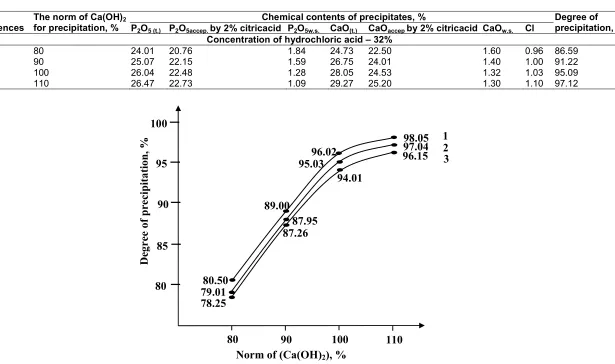
Fig. 1. Dependence of changes in the degree of precipitation of hydrochloric acid pulp from the norm of the precipitator. Concentration of НCl: 1 – 25%; 2 – 30% and 3-32%
Degree
of pr
e
cipi
ta
ti
on,
%
1
2
85
90
95
100
80
78.25
89.00
96.02
98.05
Norm of (Са(ОН)
2), %
110
100
90
80
80.50
79.01
87.26
3
97.04
96.15
87.95
95.03
CaO(t.) and CaOw.s. (water solubility) in the resulting products, and the content Р2О5(t.) reduced. For example, when using 25 %
hydrochloric acid at the norm of Ca(OH)2 100%
content CaO(t.), CaOw.s. and chlorine, respectively,
are 26.97; 1.24 and 0.96%, and when using 32% acid, they are equal to 27.59; 1.32 and 1.03%.
Under this content P2O5 (t.). In the resulting
precipitates is equal to 23.96 and 23.63%, respectively, for the acid concentration of 25 and 32%. This fact is explained by the fact that the application of more concentrated hydrochloric
acid is bad wash of CaCl2 from wet precipitate. It
is known that when using low concentration of acid, there is intensive foaming, which reduces the performance of the reactor [7]. In addition, huge amount of weak calcium chloride solution is formed, which requires large investment for its processing. Therefore, it is advisable to use high concentrated acid.
Fig. 1 shows the dependence of changes in the degree of precipitation of hydrochloric acid pulp from the norm of the precipitator and the concentration of hydrochloric acid.
Fig. 1 shown that with the increase of the norm of
Ca(OH)2 the degree of precipitation increases,
but with an increase in the concentration of hydrochloric acid, the degree of precipitation decreases from 96.02 to 94.01% at the norm 100%
of Ca(OH)2. All the above concentrations of
hydrochloric acid are optimal. The optimal rate of
the precipitator Ca(OH)2 is 100-110%. The
degree of precipitinogen within 94.01-98.05%.
Further, to obtain fertiliser precipitate, the ChEPC was used, obtained on the basis of the mineralised mass of the above composition. The method of the experiments was identical as in the case of obtaining fertiliser precipitate from mineralised mass.
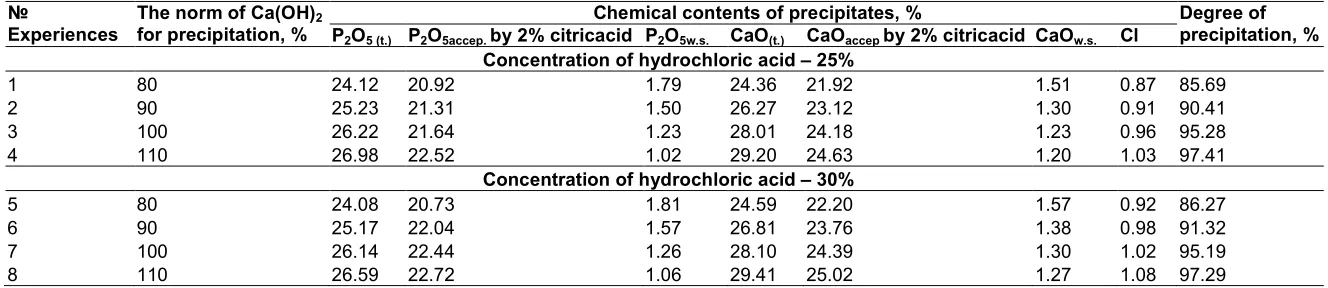
The data obtained are summarised in Table 2. It is shown that with the increase of the norm of the
precipitator Ca(OH)2 the content of P2O5 in the
obtained samples of precipitates increases. For example, at concentration of 25% HCI with an increase in the norm of the precipitator from 80 to
110% P2O5(t.)in the samples of the precipitate
ranges from 24.12 to 26.98%. The degree of precipitation increases from 85.69 to 97.41%. Despite this, the relative content of digestible
forms of P2O5 decreases. A similar pattern is
observed at other acid concentrations. The optimal norms of the precipitator are 100-110%. Fertilising precipitate obtained under optimal
conditions, contains in its composition
P2O5(t.).from 26.04 to 26.98%.
Content of P2O5accep.by 2% citric acid, ranging
from 21.64 to 22.73%. The degree of precipitation at all acid concentrations is in the range from 95.09 to 97.41%. The precipitate with such indicators can be successfully used as single fertiliser in agriculture.
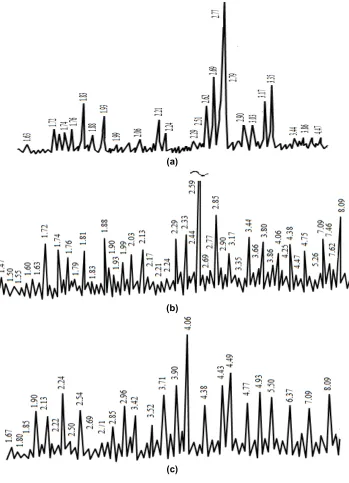
Further, X-ray phase analysis of phosphate raw materials, ChEPC and fertilising precipitate was carried out, the results of which are shown in Fig. 2. The interpretation of the diffraction bands made by comparing the values of interplanar distances of phosphorites and known minerals, allows us to assume that the diffraction bands with the values of 3.44; 3.17; 3.03; 2.79; 2.69; 2.62; 2.24; 1.93; 1.88; 1.83; 1.76; 1.74 and 1.72 Å belong to fluorocarbon-Apatite strips with interosseous distances 3.86; 2.90; 2.51; 2.29; 2.06; 1.99 and 1.63 Å characterise the presence of calcite in phosphates (Fig. 2a) [8]. The diffraction band 4.47; 3.35; 2.77 and 2.21 Å belongs to α-quartz. Quantitative relations
between fluorocarbon, calciteand quartz
correlate with the intensity of diffraction peaks related to these minerals. Radiograph ChEPC from raw material (Fig. 2b) is characterised in that the x-ray diffraction bands appear with the values of 8.09; 4.06 and 2.13 Å for dicalcium phosphate, as in the enrichment of the saline mass there is a partial decomposition of percarbonates with the formation of dicalcium phosphate and interlayer distance with the main values of 4.47; 3.17; 2.85; 2.33; 2.24 and 1.90 Å for calcium chloride, since large amount of calcium chloride remains in the enriched phosphorite when washing acidic pulps with calcium chloride and water.
The peak intensities belonging to fluoro-carbonate-apatite increase, and the peak intensities for calcite decrease, because with the enrichment of phosphorites, the amount of calcite decreases due to the decomposition of its hydrochloric acid. X-ray of the fertilising precipitate (Fig. 2c) differs from x-ray MM and ChEPC that this x-ray is virtually no peaks belonging to fluorocarbonate and calcite, on the contrary, the intensity of the peaks belonging to the precipitate increases sharply. Also there are peaks related to monocalcium phosphate 4.93; 3.90; 3.71; 3.42; 2.96; 2.69 and 1.80 Å, aluminum phosphate 6.37; 4.77; 4.49; 4.38; 3.52;
2.71; 2.50; 2.24; 1.80; 1.90 and 1.67 Å and iron phosphate (III) 5.50; 4.43; 4.38; 2.85; and
(а)
(b)
(c)
Fig. 2. Radiograph of phosphorus raw material (a), ChEPC (b) and precipitate (c)
The main disadvantage of hydrochloric acid production of the precipitate is the formation of solution of calcium chloride, which is utilised in various ways. For example, in Sweden [9] Boliden Chemi produces precipitate using hydrochloric acid technology, in which solution of calcium chloride is evaporated and sent to cement production. In Israel [10], calcium chloride solution is converted to magnesium chloride by magnesium oxide and hydrochloric
acid is regenerated. And in the present case, the resulting calcium chloride can be used as an inhibitor of corrosion of reinforcement in road construction and in the manufacture of tiles for sidewalks [11].
Thus, on the basis of the laboratory results, the principal possibility for obtaining precipitate by the interaction of off-balance ore of phosphorites
hydrochloric acid is shown. This was followed by precipitation of calcium hydroxide bypassing the stage of separation of insoluble precipitate from hydrochloric acid solution.
4. CONCLUSION
The process of decomposition of off–balance ore-waste thermal enrichment of phosphorites of Central Kyzylkum and ChEPC with hydrochloric acid was studied. For precipitinogen hydrochloric acid slurries used slurry of calcium hydroxide. The optimal parameters of the precipitation were determined. The resulting samples of precipitates under optimal conditions contain in their
composition 23.63-24.19% P2O5(t.), 21.09-21.38%
P2O5accep.. by 2% citric acid.26.97-28.41% CaO(t.) and 23.52-25.59% CaOaccep. by 2% citric acid in the case of using mineralised mass. Under optimal conditions of ChEPC obtained samples of the precipitates of the following composition: 26.04-26.98% P2O5(t.), 21.64-22.72% P2O5accep. by
2% citric acid, 28.01-29.41% CaO(t.)and
24.18-25.20% CaOaccep. by 2% citric acid. The degree of
precipitation under optimal conditions is 94.01-98.05% and 95.19-97.41%, respectively, for mineralised mass and ChEPhC.
COMPETING INTERESTS
Authors have declared that no competing interests exist.
REFERENCES
1. Briske EV, Dragunov SS. Research
process precipitation of phosphorus acid by calcium carbonate. Works of SIFF. Moscow. 1928;56:7-28.
2. Voskresensky SK, Milovanova SK,
Arkhipova LN. Receiving precipitate from
phosphorites Karatau // Reports of
scientific and technical work. SIFF.
Moscow. 1957;2:11-13.
3. Gofman I, Ionass A. Precipitation of
phosphoric acid solutions, obtaining from Vyat’s burned phosphorite by hydrochloric acid // Reports of scientific and technical work. SIFF. Moscow. 1936;134:41.
4. Mirkin I, Perelman C, Nikonova I.
Decomposition Vyat’s phosphorites by
hydrochloric acid and precipitation
obtaining phosphoric acid with calcium carbonate and milk of lime. Journal Chemical industry. Leningrad. 1933;10(7): 56-62.
5. Mamajanov SM, Amirov AM, Adilov MR,
Abdurakhmanov DR. Gettingthe precipitate on the basis of hydrochloric acid solutions
of phosphorites of Karatau. Uzbek
Chemical Journal. Tashkent. 1985;6:40-42.
6. Mamajanov SM, Amirov AM, Adilov MR,
Abdurakhmanov DR. Precipitinogen the hydrochloric acid extraction of phosphates depending on the process parameters. Uzbek chemical journal. Tashkent. 1986;3: 57-59.
7. Shamuratova MR, Sultonov BE, Sh. S.
Namazov. Hydrochloric acid obtaining of precipitate on base of phosphorite flour from Kyzylkumphosphorites. International
Journal of Recent Advancement in
Engineering and Research. 2018;4(2):8-13. India.
8. Mirkin LI. Handbook of x-ray diffraction
analysis of polycrystals. M. 1991;863.
9. Fayerson G. Foderjournalen. 1980;19(3-4):
120.
10. Patent 32291 (Israel). Declared. 27.05.69.
Publ. 26.07.72.
11. Sultonov BE, Sh. S. Namazov, Zakirov BS.
Hydrochloric acid obtaining of precipitate on base of mineralized mass from Kyzylkum phosphorites. Mining Bulletin of Uzbekistan. Navoi (Uzbekistan). 2015;1:99-101.
_________________________________________________________________________________ © 2018 Shamuratova et al.; This is an Open Access article distributed under the terms of the Creative Commons Attribution License (http://creativecommons.org/licenses/by/4.0), which permits unrestricted use, distribution, and reproduction in any medium, provided the original work is properly cited.
Peer-review history: