R E V I E W
Open Access
Impulsivity: present during euthymia in bipolar
disorder? - a systematic review
Antonia L Newman
1and Thomas D Meyer
2*Abstract
Because impulsivity is part of the presentation of bipolar disorder (BD) and is associated with its course, this systematic review presents the evidence whether increased impulsivity is present in a stable, euthymic mood and therefore potentially a vulnerability marker for BD. A multi-faceted model of impulsivity was adopted to explore how different facets may relate differently to BD. The evidence was explored in relation to studies employing measures of trait impulsivity (in self-report format) and studies exploring impulsivity with behavioural paradigms. Behavioural paradigms were separated into studies measuring response inhibition and those measuring the ability to delay gratification. Twenty-three papers met the inclusion criteria. Most studies using self-report measures found significant differences between euthymic BD patients and healthy controls. There was little evidence of increased impulsivity as measured by behavioural paradigms. Most studies found no significant difference in response inhibition between groups, though it is possible that much of the literature in this area was underpowered to detect an effect. Only five studies explored delay of gratification, of which the two methodologically strongest studies found no group differences. In conclusion, there is evidence that euthymic patients with BD report increased impulsivity when using self-ratings. However, there is currently limited evidence of impulsivity on behavioural measures assessing response inhibition, and this might be restricted to more severe cases. More research is needed on the ability to delay gratification before drawing any conclusions. However, to establish facets of impulsivity as vulnerability markers, future studies should include at-risk individuals to evaluate whether self-rated or behavioural impulsivity precedes the onset of BD.
Keywords:Bipolar disorder; Euthymia; Impulsivity; Self-report; Delay of gratification; Response inhibition
Review
Introduction
Impulsivity is one of the DSM diagnostic criteria for mania, listing as ‘excessive involvement in pleasurable activities that have a high potential for painful consequences’ (American Psychiatric Association 2013). Furthermore, impulsivity in bipolar disorder (BD) has been linked to poorer outcome, including a more severe course and suicidality (Watkins and Meyer 2013; Swann et al. 2009a). As a result, there has been a lot of interest in the relation-ship between impulsivity and BD.
Several theoretical models about BD include elements relating to impulsivity. The cognitive-behavioural model of Mansell et al. (2007) describes impulsive behaviours in re-lation to ‘ascent behaviours’which escalate an individual
towards mania. Another model proposes that the Be-havioural Activation System (BAS; Gray 1994) as a psy-chobiological system underlying motivation and approach behaviour is related to BD (Alloy and Abramson 2010). For example, Alloy et al. (2012) propose that the onset of mania is related to BAS dysregulation, leading to extreme reward-seeking behaviour. Extreme reward seeking is one facet that is linked to impulsivity, as individuals may pursue reward whilst disregarding consequences.
Impulsivity is however a broad concept, and the broad nature of impulsivity is well captured in the definition by Daruna and Barnes (1993, p. 23) who stated that ‘impulsivity encompasses a range of actions which are poorly conceived, prematurely expressed, unduly risky or inappropriate to the situation and that often result in undesirable consequences’. Researchers agree that impulsivity is multi-faceted (Barratt 1994; Reynolds et al. 2006). However, there is little consensus on the constructs referred to under the umbrella term ‘impulsivity’. For
* Correspondence:[email protected] 2
Institute of Neuroscience, Newcastle University, Ridley Building, Newcastle upon Tyne NE1 7RU, UK
Full list of author information is available at the end of the article
© 2014 Newman and Meyer; licensee Springer. This is an Open Access article distributed under the terms of the Creative Commons Attribution License (http://creativecommons.org/licenses/by/2.0), which permits unrestricted use, distribution, and reproduction in any medium, provided the original work is properly credited.
example, Whiteside and Lynam (2001) factor-analysed several widely used self-report impulsivity measures resulting in their four-factor model of impulsivity:‘lack of premeditation’,‘lack of perseverance’,‘sensation seeking’ and‘urgency’. The new factor here is urgency meaning the tendency to act impulsively in an emotional state, be it positive or negative (Cyders et al. 2007). Barratt et al. (Patton et al. 1995; Stanford and Barratt 1992) considered self-ratings, behavioural tasks and animal research result-ing in a three-factor model of impulsivity: ‘attentional’, ‘motor’and‘non-planning’impulsivity, leading to the de-velopment of the Barrett Impulsivity Scale (BIS). There is therefore no accepted consensus on the components com-prising impulsivity as a trait measured by self-reports.
With regards to behavioural manifestations of impul-sivity, two facets can be repeatedly recognised. They can be broadly categorised as follows: (a) lack of response inhibition (RI) defined by Verbruggen and Logan (2008, p. 418) as ‘the suppression of no-longer required or in-appropriate actions’; (b) inability to delay gratification defined by Arce and Santisteban (2006, p. 214) as ‘the inability to weigh the consequences of immediate and fu-ture events and, consequently, delay gratification’. These be-havioural manifestations of impulsivity (or versions closely mapping on to them) have been identified by numerous researchers with potential links to separate brain systems (e.g. Winstanley et al. 2006; Chudasama et al. 2003; Mobini et al. 2002; Swann et al. 2002; Brunner and Hen 1997). One additional fact to keep in mind is that the different facets of impulsivity are also often not strongly correlated. This is especially true for the association between self-report and behavioural measures (e.g. Reynolds et al. 2006) and be-tween different behavioural measures (e.g. Lane et al. 2003). Classifying an individual as ‘impulsive’can therefore have different meanings depending on the facets measured.
Research with acutely manic patients suggests they score higher on self-report impulsivity measures (Strakowski et al. 2009; Swann et al. 2003) and are more impulsive on tasks measuring RI (Najt et al. 2005; Strakowski et al. 2009) and ability to delay gratification (Clark et al. 2001; Strakowski et al. 2009). Impulsivity may not, however, be confined to the manic phase of the illness. For example, Swann et al. (2009b) found a sample of BD in different mood states that was high in impulsivity with respect to self-ratings and delay discounting tasks. Murphy et al. (2001) found deficits in the delay of gratification in depressed bipolar patients. However, it is not clear yet whether impulsivity is only a symptom of BD or a trait of individuals experiencing BD, and this is important for a better understanding of the aetiology of BD and for adapting psychological treatments.
To explore whether impulsivity is a trait of those with BD, research over the last decade has explored whether BD patients show elevated impulsivity during euthymic
mood. A former narrative review on impulsivity in BD (Najt et al. 2007) suggested that there were both state and trait components to impulsivity. However, this was based upon only a small number of studies, reflecting the limited research available at that time. Additionally, some behav-ioural paradigms (e.g. Continuous Performance Test (CPT), Fleck et al. 2005) do not focus on impulsivity but provide indices related to impulsivity, which have not always been covered in such reviews. Therefore, to fully evaluate the current research on impulsivity in euthymia, it is important to consider studies using such paradigms, though impulsivity may not be the focus of the research.
The aim of this systematic review is therefore to explore whether there is evidence for increased impulsivity in the euthymic stage of BD if one looks at both self-reported impulsivity and two commonly identified behavioural mani-festations of impulsivity: response inhibition and ability to delay gratification.
Method
A systematic search of the literature was undertaken. Included papers met the following criteria: (a) adult BD patients with diagnosis confirmed through structured clinical interview; (b) BD patients are described as euthy-mic, inter-episode or in remission, and some measure of current mood must have been used; (c) the study measured a form of impulsivity; as many tasks could potentially be considered measures of impulsivity, setting limits for inclu-sion in the review was necessary (we included all paradigms that have previously been used in published BD studies to explicitly investigate impulsivity, even if used in the study to explore a different concept); and (d) studies that included a healthy control group. Exclusion criteria were as follows: (a) if the impulsivity measure used was the CPT, but the study failed to report the ‘false alarm’/‘commission error’ rate; (b) tests conducted with prior experimental manipu-lation (e.g. mood induction); (c) qualitative studies; and (d) multiple publications reporting the same study, includ-ing only the most relevant paper.
Variants of the key terms‘impulsivity’,‘bipolar disorder’ and‘euthymia’were searched in the databases PsycINFO, Medline, Web of Knowledge and Scopus in November 2012. Depending on the database, explode functions, wild cards and speech marks were used, and combined searches using the Boolean terms OR and AND. For impulsivity, concepts such as ‘response inhibition’ were also entered (full list available from the authors). No date range limits were set. The concept of euthymia impacted upon search sensitivity and was removed from the search.
The journals Bipolar Disorderand Journal of Affective Disorderswere hand-searched to identify further articles. All these were studies employing the CPT, but as a meas-ure of attention rather than impulsivity. The electronic search was therefore expanded to search for the term
Newman and MeyerInternational Journal of Bipolar Disorders2014,2:2 Page 2 of 16
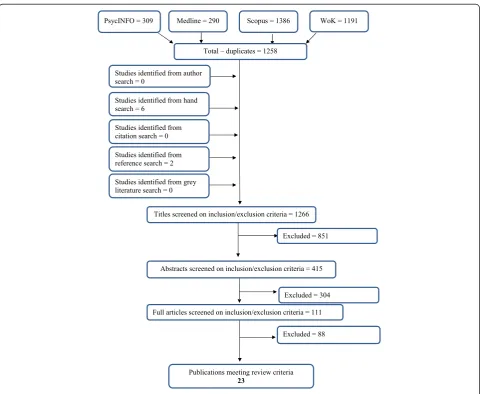
‘Continuous Performance Test’to ensure that relevant papers were identified. Key authors were searched within the databases and contacted to identify unpublished studies. References of the included studies were searched. A citation search was also conducted in PsycINFO and Scopus. Figure 1 illustrates the number of papers identified during the search and the selection process. To assess methodo-logical rigour, the papers were evaluated against a check-list of key issues exploring validity. An evaluation grid was designed and tailored to the review question, adapted from others (e.g. Hadorn et al. 1996; Scottish Intercollegiate Guidelines Network 2004). This evaluation grid was used as a guide to evaluate the quality of each paper (available from the authors on request).
Results
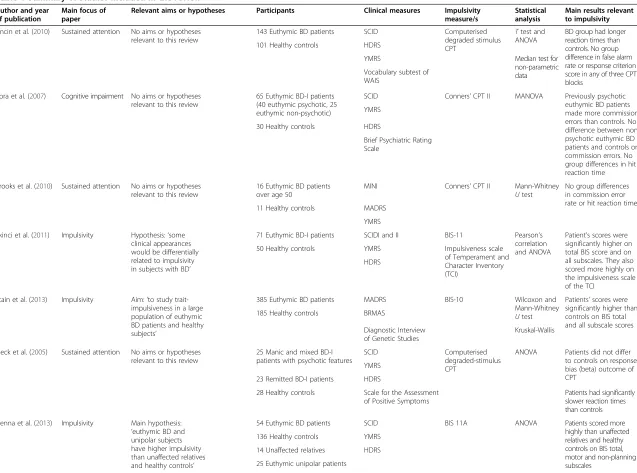
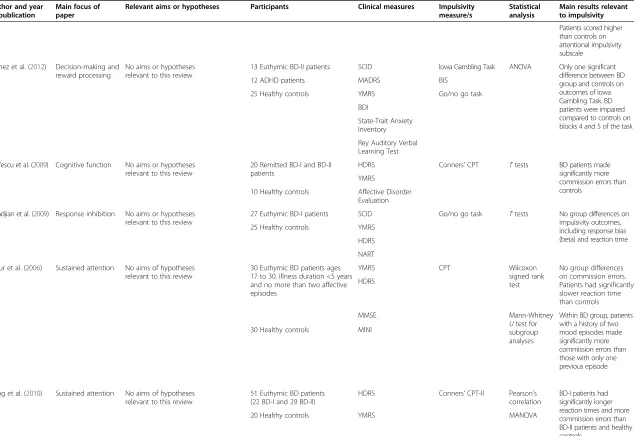
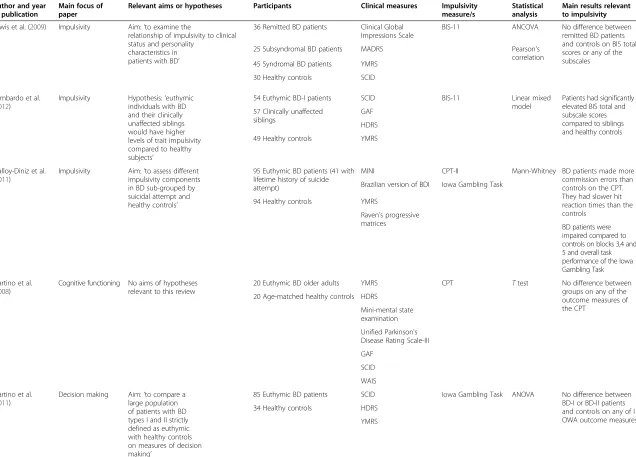
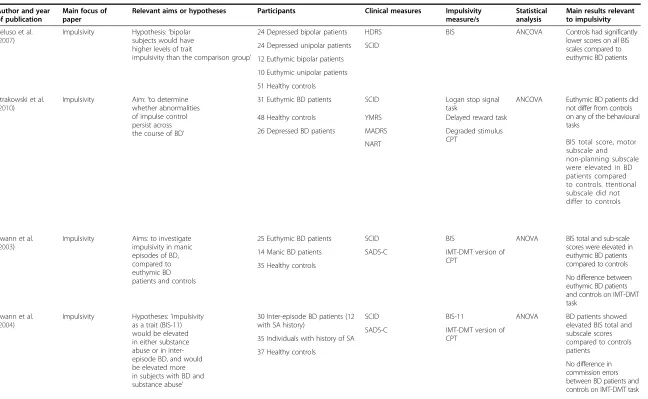
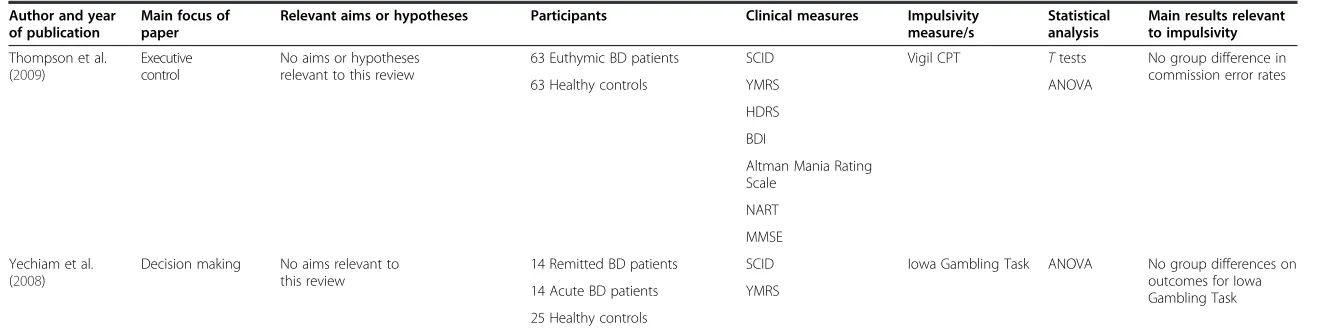
The main characteristics of the studies included are outlined in Table 1. Studies employing self-report and behavioural measures are discussed separately. Behavioural
measures are subdivided into those exploring response inhibition (RI) and those exploring ability to delay grati-fication. The detailed studies' performance against the evaluation checklist can be obtained from the authors. Key criteria included, for example whether patients were clearly defined as euthymic and controls, were verified as having no history of psychiatric illness. These issues are given particular importance in the methodological evalu-ation. Effect sizes were estimated and are reported in the respective tables. The effect sizes were calculated using the formula:
d¼m1−m2 spooled
as recommended by Thalheimer and Cook (2002).
Self-report personality measures
Ten of the studies used self-report tools measuring trait im-pulsivity (see Table 2). All used the BIS (Patton et al. 1995)
Figure 1Number of papers identified during the search and the selection process.
Newman and MeyerInternational Journal of Bipolar Disorders2014,2:2 Page 3 of 16
Table 1 Summary of studies included in the review
Author and year of publication
Main focus of paper
Relevant aims or hypotheses Participants Clinical measures Impulsivity measure/s
Statistical analysis
Main results relevant to impulsivity
Ancin et al. (2010) Sustained attention No aims or hypotheses relevant to this review
143 Euthymic BD patients SCID Computerised degraded stimulus CPT
Ttest and ANOVA
BD group had longer reaction times than controls. No group difference in false alarm rate or response criterion score in any of three CPT blocks
101 Healthy controls HDRS
YMRS Median test for
non-parametric data Vocabulary subtest of
WAIS
Bora et al. (2007) Cognitive impairment No aims or hypotheses relevant to this review
65 Euthymic BD-I patients (40 euthymic psychotic, 25 euthymic non-psychotic)
SCID Conners' CPT II MANOVA Previously psychotic euthymic BD patients made more commission errors than controls. No difference between non-psychotic euthymic BD patients and controls on commission errors. No group differences in hit reaction time YMRS
30 Healthy controls HDRS
Brief Psychiatric Rating Scale
Brooks et al. (2010) Sustained attention No aims or hypotheses relevant to this review
16 Euthymic BD patients over age 50
MINI Conners' CPT II Mann-Whitney Utest
No group differences in commission error rate or hit reaction time 11 Healthy controls MADRS
YMRS
Ekinci et al. (2011) Impulsivity Hypothesis:‘some clinical appearances would be differentially related to impulsivity in subjects with BD’
71 Euthymic BD-I patients SCIDI and II BIS-11 Pearson’s correlation and ANOVA
Patient’s scores were significantly higher on total BIS score and on all subscales. They also scored more highly on the impulsiveness scale of the TCI
50 Healthy controls YMRS Impulsiveness scale of Temperament and Character Inventory (TCI)
HDRS
Etain et al. (2013) Impulsivity Aim:‘to study trait-impulsiveness in a large population of euthymic BD patients and healthy subjects’
385 Euthymic BD patients MADRS BIS-10 Wilcoxon and Mann-Whitney Utest
Patients’scores were significantly higher than controls on BIS total and all subscale scores 185 Healthy controls BRMAS
Diagnostic Interview of Genetic Studies
Kruskal-Wallis
Fleck et al. (2005) Sustained attention No aims or hypotheses relevant to this review
25 Manic and mixed BD-I patients with psychotic features
SCID Computerised
degraded-stimulus CPT
ANOVA Patients did not differ to controls on response bias (beta) outcome of CPT
YMRS
23 Remitted BD-I patients HDRS
28 Healthy controls Scale for the Assessment of Positive Symptoms
Patients had significantly slower reaction times than controls
Henna et al. (2013) Impulsivity Main hypothesis: ‘euthymic BD and unipolar subjects have higher impulsivity than unaffected relatives and healthy controls’
54 Euthymic BD patients SCID BIS 11A ANOVA Patients scored more highly than unaffected relatives and healthy controls on BIS total, motor and non-planning subscales
136 Healthy controls YMRS
14 Unaffected relatives HDRS
25 Euthymic unipolar patients
Table 1 Summary of studies included in the review(Continued)
Author and year of publication
Main focus of paper
Relevant aims or hypotheses Participants Clinical measures Impulsivity measure/s
Statistical analysis
Main results relevant to impulsivity
Patients scored higher than controls on attentional impulsivity subscale
Ibanez et al. (2012) Decision-making and reward processing
No aims or hypotheses relevant to this review
13 Euthymic BD-II patients SCID Iowa Gambling Task ANOVA Only one significant difference between BD group and controls on outcomes of Iowa Gambling Task. BD patients were impaired compared to controls on blocks 4 and 5 of the task
12 ADHD patients MADRS BIS
25 Healthy controls YMRS Go/no go task
BDI
State-Trait Anxiety Inventory
Rey Auditory Verbal Learning Test
Iosifescu et al. (2009) Cognitive function No aims or hypotheses relevant to this review
20 Remitted BD-I and BD-II patients
HDRS Conners' CPT Ttests BD patients made significantly more commission errors than controls
YMRS
10 Healthy controls Affective Disorder Evaluation
Kaladjian et al. (2009) Response inhibition No aims or hypotheses relevant to this review
27 Euthymic BD-I patients SCID Go/no go task Ttests No group differences on impulsivity outcomes, including response bias (beta) and reaction time 25 Healthy controls YMRS
HDRS
NART
Kolur et al. (2006) Sustained attention No aims of hypotheses relevant to this review
30 Euthymic BD patients ages 17 to 30. Illness duration <5 years and no more than two affective episodes
YMRS CPT Wilcoxon
signed rank test
No group differences on commission errors. Patients had significantly slower reaction time than controls HDRS
MMSE Mann-Whitney
Utest for subgroup analyses
Within BD group, patients with a history of two mood episodes made significantly more commission errors than those with only one previous episode 30 Healthy controls MINI
Kung et al. (2010) Sustained attention No aims of hypotheses relevant to this review
51 Euthymic BD patients (22 BD-I and 29 BD-II)
HDRS Conners' CPT-II Pearson’s correlation
BD-I patients had significantly longer reaction times and more commission errors than BD-II patients and healthy controls
20 Healthy controls YMRS MANOVA
Newman
and
Meyer
Interna
tional
Journal
of
Bipolar
Disorders
2014,
2
:2
Page
5
o
f
1
6
http://ww
w.journalbip
olardisorde
rs.com/conte
Table 1 Summary of studies included in the review(Continued)
Author and year of publication
Main focus of paper
Relevant aims or hypotheses Participants Clinical measures Impulsivity measure/s
Statistical analysis
Main results relevant to impulsivity
Lewis et al. (2009) Impulsivity Aim:‘to examine the
relationship of impulsivity to clinical status and personality
characteristics in patients with BD’
36 Remitted BD patients Clinical Global Impressions Scale
BIS-11 ANCOVA No difference between remitted BD patients and controls on BIS total scores or any of the subscales 25 Subsyndromal BD patients MADRS Pearson’s
correlation 45 Syndromal BD patients YMRS
30 Healthy controls SCID
Lombardo et al. (2012)
Impulsivity Hypothesis:‘euthymic individuals with BD and their clinically unaffected siblings would have higher levels of trait impulsivity compared to healthy subjects’
54 Euthymic BD-I patients SCID BIS-11 Linear mixed model
Patients had significantly elevated BIS total and subscale scores compared to siblings and healthy controls 57 Clinically unaffected
siblings
GAF
HDRS
49 Healthy controls YMRS
Malloy-Diniz et al. (2011)
Impulsivity Aim:‘to assess different impulsivity components in BD sub-grouped by suicidal attempt and healthy controls’
95 Euthymic BD patients (41 with lifetime history of suicide attempt)
MINI CPT-II Mann-Whitney BD patients made more commission errors than controls on the CPT. They had slower hit reaction times than the controls
Brazilian version of BDI Iowa Gambling Task
94 Healthy controls YMRS
Raven’s progressive
matrices BD patients were
impaired compared to controls on blocks 3,4 and 5 and overall task performance of the Iowa Gambling Task
Martino et al. (2008)
Cognitive functioning No aims of hypotheses relevant to this review
20 Euthymic BD older adults YMRS CPT Ttest No difference between groups on any of the outcome measures of the CPT
20 Age-matched healthy controls HDRS
Mini-mental state examination
Unified Parkinson's Disease Rating Scale-III
GAF
SCID
WAIS
Martino et al. (2011)
Decision making Aim:‘to compare a large population of patients with BD types I and II strictly defined as euthymic with healthy controls on measures of decision making’
85 Euthymic BD patients SCID Iowa Gambling Task ANOVA No difference between BD-I or BD-II patients and controls on any of I OWA outcome measures 34 Healthy controls HDRS
YMRS
Newman
and
Meyer
Interna
tional
Journal
of
Bipolar
Disorders
2014,
2
:2
Page
6
o
f
1
6
http://ww
w.journalbip
olardisorde
rs.com/conte
Table 1 Summary of studies included in the review(Continued)
Author and year of publication
Main focus of paper
Relevant aims or hypotheses Participants Clinical measures Impulsivity measure/s
Statistical analysis
Main results relevant to impulsivity
Peluso et al. (2007)
Impulsivity Hypothesis:‘bipolar subjects would have higher levels of trait
impulsivity than the comparison group’
24 Depressed bipolar patients HDRS BIS ANCOVA Controls had significantly lower scores on all BIS scales compared to euthymic BD patients 24 Depressed unipolar patients SCID
12 Euthymic bipolar patients
10 Euthymic unipolar patients
51 Healthy controls
Strakowski et al. (2010)
Impulsivity Aim:‘to determine whether abnormalities of impulse control persist across the course of BD’
31 Euthymic BD patients SCID Logan stop signal task
ANCOVA Euthymic BD patients did not differ from controls on any of the behavioural tasks
48 Healthy controls YMRS Delayed reward task
26 Depressed BD patients MADRS Degraded stimulus
CPT BIS total score, motor
subscale and non-planning subscale were elevated in BD patients compared to controls. ttentional subscale did not differ to controls NART
Swann et al. (2003)
Impulsivity Aims: to investigate impulsivity in manic episodes of BD, compared to euthymic BD patients and controls
25 Euthymic BD patients SCID BIS ANOVA BIS total and sub-scale scores were elevated in euthymic BD patients compared to controls 14 Manic BD patients SADS-C IMT-DMT version of
CPT 35 Healthy controls
No difference between euthymic BD patients and controls on IMT-DMT task
Swann et al. (2004)
Impulsivity Hypotheses:‘impulsivity as a trait (BIS-11) would be elevated in either substance abuse or in inter-episode BD, and would be elevated more in subjects with BD and substance abuse’
30 Inter-episode BD patients (12 with SA history)
SCID BIS-11 ANOVA BD patients showed
elevated BIS total and subscale scores compared to controls patients
SADS-C IMT-DMT version of CPT
35 Individuals with history of SA
37 Healthy controls
No difference in commission errors between BD patients and controls on IMT-DMT task
Newman
and
Meyer
Interna
tional
Journal
of
Bipolar
Disorders
2014,
2
:2
Page
7
o
f
1
6
http://ww
w.journalbip
olardisorde
rs.com/conte
Table 1 Summary of studies included in the review(Continued)
Author and year of publication
Main focus of paper
Relevant aims or hypotheses Participants Clinical measures Impulsivity measure/s
Statistical analysis
Main results relevant to impulsivity
Thompson et al. (2009)
Executive control
No aims or hypotheses relevant to this review
63 Euthymic BD patients SCID Vigil CPT Ttests No group difference in commission error rates
63 Healthy controls YMRS ANOVA
HDRS
BDI
Altman Mania Rating Scale
NART
MMSE
Yechiam et al. (2008)
Decision making No aims relevant to this review
14 Remitted BD patients SCID Iowa Gambling Task ANOVA No group differences on outcomes for Iowa Gambling Task 14 Acute BD patients YMRS
25 Healthy controls
BDI, Beck Depression Inventory; BIS, Barratt Impulsivity Scale; BRMAS, Bech Rafaelsen Mania Scale; CPT, Continuous Performance Test; HDRS, Hamilton Depression Rating Scale; MADRS, Montgomery-Asberg Depression Rating Scale; MINI, Mini-International Neuropsychiatric Interview; MMSE, Mini Mental State Examination; NART, National Adult Reading Test; SADS-C; Schedule for Affective Disorder and Schizophrenia- Change version; SCID, Structured Clinical Interview for DSM-IV; WAIS, Weschler Adult Intelligence Scale; YMRS, Young Mania Rating Scale.
Newman
and
Meyer
Interna
tional
Journal
of
Bipolar
Disorders
2014,
2
:2
Page
8
o
f
1
6
http://ww
w.journalbip
olardisorde
rs.com/conte
which is considered as a reliable and valid tool. The BIS provides a total score as well as subscale scores of motor impulsivity (the tendency to act without thinking), at-tentional impulsivity (difficulties to sustain attention) and non-planning impulsivity (acting without considering the future). Stanford et al. (2009) suggest that individuals can be considered as highly impulsive with a total BIS score over 72. The study by Henna et al. (2013) employed ver-sion 11A of the BIS. This verver-sion was an early working version of the BIS-11, which the authors advise against using, thus this paper did not score highly on reliability of the measures employed.
Methodologically strong papers using self-report im-pulsivity measures include those by Ekinci et al. (2011) and Strakowski et al. (2010). The paper by Swann et al. (2003) did not verify the BD group as euthymic through interview or using symptom measure cut-offs. It is also not totally clear whether the control group were assessed for lifetime history of psychiatric symptoms. The criteria for euthymia adopted by Peluso et al. (2007) and Swann et al. (2004) were less strict, and the sample sizes were on the lower end. Ibanez et al. (2012) also had a small sample sizes, running a risk of being underpowered.
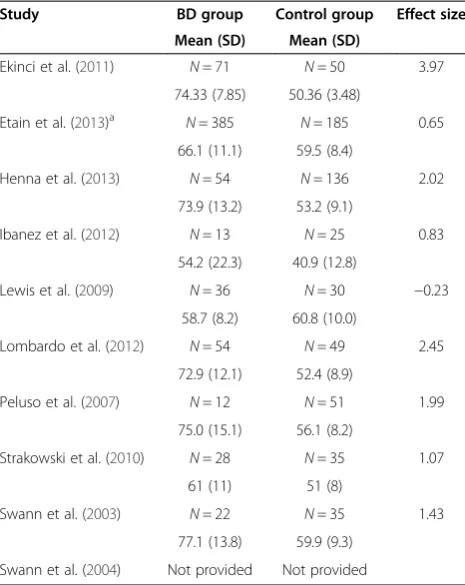
Of the ten studies in this section, all but two (Lewis et al. 2009; Ibanez et al. 2012) found significant differences between euthymic bipolar patients and controls on BIS total score. The effect size calculations were completed
and all but one of these studies found large effects (d= 1.07 to 3.96). Five of the seven studies reporting mean scores for the groups found mean BIS scores for the euthymic group of over 72, which is suggested by Stanford et al. (2009) as highly impulsive.
The Ibanez et al. (2012) study was probably underpow-ered because the estimated effect size for their group comparison was large (d= 0.83). Nevertheless, it seems noteworthy that the mean BIS score of their BD group was at the lower end of ‘normal’ range and the control group's mean was 40, which is very low, indicating either be-ing over-controlled or potentially havbe-ing completed the questionnaire incorrectly (Stanford et al. 2009).
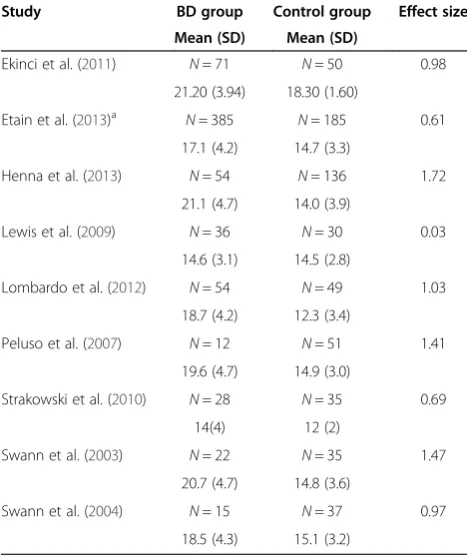
Of the nine studies reporting subscale scores (see Tables 3, 4 and 5), eight found significantly higher scores for the BD group on the subscales of non-planning and motor impulsivity. Seven of these studies also found differ-ences on the ‘attentional impulsivity’ subscale. Mostly, these results represented large effect sizes.
The study by Strakowski et al. (2010) is the only longi-tudinal study we identified. They initially assessed manic and mixed BD-I patients on a range of impulsivity mea-sures. They then followed up participants after 1 year. They found that after becoming euthymic, patients' BIS total, non-planning and motor subscales remained elevated compared to controls and did not differ significantly from scores when manic. The‘attentional subscale’reduced slightly so that it no longer significantly differed to controls,
Table 2 BIS total score: effect sizes
Study BD group Control group Effect size
Mean (SD) Mean (SD)
Ekinci et al. (2011) N= 71 N= 50 3.97
74.33 (7.85) 50.36 (3.48)
Etain et al. (2013)a
N= 385 N= 185 0.65
66.1 (11.1) 59.5 (8.4)
Henna et al. (2013) N= 54 N= 136 2.02
73.9 (13.2) 53.2 (9.1)
Ibanez et al. (2012) N= 13 N= 25 0.83
54.2 (22.3) 40.9 (12.8)
Lewis et al. (2009) N= 36 N= 30 −0.23 58.7 (8.2) 60.8 (10.0)
Lombardo et al. (2012) N= 54 N= 49 2.45
72.9 (12.1) 52.4 (8.9)
Peluso et al. (2007) N= 12 N= 51 1.99
75.0 (15.1) 56.1 (8.2)
Strakowski et al. (2010) N= 28 N= 35 1.07
61 (11) 51 (8)
Swann et al. (2003) N= 22 N= 35 1.43
77.1 (13.8) 59.9 (9.3)
Swann et al. (2004) Not provided Not provided
a
Means obtained from author as not reported in original paper.
Table 3 BIS motor impulsivity score: effect sizes
Study BD group Control group Effect size
Mean (SD) Mean (SD)
Ekinci et al. (2011) N= 71 N= 50 2.73
24.90 (3.23) 17.02 (2.25)
Etain et al. (2013)a N= 385 N= 185 0.41
23.0 (4.57) 21.29 (3.34)
Henna et al. (2013) N= 54 N= 136 1.71
26.1 (5.0) 19.4 (3.5)
Lewis et al. (2009) N= 36 N= 30 −0.69 20.2 (3.3) 22.8 (4.3)
Lombardo et al. (2012) N= 54 N= 49 1.56
26.1 (4.9) 19.8 (3.1)
Peluso et al. (2007) N= 12 N= 51 1.33
24.3 (6.7) 18.6 (3.7)
Strakowski et al. (2010) N= 28 N= 35 1.03
23 (5) 19 (3)
Swann et al. (2003) N= 22 N= 35 1.14
27.7 (4.8) 22.8 (4.0)
Swann et al. (2004) N= 15 N= 37 0.23
23.5(3.9) 22.6 (4.0)
a
Means obtained from author as not reported in original paper.
Newman and MeyerInternational Journal of Bipolar Disorders2014,2:2 Page 9 of 16
although effect size calculations still indicated a medium effect size (d= 0.69).
The methodological strength of the study by Strakowski et al. (2010) and the general consensus among studies provide strong evidence that impulsivity as measured by self-reports remains higher in euthymia than for healthy controls and may be a trait of those who experience BD. However, Lewis et al. (2009) found no differences on BIS scores. They had adopted a very strict definition of euthy-mia. However, four out of the seven papers finding signifi-cant differences in self-reported impulsivity also had strict definitions of euthymia, making this explanation unlikely. Another possibility highlighted by Lewis et al. is that they might have been recruited from a setting with less com-plex or severe cases than the recruitment sites in other studies. Therefore, it may be that the severity of illness during the acute stage is related to the level of impulsivity during euthymia. The study of Ekinci et al. (2011) was the only one to use another self-report measure, the Impulsiveness scale of the novelty-seeking dimension in the Temperament and Character Inventory (TCI; Cloninger et al. 1993). The TCI is a 240-item personality question-naire. Novelty seeking is considered a ‘higher order’ temperament within the questionnaire and consists of four ‘lower order’traits, of which impulsiveness is one. Ekinci et al. found significant differences between euthy-mic BD patients and controls on this scale representing a very large effect size (d =3.06).
Overall, there were substantially more BD-I than BD-II patients included in these studies. Strakowski et al. (2010), Lombardo et al. (2012) and Ekinci et al. (2011) used exclu-sively BD-I patients, whilst 75% of the participants in the study of Etain et al. (2013) and 90% in the study of Lewis et al. (2009) had been diagnosed with BD-I. The remaining studies did not report the type of BD diagnosis. The sam-ples represented here may therefore be more representa-tive of individuals who experience full manic episodes and are diagnosed with BD-I. In summary, there is substantial evidence that euthymic BD patients self-report higher levels of impulsivity than healthy controls. This is particu-larly the case for facets labelled as‘motor impulsivity’and ‘non-planning impulsivity’, though six of the eight studies also found higher levels of attentional impulsivity.
Behavioural measures of impulsivity
Response inhibition measures
Fifteen studies used tasks identified as measuring response inhibition (RI) using the go/no go task, versions of the CPT and a stop-signal task. Of these, only five explicitly examined impulsivity. The others mostly focused on sustained attention using a version of the CPT, from which the commission errors (false alarms), hit reaction time (HRT) and response criterion (beta) can be considered as measures of impulsive behaviour.
Table 4 BIS non-planning impulsivity score: effect sizes
Study BD group Control group Effect size
Mean (SD) Mean (SD)
Ekinci et al. (2011) N= 71 N= 50 2.38
28.11 (2.86) 21.39 (2.70)
Etain et al. (2013)a
N= 385 N= 185 0.52
26.0 (5.1) 23.5 (4.1)
Henna et al. (2013) N= 54 N= 136 1.49
26.6 (6.0) 19.7 (4.1)
Lewis et al. (2009) N= 36 N= 30 0.08
23.9 (4.4) 23.5 (5.2)
Lombardo et al. (2012) N= 54 N= 49 1.55
28.0 (5.5.) 20.3 (4.4)
Peluso et al. (2007) N= 12 N= 51 2.00
31.2 (6.8) 22.6 (3.7)
Strakowski et al. (2010) N= 28 N= 35 0.90
24 (5) 20 (4)
Swann et al. (2003) N= 22 N= 35 1.24
29.0 (6.2) 22.4 (4.8)
Swann et al. (2004) N= 15 N= 37 0.83
26.8 (5.8) 22.6 (4.7)
a
Means obtained from author as not reported in original paper.
Table 5 BIS attentional impulsivity score: effect sizes
Study BD group Control group Effect size
Mean (SD) Mean (SD)
Ekinci et al. (2011) N= 71 N= 50 0.98
21.20 (3.94) 18.30 (1.60)
Etain et al. (2013)a N= 385 N= 185 0.61
17.1 (4.2) 14.7 (3.3)
Henna et al. (2013) N= 54 N= 136 1.72
21.1 (4.7) 14.0 (3.9)
Lewis et al. (2009) N= 36 N= 30 0.03
14.6 (3.1) 14.5 (2.8)
Lombardo et al. (2012) N= 54 N= 49 1.03
18.7 (4.2) 12.3 (3.4)
Peluso et al. (2007) N= 12 N= 51 1.41
19.6 (4.7) 14.9 (3.0)
Strakowski et al. (2010) N= 28 N= 35 0.69
14(4) 12 (2)
Swann et al. (2003) N= 22 N= 35 1.47
20.7 (4.7) 14.8 (3.6)
Swann et al. (2004) N= 15 N= 37 0.97
18.5 (4.3) 15.1 (3.2)
a
Means obtained from author as not reported in original paper.
Newman and MeyerInternational Journal of Bipolar Disorders2014,2:2 Page 10 of 16
Most of these studies were good with respect to group allocation and had clear inclusion/exclusion criteria. Using the grid, the reliability of the impulsivity measures used was not rated as highly as for the self-report studies. This is mainly due to the fact that reliability for the measures used (mainly variations of the CPT) is less often formally established since the behavioural indices (e.g. error rates) are known to be often influenced by factors such as tiredness, practice or time of day. The unknown or low reliability of these measures is not necessarily a problem but needs to be kept in mind when drawing conclusions.
As described in the self-report section, the Strakowski et al. (2010) paper is methodologically strong and included multiple measures of impulsivity. The study of Bora et al. (2007) was also strong, with a strict definition of euthymia and clinical symptoms assessed by a trained clinician. The paper by Swann et al. (2003) included a measure of RI. The Brooks et al. (2010) study did not report how euthy-mia was defined and had a small sample size. Lastly, the Malloy-Diniz et al. (2011) study used relatively high cut-offs on symptom measures to define euthymia. This paper is therefore likely to contain subsyndromal patients.
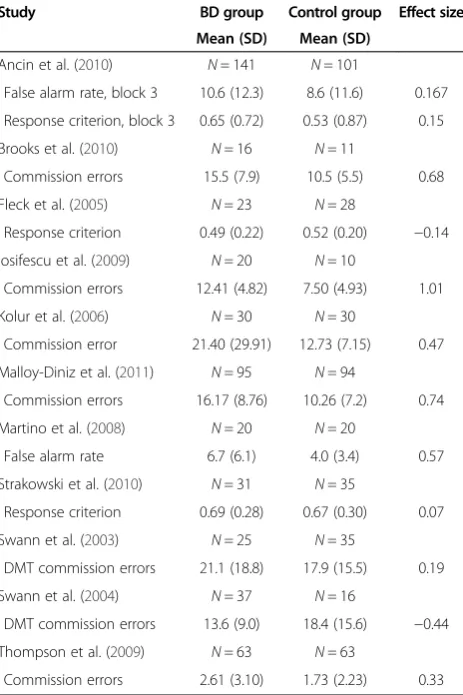
Continuous Performance Test (CPT).For the CPT, com-mission errors are the main outcome linked to impulsivity. Eleven papers reported commission error rates, of which four found significant differences between euthymic BD patients (or a subset of BD patients) and controls (see Table 6).
Only two papers found their sample of euthymic BD group as a whole to make more commission errors than controls. Both papers showed medium-large effect sizes for the group differences. One of these studies (Malloy-Diniz et al. 2011) included a sample that was not clearly euthy-mic, and the results may represent higher commission errors associated with residual symptoms. The second paper was by Iosifescu et al. (2009). They specifically in-cluded BD participants reporting cognitive deficits and compared them to healthy controls. They had methodo-logical reasons for this, as they undertook a medication trial for improving cognitive symptoms. However, their sample was therefore not representative of the general BD population.
Bora et al. (2007) separated those with and without a history of psychotic symptoms. Those with a history of psychotic symptoms made significantly more commission errors than both controls and non-psychotic patients. Kung et al. (2010) found that BD-I patients made more commission errors than controls but not BD-II patients. Neither Kung et al. nor Bora et al. reported the BD data for the whole group.
The perusal of effect sizes suggests that some studies might have been underpowered to detect significant group differences. The studies by Brooks et al. (2010), Martino et al. (2008) and Kolur et al. (2006) all showed medium
effect sizes (d =0.47 to 0.68) but failed to find significant group differences. These studies had relatively small sam-ples. Thompson et al. (2009) had larger groups, but found small-medium effects, so still may have been underpow-ered. However, Ancin et al. (2010) included a large sample but only found trivial effects.
Three studies (Ancin et al. 2010; Fleck et al. 2005; Strakowski et al. 2010) reported beta - a response criterion measure indicating liberal versus conservative responding to target stimuli. Beta can also be considered as a measure of impulsivity, but no study found significant group differences, and the effect sizes were trivial. The last CPT outcome linked to impulsivity is HRT. Of the nine studies reporting HRT, four found that euthymic BD patients were slower than healthy controls. Indeed, all studies that found BD patients were slower to respond than controls, though not all found a significant difference. Ordinarily,fasterRTs would be associated with impulsivity. A number of studies finding slower reaction times postulate that it is possible that euthymic patients sacrifice speed for accuracy.
Go/no go task. Two studies (Kaladjian et al. 2009; Ibanez et al. 2012) employed the go/no go task (see Table 7).
Table 6 Continuous Performance Test: effect sizes
Study BD group Control group Effect size
Mean (SD) Mean (SD)
Ancin et al. (2010) N= 141 N= 101
False alarm rate, block 3 10.6 (12.3) 8.6 (11.6) 0.167
Response criterion, block 3 0.65 (0.72) 0.53 (0.87) 0.15
Brooks et al. (2010) N= 16 N= 11
Commission errors 15.5 (7.9) 10.5 (5.5) 0.68
Fleck et al. (2005) N= 23 N= 28
Response criterion 0.49 (0.22) 0.52 (0.20) −0.14 Iosifescu et al. (2009) N= 20 N= 10
Commission errors 12.41 (4.82) 7.50 (4.93) 1.01
Kolur et al. (2006) N= 30 N= 30
Commission error 21.40 (29.91) 12.73 (7.15) 0.47
Malloy-Diniz et al. (2011) N= 95 N= 94
Commission errors 16.17 (8.76) 10.26 (7.2) 0.74
Martino et al. (2008) N= 20 N= 20
False alarm rate 6.7 (6.1) 4.0 (3.4) 0.57
Strakowski et al. (2010) N= 31 N= 35
Response criterion 0.69 (0.28) 0.67 (0.30) 0.07
Swann et al. (2003) N= 25 N= 35
DMT commission errors 21.1 (18.8) 17.9 (15.5) 0.19
Swann et al. (2004) N= 37 N= 16
DMT commission errors 13.6 (9.0) 18.4 (15.6) −0.44 Thompson et al. (2009) N= 63 N= 63
Commission errors 2.61 (3.10) 1.73 (2.23) 0.33
Newman and MeyerInternational Journal of Bipolar Disorders2014,2:2 Page 11 of 16
Participants must press a button when one type of stimu-lus appears and withhold responding when a different stimulus is presented. Commission errors are the outcome indicating impulsivity. Neither study found significant group differences. However, while the Ibanez et al. study found a large effect size for difference in commission error rate (d= 0.89), the effect size was trivial in the Kaladjian et al. study, and the BD group mean commission error rate was lower than the control group.
In summary, the majority of studies looking at RI failed to detect significant differences between euthymic BD patients and controls. The four studies reporting significant effects had either pre-selected or subgroups of BD patients (e.g. those with cognitive deficits). Therefore, there is limited evidence that euthymic BD patients perform more impulsively on RI measures than controls. However, there is tentative evidence that euthymic BD patients make more errors of commission in some tasks than controls but that some of the research has been underpowered to detect such an effect.
Delay of gratification measures
Five papers used paradigms measuring the ability to delay gratification (see Table 8). Two were explicitly exploring
impulsivity. The others explored decision-making more generally. However, the outcomes of the paradigms used in the papers all have relevance to this facet of impulsivity. The methodologically strong studies in this area were Strakowski et al. (2010) and Martino et al. (2011). Yechiam et al. (2008) however did not specify clear criteria for defining euthymia, and 36% of their ‘remitted’ group was still experiencing residual psychotic symptoms. They also did not measure or report the severity of mood symp-toms in the remitted group. The sample is therefore likely to have included subsyndromal patients. The methodo-logical assessment of the Malloy-Diniz et al. (2011) and Ibanez et al. (2012) had already been described before.
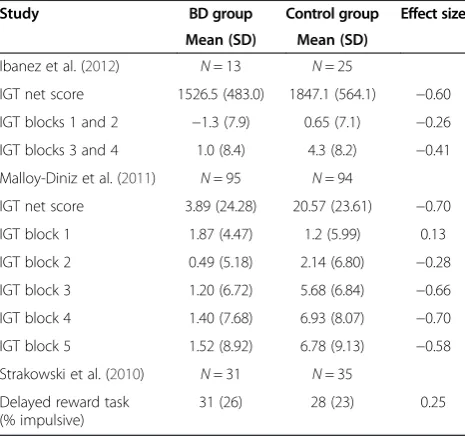
Four out of the five studies used the Iowa Gambling Task(IGT; Bechara et al. 1994). Participants are asked to choose a card from four available decks and win or lose money depending on their choice. Decks A and B provide high rewards but occasional high loses, leading to a net loss over time. Decks C and D have smaller rewards but less loses, resulting overtime in overall profit. Impulsive participants are expected to be more likely to draw from decks A and B, preferring larger immediate rewards. Of the studies using the IGT, two (Martino et al. 2011; Yechiam et al. 2008) found no significant group differ-ences. Malloy-Diniz et al. (2011) however found BD patients are impaired to controls on the overall task performance (measured by net task score) and on blocks 3, 4 and 5 of the task. Only in post hoc analyses Ibanez et al. (2012) found a significant difference between euthy-mic patients and controls on blocks 3 and 4 (combined). Group sizes in this study were however small (only 13 patients in BD group). The effect size calculations indicate medium-large effects on net IGT score (d =0.60), suggest-ing that the study may not have been sufficiently powered to detect an effect.
Strakowski et al. (2010) administered a delayed reward task to assess the ability to delay gratification. Participants use a computer mouse to select the letter A or B on the screen. Selecting A added 5 cents reward after a 5-s delay. Selecting B resulted in a variable delay, but added 15 cents. Maximum reward is gained by selecting B, and selecting A is considered the impulsive response. Euthymic BD patients showed significant improvements from their baseline manic scores and no longer differed significantly from the control group in behavioural impulsivity.
In summary, the two stronger studies and one meth-odologically weaker study found no group differences on impulsivity measures assessing ability to delay gratification. In the papers finding differences, one included patients who were not clearly euthymic, and findings may represent increased impulsivity due to the participants' mood state. The other, Ibanez et al. (2012), had a small sample size and onlypost hocanalyses revealed any group differences when specific blocks of the IGT were combined. However, their
Table 7 Go/no go response inhibition: effect sizes
Study BD group Control group Effect size
Mean (SD) Mean (SD)
Ibanez et al. (2012) N= 13 N= 25
Commission errors 7.6 (19.8) 0.37 (2.0) 0.89
Kaladjian et al. (2009) N= 20 N= 20
Commission errors 7.3 (5.5) 8.9 (7.2) −0.22
Table 8 Delay of gratification task: effect sizes
Study BD group Control group Effect size
Mean (SD) Mean (SD)
Ibanez et al. (2012) N= 13 N= 25
IGT net score 1526.5 (483.0) 1847.1 (564.1) −0.60 IGT blocks 1 and 2 −1.3 (7.9) 0.65 (7.1) −0.26 IGT blocks 3 and 4 1.0 (8.4) 4.3 (8.2) −0.41 Malloy-Diniz et al. (2011) N= 95 N= 94
IGT net score 3.89 (24.28) 20.57 (23.61) −0.70 IGT block 1 1.87 (4.47) 1.2 (5.99) 0.13
IGT block 2 0.49 (5.18) 2.14 (6.80) −0.28 IGT block 3 1.20 (6.72) 5.68 (6.84) −0.66 IGT block 4 1.40 (7.68) 6.93 (8.07) −0.70 IGT block 5 1.52 (8.92) 6.78 (9.13) −0.58 Strakowski et al. (2010) N= 31 N= 35
Delayed reward task (% impulsive)
31 (26) 28 (23) 0.25
Newman and MeyerInternational Journal of Bipolar Disorders2014,2:2 Page 12 of 16
finding and the estimated effect sizes provide tentative evidence that euthymic BD patients are less able to delay gratification than controls, although the main differences happened later during the task, potentially indicating a learning deficit or fluctuating response over time.
There is insufficient evidence to draw strong conclu-sions about the performance of euthymic BD patients on their ability to delay gratification tasks. As well as the limited number of studies, many of the tasks assessing this concept rely on other cognitive processes (such as attention and decision making) that may cloud results.
Discussion
The current review asked whether there is evidence that BD is associated with increased impulsivity even during euthymia, i.e. a potential vulnerability marker. The studies using self-report measures suggest impulsivity is a trait of those who experience BD rather than only ‘state’ related. Most studies including the methodologically strong ones -found that euthymic BD patients scored higher than con-trols on all subscales of the BIS, involving large effect sizes. The mean BIS total scores for over half the studies were also at levels indicating highly impulsive individuals. Addition-ally, in the longitudinal study by Strakowski et al. (2010), BIS scores did not significantly differ during mania, suggest-ing stability in the levels of impulsivity.
The performance on behavioural tasks did not indicate the same pattern. Few RI studies detected differences be-tween euthymic BD patients and controls, and there is therefore limited evidence of impulsive behaviour on RI tasks. However, exploration of the effect sizes of group differences suggested that a number of studies with small samples obtained medium effects despite not finding significant group differences, i.e. potentially being a problem of insufficient power. With regards to the ability to delay gratification, the two methodologically stronger studies found little evidence of group differences. How-ever, the small number of studies and paradigms used to assess delay of gratification make it hard to draw firm conclusions.
One question is whether we can conclude that the ten-tative evidence of increased impulsivity reported above indicates that this is a vulnerability marker for BD. There seems to be an association between course of BD and impulsivity. Kolur et al. (2006) reported that those with a history of two mood episodes made more commission errors than those with only one previous episode. Bora et al. (2007) reported an association between impulsivity and a history of psychotic symptoms in BD. The direction of this relationship is difficult to establish. Rather than im-pulsivity being a trait marker of those with BD, there may be a detrimental effect on impulsivity from experiencing repeated mood episodes, and this deficit may persist in euthymia. Alternatively, those who are more impulsive
may have a more severe course of illness. Research into impulsivity in symptomatic and‘at risk’for mania groups also suggests that impulsivity is related to a worsening course of illness and greater chronicity of symptoms. Swann et al. (2009a) found those with more previous mood episodes have higher BIS total scores. Kwapil et al. (2000) reported in their longitudinal study of those at risk for mania that those scoring highly on a self-report impulsivity measure experienced greater rates of BD and poorer overall adjustment to the illness. This gives some support to impulsivity as a trait which may lead to a more severe course of illness.
A related question is the‘state’versus‘trait’discussion. With respect to behavioural measures, the conceptualisa-tion of state versus trait is not clear cut. Some suggest that behavioural measures are state measures as they assess performance in that moment. However, other researchers (e.g. Najt et al. 2007) regard such measures as trait measures when assessed in a stable mood. Based on the reviewed evidence, we suggest impulsivity, incorporating all recognised facets, has not been identified as a stable trait of euthymic BD patients. Rather, some facets of im-pulsivity measured via self-report continue to be elevated, whilst RI manifestation of impulsivity may have a more state than trait relationship to BD.
There are a number of possible explanations for the difference in results between self-report and behavioural measures. We already alluded to some, such as potential problem with insufficient power of many studies using behavioural paradigms. Furthermore, self-reports of im-pulsivity might not be measuring a stable trait in this population. Those with BD may not use the same frame of reference when completing measures such as the BIS as controls. Someone with a history of (hypo)mania may answer the question ‘I do things without thinking’ by considering experiences from their manic episodes. Strakowski et al. (2010) identified this problem and ac-knowledges that‘separating affective symptoms from a bi-polar individual's“usual self”is not always straight-forward’. It is possible that rather than representing on-going impulse-control difficulties, the BIS reflects the person's view about their general functioning regarding impulsivity, including when in a mood episode. A further explanation for the discrepancy in results could be that most studies in this review used behavioural paradigms that were not primarily designed to measure impulsivity. For example, CPT is primarily an attention paradigm and theIowa Gam-bling Task is commonly referred to as a decision-making task. Any potential deficits in these processes may influence the outcomes linked to impulsivity. The lack of support for impulsivity as a trait of individuals with BD from these par-adigms may therefore represent questionable construct validity rather than a true lack in group differences in relation to the facet of impulsivity assessed. Another
Newman and MeyerInternational Journal of Bipolar Disorders2014,2:2 Page 13 of 16
consideration is that self-report and behavioural measures of impulsivity may be measuring different constructs, which are often not correlated with each other (e.g. Reynolds et al. 2006; Stanford et al. 2009). It seems essential in future research to refer more specifically to the processes and functions in question instead of impulsivity.
Lastly and related to the previous issue about looking more in depth into the processes and functions of im-pulsivity, impulsive behaviours could be activated by specific emotional states in euthymic BD patients. For example, Johnson et al. (2013) found that an increased risk for mania was associated with a tendency to behave im-pulsively when in elevated mood. Mansell and Lam (2006) also found that euthymic BD patients were less likely to follow advice following positive mood induction. These results suggest that mood elevations do not need to reach the level of mania for impulsive behaviour to be ac-tivated. Impulsivity therefore may be a state-related char-acteristic of those who experience BD.
Before drawing the final conclusions, some limitations of this review should be noted. Although we systematically searched for data, we cannot rule out that studies have been missed or non-significant results not been published. The application of the grid was done by one reviewer, and no reliability assessment was conducted. However, given the clear categories used, it seems unlikely that this would have changed the results. Furthermore, the boundaries of the concept of impulsivity are not clear so that every selection of tools and measures could be judged as arbi-trarily. We tried to be as explicit as possible to allow an evaluation of the measures we included. We see it as strength that contrary to any previous reviews on impul-sivity and BD, we have considered relevant studies that did not explicitly investigate impulsivity but presented the indices which have been interpreted as indicating impul-sivity. Lastly, a small number of the papers had samples that were likely to include subsyndromal patients. If impulsivity is activated in such subsyndromal states, this could have influenced the results. However, it is unlikely that this explains the difference between euthymic patients and controls on self-report impulsivity measures, as the studies with the most stringent definitions of euthy-mia did find significant group differences (e.g. Ekinci et al. 2011; Strakowski et al. 2010).
Conclusions
Despite the limitations, we believe there is significant evidence from the studies using self-report impulsivity measures that scores remain elevated during the euthymic stage of BD. There is therefore sufficient evidence of some facets of impulsivity persisting in the self-perception of patients during euthymia. It is less clear what the direc-tion of this reladirec-tionship might be. However, it is still not
clear if elevated impulsivity is a vulnerability factor for developing BD existing before the onset of the disorder or whether elevated self-reported impulsivity is a consequence of the disorder, a residual symptom or a reference to their previous mood-related behaviour.
Euthymic BD patients have not been clearly identified as more impulsive on behavioural measures assessing RI. However, this might rather reflect methodological issues of the studies. There is tentative evidence that those with more severe symptoms may continue to perform more impulsively on RI measures even when euthymic. Looking at the ability to delay gratification, much more research is needed before drawing any conclusions. Future research would also benefit from including those at risk of devel-oping BD. Some evidence exists and provides tentative evidence of impulsivity as a vulnerability marker for BD (e.g. Kwapil et al. 2000; Fulford et al. 2008; Giovanelli et al. 2013). However, there is insufficient literature to draw conclusions about which specific facets of impulsivity are the traits of individuals who go on to develop BD, rather than a consequence of the illness.
Competing interests
The authors declare that they have no competing interests with respect to this paper.
Authors’contributions
AN conducted the literature search, evaluated the quality of the papers and drafted the original manuscript. TM contributed to the identification of the research question, the design of the review, supported the evaluation of papers and revised the manuscript. Both authors read and approved the final manuscript.
Acknowledgements
Dr. Gabriele Jordan provided very helpful comments on an earlier draft of this paper.
Author details
1Northumberland, Tyne and Wear NHS Foundation Trust, St Nicholas
Hospital, Gosforth, Newcastle upon Tyne NE3 3XT, UK.2Institute of Neuroscience, Newcastle University, Ridley Building, Newcastle upon Tyne NE1 7RU, UK.
Received: 11 November 2013 Accepted: 27 January 2014 Published: 11 March 2014
References
Alloy LB, Abramson LY (2010) The role of the Behavioral Approach System (BAS) in bipolar spectrum disorders. Curr Dir Psychol Sci 19:189–94
Alloy LB, Bender RE, Whitehouse WG, Wagner CA, Liu RT, Grant DA, Jager-Hyman S, Molz A, Choi JY, Harmon-Jones E, Abramson LY (2012) High Behavioral Approach System (BAS) sensitivity, reward responsiveness, and goal-striving predict first onset of bipolar spectrum disorders: a prospective behavioral high-risk design. J Abnorm Psychol 121:339–351
American Psychiatric Association (2013) Diagnostic and Statistical Manual of Mental Disorders DSM-5 (5th ed). American Psychiatric Publishing, Washington, DC
Ancin I, Santos JL, Teijeira C, Sánchez-Morla EM, Bescos M, Argudo I, Torrijos S, Vázquez-Alvarez B, De La Vega I, López-Ibor JJ, Barabash A, Cabranes-Díaz JA (2010) Sustained attention as a potential endophenotype for bipolar disorder. Acta Psychiatr Scand 122:235–45
Arce E, Santisteban C (2006) Impulsivity: a review. Psicothema 18:213–20 Barratt ES (1994) Impulsiveness and aggression. In: Monahan J, Steadman HJ
(eds) Violence and Mental Disorder: Developments in Risk Assessment. University of Chicago Press, Chicago, pp 61–79
Newman and MeyerInternational Journal of Bipolar Disorders2014,2:2 Page 14 of 16
Bechara A, Damasio AR, Damasio H, Anderson SW (1994) Insensitivity to future consequences following damage to human prefrontal cortex. Cognition 50:7–15
Bora E, Vahip S, Akdeniz F, Gonul AS, Eryavuz A, Ogut M, Alkan M (2007) The effect of previous psychotic mood episodes on cognitive impairment in euthymic bipolar patients. Bipolar Disord 9:468–77
Brooks JO, Bearden CE, Hoblyn JC, Woodard SA, Ketter TA (2010) Prefrontal and paralimbic metabolic dysregulation related to sustained attention in euthymic older adults with bipolar disorder. Bipolar Disord 12:866–74 Brunner D, Hen R (1997) Insights into the neurobiology of impulsive behavior
from serotonin receptor knockout mice. Ann N Y Acad Sci 836:81–103 Chudasama Y, Passetti F, Rhodes SE, Lopian D, Desai A, Robbins TW (2003)
Dissociable aspects of performance on the 5-choice serial reaction time task following lesions of the dorsal anterior cingulate, infralimbic and orbitofrontal cortex in the rat: differential effects on selectivity, impulsivity and compulsivity. Behav Brain Res 146:105–19
Clark L, Iversen S, Goodwin GA (2001) Neuropsychological investigation of prefrontal cortex involvement in acute mania. Am J Psychiatry 158:1605–11 Cloninger C, Svrakic DM, Przybeck TR (1993) A psychobiological model of
temperament and character. Arch Gen Psychiatry 50:975–90 Cyders MA, Smith GT, Spillane NS, Fischer S, Annus AM, Peterson C (2007)
Integration of impulsivity and positive mood to predict risky behavior: development and validation of a measure of positive urgency. Psychol Assess 19:107–18
Daruna JH, Barnes PA (1993) A neurodevelopmental view of impulsivity. In: McCown WG, Johnson JL, Shure MB (eds) The Impulsive Client: Theory, Research and Treatment. American Psychological Association, Washington, DC, pp 23–37
Ekinci O, Albayrak Y, Ekinci AE, Caykoylu A (2011) Relationship of trait impulsivity with clinical presentation in euthymic bipolar disorder patients. Psychiatry Res 190:259–64
Etain B, Mathieu F, Liquet S, Raust A, Cochet B, Richard JR, Gard S, Zanouy L, Kahn JP, Cohen RF, Bougerol T, Henry C, Leboyer M, Bellivier F (2013) Clinical features associated with trait-impulsiveness in euthymic bipolar disorder patients. J Affect Disord 144:240–7
Fleck DE, Shear PK, Strakowski SM (2005) Processing efficiency and sustained attention in bipolar disorder. J Inter Neuropsychol Soc 11:49–57 Fulford D, Johnson SL, Carver CS (2008) Commonalities and differences in
characteristics of persons at risk for narcissism and mania. J Res Pers 42:1427–38
Giovanelli A, Hoerger M, Johnson SL, Gruber J (2013) Impulsive responses to positive mood and reward are related to mania risk. Cogn Emot 27:1091–104 Gray JA (1994) Three fundamental emotion systems. In: Ekman P, Davidson RJ
(eds) The Nature of Emotion: Fundamental Questions. Oxford University Press, New York, pp 243–7
Hadorn D, Baker D, Hodges J, Hicks N (1996) Rating the quality of evidence for clinical practice guidelines. J Clin Epidemiol 49:749–54
Henna E, Hatch JP, Nicoletti M, Swann AC, Zunta-Soares G, Soares JC (2013) Is impulsivity a common trait in bipolar and unipolar disorders? Bipolar Disord 15:223–7
Ibanez A, Cetkovich M, Petroni A, Urquina H, Baez S, Gonzalez-Gadea ML, Kamienkowski JE, Torralva T, Torrente F, Strejilevich S, Teitelbaum J, Hurtado E, Guex R, Melloni M, Lischinsky A, Sigman M, Manes F (2012) The neural basis of decision-making and reward processing in adults with euthymic bipolar disorder or attention-deficit/hyperactivity disorder (ADHD). PLoS One 7(5), doi:10.1371/journal.pone.0037306
Iosifescu DV, Moore CM, Deckersbach T, Tilley CA, Ostacher MJ, Sachs GS, Nierenberg AA (2009) Galantamine-ER for cognitive dysfunction in bipolar disorder and correlation with hippocampal neuronal viability: a proof-of-concept study. CNS Neurosci Ther 15:309–19
Johnson SL, Carver CS, Mulé S, Joormann J (2013) Impulsivity and risk for mania: towards greater specificity. Psychol Psychother: Theory Res Pract 86:401–12 Kaladjian A, Jeanningros R, Azorin JM, Nazarian B, Roth M, Mazzola-Pomietto P
(2009) Reduced brain activation in euthymic bipolar patients during response inhibition: an event-related fMRI study. Psychiatry Res 173:45–51 Kolur U, Reddy Y, John J, Kandavel T, Jain S (2006) Sustained attention and
executive functions in euthymic young people with bipolar disorder. Br J Psychiatry 189:453–8
Kung CH, Lee SY, Chang YH, Wu JY, Chen SL, Chen SH, Chu C-H, Lee I-H, Yeh T-L, Yang Y-K, Lu R-B (2010) Poorer sustained attention in bipolar I than bipolar II disorder. Ann Gen Psychiatry 9:8. doi:10.1186/1744-859X-9-8
Kwapil TR, Miller MB, Zinser MC, Chapman LJ, Chapman J, Eckblad M (2000) A longitudinal study of high scorers on the Hypomanic Personality Scale. J Abnorm Psychol 109:222–6
Lane S, Cherek DR, Rhodes HM, Pietras CJ, Techeremissine OV (2003) Relationships among laboratory and psychometric measures of impulsivity: implications in substance abuse and dependence. Addict Disord Their Treat 2:33–40
Lewis M, Scott J, Frangou S (2009) Impulsivity, personality and bipolar disorder. Eur Psychiatry 24:464–9
Lombardo LE, Bearden CE, Barrett J, Brumbaugh MS, Pittman B, Frangou S, Glahn DC (2012) Trait impulsivity as an endophenotype for bipolar I disorder. Bipolar Disord 14:565–70
Malloy-Diniz LF, Neves FS, De Moraes PHP, De Marco LA, Romano-Silva MA, Krebs MO, Corrêa H (2011) The 5-HTTLPR polymorphism, impulsivity and suicide behavior in euthymic bipolar patients. J Affect Disord 133:221–6 Mansell W, Lam D (2006)‘I won’t do what you tell me!’: elevated mood and the
assessment of advice-taking in euthymic bipolar I disorder. Behav Res Ther 44:1787–801
Mansell W, Morrison A, Reid G, Lowens I, Tai S (2007) The interpretation of, and responses to, changes in internal states: an integrative cognitive model of mood swings and bipolar disorders. Behav Cogn Psychother 35:515–39 Martino DJ, Igoa A, Marengo E, Scapola M, Ais ED, Strejilevich SA (2008) Cognitive
and motor features in elderly people with bipolar disorder. J Affect Disord 105:291–5
Martino DJ, Strejilevich SA, Torralva T, Manes F (2011) Decision making in euthymic bipolar I and bipolar II disorders. Psychol Med 41:1319–27 Mobini S, Body S, Ho MY, Bradshaw CM, Szabadi E, Deakin JF, Anderson IM (2002)
Effects of lesions of the orbitofrontal cortex on sensitivity to delayed and probabilistic reinforcement. Psychopharmacology 160:290–8
Murphy FC, Rubinsztein JS, Michael A, Rogers RD, Robbins RD, Paykel E (2001) Decision-making cognition in mania and depression. Psychol Med 31:679–93 Najt P, Glahn D, Bearden CE, Hatch J, Monkul ES, Kaur S, Villarreal V, Bowden C,
Soares JC (2005) Attention deficits in bipolar disorder: a comparison based on the Continuous Performance Test. Neurosci Lett 379:122–6
Najt P, Perez J, Sanches M, Peluso MAM, Glahn D, Soares J (2007) Impulsivity and bipolar disorder. Eur Neuropsychopharmacol 17:313–20
Patton JH, Stanford MS, Barratt ES (1995) Factor structure of the Barratt Impulsiveness Scale. J Clin Psychol 51:768–74
Peluso M, Hatch J, Glahn D, Monkul E, Sanches M, Najt P, Bowden CL, Barratt ES, Soares JC (2007) Trait impulsivity in patients with mood disorders. J Affect Disord 100:227–31
Reynolds B, Ortengren A, Richards JB, De Wit H (2006) Dimensions of impulsive behaviour: personality and behavioural measures. Pers Individ Dif 40:305–15 Scottish Intercollegiate Guidelines Network (2004) Annex D: completed
checklist., http://www.sign.ac.uk/pdf/sign50annexc.pdf.
Stanford MS, Barratt ES (1992) Impulsivity and the multi-impulsive personality disorder. Pers Individ Dif 13:831–4
Stanford MS, Mathias CW, Dougherty DM, Lake SL, Anderson NE, Patten JH (2009) Fifty years of the Barratt Impulsiveness Scale: an update and review. Pers Individ Dif 47:385–95
Strakowski SM, Fleck DE, DelBello MP, Adler CM, Shear PK, Keck PE Jr, Moss Q, Cerullo MA, Kotwal R, Arndt S (2009) Characterizing impulsivity in mania. Bipolar Disord 11:41–51
Strakowski SM, Fleck DE, DelBello MP, Adler CM, Shear PK, Kotwal R, Arndt S (2010) Impulsivity across the course of bipolar disorder. Bipolar Disord 12:285–97 Swann AC, Bjork JM, Moeller FG, Dougherty DM (2002) Two models of
impulsivity: relationship to personality traits and psychopathology. Biol Psychiatry 51:988–94
Swann AC, Pazzaglia P, Nicholls A, Dougherty DM, Moeller F (2003) Impulsivity and phase of illness in bipolar disorder. J Affect Disord 73:105–11 Swann AC, Dougherty DM, Pazzaglia PJ, Pham M, Moeller F (2004) Impulsivity: a
link between bipolar disorder and substance abuse. Bipolar Disord 6:204–12 Swann AC, Lijffijt M, Lane SD, Steinberg JL, Moeller FG (2009a) Increased trait-like
impulsivity and course of illness in bipolar disorder. Bipolar Disord 11:280–8 Swann AC, Lijffijt M, Lane SD, Steinberg JL, Moeller FG (2009b) Severity of bipolar
disorder is associated with impairment of response inhibition. J Affect Disord 116:30–6
Thalheimer W, Cook S (2002) How to calculate effect sizes from published research: A simplified methodology., Available at http://www.bwgriffin.com/ gsu/courses/edur9131/content/Effect_Sizes_pdf5.pdf. Accessed 20 February 2013
Newman and MeyerInternational Journal of Bipolar Disorders2014,2:2 Page 15 of 16
Thompson JM, Gray JM, Crawford JR, Hughes JH, Young AH, Ferrier I (2009) Differential deficit in executive control in euthymic bipolar disorder. J Abnorm Psychol 118:146–60
Verbruggen F, Logan GD (2008) Response inhibition in the stop-signal paradigm. Trends Cogn Sci 12:418–24
Watkins HB, Meyer TD (2013) Is there an empirical link between impulsivity and suicidality in bipolar disorders? A review of the current literature and the potential psychological implications of the relationship. Bipolar Disord 15:542–58
Whiteside SP, Lynam DR (2001) The five factor model and impulsivity: using a structural model of personality to understand impulsivity. Pers Individ Dif 30:669–89
Winstanley CA, Eagle DM, Robbins TW (2006) Behavioral models of impulsivity in relation to ADHD: translation between clinical and preclinical studies. Clin Psychol Rev 26:379–95
Yechiam E, Hayden EP, Bodkins M, O'Donnell BF, Hetrick WP (2008) Decision making in bipolar disorder: a cognitive modelling approach. Psychiatry Res 161:142–52
doi:10.1186/2194-7511-2-2
Cite this article as:Newman and Meyer:Impulsivity: present during euthymia in bipolar disorder? - a systematic review.International Journal
of Bipolar Disorders20142:2.
Submit your manuscript to a
journal and benefi t from:
7Convenient online submission
7Rigorous peer review
7Immediate publication on acceptance
7Open access: articles freely available online
7High visibility within the fi eld
7Retaining the copyright to your article
Submit your next manuscript at 7 springeropen.com
Newman and MeyerInternational Journal of Bipolar Disorders2014,2:2 Page 16 of 16