N O T E
Technological development for the control of humidity
conditioning performance of slit materials made from Japanese
cedar
Yuka Miyoshi1• Mariko Furutani2•Mayuko Ishihara3•Shunichi Tai1•
Yuzo Furuta1•Shuichi Kawai4
Received: 15 April 2015 / Accepted: 2 September 2015 / Published online: 28 September 2015
ÓThe Japan Wood Research Society 2015
Abstract For the purpose of technology development to control the humidity conditioning performance of slit material made from Japanese cedar, the effects of the groove shape of slit samples, air convection, and heat treatment on moisture adsorption and desorption properties were studied. The results obtained are as follows. The moisture adsorption and desorption rates of slit samples were increased with increase of end grain area of them. However, the moisture adsorption and desorption rates were not increased with increase of depth of concave, although the end grain area was increased. On the other hand, reduced rates of the slit samples with deep concave were increased by air convec-tion. The increase ratios of moisture adsorption and des-orption rates were larger in samples with deep concave. Equilibrium moisture content was decreased with increase of heat treatment temperature. Pore volume of micropores smaller than 0.6 nm was decreased with increases of heat treatment temperature. Compromise position of processing condition for slit material should be sought considering production and labor costs, drying conditions, and installa-tion environment in addiinstalla-tion to results obtained in this study.
Keywords Humidity conditioning performanceSlit material Heat treatment temperatureJapanese cedar
Introduction
It is an important subject to make effective use of the domestic wood in Japan. In particular, the technological developments of new use and application are needed for Japanese cedar which was forested in approximately 40 % of the area in Japan. In recent years, for effective utilization method of Japanese cedar, the functions of air purification [1] and humidity conditioning [2–4] of Japanese cedar have been noted. These features have been reported to be excellent in end grain surface. However, Japanese cedar materials generally are often used by exposing the edge grain or flat grain surface in room. Therefore, it is not possible to take advantage of their functions in end grain surface. Accordingly, to increase the exposed area of the end grain surface, the Japanese cedar material carved some slits in the fiber orthogonal direction in the flat grain sur-face which has already been put to practical use. So, the slit material of Japanese cedar is utilized in various products such as furniture and interior materials.
For studies on hygroscopic performance of wood, from the relationship between logarithm of the humidity and the temperature in enclosure space, the index of the humidity conditioning performance of the material is defined as B value [5], and the humidity conditioning performance of various materials has been compared by B value [6]. Besides, an evaluation is also performed using the Cb value of an index of the humidity conditioning performance of the material when the temperature change with the amplitude of sine wave is given in the enclosure space [7]. From these studies mentioned above, wood has excellent
& Yuka Miyoshi
1 Division of Environmental Sciences, Graduate School of Life
and Environmental Sciences, Kyoto Prefectural University, Hangi-cho, Shimogamo, Sakyo-ku, Kyoto 606-8522, Japan
2 Hokushin Co., Ltd., 17-2 Mokuzai-cho, Kishiwada,
Osaka 596-8521, Japan
3 Seiki Co., Ltd., 265-2 Makieya-cho, Nakagyo-ku, Kyoto,
Kyoto 604-0857, Japan
4 Graduate School of Advanced Integrated Studies in Human
Survivability, Kyoto University, 1 Yoshida-Nakaadachi-cho, Sakyo-ku, Kyoto 606-8306, Japan
humidity conditioning performance, and the effect of the humidity conditioning performance is increased with increasing the ratio (A0/V0) of the lined area (A0) to the volume of enclosure space (V0). Therefore, in the slit material of Japanese cedar, it is also expected that the rates of moisture adsorption and desorption are increased by the way of use which theA0/V0 and the area of the end grain surface exposed are larger.
However, for slit material, it cannot be said that the way of optimum production has been established because the effects of the slit shape, drying conditions, and installation environment on moisture adsorption and desorption prop-erties of slit samples were not sufficiently studied. To produce the slit materials with considering production and labor costs, drying conditions, and installation environ-ment, it is necessary to study the relationship between the performances of moisture adsorption and desorption and the factors affecting these performances.
Accordingly, in this report, to clarify the effects of the slit shape, air convection, and heat treatment for slit sam-ples, various physical quantities including moisture adsorption and desorption properties were measured. Then, these results were considered in some view points.
Materials and methods
Materials
Samples were made from a 50-year-old Japanese cedar tree (Cryptomeria japonica) which grew in Ohno experimental forest owned by Kyoto prefectural university. The diameter at breast height of the tree was about 25 cm. The samples were dried in natural drying condition, and then the sam-ples were made in 3 patterns as follows; samsam-ples (1) used measurements of moisture adsorption and desorption, samples (2) used measurements of equilibrium moisture content, and samples (3) used measurements of micropores. The samples (1) were made in 2 shape patterns;end grain samples with the shapes cut in 40 mm in radial direction (R), 70 mm in tangential direction (T), and 2, 5, 7, and 10 mm in longitudinal direction (L) to study effects of thickness in L direction (shown in Fig.1a),`samples with the shapes cut in 0°(flat grain section), 30°, 45°, 60°, and 90°(end grain section) to study effects of cutting angles for end grain (shown in Fig.1b). These samples were covered with aluminum tapes in four sides except each cross section. The slit samples were made by applying the grooves at intervals of 6 mm in flat grain section. The shape of sam-ples was 70 mm (L)940 mm (R)970 mm (T). The slit samples with the convex thicknesses of 2, 5, 7, and 10 mm and the concave depth and width of 7 and 6 mm, respec-tively, were shaved off by a circular saw to study the
effects of the convex thickness in L direction (Fig.1c2). The slit samples with the convex thicknesses of 7 mm and the concave depth of 3, 7, 15, 20, and 30 mm were shaved off by a circular saw to study the effects of the concave depth (Fig.1d2). In addition, flat grain samples with no grooves were made.
The slit samples were covered with aluminum tapes as shown in Fig.1c1, d1 to protect the moisture adsorption in sections except the convex.
The samples (2) were dried at 25, 45, 60, and 105°C for more than a day in a fan dryer after dried in natural drying condition. The shape was 7 mm (L)940 mm (R)940 mm (T).
The samples (3) were made by cutting into 1–2 mm cubes. The weights were about 1 gram.
Measurement of moisture adsorption and desorption
The humidity conditioning of the samples were carried out at constant temperature and room humidity (20°C, 65 % R.H.) until the weight of each sample reached a constant weight. Then moisture adsorption for each sample was started in the desiccator (20°C, 93 % R.H.) volume of which was about 13 L. The relative humidity was con-trolled using a saturated KNO3 solution. The weight of
each sample in the adsorption process was measured after 30 min, 1 h, 1 h 30 min, 3 h, 6 h, 12 h, and 24 h. The specimen was quickly taken out from the desiccator and then the weight was measured using the electronic balance. After the measurements, specimen was returned to the desiccator quickly. Then the weight of each sample in desorption process was measured at constant temperature and room humidity (20 °C, 65 % R.H.) using the electronic balance. These measurements were carried out under windless or air convection. The air convection in the des-iccator was made by a case fun (1400 rpm, 92 mm992 mm) and the wind velocity was about 0.7 m/ s.
Measurement of equilibrium moisture content
The measurements of equilibrium moisture content were carried out after the weight of each sample (2) reached constant in each desiccator conditioned with each saturated salt solution at 23 % R.H. (CH3COOK), 42 % R.H.
(K2CO3), 65 % R.H. (NH4NO3), or 85 % R.H. (KCl).
Measurement of micropore
structure, each sample (3) which was dried at 45, 60, or 105°C using a mantle heater supplied with the AUTO-SORB-1 was used for adsorption measurements of CO2
gas. The adsorption isotherms obtained were analyzed by the Horvath–Kawazoe method in reference to the previous studies [8], and the relationship between micropore size and the pore size distribution was calculated.
Results and discussion
Moisture adsorption and desorption properties of plate samples
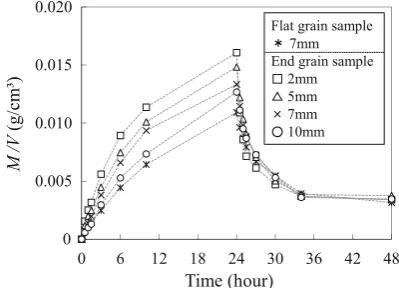
In moisture conditioning materials, to evaluate the humidity conditioning performance, it is important to compare the moisture adsorption and desorption rates after the humidity changed. Therefore, to study the effects of thickness in longitudinal direction and cutting angle to longitudinal direction for end grain samples, the rates of moisture adsorption and desorption were measured. The amount of moisture adsorption and desorption and the volume of sample were named M and V, respectively. Figure2 shows typical behaviors of M/V. In this study, rates ofM/V were obtained from the value ofM/Vat 6 h after the measurement was started. The reason for this is because rate of M/V was largely decreased after 10 h as shown in Fig.2. The relationship between the rates ofM/V and the thickness in longitudinal direction of plate samples is shown in Fig.3. The rates ofM/Vwere decreased with
increase of thickness. Generally, the average length of tracheid of Japanese cedar is 3 mm [9]. So, it may be considered that the length of tracheid affects the moisture adsorption and desorption properties of end grain samples with different thickness in longitudinal direction.
In previous studies, moisture adsorption and desorption per unit area and moisture transmission rate of end grain samples were much larger than those of flat grain samples [3,10]. The surface cut in 90°to longitudinal direction is end grain, and the surface approaches from end grain to flat grain when the cutting angle is reduced. If the cutting angle is reduced, the area of cutting surface is increased. How-ever, the ratio of projected area of end grain to the area of Fig. 1 The shape of specimens. a Plate samples with various
thickness in longitudinal direction. b Plate samples with various cutting angles to longitudinal direction.cSlit samples with various
convex thickness in longitudinal direction.dSlit samples with various concave depth.Llongitudinal direction,Rradial direction,T tangen-tial direction
M /V
(g/cm
³)
0 0.005 0.010 0.015 0.020
0 6 12 18 24 30 36 42 48
Time (hour)
Flat grain sample 7mm End grain sample
2mm 5mm 7mm 10mm
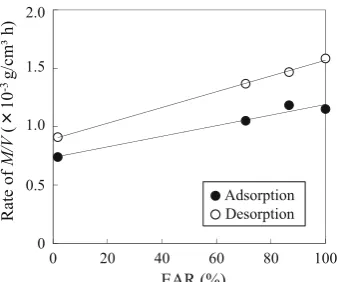
cutting surface is decreased. Therefore, to compare the contribution of moisture adsorption and desorption prop-erties of end grain, the ratio was defined as an effective area ratio of end grain (EAR). The exposed area of end grain section was defined as 100 % of EAR. When the timbers having the same areas of end grain section are cut obliquely to the axial direction, the exposed area of the cross section is increased. Then, the ratio of the original area of the end grain section against the exposed area of cross section was defined as the EAR. Figure4shows the relationship between rates of M/Vand EAR. The rates of M/V were increased with increase of EAR. On the other hand, the samples cut in less than 90°have larger exposed surface of cell lumen in comparison with that of end grain sample. In other words, it is suggested that moisture adsorption and desorption properties of cross section were
affected by moisture diffusion in cell wall rather than the amount of exposed surface of cell lumen.
Moisture adsorption and desorption properties of slit samples
Figure5 shows moisture adsorption and desorption rates per unit volume of convex (M/Vc) and rate ofM/Vcper unit
end grain area of convex (M/VcA) of the slit samples with
various convex thickness in longitudinal direction. Rate of M/Vc was decreased with increase of convex thickness in
longitudinal direction. This tendency is similar to Fig.3 and the cause of results are considered that diffusion of water vapor from the surface to the inside of wood is quick in the thinner samples. When the convex thickness is increased, end grain area of convex is decreased. There-fore, rate ofM/VcAwas calculated. The rate ofM/VcAwas
not decreased with increase of convex thickness, although M/V was decreased with increase of thickness in longitu-dinal direction in plate sample. This result indicates that moisture adsorption and desorption properties were affec-ted by increase of end grain areas of convex rather than the convex thickness in slit samples.
Figure6 shows rates of M/Vc and M/Vc A of the slit
samples with various concave depths. Rate of M/Vc was
decreased with increase of concave depth. The tendency like this was almost same in rate ofM/VcA. The cause of
these results was considered as follows. These slit samples were measured in windless desiccator. Therefore, at the deep portion of concave, air forced convection cannot be caused. For example, when moisture adsorption is carried out on the surface of slit sample, humidity close to the slit surface is reduced. If the difference between the ratios of moisture contained in slit sample and in air is larger, the moisture adsorption and desorption rates are larger.
0 2 4 6 8 10 12
Thickness in longitudinal direction (mm) Adsorption
Desorption 2.0
1.5
1.0
0.5
0
Rate of
M/
V
(
10
-3 g/cm
³
h
)
Fig. 3 The relationship between moisture adsorption and desorption rates per unit volume and thickness in longitudinal direction of plate samples.M,Vrefer to Fig.2. Rates ofM/Vwere obtained from the values ofM/Vat 6 h after the measurements were started
0 20 40 60 80 100
2.0
1.5
1.0
0.5
0
Rate of
M/
V
(
10
-3 g/cm
³
h
)
EAR (%)
Adsorption Desorption
Fig. 4 The relationship between moisture adsorption and desorption rates per unit volume and effective area ratio of end grain.M,V, refer to Fig.2. EAR effective area ratio of cress section, rates ofM/Vwere obtained from the values ofM/Vat 6 h after the measurements were started
0 2 4 6 8 10 12 0 2 4 6 8 10 12
Adsorption Desorption 4.0
3.0
2.0
1.0
0
Ra
te of
M/
Vc
(
10
-3g/cm³
h)
Convex thickness (mm)
5.0
4.0
3.0
2.0
1.0
0
Rate of
M/V
c
A
(
10
-5
g/cm³cm
2h)
Adsorption Desorption
Convex thickness (mm)
(b)
(a)
Fig. 5 The relationship between moisture adsorption and desorption rates and convex thickness in longitudinal direction. a Moisture adsorption and desorption rates per unit volume of convex;bmoisture adsorption and desorption rates per unit volume and per unit end grain area of convex.Mrefers to Fig.2.Vcvolume of convex of slit sample,
However, the difference between the ratios of moisture contained in those is smaller, moisture adsorption and desorption rates are also smaller. Therefore, it might be considered that moisture adsorption and desorption rates were decreased with increase of concave depth, because the diffusion of moisture did not rapidly occur at the deep portion of concave.
To clarify the effect of the air convection on moisture adsorption and desorption properties of slit samples, the relationship between the changing rates of moisture adsorption and desorption due to air convection (M/Ma)
and concave depth of slit samples is shown in Fig.7. In all of the slit samples with various concave depth,M/Mawas
increased due to air convection. The value of M/Ma was
larger in samples with deep concave.
These results indicate as follows. The moisture adsorp-tion and desorpadsorp-tion rates of slit samples were increased with increase of end grain area of them. However, the moisture adsorption and desorption rates were not increased with increase of depth of concave, although the
end grain area was increased. And these reduced rates are increased by air convection at the deep portion of concave. In the future, to improve the control technology of humidity conditioning performance, it is necessary to consider the influence of concave width and conditions of air convection on the moisture adsorption and desorption properties in addition to results obtained in this study.
Influences of heat treatment on Japanese cedar material
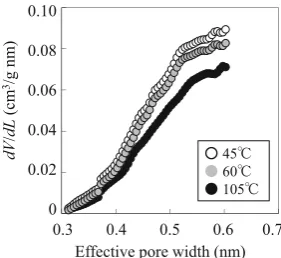
The existing slit material of Japanese cedar is dried at low temperature not to reduce the fragrance components emitted from the slit material. However, the effect of drying conditions on the humidity conditioning perfor-mance is not studied. Then, paying attention to the drying temperature, hygroscopicity of the samples treated at var-ious temperatures was studied. Figure8 shows the rela-tionship between heat treatment temperature and equilibrium moisture content (EMC) at each relative humidity. EMC was decreased with increase of heat treatment temperature. The difference in EMC among samples treated at each temperature was larger at lower relative humidity condition. A tendency like this was observed in Japanese cypress treated from 140 to 200°C in previous study [11]. Figure9 shows influence of drying temperature on pore size distribution determined by the adsorption of CO2 with samples dried at different
tem-peratures. The 0.6 nm or less size of pores are the size at which one or two water molecules can be adsorbed and the range of pore size is important for humidity conditioning performance of wood. Pore volume smaller than 0.6 nm was decreased with increase of heat treatment temperature. Therefore, it may be suggested that reduction of EMC is caused by the decrease of micropores smaller than 0.6 nm due to heat treatment. It is reported that the reduction of hygroscopicity and micropores due to heat treatment is
0 10 20 30 40 0 10 20 30 40
Concave depth (mm)
12
10
8
6
4
2
0 Adsorption
Desorption 2.5
2.0
1.5
1.0
0.5
0
Adsorption Desorption
Concave depth (mm)
Rate of
M/
Vc
(
10
-3 g/cm
³
h
)
Rate of
M/
Vc
A
(
10
-5
g/cm³cm
2h)
(b)
(a)
Fig. 6 The relationship between moisture adsorption and desorption rates and concave depth.aMoisture adsorption and desorption rates per unit volume of convex;bmoisture adsorption and desorption rates per unit volume and per unit end grain area of convex.Mrefers to Fig.2. Vc,Arefer to Fig.5. Rates ofM/Vwere obtained from the values ofM/Vat 6 h after the measurements were started
0 100 200 300 400 500
0 10 20 30 40
Adsorption Desorption
Concave depth (mm)
Changing rate of
M/M
a
(%
)
Fig. 7 The relationship between changing rate of moisture adsorp-tion and desorpadsorp-tion rates due to air convecadsorp-tion.Mmoisture adsorption and desorption rate measured in windless desiccator, Ma moisture adsorption and desorption rate measured in desiccator with air convection, changing rates ofM/Mawere obtained from the values of
Mat 6 h after the measurements were started
0 5 10 15 20
0 20 40 60 80 100
Relative humidity (%) 25
45 60 105
EMC
(%)
almost recovered to their original level by rewetting [8, 11]. In other words, the changes of hygroscopicity and micropores of heat-treated wood are reversible [8, 11]. Therefore, in the future, if the changes of the humidity conditioning performance of slit samples dried at various schedules are examined under humidity cycle, it may be possible to suggest appropriate methods of drying and use not to impair the moisture adsorption and desorption properties.
Conclusion
To clarify the influence of the groove shape of slit samples, air convection and heat treatment on humidity conditioning performance, various physical quantities including mois-ture adsorption, and desorption properties were measured. The results obtained are as follows.
1. The moisture adsorption and desorption rates of slit samples were increased with increase of end grain area of them. However, the moisture adsorption and desorption rates were not increased with increase of depth of concave, although the end grain area was increased. On the other hand, reduced rates of the slit samples with deep concave were increased by air convection.
2. Equilibrium moisture content was decreased with increase of heat treatment temperature. Pore volume of micropores smaller than 0.6 nm was decreased with increase of heat treatment temperature. Therefore, it may be suggested that reduction of equilibrium
moisture content is caused by the decrease of micro-pores smaller than 0.6 nm due to heat treatment. Compromise position of processing condition for slit material should be sought considering production and labor costs, drying conditions, and installation environment in addition to results obtained in this study.
Acknowledgments This study was supported by ‘‘The mission research’’ and ‘‘The development of new area’’ grant funded by RISH (Research Institute for Sustainable Humanosphere). The authors would like to appreciate the members of the projects.
References
1. Tsujino Y, Warashima M, Morioka J, Takenaka N, Bandow H, Maeda Y (2000) Wooden materials suitable for storage boxes or cellar walls to remove nitrogen dioxide and ozone in ambient air. Glob Environ Res 4:89–94
2. Ohata T, Kawamura S (2012) Evaluation of basic moisture adsorption and desorption performance of various building materials (in Japanese). Res Rep Shimane Inst Ind Technol 48:16–19
3. Tsumura T (2006) A study on adsorption and desorption of water vapor in the cut end of a wood (Part 1 Response method of humidity) (in Japanese). In: Summaries of technical papers of annual meeting of Architectural Institute of Japan 2006, Yoko-hama, pp 1003–1004
4. Tsumura T (2007) A study on adsorption and desorption of water vapor in the cut end of a wood (Part 2 Response method of temperature) (in Japanese). In: Summaries of technical papers of annual meeting of Architectural Institute of Japan 2007, Fukuoka, pp 1055–1056
5. Maki F, Norimoto M, Yamada T (1981) Evaluation of the humidity control performance of interior materials (in Japanese). Wood Ind 36:476–480
6. Norimoto M, Ohgama T, Yamada T (1990) Humidity conditions caused by wood (in Japanese). Mokuzai Gakkaishi 36:341–346 7. Morooka T, Homma Y, Norimoto M (2007) Criterion for
esti-mating humidity control capacity of materials in a room. J Wood Sci 53:192–198
8. Kojiro K, Furuta Y, Ishimaru Y (2008) Influence of heating and drying history on micropores in dry wood. J Wood Sci 54:202–207
9. Society The Japan Wood Research (ed) (2011) Structure of wood (in Japanese). Bun-eido Publishing Co., Ltd., Tokyo, p 37 10. Miyano A, Kobayashi S, Miyano N (1994) Moisture transmission
of the woods (in Japanese). In: Summaries of technical papers of annual meeting of Architectural Institute of Japan 1994, Nagoya, pp 265–266
11. Obataya E, Tanaka F, Norimoto M, Tomita B (2000) Hygro-scopicity of heat-treated woodI: effects of after-treatments on the hygroscopicity of heat-treated wood (in Japanese). Mokuzai Gakkaishi 46:77–87
Effective pore width (nm)
45 60 105
0.10
0.08
0.06
0.04
0.02
0
0.3 0.4 0.5 0.6 0.7
dV
/
dL
(cm
3/g
n
m
)
Fig. 9 Influence of heat treatment temperature on pore size distri-bution determined by the adsorption of CO2with samples dried at