...
...
Research article
Factors controlling internal initiation of
transcription at
PRY3
in budding yeast
Ben Lee*
Department of Biochemistry, University of Oxford, South Parks Road, Oxford, OX1 3QU, UK.
*Corresponding author:Wolfson College, Oxford, OX2 6UD, UK. Tel:þ44 (0) 1865 275263. Email: [email protected]
Supervisor:Dr. Jane Mellor, Department of Biochemistry, University of Oxford, South Parks Road, Oxford, OX1 3QU, UK.
Transcription initiation from within the coding regions of genes has been observed in budding yeast as a natural phenomenon induced by environmental changes. However, such ‘internal initiation’ events have also been observed in mutant yeast strains with aberrant chro-matin structure. Failure to suppress initiation from cryptic internal promoters is thought to result from either loss of appropriate nucleo-some density or loss of appropriate histone modifications in the coding region.PRY3is a gene previously shown to undergo internal initiation in response to mating pheromone. This project aimed to uncover which factors are involved in suppressing inappropriate tran-scription initiation from an internal TATA-box atPRY3in the absence of mating pheromone. This work demonstrates that factors con-trolling nucleosome density (Spt6, Spn1 and Spt10) but not histone deacetylation (Eaf3) are required to suppress internal initiation at PRY3 in the absence of mating pheromone. In addition, TATA-box binding protein (TBP) is required for internal initiation at PRY3. Taken together, these results indicate that internal initiation atPRY3is predominantly suppressed by a nucleosome reassembly mech-anism rather than histone modifications, and suggest that the transcriptional output atPRY3is controlled by competition between TBP and nucleosomes for binding an internal TATA-box.
Key words: chromatin, transcription, initiation, Spt6,PRY3, fidelity.
Introduction
The hereditary material in eukaryotes is organized as a deoxyribonucleoprotein complex known as chromatin.1
Nucleosomes, the fundamental units of chromatin structure and function, not only compact the genome but are also inti-mately involved in regulating its expression.2 Modification
by ATP-dependent chromatin remodelling, histone post-translational modifications (such as acetylation, methylation and phosphorylation) and incorporation of histone variants renders chromatin a highly dynamic complex and these changes underlie all nuclear genomic processes that occur in its context.3 – 6
During the process of transcription, modification of chro-matin structure influences the accessibility and function of proteins that interact with chromatin and DNA. For example, nucleosomes generally impair accessibility of tran-scription factors to enhancers and promoters, and impose a physical barrier to the passage of elongating RNA polymer-ase II (RNAPII).7, 8 The increases in nucleosome mobility
and DNA accessibility that are mediated by chromatin modi-fications during transcription must be coordinated, however, with modifications that restore a repressive chromatin struc-ture after the passage of RNAPII through a gene.9Failure to
maintain appropriate chromatin structure in the open-reading-frame (ORF) of certain genes can lead to an aberrant transcription phenotype known as ‘internal initiation’ where transcription initiates from a cryptic pro-moter located within the coding region of a gene.10 – 12
Studies using mutant yeast strains with aberrant chromatin structure have identified two mechanisms by which internal initiation is suppressed and thus ‘transcriptional fidelity’ maintained: (i) cotranscriptional nucleosome reassembly by histone chaperones, such as Spt6 and FACT, provides appro-priate nucleosome density to conceal internal promoters and repress internal initiation;10, 11and (ii) histone methylation
directs deacetylation of histones to form a repressive chroma-tin structure.12
FLO8is an example of gene where an internal TATA-box promoter is suppressed by reassembly of appropriate
...
#The Author 2008. Published by Oxford University Press.
This is an Open Access article distributed under the terms of the Creative Commons Attribution Non-Commercial License
nucleosome density in the coding region during transcrip-tion. Internal initiation at FLO8 is observed in histone depletion strains, such as spt10D, spt21D, bur1D, bur2D
( positive regulators of histone gene expression13) and bur5D (histone H3), and in strains that are defective in Spt6 and FACT, transcription elongation factors that func-tion as cotranscripfunc-tional histone chaperones.7, 10, 11 Since SPT6 is essential to growth and viability, the temperature-sensitive alleles, spt6140 and spt61004, have been used to study Spt6 function.14 While the exact mutation inspt6140 is unknown, the protein encoded byspt61004contains a 63 amino-acid deletion (931 –994) that removes its non-specific DNA-binding helix–hairpin–helix (HhH) domain. At 398C (the non-permissive temperature) but not 308C (the permiss-ive temperature), these two alleles exhibit internal initiation atFLO8 due to disruption of the cotranscriptional histone chaperone activity of Spt6 and exposure of the internal TATA-box.10 Further investigation of factors suppressing internal initiation atFLO8has identified Spn1, an essential protein that interacts with Spt6; and the SH2 (Src-homology 2) domain of Spt6 (M. Youdell, personal communication).
The second mechanism proposed to suppress internal initiation relies upon appropriate histone modifications in the coding region. Methylation of lysine 36 on histone H3 (H3K36me) by Set2 during transcription has previously been shown to recruit the repressive Rpd3(S) complex via its chromodomain-containing Eaf3 subunit to deacetylate histones in the coding region and suppress internal initiation from genes such asSTE11.12, 15Histone deacetylation may suppress internal initiation by promoting stable histone-DNA interactions and preventing the binding of bromodomain-containing transcription factors, such as Bdf1 in TFIID.16 – 18 Internal initiation at STE11 is thus
observed in set2D and eaf3D strains, and also in spt61004 (but not spt6140 or spt6SH2—M. Youdell, personal com-munication) due to a H3K36 methylation defect at both the permissive temperature (308C) and the non-permissive temperature (398C).12
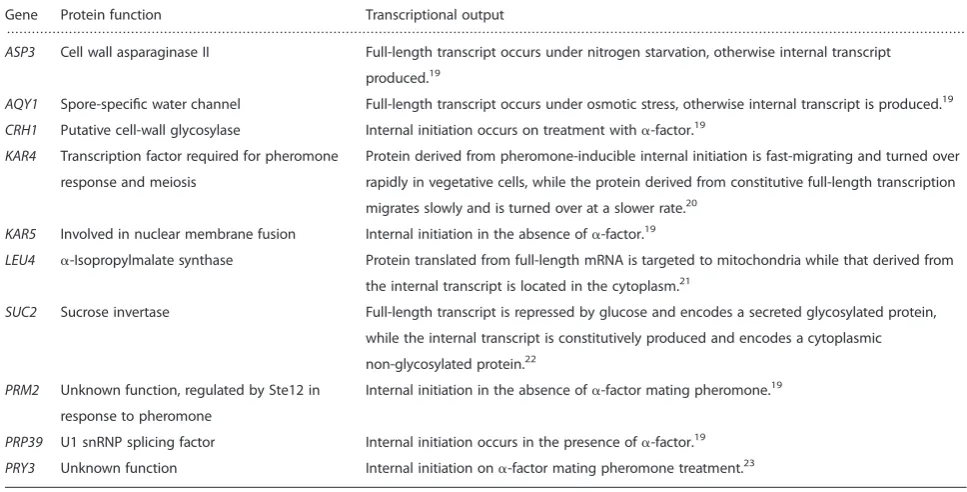
While internal initiation occurs at FLO8 andSTE11 in certain mutant yeast strains with aberrant chromatin struc-ture, biologically relevant internal initiation has been docu-mented in wild-type yeast strains for numerous genes, as highlighted in Table 1.
Transcription from an internal promoter has the potential to produce mRNA that can be transcribed in the same ORF as the full-length transcript to produce an N-terminal trun-cated protein that may lack specific domains or be targeted to different cellular locations. For example, the Leu4 protein derived from full-length LEU4 mRNA is targeted to mitochondria, while truncated Leu4, lacking a signal sequence, is cytoplasmic.21 Internal initiation may also confer different regulatory properties on gene expression; for example, Suc2 protein is constitutively expressed when
translated from an internal transcript, whereas in glucose, full-lengthSUC2transcription is repressed.22
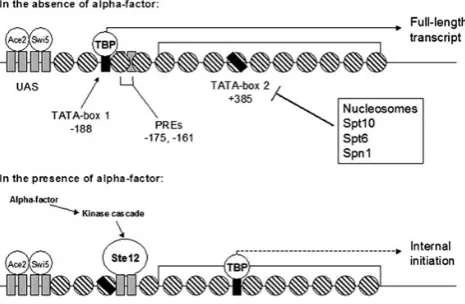
PRY3 is a budding yeast gene that undergoes different transcription events dependent on the presence of a-factor mating pheromone (Fig. 1).23 In the absence of a-factor, transcription initiation occurs from the core TATA-box 1 promoter at –188 and a full-length transcript is produced. However, when cells are treated with a-factor, full-length transcription is repressed and internal initiation of transcrip-tion occurs from TATA-box 2, which lies 385 nt downstream of the initiating ATG codon. Although the significance of this internal initiation event is unknown, it is thought to arise from the activation of the transcription factor Ste12 by the pheromone kinase cascade. Its subsequent binding to upstream pheromone-response-elements (PREs) at 2175 and 2161 prevents TATA-box binding protein (TBP) from binding to TATA-box 1, and thus transcription initiates from TATA-box 2.23
How transcription from TATA-box 2 is repressed in the absence ofa-factor is currently unknown. Is the internal pro-moter repressed by appropriate nucleosome density in the coding region like FLO8, or by repressive histone modifi-cations like STE11? This investigation aimed to address which factors are important in suppressing internal initiation atPRY3in the absence ofa-factor mating pheromone.
Materials and methods
Yeast strains and culture
Yeast cultures from 0.5107cells/ml were grown in YPD
medium (1% Difco yeast extract, 1% bactopeptone, 2% glucose) at 308C to exponential phase (1 –1.5107 cell/
ml). Cultures of the twospt61004 spt15 strains were
incu-bated at 308C in leucine–glucose –CSM medium with 2% raffinose until OD6000.8. For galactose-induced samples,
30 ml cultures were washed, resuspended in leucine– glucose –CSM medium with 2% galactose, and incubated for a further 45 or 120 min. Heat shock was carried out at 398C for a further 90 min where stated.
RNA extraction and northern blotting
Total RNA was prepared by the standard hot acid phenol method and separated on 1.2% formaldehyde/MOPS agarose gels for approximately 9 h at 80 V.24 Gels were blotted by the standard method and RNA fixed by baking for 2 h.24 Radioactive probes were made using a Stratagene Prime-It II random primer labelling kit and purified using Sephadex G-50. Probes correspond to positions relative toþ1 at ATG:PRY3(þ20 toþ1600),SER3(0 toþ1000),VHT1 (þ20 toþ1700) andRDN18(0 toþ400). Membranes were hybridized overnight at 658C and washed twice in 1SSC/
0.1% SDS for 20 min and twice in 0.2SSC/0.1% SDS for 20 min. Bands were detected by autoradiography.
Protein extraction and western blotting
All cultures were harvested at 48C and 100ml acid-washed glass beads, 300ml 6 M urea, 40ml 100 mM dithiothreitol and 260ml loading buffer (50 mM Tris pH 6.8, 2% SDS, 0.05% bromophenol blue, 10% glycerol) were added to the pellet before vortexing for 3 min and boiling for 5 min.
SDS– PAGE and western blotting were carried out by stan-dard methods using anti-haemagglutin (HA) and anti-b-actin monoclonal antibodies at a dilution of 1/1000, and probing with an anti-mouse IgG secondary antibody conjugated to horseradish peroxidase.24
Results
Suppression of internal initiation atPRY3in the absence ofa-factor requires Spt10, Spt6 and Spn1, but not Eaf3
Transcription initiation from the cryptic internal promoters atFLO8 occurs when factors controlling nucleosome reas-sembly are disrupted. In contrast, factors controlling H3K36me and histone deacetylation repress the internal pro-moters at STE11.10, 12 Transcription from the internal TATA-box of PRY3 occurs only in the presence of
a-factor.23Northern blotting was used to investigate which factors required for transcriptional fidelity at FLO8 and STE11 are also needed to suppress internal initiation at PRY3in the absence ofa-factor.
Figure 2 shows that internal initiation occurs in both spt61004andspt6140strains at both 308C and 398C; in the two temperature-sensitive spn1 strains at 398C; and in spt10D. Internal initiation also occurs in spt6SH2, a strain that lacks the 100 C-terminal amino acids of Spt6 that contain a Src-homology 2 (SH2) domain. Furthermore, these same strains have an increased amount of full-length transcript coincident with the production of the short intern-ally initiated transcript. Notably, deletion ofEAF3does not lead to internal initiation nor to increased full-length
... Table 1. Genes that undergo biologically relevant internal initiation in budding yeast
Gene Protein function Transcriptional output
ASP3 Cell wall asparaginase II Full-length transcript occurs under nitrogen starvation, otherwise internal transcript produced.19
AQY1 Spore-specific water channel Full-length transcript occurs under osmotic stress, otherwise internal transcript is produced.19
CRH1 Putative cell-wall glycosylase Internal initiation occurs on treatment witha-factor.19
KAR4 Transcription factor required for pheromone response and meiosis
Protein derived from pheromone-inducible internal initiation is fast-migrating and turned over rapidly in vegetative cells, while the protein derived from constitutive full-length transcription migrates slowly and is turned over at a slower rate.20
KAR5 Involved in nuclear membrane fusion Internal initiation in the absence ofa-factor.19
LEU4 a-Isopropylmalate synthase Protein translated from full-length mRNA is targeted to mitochondria while that derived from the internal transcript is located in the cytoplasm.21
SUC2 Sucrose invertase Full-length transcript is repressed by glucose and encodes a secreted glycosylated protein, while the internal transcript is constitutively produced and encodes a cytoplasmic non-glycosylated protein.22
PRM2 Unknown function, regulated by Ste12 in response to pheromone
Internal initiation in the absence ofa-factor mating pheromone.19
PRP39 U1 snRNP splicing factor Internal initiation occurs in the presence ofa-factor.19
PRY3 Unknown function Internal initiation ona-factor mating pheromone treatment.23
Figure 1. Transcriptional output atPRY3is regulated bya-factor mating pheromone. Ace2 and Swi5 are transcription factors that bind an upstream activation sequence (UAS) and activate gene expression in early G1phase
and M/G1phase, respectively. In the absence ofa-factor, TBP is recruited
to TATA-box 1 and full-length transcription from 276 occurs. a-factor binding to cell-surface receptors initiates a mitogen-activated protein kinase (MAPK) cascade that phosphorylates and activates the Ste12 tran-scription factor. Ste12 binding to pheromone response elements (PREs) at2175 and 2161 prevents TBP from binding TATA-box 1 and thus it binds TATA-box 2 atþ385 and directs internal initiation atPRY3.23
transcript. This experiment was repeated a further two times with comparable results (data not shown).
These results show that Spt10, Spn1 and Spt6 (but not Eaf3) are required to suppress internal initiation at PRY3
in the absence of a-factor. Complete loss of Spt6 function enhances the production of the internal transcript suggesting that, similar to FLO8, transcriptional fidelity at PRY3 is maintained by a nucleosome reassembly mechanism requir-ing the Spt6 chaperone function. Significant levels of the internal transcript, however, are evident at the permissive temperature (308C) for the spt61004 allele (no defect in histone chaperone activity) and thespt6140allele (no defect in H3K36me or histone chaperone activity), suggesting a potentially novel mechanism for suppression of internal tran-scripts at PRY3. The increase in levels of full-length tran-script in the strains defective in histone assembly suggests that the upstream promoter is also restrained by nucleosomes.
The ability of TBP to bind a TATA-box is required for internal initiation atPRY3
Both the upstream and the internal promoters at PRY3 have canonical TATA-boxes. I tested whether internal initiation at PRY3is dependent on the ability of TATA-box binding protein (TBP) to bind to a TATA-box. The spt61004 strain was transformed with plasmids that over-express substituted versions of TBP (Spt15) under the control of a galactose-inducible promoter. The two mutants, spt15V71E and spt15V161E, contain single valine-to-glutamate substi-tutions of different amino acids along the concave DNA-binding surface of TBP that specifically abolish DNA binding in a dominant-negative fashion, without affecting functions independent of DNA binding.25, 26 The two plasmid constructs produce TBP tagged with a haemagglutin (HA) epitope, allowing analysis of mutant TBP expression under inducing (galactose) and non-inducing (raffinose) con-ditions by western blot. Figure 3 shows that both spt61004 spt15 strains over-express TBP only in the presence of galactose.
Microarray analysis of genome-wide transcription in spt15V71Eandspt15V161Estrains has revealed the effects of over-expression of the substituted TBP proteins on TATA-dependent transcription.25 Figure 4 shows that the effect of disruption of TATA-box dependent transcription on two control genes,VHT1andSER3, in anspt61004 back-ground is consistent with the results of the microarray study. VHT1 transcription is highly dependent on its TATA-box promoter, and preventing the TBP-TATA interaction by over-expression of TBPV71E or TBPV161E abolishes VHT1 tran-scription. SER3transcription is repressed by a non-coding interfering transcript (SRG1) produced from a TATA-TBP dependent promoter. Loss of the interfering transcript upon over-expression of TBPV71Eand TBPV161Erelieves the transcriptional interference-mediated repression of down-stream SER3transcription.27These two results are consist-ent with the microarray data, demonstrating that the mutant TBP in both spt15 spt61004 strains is disrupting TATA-box-dependent transcription.
Figure 2. Northern blot analysis of transcription atPRY3.Total RNA was extracted from cultures grown in YPD at 308C until exponential phase and heat shock was carried out at 398C for an additional 90 min where stated. FY119 and BY4741 indicate the genetic backgrounds of wild-type (WT) and mutant strains, as detailed in Table 2. The protein encoded by
spt61004contains a 63 amino-acid deletion (931 – 994) that removes its non-specific DNA-binding helix-hairpin-helix (HhH) domain; spt6140 is a temperature-sensitive allele ofSPT6; andspt6SH2encodes a protein that lacks the 100 C-terminal amino acids containing an SH2 domain. spn17
and spn113 encode temperature-sensitive versions of Spn1, an Spt6-interacting protein. The eaf3D strain lacks the histone deacetylase Eaf3 whilespt10Dlacks the Spt10 protein, a positive regulator of histone gene expression. The membrane was reprobed forRDN18(encoding 18S ribosomal RNA) to control for RNA loading.
... Table 2. Yeast strains
Strain Parent Genotype Reference
FY119 (WT) FY119 MATa,his4-912d, leu2D1, ura3-52, trp1D63, lys2-128d
F. Winstona
BY4741 (WT)
BY4741 MATa, his3D1, leu2D0, met15D0, ura3D0
EUROSCARF
spt61004 FY119 spt61004 F. Winston
spt6140 FY119 spt6140 F. Winston
spt6SH2 FY119 SPT6SH2::ADH1
TKanMX M. Youdellb
spn17 FY119 spn17 G. Hartzogc
spn113 FY119 spn113 G. Hartzog
eaf3D FY119 eaf3D::Trp1 M. Youdell
spt10D BY4741 spt10D::Trp1 EUROSCARF
spt15V71E
spt61004
spt61004 pCALF-leu-pGal-spt15V71E-HA This study
spt15V161E
spt61004
spt61004 pCALF-leu-pGal-spt15V161E-HA This study
a
Department of Genetics, Harvard Medical School, Boston, MA 32003, USA b
Department of Biochemistry, University of Oxford, Oxford, UK c
Department of Molecular, Cell and Developmental Biology, University of California at Santa Cruz, Santa Cruz, CA 95064, USA
Transcription of PRY3 was subsequently analysed in spt15V71E spt61004 and spt15V161E spt61004 strains under non-inducing (raffinose) and inducing conditions (galactose). Figure 4 shows that internal initiation occurs in bothspt15 spt61004 strains in raffinose, but after galactose induction for 45 and 120 min both full-length and internal initiation are substantially abolished at PRY3in bothspt15 spt61004 strains. This result suggests that the full-length transcript
and internal initiated transcript at PRY3 are dependent upon TBP binding to a TATA-box, and suggests the internal transcript observed arises from TATA-box 2.
Discussion
PRY3 undergoes internal initiation in response to a-factor mating pheromone due to binding of activated Ste12 to PREs, consequential occlusion of TATA-box 1 at 2188 and selection of TATA-box 2 at þ385. In the absence of
a-factor, the utilization of TATA-box 2 is suppressed and transcription initiation occurs at TATA-box 1 to produce a full-length transcript.23
Internal initiation is observed, however, when factors con-trolling nucleosome reassembly are disrupted in spt61004, spt6140, spn17 and spn113 strains at 398C; and in spt10D
andspt6SH2. Together with the absence of internal initiation in an eaf3D strain, these results suggest that, likeFLO8, a mechanism predominantly involving nucleosome reassembly rather than histone methylation and deacetylation is import-ant for maintenance of transcriptional fidelity atPRY3. Due to disruption of the cotranscriptional histone chaperone function of Spt6 inspt61004andspt6140at 398C, or depletion of histone levels inspt10D, the inability to restore adequate nucleosome density over the coding region after the passage of elongating RNAPII allows transcription initiation from an internal promoter.
Since over-expression of substituted TBP that is unable to direct TATA-dependent transcription in the spt61004 spt15V71Eandspt61004spt15V161Estrains leads to appropri-ate changes in the VHT1 and SER3 controls, the loss of internal initiation at PRY3 upon over-expression of TBPV71Eand TBPV161Eshows that the internal transcript is dependent upon the ability of TBP to bind to a TATA-box (Fig. 4). Although this suggests that the internal transcript may arise from TATA-box 2, this needs to be supported by mapping of its transcriptional start site by primer extension analysis or rapid amplification of cDNA ends (RACE).
A model for suppression of internal initiation atPRY3in the absence ofa-factor is presented in Fig. 5. Spt6-mediated cotranscriptional nucleosome reassembly over the coding region during transcription that initiates from TATA-box 1 is predicted to conceal TATA-box 2 and prevent internal initiation. A further investigation of factors suppressing internal initiation at PRY3 could analyse the role of com-ponents of FACT, such as Spt16, which have been shown to be required to suppress internal initiation atFLO8.10
In addition, however, internal initiation at PRY3 is observed inspt6140andspt61004strains at 308C. The func-tion disrupted here is probably independent of the histone modification pathway since: (i) spt6140 is not defective in H3K36me (M. Youdell, personal communication); and (ii) thoughspt61004is defective in H3K36me,eaf3Dsignificantly does not display internal initiation. Furthermore, since the
Figure 3.Western blot confirming overexpression of TBPV71E-HA and TBPV161E-HA inspt15 spt61004strains under inducing conditions (galactose) but not non-inducing (raffinose) conditions. Cultures were incubated at 308C in leucine – glucose – SM medium with 2% raffinose until OD600
0.8. For galactose-induced samples, 30 ml cultures were washed, resus-pended in leucine – glucose – CSM medium with 2% galactose and incu-bated for a further 2h. Total protein extracts were run on a 15% SDS-polyacrylamide gel.a-HA is a monoclonal antibody against haemag-glutin. a-b-actin is a monoclonal antibody againstb-actin – used as a loading control.
Figure 4. The effect ofspt15V71Espt61004andspt15V161Espt61004mutants
on transcription and internal initiation atPRY3.Cultures were incubated at 308C in leucine – glucose – CSM medium with 2% raffinose until OD6000.8. For galactose-induced samples, 30 ml cultures were washed,
resuspended in leucine – glucose – CSM medium with 2% galactose and incubated for a further 45 or 120 min. For both galactose-induced and non-induced cultures, heat shock was carried out at 398C for a further 90 min. The spt61004(YPD) culture was grown in YPD medium as described in
Material and methods, and heat-shocked at 398C for 90 min. The mem-brane was reprobed forRDN18(encoding 18S ribosomal RNA) to control for RNA loading.
cotranscriptional histone chaperone function ofspt6140and spt61004 is not abolished at 308C, the disrupted function may also be independent of nucleosome reassembly.10 However, this novel observation could in fact be explained in accordance with a nucleosome reassembly model if the kinetics of nucleosome reassembly are altered in these mutants at 308C. If nucleosomes compete with Ace2/
Swi5-promoted TBP for binding to the internal TATA-box, then a decreased speed of nucleosome reassembly in spt6140orspt61004at 308C may allow TBP to out-compete nucleosomes for TATA-box binding. To further investigate this nucleosome/TBP competition hypothesis, the chromatin structure over PRY3 in spt6140 and spt61004 at 308C could be analysed by micrococcal nuclease digestion and the kinetics of nucleosome reassembly by chromatin immunoprecipitation.
Increases in full-length transcription are also observed under the same conditions that induce internal initiation at PRY3(Fig. 2). This may indicate that nucleosome reassem-bly at TATA-box 1 is also required to regulate full-length transcription. Nucleosome occlusion of TATA-boxes is a common mechanism of repression, and a requirement for Spt6-mediated nucleosome reassembly in transcriptional repression has previously been shown for PHO5, PHO8,
ADH2, ADY2andSUC2.28
Conclusion
This investigation has demonstrated that: (i) maintenance of transcriptional fidelity at PRY3 in the absence of a-factor requires Spt6, Spn1 and Spt10, but not Eaf3. This suggests that appropriate nucleosome density in the coding region is important to suppress internal initiation; (ii) internal
initiation atPRY3 is dependent upon the ability of TBP to bind to a TATA-box, suggesting that internal initiation arises from TATA-box 2. Taken together, these results suggest a model for transcriptional output atPRY3 that is dependent upon competition between TBP and nucleosomes for binding an internal TATA-box. Transcription factors may promote TBP binding while Spt6 may control the kinetics of nucleosome reassembly.
Acknowledgements
I would like to thank Jane Mellor and Michael Youdell for excellent supervision and encouragement during the whole project; and Anitha Nair and David Clynes for technical help and discussions. I would like to thank Fred Winston and Grant Hartzog for providing yeast strains, and B. Franklin Pugh for the spt15V71E and spt15V171E (TBP) plasmids.
Funding
Work in the lab is supported by The Wellcome Trust.
References
1 Kornberg RD, Lorch Y (1992) Chromatin structure and transcription.Ann Rev
Cell Biol8: 563 – 587.
2 Khorasanizadeh S (2004) The nucleosome: from genomic organization to
genomic regulation.Cell116: 259 – 272.
3 Tabancay AP Jr, Forsburg SL (2006) Eukaryotic DNA replication in a chromatin
context.Curr Top Dev Biol10: 4935 – 4941.
4 Cobb RM, Oestreich KJ, Osipovich OAet al. (2006) Accessibility control of
V(D)J recombination.Adv Immunol91: 45 – 109.
5 Morrison AJ, Shen X (2005) DNA repair in the context of chromatin.Cell Cycle
4: 568 – 571.
6 Mellor J (2006) Dynamic nucleosomes and gene transcription.Trends Gen22:
320 – 329.
7 Belotserkovskaya R, Oh S, Bondarenko VA et al. (2003) FACT facilitates
transcription-dependent nucleosome alteration.Science301: 1090 – 1093.
8 O’Neill TE, Roberge M, Bradbury EM (1992) Nucleosome arrays inhibit both initiation and elongation of transcripts by bacteriophage T7 RNA polymer-ase.J Mol Biol223: 67 – 78.
9 Lieb JD, Clarke ND (2005) Control of transcription through intragenic
pat-terns of nucleosome composition.Cell123: 1187 – 1190.
10 Kaplan CD, Morris JR, Wu Cet al. (2003) Transcription elongation factors
repress transcription initiation from cryptic sites.Science301: 1096 – 1099.
11 Mason PB, Struhl K (2003) The FACT complex travels with elongating RNA polymerase II and is important for the fidelity of transcriptional initiation in vivo.Mol Cell Biol23: 8323 – 8333.
12 Carozza MJ, Li B, Florens Let al. (2005) Histone H3 methylation by Set2
directs deacetylation of coding regions by Rpd3S to suppress spurious
intra-genic transcription.Cell123: 581 – 592.
13 Dollard C, Ricupero-Hovasse SL, Natsoulis Get al. (1994) SPT10 and SPT21 are
required for transcription of particular histone genes inSaccharomyces
cere-visiae.Mol Cell Biol14: 5223 – 5228.
Figure 5.Suppression of internal initiation at PRY3 in the absence of
a-factor mating pheromone. Cotranscriptional reassembly of nucleosomes over the coding region of PRY3 prevents transcription initiation from TATA-box 2 in the absence of a-factor. Internal initiation arises when Spt10, Spt6 or Spn1 is disrupted.
... 14 Clark-Adams CD, Winston F (1987) The SPT6 gene is essential for growth and
is required for delta-mediated transcription inSaccharomyces cerevisiae.Mol
Cell Biol7: 679 – 686.
15 Keogh MC, Kurdistani SK, Morris SA et al. (2005) Cotranscriptional Set2
methylation of histone H3 lysine 36 recruits a repressive Rpd3 complex.
Cell18: 593 – 605.
16 Jacobson RH, Ladurner AG, King DSet al. (2000) Structure and function of a
human TAFII250 double bromodomain module.Science288: 1422 – 1425.
17 Matangkasombut O, Buratowski RM, Swilling NWet al. (2000) Bromodomain
factor 1 corresponds to a missing piece of yeast TFIID. Genes Dev 14:
951 – 962.
18 Wolffe AP, Guschin D (2000) Review: chromatin structural features and
targets that regulate transcription.J Struct Biol129: 102 – 122.
19 Law GL, Bickel KS, MacKay VLet al. (2005) The undertranslated transcriptome
reveals widespread translational silencing by alternative 5’ transcript leaders. Genome Biol6: R111.
20 Gammie AE, Stewart BG, Scott CFet al. (1999) The two forms of karyogamy
transcription factor Kar4p are regulated by differential initiation
of transcription, translation, and protein turnover. Mol Cell Biol 19:
817 – 825.
21 Beltzer JP, Morris SR, Kohlhaw GB (1988) Yeast LEU4 encodes mitochondrial
and nonmitochondrial forms of alpha-isopropylmalate synthase.J Biol Chem
263: 368 – 374.
22 Carlson M, Botstein D (1982) Two differentially regulated mRNAs with
differ-ent 5’ ends encode secreted with intracellular forms of yeast invertase.Cell
28: 145 – 154.
23 Bickel KS, Morris DR (2006) Role of the transcription activator Ste12p as a
repressor of PRY3 expression.Mol Cell Biol26: 7901 – 7912.
24 Sambrook J, Fritsch EF, Maniatis T (1989)Molecular Cloning: A Laboratory
Manual. New York: Cold Spring Harbour Laboratory Press.
25 Chitikila C, Huisinga KL, Irvin JDet al. (2002) Interplay of TBP inhibitors in
global transcriptional control.Mol Cell10: 871 – 882.
26 Jackson-Fisher AJ, Chitkila C, Mitra Met al. (1999) A role for TBP dimerization in
preventing unregulated gene expression.Mol Cell3: 717 – 727.
27 Martens JA, Wu PY, Winston F (2005) Regulation of an intergenic transcript
controls adjacent gene transcription inSaccharomyces cerevisiae.Genes Dev
19: 2695 – 2704.
28 Adkins MW, Tyler JK (2006) Transriptional activators are dispensable for tran-scription in the absence of Spt6-mediated chromatin reassembly of
promo-ter regions.Mol Cell21: 405 – 416.
Submitted on 30 September 2007; accepted on 17 December 2007