R E S E A R C H
Open Access
Efficient AMP decision and search range
adjustment algorithm for HEVC
Xinpeng Huang
1,2, Ping An
1,2*and Qiuwen Zhang
3Abstract
The advanced video encoder High Efficiency Video Coding (HEVC) utilizes several novel coding tools so that it can obtain improvement in coding performance for a huge number of video data. However, these tools increase the computational complexity greatly specially in the interprediction phase. Therefore, optimization for interprediction plays an important role in accelerating the whole HEVC encoding process. To this end, this paper proposes an efficient prediction algorithm for improving HEVC intercoding. According to the spatial correlation between the current block and its co-located block in the previous frame, we design a fast decision method so as to perform asymmetric partitions directly without the complicated calculation. Furthermore, based on the motion degree function we defined, the motion search range of motion estimation can be adaptively adjusted. Experimental results demonstrate that the proposed algorithm is able to save coding time significantly both under RandomAccess and Lowdelay P configurations, with a negligible drawback in term of Bjontegaard delta-rate increase.
Keywords:HEVC, Interprediction, Asymmetric partition, Search range
1 Introduction
High Efficiency Video Coding (HEVC), an advanced video coding standard, is a good substitute for encoding
ultra-high-definition video. In contrast to other
standards, HEVC employs several new coding tools to eliminate redundancy existing in inter- and intraframes [1–4]. The higher precision and more flexible partition structure is one of the major reasons that HEVC out-performs H.264/AVC [5]. Additionally, good perform-ance of HEVC makes it be applied to several extensions
[6–11]. In HEVC, every frame of video is divided into
coding tree units (CTUs) and each CTU can be split re-cursively using quad-tree structure, until the minimum size is reached. Similar to macroblock concept in H.264/AVC, coding unit (CU) is the basic unit in HEVC that carries the whole coding information of current block [12, 13]. There are eight prediction units (PUs) shown in Fig. 1, and these eight PU partitions are named as PART_2N×2N, PART_N×N, PART_2N×N, PART_N×2N, PART_2N×nU, PART_2N×nD, PART_nL×2N,
PART_nR×2N, respectively. Among these eight labels,
uppercase N denotes half the length of current CU’s
length or width and lowercase n signals one quarter of that [14]. It is akin to CU that PU brings the informa-tion about predicinforma-tion. If current CU is encoded with intraprediction, it is always divided using square parti-tion, namely INTRA_2N×2N and INTRA_N×N. As il-lustrated in Fig. 1, a CU can either be coded as a single PU or it can be split into two or four rectangular PUs.
After PU division, motion estimation (ME) is performed to find out the optimal motion vector (MV) of current block through matching corresponding samples. The com-putational load of ME in HEVC is related to the motion search range in matching process. For the full search range, 128 candidate points (configured as [−64, 64]) are adopted in horizontal and vertical directions, respectively. In other words, more than 16,000 points should be searched to find the best MV for current block. Although the fast ME approach TZ Search is added into the latest HEVC refer-ence software to simplify the MV search process, the coding complexity is still very high. In interprediction stage, asym-metric partition (AMP) partitioning and ME process can promote the matching precision. However, the coding time is increased significantly for the novel complex design. * Correspondence:[email protected]
1
Shanghai Institute for Advanced Communication and Data Science, Shanghai University, Shanghai 200444, China
2Key Laboratory of Ministry of Education for Advanced Display and System
Application, Shanghai University, Shanghai 200072, China Full list of author information is available at the end of the article
Therefore, this paper presents an efficient approach to reduce the calculation burden in interprediction. Firstly, we find out a fast decision method so that some prediction units are divided into asymmetric partitions directly with-out the complex calculation. And then, based on the motion degree function we defined, the motion search range of ME can be adaptively adjusted.
The remainder content of this article is organized as follows. Our proposed method is described in Section 2. Section 3 demonstrates the experimental comparison between our proposed approach and other methods and discusses the coding performance of the proposed algo-rithm. Finally, we summarize this paper in Section 4.
1.1 The related previous work
To reduce interprediction computational burden for HEVC encoder, many researchers have proposed various fast methods. These methods aim to simplify PU mode decision process that we sum up as follows. A different CU visiting order is stated in Ref. [15], and this modification reduces the complexity of CU size decision, mode decision, and interframe prediction. Another fast CU size prediction for HEVC is presented in Ref. [16], which early terminates par-titioning modes to reduce computational complexity. Ref. [17] adopts convolution neural network to decrease no less than two CU partition modes for rate distortion optimization (RDO). A set of procedures for partition structure determination is designed in Ref. [18] to early ter-minate exhaustive RDO process using data mining tech-niques. An early terminating fast intermode decision algorithm, namely hierarchical intermode decision (HIMD), is presented in Ref. [19] using the correlation between RD cost and PU size. A course of low complexity mode deci-sion algorithm consists of four early termination strategies and this approach uses co-located block depth information and current block size information to terminate RDO process [20]. A reverse CU access approach is proposed in Ref. [21] that can further reduce HEVC coding complexity, particularly for high motion activity sequences. A fast CU partitioning algorithm is provided in Ref. [22] for HEVC, and this method early terminates the CU size decision process based on the Bayesian decision rule. A fast inter-prediction mode decision algorithm is proposed in our previous work [23] that uses current block edge infor-mation to simplify RDO process so as to accelerate coding time for HEVC encoder.
Furthermore, complex ME process in HEVC encoder requires a huge calculation, so many low-complexity algo-rithms have been presented to make improvement on ME process. A block motion information derivation is described in Ref. [24] without conventional motion estimation and motion parameters. A fast algorithm is introduced in Ref. [25] to reduce the number of ME searching points from 81 to just 31. A fast ME decision
method is provided in Ref. [26] that skips block search process adaptively on the basis of the relationship between the two types PU after classifying PUs into two classes. Two individual algorithms are proposed in Ref. [27] that obtain the best performance collaboratively. A better balance is stated between computational burden and RD performance in Ref. [28]. In Ref. [29], authors state fast mode decision algorithm not only for CU size decision but also for ME decision, and it achieves a great time saving.
Admittedly, all of these approaches have improved coding efficiency of intercoding for HEVC encoder. How-ever, it is hard for interprediction optimization to balance the computational complexity and the coding perform-ance. Motivated by the abovementioned issue, we propose an efficient AMP decision and search range adjustment al-gorithm for HEVC.
1.2 Preliminary work
Because of the huge amount of data, especially when having an advanced hierarchical partition design in current HEVC standard, compression of high-definition video content relies heavily on the efficient compression of video informa-tion. Note that, one way of performing prediction mode de-cision would exhaustively search the possibilities within a set containing all possible modes, which results in an un-desirable complexity. To determinate the optimal mode, it adopts Lagrange multiplier to find the certain mode with the least RD cost as the best one, and the RD cost function (J) is shown as follows:
J¼DmodeþλBRmode ð1Þ
whereDmodedenotes the distortion between the current
mode and the matching mode on average,λsignifies the
Lagrange multiplier, and BRmode is bits required for
signaling the coding mode and the associated side infor-mation. Moreover, CU division way in HEVC is identical to that way in H.264/AVC, while new PU partitions (including square partition (SP), symmetric partition (SMP), and AMP) have been developed for HEVC inter-prediction. In contrast to H.264/AVC intermode predic-tion, before the decision of the optimal MV for a block, all the SP, SMP, and AMP in PU modes are added to the pre-decision list. And then, all possible search point candidates corresponding to the PU mode in pre-decision list are considered as full RD search list to perform ME using full search range. During this proced-ure, the distortion among all candidates (including PU partitions and search points) is computed and the best prediction mode is selected. This technique enhances the highest possible coding precision in HEVC encoder,
extremely high coding complexity, so it limits HEVC for practical applications.
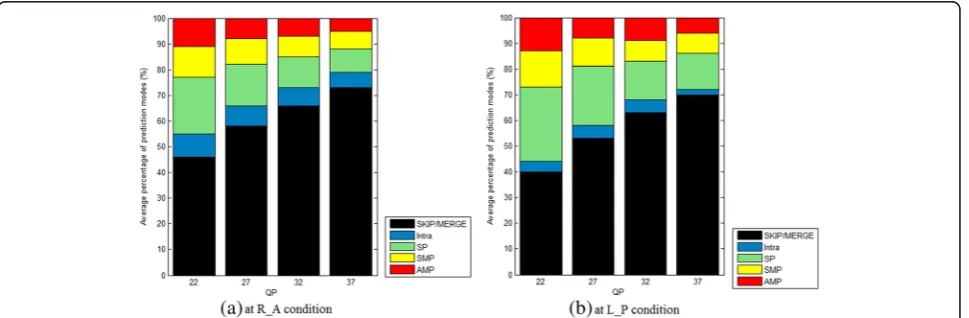
In preliminary work, prediction modes distribution has been checked at RA (RandomAccess configur-ation) and LDP (Lowdelay P configurconfigur-ation) condi-tions. Figure 2 shows the average area shares of prediction modes in HEVC encoder at RA and LDP conditions. It is obvious that with the reduction of quantization parameter (QP), more and more blocks choose AMP as the best interprediction mode under both RA and LDP configurations. Although the share of AMP is lower than other mode decision, it is very time-consuming to perform AMP for interprediction modes. Furthermore, rather than intracoding, all of interprediction modes need to be addressed with ME, which results in both high calculation burden and a long coding time. To analyze the computational load of AMP partitioning and ME process in HEVC encoder, extensive experiments were conducted on ten text sequences with QP setting as 22, 27, 32, and 37. These set-tings are tabulated in Table 1 according to common test
condition (CTC) [30], and HEVC test model 14.0 (HM 14.0) is used as the experimental platform.
The encoder configuration is as follows: GOP length is set to 8 with an intraperiod being 32; the maximum CU size is 64 × 64, and CU depth level is set to 4; search range of ME is configured as [−64, 64]. We execute simulated experiments twice with AMP disabled (off) and enabled (on) for each test sequence, and the original HM reference software (AMP on) is regarded as the benchmark. More-over, computational load for these experiments is reflected
by coding time which is calculated by ΔT¼T
avg off−T
avg on
Tavg on ,
where Tavgoff andTavg
on mean the average coding time when
AMP off and AMP on, respectively. In addition, peak signal-to-noise ratio (PSNR) change, bitrate variation, and
coding time change are measured by “BD-PSNR (dB)”
(Bjontegaard Delta PSNR), “BD-BR (%)” (Bjontegaard
Delta Bitrate), and“ΔT(%)”[31].
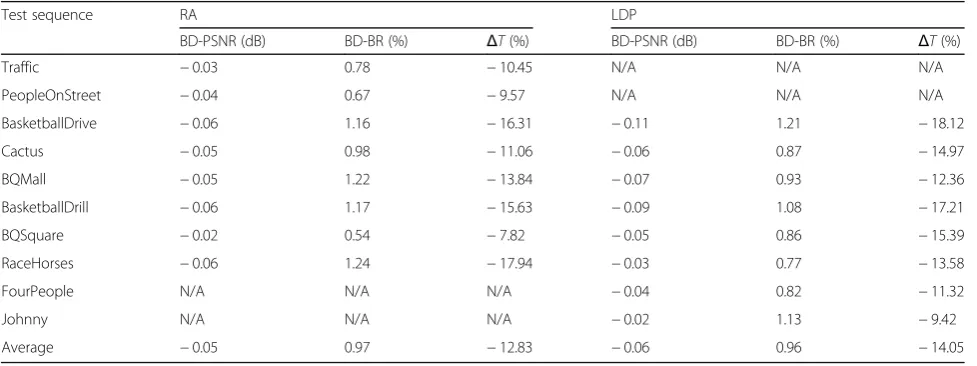
Table 2 illustrates the coding efficiency comparison between the HM 14.0 with AMP off and the original HM 14.0 with AMP on both under RA and LDP cases. The minus and the positive number respectively denote drop and augment compared with the data derived by the bench-mark (the same as in the following tables). From the experi-mental results, one can notice from Table 1 that the
maximum time saving of 18.12% for “BasketballDrive”
under LDP configuration when AMP is disabled. The coding time is averagely reduced about 12.83 and 14.05% under “RA” and “LDP” case, respectively. It can be seen that disabling AMP can speed up encoding process. While for the sequences with small movement activity, such as “BQSquare”and“Johnny”, PSNR is close to that of original HEVC encoder with AMP off. However, when AMP is dis-abled, both PSNR loss and bitrate increase are obviously significant. It also can be seen from Table 2 that for test se-quences with much high motion activity areas, such as “BasketballDrive,” “BasketballDrill,” and “RaceHorses,” the Fig. 1The eight PU partitions. Left: square partition (SP); middle:
symmetric partition (SMP); right: asymmetric partition (AMP)
coding time reduction for them is relatively more than that of other test sequences after disabling AMP. Because turn-ing off AMP can eliminate amounts of complicated ME process, computational load is saved conspicuously, and yet PSNR loss and bitrate increase are evident.
These results demonstrate that there is much room to simplify the interdecision process in HEVC. Accordingly, if we can exploit certain information to adaptively stop some specific blocks executing AMP prediction, and if the complex ME process can be simplified in HEVC encoder, the calculation load will be reduced dramatically in the whole HEVC interencoding process.
2 The proposed efficient method for HEVC intercoding
As presented in the previous sections, the complicated intermode decision consumes plenty of coding time, which prevents HEVC encoder from practical application. Hence, optimizing interprediction is a main challenge for fulfilling coding time saving.
2.1 AMP decision skipping algorithm
Through analyzing comparative results in Section 1, not-withstanding disabling AMP can avoid complicated ME process, most of CUs are further split. Thus, further split-ting damages PSNR and bitrates simultaneously. For current CU, more coding time will be saved if the optimal prediction mode is determined in advance. We would like to propose an efficient AMP decision algorithm that can early decide whether AMP is the best partition or not.
According to the simulated results in Table 2, we compare sequence content between AMP on and
AMP off. The test sequence “RaceHorses” is taken as
an example. We can observe from Fig. 3 that when AMP is disabled, just a small part of CUs carry out SKIP mode (in blue rectangle). While some CUs are partitioned by AMP when AMP is enabled, but their corresponding CUs were split into smaller sub-CUs (in red rectangle) when AMP is disabled. This is the reason that coding time reduces not sufficiently while the loss of coding performance is not so much when AMP is disabled.
As mentioned by [32–34], it is just an MV that distin-guishes the current CU and its co-located CU in previ-ous coded frame. Accordingly, the relationship between them can be modeled as I(p+mv,t−1) =I(p,t), where
I(p,t) denotes the value of pixel in p position at ttime
andmvrepresents motion vector. Furthermore, the high
correlation between CU and its co-located CU has been verified in [33, 34]. In accordance with this high
correl-ation, we conduct extensive experiments on ten
sequences in Table 1 to discover the relationship between AMP and CU position. As illustrated in Fig. 4,
current CU is termed as CUcur, which should have been
encoded as AMP with AMP off. Its corresponding CU is labeled asCUcor, which is decided as AMP. In addition,
the co-located CU of CUcor is labeled as CUcol. The
Table 2Comparison between HM 14.0 (AMP off) and the original HM 14.0 (AMP on)
Test sequence RA LDP
BD-PSNR (dB) BD-BR (%) ΔT(%) BD-PSNR (dB) BD-BR (%) ΔT(%)
Traffic −0.03 0.78 −10.45 N/A N/A N/A
PeopleOnStreet −0.04 0.67 −9.57 N/A N/A N/A
BasketballDrive −0.06 1.16 −16.31 −0.11 1.21 −18.12
Cactus −0.05 0.98 −11.06 −0.06 0.87 −14.97
BQMall −0.05 1.22 −13.84 −0.07 0.93 −12.36
BasketballDrill −0.06 1.17 −15.63 −0.09 1.08 −17.21
BQSquare −0.02 0.54 −7.82 −0.05 0.86 −15.39
RaceHorses −0.06 1.24 −17.94 −0.03 0.77 −13.58
FourPeople N/A N/A N/A −0.04 0.82 −11.32
Johnny N/A N/A N/A −0.02 1.13 −9.42
Average −0.05 0.97 −12.83 −0.06 0.96 −14.05
N/Anot applicable
Table 1Test sequence information
Class Resolution Test sequence Frame rate Bit depth Motion degree
A 2560 × 1600 Traffic 30 fps 8 High
PeopleOnStreet 30 fps 8 Low
B 1920 × 1080 BasketballDrive 50 fps 8 High
Cactus 50 fps 8 Low
C 832 × 480 BQMall 60 fps 8 Low
BasketballDrill 50 fps 8 High
D 416 × 240 BQSquare 60 fps 8 Low
RaceHorses 30 fps 8 High
E 1280 × 720 FourPeople 60 fps 8 Low
experiments are to calculate the probabilities of mode distribution ofCUcolandCUcor.
Table 3 shows the posterior probabilities of CUcur
mode selection and CUcol mode selection, where Mcur
and Mcol represent the optimal mode of CUcur and
CUcol, respectively. It is obvious from Table 3 that if
CUcur are selected as SKIP mode with AMP disabled,
over 96% ofCUcolin previous coded frame is decided as
SKIP mode when AMP is enabled. In particular, when
QP selects 37, the probability of SKIP mode for CUcol
reaches up to 98.7%. It demonstrates that if Mcur
chooses SKIP mode,Mcolwill also be SKIP mode likely.
However, if CUcur is further split when AMP is off, the
modes on CUcoldistribute evenly (20.4% of SKIP mode,
18.8% of MERGE mode, 53.1% of three partition modes and 7.7% of intramode). Because of the high relevance between two adjacent frames, AMP decision on current
CU can be avoided adaptively based on whether Mcolis
SKIP mode or not. In other words, AMP decision on one CU should be skipped immediately without any RD cost calculation process if the co-located CU in previous coded frame of this CU was encoded as SKIP mode. Otherwise, current CU will be predicted as AMP or still as SMP. This approach achieves some AMP decision skipping with sacrificing coding quality, while this loss is
quite negligible and the computational load reduction is very significant.
2.2 Search range adjustment algorithm
ME is the most computationally expensive procedure in HEVC encoder. The search range of the matched sample restrains current block to obtain the best MV within a limited area in the reference frame. Larger the search range is, higher the computational burden costs. Contrar-ily, a very small motion search range contains a few candi-date points for matching so that the best MV can be checked out within a short time. An appropriate search range is capable of saving considerable search time and at the same time keeping a good RD performance for HEVC encoder. However, due to small size search range has poor candidates, a low precision and even an extreme error will be generated. In addition, a large motion search range is indispensable for reliable prediction. Therefore, the motion search range can be adjusted properly without loss of HEVC coding efficiency.
In this section, the coding information (including search range and CU size) from the spatial adjacent blocks will be exploited to discover the characteristics among spatial blocks in the same frame and to determine search range for current CU. Extensive experiments were conducted on six typical text sequences from Table 1, and simulated condi-tions are same as configuration in Section 1.
Six selected test sequences in Table 4 can be encoded with both RA and LDP cases according to CTC.
Sequences “BasketballDrive,” “BasketballDrill,” and
“RaceHorses” have many fast moving objects, while
sequences“Cactus,” “BQMall,” and“BQSquare”are with
relatively low movement activity, and “BQSquare” even
has large static background. For better understanding
Table 3Posterior probabilities ofCUcurmode selection and
CUcolmode selection
Mcur Mcol Probability (P(Mcol|Mcur), %) Average
QP = 22 QP = 27 QP = 32 QP = 37
SKIP SKIP 94.2 95.5 96.3 98.7 96.2
MERGE 0.8 0.6 0.5 0.1 0.5
SP 1.1 1.0 0.8 0.4 0.9
SMP 1.7 1.4 1.2 0.5 1.2
AMP 1.6 1.3 0.9 0.3 1.0
Intra 0.6 0.2 0.3 0.0 0.3
Further split SKIP 18.5 20.1 21.3 21.8 20.4
MERGE 18.3 19.7 18.1 18.9 18.8
SP 19.2 20.9 22.1 20.0 20.6
SMP 19.3 18.4 17.9 16.5 18.0
AMP 13.4 14.8 14.2 15.7 14.5
Intra 11.3 6.1 6.4 7.1 7.7
Fig. 3CU and PU partition of the second frame in“RaceHorses” under RA case with QP of 32.aAMP on.bAMP off
for readers, based on the average portions of each CU size, we normalize the distribution data using area normalization method. The area normalization method can be used to measure the fineness of specimen in chemistry, while we adopt this method to further high-light the CU size distribution in this paper. For the
sequences with complex motion objects (“
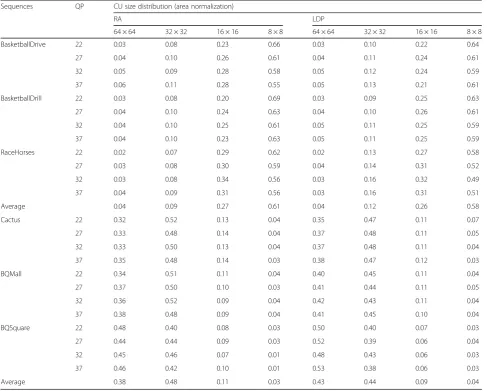
BasketballD-rive,” “BasketballDrill,” and “RaceHorses”), their small size CU (16 × 16 and 8 × 8) is close to 0.90 under RA configuration, as well as 0.84 under LDP configuration as shown in Table 4. In particular, as a test sequence
with large global motion area, sequence “RaceHorses”
has a huge amount of movement information, so the small size CU in this sequence also accounts for nearly 0.90 at RA condition. It is because that motion in these test sequences is quite rich and objects in them move dramatically, it needs small size CU to record abundant movement information for fulfilling an accurate MV coding. Nevertheless, in the other three test sequences
with comparative simple motion, the overwhelming ma-jority of CU is big size (64 × 64 and 32 × 32), where it is from 0.83 (“Cactus” in RA case) to 0.90 (“BQSquare” in LDP case) on average at both two conditions. Particu-larly “BQSquare” has large motionless region, so CUs in this test sequence are almost totally chosen as big size. Another observation from Table 4 is that as QP value is rising, the share of big size CU is growing, since growth of QP smoothens the video texture so that the motion degree is slow. The region in current CU with big size is covered by homogeneous texture or motion content, while the small size CUs carry a large number of texture and movement information. As a result, we can initially determine motion degree upon the current CU size.
Based on aforementioned observations, we can find that motion degree is relative closely to CU size. More-over, the first three sequences contain complex motion, so the CU size in these four sequences always tends to
Table 4Distribution of CU sizes for six typical test sequences
Sequences QP CU size distribution (area normalization)
RA LDP
64 × 64 32 × 32 16 × 16 8 × 8 64 × 64 32 × 32 16 × 16 8 × 8
BasketballDrive 22 0.03 0.08 0.23 0.66 0.03 0.10 0.22 0.64
27 0.04 0.10 0.26 0.61 0.04 0.11 0.24 0.61
32 0.05 0.09 0.28 0.58 0.05 0.12 0.24 0.59
37 0.06 0.11 0.28 0.55 0.05 0.13 0.21 0.61
BasketballDrill 22 0.03 0.08 0.20 0.69 0.03 0.09 0.25 0.63
27 0.04 0.10 0.24 0.63 0.04 0.10 0.26 0.61
32 0.04 0.10 0.25 0.61 0.05 0.11 0.25 0.59
37 0.04 0.10 0.23 0.63 0.05 0.11 0.25 0.59
RaceHorses 22 0.02 0.07 0.29 0.62 0.02 0.13 0.27 0.58
27 0.03 0.08 0.30 0.59 0.04 0.14 0.31 0.52
32 0.03 0.08 0.34 0.56 0.03 0.16 0.32 0.49
37 0.04 0.09 0.31 0.56 0.03 0.16 0.31 0.51
Average 0.04 0.09 0.27 0.61 0.04 0.12 0.26 0.58
Cactus 22 0.32 0.52 0.13 0.04 0.35 0.47 0.11 0.07
27 0.33 0.48 0.14 0.04 0.37 0.48 0.11 0.05
32 0.33 0.50 0.13 0.04 0.37 0.48 0.11 0.04
37 0.35 0.48 0.14 0.03 0.38 0.47 0.12 0.03
BQMall 22 0.34 0.51 0.11 0.04 0.40 0.45 0.11 0.04
27 0.37 0.50 0.10 0.03 0.41 0.44 0.11 0.05
32 0.36 0.52 0.09 0.04 0.42 0.43 0.11 0.04
37 0.38 0.48 0.09 0.04 0.41 0.45 0.10 0.04
BQSquare 22 0.48 0.40 0.08 0.03 0.50 0.40 0.07 0.03
27 0.44 0.44 0.09 0.03 0.52 0.39 0.06 0.04
32 0.45 0.46 0.07 0.01 0.48 0.43 0.06 0.03
37 0.46 0.42 0.10 0.01 0.53 0.38 0.06 0.03
be small. While the motion in the last three sequences is relatively slow, therefore, the big CU accounts for the vast majority. In other words, fast/slow motion leads to small/big size CU and requires big/small motion search range. Consequently, according to the motion informa-tion of CU size, various CU sizes are divided into four categories and the weight value (ω) can be setup on dif-ferent CU sizes, as shown in Table 5.
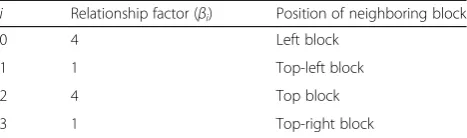
MVs of the current CU are always correlated with the MVs of its spatially neighboring blocks [33]. It is possible that the current block and its spatially adjacent blocks have the same moving object with similar movement information and the motion of the object is unlikely to alter abruptly over time. Accordingly, the relationship among movement information of the spatially neighbor-ing blocks can be utilized to adjust search range for current CU. Furthermore, a plenty of experiments have been conducted on various test sequences, and it is ob-served that most objects move along horizontal or verti-cal direction. Hence, we tabulate Table 6 to assign the relationship factor (βi) between current CU and its adja-cent spatial blocks. The spatial correlation is one of the major parameters for measuring motion degree of current CU [35]. Additionally, another crucial parameter to judge the degree is current CU size, where different sizes are assigned different weight values as tabulated in Table 5. Therefore, we can determine the motion degree
of current CU in accordance with the weight value (ω)
and the relationship factors (βi) as follows:
MD¼ωX3
i¼0
ωi⋅βi⋅fi ð2Þ
whereMDrepresents motion degree of current CU, and
weight valueωiis signified by search ranges of neighbor-ing blockiaccording to results in Table 5, as well as the flagfiis set as 1 if neighboring blockiis available; other-wise, it is assigned as 0.
In general, the larger the parameter MD is, the
stronger the uncertainty of motion is and the bigger the search range is. According to this regulation, the search range of current CU is able to be determined through Table 7. T1,T2, and T3in Table 7 are
thresh-olds to classify current CU into each types. Inspired by [35] and through a great deal of experimental
results, we achieve the accuracies of the proposed algorithm using various thresholds, which are shown in Table 8. The accuracies here are defined as the match-ing rate between the MVs by the proposed algorithm and the MVs by the original HEVC encoder.T1,T2, andT3are
assigned to 0.65, 10.50, and 13.00, respectively. This configuration is capable of adjusting search range for current CU, which avoids extremely high computational load from full search range and achieves a consistent coding performance.
2.3 Overall algorithms
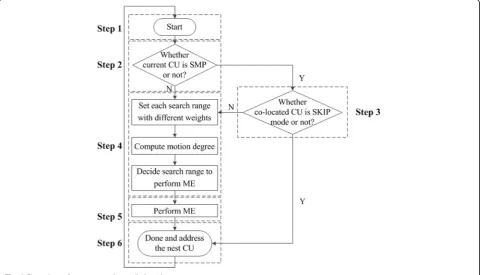
On the basis of the aforementioned analysis, our pro-posed efficient approach for HEVC combines fast PU partition decision algorithm and fast ME process algo-rithm. The flow chart of our proposed overall algorithms is illustrated as Fig. 5.
We further describe the steps in detail as follows: Step 1: Start interprediction for a CU.
Step 2: Determine whether current CU is partitioned to SMP (PART_2N × N and PART_N × 2 N) or not. If current CU is divided into SMP, go to step 3; otherwise, go to step 4.
Step 3: Perform AMP decision skipping. Derive the co-located CU in previous coded frame of current CU; if it was encoded as SKIP mode, current CU should also be decided as SKIP mode and go to step 6; otherwise, current CU should further be decided as AMP or still as SMP and go to step 4.
Step 4: Perform fast search range adjustment.
Step 4.1: Set the weight value (ω) upon each CU
sizes and assign each search ranges corresponding to
different ω as shown in Table 5.
Step 4.2: Compute motion degree of current CU based on Eq. (2) using several parameters, including relationship factor from Table 6.
Table 7Search range adjustment usingMD
Search range Condition
[−8, 8] MD<T1
[−16, 16] T1≤MD<T2
[−32, 32] T2≤MD<T3
[−64, 64] T3≤MD
Table 6Relationship factor (βi) and position of neighboring
block
i Relationship factor (βi) Position of neighboring block
0 4 Left block
1 1 Top-left block
2 4 Top block
3 1 Top-right block
Table 5Weight values for each CU size
CU size Weight value (ω)
64 × 64 0.1
32 × 32 0.2
16 × 16 0.3
Step 4.3: According to values of T1,T2, and T3,
de-cide which search range for the current CU should be selected to execute ME.
Step 5: Perform ME with modified search range for current CU.
Step 6: Go to step 1 and address the next CU.
3 Results and discussion
This section analyzes the performance in terms of cod-ing time, bitrates, and PSNR. In the followcod-ing, the two sub-methods are described as (i) AMP decision skipping
algorithm (labeled “ADS”) and (ii) search range adjust-ment algorithm 2 (labeled“SRA”).
For both algorithms, the HEVC test model (HM) ref-erence software HM14.0 has been utilized. For these tests, ten sequences are released by JCT-VC group and the detailed information of the test sequences is pro-vided in Table 1 in Section 1. It is noteworthy that all the ten test sequences in Table 1 are selected from the CTC and they have all kinds of resolutions (from 416 × 240 to 2560 × 1600) and various motion characteristics (low and high motion degree). All the experiments are
Fig. 5Flow chart of our proposed overall algorithms
Table 8Comparison between ADS and the original HM 14.0
Test sequence RA LDP
BD-PSNR (dB) BD-BR (%) ΔT(%) BD-PSNR (dB) BD-BR (%) ΔT(%)
Traffic −0.03 0.47 −8.26 N/A N/A N/A
PeopleOnStreet −0.03 0.51 −8.38 N/A N/A N/A
BasketballDrive −0.03 0.73 −13.84 −0.08 0.91 −14.33
Cactus −0.05 0.71 −9.93 −0.05 0.68 −12.18
BQMall −0.04 0.82 −10.41 −0.06 0.72 −10.07
BasketballDrill −0.02 0.87 −12.55 −0.06 0.85 −13.46
BQSquare −0.02 0.42 −5.97 −0.05 0.71 −11.25
RaceHorses −0.04 0.69 −14.02 −0.02 0.57 −12.53
FourPeople N/A N/A N/A −0.03 0.63 −9.76
Johnny N/A N/A N/A −0.02 0.89 −8.87
Average −0.03 0.65 −10.42 −0.05 0.75 −11.56
simulated on two Intel Xeon E5-2640 v2 2.0GHz, 32GB DDR3 random access memory, and compiled on Micro-soft Visual C++ 2010 under RA and LDP cases. In addition, operating system is 64-bit Microsoft Windows 7 SP1. The encoder is configured as follows: both max-imum CU width and height are 64 pixels, and maxmax-imum partition depth is 4, resulting in minimum CU size of 8 × 8 pixels; period of I-Frame is 32, and GOP (group of picture) size is 8; full search range of ME is set with 64; QP is respectively selected with 22, 27, 32, and 37; RDO, SAO (sample adaptive offset), and AMP are enabled; and CABAC (context-based adaptive binary arithmetic coding) is used as the entropy coder.
In this section, intuitive comparison is shown in Figs. 6, 7, 8, and 9. Meanwhile, the results of comparative
experiments are tabulated in Tables 8, 9, and 10 which show the results between our approach and the original HEVC encoder. Figures 10, 11, and 12 provide the results compared with the state-of-the-art fast intercoding methods in detail. Note that the same as Section 1, changes of PSNR, bitrates, and coding time are labeled by “BD-PSNR (dB),” “BD-BR (%),”and“ΔT(%),”respectively.
3.1 Evaluation of individual algorithm ADS compared with HM 14.0
versus the original HM 14.0. From Table 8, we can note that sub-algorithm ADS can obtain coding complexity re-duction with almost the same encoding performance for all ten test sequences. More specifically, it reduces 10.42 and 11.56% coding time averagely for them under RA and LDP cases, respectively. The loss of PSNR for ADS is from −0.08 dB (“BasketballDrive”under LDP configuration) to −0.02 dB, and bitrate increase is from 0.42% (“BQSquare”
under RA configuration) to 0.91% (“BasketballDrive”
under LDP configuration). Since ADS simplifies AMP de-cision for PU mode dede-cision, for the test sequences with high movement region, coding time saving is from the maximum of 14.33% (“BasketballDrive”at LDP condition)
to the minimum of 12.53% (“RaceHorses” at LDP
condi-tion), which is evident. Although some of these ten test se-quences have much slow motion areas (including “Traffic,” “Cactus,” “BQMall,” “BQSquare,”“FourPeople,” and“Johnny”), the coding time reduction still achieves ap-proximately 8.67% under RA case and 10.43% under LDP case. Because of high definition and high motion activity, RD performance for test sequence“BasketballDrive”is less than satisfactory, but coding time saving reaches the ex-pected goal with the maximum of 14.33% at LDP
condition. These results imply that the proposed ADS al-gorithm can accelerate PU partition decision in HEVC en-coder through skipping some AMP decision.
3.2 Evaluation of individual algorithm SRA compared with HM 14.0
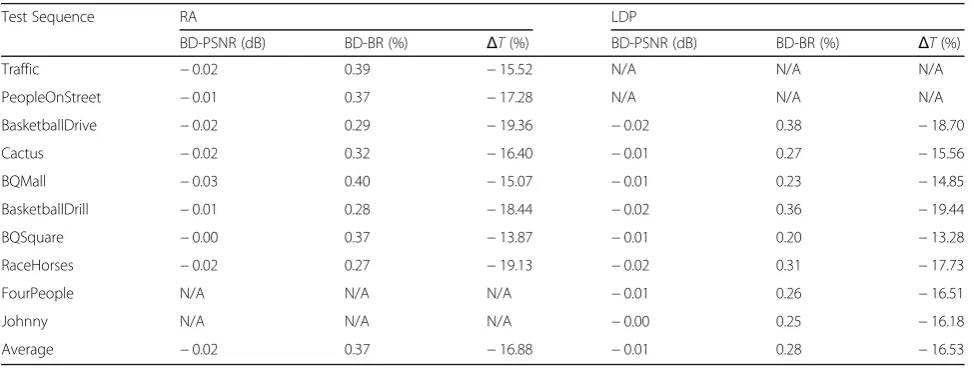
Table 9 demonstrates the experimental results of our SRA algorithm compared with the original HM 14.0. It can be seen from Table 9 that over 16% of time saving is obtained by SRA algorithm at both RA and LDP conditions. Mean-while, decrease of PSNR and increase of bitrates are within acceptable range (−0.02 dB of PSNR decrease and
0.37% of bitrates increase at RA condition as well as −
0.01 dB of PSNR decrease and 0.28% of bitrates increase at LDP condition on average). In particular, for test se-quences“BQSquare”with RA configuration and“Johnny” with LDP configuration, coding performance are totally identical to that of the original HEVC encoder in respect of PSNR. Additionally, bitrates rise from just 0.20% (“BQSquare” under LDP case) to 0.40% (“BQMall”under RA case) using SRA method. Because SRA adaptively diminishes the motion search range of ME and discards lots of unnecessary search region, bitrate increase is
Table 9Comparison between SRA and the original HM 14.0
Test Sequence RA LDP
BD-PSNR (dB) BD-BR (%) ΔT(%) BD-PSNR (dB) BD-BR (%) ΔT(%)
Traffic −0.02 0.39 −15.52 N/A N/A N/A
PeopleOnStreet −0.01 0.37 −17.28 N/A N/A N/A
BasketballDrive −0.02 0.29 −19.36 −0.02 0.38 −18.70
Cactus −0.02 0.32 −16.40 −0.01 0.27 −15.56
BQMall −0.03 0.40 −15.07 −0.01 0.23 −14.85
BasketballDrill −0.01 0.28 −18.44 −0.02 0.36 −19.44
BQSquare −0.00 0.37 −13.87 −0.01 0.20 −13.28
RaceHorses −0.02 0.27 −19.13 −0.02 0.31 −17.73
FourPeople N/A N/A N/A −0.01 0.26 −16.51
Johnny N/A N/A N/A −0.00 0.25 −16.18
Average −0.02 0.37 −16.88 −0.01 0.28 −16.53
N/Anot applicable
inconspicuous with regard to the test sequences with low motion activity areas, such as“BQSquare,” “FourPeople,” and“Johnny.”It indicates that SRA is suitable for the test sequence whose objects move slowly, since SRA method can eliminate much computational complexity on candi-date point searching through adjusting search range. Fur-thermore, coding time reduction is particularly significant
on test sequences with complex movement, such as“
Bas-ketballDrive,” “BasketballDrill,” and “RaceHorses.” The analysis about the results in Table 9 states that the pro-posed fast SRA algorithm maintains the nearly same coding efficiency as the original HEVC encoder with con-siderable reduction for the computational load.
3.3 Proposed overall algorithm assessment
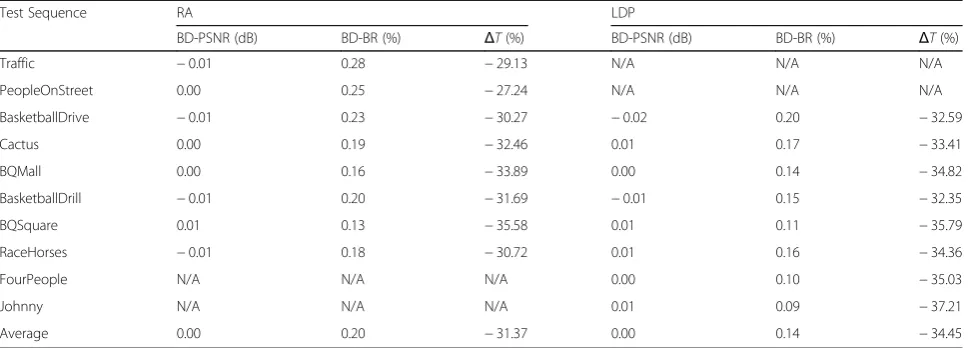
Table 10 illustrates the experimental result comparison between the proposed overall algorithms (ADS plus SRA) and the original HEVC encoder. The results demonstrate that the proposed algorithm can save the encoding time dramatically with 31.37% under RA con-figuration and 34.45% under LDP concon-figuration on
aver-age, where the maximum reduction of 37.21%(“Johnny”
at LDP condition) and the minimum reduction of 27.24% (“PeopleOnStreet”at RA condition), respectively.
When ADS performs, inter partition mode can be decided in advance. This process has accelerated inter-mode decision. Based on this improvement, ME can be skipped conditionally or performed under proper search range with SRA. Only performing ADS can skip some interpartition modes without any RD cost calculation process, but ME with full search range, if any, consumes much time. Similarly, although SRA can adjust search range for ME, computational complexity is still high during interpartition mode decision without ADS. It is inevitable that collaboration of ADS and SRA outper-forms the individual algorithms. Therefore, the coding time reduction by joint algorithm is more than the time saved by ADS and SRA, respectively (11 and 16%).
Test sequence “Johnny” has both large static
back-ground regions and large homogeneous areas, so most of CUs can be immediately predicted as SKIP mode without AMP decision using ADS. Furthermore, search
range can be diminished as minimum range [−8, 8]
using SRA for some blocks, which accomplishes coding time decrease efficiently. Since the proposed overall al-gorithms skip complicated AMP decision and adjust motion search range of ME process rather than exhaust-ive candidates search, the computational burden for the
Fig. 10Comparison of the subjective quality of the 42nd frame in test sequence“BasketballDrive”aEncoded by the original HM 14.0.bEncoded by the proposed algorithm
Table 10Comparison between ADS + SRA and the original HM 14.0
Test Sequence RA LDP
BD-PSNR (dB) BD-BR (%) ΔT(%) BD-PSNR (dB) BD-BR (%) ΔT(%)
Traffic −0.01 0.28 −29.13 N/A N/A N/A
PeopleOnStreet 0.00 0.25 −27.24 N/A N/A N/A
BasketballDrive −0.01 0.23 −30.27 −0.02 0.20 −32.59
Cactus 0.00 0.19 −32.46 0.01 0.17 −33.41
BQMall 0.00 0.16 −33.89 0.00 0.14 −34.82
BasketballDrill −0.01 0.20 −31.69 −0.01 0.15 −32.35
BQSquare 0.01 0.13 −35.58 0.01 0.11 −35.79
RaceHorses −0.01 0.18 −30.72 0.01 0.16 −34.36
FourPeople N/A N/A N/A 0.00 0.10 −35.03
Johnny N/A N/A N/A 0.01 0.09 −37.21
sequences with low motion activity reduces significantly.
For the sequences with slow movement, including“
Traf-fic,” “Cactus,” “BQMall,” “BQSquare,” “FourPeople,” and “Johnny,”the proposed overall algorithms averagely save coding time 32.77% (in RA case) and 35.25% (in LDP case), and bitrate increase for these sequences are only 0.19% (in RA case) and 0.12% (in LDP case) on average, which is negligible. Moreover, the average PSNR loss for all the test sequences is 0.00 dB under two configura-tions. These results indicate that the proposed efficient AMP decision and search range adjustment algorithm can accelerate intercoding greatly with the same coding performance as HEVC encoder.
3.4 Intuitive evaluation of our proposed algorithm
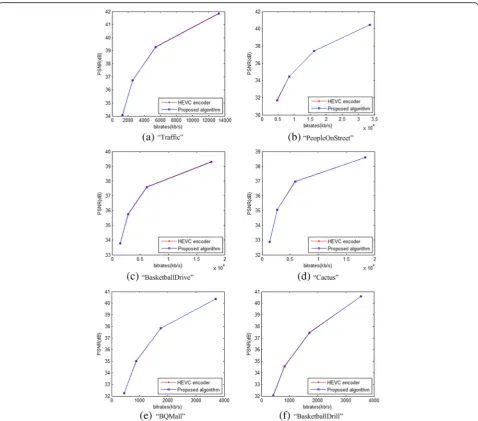
In order to illustrate the experimental results intuitively, Figs. 6 and 7 provide more information about the proposed overall algorithm compared with the original HEVC encoder in detail. It can be noticed from Figs. 6 and 7 that the proposed overall algorithm can obtain nearly the same coding performance as the original HEVC encoder in terms of PSNR and bitrates.
3.5 Subjective performance comparison
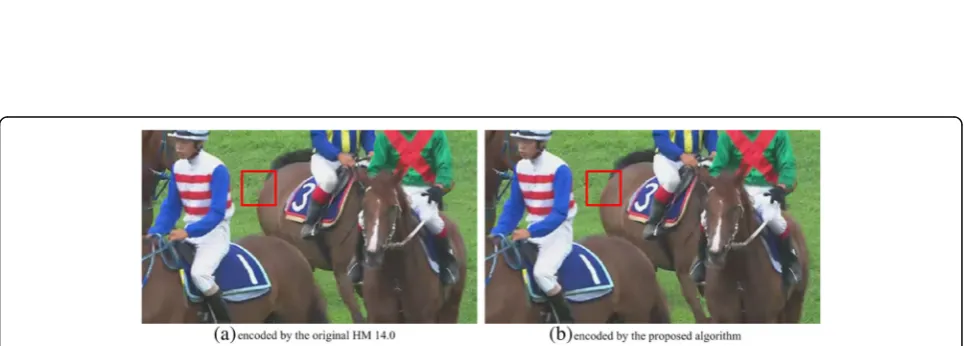
Figures 8, 9, and 10 show the 22nd frame of “
Race-Horses” (416 × 240), the 32nd frame of“BasketballDrill”
(832 × 480), and the 42nd frame of “BasketballDrive”
(1920 × 1080) under RA case with QP of 32, aiming at
comparing subjective performance between our pro-posed approach and the original HEVC encoder.
It is evident that the region marked by the red rectangle in Fig. 8b is more smoothly than that in Fig. 8a. Additionally, the area labeled by the red rectangle in Fig. 9a is more blurred than that in Fig. 9b. Except for Figs. 8 and 9, we can also find from Fig. 10 that there exists no apparent flaw in
Fig. 10b for the proposed algorithm from the
perspective of subjective quality. The subjective per-formance comparison demonstrates that the proposed algorithm and the original HEVC encoder have ex-tremely similar subjective qualities, but the coding ef-ficiency of the proposed algorithm is higher than that of the original HEVC encoder.
3.6 Comparison with the state-of-the-art algorithms [26, 27, 29]
It is illustrated as Figs. 11, 12, and 13 that the coding efficiency comparison between the proposed algorithm and the state-of-the-art algorithms in Ref. [26, 27, 29] under RA configuration and Figs. 11, 12, and 13 reflect the compari-sons about coding time reduction, Bjontegaard Delta PSNR, and Bjontegaard Delta Bitrate, respectively. From Fig. 11, it is obvious that other than the algorithm in [27], the coding time is generally saved more by the proposed algorithm than that by algorithms in [26, 29], but the bitrate increase by our method is significantly less than that by the method in [27] (as shown in Fig. 13). Meanwhile, according to the
data comparisons from Fig. 12, we can see that in respects of PSNR loss achievement of our proposed algorithm is nearly same as that of algorithm in [27]. Note that the pro-posed algorithm distinctly outperforms the other algo-rithms in [26, 29]. For bitrate drop, our method is superior to both algorithms in [26, 27] except for algorithm in [29], while our approach achieves a better coding time reduction and PSNR gain than the approach in [29]. To sum up, the proposed algorithm can keep a consistent coding efficiency compared with the state-of-the-art fast HEVC algorithms in [26, 27, 29].
4 Conclusion
In this paper, our proposed algorithm performs the out-standing coding efficiency for interprediction and is demonstrated by aforementioned experimental results. Because the proposed method achieves redundant PU mode decision skipping and adaptive search range of ME adjustment, it can reduce abundant coding time extremely and maintain almost the same coding performance as the original HEVC encoder. Moreover, comparison experiments with the state-of-the-art algo-rithms in Ref. [26, 27, 29] show that our algorithm is more close to the original HEVC encoder than other novel methods in terms of RD performance. In conclu-sion, the proposed algorithm can improve coding effi-ciency significantly and implement HEVC encoder for real-time application.
Acknowledgements
The authors would like to thank the editors and anonymous reviewers for their valuable comments.
Funding
This work was supported in part by the National Natural Science Foundation of China, under Grants U1301257, 61571285, and 61771432.
Availability of data and materials
Data will not be shared; reason for not sharing the data and materials is that the work submitted for review is not completed. The research is still ongoing, and those data and materials are still required by the author and co-authors for further investigations.
Authors’contributions
PA designed and conceived the research. XP performed the simulated experiments and QZ analyzed the exprimental results. XP wrote the
manuscript. PA and QZ edited the manuscript. All authors read and approved the final manuscript.
Authors’information
Xinpeng Huang received the M.D. degree in information engineering from Zhengzhou University of Light Industry, Zhengzhou, China, in 2013. He is currently pursuing the Ph.D. degree in communication and information systems from Shanghai University, Shanghai, China. His current research interests include video coding, light field image compression, and extensions of the High Efficiency Video Coding.
Ping An received her B.S. and M.S. degrees from Hefei University of Technology, Hefei, China, in 1990 and 1993, respectively, and the Ph.D. degree in communication and information systems from Shanghai University, Shanghai, China, in 2002. She is currently a professor in School of Communication and Information Engineering, Shanghai University. Her research interests include stereoscopic and three-dimensional vision analysis and image and video processing, coding, and application.
Qiuwen Zhang received his Ph.D. degree in communication and information systems from Shanghai University, Shanghai, China, in 2012. Since 2012, he has been with the faculty of the College of Computer and Communication Engineering, Zhengzhou University of Light Industry, where he is currently an Associate Professor. He has published over 30 technical papers in the field of video coding and image processing. His major research interests include 3D signal processing, 3D High Efficiency Video Coding (3D-HEVC), video codec optimization, and multimedia communication.
Competing interests
The authors declare that they have no competing interests.
Publisher’s Note
Springer Nature remains neutral with regard to jurisdictional claims in published maps and institutional affiliations.
Author details
1Shanghai Institute for Advanced Communication and Data Science,
Shanghai University, Shanghai 200444, China.2Key Laboratory of Ministry of Education for Advanced Display and System Application, Shanghai University, Shanghai 200072, China.3College of Computer and Communication Engineering, Zhengzhou University of Light Industry, Zhengzhou 450002, China.
Received: 29 March 2017 Accepted: 7 November 2017
References
1. B Bross, W-JH, GJ Sullivan, J-R Ohm, T Wiegand. High Efficiency Video Coding (HEVC) text specification draft 8, in document JCTVC-J1003, Stockholm, Switzerland, 2012. http://phenix.intevry.fr/jct/doc_end_user/ documents/10_Stockholm/wg11/JCTVC-J1003-v8.zip.
2. GJ Sullivan, J-R Ohm, W-J Han, T Wiegand, Overview of the high efficiency video coding (HEVC) standard. IEEE Transactions on circuits and systems for video technology22(12), 1649–1668 (2012)
Publishing, Cham, Switzerland, 2016). https://link.springer.com/content/pdf/ 10.1007%2F978-3-319-25778-5.pdf.
4. Rao, K.R.: High efficiency video coding. 2016 Signal Processing: Algorithms, Architectures, Arrangements and Applications (SPA), 11-11 (2016). doi:10. 1109/spa.2016.7763576
5. Mora EG, Cagnazzo M, Dufaux F. AVC to HEVC transcoder based on quadtree limitation. Multimedia Tools & Applications76(6), 1-25 (2017) 6. G Tech, Y Chen, K Müller, J-R Ohm, A Vetro, Y-K Wang, Overview of the
multiview and 3D extensions of High Efficiency Video Coding. IEEE Transactions on Circuits and Systems for Video Technology26(1), 35–49 (2016) 7. DA Milovanovic, D Kukolj, ZS Bojkovic,Recent Advances on 3D Video Coding
Technology: HEVC Standardization Framework(Springer New York, New York, USA, 2017). https://link.springer.com/content/pdf/10.1007%2F978-1-4939-4026-4.pdf.
8. F Bossen, B Bross, K Suhring, D Flynn, HEVC complexity and implementation analysis. IEEE Transactions on Circuits & Systems for Video Technology 22(12), 1685–1696 (2012)
9. Yu, H., Wang, W., Xu, M.: Context Reduction of Palette Run Type in High Efficiency Video Coding (HEVC) Screen Content Coding (SCC). (2017). 10. P Wen-Hsiao, FG Walls, RA Cohen, X Jizheng, J Ostermann, A MacInnis, L
Tao, Overview of screen content video coding: technologies, standards, and beyond. IEEE J. Emerg. Sel. Top. Circuits Syst. (USA)6(4), 393–408 (2016). doi: 10.1109/jetcas.2016.2608971
11. W Liu, J Li, YB Cho, A novel architecture for parallel multi-view HEVC decoder on mobile device. EURASIP Journal on Image and Video Processing 2017(1), 24 (2017). doi:10.1186/s13640-017-0174-5
12. Y Dai, D Liu, F Wu,A Convolutional Neural Network Approach for Post-Processing in HEVC Intra Coding(Springer International Publishing, Cham, Switzerland, 2017). https://link.springer.com/content/pdf/10.1007%2F978-3-319-51811-4.pdf.
13. A BenHajyoussef, T Ezzedine, A Bouallègue, Gradient-based pre-processing for intra prediction in High Efficiency Video Coding. EURASIP Journal on Image and Video Processing2017(1), 9 (2017). doi:10.1186/s13640-016-0159-9 14. Roh HJ, Han SW, Ryu ES. Prediction complexity-based HEVC parallel
processing for asymmetric multicores, 1-14, (2017). doi: 10.1007/s11042-017-4413-7.
15. Zupancic, I, Blasi SG, Peixoto E, Izquierdo E. HEVC encoder optimisations using adaptive coding unit visiting order. In: IEEE International Conference on Image Processing 2016, pp. 794-798. http://ieeexplore.ieee.org/ document/7532466/.
16. Qing A, Zhou W, Wei H, Zhou X, Zhang G, Yang J. A fast CU partitioning algorithm in HEVC inter prediction for HD/UHD video. In: 2016 Asia-Pacific Signal and Information Processing Association Annual Summit and Conference (APSIPA), pp. 1-5. http://ieeexplore.ieee.org/document/7820718/. 17. Z Liu, X Yu, Y Gao, S Chen, X Ji, D Wang, CU partition mode decision for
HEVC hardwired intra encoder using convolution neural network. IEEE Trans. Image Process.25(11), 5088–5103 (2016). doi:10.1109/TIP.2016.2601264 18. G Correa, PA Assuncao, LV Agostini, LA da Silva Cruz, Fast HEVC encoding
decisions using data mining. IEEE Transactions on Circuits and Systems for Video Technology25(4), 660–673 (2015)
19. Zeng H, Xiang W, Cai C, Chen J. Hierarchical inter mode decision for HEVC. In: International Symposium on Intelligent Signal Processing and Communication Systems 2015, pp. 658-662. http://ieeexplore.ieee.org/ document/7432853/.
20. W Zhao, T Onoye, T Song, Hierarchical structure-based fast mode decision for H.265/HEVC. IEEE Transactions on Circuits & Systems for Video Technology25(10), 1651–1664 (2015)
21. Zupancic, I., Blasi, S.G., Peixoto, E., Izquierdo, E.: Inter-prediction optimizations for video coding using adaptive coding unit visiting order. IEEE Transactions on MultimediaPP(99), 1-1 (2016). doi:10.1109/TMM.2016.2579505 22. HS Kim, RH Park, Fast CU partitioning algorithm for HEVC using an
online-learning-based Bayesian decision rule. IEEE Transactions on Circuits and Systems for Video Technology26(1), 130–138 (2016). doi:10.1109/TCSVT. 2015.2444672
23. X Huang, Q Zhang, X Zhao, W Zhang, Y Zhang, Y Gan, Fast inter-prediction mode decision algorithm for HEVC. Signal Image Video Process.11(1), 33– 40 (2017). https://doi.org/10.1007/s11760-016-0887-4
24. Zhang, N., Fan, X., Zhao, D., Gao, W.: Merge mode for deformable block motion information derivation. IEEE Transactions on Circuits and Systems for Video TechnologyPP(99), 1-1 (2016). doi:10.1109/TCSVT.2016.2589818
25. Nguyen T, Nguyen P, Nguyen P, Dinh C. A novel search pattern for Motion Estimation in High Efficiency Video Coding. In: 2016 International Conference on Computer Communication and Informatics (ICCCI), pp. 1-6. http://ieeexplore.ieee.org/document/7479971/.
26. Z Pan, J Lei, Y Zhang, X Sun, Fast motion estimation based on content property for low-complexity H.265/HEVC encoder. IEEE Trans. Broadcast.62, 1–10 (2016)
27. A Medhat, A Shalaby, MS Sayed, M Elsabrouty, Adaptive low-complexity motion estimation algorithm for high efficiency video coding encoder. IET Image Process.10(6), 438–447 (2016)
28. Wu J, Guo B, Hou J, Yan Y, Jiang J. Fast CU encoding schemes based on merge mode and motion estimation for HEVC inter prediction. Ksii Transactions on Internet & Information Systems,10(3),1195-1211 (2016) 29. H Kibeya, F Belghith, MAB Ayed, N Masmoudi, Fast coding unit selection
and motion estimation algorithm based on early detection of zero block quantified transform coefficients for high-efficiency video coding standard. IET Image Process.10(5), 371–380 (2016)
30. Bossen F. Common test conditions and software reference configurations, in document JCTVC-F900 Geneva, Switzerland, March, 2011. http://phenix. intevry.fr/jct/doc_end_user/documents/6_Torino/wg11/JCTVC-F900-v1.zip. 31. G Bjøntegaard. Calculation of average PSNR differences between RD-curves,
ITU-T Q.6/SG16 VCEG 13th Meeting, Document VCEG-M33, Austin, USA, 2001
32. J Xiong, H Li, F Meng, S Zhu, Q Wu, B Zeng, MRF-based fast HEVC inter CU decision with the variance of absolute differences. IEEE Transactions on Multimedia16(8), 2141–2153 (2014). doi:10.1109/TMM.2014.2356795 33. L Shen, Z Liu, Z Zhang, X Shi, Fast inter mode decision using spatial
property of motion field. IEEE Transactions on Multimedia10(6), 1208–1214 (2008). doi:10.1109/TMM.2008.2001358
34. L Shen, Z Zhang, Z Liu, Adaptive inter-mode decision for HEVC jointly utilizing inter-level and spatiotemporal correlations. IEEE Transactions on Circuits and Systems for Video Technology24(10), 1709–1722 (2014). doi:10. 1109/TCSVT.2014.2313892