COACHING FRAMEWORK (AKW-PMCF)
PROJECT MANAGEMENT
C H E K F O U N G T A N
S C H O O L O F C O M P U T I N G A N D E N G I N E E R I N G
U N I V E R S I T Y O F W E S T L O N D O N
Abstract: Coaching is an effective leadership tool for assisting project managers in
coping with the pressure and the demand of managing complex projects
successfully by balancing time, scope, resources and quality constraints. However,
there is a lack of project management specific coaching frameworks. Hence, this
paper aims to develop an "applied, knowledge, and work-based" oriented project
management coaching framework (AKW-PMCF) which helps professionals at
different levels to cope with project management challenges. We applied design
science methodology in this research. We collected the data via explorative survey
from project management professionals and employed descriptive analysis when
analysing the data. As a result, we developed AKW-PMCF. AKW-PMCF consists of
eight coaching steps and seven knowledge areas. We then evaluated AKW-PMCF
with Kirkpatrick and Kirkpatrick (2016)'s learning model and technology
acceptance model (TAM) via experts’ feedback. The results showed that AKW-PMCF
improved the project management skills of the project professionals (the experts)
and they will apply the framework for coaching their team members. This research
has extended the existing coaching literature by producing AKW-PMCF, broadened
the TAM’s application in assessing a non-technological management product, and
provided an applied and work-based method for aspiring coaches in project
management. In addition, AKW-PMCF is instrumental for the project managers
who would like to serve as coaches in their project team.
A N N I E W E N U
L I F E Q U A L I T Y I M P R O V E M E N T C O A C H I N G ( L Q I C )
K E Y W O R D S : P R O J E C T M A N A G E M E N T , C O A C H I N G ,
D E S I G N S C I E N C E R E S E A R C H , K I R K P A T R I C K A N D
K I R K P A T R I C K L E A R N I N G M O D E L , T E C H N O L O G Y
A C C E P T A N C E M O D E L
DOI NUMBER: 10.19255/JMPM01802
Project management is an increasingly popular profession as the global economy is becoming more projects oriented due to increased opportunities. According to PMI (2017), there are 87.7 million project management oriented roles worldwide by 2027. Project managers must ensure that the organisation’s mission and vision are understood so that they conduct the project by linking the mission with the company’s interests (Joseph, 2014). Leadership skills are essential in managing not only single but a multitude of activities due to the challenging project management environment (Berg & Karlsen, 2016). Moreover, project managers should also equip with not only with technical skills but also interpersonal skills such as motivation, communication, influencing, negotiation, decision making and problem-solving skills to build a high performing team (Ramazani & Jergeas, 2015). However, project managers are always working under pressure due to increasing level of complexity and demand in project environments (Berg & Karlsen, 2013; Bjorvatn & Wald, 2018).
Coaching is a useful leadership tool in helping project managers to cope with challenges such as managing people effectively, project uncertainty, culture
development, self and staff motivation (Berg & Karlsen, 2007). Coaching focusses on coachee’s personal development and identifies the required resources to achieve the goals (Anghel & Voicu, 2013). Coaching is different from mentoring, teaching, training, and counselling. Coaching focuses on the current situation and what action to take for getting to the desired place in the future. The coach assists the coachee to uncover their answers with clarity about what they want to achieve in the future and how to address their
limitations. Whereas mentoring, teaching, training and counselling are activities where a mentor guides the mentee, the teacher transfers knowledge and information the student lacks, training is the act of showing a person a particular skill or type of behaviour and counselling is focusing on understanding a person’s past events (Zenger and Stinnett 2010).
Despite there are many project management resources in outlining the criteria of being a successful project manager, the focus is still on the technical aspect rather than the soft or human aspect (Petter & Randolph, 2009; Pollack, 2007). And project failures are commonly associated with the human element of the project such as a poor relationship between the project team and the relevant stakeholders (Ewin, Luck, Chugh, & Jarvis, 2017). Therefore, organisations should consider coaching as a way to enable project managers in developing the soft skills that most project management education programs do not cover (Ramazani & Jergeas, 2015; Thompson & Cox, 2017). There are various coaching methodologies and frameworks in business environments. However, there is a lack of project management specific coaching frameworks. Hence, this research aims to develop a project management coaching framework which enables project management coaches to improve their coaching skills by providing a structure and guidance when coaching project managers.
In this paper, we will first review the related literature on project management and various coaching methodologies in Section 2. Section 3 describes design science as the research methodology employed in developing the
framework. Section 4 illustrates the framework and Section 5 depicts the evaluation results from the experts’ feedback. We conclude the paper by discussing the theoretical and practical contributions, limitation, and future work.
1 Introduction
The common project management methodologies used in the industry are Project Management Body of Knowledge (PMBOK) (Ghosh, Forrest, Dinetta, Wolfe, & Lambert, 2012), PRINCE2 (PRojects IN Controlled Environments) (Axelos, 2017), Agile (Goodpasture, 2010; Paulk, 2002), and Lean project management (Stellman & Greene, 2014).
For ensuring successful project management, it is crucial for all parties involved to commit to using a standard set of processes and procedures in managing and controlling the project, followed by monitoring the achievement against the project plan. Moreover, there is a need to identify the variation by comparing actual progress and planned progress so that project managers can plan and execute corrective actions (Young, 2016). Due to the complexity of the project management environment, project managers usually face individual and technical challenges. Individual challenges include leadership (e.g., lack of confidence and self-esteem, poor communication and motivation skills) (Berg & Karlsen, 2016) and stress (e.g., illness, absence, high employee turnover, burnout, decreasing job satisfaction and wellbeing) (Berg & Karlsen, 2007, 2013); whereas technical challenges include keeping up with the latest development in the project knowledge domain and skills in dealing with complex projects and uncertainties (Neuhauser, 2007). Therefore, a successful project manager should equip not only technical skills (hard skills) but also the leadership skills (soft skills) that are paramount to project management (Berg & Karlsen, 2016; Clarke, 2016). Table 1 illustrates the skills required for a successful project manager.
2 Project Management Coaching Methodologies
Project management activities consist of planning,
motivating, and controlling project aspects and motivating everyone involved in the project in order to achieve the time, cost, and performance objectives (Lester, 2007). Project management is knowledge intensive as it involves the application of knowledge, skills and techniques of project teams in ensuring a successful project (Joseph, 2014; Schwalbe, 2014).
2.1 Project Management and Key Criteria of
Successful Project Managers
Coaching is an intensive and systematic support for individuals or groups using a range of behavioural methods and techniques to assess them for achieving self-congruent goals or change and development in order to enhance their personal wellness and
professional performance which eventually leading to their organisations effectiveness (Cox, Bachkirova, & Clutterbuck, 2014; Roger, 2012; Segers, Vloeberghs, Henderickx, & Inceoglu, 2011). Coaching helps individuals to learn rather than to teach them, and it unlocks their potential to maximise their performance (Whitmore, 2009). Coaching is an extended cognition where a new piece of knowledge is employed for a new explanation or to fill the gap in the existing explanation. The practices associated with coaching include
building rapport, listening, reflecting, clarifying, goal setting, using intuition, giving feedback, demonstrating empathy and critically questioning (Cox et al., 2014).
2.2 Coaching Methodologies in Business
Environment
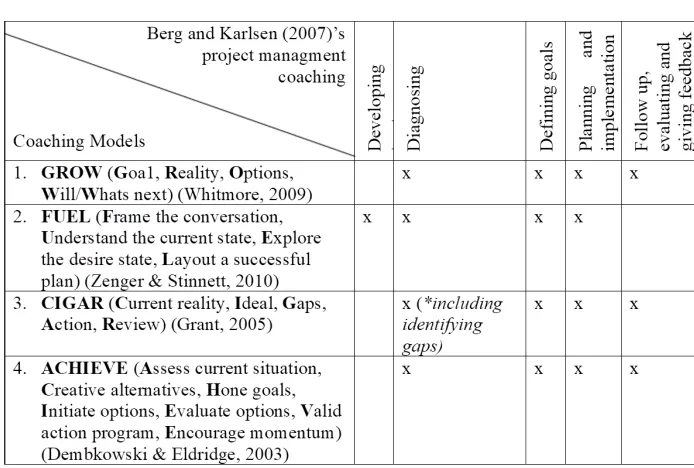
Based on the synthesis in Table 2, we found that there are a few limitations with the mentioned coaching models. GROW, CIGAR and ACHIEVE coaching models do not have a step for building trust and rapport with the coachee. The trust aspect poses a challenge for a novice coach. Starting the coaching process by setting the desired goal in the GROW model is risky if the goal is wrong from the beginning. The coaching model should enable coaches to reveal the current reality by challenging the coachee with open questions to uncover the underlying problem. If the coach does not discover the problem, the problem will be fixed on the surface and will continue to happen. The CIGAR and ACHIEVE models have to be applied by an experienced coach as these models require a lot of patience to ask a lot of questions and allow the coachee to come up with alternatives. Moreover, the coaching process in the GROW, FUEL and ACHIEVE models do not have a step where the coach can ask the coachee to talk about the potential challenge or obstacle that stops him or her for achieving the desired goal. Missing this step, especially for a novice coach can lead to a coaching failure where the coachee faces the same obstacle but not know how to deal with it. Hence, the modern coaching framework should address these limitations. Table 2 Key coaching models and their characteristics
Coaching can be applied to solve problems, motivate staff, delegating, team building and relationships issues, task performance, appraisal, and assessment, staff development, team reworking, planning and reviewing (Whitmore, 2009). Coaching can assess project managers in achieving a better result by emphasising on thinking pattern development, behaviour pattern development, learning pattern development and emotional pattern development (Madsen, 2012). It is recognised as one of the best practice in talent management and regularly practised in organisations such as executive coaching. Executive coaching has grown considerably in the past decade (Segers et al., 2011), it is an action learning process related to the individual directed at building his or her capability, knowledge, focus and commitment to achieve professional and organisational goals (Campone, 2015). There are various coaching models with different focus used in coaching (Beattie et al., 2014). Table 2 depicts the key coaching models in the business environment, and their characteristics compared to the project management specific coaching process suggested by Berg and Karlsen (2007).
3 Research Methodology
3.1 Design Science Research
Design Science Research (DSR) has a problem-solving paradigm where it extends the boundaries of human and capabilities in organisations by seeking to create new and innovative artefacts (Hevner, March, Park, & Ram, 2004). DSR originates in information systems research (Gregor & Hevner, 2013), and now it is widely applied in multidisciplinary research such as project management (Pournader et al., 2015). DSR aims to deliver artefacts which consist of the body of knowledge in meeting specific objectives or solving real-world problems (Simon, 1997). Artefacts can be intangible (e.g. models and methods) or tangible (e.g. prototypes and software) (March & Smith, 1995). In this research context, the project management coaching framework is an artefact as it is designed to help working professionals to become successful project managers (Ahlemann, El Arbi, Kaiser, & Heck, 2013). Hevner (2007) propounds the three research cycles in DSR (relevance, rigor, and design cycles) to inform the development of the framework in Figure 1. The relevance cycle gathers the coaching requirements from the project management environment as part of designing this framework.
This cycle includes empirical investigations ensuring the practicality of the framework (adapted from Pournader et al., 2015) (see Section 3.2). The rigor cycle covers existing literature or knowledge base that provides grounding theories, methods and the domain experiences which feed into the research, which contributes to the design cycle, where the framework is developed. The design cycle consists of activities such as designing and evaluating the framework (see Section 4 and 5). The evaluation activity ensures the project management coaching framework is functioning well before releasing it to the project management environment. In the rigor cycle, this research later adds new knowledge to the growing knowledge base of project management coaching (see Section 6.1). The three DSR cycles in-form the research design of developing the framework.
3.2 Data Collection, Analysis and Preliminary
Findings
Moreover, most of the respondents suggested that organisations should tailor the coaching sessions based on their needs. Furthermore, organisations should ensure the coaching sessions are in plan for the entire project life cycle which is from project initiation to project closures. Regarding project management methodologies, a majority of the respondents felt that Agile/Scrum is commonly used in their work
environment, followed by PRINCE2, PMBOK, and Waterfall. Hence, it is vital that the coaching
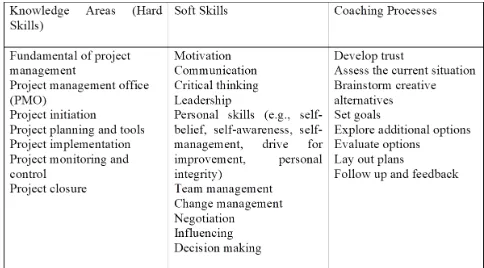
knowledge areas tailored to the project management methodology adopted by the coachee’s organisation. Table 4 summarises the project management knowledge areas (hard skills), soft skills required, and the preferred coaching processes in project
management according to the respondents’ feedback. This method helped us to identify and describe the
reality in project management coaching by looking into relevant coaching and project management aspects, the domain knowledge and social skills required to be a successful project manager. Out of the 51 respondents, 71% of them are already working as a project manager or team leader, whereas the rest are planning to become a project manager. 21% of the respondents are from the construction section, 35% each from IT and project management organisation and the rest are from sectors such as finance and the public sector. 84% of the respondents found that soft skills are more important compared to hard skills, whereas 13% of them considered both hard and soft skills are equally important. 94% of the respondents believed that coaching is essential in the project management context.
4 AKW Project Management Coaching
Framework (AKW-PMCF)
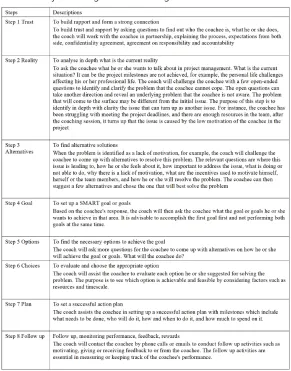
In this paper, we produce the AKW Project Management Coaching Framework (AKW-PMCF) following the DSR principles (see Figure 2). AKW stands for “Applied, Knowledge, Work-based” and it signifies the key characteristics of the PMCF. The framework provides a scientific and organised coaching process and guidance to the coach.
This framework is applied and work-based as it covers the project management coaching requirements from the working professionals, also it consists of the essential project management knowledge areas during the coaching session. The coach can be a professional coach in project management or a project manager acting as a coach to the team members. AKW-PMCF consists of the eight essential coaching processes (see Table 5) and seven project management coaching areas (see Table 6) covered in coaching sessions. The project management coaching areas cover how hard skills elements interlink with soft skills. AKW-PMCF provides the coach with a structural guideline in project management coaching. By following the eight coaching processes, and depending on coachee’s challenge, the coach can employ any of the coaching areas in helping the coachee to identify the underlying root cause and find alternatives to resolve the issue. Table 3 Themes of explorative survey
For gathering the requirements in developing the project management coaching framework, we have collected data via explorative survey. Table 3 shows the key themes of the survey. The explorative survey is suitable for collecting information from a sample of people to illustrate, compare or evaluate their knowledge, opinion and behaviour concerning the development of the framework, and compare the results with the literature findings (Fink, 2012; Sekaran & Bougie, 2016). We created the explorative survey using Survey Monkey and distributed it to working
professionals in the project management environment via social media platforms such as Linkedin groups. As a result, we managed to collect data from 51
respondents.
We then employed descriptive analysis in analysing the collected data. The descriptive analysis illustrates various aspects from the collected data and provides an accurate narrative of the phenomenon (Robson & McCartan, 2016).
One respondent asserted that “coaching helps you (the existing or future project manager) to acknowledge your own potential and find the right
answers/approach to solving problems in a way that it perfectly fits your abilities and skills. Having answers or solutions served to you by someone else (trainer, counsellor) may not fit into your overall spectrum of potential (ideas, perceptions, skills, abilities,
knowledge)”. The top four coaching models that the respondents found relevant to the project
management context are ACHIEVE, GROW, BERG and KARLSEN (2007)’s model, and FUEL. Respondents particularly highlighted a few key stages in the project management coaching process (see Table 4).
Table 4 Project management coaching requirements
5 Evaluation
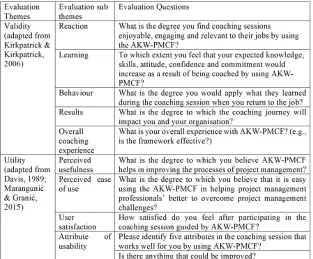
We applied expert feedback to evaluate the validity and utility of AKW-PMCF. Expert feedback is an established method to assess the claims, validity or trustworthiness of the research outcome (Sandelowski, 1998). Table 7 demonstrates the evaluation questions drawn by the Kirkpatrick and Kirkpatrick (2006)’s learning model (KLEM) for the validity aspect and the technology acceptance model (TAM) from Marangunić and Granić (2015) for the utility aspect. KLEM is commonly employed for assessing the effectiveness of coaching programmes (Ely et al., 2010) such as the work from Yoon, Shin, Bouphavanh, & Kang (2016). In this paper, we adopted KLEM in measuring the success or failure of the coaching session conducted via AKW-PMCF. We also used KLEM to study the participants’ likelihood of applying what they had learned and if their skills improved or developed as a result of the coaching session, and also whether what they learned will have an impact on them and their organisations. Similar to Ta and Prybutok (2018)’s work, TAM was adapted to assess the acceptance of a non-traditional information system. The two main constructs of TAM we adapted were the perceived usefulness and perceived ease of use (Davis, 1989), followed by the other
constructs for assessing the coachees satisfaction towards the framework. The evaluation procedure involves an hour coaching session with the selected experts followed by having them to respond to the evaluation questionnaire. In this research, we selected four experts who have different levels of project management working experiences.
5.1 Evaluation Procedure and Experts’ Feedback
Table 6 Project Management Coaching Areas in AKW-PMCF
Table 7 Evaluation themes and questions
Two experts (R1 and R2) had the background in project management and considered themselves as inexperienced project managers, whereas the other two experts considered themselves as experienced project managers (R3 and R4), one had extensive experience in managing telecommunication projects and the other in managing construction projects.
5.2 Evaluation Results
We employed descriptive analysis in analysing the results collected from the four experts. Descriptive analysis provides the appropriate narratives that help us in examining the validity and utility aspects of AKW- PMCF (adopted from Robson & McCartan, 2016). In general, all four experts (R1, R2, R3 and R4) felt that the framework is valid in the context of project
management coaching. They claimed that the framework is useful for them to improve their project management skills also for them to apply the framework for coaching their team members. We assessed reaction, learning, behavior, results and the overall learning experience aspects in the lens of the validity of AKW-PMCF. From the reaction
perspective, three experts (R1, R2, and R4) found that the coaching session was highly enjoyable and
engaging whereas R3 found that the level of enjoyment and engagement is medium. The results showed that AKW-PMCF is an engaging coaching framework where coachees felt safe to talk and it enables the coach to build the rapport and trust with the coachees.
Regarding the learning aspect, all four experts claimed that AKW-PMCF had increased their knowledge and skills highly in project management. As for behaviour aspect, the two experienced project managers (R3 and R4) expressed that it is highly likely that they will apply the knowledge gained in the coaching session in their job. The inexperienced project managers, R1 may apply what he has learned whereas R2 is not sure. In terms of the results aspect, R1, R3 and R4 believed that the coaching session has a high impact to them and their organisation whereas R2 was not sure about the impact of the coaching session to him. As for the overall coaching experience, all four experts found that the coaching session was good. For R1 and R2, as an inexperienced project manager, R1 found that the coaching session helped her a lot especially in guiding her to find the right solutions in project management; and R2 felt that the coaching session was a good experience. He added, “it helped me capitalise on my existing knowledge and experience by putting it into
such a perspective, that I was able to find solutions to the challenges I needed to overcome, as well as ways to exploit the available opportunities.” For R3 and R4, the experienced project managers, R3 expressed that the coaching session was a good experience as it helped him to see a situation in various perspective. Similar to R3, R4 thought that the coaching session was good for exploring ideas and motivating him in achieving his goals.
We also assessed the utility aspect of AKW-PMCF through the perceived usefulness, perceived ease of use, user satisfaction, and attributes of usability. Starting with perceived usefulness perspective, all four experts found that coaching using AKW-PMCF will increase their personal and team’s skills and
performance. The outcome showed that the coaching framework has provided a structural approach in helping the coaches to fill their skills gap or strengthen the skillsets and therefore increasing their
performance. Regarding the perceived ease of use, the inexperienced project manager, R1 claimed that she could use the framework if a good instructions manual is provided, whereas R2, R3, and R4 expressed
respectively that the coaching processes in AKW-PMCF were clear to understand and to use, the coaching sessions were easy to follow and easy to clarify the underlying issues. About user satisfaction, the
inexperienced project manager R2 and experienced R4 expressed that they were satisfied that they were more aware of issues that surfaced during the session that they were initially unaware of them. R1 as an
6.2 Limitations and Future Work
The key limitations of this research are the sample size used for the exploratory survey, and the number of experts participated in the coaching session as part of the research evaluation. In the future, we aim to increase the sample size when enhancing the coaching features in AKW-PMCF. Moreover, we plan to increase the number of experts from different industries for participating in the coaching sessions. This approach will improve the research rigour, and we can capture the industry-specific patterns. The results can later contribute to a customisable coaching framework for a specific industry. Also, we aim to automate the coaching process by delivering a technological coaching artefact, where we could provide a self-coaching service to the coachees. We will then apply the dimensions as part of the evaluation of this technological artefact in the future (inspired by Otte, Bangerter, Britsch, & Wüthrich, 2014).
Furthermore, we also aim to refine the existing feature of AKW-PMCF. Although AKW-PMCF is designed for project management professionals at different levels, we found that there is a need to impart a process for enhancing the hard skills for inexperienced coachees. As the inexperienced coachees are still in their early years of project management, it is challenging for them to derive a sound solution at the end of the session, just because they do not possess the specialist knowledge in project management. Moreover, we will also be examining the psychological literature for enhancing the soft skills coaching areas (inspired by Bluckert, 2006). Also, we will study the possibility to
incorporating various project management methodologies such as PRINCE2 (Axelos, 2017) and Agile (Goodpasture, 2010; Paulk, 2002) in producing a methodological specific coaching framework. amazing to set proper timing of the goal, choices
supported on a proper focus, good process, and a sense of commitment is realized after the coaching session to the planned dates”. R2, the inexperienced manager added the following comments in terms of the attribute of usability, “it is intuitive, helps roll out your thoughts associated with the issue at hand, natural flow of questions and guiding statements, easy to follow, non-intrusive, yet effective in unlocking your potential as you gradually become more aware of how things and concepts related to the domain connect. It is also an incremental approach that helps you build your thread of thoughts step by step, and you can add layer by layer until your vision is complete and you can clearly see the approach best suited for you.” When asked about how to improve AKW-PMCF, R2 asserted that:” Some participants may be at the beginning of their career in project management and therefore in- experienced, so they might not be able to come up with a sound solution at the end of the session, they might just not have the answers to the challenges they don’t possess specialist skills (hard skills), thus the framework might include a special branch in the process for this case, that gradually makes suggestions related to the principles of project management., just enough to get the participant through the complexity issue that he is stuck on”. R4 suggested that the
framework should consider merging the understanding and initiation coaching areas into initiation area as it is the phase where the project manager has to obtain the understanding of the project.
6 Discussions and Conclusion
6.1 Theoretical and Practical Contributions
This research posits theoretical and practical contributions. From the theoretical perspective, this research fills the gap where there is a lack of such project management coaching frameworks in the existing literature. Moreover, this research reviews the literature of various coaching models such as GROW (Whitmore, 2009), FUEL (Zenger & Stinnett, 2010),
CIGAR (Grant, 2005), and ACHIEVE (Dembkowski & Eldridge, 2003) that are commonly applied in the business environment, and together with the project management literature, this research produces AKW- PMCF which is theoretically grounded. Moreover, this research attempts the revolutionary approach by conjugating the learning model from Kirkpatrick and Kirkpatrick (2006) and technological acceptance model from Marangunić and Granić (2015) in assessing the validity and utility aspects of AKW-PMCF. The four- level taxonomy of the Kirkpatrick and Kirkpatrick (2006) is commonly applied in evaluating the effectiveness of coaching programmes. On the other hand, the technology acceptance model is an
information system theory that focusses on how users accept and use technology. Inspired by Ta and Prybutok (2018)’s work, this research applied TAM in a non-technological system, but to a project
management product. And this research shows that the non-conventional application of TAM works for in the project management context. This approach provides future research avenues for academics to expand the use of TAM.
From a practical perspective, this research delivers a unique, structural and all rounded approach to project management coaching. AKW-PMCF provides a systematic coaching method to coaches or project managers who are acting as the coach in the necessary project management coaching areas. AKW-PMCF covers essential project management knowledge, which is developed by studying various project
management methodologies. The systematic processes enable coaches to help the coachees to find out the root cause of the problems which could be related to soft or hard skills challenges. The framework then guides coachees to find relevant solutions for addressing the challenges. Based on the evaluation results, it has shown that AKW-PMCF can serve as a generic coaching framework in various industries.
"...this research produces AKW-PMCF which is
theoretically grounded and attempts the
revolutionary approach by conjugating the
learning model from Kirkpatrick and
Kirkpatrick (2006) and technological
acceptance model from Marangunić and Granić
(2015) in assessing the validity and utility
aspects of AKW-PMCF.
Ahlemann, F., El Arbi, F., Kaiser, M. G., & Heck, A. (2013). A process framework for theoretically grounded
prescriptive research in the project management field. International Journal of Project Management, 31(1), 43– 56. https://doi.org/10.1016/j.ijproman.2012.03.008
Anghel, A., & Voicu, C. (2013). Coaching and Mentoring in Bachelor′s Degree Programs for Social Workers and Teachers. Procedia - Social and Behavioral Sciences, 92, 36–40. https://doi.org/10.1016/j.sbspro.2013.08.633 Axelos. (2017). What is PRINCE2? | PRINCE2 | AXELOS. Retrieved February 1, 2018, from
https://www.axelos.com/best-practice- solutions/prince2/what-is-prince2
Berg, M. E., & Karlsen, J. T. (2007). Mental models in project management coaching. EMJ - Engineering Management Journal.
https://doi.org/10.1080/10429247.2007.11431736 Berg, M. E., & Karlsen, J. T. (2013). Managing stress in projects using coaching leadership tools. EMJ - Engineering Management Journal.
https://doi.org/10.1080/10429247.2013.11431995 Berg, M. E., & Karlsen, J. T. (2016). A study of coaching leadership style practice in projects. Management Research Review, 39(9), 1122–1142.
https://doi.org/10.1108/MRR-07-2015-0157
Bjorvatn, T., & Wald, A. (2018). Project complexity and team-level absorptive capacity as drivers of project management performance. International Journal of Project Management, 36(6), 876–888.
https://doi.org/10.1016/j.ijproman.2018.05.003
Blaskovics, B. (2016). The impact of project manager on project success - The case of ICT sector. Society and Economy. https://doi.org/10.1556/204.2016.38.2.7 Bluckert, P. (2006). Psychological dimensions of executive coaching. United Kingdom: McGraw-Hill Education.
Bresser, F., & Wilson, C. (2010). What is coaching? In Excellence in coaching: The industry guide.
https://doi.org/https://doi.org/10.1037/1065-9293.59.1.68 Burke, W. W. (2014). Rethinking Organization Change. In Organisational Change:Theory and Practice.
Cameron, E., & Green, M. (2015). Making sense of change management: A complete guide to the models, tools and techniques of organizational change. Kogan Page. https://doi.org/10.1016/S0969-4765(04)00066-9
Campone, F. (2015). Executive Coaching Practices in the Adult Workplace. New Directions for Adult and
Continuing Education. https://doi.org/10.1002/ace.20152 Clarke, M. (2016). Addressing the soft skills crisis. Strategic HR Review. https://doi.org/10.1108/SHR-03- 2016-0026
Cox, E., Bachkirova, T., & Clutterbuck, D. (2014). The Complete Handbook of Coaching. The Complete Handbook of Coaching. London, UK: SAGE Publications Ltd. https://doi.org/10.1080/17521880903541620
Davis, F. D. (1989). Perceived Usefulness, Perceived Ease of Use, and User Acceptance of Information Technology. MIS Quarterly. https://doi.org/10.2307/249008
Dembkowski, S., & Eldridge, F. (2003). Beyond GROW: A new coaching model. The international journal of mentoring and coaching. The International Journal of Mentoring and Coaching, 1(1), 21.
DuBois, M., Koch, J., Hanlon, J., Nyatuga, B., & Kerr, N. (2015). Leadership Styles of Effective Project Managers: Techniques and Traits to Lead High Performance Teams. Journal of Economic Development, Management, IT, Finance & Marketing.
Ely, K., Boyce, L. A., Nelson, J. K., Zaccaro, S. J., Hernez- Broome, G., & Whyman, W. (2010). Evaluating leadership coaching: A review and integrated framework.
Leadership Quarterly.
https://doi.org/10.1016/j.leaqua.2010.06.003 Ewin, N., Luck, J., Chugh, R., & Jarvis, J. (2017). Rethinking Project Management Education: A Humanistic Approach based on Design Thinking. In Procedia Computer Science (Vol. 121, pp. 503–510). https://doi.org/10.1016/j.procs.2017.11.067
Fink, A. (2012). How to conduct surveys: A step-by-step guide. SAGE Publications Ltd.
Ghosh, B. S., Forrest, D., Dinetta, T., Wolfe, B., & Lambert, D. C. (2012). Enhance PMBOK ® by Comparing it with P2M , ICB , PRINCE2 , APM and Scrum Project
Management Standards. PM World Today, XIV(I), 1–77.
Goodpasture, J. (2010). Project management the agile way: Making it work in the enterprise. J. Ross Publishing. Gorog, M. (2002). Strategy-Oriented Approach to Projects and the Question of Project Success. Society and Economy. https://doi.org/10.1556/SocEc.24.2002.1.3 Grant, A. M. (2005). What is evidence-based executive, workplace and life coaching? In Evidence-based coaching, Vol 1: Theory, research and practice from the behavioural sciences (Vol. 1, pp. 1–12).
https://doi.org/10.1.1.469.990
Gregor, S., & Hevner, A. R. (2013). Positioning and Presenting Design Science Research for Maximum Impact. MIS Quarterly, 37(2), 337–355.
https://doi.org/10.2753/MIS0742-1222240302
Hackman, J. R., & Wageman, R. (2005). A theory of team coaching. Academy of Management Review.
https://doi.org/10.5465/AMR.2005.16387885 Hevner, A. R. (2007). A Three Cycle View of Design Science Research A Three Cycle View of Design Science Research. Scandinavian Journal of Information Systems, 19(2), 87–92.
https://doi.org/http://aisel.aisnet.org/sjis/vol19/iss2/4 Hevner, A. R., March, S. T., Park, J., & Ram, S. (2004). Design Science - Hevner. Design Science in Information Systems Research Author MIS Quarterly, 28(1), 75–105. Retrieved from
http://www.jstor.org/stable/25148625%0Ahttp://www.jst or.org/stable/25148625%0Ahttp://www.jstor.org/stable/2 5148625
Hwang, B. G., & Ng, W. J. (2013). Project management knowledge and skills for green construction:
Overcoming challenges. International Journal of Project Management.
https://doi.org/10.1016/j.ijproman.2012.05.004 Joseph, H. (2014). Fundumentals of Project
management. Igarss 2014. https://doi.org/10.1007/s13398- 014-0173-7.2
Kirkpatrick, D. L., & Kirkpatrick, J. D. (2006). Evaluating training programs: the four levels. Evaluating training programs (3rd Editio). San Francisco: Berrett-Koehler Publishers, Inc.
Kotter, J. P. (2012). Leading change. Harvard Business Review. USA. https://doi.org/10.1109/EMR.2009.5235501
Larson, E. W., & Gray, C. F. (2015). A Guide to the Project Management Body of Knowledge: PMBOK (®) Guide. Project Management Institute.
Lester, A. (2007). Project Management, Planning and Control. Project Management, Planning and Control. https://doi.org/10.1016/B978-0-7506-6956-6.X5000-X Madsen, S. (2012). The Project Management Coaching Workbook: Six Steps to Unleashing Your Potential. (M. C. Inc, Ed.). USA.
Marangunić, N., & Granić, A. (2015). Technology
acceptance model: a literature review from 1986 to 2013. Universal Access in the Information Society, 14(1), 81–95. https://doi.org/10.1007/s10209-014-0348-1
March, S. T., & Smith, G. F. (1995). Design and natural science research on information technology. Decision Support Systems, 15(4), 251–266.
https://doi.org/10.1016/0167-9236(94)00041-2 Maslow, A. (1943). A theory of human motivation. Psychological Review; Stanford University, 370–396. Neuhauser, C. (2007). Project Manager Leadership Behaviors and Frequency of Use by Female Project Managers. Project Management Journal, 38(1), 21–31. https://doi.org/10.1177/875697280703800103.
Otte, S., Bangerter, A., Britsch, M., & Wüthrich, U. (2014). Attitudes of coaches towards the use of computer-based technology in coaching. Consulting Psychology Journal. https://doi.org/10.1037/a0035592
Passmore, J. (2010). DONE_A grounded theory study of the coachee experience: The implications for training and practice in coaching psychology. International Coaching Psychology Review.
Paulk, M. C. (2002). Agile Methodologies and Process Discipline. Institute for Software Research, 15–18.
Pollack, J. (2007). The changing paradigms of project management. International Journal of Project Management, 25(3), 266–274.
https://doi.org/10.1016/j.ijproman.2006.08.002
Pournader, M., Tabassi, A. A., & Baloh, P. (2015). A three- step design science approach to develop a novel human resource-planning framework in projects: The cases of construction projects in USA, Europe, and Iran.
International Journal of Project Management, 33(2), 419– 434. https://doi.org/10.1016/j.ijproman.2014.06.009 Ramazani, J., & Jergeas, G. (2015). Project managers and the journey from good to great: The benefits of
investment in project management training and
education. International Journal of Project Management, 33(1), 41–52. https://doi.org/10.1016/j.ijproman.2014.03.012 Ravindranath, S. (2016). Soft Skills in Project
Management: A Review. IUP Journal of Soft Skills. Riaz, A., Haider, M. H. (2010). Role of transformational and transactional leadership on job satisfaction and career satisfaction. Business and Economic Horizons. https://doi.org/10.15208/beh.2010.05
Robson, C., & McCartan, K. (2016). Real World Research. Edition. Blackwell Publishing. Malden.
Roger, J. (2012). Coaching Skills: A Handbook. United Kingdom: McGraw-Hill Education.
Sandelowski, M. (1998). The call to experts in qualitative research. Research in Nursing & Health, 21(5), 467–471. Schwalbe, K. (2014). Information Technology Project Management. Course Tecnhnology.
Segers, J., Vloeberghs, D., Henderickx, E., & Inceoglu, I. (2011). Structuring and understanding the coaching industry: The coaching cube. Academy of Management Learning and Education.
https://doi.org/10.5465/AMLE.2011.62798930
Sekaran, U., & Bougie, R. (2016). Research Methods for Business: A Skill Building Approach. In Research methods for business (p. 436). John Wiley & Sons. Simon, H. A. (1997). The sciences of the artificial (3rd ed). Computers & Mathematics with Applications (Vol. 33). https://doi.org/10.1016/S0898-1221(97)82941-0
Stellman, A., & Greene, J. (2014). Learning agile: Understanding scrum, XP, lean, and kanban. O’Reilly Media, Inc.
Stevens, N. (2008). Learning to Coach: For Personal and Professional Development. United Kingdom: How To Books Ltd.
Ta, A., & Prybutok, V. (2018). A mindful product
acceptance model. Journal of Decision Systems, 27(1), 19– 36. https://doi.org/10.1080/12460125.2018.1479149
Thompson, S., & Cox, E. (2017). How Coaching is used and Understood by Project Managers in Organizations. Project Management Journal.
https://doi.org/10.1177/875697281704800505 Whitmore, J. (2009). Coaching for Performance: Growing human potential and purpose. In Coaching for Performance: Growing human potential and purpose. https://doi.org/10.1017/CBO9781107415324.004
Yoon, H. B., Shin, J.-S., Bouphavanh, K., & Kang, Y. M. (2016). Evaluation of a continuing professional development training program for physicians and physician assistants in hospitals in Laos based on the Kirkpatrick model. Journal of Educational Evaluation for Health Professions.
https://doi.org/10.3352/jeehp.2016.13.21
Young, T. L. (2016). Successful Project Management. International Journal of Project Management. https://doi.org/10.1016/0263-7863(86)90058-X
Zenger, J., & Stinnett, K. (2010). The Extraordinary Coach: How the Best Leaders Help Others Grow. McGraw-Hill. https://doi.org/doi:10.1036/9780071743778
AUTHOR
Annie Kal Wenu is a project management coach,
speaker, and author. She has a BSc Honours in
Business Management with HR and a Masters in
Applied Project Management (Enterprise pathway).
She is the founder of Life Quality Improvement
Coaching - LQIC. She helps men and women turn their
passion into a successful project from start to finish by
managing their time, costs, resources and scope
efficiently so that they move to the next level and live
the life they always wanted. Even if they go through
challenges, she helps them identify those challenges
and uncover the underlying problems and deal with
them. She speaks on varied topics around business
management and self-development to educate,
empower and motivate her clients. (www.lqic.co.uk)
email: [email protected]
Annie Wenu
AUTHOR
Chekfoung Tan has a PhD in Informatics from Henley
Business School, University of Reading, UK. She is
active in practice-based research, and her research
interests are project management, information systems,
and organisational semiotics. She has published in a
number journals, and prestigious IS conferences. She
has years of experiences working in a project and
consultancy environment. The IT projects she has
delivered include knowledge management solution for
a global non-profit organisation, information
architecture development for a UK hospital, application
rationalisation project for a UK council, the global
service desk implementation for a multinational
tobacco company, and incident management for an oil
and gas company based in Australia.
email: [email protected]