ORIGINAL ARTICLE DOI 10.1007/s10086-003-0571-5
Md Iftekhar Shams · Hiroyuki Yano
Compressive deformation of wood impregnated with low molecular weight
phenol formaldehyde (PF) resin II: effects of processing parameters
Received: April 25, 2003 / Accepted: August 1, 2003
M.I. Shams (*) · H. Yano
Research Institute for Sustainable Humanosphere, Kyoto University, Gokasho, Uji, Kyoto 611-0011, Japan
Tel. 81-774-38-3670; Fax 81-774-38-3678 e-mail: [email protected]
Abstract To obtain high-strength phenol formaldehyde (PF) resin-impregnated compressed wood at low pressing pressure, the effects of resin content, preheating tempera-ture, pressing temperatempera-ture, and pressing speed on the com-pressive deformation of oven-dried low molecular weight PF resimpregnated wood was investigated. With an in-crease of PF resin content, the Young’s modulus of the cell wall perpendicular to the fiber direction decreases, and collapse-initiating pressure decreases linearly with the Young’s modulus. This indicates that the occurrence of cell wall collapse is strain-dependent. By increasing preheating temperatures, the collapse-initiating pressure increases due to the increment of the Young’s modulus of the cell wall. An increase in pressing temperature results in the thermal softening of the cell wall and causes collapse at a lower pressure. The wood is compressed effectively despite accel-erated resin curing. The pressing speed significantly affects the viscoelastic deformation of the cell wall and the wood is well deformed with decreasing pressing speed, although the differences in density and mechanical properties are rela-tively small after a pressure-holding period of 30 min. In all the parameters examined in this study, the Young’s modu-lus and bending strength increase with increasing density.
Key words PF resin impregnation · Compressive deforma-tion · Preheating · Pressing temperature · Mechanical properties
Introduction
The authors have previously found that the impregnation of low molecular weight phenol formaldehyde (PF) resin into
wood softens the cell walls and causes collapse at low press-ing pressure.1
In addition, pressure holding caused signifi-cant creep deformation of the resin-impregnated wood. This also makes it possible to initiate collapse at low pres-sure, and, as a consequence, enables the densification of wood. Because the density of wood was directly related to its mechanical properties, we concluded that a combination of low molecular weight PF resin impregnation and pres-sure holding is a promising technique for obtaining high-strength wood at low pressing pressure.
These findings indicated that the optimum processing conditions for obtaining high-strength wood at low pressure have to be clarified in relation to the viscoelastic properties and behavior of resin-impregnated wood. Thus, in this study, after verifying that collapse initiation was strain-dependent with changing resin content in the cell wall, the effect of temperature in the preheating process, which is a common process for making PF resin-impregnated com-pressed wood (Compreg), was investigated. Then, the ef-fects of hot-pressing temperature and pressing speed were studied.
Materials and methods
Raw material
The raw material was Japanese cedar (Cryptomeria
japonica) with an air-dried density of 0.34 g/cm3
. Flat-sawn grain specimens with dimensions of 60 mm (longitudinal, L) by 40 mm (tangential, T), and 6 mm (radial, R) were cut in a series from the sapwood portion of a block. Average annual rings width was 1.7 mm.
PF resin treatment
mens were vacuum-dried at 50°C for 12 h to remove any residual moisture (oven-dried). The weight gain (WG, %) and volume gain (VG, %) due to the treatment were deter-mined using oven-dried weight and volume before and after treatment.
Measurement of deformation of wood
Deformation of the wood in the radial direction was inves-tigated using the same procedure as described in the pre-vious paper.1
Two specimens were compressed using hot plates attached to an Instron 5500 universal testing machine for each condition, as shown in Table 1. Processing condi-tions for each parameter are as follows:
1. Resin concentration: Oven-dried specimens treated with different concentrations of PF resin solution were com-pressed at 150°C and with a pressing speed of 5 mm/min up to 2 MPa without preheating, and the pressure held for 30 min.
2. Preheating temperature: Oven-dried specimens treated with 20% PF resin solution were preheated at different temperatures (50°, 70°, 90°, and 100°C) for 1 h under vacuum. After cooling to room temperature, oven-dried specimens were compressed at 150°C and with a pressing speed of 5 mm/min up to 2 MPa, and the pressure held for 30 min.
3. Pressing temperature: Oven-dried specimens treated with 20% PF resin solution were compressed at different pressing temperatures (80°, 100°, 120°, 140°, 160°, and 180°C) at pressing speeds of 5 mm/min up to 2 MPa with-out preheating, and the pressure held for 30 min. 4. Pressing speed: Oven-dried specimens treated with 20%
PF resin solution were compressed at different pressing speeds (2, 5, 10, 20, and 50 mm/min) at 150°C up to 5 MPa without preheating, and the pressure held for 30 min.
Evaluation of bending properties
Two specimens with dimensions of 50 mm (L) 8 mm (T) were cut from each compressed plate and oven-dried for 6 h at 105°C before measurement of the oven-dried weight and final dimensions. The cut edges along the length of the specimens were rounded slightly with sandpaper (grit #300) in order to eliminate the micro cracks brought about during
Results and discussion
Effects of PF resin content
Low molecular weight PF resin in a cell wall acts as a plasticizer, resulting in the densification of wood at low pressure.1 The degree of plasticization of the cell wall seems to be affected by the resin content in the cell wall because the interactive forces among wood constituents may be al-tered by changing the amount of plasticizer. Hence, the change of deformation behavior with changing resin con-tent was investigated.
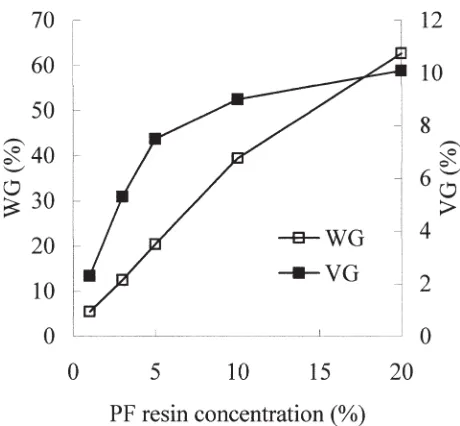
Figure 1 shows the weight gain (WG) and volume gain (VG) of wood due to the treatment with various PF resin concentrations. As can be seen, the weight gain increased proportionally with the increase in PF resin concentration, and was accompanied by an increase in volume gain. This relationship indicates that the amount of PF resin main-tained in cell walls increased with PF resin concentration.
The deformation behavior of PF resin-impregnated wood treated with different resin concentrations is com-pared in Fig. 2. Like the stress–strain curve for all other cellular materials, the PF resin-impregnated wood shows a linear region at lower stress followed by a long collapse region with a roughly constant stress. Linear elasticity is due to cell wall bending2
and Young’s modulus could be ob-tained using the initial slope of the stress–strain curve. From Fig. 2, it is apparent that the stress required to compress wood is greatly influenced by the concentration of PF resin.
Table 1. Processing conditions
Parameters Levels
Resin concentration (%) 0, 1, 3, 5, 10, 20 Preheating temperature (°C) 50, 70, 90, 100
Pressing temperature (°C) 80, 100, 120, 140, 160, 180
With increasing resin concentration, collapse tends to ini-tiate at a lower stress. For example, in the case of a resin concentration of 3% having a volume gain of 5.3%, the collapse is initiated at around 1.6 MPa, while at 20% with a volume gain of 10.1%, collapse occurs at approximately 1.0 MPa. A higher amount of PF resin in the cell wall causes more softening of the cell wall resulting in the possibility of initiation of collapse at a lower pressure.
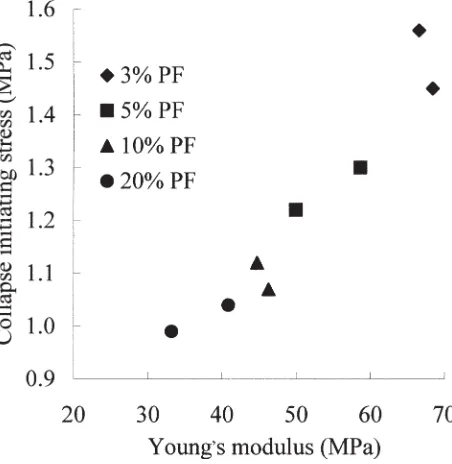
The stress–strain curve was further analyzed to better understand the deformation mechanism. Figure 3 shows the relationship between Young’s modulus in the radial direc-tion and collapse-initiating stress. The Young’s modulus is evaluated by fitting a straight line to the elastic region of the stress–strain curve and determining the inclination. The collapse-initiating stress is evaluated as the intercept of the straight line of the elastic region and a fitted straight line of the collapse-dominant region up to the strain of 0.1 mm/ mm. From the Fig. 3, it is clear that there is a linear relation-ship between Young’s modulus in the radial direction and the collapse-initiating stress. This indicates that increasing the amount of PF resin acting as a plasticizer reduces the Young’s modulus of cell walls perpendicular to the fiber direction resulting in initiation of collapse at lower stress.
Wolcott et al.2
reported that for low-density wood, cellu-lar collapse could result from the elastic buckling of the cell walls. When we look at the collapse related to buckling of cell walls, the buckling stress (σb) can be represented by Euler’s formula for a beam3
σb p2 2 12
EA L
where E, L, and A are Young’s modulus, length, and cross-sectional area of a beam, respectively. In this study, because the samples were prepared from the same series of block, allowing us to consider L and A identical, but Young’s modulus of the cell wall perpendicular to the fiber direc-tion varies, and decreases with increasing resin content. Collapse-initiating stress decreased linearly with decreasing Young’s modulus as shown in Fig. 3. This suggests that the initiation of collapse is strain-dominant. Furthermore, Fig. 2 shows that a specific strain of 0.06–0.08 mm/mm is required regardless of the PF resin content to initiate cell wall collapse.
The mechanical properties of PF resin-impregnated compressed wood improved linearly with density.1
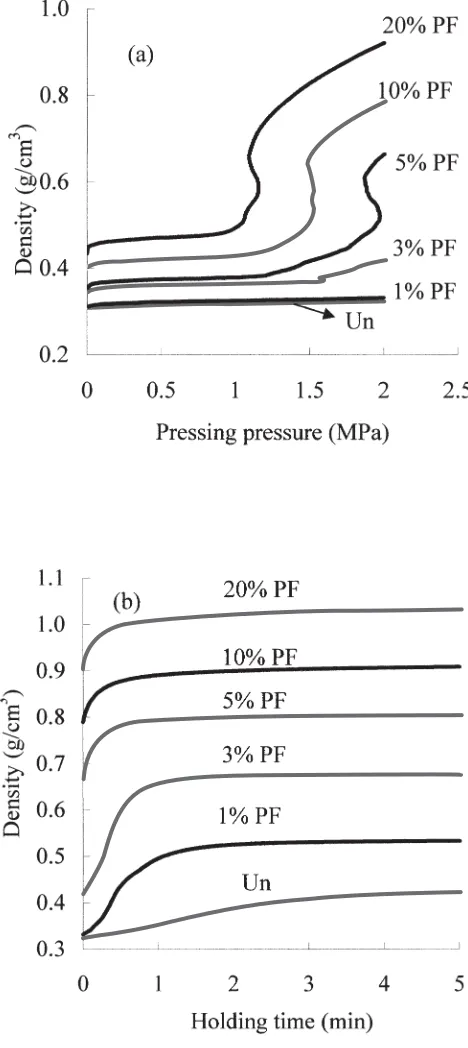
Thus, the relationship between pressing pressure and density at various concentrations of PF resin solution was evaluated as shown in Fig. 4a. It seems that high PF resin concentrations, that is, high PF resin content, results in high densification. For example, 20% PF resin-treated wood (WG: 62.7%, VG: 10.1%) has a density of 0.95 g/cm3 at a pressing pressure of 2 MPa. This density is about 15% higher than that of 10% PF resin-treated wood (WG: 39.5%, VG: 9.0%). On the other hand, 1% PF resin-treated wood (WG: 5.5%, VG: 2.3%) showed a similar behavior to that of untreated wood and did not deform well. These differences can be related to the differences in collapse-initiating stress, as shown in Fig. 2.
Pressure holding causing creep deformation of the cell walls was also effective in initiating cell wall collapse at low pressing pressure and resulted in significant densification of wood.1
Thus, the effects of pressure holding on the densifi-cation of wood treated with various concentrations of PF resin solution are shown in Fig. 4b. The density of PF resin-impregnated wood increased during pressure holding, and Fig. 2. Stress–strain curve of wood treated with different
concentra-tions of PF resin during compression. Pressing temperature, 150°C; pressing speed, 5 mm/min. Un indicates untreated wood
the effects of pressure holding on the density differed in relation to the PF resin concentration. Eventually, the den-sity reached 1.08 g/cm3 during pressure holding at 2 MPa when wood was treated with 20% PF resin solution. The 3% PF resin-treated wood deformed well compared to others during pressure holding. This is explained by the finding that the strain of 3% PF resin-treated wood was in the collapse region before pressure holding as shown in Fig. 2.
the PF resin.
The mechanical properties of PF resin-impregnated wood vary with resin concentration as shown in Table 2. The bending properties were improved when the concen-tration of PF resin solution was increased, mainly due to the higher density. The Young’s modulus and bending strength reached 22.5 GPa and 235.8 MPa, respectively, at 20% resin concentration. These findings suggested that a high amount of PF resin in the cell wall is important in utilizing the collapse region effectively to obtain high-strength wood at low pressing pressure.
Effects of preheating temperature
The above results imply that processing parameters that affect the viscoelastic properties or viscoelastic behavior of the cell wall play an important role in obtaining highly deformed wood at low pressing pressure. The effects of drying and preheating of resin-impregnated wood, which is a common process for making Compreg, were thus studied as drying or preheating temperature may alter the degree of plasticization of the cell wall by changing the degree of polymerization of the resin.
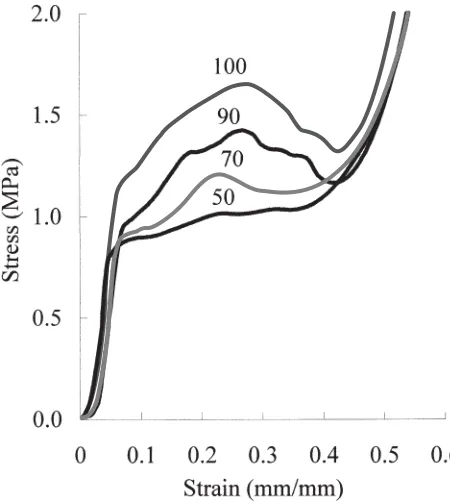
Figure 5 shows the stress–strain curves of PF resin-impregnated wood at different preheating temperatures. Our finding that the cell wall collapse is strain-dependent rather than stress-dependent can be observed. Further-more, it can be seen that the higher the preheating tempera-ture, the higher the stress required to initiate cell wall collapse. For example, initiation of the cell wall collapse occurs around 1.2 MPa at 100°C, while collapse occurs at 0.8 MPa at 50°C. It seems that condensation of the PF resin during preheating reduces the effect of the resin as a plasti-cizer and results in an increment of Young’s modulus of the cell wall.
It can also be seen that when PF resin-impregnated woods of high preheating temperatures such as 90°C or 100°C were compressed, the stress increased to a certain level and then fell off. This can be attributed to the stress relaxation behavior of the cell wall during compression, because the compression of wood in this experiment was done at slower pressing speed (5 mm/min). The effects of pressing speed will be discussed later.
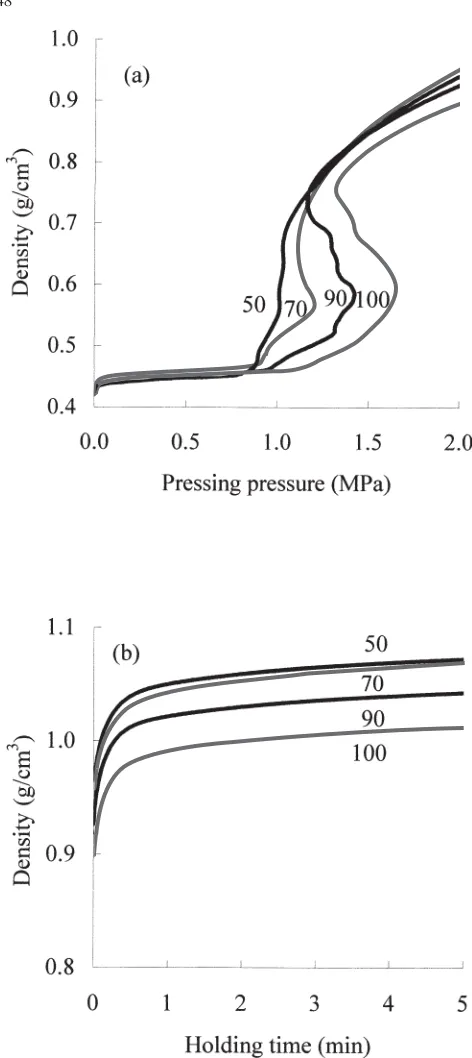
Figure 6a shows that although the density of resin-impregnated wood at 2 MPa was not significantly different at different preheating temperatures, the changes in density with pressure differed. In addition, as shown in Fig. 6b, within 1 min of pressure holding, the density increased significantly for each preheating condition and wood preheated at higher temperatures showed less compres-sion. These results suggest that when the samples were com-pressed at 1 MPa and held at pressure, the final density would change significantly with preheating temperature. Fig. 4. Changes of density against pressing pressure (a) and
PF resin-impregnated wood preheated at higher tem-peratures showed low bending strength, due mainly to the low density, as shown in Table 2. Drying or preheating of PF resin-impregnated wood at low temperature is preferable to obtain high-strength wood at low pressing pressure.
Effects of pressing temperature
Pressing temperature seems to be an important factor not only for determining the time for resin curing but also for the degree of plasticization of cell walls. Because thermal softening of wood swollen with either water or ethylene glycol occurs at approximately 60° to 80°C,4–6
it is expected that increasing pressing temperature causes a lowering of the viscosity of low molecular weight PF resin before con-densation and thermally softens the cell wall swollen by the PF resin. As a consequence, this reduces the Young’s modu-lus and hence the cure. On the other hand, if compressed at low temperature, although the degree of thermal softening of the cell walls reduces, the resin can be prevented from hardening and acts as a plasticizer for a longer period result-ing in larger creep deformation. Figure 7 shows the stress– strain curve of PF resin-impregnated wood at different pressing temperatures indicating that pressing temperature significantly affected the deformation behavior of PF resin-impregnated wood. With an increase in pressing tempera-ture, collapse-initiating stress decreased significantly.
The relationship between density and pressing pressure of PF resin-impregnated wood compressed at different tem-peratures is shown in Fig. 8a. Until a temperature of 120°C is reached, the PF resin-impregnated wood did not show significant thermal softening and as a result the density of the wood did not change up to 2 MPa. The density of the PF resin-impregnated wood at a temperature of 120°C was 0.53 g/cm3
. The most densified condition was found at a pressing temperature of 160°C. The density of wood reached 0.93 g/cm3
at a pressure of 2 MPa. However, at a pressing temperature of 180°C, PF resin-impregnated wood showed less compression compared with that with a press-Table 2. Effects of processing parameters on the mechanical properties of phenol formaldehyde
resin-impregnated compressed wood
Parameters Density Young’s modulusa Bending strengtha
g/cm3 (GPa) (MPa)
Resin concentration
1% 0.48 6.0 (0.6) 87.2 (6.2)
3% 0.64 12.0 (0.4) 125.0 (4.3)
5% 0.75 16.9 (0.8) 182.0 (10.4)
10% 0.93 20.1 (1.1) 193.2 (9.4)
20% 1.13 22.5 (0.9) 235.8 (6.2)
Preheating temperature
50°C 1.06 24.7 (1.7) 275.6 (7.9)
70°C 1.06 25.9 (1.9) 263.2 (3.4)
90°C 1.03 24.6 (1.1) 264.4 (5.6)
100°C 0.98 23.2 (1.6) 244.8 (18.0)
Pressing temperature
120°C 1.07 22.0 (1.2) 255.5 (43.6)
140°C 1.07 22.6 (1.7) 245.1 (22.7)
160°C 1.06 21.0 (1.1) 241.2 (47.6)
180°C 0.95 17.9 (0.2) 148.3 (20.9)
Pressing speed
2 mm/min 1.10 18.9 (0.4) 197.4 (5.9)
5 mm/min 1.24 26.7 (0.9) 280.0 (2.9)
10 mm/min 1.20 26.4 (1.1) 295.7 (6.1)
20 mm/min 1.24 25.4 (2.4) 267.8 (2.9)
50 mm/min 1.17 25.7 (0.6) 268.2 (13.1)
aEach value is the average of three samples, values in parentheses are standard deviations. Pressure-holding time is 30 min
Fig. 6. Changes of density with pressing pressure (a) and pressure-holding time (b) at different preheating temperatures. The numbers on the curves show preheating temperatures (°C)
Fig. 7. Stress–strain curve of PF resin-impregnated wood during com-pression at different pressing temperatures. Resin concentration, 20%; pressing speed, 5 mm/min. The numbers on the curves show pressing temperatures (°C)
ing temperature of 160°C. This is probably due to the accel-erated condensation of PF resin.
The most important observation was found during pres-sure holding. Figure 8b shows that the density of the PF resimpregnated wood compressed below 140°C in-creased significantly with time. The analysis of the stress– strain curve including the pressure-holding period revealed that because the strain of the PF resin-impregnated wood compressed at low temperature was in the collapse or
elas-tic deformation region before starting pressure holding, as shown in Fig. 7, it deformed during pressure holding with significant increment of strain. As a result, the density in-creased from 0.50–0.55 g/cm3
to 0.95–1.0 g/cm3
. Within 1 min of pressure holding, the density increased significantly, ex-cept at a temperature of 80°C. During hot pressing at 80°C, the PF resin-impregnated wood required more than 30 min to reach its final density due to the difference in the degree of softening. This densified condition could not be fixed by pressing at 120°C for 30 min owing to insufficient curing of the PF resin and consequential spring-back after pressure release. It can thus be said that as long as the deformed condition is fixed, hot pressing at a low tempera-ture is applicable for the densification of wood at low press-ing pressure.
The bending strength of wood compressed at 180°C for 30 min was comparatively lower than wood pressed at 140°C to 160°C, as shown in Table 2. These lower bending strengths may be attributed to the thermal deterioration of the samples.
Effects of pressing speed
Fig. 8. Changes of density with pressing pressure (a) and pressure-holding time (b) at different pressing temperatures. The numbers on the curves and those indicated by arrows show pressing temperatures (°C)
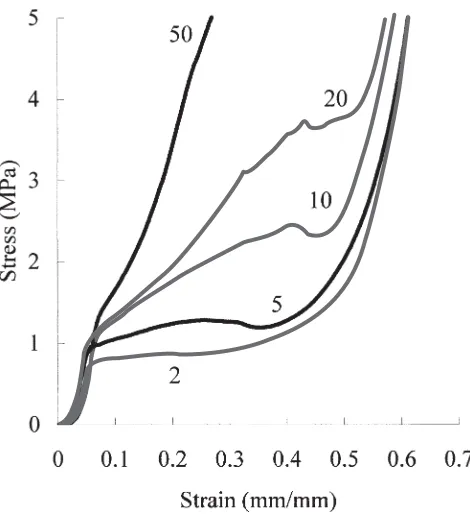
Fig. 9. Stress–strain curve of PF resin-impregnated wood during com-pression at different pressing speeds. Resin concentration, 20%, press-ing temperature, 150°C. The numbers on the curves show presspress-ing speeds (mm/min)
a pressure of 5 MPa was reached. With decreasing pressing speed, the wood started to collapse until 5 MPa, and became more viscous at lower pressing speeds such as 2 mm/min and 5 mm/min.
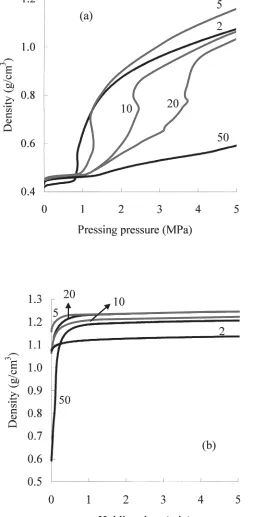
The relationship between pressing pressure and the den-sity of wood at different pressing speeds is compared in Fig. 10a. A pressing speed of 5 mm/min resulted in higher densification and achieved a density of 1.16 g/cm3
at a pres-sure of 5 MPa, whilst a pressing speed of 2 mm/min showed
less increment of density because of the condensation of the PF resin. On the other hand, at higher pressing speeds such as 50 mm/min, the density at 5 MPa was 0.58 g/cm3
. From Fig. 9, it can be seen that at 50 mm/min, PF resin-impreg-nated cell walls resisted in an elastic manner against the applied pressure even in the collapse region, and strain did not develop above 0.2 mm/mm, which is three times the collapse-initiating strain.
Figure 10b shows the effects of pressure holding on the densification of the PF resin-impregnated wood compressed at different pressing speeds. The results showed that the density of PF resin-impregnated wood at a pressing speed of 50 mm/min increased drastically during pressure holding. The wood compressed at 50 mm/min seemed to start de-forming during pressure holding, and the density drastically increased and reached 1.20 g/cm3
within 1 min. Pressure holding is necessary when resin-impregnated wood is com-pressed at high pressing speed.
Because the same density was obtained regardless of pressing speed after pressure holding for 30 min, except at 2 mm/min, differences in the mechanical properties were not found, as shown in Table 2. The lower mechanical prop-erties caused by lower density at a pressing speed of 2 mm/ min can be attributed to the excessive condensation of the PF resin prior to deformation.
Conclusions
tempera-Fig. 10. Changes of density with pressing pressure (a) and pressure-holding time (b) at different pressing speeds. The numbers on the curves and those indicated by arrows show pressing speeds (mm/min)
Young’s modulus of the cell walls perpendicular to the fiber direction decreases. Collapse-initiating stress decreases linearly with the Young’s modulus, indi-cating that the occurrence of cell wall collapse is strain-dependent.
2. By increasing preheating temperatures, the collapse-initiating stress increases due to increases in Young’s modulus, and the density and mechanical properties of wood after pressure holding for 30 min decrease. 3. Increasing pressing temperature results in the thermal
softening of cell walls, causing collapse at lower pressure and densifies wood effectively.
4. Pressing speed affects the viscoelastic deformation of the cell wall significantly, and wood is deformed effectively with decreasing pressing speed although the differences in density and mechanical properties become negligible after a pressure-holding period of 30 min.
Acknowledgments The authors thank Gun-ei Chemical Industry Ltd for supplying low molecular weight phenol formaldehyde resin. Financial assistance from Ministry of Education, Culture, Sports, Sci-ence and Technology, Japan, is greatly appreciated.
References
1. Shams MI, Yano H, Endou K (2004) Compressive deformation of wood impregnated with low molecular weight phenol formaldehyde (PF) resin I: effects of pressing pressure and pressure holding. J Wood Sci 50:337–342
2. Wolcott MP, Kamke FA, Dillard DA (1994) Fundamental aspects of wood deformation pertaining to manufacture of wood based composites. Wood Fiber Sci 26:496–511
3. Timoshenko SP, Gere JM (1961) Theory of elastic stability. McGraw-Hill, New York, pp 132–135
4. Salmen L (1984) Viscoelastic properties of in situ lignin under water saturated condition. J Mater Sci 19:3090–3096