Study On Applying “Augmented Reality” For
Effective Learning Of School Curriculum Of
Advanced Level In Sri Lanka
B.M. Terrence ChandikeAbstract: Advanced Level examination is the most critical examination that determines the future of the students in Sri Lanka as it is the path for the higher education. In Sri Lanka, students are sitting for Advanced Level examination in Art, Commerce, Bio or Maths streams. The objective of this study was to develop a framework with Augmented Reality applications to be used in Advanced Level Bio science subject as a supportive learning technique, evaluating the performances of the students with developed Augmented Reality (AR) applications running on the computer. The study was carried out using the Advanced Level students in Gampaha educational region. AR application was developed using Java language and with available supportive tools. As this application was based on markers, another tool was used to create markers. An open ended questionnaire was provided to the selected students to identify the feasibility and students‟ perception on the developed AR application for the students. A question paper was designed based on the subject area of the developed AR application to evaluate the student performances. After developing the AR application, it was provided to the half of the selected student sample(one class) and the other half of the students (another class) was exposed to normal existing learning procedure. Thereafter, both student samples were exposed to the common examination to assess the performances. AR application helped to enhance the students‟ performances by increasing the student interest, better understanding, memorizing ability and increasing the pass rate of the students.
Keywords: Advanced Level, Augmented reality, School Curriculum, Teaching technique.
————————————————————
1.
I
NTRODUCTIONAdvanced Level is the most important competitive examination in Sri Lanka as this examination decides the future of students. Hence this is a turning point of the students‟ lives, which decides their future. So, Advanced Level is a kind of special juncture to all students in Sri Lanka. All the syllabi in Advanced Level subjects have vast area to be covered. Students must learn it and recall it at the examination. Scientists proved that visualization is the best way for memorization, because through an image, students are able to get many ideas than reading or listening. Therefore, with a method to visualizing the diagram or any other image, student can obtain the message easily and effectively. In addition to that, certain schools in Sri Lanka have not equipped with adequate lab facilities and resources to provide the practical knowledge for the students. In such situations a method to visualize an image has a vital role in providing practical knowledge for the students by simulating the actual situation. Augmented reality is a way to visualize something as real. Also using this method anyone can obtain the idea and more facts easily. Using Augmented Reality students are able to observe the actual 3D of an image. Also teachers can explain the lessons easily. Through augmented reality, I am able to create an additional layer of our visual landscape. This enables the students to inspect modules from multiple viewpoints, and also allow students to control the interaction of modules. In schools of Sri Lanka, live specimens and sophisticated laboratory facilities are required to conduct the practical component of biological studies. But these resources are not available in schools all over the country. Finding certain live specimens is not that easy all the time. By introducing AR applications to support the school curriculum of Advanced Level in Sri Lanka would help to increase the pass rate at the A/ L examination and to enrich the nation with intellectuals. Uses of mobile phones are popular all over the country without any obstacles. Hence, use of AR application with mobile phones, tabs, pc would definitely become popular among
restricting to the class rooms or schools, all over the country and overseas. Internationally this technology is used in many countries for medicine, geographical field work, journalism, architecture and so on (Hollerer & Feiner, 2004). Therefore, developing an AR application for effective learning of School Curriculum of Advanced Level in Sri Lanka is important. Therefore, the primary objective of this research was to study on applying Augmented Reality (AR) for effective learning of School Curriculum of Advanced Level in Sri Lanka. The specific objectives of the research are:
1. Developing a framework with AR applications for Advanced Level subjects as a supportive learning tool. 2. Evaluating the performances of the developed AR
applications running on the computer/Tablet Pc or Smart Phone, which can offer substantial advantages over existing audio/video guides and text books.
2.
L
ITERATURER
EVIEWaudio overlays. In 1998, Ramesh Raskar, Greg Ilch and Henry Funchs introduced special AR reality to UNCG (Raskar, Ilch& Fuchs, 1998). Bruse Thomas created the first outdoor mobile AR game called AR Quake in 2001 (Thomas et al; 2001). In 2008, Wikitude released AR travel guide (Wikitude, 2011). In the Augmented Reality field there are so many technologies being used. As hardware components processor, display, sensors and input devices. Present mobile computing devices like smart phones and tablet computers contain these elements which often include a camera and MEMS (Microelectromechanical systems) sensors such as accelerometer, GPS, and solid state compass, making them proper AR platforms. A head-mounted display (HMD) is a display device paired to a headset such as a harness or helmet. Hughes et al., (2005) explained that AR technologies can be designed to interact through many sensory channels. Auditory, visual, olfactory and haptic are few examples for such channels. According to Ludwig &Reimann, (2005) potential AR application falls into three main categories such as (a) presentation and visualization, (b) industry and (c) edutainment. HoIver, Hamilton (2011) explained the application of AR within education, media, entertainment industry, gaming industry, travel and tourism industry, marketing, the expanding field of online social network and in everyday life. Hence, AR applications have tremendous potential for all fields where rapid information transfer is critical (Yuen et al., 2011). In Sri Lanka also this concept can be used to develop the education sector as well as to the other sectors in order to develop the country with new technology. By introducing an AR application for the A/L students in Sri Lanka, students are able to learn their subjects more efficiently and effectively within the class room and anywhere within the country or overseas. Thereby, this study contributes to increase the pass rate of the students of Sri Lanka and produces more intellectuals to the country and to the world.
3.
M
ETHODOLOGY3.1 Research rationale and experiment preparation This study was mainly focused on the supplemental learning effect of AR-based learning tools in a biology course. The lesson used for the study was „„Human blood circulatory system‟‟. Biology teacher was interviewed before designing and developing this AR tool to find out the students‟ interest on existing traditional learning method.
3.2 Establishment of AR application
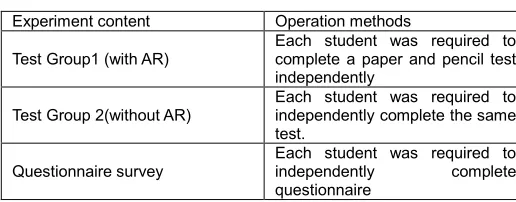
Augmented Reality application was developed for the bio science subject using java language and available supportive tools (BuildAR). As this application was based on markers, another tool (ARToolkit) was used to create markers. After establishing the AR software, it was installed on each computer in the classroom. The experiment contains three sections, as shown in Table 1.
Table 1: Experiment design
Experiment content Operation methods
Test Group1 (with AR) Each student was required to complete a paper and pencil test independently
Test Group 2(without AR)
Each student was required to independently complete the same test.
Questionnaire survey
Each student was required to independently complete questionnaire
3.3 Research question and hypothesis
Research question: Is there a significant difference between the students‟ marks obtained using AR techniques and using traditional teaching methods. t-test is used to compare the means of the two samples of related data.
Hypotheses:
The 'null hypothesis' H0: There is no difference in mean group 1 and group 2 test marks An 'alternative hypothesis': H1: There is a difference in mean group1 and group 2 test marks
3.4 Data collection
A Likert scale questionnaire was provided to randomly selected students from Gampaha educational region to identify the feasibility and students‟ perception on the developed AR application for the students. The questionnaire was based on the following major statements: Teaching and learning using AR technique is very
interesting
AR tool is contributing towards better understanding of the learning material
Using AR as a teaching tool is eventually leading towards passing the subject
Easy to memorize using models implemented in AR
A question paper was designed based on the lesson: „Human blood circulatory system‟‟ of Bio science subject of the advanced level curriculum to evaluate the student performances. After developing the AR application, it was provided to the half of the selected student sample and the other half of the students was exposed to normal existing learning procedure. Thereafter, both student samples were exposed to the common examination to assess the performances.
3.5 Data analysis
4.0
R
ESULTS4.1 Overall cognitive performance
The experiment produced 28 + 25 test copies (28 for the Group 1 and 25 for the group 2), all of which are considered effective. The full marks of the test is 100 points. An independent t-test was conducted for the group1 and group2 score variables. The tested variable is group1 average score minus group1 average score, which stands for the difference yielded after using the AR tool for two groups. The results are shown in Table 2.
Table 2: Paired t-test for pre-test and post-test score variables.
Max Min Median Average Gain AVG Stan.Dev. Group
1 97 18 66 65 18.57414
Group
2 73 19 41 44 21 15.96632
Improvement (%) = (Avg of Group 1 - Avg of Group 2)/ Avg of Group 1 x 100%
Improvement (%) =(65-44)/44 * 100% = 47.33%
This results clearly shows that the average marks of group one has a 47% improvement than the average marks of group 2.
4.2 Results of independent T test using SPSS
Mean marks of group one was 65.46 and group 2 was 44.44. It was clear that mean marks obtained in group 1 is higher than group 2.
Table 3: Group Statistics
Group N Mean Std. Deviation Std. Error Mean
Marks 1 28 65.46 18.574 3.510
2 25 44.44 15.966 3.193
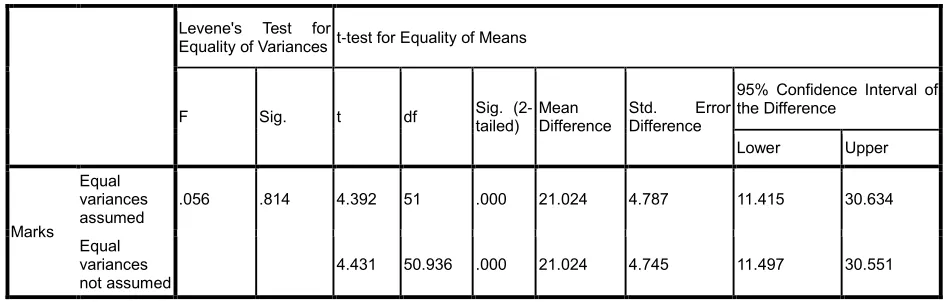
Table 4 shows the results of the Independent Samples Test. According to the results, significant value of Levene‟s test was greater than 0.05. Hence, variability in two conditions was same. It reveals marks score in group-1, did not vary significantly than the mark scores in group 2. Therefore, equal variance assumed. Significance (2 tailed) was less
than 0.05 value. Hence, there was significant statistical difference between two groups. According to the group statistics (Table 3) group 1 (students marks with AR tools) significantly higher than group 2 (marks obtained with traditional teaching method).
Table 4: Results of the Independent Samples Test
Levene's Test for
Equality of Variances t-test for Equality of Means
F Sig. t df Sig. (2-tailed) Mean Difference Std. Difference Error
95% Confidence Interval of the Difference
Lower Upper
Marks Equal variances assumed
.056 .814 4.392 51 .000 21.024 4.787 11.415 30.634 Equal
variances not assumed
4.431 50.936 .000 21.024 4.745 11.497 30.551
Students’ average marks
Figure 1 Shows different level of the marks scored by the students with the application of augmented reality as a teaching tool and with the traditional method of teaching. Result revealed that 25% of the students achieved marks between 41-60% in exam with AR teaching methods whereas 28% with traditional teaching tools. However, 43%
increased with the tools of AR compared to the traditional teaching method. This achievement was higher for the higher grades of marks (ex: 60-100).
Figure: 1 Student average marks for the bioscience subject with the use of AR and without AR application in Gampaha
educational region.
According to the present study, more than 50% of the students were much interested in the application of AR as a teaching tool in school level (Figure 4). 28% of the students out of the total agreed that teaching with AR tools were interesting to them. However, no one disagreed or strongly disagreed to the above statement. Result reveals that using AR tools has become more popular among the A/L students compared to traditional teaching method.
Figure 4: Student interest on teaching with AR tools
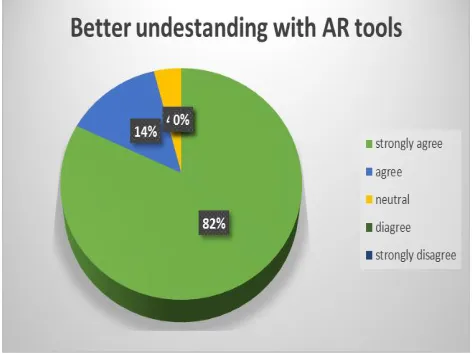
It was noted that 82% of the students were strongly agreed with statement on” better understanding of lessons can be achieved with AR tools than traditional teaching method” (Figure 5). None of the students was disagreed or strongly disagreed with the above statement. Hence, AR tools can be used to upgrade the knowledge of the students very efficiently without any argument.
Figure 5: understandability of the lessons with AR tools
Figure 6 shows that the students‟ view on increasing the pass rate of the students with AR tools. 42% of the students agreed and 28 of the students strongly agreed with the above statement. Less than 10% of the students disagreed or strongly disagreed with the statement.
Figure 6: Increasing the pass rate with AR tools
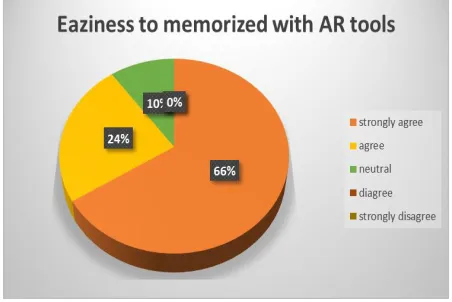
Figure 7: Easiness of memorizing subject matters with AR tools
5.0
D
ISCUSSIONBased on the data analysis of learning effectiveness, students‟ attitudes, the observations and interviews, following preliminary conclusions were made. The AR inquiry-based learning tool had significant supplemental learning effects on students. Group 1 test scores represent students‟ learning outcomes when using AR model and Group 2 test scores represent students‟ learning outcomes when using text book. The test score of the students those who exposed to traditional teaching method was significantly less than the students who had used AR tools. Second, the AR tool results in more significant learning gains for low-achieving students than for high-achieving students. The AR tool was more effective for low-achieving students, possible reasons for this was analysed disparity. (1) The original scores of high-achieving students were
very high; some students were even close to full marks. The space for improvement is quite limited.
(2) The test was relatively basic and was already mastered by high-achieving students at the start point.
(3) The AR tool aims to aid students in exploring and generalizing concepts; its effect may not be entirely demonstrated on a paper and pencil test.
In addition, representing learning gains with the differences in paper and pencil test scores can be biased, especially when the main goal of this AR tool is to help students develop problem-solving skills, inquiry-based exploration skills instead of merely cognitive memorization. In future experiments, open-ended questions targeted at students‟ inquiry process with AR for better representing of the outcome of the experiment. Additionally, the AR tool provides a new cognitive method and is expected to have a long-term memory effect on students through their inquiry-based observation and operation. However, the test was conducted immediately after the learning activity, so the time effect of the AR tool cannot be exactly measured. From the perspective of usability of the AR tool, providing long and detailed instructions for middle school students may not be appropriate. In further design, the learnability and flexibility of this AR tool could be increased, enabling students to master it without much learning and in a shortest time. In general, students possess a positive learning attitude and provide positive evaluations of the AR tool, as suggested by questionnaire statistics. Further, there
was a significant positive correlation between students‟ learning attitudes and their evaluation of the AR tool. This result indicates that the AR tool is like any other learning tool in that the learning gains it produces are based on students‟ beliefs that learning the discipline is important.
6.0
C
ONCLUSIONSThe AR tool is beneficial in improving middle school students‟ cognitive test performance on corresponding content, and has relatively larger influence on low-achieving students. Students generally hold a positive attitude toward the AR tool and enjoyed the exploration experience.
6.1 Possible improvements and future work
Based on the findings, it is possible to further employ this AR tool as a remedial learning tool and extend the method to other chapters and contents in middle school Science courses that require students to memorize abstract structures and concepts. With the application and instruction form, teachers are able to apply this AR tool in inquiry-based learning in their own classes. Through this empirical study, it was witnessed the great potential and acceptance of this type of AR tool. The research shows that in an inquiry-based biology learning scenario, students‟ academic performance will be enhanced by utilizing AR learning tool. It is important to find how this AR tool compares with other learning software and whether the AR learning tool will result in longer-lasting memory.
R
EFERENCES[1] Azuma, R. T. (1997). A survey of augmented reality. Presence, 6(4), 355-385.
[2] Breen, D. E., Whitaker, R. T., Rose, E., &Tuceryan, M. (1996). Interactive occlusion and automatic object placement for augmented reality. In Computer Graphics Forum15(3), pp. 11-22. Blackwell Science Ltd.
[3] Azuma, R., Balliot, Y., Behringer, R., Feiner, S., Julier, S., and Maclntyre, B. (2001). Recent Advances in Augmented Reality. IEEE Computer Graphics and Applications 21, 6.