INTRODUCTION
The rapid industr ialization of many countries indicates that the competition for the price of metal resources will increase. It is obvious that metals are extremely impor tant in moder n engineering, yet many can be badly affected by corrosion.
All metals are thermodynamically unstable and to react with their environment top produce compounds such as oxides or carbonates. This reaction involves the movement of electrons and is called electrochemical reaction. Its corrosion can cause considerable losses to the user. Thus it is a greatest disaster in modern age of science and technology / industrialization. Hence corrosion control is warranted one of practical methods for corrosion protection is use of inhibitors. The most effective and economic way of reducing losses due to corrosion can be achieved by using plant extract.
Inhibiting effect of seed extract of Abrus precatorius
on corrosion of aluminium in sodium hydroxide
R. RAJALAKSHMI, S. SUBHASHINI, M. NANTHINI and M. SRIMATHI
Department of Chemistry, Avinahilingam University for Women, Coimbatore - 641 043 (India).
(Received: April 12, 2009; Accepted: June 03, 2009) ABSTRACT
Economic losses due to corrosion are direct, as well as, indirect and affect the economy of country. Corrosion inhibitors are one of the widely used methods to control corrosion. Particular advantage of corrosion inhibitor is that often can be implemented or changed in situation without disturbing a process. Due to toxic nature and high cost of some inhibitors currently in use it is nearly to develop environmentally acceptable and less expensive inhibitors. Natural product can be considered as a good source for this purpose. An evaluation of effective performance of seed extract of abrusprecatorius on corrosion inhibition of aluminium in sodium hydroxide at ambient temperature has been made. Conventional weight loss and polarization measurements techniques were used for evaluation. Surface coverage values were tested graphically for suitable adsorption isotherms.
Key words: Abrus precatorius, Corrosion, Sodium hydroxide.
The extracts of some common plants and byproduct (Peels, seeds , fruit shell etc.,) contain many organic compounds. E.g., Organic and amino acids, alkaloids, pigments, proteins and tannins. Most of these constituents are known to have an inhibitor action. Hence in our present study has been carried out to investigate the effect of seed extract of Abrusprecatorius on corrosion of aluminium in sodium hydroxide.
EXPERIMENTAL
The inhibitor used for this study was Abrusprecatorius the extract was prepared by 2.5 g of dried seed in 500ml of 4N NaOH for 3 hours kept overnight filtered made up to 500 ml to get 5
% extract of the inhibitor. Literature collection reveals presence of following constituents present in seeds of Abrusprecatorius
Plant profile
Gundumani Phytochemical constituents
Botanical name: Abruprecatorious Family Name: Fabaceae
Tamil Name: Gundumani Malayala Name: Kunni kuru
English Name: Roasry Pea, Prayer beads, Wild Liquorice, Jequirity bean Habit: Tree
Propogation: Seeds
Chemical composition: Proteins named Abrins Parts used: Seeds
Medicinal uses: Cancer cells Cultivated area: All over world Price: 100seeds – Rs.10
Number of distinct activities for species =234
Weight loss methods
The weight loss measurements were carried out with varying concentration of the inhibitor from 2 – 14 %. The experiments were conducted at
Polarization studies
Tafel polarization curves were recorded potentiodynamically using computerized solartron model 1284Z.
The conventional three electrode glass cell assembly was used with a Aluminum -19500 rod as a working electrode, Pt foil as the counter electrode and calomel electrode as the reference electrode. The cell assembly was immersed in 4N NaOH in the presence and absence of inhibitors after a specific period of time, potentiodynamic polarization studies were carried out a sweep rate of 2mv/sec potential (E) vs. log current (I) plots were recorded.
RESULTS AND DISCUSSIONS
The results pertaining to the present investigation of seed extract of abrusprecatorius are tabulated and discussed.
Effect of Concentration of inhibitor on the corrosion of A1 in 4N NaOH
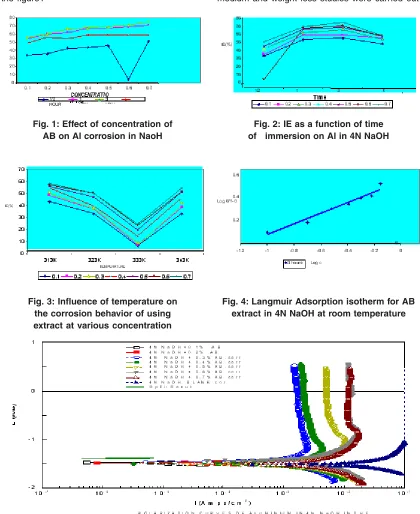
Fig.1 Depicts the effect of concentration of the plant extract on A1 corrosion in 4N NaOH medium. From the table1 it is understood that the concentrations of the plant extract Abrusprecatorius increase the inhibition efficiency, for all the periods of immersion. The maximum inhibition efficiency was found to be 75.25% at 0.7% concentration during 3 hrs of immersion.
Table 1: Effect of immersion on the IE of AB extract on aluminium
Concentration ½ hr 1 hr 3 hr 6 hr
(%) CR IE CR IE CR IE CR IE
(mpy) (%) (mpy) (%) (mpy) (%) (mpy) (%)
0.1 1117 33.8 99 53.7 21829 55.3 72245 48.7
0.2 1090 35.4 82 59.8 19653 59.7 65181 55.8
0.3 969 42.5 75 62.1 16350 66.5 64727 54.0
0.4 964 42.8 68 66.6 15808 67.6 58903 58.2
0.5 923 45.3 67 66.8 15402 68.4 58758 58.3
0.6 859 49.1 64 68.3 14251 70.8 58352 58.3
0.7 765 54.2 61 70.1 12085 75.2 58552 58.4
Table 2: Variation of IE and corrosion rate of AL at higher temperature
Concentration 313k 323k 333k 343k
(%) CR IE CR IE CR IE CR IE
(mpy) (%) (mpy) (%) (mpy) (%) (mpy) (%)
0.1 2027 42.6 5041 32.7 15709 6.0 6844 32.9
0.2 1826 48.3 4724 36.9 15623 6.4 6285 38.4
0.3 1737 50.8 4651 38.0 15184 9.0 5893 42.2
0.4 1628 54.0 4548 39.3 14277 14.0 5532 50.9
0.5 1556 55.9 4027 46.6 13514 19.0 5003 50.9
0.6 1523 56.9 3752 49.9 12824 23.2 4989 51.1
Fig. 5: Polarization curves of Al in the presence of AB extract in NaOH
Fig. 4: Langmuir Adsorption isotherm for AB extract in 4N NaOH at room temperature Fig. 3: Influence of temperature on
the corrosion behavior of using extract at various concentration Fig. 1: Effect of concentration of
AB on Al corrosion in NaoH
Fig. 2: IE as a function of time of immersion on Al in 4N NaOH This may be attributed to the increase in
the surface area of the adsorbed molecules of the plant extract on A1 surface. This is represented in the figure1
Effect of Time of immersion on A1 in the presence of plant extract (AB)
in the absence and presence of plant extract at various time intervals. Experimental results were shown in the fig. 2. From the figure it is clear that inhibition efficiency was found to be maximum at 3 hours of immersion.
Initially inhibitors efficiency increase from ½ hour to 3 hours and then there is a decline inhibition effect at 6 hours. This behaviour maybe attributed due to the increase in corrosion loss with increase in the time of immersion may be ascribed to changes occurring in the inhibitor and to the built up of metal salts in solution. Many researchers pointed out rather strongly to the fact that the rate increase is carried largely by the increase in active surface area as the metal is attacked. Nevertheless it might have been due to the contamination and weakening of the extract medium by the corrosion product.
Influence of Temperature on A1 corrosion in 4N NaOH
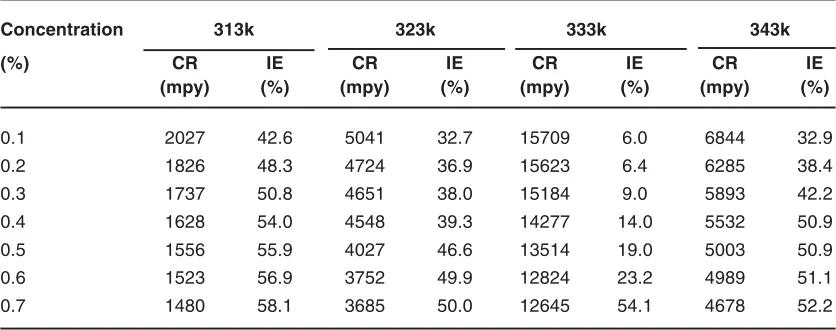
Temperature studies were carried out for A1 corrosion the absence and presence of plant extract by weight loss measurements. Temperature studies are purposeful to learn about thermo-dynamic parameters and activation energy of the system Table 2, Fig. 3 List the effect of temperature of A1 corrosion in 4N NaOH. From table it can be inferred that as the concentration of the plant extract AB increase the inhibitor efficiency also increase with the temperature increase from 40°- 50°.
The inhibitor efficiency further decline at 60°C.At 700C the efficiency again increase and this can be explained by the following way. With the increase of temperature of equilibrium between adsorption and desorption process is shifted leading to a higher desorption rate than adsorption until equilibrium is again established at a different value
Table 3: Corrosion parameters of AL in 4N NaOH in the presence of seed extract of AB S. No Concentration(%) I Corr X 10-3 E Corr V Ba mv/dec Bc mv/dec I E (%)
1 Blank 36.77 1.50 537 402
-2 0.3 17.15 1.46 737 421 53.31
3 0.4 13.47 1.5 577 381 63.36
4 0.5 09.00 1.52 610 445 75.52
5 0.6 4.448 1.43 567 471 87.9
6 0.7 3.188 1.50 388 356 91.5
of equilibrium constant. It explains the lower inhibition effect at higher temperature especially at higher concentration of the inhibitor.
Initially there may be physical adsorption at 50 and 60 and afterwards there may be chemical adsorption of the plant extracts on A1 surface resulting in the increase in the inhibition effect. In corrosion, generally it is assumed that inhibitor act through a process of adsorption on the metal surface. The adsorption of the inhibitor may determine the structural change of the double layer thus reducing the rate of electrochemical partial reaction. The knowledge of the adsorption behavior of the inhibitor is important for the definition of its active mechanism for this reason various isotherms were studied.
In the present study Langmuir adsorption Isotherm is tried by plotting Log θ / 1- θ Vs log c. the straight line for Langmuir adsorption indicates the inhibitor adsorbs on the A1 surface and there is a formation of monolayer in the A1 surface. This prevents the corrosion of A1 surface in alkaline medium.
Polarization studies
Experiment was duplicated and means value was calculated
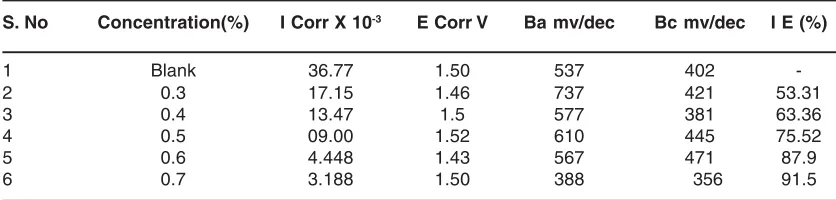
The results of polarization studies of Al in NaOH with and without the seed extract of AB are furnished in the table.3. From the table the Icorr was found to decrease with increase the concentration of inhibitor. This indicates that the inhibitor inhibits corrosion in aluminium strongly. The inhibitive effect were determined from the value of corrosion current and maximum inhibition effect is to found to be 0.7 concentration
CONCLUSION
It can be concluded from the findings that seed extract of Abrusprecatorius (AB) acts as an effective inhibitor at different concentration at different times of intervals. The efficiency of seed extract of Abrusprecator ius on corrosion of aluminium may be due to presence of phytochemical constituents, which are adsorbed on aluminium surface.
Results are summarized below.
´ Maximum inhibition efficiency was found to be at 3 hours of immersion at room temperature.
´ Initially there may be physical adsorption at 50°C and 60°C and afterwards there may be chemical adsorption of the plant extracts
on Al surface resulting in the increase in the inhibition effect.
´ Langmuir adsorption Isotherm was obeyed and it indicates that the seed extract of AB are adsorbed on the Al surface thus forming highly protecting oxide film.
´ Thermodynamic parameters ΔG, ΔH and ΔS wer evaluated and the negative value of ΔG inferred that there is a strong interaction between metal surface and the seed extract of AB.
´ A value of Activation energy reflects the effectiveness of inhibitor.
´ From the polarization studies the values of
ICorr decreases with increasing concentration
of the inhibitor in for the inhibition are adsorbed on the Al surface.
´ Tafel constants ba and bc indicate that the inhibitors are mixed type.
´ Inhibition efficiency obtained by weight loss method and polarization method are quite comparable.
ACKNOWLEDGEMENTS
We are thankful to the Chancellor, Vice chancellor, Head of the department of chemistry and guide, department of chemistry, Avinashilingam University for women, Coimbatore, for providing necessary facilities.
1. Daufins, G., Tablea, J.P., Pagetti, J., Corrosion science, 17: 893 (1977).
2. Anicai, l., manca, A.C., Visan, T., Transactions of the SAEST, 418: 41 (2004).
3. El etre, A.v., Corrosion science, 43: 1031 (2001).
4. Gomma, G.K., wahdon, M.H., Mater Chew Phys., 39: 209 (1995).
5. Madkour, L.H., Issa, R.M., Elghrabaury, IM, Journals in chemistry, 408 (1999).
6. Muller, B., Schmelich, T., Corrosion science, 37: 877 (1995).
7. Sharif Ahmad, Syed Marghoob Ashraf, Fehmida Nagvi, Shakuntala Yadav, Fahmina
REFERENCES
zafar, Journals of Macromolecular science, 43: 1409 (2006).
8. Subramaniyan, N., Ramakrishnaiah, K., Indian Journal of Technology, 8: 369 (1970). 9. Roa, A., Padmalatha Nayak, j., Shetty, A.N.,Transactions of the SAEST, 41: 1(2006). 10. Valand, T., Nilson, G., Corrosion science, 17:
449(1977).
11. Vadavl, P.N.S., Singh, A.K., Asian Journals of Chemistry, 11: 580 (1999).
12. Yadav. P.N.S., Wadhwani, R., Transactions of the SAEST, 28: 3 (1993).