4941
Determining The Size Of The Raw Material
Reserve From The Established Risk Factor And
The Possible Raw Material Needs At The
Enterprise
Svitlana Usherenko, Sergei Leontovych, Nadiia Pysarenko, Karina Nazarova, Viktoria Nehodenko
Abstract: Timely provision of production with material resources depends on the size and completeness of production stocks in the warehouses of the enterprise. The urgent task is to determine the optimal size of the reserve for different types of raw materials, because a large raw material reserve covers all occasional deviations in excess of the estimated raw material consumption, but this is related to the cost of storing the reserve. The article presents a classification of the methods used to determine the demand for raw materials in the future for the effective management of material flows in the enterprise. It is hypothesized that the random magnitude of the need for raw materials between two regular purchases of raw materials has a normal law of distribution with a mathematical expectation equal to the size of the raw material purchasing party (the average of the total possible consumption of raw materials) and the variance equal to the fluctuation of raw material needs. The company analyzes areas of activity and shows that the size of the raw material reserve for the enterprise depends on the established risk factor. The article considers the case where the probability distribution of possible raw material needs for an enterprise is a Poisson distribution. It is shown that from the two asymptotic formulas: the local Moivre theorem and the Poisson distribution by the Bernoulli scheme, the asymptotic formula of the normal distribution function follows for the Poisson formula. The correlation between the size of the raw material reserve and the size of the raw material purchasing party was found. Therefore, the problem of determining the optimal amount of raw material purchases is solved using probabilistic methods.
Index Terms: Inventory management, Gaussian curve, Laplace function, optimal raw material reserve, purchase of raw material, total costs, Poisson distribution.
—————————— ——————————
1 INTRODUCTION
THE transition to a market economy determines the role and growing importance of purchasing logistics in public production, which causes a number of significant changes in the field of logistics of production [1]: pressure of fast growing product range;
reducing the time of introduction into production of new products, which accelerates the expansion of the range; shortening the duration of the production cycle;
aggravation of competition between producers against the background of market saturation with the required goods.
All these changes have led to the fact that different types of activity of the enterprise - production, economy, financial activities have become increasingly dependent on the state of logistics [2]. It has emerged that the supply system has large areas of inefficiency, the rationalization of which can bring great savings.
There was a need to implement new approaches to the organization and management of the processes of material support of production [3]. Timely provision of production with material resources depends on the size and completeness of production stocks in the warehouses of the enterprise. Production inventories are means of production which have been received at the warehouses of the enterprise, but not yet involved in the production process. Creation of such stocks allows to provide material release to shops and to workplaces in accordance with requirements of technological process. It should be noted that a significant amount of material resources are being diverted to inventory creation. Reducing inventories reduces maintenance costs, lowers costs, speeds up circulating assets, which ultimately increases profits and production profitability. Therefore, it is very important to optimize the value of stocks. The provision for disruption of supply and increase in output is characterized by a relatively constant value and restores upon receipt of the next batch of materials. The standard of the material safety stock is determined by the lag of deliveries or by the actual data on the receipt of materials. Calculating the optimal size of such a reserve is a pressing issue. The enterprise should strive to minimize the volume of stocks, however, the stock of raw materials in the warehouse should be optimal. The point of economically justified order is at the point of equality of purchase and storage costs. For expensive parts, the cost of purchasing is low and the main burden lies on the cost of storage. Costs can be minimized if small-value items are ordered in large batches at long intervals and expensive ones are ordered more frequently but in smaller batches. If the timing of the order satisfies the enterprise, the smallest amount of details is ordered at the set time of the application. Maintaining inventory at the lowest possible level is a means of increasing the profit of the enterprise. Therefore, the main task is to find the optimal level for each product position, ie the ______________________________
Svitlana Usherenko, Department of Corporate Finance and Controlling, Kyiv National Economic University named after Vadym Hetman, Kyiv, Ukraine. Email: [email protected] Sergei Leontovych, PhD (Economic), Center for Military and
Strategic Studies of the National Defence University of Ukraine named after Ivan Cherniakhovskyi, Kyiv, Ukraine. Email: [email protected]
Nadiia Pysarenko, PhD (Economic),Capital Union School, Kyiv, Ukraine. Email: [email protected]
Karina Nazarova, Doctor of Economics, Head of the Department of Financial Analysis and Audit, Kyiv National University of Trade and Economics, Kyiv, Ukraine. [email protected]
4942 lowest level of inventory that meets the requirements of
production. The optimal size of the stock should match the economically optimal volume of the purchase lot plus some warranty stock. The optimum volume of the batch is equal to the volume of materials used in the normal course of the production process to produce products of the batch of optimal size. There are two major issues in managing inventory or inventory: when to replenish the stock and what should be its optimal size. It is obvious that stocks require some storage costs until they are disposed of. Moreover, losses of the company increase primarily due to the fact that part of working capital is invested in stocks. Therefore, in each case, it is important to build a mathematical model describing the system under study, and on this basis to find the optimal ratio between the costs and benefits of the selected level of inventories and to determine which stocks for each of the groups of goods or raw materials are sufficient.
2
REVIEW
OF
SCIENTIFIC
SOURCES
The theory of inventory management was developed in the early twentieth century. There are two different approaches to inventory management theory: order size is fixed, and the time interval between orders is fixed [4, 5]. other inventory management models were developed under specific operating conditions for the enterprise. Problems of inventory optimization have been dealt with by such scientists as O. Lyashenko, Bely BN, Derbentsev DA, Yukhimenko AI, Vovk VM, Nerush YM, Novikov OA, Uvarov SA, Levitsky GE, Linders MR, Firon H.E. etc.A prerequisite for effective management of material flows is knowledge of the need for the future. Consider the methods used to determine it. Determined calculation methods are used in the calculation of the secondary need for materials on a known primary [6]. In the analytical method, the calculation comes from the product specification [7]. The synthetic method involves calculations for each group of parts based on their degree of applicability on the individual steps of the hierarchy [8]. Stochastic calculation methods allow us to determine the expected need based on numerical data that characterize its change over a period of time [9]. For this purpose, the approximation of averages (used in conditions where the need for materials fluctuates by months at a stable average) is used, the method of exponential smoothing (a constant smoothing factor a is entered into the calculations, the value of which is selected so as to minimize the prediction error) and regression analysis (implies approximation of known trends in material resource consumption through mathematical functions that can be extrapolated to the future) [10, 11] .
Note that the guarantee stock of raw materials at the enterprise is intended for use when [12]:
- demand exceeds forecast;
- the corresponding material is produced less than planned; - the actual lead time of this order exceeds the normal time.
Note that the main purpose of inventory management is to minimize the various costs associated with the acquisition, storage of inventory. To achieve this goal are defined [13]:
- optimal order size for replenishment of stocks; - time of ordering replenishment order.
These problems are solved with the use of economic and
mathematical methods, as well as with the help of automated inventory management systems [14]. Scientists from different countries have written a large number of monographs related to this subject, among which we will note [15, 16, 17, 18]. In the last few decades, interest in the theory of procurement and inventory has not diminished. And despite the fact that scientists have developed many methods of inventory management and a large number of related practical problems, the issues raised still remain relevant.
3 RESULTS
Consider a small business called «Belichanka» specialized in the production of upholstered, cabinet and office furniture. Production has a profitability of about 35%. Number of workers 63 people. We would like to emphasize that the furniture enterprise has some reserve of raw materials (bar, boards, sheets of chipboard and fiberboard, fastening details, fabric of various kinds) in some size, and then purchases the main raw material. If the supply of raw materials is reduced to the size of the reserve, a new batch of raw materials is purchased. Unforeseen raw material needs are covered by the reserve.The urgent task is to determine the optimal size of the reserve for different types of raw materials. An unconditionally significant raw material reserve covers all occasional deviations in excess of the estimated raw material consumption, but is associated with the cost of storing the reserve.
Denote by:
V is the the amount of raw material demand between the two regular purchases of raw materials,
S is the size of the raw material purchase batch, R is the raw material reserve (R = V - S).
It is necessary to determine the size of the reserve so that the risk that the reserve will be insufficient would be equal to a given probability value, for example p = 0.01. Thus, the reserve R must be such that the probability that the value of a random variable V is greater than the sum R + S, that is, the value of the raw material purchasing party plus the reserve:
( ) ( )
P V S R P V S R p (1)
Thus, the event characterizing the state of insufficient reserve - corresponds to the probability p. It is known if the differential function f x
of the normal probability distribution has theform
, , ,x a
f x e a R
2 2
2 1
0
2 (2)
The distribution of the random variable X is called normal, which is determined by two parameters denoted by
N a, , aM X ; D X
.4943
2 2
2 1 ( ) ( , ), ( )
2
V S
P V N S P V e
(3)
We will replace:
.
V S
u
Formula (3) will look like:
2
2 1
( ) .
2
u
P u e
(4)
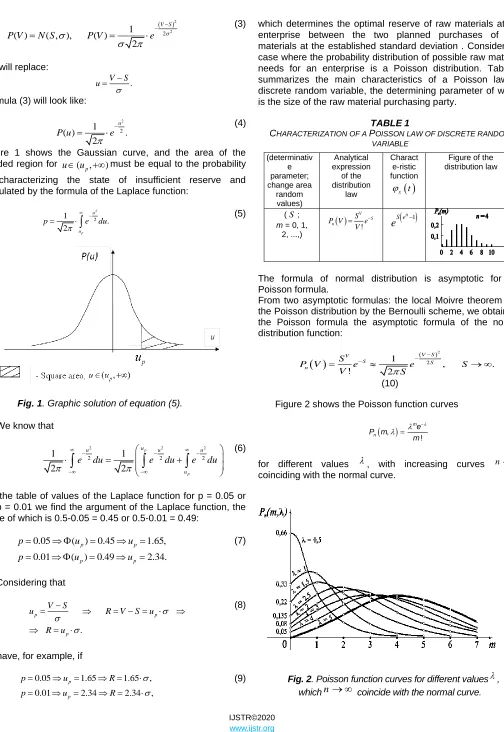
Figure 1 shows the Gaussian curve, and the area of the shaded region for u(up,)must be equal to the probability
p, characterizing the state of insufficient reserve and calculated by the formula of the Laplace function:
2
2 1
. 2
p u
u
p e du
(5)Fig. 1. Graphic solution of equation (5).
We know that
2 2 2
2 2 2
1 1
2 2
p
p u
u u u
u
e du e du e du
(6)For the table of values of the Laplace function for p = 0.05 or for p = 0.01 we find the argument of the Laplace function, the value of which is 0.5-0.05 = 0.45 or 0.5-0.01 = 0.49:
0.05 ( ) 0.45 1.65,
0.01 ( ) 0.49 2.34.
p p
p p
p u u
p u u
(7)
Considering that
.
p p
p
V S
u R V S u
R u
(8)
we have, for example, if
0.05 1.65 1.65 ,
0.01 2.34 2.34 ,
p
p
p u R
p u R
(9)
which determines the optimal reserve of raw materials at the enterprise between the two planned purchases of raw materials at the established standard deviation . Consider the case where the probability distribution of possible raw material needs for an enterprise is a Poisson distribution. Table 1 summarizes the main characteristics of a Poisson law of discrete random variable, the determining parameter of which is the size of the raw material purchasing party.
TABLE1
CHARACTERIZATION OF A POISSON LAW OF DISCRETE RANDOM
VARIABLE
(determinativ e parameter; change area
random values)
Analytical expression
of the distribution
law
Charact e-ristic function
x t
Figure of the distribution law
(S; m = 0, 1,
2, ...,)
!
V S n
S
P V e
V
S e
it 1e
The formula of normal distribution is asymptotic for the Poisson formula.
From two asymptotic formulas: the local Moivre theorem and the Poisson distribution by the Bernoulli scheme, we obtain for the Poisson formula the asymptotic formula of the normal distribution function:
2
2
1
, .
! 2
V S
V
S S
n
S
P V e e S
V S
(10)
Figure 2 shows the Poisson function curves
,
!
m
n
e P m
m
for different values , with increasing curves n coinciding with the normal curve.
4944 We relate to the Gaussian curve:
2 2
2 2
1 1
( ) , .
2 2
V S u
S n
V S
P V e P u e u
S S
(11)
From the formula (11) we find the relation of the reserve of raw materials, depending on the size of the purchase lot of raw materials:
V S
,u V S u S R u S
S
(12)
moreover, the area of the region under the normal curve for
( p, )
u u must be equal to the probability p, which characterizes the state of insufficient reserve and is calculated by the formula of the Laplace function:
2
2 1
.
2 p
u
u
p e du
(13)If you set the probability p, then the table of values of the Laplace function for p = 0,05; p = 0.04; p = 0.03; p = 0.02; p = 0.01 we find respectively the arguments of the Laplace function:
0.05 ( ) 0.45 1.65,
0.04 ( ) 0.46 1.76,
0.03 ( ) 0.47 1.89,
0.02 ( ) 0.48 2.06,
0.01 ( ) 0.49 2.34.
p p
p p
p p
p p
p p
p u u
p u u
p u u
p u u
p u u
(14)
Considering that
p
R V S u S (15)
We have:
0.05 1.65 1.65 ,
0.04 1.76 1.76 ,
0.03 1.89 1.89 ,
0.02 2.06 2.06 ,
0.01 2.34 2.34 .
p
p
p
p
p
p u R S
p u R S
p u R S
p u R S
p u R S
(16)
Formulas (16) express the relationship between the size of the raw material reserve and the size of the raw material purchasing party. Therefore, the task is to determine the optimal size of the purchase of raw materials.
Total costs for the purchase and storage of raw materials can be expressed by the formula:
, 2
KQ S
D C R
S
or
,
2 p
KQ S
D C u S
S
(17)
where Q is the annual supply, provided that storage was worth nothing;
C is the annual storage unit cost;
K is the cost of purchasing a new batch of raw materials. To determine the optimal size of the purchase of raw materials
find a derivative DSand equate it to zero:
2 0,
2 2
p S
u KQ C D
S S
we will result in a common denominator
2
2 2
0, 2
p KQ CS u S S
S
Having made a substitution S t 0, we have the equation of the fourth degree:
4 3
2 0.
p
Ct u t KQ
(18)
Solving equation (9) numerically provided that C = 53.5 conventional units, KQ170000 conventional units, we have the following solutions:
8.93628 , 0.00771027 8.92855 ,
0.00771027 8.92855
{{ } { }
{ }, { 8.92086}}.
x x i
x i x
(19)
Thus,
8.92086, S 79, 5817.
t
Thus, the optimal size of the raw material is determined.
4 DISCUSSION
In practice, the calculations are based on some predetermined probability that the need for raw materials will not exceed the available reserve. This probability is called a confidence factor, the value of which is, for example, 95% or 99%. Instead of a confidence factor, you can use the probability of the opposite event, ie the so-called risk factor of 5% or 1%, respectively, which expresses the likelihood that the reserve will not be sufficient to cover the need for raw materials.
Therefore, in our opinion, in order to find the size of the raw material reserve from the established risk factor and the Poisson distribution of possible raw material needs for the enterprise, it is necessary to perform the following tasks: - to lead the classification of methods for determining the
needs of raw materials;
- analyze the selected company from five main areas of activity;
- show that the size of the raw material reserve for the enterprise depends on the established risk factor;
- analyze the case where the probability distribution of possible raw material needs for the enterprise is a Poisson distribution;
4945 purchased.
5 CONCLUSIONS
Thus, the size of the raw material reserve for the selected enterprise depends on the established risk factor (the lower the risk, the greater the reserve). In addition, the size of the reserve is directly proportional to the root mean square deviation. fluctuations in raw material needs. The value of the root mean square deviation can be determined on the basis of fluctuations in raw material needs in previous periods, taking into account possible changes that have occurred recently. In the case where the probability distribution of the possible need for raw materials is normal, the optimal sizes of the raw material purchasing party and the size of the raw material reserve are independent of each other. The size of the reserve, defined in kind at this risk factor, does not depend either on the cost of purchasing the batch of raw materials or on the specific storage costs, as opposed to the optimal size of the batch, which depends on these parameters.
In addition, the size of the reserve is directly proportional to the root mean square deviation; fluctuations in raw material needs. The value of the root mean square deviation can be determined on the basis of fluctuations in raw material needs in previous periods, taking into account possible changes that have occurred recently.Otherwise, if the distribution of probable raw material demand is a Poisson distribution. In this case, the size of the reserve and the optimal size of the raw material purchasing batch depend on each other.
REFERENCES
[1] Schwartz L.B. Multi-level production/inventory control systems: theory and practice. [Text] / L.B. Schwartz (ed) // Studies in the Management Sciences. – North Holland, 1981. – v.16 – P. 163-193.
[2] Taha H.A. Operations Research – An Introduction (7th ed). [Text] / H.A. Taha. – Prentice Hall, Inc., New Jersey, 2003.
[3] Zhou Taiping, Jiang Dongyan. A brief discussion on the warehouse management technology [J]. Technology and Enterprise, 2012, (9): 49.
[4] Altug, M. S. Optimal dynamic return management of fixed inventories. JournalofRevenueandPricing Management.v. 11, n. 6, p.569-595, 2012.
[5] Vilson Menegon Bristot, Leopoldo Pedro Guimarães Filho, Rúbia Garcia Santana. Inventory Management: Case Study in a Retail Enterprise in the Far South of Santa Catarina. American Journal of Engineering Research (AJER), e-ISSN: 2320-0847 p-ISSN : 2320-0936, 2018, Volume-7, Issue-3, pp-300-309 [6] Ceryno, P.S., Scavarda, L.F., Klingebiel, K., Yüzgülec, G. (2013),
Supply chain risk management: A content analysis approach. International Journal of Industrial Engineering and Management, 4(3), 141-150.
[7] Logožar, K. (2013), The specifi cs of supply chain integration with small and medium-sized enterprises. Our Economy, 59(1-2), 3-12.
[8] Tetiana Bludova, Nataliya Danylyuk, Oleksandr Dyma, Olena Kachan, Olena Horokhova. Implementation of manufacturer and reseller interaction models, taking into account advertising costs. International Journal of Recent Technology and Engineering (IJRTE) , Volume-8 Issue-4, November 2019, рр. 4727-4736. [9] Ab Talib, M.S., Hamid, A.B.A. (2014), Application of critical
success factors in supply chain management. International Journal of Supply Chain Management, 3(1), 21-29.
[10] Tetiana Bludova, Svitlana Usherenko, Larisa Gromozdova, Nelina Khamska, Olena Shaposhnik. Simulation depending profitability of sales variable costs on forming functions marginal profit enterprise in reengineering . International Journal of Innovative Technology and Exploring Engineering’(IJITEE), Volume-9 Issue-2, рр. 4885-4890.
[11]Naliaka, V. W., & Namusonge, G. S. (2015). Role of inventory management on competitive advantage among manufacturing firms in Kenya: A case study of Unga Group Limited. International Journal of Academic Research in Business and Social Sciences, 5(5), 87–104.
[12]Chan, F.T.S. and Wang, Z. (2014), Robust production control policy for a multiple machines and multiple product-types manufacturing system with inventory inaccuracy. International Journal of Production Research, 52(16), 4803-4819.
[13]Sudipta Ghosh, “Performance Appraisal Through Inventory Management”. The Management Accountant, 2005, pp.560-562.
[14]Mukhopadhyay, D. “JIT – A Strategic Inventory Cost Management Approach – An Empirical Study” The Management Accountant, January 2008, pp 60-64.
[15]Deveshwar, A., & Dhawal, M. (2013). Inventory management delivering profits through stock management. World Trade Centre, Dubai: Ram University of Science and Technology. [16]Choi, T. (2012). Handbook of EOQ inventory problems –
Stochastic and deterministic models and applications. New York, Heidelberg, Dordrecht, London: Springer
[17]Nzuza, Z. W. (2015). Factors affecting the success of inventory control in the stores division of the Thekwini Municipality Durban: A case study. Durban, South Africa: Durban University of Technology.