Licensed under Creative Common Page 1
http://ijecm.co.uk/
ISSN 2348 0386
AN ANALYSIS OF THE EFFECTS OF SELECTED HUMAN RESOURCE MANAGEMENT
PRACTICES ON THE CORPORATE PERFORMANCE OF A MULTINATIONAL COMPANY,
WESTERN NIGERIA
Oludayo, A. Olumuyiwa
Department of Business Management, Covenant University, Ota, Nigeria
Omonijo, Dare Ojo
Department of Academic Affairs, Covenant University, Ota, Nigeria
Abstract
Studies have attempted to recommend designs of various HR systems to achieve organizational
goals as well as determine best set of complementing HR practices that will indeed boost
performance. However, several limitations spanning from different levels of analysis, size of
firm, union status of organizations and business environment have limited the acceptability of
several advancements, hence, the need for a contextual study such as this. It therefore sets to
discover if systems of high-performance HR practices will boost productivity. It equally examines
if complementing high-performance HR practices will boost productivity. The study engages
Pearson’s product-moment correlation coefficient at 0.01 level of significance for degree of
freedom 2 to test these hypotheses. Moreover, regression analysis was employed to measure
the contribution of the independent variable to the dependent variable while student-t-test, beta
and F-ratio were used to test the relationship in terms of nature and strength. Our findings
revealed that high-performance HR practices will boost productivity. It equally ascertained that
complementing high-performance HR will improve productivity of staff.
Keywords: Human Resources Management Practices, Corporate Performance, Multinational
Company, Western Nigeria
INTRODUCTION
Contemporary organizations are constantly confronting pressures to improve service and
productivity. The precariousness of the external working environment and the rapid rate of
technological change increasingly demand innovative means of improving business
Licensed under Creative Common Page 2
determinants of competitive advantage and the need for effective manpower management has
become more important than ever before.
The task of effective human resource manager in recent times has gone beyond just the
HR unit of the organization alone. The responsibility for exploring the potentials of the people in
work settings for maximum performance is now shared between senior managers, HR professionals and line managers. However, the challenges facing today’s organization provides
an ideal occasion for the diverse HR practices to prove its ability to contribute towards corporate
performance. HR in organizations is considered as a critical component in the maintenance and
improvement of corporate performance (Bowen and Ostroff, 2004; Ostroff and Bowen, 2000).
Moreover, HR is assumed to affect knowledge, skills, abilities (Schuler and Jackson, 1995),
attitudes and behaviour of employees Guest, (2002), and may affect the performance of an
organisation (Den Hartog et al., 2004). Research shows that the human element in
organisations is an indispensable variable as organizations try to stay ahead of competition.
Research further reveals that HR can play a decisive role in organisational performance (Arthur
1994; Becker and Gerhart, 1996; Boselie et al,. 2005; Guest et al,. 2003; Wood, 1999; Youndt
et al., 1996). Two factors have been assumed to be important factors in explaining the link
between HR and corporate performance. Baron and Kreps (1999) identified these two factors
as:
1. The alignment of HR with the organisation strategy (strategic fit) and
2. The alignment of the various HR practices, such as career opportunities, training
and appraisal, within the organisation (internal fit)
Baron and Kreps hypothesize that when HR within an organisation is well aligned, and
employees know what is expected of them, they will invariably act similarly and have uniform
expectations about work and behaviour. It is on this note that this study is conceived. It strives
to find out if systems of high-performance HR practices will boost productivity. It findings is
expected to indicate whether complementing high-performance HR practices will boost
productivity in the organization under study.
Hypotheses
Based on the findings of Arthur (1994) that firms, which embrace ‘collaborative’ HR systems had lower turnover rates and higher productivity than firms with ‘calculative’ systems whose
emphasis is efficiency and the reduction of labour costs, it has been hypothesized (in the null
form) that:
(a) Systems of high-performance HR practices will not boost productivity.
Licensed under Creative Common Page 3
The above hypotheses were tested using Pearson’s product-moment correlation coefficient at
0.01 level of significance for degree of freedom 2. It was used to establish the relationship
between dependent and independent variables. Also, regression analysis was used to measure
the contribution of the independent variable to the dependent variable. Finally, the relationship
in terms of nature and strength were tested using student-t-test, beta and F-ratio.
Exposition of Research on Human Resources Managment
Researchers into human resource management have accentuated that HR practices may lead
to higher organization performance and be the essence of sustained competitive advantages
(Wright et al., 2001). Huselid, (1995) opines that there is an increasing accord that HR policies
can, if properly organized, offer a significant contribution to corporate performance. The use of
High Performance Work Practices can improve the knowledge, skills and abilities of an organization’s current and prospective employees. These practices can increase employee
motivation, decrease absenteeism, and boost retention of value-driven employees while giving
room to redundant workers to leave the organization (Jones and Wright, 1992; U.S. Department of Labour 1993). However put, an organization’s choice of employment practices, policies and
strategies will determine the productivity of its workers.
This study explores leading theories in human resource management–performance
linkage research. The HR literature holds that theories whose focus are on the productivity
effects of work practices often center on modes in which compensation policies, such as profit
sharing, efficiency wage payments, or other forms of incentive pay, can affect workers
productivity. Other theories imply that bringing individual but related HR practices together in a
HR system may be vital determinants of productivity than individual work practices.
This discourse also explores diverse human resource management practices as
evaluated in literature. Guest, (2002) argued that the effect of HR on corporate performance is contingent upon individual employee’s response to constituted HR practices. Therefore, the
impact will move in direction of the perception of HR practices by the employee. Patterson et al.
(1997) while discussing impact of HR practices on performance asserted that HR practices
covering selection and training greatly influence performance by providing appropriate skills.
Their research revealed that HR practices have prevailing impact on corporate performance
Licensed under Creative Common Page 4 THEORETICAL INSIGHTS
The contingency approach to HR management is premised on the basis of no one best way to
manage employees for high performance. The theory holds that HR practices must be tailored
to the particular circumstances been confronted by an organization. The contingency
perspective (also called the situational approach) assumes that there is no universally
acceptable response to issues bothering on HR systems that ensure increased performance of
employees because organizations, people, and situations are dynamic and do change over time
(Baird and Meshoulam, 1988). Thus, the appropriate approach towards increasing the corporate
performance rating is dependent on a complex variety of critical environmental and internal
contingencies.
Contingency theory begins with the assertion of "it depends," stating that the way out to
any one managerial impasse is dependent on the factors that impinge on the situation. For
instance, where slight distinction in materials exists in the production process, it becomes
pertinent to assign work into highly routine tasks. However, where distinction is high, requiring
many judgments concerning which material is suitable and which is not, managers will want to
avoid making tasks routine. Another illustration that supports this assertion focuses on training.
Human relations training might be more effective under what Porter, (1980) terms a
differentiator, as opposed to a cost-leadership strategy. The differentiator relies heavily on
innovation and teamwork, so that the returns to human relations training could be imagined to
be greater under new circumstances.
The Contingency approach is organizationally rooted on the postulation that the choice
of a blend of Human Resource Management practices is influenced by the strategy engaged in
the organization. This assertion further holds that the choice of strategy is influenced by business oriented environmental factors and those organizations which achieve ‘vertical fit’
between Human Resource Management practices, strategic choices and environmental
features will achieve better results than other organizations (Baird and Meshoulam, 1988;
Youndt et al., 1996).
The effectiveness of an organization’s HR policies according to the argument of the
contingency approach demands a consistency with other aspects of the organization. The primal contingency factor is considered to be the organization’s strategy; hence, HR practices are expected to be consistent with the organization’s strategy. Corporate performance will be
enhanced when the right fit between corporate strategy and HR practice is achieved (Schuler,
1989). This perspective negates the existence of the best practices in managing human
resources.
The contingency view has a sizeable theoretical appeal premised in the western
Licensed under Creative Common Page 5
HR systems, Schuler, (1989) identifies a set of behavioural patterns which he proposes to be
determined by corporate strategic needs (e.g., risk taking versus risk avoidance, cooperation
versus independent action, rule adherence versus innovation); these in turn are achieved by the
selection of appropriate HRM practices in such areas as staffing, assessment, training and
development, and compensation. This suggests that no one practice can match an
organizational strategy to achieve an identified corporate goal. Begin, (1991) offers a
comparable framework, one poised to comprehend corporate HR systems across the nation. He
identified a multi-tiered set of system expectations, these expectations range from employee proficiency to system incorporation and financial elasticity–all of which ultimately inform
corporate performance – driving the choice of Human Resource Management system
components.
The situational perspective of the contingency theory has been a major attraction among
researchers. They have argued that the productivity of an organization and its HR practice must
of necessity conform to other facets and strategies of the organization (Arthur, 1994; Sanz-Valle
et al., 1999; Schuler and Jackson, 1987; Sparrow et al., 1994; Youndt et al., 1996). Schuler and
Jackson, (1987) having adopted the concept of synergy, suggest that if HR practices are not
consistent with corporate strategies, then they can be more competitively disadvantageous than
advantageous by restraining both individual and corporate performance. Indeed, one objective
of research within the contingency framework is to specify those dimensions and conditions that
do affect a situation and those that do not. Irrespective of the success that has been recorded in
the utilization of this approach towards increased corporate performance, there have been
numerous criticisms.
The contingency approach was useful in recognizing that the complication attendant to
comprehending human and corporate systems has made it challenging to develop a universally
acceptable system of management principle. A major criticism beckons on the question of
whether management can be practiced by intuition given that the contingency approach points
to every situation as a unique one, thereby negating the value of prior knowledge and wisdom.
From a research perspective, it has been found lacking in the requirement for postulating
a theory whose validity of assumptions is expected to be steady and unchanging even when
differing assumptions are postulated. In a contingency framework, if differing results are
obtained, the contingency response would be that the situation is unique or that essential
dimensions affecting the situation were not tested. Thus, showing that contradictory
Licensed under Creative Common Page 6 METHODOLOGY
Research Design
The research design for this study was a descriptive in nature using survey design. It elicited
responses from an array of employees of the organization of study.
Research Instruments
An empirical investigation was conducted through the use of questionnaire. The questionnaire
consist of three sections; corporate performance, human resources practices and
demographics. The demographics questions consisted of items that sought information with regard to: gender, age, education, number of years’ experience within the industry and the
organization currently which the respondent works. The corporate performance section
consisted of 2 items to measure productivity and turnover. The human resources practices
section consisted of 36 items to measure selection, compensation, job definition, employee
participation, career planning, performance appraisal and training. The human resources practices and the indicators of performance–productivity and turnover – in the questionnaire
were scored on a 7-point Likert-type scale (also known as the summated rating scale) with 1
expressing very strongly disagree, 2 strongly disagree, 3 disagree, 4 fairly agree, 5 agree, 6
strongly agree and 7 very strongly agree.
Population of Study and Sample Size
The staff of the multinational company at Agbara plant represents the population of this study.
The total population in figure is one hundred and eighty-five (185). Out of which one hundred
and thirty-five (135) were selected. The company was reticulated into thirteen (13)
department-Production, Engineering, Nutritional Health Drinks, Procurement, Over The Counter, Finance,
Supply & Warehouse, Occupational Harzard Category, Environmental Health & Safety,
Security, Human Resources, Quality Assurance and Operational Excellence. Proportional
sample technique was used to select sample from each department. Hence, each department
produced sample based on the strength of its staff.
Data Reliability
The Cronbach alpha coefficient was used to test the reliability of the measurement scale in this
study. Dwelling on this test, the Cronbach Alpha coefficient was .976 for the 48 items analysed
Licensed under Creative Common Page 7
Table 1: Reliability Statistics
Cronbach's Alpha N of Items
.976 48
This shows that these items are highly reliable. It therefore suffices to say that the individual
items in the scale have been found and adjudged to be highly reliable; hence the results that will
be derived from their analysis can be depended upon and used in policy formulation and
strategy implementation.
Content Validity
In this study, content validity was ascertained by the adoption of a questionnaire by an expert.
Statistical Analysis
The returned questionnaires were screened for comprehensiveness. Afterward, the responses
from the appropriate research questionnaires were captured, coded and inputted into a
database using the Statistical Product and Service Solutions (SPSS; Formerly known as
Statistical Package for the Social Sciences). The following statistical methods were utilized on the empirical data set to test the hypotheses: Analysis of variance, Pearson’s product-moment
correlation and multiple regression.
RESULTS
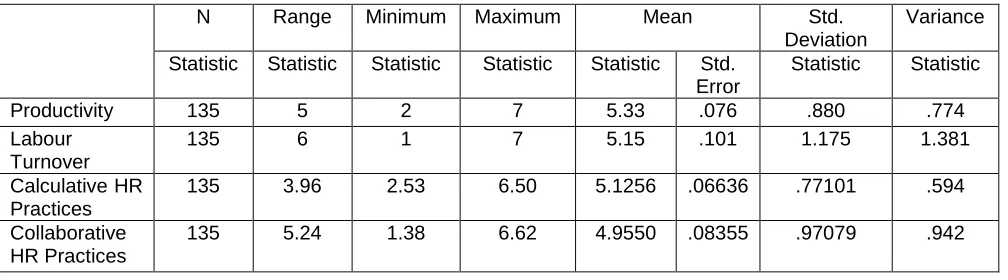
The Descriptive Statistics of Dependent and Independent variable is shown in Table 2
below. This table includes descriptive statistics for each variable. Specifically, the table includes
the number of cases (N), the range, the mean, the standard deviation, and the variance. Of
greatest interest here are the mean scores for productivity (5.33) and for labour turnover (5.15)
as well as that of the calculative HR practices (5.1256) and collaborative HR practices (4.9550).
Table 2: Descriptive Statistics of Dependent and Independent Variables
N Range Minimum Maximum Mean Std. Deviation
Variance
Statistic Statistic Statistic Statistic Statistic Std. Error
Statistic Statistic
Productivity 135 5 2 7 5.33 .076 .880 .774
Labour Turnover
135 6 1 7 5.15 .101 1.175 1.381
Calculative HR Practices
135 3.96 2.53 6.50 5.1256 .06636 .77101 .594
Collaborative HR Practices
Licensed under Creative Common Page 8
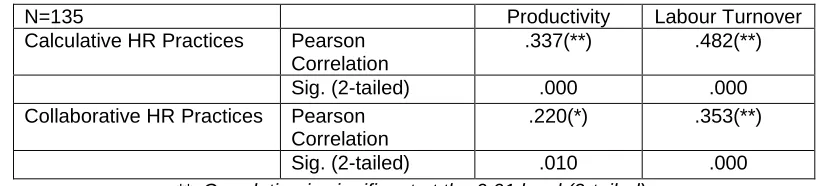
Using SPSS v. 15 to determine the relationship between the calculative and collaborative HR
practices, table 3 below reveals the results of the of the correlation analysis of the dependent
and independent variables.
Table 3: Correlations of Calculative and Collaborative HR Practices
N=135 Productivity Labour Turnover
Calculative HR Practices Pearson Correlation
.337(**) .482(**)
Sig. (2-tailed) .000 .000 Collaborative HR Practices Pearson
Correlation
.220(*) .353(**)
Sig. (2-tailed) .010 .000 ** Correlation is significant at the 0.01 level (2-tailed).
INTERPRETATION OF RESULTS
The relationship between independent variables - calculative HR practices and collaborative HR
practices – and dependent variables – productivity and Labour turnover – having been
investigated using the Pearson product-moment correlation coefficient revealed a significant
relationship between the dependent and independent variables. There was a moderate
correlation between the calculative HR practices, productivity and Labour turnover [r=.337
(productivity), r=.482 (labour turnover), n=135, p<.0005], with calculative HR practices been
more associated with increased turnover than with productivity. On the other hand, collaborative
HR practices has a slight correlation with productivity [r=.220, p<.010] and a moderate
correlation with Labour Turnover [r=.353, p<.0005].The collaborative system of
high-performance HR practice negates our hypothesis 1 when compared with the calculative system
of high-performance HR practice. Hence, we accept the hypothesis that asserts that systems of
High-performance HR practices will boost productivity.
The standard multiple regression was used to generate results that will indicate how well
the set of variables representing Complementing High-performance HR practices is able to
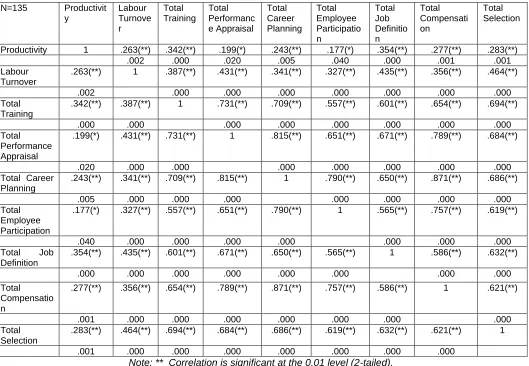
predict employee turnover and productivity. In order to find the relationship between the individual HR practices and employee turnover and productivity, the Pearson’s product-moment
correlation coefficient was used.
The individual HR practices used in this study have been identified in literature. The
combined HR practices that make up the independent variables in this study have been
identified as the complementing HR practices for this second hypothesis.
Table 2 showed the descriptive statistics of the dependent and independent variables that make
Licensed under Creative Common Page 9
variables–productivity and labour turnover–and independent variables–training, selection,
compensation, career planning, performance appraisal, job definition, and employee participation–to determine the level of relationship each HR practice bears on productivity and
turnover. The table reveals that there are statistically significant relationships between the
dependent and independent variables.
Table 4a below is the model summary. It shows how much of the variance in the
dependent variable (productivity) is explained by the model (which includes the variables of
Total Selection, Total Employee Participation, Total Job Definition, Total Training, Total
Compensation, Total Performance Appraisal, and Total Career Planning). In this case the R
square value is .212. Expressed by a percentage, this means that our model (which includes
Total Selection, Total Employee Participation, Total Job Definition, Total Training, Total
Compensation, Total Performance Appraisal, and Total Career Planning) explains 21.2% of the
variance in productivity.
Table 4a: Descriptive Statistics of Dependent and Independent Variables
Note: a. Predictors: (Constant), Total Selection, Total Employee Participation, Total Job Definition, Total Training, Total Compensation, Total Performance Appraisal, Total Career Planning
Table 4b below shows the assessment of the statistical significance of the result. This
tests the null hypothesis that multiple R in the population equals 0. The model in this table
reaches statistical significance (Sig = .000)
N Range Minimum Maximum Mean Std. Deviation
Varianc e Statistic Statistic Statistic Statistic Statistic Std. Error Statistic Statistic
Productivity 135 5 2 7 5.33 .076 .880 .774
Labour Turnover
135 6 1 7 5.15 .101 1.175 1.381
Total Training 135 4.33 2.33 6.67 5.1506 .06941 .80650 .650 Total
Performance Appraisal
135 4.86 1.71 6.57 5.0825 .07567 .87915 .773
Total Career Planning
135 5.29 1.43 6.71 4.9397 .08438 .98038 .961
Total Employee Participation
135 5.33 1.33 6.67 4.9704 .09223 1.07162 1.148
Total Job Definition
135 5.00 2.00 7.00 5.2815 .07244 .84168 .708
Total
Compensation
135 6.00 1.00 7.00 4.9170 .09201 1.06907 1.143
Total Selection 135 4.25 2.75 7.00 5.1963 .07777 .90365 .817 Valid N
(listwise)
Licensed under Creative Common Page 10
a Predictors: (Constant), Total Selection, Total Employee Participation, Total Job Definition,
Total Training, Total Compensation, Total Performance Appraisal, Total Career Planning
b Dependent Variable: Productivity
The Table 4b also shows which of the variables included in the model contributed to the
prediction of the dependent variable. The study is interested in comparing the contribution of
each independent variable; therefore beta values are used for the comparison. In this table, the
largest beta coefficient is -.390 which is for Total Performance Appraisal. This means that Total
Performance Appraisal makes the strongest unique contribution to explaining the dependent
variable – productivity – when the variance explained by all other variables in the model is
controlled for.
Table 4b: Correlations of Dependent and Independent Variables
Note: ** Correlation is significant at the 0.01 level (2-tailed).
N=135 Productivit
y Labour Turnove r Total Training Total Performanc e Appraisal Total Career Planning Total Employee Participatio n Total Job Definitio n Total Compensati on Total Selection
Productivity 1 .263(**) .342(**) .199(*) .243(**) .177(*) .354(**) .277(**) .283(**)
.002 .000 .020 .005 .040 .000 .001 .001
Labour Turnover
.263(**) 1 .387(**) .431(**) .341(**) .327(**) .435(**) .356(**) .464(**)
.002 .000 .000 .000 .000 .000 .000 .000
Total Training
.342(**) .387(**) 1 .731(**) .709(**) .557(**) .601(**) .654(**) .694(**)
.000 .000 .000 .000 .000 .000 .000 .000
Total Performance Appraisal
.199(*) .431(**) .731(**) 1 .815(**) .651(**) .671(**) .789(**) .684(**)
.020 .000 .000 .000 .000 .000 .000 .000
Total Career Planning
.243(**) .341(**) .709(**) .815(**) 1 .790(**) .650(**) .871(**) .686(**)
.005 .000 .000 .000 .000 .000 .000 .000
Total Employee Participation
.177(*) .327(**) .557(**) .651(**) .790(**) 1 .565(**) .757(**) .619(**)
.040 .000 .000 .000 .000 .000 .000 .000
Total Job
Definition
.354(**) .435(**) .601(**) .671(**) .650(**) .565(**) 1 .586(**) .632(**)
.000 .000 .000 .000 .000 .000 .000 .000
Total Compensatio n
.277(**) .356(**) .654(**) .789(**) .871(**) .757(**) .586(**) 1 .621(**)
.001 .000 .000 .000 .000 .000 .000 .000
Total Selection
.283(**) .464(**) .694(**) .684(**) .686(**) .619(**) .632(**) .621(**) 1
Licensed under Creative Common Page 11
Table 4c below also seeks to explain which of the variables is making a statistically significant
unique contribution to the model. It is important to state here that this is dependent on the
variables that are included in the model, and how much overlap there is among the independent
variables.
Table 4c: Model Summary
Model R R Square
Adjusted R Square
Std. Error of the Estimate
1 .460(a) .212 .168 .802 Note: a Dependent Variable: Productivity
Further, looking at the Sig. column in table 4d below, it reveals that total training, total
performance appraisal, total job definition and total compensation made a unique, and
statistically significant, contribution to the prediction of productivity level, hence, we accept the
hypothesis.
Table 4d: ANOVA (b)
Model Sum of Squares Df Mean Square F Sig. 1 Regressio
n
21.947 7 3.135 4.87
3
.000(a)
Residual 81.712 127 .643 Total 103.659 134
DISCUSSION
Ichniowski et al., (1997), found the impact of ‘cooperative and innovative’ HR practices to have
a positive and considerable effect on firm efficiency. This finding concurs with that of Arthur, (1994) which revealed that firms that embrace ‘collaborative’ HR systems had lower turnover rates and higher productivity than firms with ‘calculative’ systems whose emphasis is efficiency
and the reduction of labour costs. This assertion of Arthur, (1994) supports our findings in this
study and helps to validate our decision to reject the null hypothesis.
The implication of the results presented suggests that collaborative HR practices have
contributed more significantly towards productivity than calculative HR practices; hence, for
enhanced productivity in the organization, management is advised to focus more engaging
employee participation and career planning programs. This will lead to the employees been
more committed to the task given to them.
This study found out that a combination of complementing HR practices will invariably
Licensed under Creative Common Page 12
(1995) where he found that ‘combinations’ of internally consistent HR practices were linked with
greater productivity and quality in 62 automotive plants.
The HR practices identified as contributing significantly to the improved productivity of the organization should be supportive, complementing one another’s strengths and the degree
of contribution to the productivity level of the organization. Baird and Meshoulam, (1988)
asserted that corporate performance will be improved to the degree that organizations engage
HR practices that support one another (the internal fit).
A review of the HR practices deduced as having contributed to the improvement of
productivity reveals that they fit together, hence, they promote value-based HR activities.
Osterman, (1994)found that organizations that place high value on employee commitment, for
example, are not likely to use term employees rather they are likely to invest in innovative work
practices such as skills training and incentive compensation. Huselid, (1995) posits that the
effectiveness of employee participation systems will be improved if employees are aware of that
their efforts will be rewarded and has the tendency to ensure their advancement.
Calculative HR practices if emphasized above collaborative HR practices will generate
more labour turnover than the collaborative practices. Therefore the reduction of labour turnover
will demand the intensification of collaborative HR practices in order to ascertain employee
loyalty to the cause of the organization. Calculative HR practices have been discovered to be
individualised and performance-oriented practices yet they do not promote productivity as
collaborative HR practices do. Collaborative HR practices seek to enhance the commitment of
the employee and from this study it can be deduced that commitment-oriented practices will
improve productivity and reduce turnover when considered against the calculative HR practices
which are control-oriented.Therefore, the two hypotheses tested were found to be accepted as
they were statisticallyestablished to be significant. The explanation of the findings is given in the
following discuss.
Theoretical Findings
The Contingency approach to the discourse of HR-performance found expression in the
postulation that confirms that a blend of HR practices is influenced by organizational strategy.
Further revelations indicate that the choice of strategy is influenced by a determination of the ‘vertical fit’ between HR practices, strategic choices and environmental features, thus a better
output in terms of performance will be achieved. (Baird and Meshoulam, 1988; Youndt et al.,
1996)
Motivation enhancing practices were reported to have a positive influence on employee
commitment, and ultimately result in motivational outcomes. Consistent with the perceived
Licensed under Creative Common Page 13
performance appraisal, incentives and other rewards-for-performance signal a positive
estimation of employee efforts thus increasing reciprocal obligation (Meyer and Allen 1997; Rhoades et al. 2001). Furthermore, Klein’s (1987) asserts that employee’s interests in the
organization are aligned towards greater commitment and corporate loyalty if financial rewards
are calculated to boost dedication to performance. However, these practices may not give an
assurance of sustained high performance unless the compensation level favours employees
even during turnover.
The resource-based view model of human resource management confirms that
high-performance organizations focus basically on the development and retention of the skills and
knowledge of workers. It seeks not to fit human resource management practices to the multiple
and emergent strategies of organisations so that the development of complementing HR
practices can pave the way for employee development.
Employee training as an important part of human resources is a form of investment in
human capital. It advances further the human resource practices of recruitment and selection.
Once recruitment and selection processes are concluded, training programs are put up to
enhance job skills. Training programs enable new employees to align their skills and knowledge
towards achieving corporate strategies. The essence of training has been to ensure that
employees discharge their assignment maximally and to the best of their capacities. It also
gives room for employees to correct deficiencies in performance levels (Gomez-Mejia et al.,
1995).
Singh (2004) asserts that compensation is a mechanism using financial and
non-financial incentives, pay and benefits to align employee behaviour with corporate strategy.
Kalleberg and Moody, (1994) reported that compensation is positively associated to the
performance of the organization. The compensation policy that favours higher rewards leads to
a harmonious relationship between management and employees, thus leading to a reduction in
turnover (Kalleberg and Moody, 1994; Arthur, 1994).
Research findings have indicated positive correlation between compensation,
performance-oriented pay and corporate performance as indicated in productivity (Delaney and
Huselid, 1996; Lazear, 1996).Performance appraisals have been revealed to be more
concerned with employee wellbeing, development and motivation of staff. McGregor,
(1957)reports that performance appraisal targets effective supervision that often leads to
employee development and culminate in increased productivity. Findings have identified areas
of emphasis for performance reviews as those vital to the performances of employees in the
workplace with intent to know how well they are faring while proffering suggestions for
Licensed under Creative Common Page 14
discretion to work if proper performance appraisal is obtainable and is propped up by
compensation system linked with the performance management system.
Job definition, if clearly outlined and unambiguously communicated to the employee will
achieve supervisory expectations in areas of task accomplishment, skill enhancement, team
coherence and realization of corporate goals (Qureshi et al., 2006)
Empirical Findings
The finding of Ichniowski et al., (1997) perfectly fits our study on compensation as a major
independent variable that impacts on employee productivity. It discovered that
performance-driven compensation is applied to both calculative and collaborative HR systems. A distilling
factor in the study reveals the implications for industrial relations practice. In a unionized
organization such as was studied in this research work, performance-based compensation
formed part of collaborative HR, and trade unions gained a representative role.
The results of the research conducted by Qureshi, (2006) regarding impact of HR
practices on corporate performance in Pakistan were tangential with our finding that HR practice
system affects corporate performance indicating positive employee outcomes. Ichniowski et al., (1997), found the impact of ‘cooperative and innovative’ HR practices to have a positive and
considerable effect on firm efficiency. This finding concurs with that of this assertion by Arthur
(1994) supports our findings in this study and helps to validate our decision to reject the
proposition that systems of high-performance HR practices do not boost productivity.
The implication of the results presented suggests that collaborative HR practices have
contributed more significantly towards productivity than calculative HR practices. Collaborative
HR practices seek to enhance the commitment of the employee and from this study it can be
deduced that commitment-oriented practices will improve productivity and reduce turnover when
considered against the calculative HR practices which are control-oriented. This study has
found out that a combination of complementing HR practices will invariably lead to enhanced
productivity of the organization. This discovery is substantiated by MacDuffie, (1995) where he found that ‘combinations’ of internally consistent HR practices were linked with greater
productivity and quality in 62 automotive plants.
RECOMMENDATIONS
Having reviewed complementing HR practices under the AMO framework of Ability, Motivation
and Opportunity, it is important for managers to note that for employees to engage in
behaviours that are beneficial to the sustainability of organizational competitive advantage the
Licensed under Creative Common Page 15
1. There must be sufficient number of employees with the required ability (skills,
experience, knowledge, etc) to do current and potential jobs.
2. There must be reasonable motivation for them to maximally utilize their abilities. These
motivational factors could take the form of financial or non-financial incentives but must
certainly include social rewards (and sanctions) and recognition of input as applied by
co-workers and immediate bosses.
3. There must be an opportunity to engage in discretionary behaviour (thus the importance
of job definition). Opportunity is the invitation to have employees participate and get
involved in organizational tasks of goal attainment. This should occur both within the job itself in terms of how the job can best be done (known as ‘on-line participation’) and outside the job as a member of a team or work area, and a ‘citizen’ of the organisation
(off line-participation).
From the results derived from hypothesis 1, management is advised to focus more engaging
employee participation and career planning programs. This will lead to the employees been
more committed to the task given to them. Calculative HR practices if emphasized above
collaborative HR practices will generate more labour turnover than the collaborative practices.
Therefore the reduction of labour turnover will demand the intensification of collaborative HR
practices in order to ascertain employee loyalty to the cause of the organization. Calculative HR
practices have been discovered to be individualised and performance-oriented practices yet
they do not promote productivity as collaborative HR practices do.
CONCLUSION
Whilst the conclusion of this study does not differ substantially from those obtained by other
scholars, a contextual approach, with fuller attention to a unionized organization as a whole,
enabled the researchers to re-appraise the relationship between HR practices and performance.
Thus, performance was defined in terms of productivity and labour turnover that corresponds to
the HR practices in place. Moreover, performance was measured subjectively in
intra-organizational output and an effort was made to avoid undue emphasis on strictly financial or
economic parameters. The intention, then, was to obtain insight on both human resource
management practices and corporate performance in terms of productivity and turnover. The
methodology used was essentially quantitative, although it also entailed a level of narrative
analysis in the literature review. For this reason, focus was on comparison of opposites, namely ‘calculative’ HR practices on the one hand and ‘collaborative’ HR practices on the other. This is
a strategy geared to highlighting variations found in different HR systems/contexts. Like
Licensed under Creative Common Page 16
positive impact on corporate performance, particularly if the organization adapts complementing
HR practices that boosts productivity while reducing turnover.
IMPLICATIONS FOR FURTHER RESEARCH
As a way of advancing the field of Human Resource Management, further studies can be
carried out to address the following deficiencies in the HR-Performance research.
More theoretical approaches should be tested for wide acceptability given that the
acceptable theories in this research area are concentrated on a few paragdn.
Second, research methods differ in analyzing the linkage between HR and Performance,
thus, a review of effective techniques for measuring and analyzing the variables in this
research area should be advanced.
The recommendations that are derived from the previous research are somewhat not applicable
to different sizes of organizations, thus, research can be advanced considering the levels of business organizations such as SME’s, Private Institutions, Public Institutions, Multinationals
and their subsidiaries.
REFERENCES
Arthur, J. (1994). Effects of Human Resource Systems on Manufacturing Performance and Turnover. Academy of Management Journal, 37, 3:670-87.
Baird, L and Meshoulam, I. (1988). Managing two fits of strategic human resource management. Academy of Management Review, 13:116-128
Baron, J. N and Kreps, D. M. (1999). Strategic Human Resources: Frameworks for General Managers. NY: Wiley.
Begin, J. P. (1991). Strategic Employment Policy: An Organisational Systems Perspective. En-glewood Cliffs New Jersey: Prentice Hall.
Boselie, P., Dietz, G and Boon, C. (2005). Commonalities and Contradictions in HRM and Performance Research. Human Resource Management Journal, 15, 3:67
Bowen, D. E and Ostroff, C. (2004). Understanding HRM-firm performance linkages: The role of "strength" of the HRM system. Academy of Management Journal, 29: 203-221.
Delaney, J. T., Lewin, D and Ichniowski, C. (1989). .Human Resource Policies and Practices in American Firms. Washington Dc: U.S. Government Printing Office.
Delaney, J. T and Huselid, M. A. (1996).The impact of human resource management on perceptions of organizational performance. Academy of Management Journal, 39:949-969.
Den Hartog, D. N., Boselie, J. P and Paauwe, J. (2004). Performance management: A model and research agenda. Applied Psychology: An International Review, 5: 556-569.
Gomez-Mejia, L. R., Balkin, D. B and Cardy, R. L. (2003). Managing Human Resources, Delhi: Pearson Education (Singapore) Pte. Limited.
Guest, D. (2002). Human resource management, corporate performance and employee well-being: building the worker into HRM. The Journal of Industrial Relations, 44, 3: 335-358.
Licensed under Creative Common Page 17 Huselid, M. (1995). The Impact of Human Resource Management Practices on Turnover, Productivity, and Corporate Financial Performance, Academy of Management Journal, 38, 3: 635-72.
Ichniowsk,i C., Kathryn, S and Giovanna, P. (1997). The effect of human resource management practices on productivity: a study of steel finishing lines, American Economic Review, 87, 3:291-313.
Jones G. R and Wright, P. M. (1992). An economic approach to conceptualizing the utility of human resource management practices. In: K. Rowland and G. Ferris (Eds.), Research in personnel
Klein, H., Morrow, J and Brinsfield, C. (1987). Understanding commitment in the workplace: Differentiating commitment strength, rationales and targets.
Lazear, E. P. (1996). .Performance Pay and Productivity. Cambridge: NBER working paper series. MacDuffie, J. (1995). Human Resource Bundles and Manufacturing Performance: Organizational Logic and Flexible Production Systems in the World Auto Industry, Industrial and Labor Relations Review, 482, 1:97-221.
McGregor and Douglas (1957), An uneasy look at performance appraisal. Harvard Business Review, 35,3: 89-94.
Meyer, J.P and Allen, N. J. (1997). Commitment in the workplace: Theory, Research, and Application. Thousand Oaks, CA: Sage.
Osterman, P. (1994). How Common is Workplace Transformation and Who Adopts It?, Industrial and Labor Relations Review, 47, 2:173-188.
Ostroff, C and Bowen, D. (2000). Moving HR to a higher level: HR practices and organizational effectiveness in: K. Klein and S. Kozlowski (eds), Multilevel Theory, Research and Methods in Organizations: Foundations, Extensions and New Directions. San Francisco: Jossey-Bass.
Patterson, M.G., West, M.A., Lawthom, R. and Nickell, S. (1997). Impact of People Management Practices on Business Performance. London: Institute of Personnel and Development.
Peccei, R and Rosenthal, P. (2001). Delivering customer-oriented behaviour through empowerment: an empirical test of HRM assumptions. Journal of Management Studies, 38, 6: 831-57.
Porter, M. E. (1980). Competitive Strategy. New York: The Free Press.
Qureshi, M. T and Ramay, I. M. (2006). Impact of Human Resource Management Practices on Organizational Performance in Pakistan. Muhammad Ali Jinnah University: Islamabad.
Rhoades, L., Eisenberg, R and Armeli, S. (2001). Affective commitment to the organization: the contribution of perceived organizational support. Journal of Applied Psychology, 86: 825-836.
Sanz-Valle, R., Sabater-Sanchez, R and Aragon-Sanchez, A. (1999). Human resource management and business strategy links: an empirical study. The International Journal of Human Resource Management, 10, 4: 655-671.
Schuler, R.S and Jackson, S. E. (1987). Linking Competitive Strategies with Human Resource Management practices. The Academy of Management Executive, 2, 3: 207-219.
Schuler, R. S. (1989). Strategic human resource management and industrial relations. Human Relations, 42, 2: 157-184.
Singh, P. K. (2004). Working Capital Management in Lupin Laboratories Ltd.—A Case Study.The Management Accountant, 4.
Thompson, J. D. (1967). Organizations in Action, New York: McGraw-Hill.
US Department of Labor (1993). High Performance Work Practices and Work Performance. Washington, D. C.: US Government Printing Office
Wood, S. (1999). Human resource management and performance. International Journal of Management Review, 1, 4: 367-413.
Licensed under Creative Common Page 18 Wright, P. M and Gardner, T. M. (2003). The human resource-firm performance relationship: methodological and theoretical challenges, in: D Holman, TD Wall, CW Clegg P, Sparrow, A Wright PM. and Boswell, WR 2002 Desegregating HRM: A Review and Synthesis of Micro and Macro Human Resource Management Research. Journal of Management, 28: 247- 276.
Wright, P. M and McMahan, G. C. (1992). Theoretical perspectives for strategic human resource management. Journal of Management, 18, 2:295–320.