Rurality in Canadian physiotherapy studies: a literature search
and synthesis
Abstract
Background: Rural residents have been reported to have
poorer health and shorter life expectancies. Limited access to healthcare services due to geographical limitations is a significant causal factor and many efforts have been made to break these barriers. However, the health requirements of rural residents may be dissimilar to urban residents due to genetic makeup, culture, and environment. Thus, it is important to include rural residents in health research.
Objectives: The first objective of this study is to assess
the existing literature and determine the prevalence of rural residents’ inclusion in Canadian physiotherapy studies. The second objective is to determine the specific health areas that have been studied using rural residents. The field of physiotherapy is chosen as it is an important part of healthcare with physiotherapists playing integral roles in prevention, management, and treatment of illnesses.
Methods: Three major electronic databases PubMed,
Embase, and PsycINFO were searched using the following keywords: physiotherapy OR physical therapy AND rural AND Canada. Information regarding the area of research, the percentage of rural participants, and the main results were extracted.
Results: In total, 94 articles were retrieved and after
screening them against the inclusion criteria, a total of eight studies were selected. The health areas investigated in these eight studies were arthritis, stroke, cardiac rehabilitation in children, pain management, and cardiometabolic syndrome.
Discussion: Eight is an alarmingly low number of
studies that have included rural participants and a large number of areas remain unstudied in this population. Future researchers are recommended to realize the potential differences between rural and urban residents and to include both types of dwellers in their studies or to explicitly indicate which type was recruited.
Introduction
R
ural health is a particular area of medicine and allied health fields that involves the delivery of healthcare to individuals living in rural areas. People residing in rural areas have been reported to have poorer health1 which includes suffering from a higher prevalence of chronic diseases and traumatic injuries,2 leading to shorter life expectancies.3 One of the most prominent reasons for this is that people residing in rural areas often have limited access to healthcare services.1 To address this issue, federal organizations and task forces have been developed to educate, recruit, and retain rural physicians. However, it is important to realize that other healthcare professionals are also highly needed in rural areas.4 For instance, physiotherapy is one of the most needed health services in rural Canada.5 A study by Bath and colleagues which examined physiotherapy practice patterns in rural versus urban areas of Saskatchewan concluded that only 11.2% of physiotherapists were listed in a rural primary employment location.6 Studies have been conducted to address this issue, for instance, Solomon and colleagues reported that availability of leisure and recreation activities, the proximity of family of origin, the influence of spouse or partner, and professional isolation contributed to the recruitment of physiotherapists in rural northwestern Ontario in Canada.7 Stress, burnout, and lack of recognition are also other factors that can significantly influence the retention of physiotherapists in rural areas.8In addition to limited access to healthcare, many other factors potentially contribute to the uniqueness of the health requirements of rural residents including cultural background, genetic makeup, and environmental factors. Cultural differences can include different types of relationships, coping mechanisms, health beliefs and knowledge, rituals, and even diets.9 The genetic makeup of rural residents could have a stark difference compared with urban populations due to genetic isolation, which can, in turn, be due to environmental barriers or the desire to be isolated.10 The difference in population genetic structure can lead to differences in susceptibility to diseases.11,12 Environmental factors can also differentiate the health requirements of rural residents by imposing different climates, geographical limitations, different types of injuries, and exposure to different air and water quality.13 Therefore, aside from studies that attempt to understand how to better deliver health services, another cornerstone of rural health is research that directly involves the health needs of rural residents by recruiting them as participants. It is imperative to integrate rural residents in health science research as this group of people may not necessarily be identical to urban dwellers.
Shirin Modarresi (MSc, PhD (c))
Study Characteristics
Table 1 lists the characteristics of all the included studies. Four of the eight studies recruited participants from rural Ontario,15,16,21,22 two recruited from rural Saskatchewan,18,20 and one recruited participants from rural Alberta.19 One study did not state which Canadian rural area they recruited their participants from.17 Different types of study designs were used, including: two qualitative (one descriptive case-study and one interpretive),15,22 two prospective cohorts,16,19 one prospective randomized trial,17 one case series,18 one mixed methods,20 and one randomized controlled trial.21 The majority of the studies focused solely on rural residents,15,18–22 while two studies had a mixture of rural and urban dwelling participants.16,17 The percentage of female participation ranged from 41%17 to 78%20 and sample sizes ranged from 1315 to 524.16 The percentage of females/males and mean age were not reported in one study.18 One study was conducted with children as participants with a mean age of 9.1,17 but most of the articles were focused on adults and older adults, as the reported mean age by each of the remaining studies was between the range of 45.219 to 74.9.16
Health Areas of Research and Main Results of the Included Articles
Arthritis
One of the areas investigated was arthritis.15,18,20 The study by Cameron and colleagues is the earliest physiotherapy study that involved rural residents.18 In this study, the authors describe a new program in which physiotherapists make home visits as well as see patients in the clinic to assist them to become self-sufficient and to increase their activities of daily living. The main methods utilized by the physiotherapists were instruction in active and active-This is a significant concern due to the potentially different
prevention and treatment strategies that need to be employed by health professionals for rural residents. This concern is relevant to the field of physiotherapy as this profession can be involved in the prevention, management, and treatment of illnesses.14 For instance, one of the ways in which physiotherapists promote health is by prevention or reduction of falls experienced by older adults, however, falls experienced by rural older adults could be different than those experienced by urban older adults due to potentially different causal factors. Therefore, the first objective of this study was to systematically search the current literature and report the prevalence of Canadian physiotherapy studies that have included rural residents. The second objective is to report the content of these studies, or in other words to report the areas of physiotherapy that have been studied in rural areas.
Methods
The article selection process was done in five steps. Step one consisted of searching three major electronic databases PubMed, Embase, and PsycINFO in December 2018 using the following keywords: physiotherapy OR physical therapy AND Canada AND rural. No additional filters based on the type of subjects, date of publication, or language were used. In step two, duplicate articles were removed using Mendeley Desktop (version 1. 19. 3). Step three consisted of screening the titles and abstracts of the remaining articles based on the inclusion criteria (mentioned below) and in step four, the full-text of studies that passed step three were screened as a confirmation process. The reference lists of accepted articles were then manually searched in step five to find any articles that were not captured in the electronic database search.
The following inclusion criteria were used: 1. Canadian studies; 2. Studies that were related to the field of physiotherapy; and 3. Studies that were either entirely focused on rural residents or had a known percentage of participants from rural areas. Studies that were exclusively about educating physiotherapists on rural practice, the prevalence of physiotherapy services in rural areas, or had only physiotherapists as participants were excluded. In addition, conference posters, abstracts, dissertations, news articles, and books were excluded.
Information regarding health areas of research and their outcomes were synthesized. In addition, to describe the selected articles, the following data were extracted from the included studies: authors, year of publication, the percentage of rural participants, the percentage of female participants, sample size, mean age, and study design.
Results
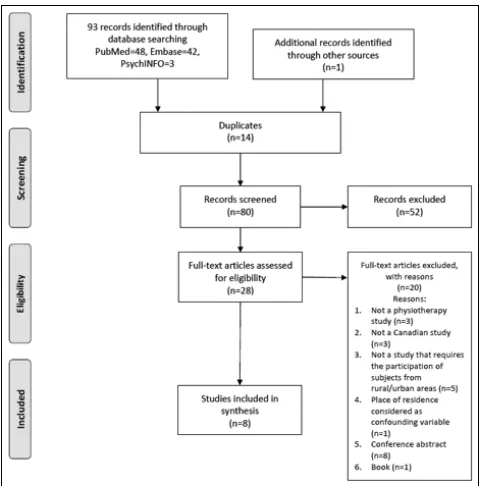
In total, 94 studies were identified through the electronic database (PubMed: 48, Embase: 42, PsychINFO: 3) and manual search (n = 1). After removing duplicates (n = 14), the title and abstracts of 80 articles were screened and 52 articles were excluded at this stage. The full texts of the remaining 28 articles were screened against the inclusion criteria. At this stage of the review, 20 studies were excluded and eight15–22 were selected to be included in this review. A flow diagram of the article selection process with details is depicted in Figure 1.
resisted exercises through using rope, rubber tubing, pulleys, and other similar equipment. In addition, the physiotherapists made alterations in home furnishings including changes in heights of tables and bed, strengthening of stair railings, alterations to chairs and toilets. The results of this study indicated that improvement in functional capacity was achieved in most of the patients, however, the success depended strongly on the expertise of the physiotherapist.18 The study by Gillis and colleagues assessed the perspectives of people with hip and knee arthritis about a physiotherapy extended-role practitioner (ERP) model of care study through semi-structured interviews.15 ERP is a model designed to increase the competencies of physiotherapists so that they can practice healthcare beyond their traditional duties. The results of this study indicated that in general rural residents had positive experiences with the ERP model.15 The third study that focused on arthritis is, in fact, the most recent physiotherapy study with rural participants.20 This study assessed barriers for access to medical and allied health services from the perspective of patients with arthritis. Structured interviews with standardized scripts were conducted on topics such as appointment waiting times, travel requirements, and satisfaction with healthcare provision. The results indicated that patients were mostly concerned with appointment waiting time with only 53% of the participants having seen a physiotherapist.20
Stroke
Another area of research investigated by studies in this review was stroke.16,22 The study by Langstaff and colleagues had the highest number of participants at 524 and took over three years, during which they assessed the impact of improving access to timely intensive home-based stroke rehabilitation follow-up care. The results indicated that this type of improvement decreased hospital length of stay, hospital readmission rates, and average wait times. In addition, the mean total number of community therapy visits increased.16 The second study that focused on stroke patients was conducted by Taylor and colleagues to assess the experiences from video conference participation for their healthcare.22 During video conferences a variety of healthcare activities were done including clinical assessments, educational sessions, information sharing, facilitated discussion, goal-setting, and exercise.22 The
results indicated that participants enjoyed the program mostly because they didn’t have to travel long distances and that they felt comfortable in discussions and during the exercises. The authors also reported some limitations of the program including a loss of subtleties in communication, lack of feedback to the group facilitators, and lack of a medium to address concerns.22
Chronic Pain Management
One study investigated chronic pain management by a multidisciplinary team consisting of a family physician, psychologist, physiotherapist, kinesiologist, nurse, and dietician.19 The results of this study indicated that not only it is possible in a rural setting, but also patients’ level of pain and disability significantly improved when cared for by the multidisciplinary team.19 In this study, the physiotherapist was involved with the primary assessment and management by prescribing exercise programs.19
Cardiac Rehabilitation in Children
The randomized trial conducted by Longmuir and colleagues investigated the difference between different physical activity enhancing exercise prescriptions delivered by parents and education programs in children with single-ventricle physiology after Fontan.17 The results of this study suggested that gross motor skills were improved in all groups. In a multivariate repeated measures regression model, it was discovered that spring season, male sex, greater baseline activity, and better gross motor skill, leads to better outcomes. Another important finding of this study was that the benefits were not different for urban and rural residents.17
Blood Pressure and Other Metabolic Risk Factors
The only randomized controlled trial was the study by Petrella and colleagues.21 In this study, the effects of a mobile health (mHealth) intervention on systolic blood pressure and other cardiometabolic risk factors were compared to an active control intervention. Participants were all individuals with increased cardiometabolic risk. The results indicated that after 12 weeks, greater improvements were seen in the active control group compared to the intervention group, and after 52 weeks there was no difference, but significant improvements were detected across the entire population.21
Table 1. Study Characteristics of the Included Articles (n=8) – listed by year
Authors, year Rural area Area of research Study design % rural % female Sample
size Mean age
Nair et al., 201620 Saskatchewan Rheumatoid arthritis Mixed methods
(cross-sectional) 100% 78% 100 58.8
Petrella et al., 201421 Ontario Cardiometabolic
syndrome Randomized controlled trial 100% IG: 73%CG:76% IG: 75CG: 74 IG: 55.7CG: 57.8
Langstaff et al., 201416 Southeastern
Ontario Stroke Prospective cohort 60% 48% 524 74.9
Gillis et al., 201315 Ontario Hip and knee arthritis Qualitative descriptive
case-study 100% 69% 13 66.5
Longmuir et al., 201317 Not reported Cardiac rehabilitation in
children Prospective randomized trial 25% 41% 54 9.1
Taylor et al., 201222 Ontario Stroke Interpretive qualitative 100% 47% 19 66.2
Burnham et al., 201019 Alberta Pain management Prospective cohort 100% 62% 29 45.2
Cameron et al., 196118 Saskatchewan Arthritis and allied
impose different challenges. This distinction between rural and urban health requirements is a significant factor that should be considered when researchers investigate risk factors.
Another example that can be used to explain how the health requirements of rural and urban residents can be different is by looking at the problem of chronic pain through a biopsychosocial perspective. According to the biopsychosocial model of pain, not only the extent of damage to tissue is important in recovery (from an injury), but also psychological and social aspects of an individual’s life will influence the experience of pain.28 The important concept to note here is that the psychological and social aspects of rural and urban residents can be different and the potential causes may be related to differences in culture and the social structure. For example, a study that assessed the association between rurality and psychiatric disorders reported that rural residents with psychiatric comorbidities are at an increased risk of addiction.29 Symonette and colleagues investigated the effect of social support on outcomes following distal radius fractures and concluded that higher social support is correlated with better recovery.30 Nevertheless, it should be noted that social support has been reported to be defined differently and have differing effects on health for rural and urban residents.31 These differences in psychological and social aspects that have a great influence on health, reinforce the need for studies to investigate the health of rural and urban residents either separately or include a combination of both populations.
Another notable finding of this study is that only a limited number of health areas have been investigated in Canadian physiotherapy studies (arthritis,15,18,20 stroke,16,22 cardiac rehabilitation in children,17 pain management,19 and cardiometabolic syndrome21), leaving a large number of health areas unstudied. These areas include (but are not limited to): cancer, neurological disorders, mental and cognitive disorders, respiratory disorders, musculoskeletal injuries, geriatrics, women’s health, falls, and health areas related to gender. Notwithstanding the foregoing, it is essential to realize that conducting research in rural areas or with rural participants imposes certain difficulties. One of these difficulties includes using measurement tools that have been developed for urban dwellers, which will be problematic to use because of unestablished reliability and validity in rural populations.32 Other major structural difficulties in conducting research with rural participants are environmental barriers, which includes significant increases in travel times by the researchers and locating appropriate participants.32 Another related point to consider is that due to the the limited number of physiotherapists practicing in rural areas, there is considerably less available time and resources that can be allocated to research versus clinical work.
Limitations
The first limitation of this study is that the quality of the included studies was not assessed. However, it is important to keep in mind that the aim of this review was to determine the prevalence of physiotherapy studies that have been conducted in rural areas and to shed light on the health topics that have been investigated, regardless of their quality. Given the dearth of such studies, assessing the quality or risk of bias doesn’t affect the results of this study. The second limitation of this review rests within the limitations of the available literature in that some articles that had rural participants (in addition to urban participants) may have been
Discussion
To the author’s knowledge, this is the first study that investigated the prevalence of rural residents’ recruitment in Canadian physiotherapy research and explored the health areas that have been investigated in this population. Through this literature search and synthesis, we were able to bring light to the notion that to date only eight Canadian physiotherapy studies have included rural residents as their participants. This is an alarmingly low prevalence considering that hundreds of physiotherapy research studies get published each year. It is important to recognize that rural residents may potentially have unique health requirements due to their culture, genetic makeup, and environmental circumstances. Therefore, to meet rural residents’ health requirements researchers need to include rural residents as participants. Through this study, it was discovered that only a limited number of health areas have been studied in Canadian rural areas including arthritis,15,18,20 stroke,16,22 cardiac rehabilitation in children,17 pain management,19 and cardiometabolic syndrome.21
In Canada, it is the law that everyone should have access to healthcare services.23 However, rural residents still suffer from poor health and shorter life expectancies, and face issues regarding access to healthcare services including physiotherapy.1 Limited access to healthcare services is a major issue and many efforts have been made towards its improvement.3 After conducting the database search, it was noted that the majority of physiotherapy studies that had focused on rural areas were conducted in efforts to address this issue (i.e., increase access to healthcare). For instance, a recent study by Taylor-Gjevre and colleagues evaluated the use of video-conferencing for rheumatoid arthritis patients for follow-up support and compared the results to the more traditional in-person clinic support. Their findings indicated that there is benefit in video-conferencing as there was no difference in effectiveness between the two methods.24 The fact that there are many publications about circumventing barriers to healthcare is a significant achievement considering that environmental and financial barriers are potentially the cornerstones of the bigger problem of poor health experienced by rural residents. However, one of the main questions that remain is how are we, the healthcare providers, supposed to treat patients when there is limited research about the unique health requirements of rural residents?
excluded because this information was not explicitly stated in the study. However, the purpose of this study was to capture articles that did, in fact, realize the distinction between rural and urban health requirements, therefore this limitation does not have a significant impact on the results. The findings of the aforementioned studies may appropriately generalize to the entire population of interest (including both rural and urban), but this information still needs to be explicitly collected and stated in all studies in order to avoid misunderstanding of the generalizability of the results.
In summary, it is important to reiterate that rural and urban residents have potentially distinct health requirements due to their possibly different genetic makeup, culture, and environment. Therefore, it is crucial that health researchers include both types of dwellers in their studies. In this review, we examined the prevalence of rural residents in Canadian physiotherapy studies and the results show an alarmingly low number of research articles with rural residents, and naturally a limited number of health areas have been covered in these studies. We recommend future researchers to realize the potential difference and include rurality as part of their investigation.
References
1. Shah TI, Milosavljevic S, Bath B, T.I. S, S. M. Measuring geographical accessibil-ity to rural and remote health care services: Challenges and considerations. Spat Spatiotemporal Epidemiol. 2017;21:87-96. doi:http://dx.doi.org/10.1016/j. sste.2017.04.002
2. DesMeules, Marie, Raymond Pong, Claudia Lagacé, Denis Heng, Doug Manuel, Roger Pitblado, Ray Bollman, Judy Guernsey, Arminee Kazanjian and IK. How healthy are rural Canadians? An assessment of their health status and health de-terminants. Can Inst Heal Inf. 2006.
3. Mitton C, Dionne F, Masucci L, Wong S, Law S. Innovations in health service organization and delivery in northern rural and remote regions: a review of the literature. Int J Circumpolar Health. 2011;70(5):460-472.
4. Physician Working Group on Rehabilitation Services: Conversation on Health: Improving Rehabilitation Services for the People of British Columbia. Vancou-ver, BC; 2007. http://www.health.gov.bc.ca/library/publications/year/2007/ conversation_on_health/media/Rehab_Services_in_BC.pdf.
5. Roots RK, Li LC. Recruitment and retention of occupational therapists and phys-iotherapists in rural regions: a meta-synthesis. BMC Health Serv Res. 2013;13:59. doi:10.1186/1472-6963-13-59
6. Bath B, Gabrush J, Fritzler R, et al. Mapping the Physiotherapy Profession in Saskatchewan: Examining Rural versus Urban Practice Patterns. Physiother Can. 2015;67(3):221-231. doi:10.3138/ptc.2014-53
7. Solomon P, Salvatori P, Berry S. Perceptions of important retention and re-cruitment factors by therapists in northwestern Ontario. J Rural Health. 2001;17(3):278-285.
8. Adrian S. Successful recruitment: what now? Asutralian J Rural Heal. 2008;16(4). 9. Farmer J, Bourke L, Taylor J, et al. Culture and rural health. Aust J Rural Health.
2012;20(5):243-247. doi:10.1111/j.1440-1584.2012.01304.x
10. Wereszczuk A, Leblois R, Zalewski A. Genetic diversity and structure related to expansion history and habitat isolation: stone marten populating rural-urban habitats. BMC Ecol. 2017;17(1):46. doi:10.1186/s12898-017-0156-6
11. Rhee SH, Hewitt JK, Young SE, Corley RP, Crowley TJ, Stallings MC. Genetic and environmental influences on substance initiation, use, and problem use in adolescents. Arch Gen Psychiatry. 2003;60(12):1256-1264. doi:10.1001/arch-psyc.60.12.1256
12. Aref-Eshghi E, Hurley O, Sun G, et al. Genetic associations in community context: a mixed model approach identifies a functional variant in the RBP4 gene associ-ated with HDL-C dyslipidemia. BMC Med Genet. 2018;19(1):205. doi:10.1186/ s12881-018-0719-1
13. Merchant J, Coussens C, Gilbert D, eds. Rebuilding the Unity of Health and the Environment in Rural America: Workshop Summary. Washington (DC); 2006. doi:10.17226/11596
14. Adami PE, Negro A, Lala N, Martelletti P. The role of physical activity in the prevention and treatment of chronic diseases. Clin Ter. 2010;161(6):537-541. 15. Gillis K, Augruso A, Coe T, et al. Physiotherapy extended-role practitioner for
individuals with hip and knee arthritis: patient perspectives of a rural/urban part-nership. Physiother Can. 2014;66(1):25-32. doi:10.3138/ptc.2012-55
16. Langstaff C, Martin C, Brown G, et al. Enhancing community-based reha-bilitation for stroke survivors: Creating a discharge link. Top Stroke Rehabil. 2014;21(6):510-519. doi:http://dx.doi.org/10.1310/tsr2106-510
17. Longmuir PE, Tyrrell PN, Corey M, Faulkner G, Russell JL, McCrindle BW. Home-based rehabilitation enhances daily physical activity and motor skill in children who have undergone the Fontan procedure. Pediatr Cardiol. 2013;34(5):1130-1151. doi:10.1007/s00246-012-0618-8
18. M.G.P. G, CAMERON MG, FARMER RH. Home physiotherapy for arthritic patiente in rural Saskatchewan: A program or the Canadian Arthritis and Rheu-matism Society (Saskatchewan Division). Sask Canad Med Ass J. 1961;85(12):694-697. http://ovidsp.ovid.com/ovidweb.cgi?T=JS&PAGE=reference&D=emcl1& NEWS=N&AN=281179889.
19. R. B, J. D, Burnham R, Day J, Dudley W. Multidisciplinary chronic pain man-agement in a rural Canadian setting. Can J Rural Med. 2010;15(1):7-13. http:// ovidsp.ovid.com/ovidweb.cgi?T=JS&PAGE=reference&D=emed11&NEWS=N &AN=358463332.
20. Nair B V, Schuler R, Stewart S, Taylor-Gjevre RM. Self-Reported Barriers to Healthcare Access for Rheumatoid Arthritis Patients in Rural and Northern Sas-katchewan: A Mixed Methods Study. Musculoskeletal Care. 2016;14(4):243-251. doi:10.1002/msc.1146
21. Petrella RJ, Stuckey MI, Shapiro S, Gill DP. Mobile health, exercise and meta-bolic risk: a randomized controlled trial. BMC Public Health. 2014;14:1082. doi:10.1186/1471-2458-14-1082
22. Taylor DM, Stone SD, Huijbregts MP. Remote participants’ experiences with a group-based stroke self-management program using videoconference technology. Rural Remote Health. 2012;12:1947.
23. Canada Health Act.; 1985. https://laws-lois.justice.gc.ca/eng/acts/c-6/. 24. Taylor-Gjevre R, Nair B, Bath B, et al. Addressing rural and remote access
dis-parities for patients with inflammatory arthritis through video-conferencing and innovative inter-professional care models. Musculoskeletal Care. 2018;16(1):90-95. doi:10.1002/msc.1215
25. The Value of Physiotherapy. Canadian Physiotherapy Association. https://phys-iotherapy.ca/value-physiotherapy. Published 2018.
26. Doi T, Shimada H, Park H, et al. Cognitive function and falling among older adults with mild cognitive impairment and slow gait. Geriatr Gerontol Int. 2015;15(8):1073-1078. doi:10.1111/ggi.12407
27. Modarresi S, Divine A, Grahn JA, Overend TJ, Hunter SW. Gait parameters and characteristics associated with increased risk of falls in people with demen-tia: a systematic review. Int psychogeriatrics. December 2018:1-17. doi:10.1017/ S1041610218001783
28. Gatchel RJ, Peng YB, Peters ML, Fuchs PN, Turk DC. The biopsychosocial ap-proach to chronic pain: scientific advances and future directions. Psychol Bull. 2007;133(4):581-624. doi:10.1037/0033-2909.133.4.581
29. Coughlin LN, Wilson SM, Erwin MC, Beckham JC, Calhoun PS. Cigarette smoking rates among veterans: Association with rurality and psychiatric disorders. Addict Behav. 2018;90:119-123. doi:10.1016/j.addbeh.2018.10.034
30. Symonette CJ, Macdermid J, Grewal R. Social Support Contributes to Out-comes following Distal Radius Fractures. Rehabil Res Pract. 2013;2013:867250. doi:10.1155/2013/867250
31. Tobiasz-Adamczyk B, Zawisza K. Urban-rural differences in social capital in relation to self-rated health and subjective well-being in older residents of six regions in Poland. Ann Agric Environ Med. 2017;24(2):162-170. doi:10.26444/ aaem/74719