ISSN: 2231-5381
http://www.ijettjournal.org
Page 2688Design, Modelling and Analysis of a Single Raw
Four Point Angular Contact Split Ball Bearing to
Increase its Life.
Pranav B. Bhatt #1, Prof. N. L. Mehta *2
#1M. E. Mechanical (CAD/CAM) Student, Department of Mechanical Engineering, B. H. Gardi College Of Engineering and
Technology, Rajkot, Gujarat, India.
*2 Asst. Professor, Department of Mechanical Engineering, B. H. Gardi College of Engineering and Technology,
Rajkot, Gujarat, India.
Abstract – In this paper design of four points angular contact ball bearing is done which is used in Propeller shaft of an air craft. This type of ball bearing can support radial load and axial load in both directions due to the four points of contact available. The inner ring of a four point angular contact ball bearing is split so because of larger ball quantity, higher carrying capacity is possible. In current work the models of the parts of the bearing are prepared considering the drawings of the bearing. With the help of analytical design life of bearing in working hours can be calculated. With the help of design parameters bearing can be modelled. After modelling, with the help of dynamic analysis of bearing its life in working hours can be calculated.
Index terms - Four point angular contact ball bearings, Split ball bearing, Propeller shaft
I. INTRODUCTION
An angular contact ball bearing uses axially asymmetric races. Angular contact bearings better support "combined loads". It achieves this by using at least two races to contain the balls and transmit the loads through the balls. In most applications, one race is stationary and the other is attached to the rotating assembly (e.g., a hub or shaft). As one of the bearing races rotates it causes the balls to rotate as well. This kind of bearings can be used in transmissions [6]. In this paper four point angular contact ball bearing is designed and analysed which is used on propeller shaft of aircraft. As a result life of bearing can be calculated which is less because of very high speed[1].
II. LITERATURE REVIEW
It has been studied that all angular-contact ball bearings have similar features regarding geometry,
mechanism, and structure [2]. The stiffness of
angular-contact ball bearings has a significant influence on the dynamics of a rotating shaft and the
precision of the machine system [3] the rolling
contact fatigue (RCF) life of rolling elements can be determined by full-scale bearing endurance tests. These tests that are conducted in bearing life test
rigs are expensive and time consuming[4]. Bearing
designers would like to understand the impact of four variables namely Ball material density, Subsurface residual stress, Gradient in yield strength with depth Raceway surface hardness/yield strength that are thought to affect spall propagation[7]. The normal contact stresses between steel ball and inner and outer ring raceway are calculated under different
negative clearance when bearing idling [8]. One
important demand on spindle system in modern machine tools is to realize higher rotational speeds in order to increase the machining efficiency [5]. Short spall propagation times of failing main shaft ball bearings of aircraft engines are a serious safety
concern for single engine aircraft[7].
III. ANALYTICAL DESIGN OF THE BEARING
A. Input Data
Ball diameter Dw = 13.49375 mm
Radial load Fr = 8000 N
ISSN: 2231-5381
http://www.ijettjournal.org
Page 2689RPM = 25000 No. of balls Z = 15 Ball pitch diameter = 92.5 mm No. of rows i = 1
B. Contact Angle
α = cos-1[1- {Gr / 2(ri + rc - Dw)}][12]
= cos-1[1- {0.15 / 2(7.06+7.06 - 13.49375}]
α = 28.5○ where,
Gr = radial clearance ri = inner groove radius
rc = outer groove radius α = contact angle
Dw = Ball diameter
Dw x cosα / dpw
= (13.49375 x cos 28.5○) / 92.5 = 0.128
Where,
Dw = Ball diameter α = contact angle
dpw = Ball pitch diameter
Therefore, as per ISO standards, Fc = 58.15 from interpolation.
Where,
Fc = factor for dynamic load rating calculation
C. Dynamic Load Ratings
Cr = Dynamic equivalent radial load
Cr = Fc (i x cosα)0.7 x (Z)2/3 x (Dw)1.8[11]
= 58.15(1 x cos 28.5)0.7 x (15)2/3 x (13.49375)1.8
Cr = 34960.55 N
D. Dynamic Equivalent Radial Load
Pr = X Fr + y Fa[1]
Where,
X = radial load factor = 1 Y = Thrust load factor = 0 Fr = Radial load
Pr = 1 x 8000 + 0
Pr = 8000N
E. Static Equivalent Radial Load
Por = X Fr + Y Fa[1]
Where, X = 0.5 Y = 0.29
From ISO Standards,
Por = 0.5 x 8000 + 0.27 x 21000
Por = 9670 N
F. Basic Life Ratings
L0 = (Cr/Pr)k [11]
Where,
Cr = Basic dynamic load rating
Pr = Dynamic radial load
K = 3 for ball bearings
L10 = 34960.55/8000
= 88.457
G. Life in Revolutions
L = L10 x 106[11]
= (Cr/Pr)k x 106
= 83.457 x 10⁶ Revolutions Where,
L = life in revolution
H. Life in Working Hours
L = 60 x N x Lh[11]
Lh = L/60 x N
= 83.457 x 10⁶/60 x 25000 Where,
Lh = Life in
ISSN: 2231-5381
http://www.ijettjournal.org
Page 2690 IV. ASSEMBLY OF THE BEARINGFigure 1 Assembly of the Bearing[10]
V. DEVELOPED DESIGN
Table 1 Developed design
Parameters No. Of Balls Ball diameter Contact angle
Life in working
hours Developed
design 15 13.49375 28.5
○ 55.638
VI. MODELING OF THE BEARING
A. Model and Geometry of Outer Race of the Bearing
Figure 1 Model and Geometry of outer race of the Bearing
B. Model and Geometry of Inner Race of the Bearing
Figure 2 Model and geometry of inner race of the Bearing
C .Model and Geometry of Cage of the Bearing
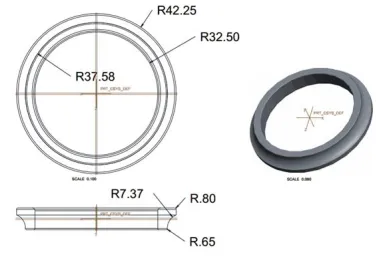
Figure 3 Model and geometry of cage of the Bearing)
D. Model and geometry of Ball of the Bearing
ISSN: 2231-5381
http://www.ijettjournal.org
Page 2691E. Assembly Model of the Bearing
Figure 5 Model and geometry of assembly of the Bearing
VII. DYNAMIC ANALYSIS RESULTS
A. Load Direction for Linear Static Analysis in Static Mode
Figure 6 Load directions in static Condition [12]
B. Pre-Processing for Dynamic Analysis of Bearing
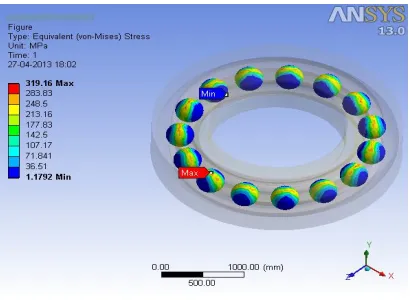
For the analysis of bearing boundary condition and force these parameters are required to be applied and then next step is meshing. Meshing is nothing but dividing objet in to small parts for results on that all different parts. In our object meshing is done by tetra method, fixed support applied at cage as a boundary condition, frictionless support applied at inner & outer ring due to lubrication, rotational force applied at a centre (25000 RPM), Axial force applied at outer ring with value of 21000 N.
C. Result Obtained by Dynamic Analysis in Form of Stress
Here, there are results in form of Von-misses Stress produced due to rotation of bearing at 25000 RPM.
Figure 7 Stresses on Outer Race
Figure 8 Stresses on Inner Race
ISSN: 2231-5381
http://www.ijettjournal.org
Page 2692 (Figure 10 Stresses on Balls)D. Results Obtained by Dynamic Analysis in Form of Life
Here, main objective of this research is to increase bearing life in working hours. It is resulted by changing inner grove radius, outer groove radius, contact angle, number of balls, and diameter of balls. After these changes following results are obtained.
Fig. 11.Life of Outer Race
Figure 12 Life of Cage
Figure 13 Life of Inner Race
ISSN: 2231-5381
http://www.ijettjournal.org
Page 2693 VIII. RESULTS AND CONCLUSIONTable 2 Comparison of life of the Bearing
Life in working hours by design 55.638 hours
Life in working hours by analysis 70 hours
In analytical design, by increasing numbers of ball, decreasing ball diameter, and changing the contact angle, the life in working hours can be increased. From the results of analytical design and analysis it can be seen that life of bearing is nearly same in both cases. Due to higher stresses, the life in working hours is limited to hours. It can be further increased by changing the parameters, material and lubrication of the Bearing.
IX. REFERENCES
[1] Robert P. Tata, “Ball Bearing Design”.vol.II
[2] Jing Liu, Yimin Shao, Teik C. Lim, “Vibration analysis of ball bearings with a localized defect applying piecewise response function”, Mechanism and Machine Theory 56 (2012) 156–169.
[3] Yuan Kanga, Chih-Ching Huang, Chorng-Shyan Lin, Ping-Chen Shen,
Yeon-Pun Changa, “Stiffness determination of angular-contact ball bearings by using neural network”, Tribology International 39 (2006) 461–469.
[4] Mohsen Mosleh, Keron Bradshaw, “Role of component configuration in
evaluation of accelerated rolling contact fatigue of ball bearings”, Wear 271 (2011) 2681– 2686.
[5] Shoji Noguchi, Tohru Kanada b, “3- and Contact Point Spindle Bearings
-a new Approach for High Speed Spindle Systems”, Laboratory of Machine Tools and Production Engineering. Aachen. Germany
[6] J. Jedrzejewski, W. Kwasny, “Modelling of angular contact ball
bearings and axial displacements for high-speed spindles”, CIRP Annals - Manufacturing Technology 59 (2010) 377–382.
[7] Nathan A. Branch, Nagaraj K. Arakere, Nelson Forster, Vaughn
Svendsen, “Critical stresses and strains at the spall edge of a case hardened bearing due to ball impact”, International Journal of Fatigue 47 (2013) 268–278.
[8] You Hui-yuan, Zhu Chun-xi, Li Wu-xing, “Contact Analysis on Large Negative Clearance Four-point Contact Ball Bearing”, Procedia Engineering 37 ( 2012 ) 174 – 178.
[9] Machine Design by R.C.Patel. B.E (Mech.) M.S. University Baroda. Vol.II.
[10] AEC Bearings catalogues.2010-2011.
[11] ISO Standards (IS: 3821, IS 3823:1988, ISO76:1987)
![Figure 6 Load directions in static Condition [12]](https://thumb-us.123doks.com/thumbv2/123dok_us/8604177.1725032/4.595.74.256.344.459/figure-load-directions-static-condition.webp)