ISSN: 2231-5381
http://www.internationaljournalssrg.org
Page 289An Edge Detection Algorithm based on Fuzzy Logic
Shikha Bharti Sanjeev Kumar
M.Tech Scholar/Electronics & Comm.Engg./ Asst. Professor/ Electronics & Comm.Engg./ Amritsar college of Engg. & Technology, Amritsar college of Engg. & Technology,
Amritsar, Amritsar, 143001, India 143001, India
Abstract
—Edges characterize boundaries and are therefore considered for prime importance in image processing. Edgedetection filters out useless data, noise and frequencies while preserving the important structural properties in an image. The proposed method adopts fuzzy reasoning in order to extract edges. Here the scanning of an image using the windowing technique takes place which is subjected to a set of fuzzy conditions. A 2*2 scanning mask is used and the Fuzzy inference system designed has four inputs, which corresponds to four pixels of the scanning matrix, one output that tells whether the pixel under consideration is “edge” or “non-edge” pixel. In this paper, we evaluate the performance of a fuzzy inference system in edge detection. The results for images with high contrast variation are compared to those obtained with the linear Sobel operator.
Keywords
─
Image processing, Fuzzy logic, Fuzzy image processing, MATLAB, Edge detection, fuzzy rules, fuzzification, de-fuzzification1. INTRODUCTION
Edge detectors have been an essential part of many computer vision systems and in this modern era these are of great importance. The edge detection process serves to simplify the analysis of images by drastically reducing the amount of data to be processed, while at the same time preserving useful structural information about object
boundaries. There is certainly a great deal of diversity in the applications of edge detection,
but it is felt that many applications share a common set of requirements. These requirements yield an abstract edge detection problem, the solution
of which can be applied in any of the original problem domains[7].
ISSN: 2231-5381
http://www.internationaljournalssrg.org
Page 290 The goal of the edge detection is to locate thepixels in the image that corresponds to edges of the objects seen in the image. An idea to solve the problem of edge detection by using fuzzy image processing and as well as the comparisons of the results with traditional methods of edge detection is the main consideration of this work. [5,6] . A fuzzy relative pixel value algorithm for edge detection has been presented by Shashank Mathur and Anil Ahlawat,in which the relative pixel values in 3*3 pixel mask are checked for scanning of image using the windowing technique, which is subjected to a set of fuzzy conditions for the comparison of pixel values with adjacent pixels to check the pixel magnitude gradient in the window.[1]
In this paper , the 2*2 window mask is used alongwith the fuzzy logic rules based algorithm for the detection of image edges.
Fuzzy Inference based system in MATLAB environment has been developed, which is capable of detecting edges of an image . The result has been compared with the standard Algorithms.
A.Fuzzy Image Processing
The work of this paper is concerned with the development of fuzzy logic rules based algorithm for the detection of image edges. For applying fuzzy on an image in order to detect the edges, image preprocessing is done. Fuzzy image processing is the collection of all approaches that understand, represent and process the images, their segments and features as fuzzy sets. Fuzzy image processing has three main stages, shown in the figure 1, The fuzzification and defuzzification steps do not possess fuzzy hardware. Therefore, the coding of image data (fuzzification) and decoding of the results (defuzzification) are steps that make possible to process images with fuzzy techniques. In many image processing applications, expert knowledge is used to
overcome the difficulties (e.g. object recognition, scene analysis).
Fig.1 The general structure of fuzzy image processing
Fuzzy set theory and fuzzy logic offer powerful tools to represent and process human knowledge in form of fuzzy if-then rules.
2.PROPOSED METHOD
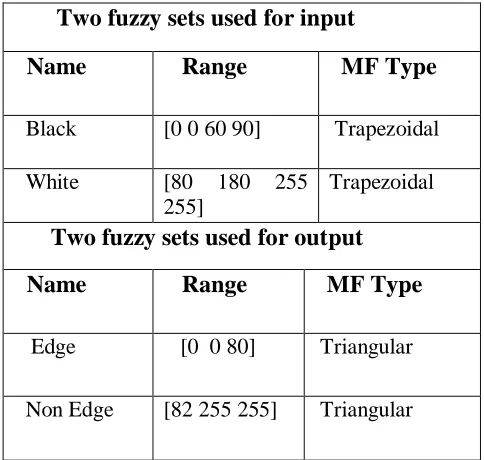
In this proposed method four inputs and one output is given to the fuzzy inference system. The four inputs are the four pixels of the 2*2 masking window.For inputs and output ,the triangular membership function is used. Two fuzzy sets are used for the input -Black & White and two fuzzy sets are used for the output- Edge &. Non-Edge
A.Fuzzy sets and fuzzy membership functions
ISSN: 2231-5381
http://www.internationaljournalssrg.org
Page 291 Fig. 3 Membership functions of the fuzzy sets associatedto the input
Fig. 4 Membership functions of the fuzzy sets associated to the output
The functions adopted to implement the “and” and “or” operations are the minimum and maximum functions, respectively. The Mamdani method is chosen as the defuzzification procedure, which means that the fuzzy sets obtained by applying each inference rule to the input data are joined through the add function; the output of the system is then computed using weighted average method of the resulting membership function. The values of the two membership functions of the output are designed to separate the values of the edges regions and non edges regions of the image. The mask is slid over an area of the input continues to shift towards right until it reaches the end of a row. It then starts at the beginning of the next row & process continues till the whole image is scanned.
Table 1. FUZZY SETS FOR INPUT AND OUTPUT
Two fuzzy sets used for input
Name Range MF Type
Black [0 0 60 90] Trapezoidal
White [80 180 255 255]
Trapezoidal
Two fuzzy sets used for output
Name Range MF Type
Edge [0 0 80] Triangular
Non Edge [82 255 255] Triangular
When this mask is made to slide over the image, the output is generated by the fuzzy inference system based upon the rules and the value of the pixels P1, P2, P3 and P4. To accomplish the task of edge detection using fuzzy logic,the step by step methodology is followed as described under
a) Crisp inputs for P1, P2, P3 & P4 are fuzzified into various fuzzy sets, having membership functions Black & White.
b) Firing strength is calculated using fuzzy t-norms operators (MIN or PRODUCT) on MFs. c) Fuzzy rules are fired for each crisp input. d) Aggregate resultant output FS for all fired rules is achieved by using MAX operator (s-norm).
e) De-fuzzification is performed using the Centroid method.
f) Crisp Output P4_out is the pixel value of the output image i.e. one containing the edges and non edge regions.
ISSN: 2231-5381
http://www.internationaljournalssrg.org
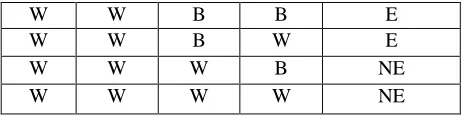
Page 292 B.Fuzzy Inference Rules:The inference rules depend on the weights of the four neighbor gray level pixels, if the neighbor’s weights are degree of blacks or degree of whites. The powerful of these rules is the ability to extract all edges in the processed image directly. This study is assaying all the pixels of the processed image by studying the situation of each neighbor of each pixel. The condition of each pixel is decided by using the floating 2x2 mask which can be scanning the all grays. In this location, some of the desired rules are explained. Since we have four pixel values as input, the total number of rules generated is sixteen. We have defined two fuzzy sets Black (B) and White(W) for four fuzzy input variables
P1,P2,P3and P4 and two fuzzy sets Edge (E)and Non Edge (NE) for output variable P4_out representing the image after the edges have been detected over the universe of discourse U = [0 ,..., G - I] (G = 256).From the experience of the tested images in this study, it is found that the best result to be achieved at the range black from zero to 80 gray values and from 80 to 255 meaning that the weight is white The fuzzy rules for this fuzzy edge detection algorithm are shown below:
Table2. Fuzzy Rule Matrix
Fuzzy Inputs Fuzzy
Output
P1 P2 P3 P4 P4_out
B B B B NE
B B B W E
B B W B E
B B W W E
B W B B E
B W B W E
B W W B E
B W W W E
W B B B E
W B B W E
W B W B E
W B W W E
W W B B E
W W B W E
W W W B NE
W W W W NE
3.SIMULATION RESULTS
The proposed system was tested with different Images, its performance being compared the existing edge detection algorithms and it was observed that the outputs of this algorithm provide much more distinct marked edges and thus have better visual appearance than the standard existing It can be observed that the output that has been generated by the fuzzy method has found out the edges of the image more distinctly as compared to the ones that have been found out by the “Sobel” edge detection algorithm. Thus the Fuzzy rule based System provides better edge detection and has an exhaustive set of fuzzy conditions which helps to extract the edges with a very high efficiency.
ISSN: 2231-5381
http://www.internationaljournalssrg.org
Page 293 6. CONCLUSIONIn this paper, emphasis has been to develop a very simple & small but a very efficient, fuzzy rule based edge detection algorithm to abridge the concepts of artificial intelligence and digital image processing. The algorithm and associated GUI has been developed in MATLAB environment. Comparisons were made with the various other edge detection algorithms that have already been developed. Displayed results have shown the accuracy of the edge detection using the fuzzy rule based algorithm over the other algorithms. The fuzzy rule based algorithm has been successful in obtaining the edges that are present in an image after the its implementation and execution with various sets of images. Sample outputs have been shown to make the readers understand the accuracy of the algorithm. Thus developed algorithm exhibits tremendous scope of application in various areas of digital image processing.
7. FUTURE SCOPE
The technique applied in this paper can be optimized by the fusion of other intelligent methods like Artificial Neural Network, Genetic Algorithm etc. Also within the Fuzzy logic technique ,a type 2 Fuzzy system can be used to get better response. Various parameters can be varied in order to improve the edges.Moreover the size of the mask can be increased and accordingly more rules can be set and results can be compared w.r .t the mask size.
.
REFERENCES
[1] Shashank Mathur, Anil Ahlawat, “Application Of Fuzzy Logic In Image Detection”, International Conference
"Intelligent Information and Engineering Systems" INFOS 2008, Varna, Bulgaria, June-July 2008
[2] O. R.Vincentand and O. Folorunso [2009]
“A descriptive algorithm for sobel image edge
detection” Proceedings of Informing Science &
IT Education Conference (InSITE) 2009
[3] LIANG, Lily, Rui and LOONEY, Carl, G. Competitive fuzzy edge detection. 2003, Applied Soft Computing 3, pp. 123–137.
[4] E. Argyle. “Techniques for edge detection,”
Proc. IEEE, vol. 59, pp. 285-286, 1971.
[5] Ayman A. Alyand and Abdallah A. Alshnnaway [2009], “An edge detection and
filtering mechanism of two dimensional digital objects
[6] Tizhoosh [1997], “Fuzzy Image Processing.”
Springer and 1997. based on fuzzy inference” World Academy of
Science and Engineering and Technology 53 2009
[7] John Canny. [Nov. 1986], “A computational approach to edge detection”. Pattern Analysis and Machine Intelligence and IEEE Transactions on and PAMI-8(6):679–698
[8] Becerikli T. and Anf Karan Y. [2005], “A new fuzzy approach for edge detection”. In J. Cabestany, A. Prieto, and D. Sandoval,editors,