Dramatic Improvement of CRISPR/Cas9
Editing in
Candida albicans
by Increased
Single Guide RNA Expression
Henry Ng, Neta Dean
Department of Biochemistry and Cell Biology, Stony Brook University, Stony Brook, New York, USA
ABSTRACT The clustered regularly interspaced short palindromic repeat system with CRISPR-associated protein 9 nuclease (CRISPR/Cas9) has emerged as a versatile tool for genome editing in Candida albicans. Mounting evidence from other model systems suggests that the intracellular levels of single guide RNA (sgRNA) limit the efficiency of Cas9-dependent DNA cleavage. Here, we tested this idea and describe a new means of sgRNA delivery that improves previously described methods by ~10-fold. The efficiency of Cas9/sgRNA-dependent cleavage and repair of a single-copy yeast enhanced monomeric red fluorescent protein (RFP) gene was measured as a function of various parameters that are hypothesized to affect sgRNA accumulation, including transcriptional and posttranscriptional processing. We analyzed different promoters (SNR52,ADH1, andtRNA), as well as different posttranscriptional RNA pro-cessing schemes that serve to generate or stabilize mature sgRNA with precise 5=
and 3= ends. We compared the effects of flanking sgRNA with self-cleaving ri-bozymes or by tRNA, which is processed by endogenous RNases. These studies dem-onstrated that sgRNA flanked by a 5= tRNA and transcribed by a strong RNA poly-merase II ADH1 promoter increased Cas9-dependent RFP mutations by 10-fold. Examination of double-strand-break (DSB) repair in strains hemizygous forRFP dem-onstrated that both homology-directed and nonhomologous end-joining pathways were used to repair breaks. Together, these results support the model that gRNA ex-pression can be rate limiting for efficient CRISPR/Cas mutagenesis inC. albicans.
IMPORTANCE Candida albicansis an important human fungal pathogen. An under-standing of fungal virulence factors has been slow becauseC. albicansis genetically intractable. The recent development of CRISPR/Cas in C. albicans (V. K. Vyas, M. I. Barrasa, G. R. Fink, Sci Adv 1:e1500248, 2015,https://doi.org/10.1126/sciadv.1500248) has the potential to circumvent this problem. However, as has been found in other organisms, CRISPR/Cas mutagenesis efficiency can be frustratingly variable. Here, we systematically examined parameters hypothesized to alter sgRNA intracellular levels in order to optimize CRISPR/Cas in C. albicans. Our most important conclusion is that increased sgRNA expression and maturation dramatically improve efficiency of CRISPR/ Cas mutagenesis inC. albicansby ~10-fold. Thus, we anticipate that the modifications described here will further advance the application of CRISPR/Cas for genome editing inC. albicans.
KEYWORDS CRISPR,Candida albicans, RFP, double-strand-break repair
C
andida albicansis an opportunistic fungus that is a major cause of fatal infections, especially in individuals with compromised immune systems. Despite its impor-tance as a human pathogen, a deeper understanding of pathogenesis has been limited by the genetic intractability ofC. albicans;C. albicanshas a parasexual life cycle with no meiosis, and therefore genetic crosses are not possible. SinceC. albicansnormally exists as a diploid, recessive mutations must be made homozygous. The development of theReceived23 December 2016Accepted27
March 2017 Published19 April 2017
CitationNg H, Dean N. 2017. Dramatic improvement of CRISPR/Cas9 editing in
Candida albicansby increased single guide RNA expression. mSphere 2:e00385-16.https:// doi.org/10.1128/mSphere.00385-16.
EditorMichael Lorenz, University of Texas Health Science Center
Copyright© 2017 Ng and Dean. This is an open-access article distributed under the terms of theCreative Commons Attribution 4.0 International license.
Address correspondence to Neta Dean, [email protected].
Molecular Biology and Physiology
crossm
on September 8, 2020 by guest
http://msphere.asm.org/
clustered regularly interspaced short palindromic repeat system with CRISPR-associated protein (CRISPR/Cas) in C. albicans (1) is an important advance that promises to accelerate the pace of progress inCandida albicansbiology research.
CRISPR/Cas is a system that provides adaptive immunity in bacteria (2–4). Adapta-tion of type II CRISPR/Cas for eukaryotic gene editing requires RNA-guided recruitment of the Cas9 nuclease to specific DNA sequences that are adjacent to an “NGG” protospacer adjacent motif (PAM) (5–7). Cas9 is recruited to the target site by a single guide RNA (sgRNA) comprised of a 20-nucleotide guide RNA (gRNA), which directs cleavage specificity by base-pairing complementarity to the target site, and an ~80 nucleotide trans-activating CRISPR-targeting RNA (tracrRNA), which binds Cas9. The sgRNA/Cas9 ribonucleoprotein is recruited to the target site, where Cas9 creates a double-strand break (DSB) 3 bases upstream of the PAM site (3). Since chromosomal breaks are lethal, there is a strong selection for their repair, either by nonhomologous end joining (NHEJ) or by homology-directed repair. The introduction of a DSB can increase the rate of recombination by repair with linear homologous DNA by several thousand-fold (5, 8, 9). Thus, donor repair fragments containing homology to regions flanking the DSB can be designed to introduce deletions or other alterations with single-base-pair precision.
Evidence has supported the idea that intracellular levels of correctly folded, nuclear localized sgRNA limit the rate of Cas9-dependent cleavage (10, 11). Up until now, C. albicans CRISPR/Cas studies have used the RNA polymerase III (Pol III) SNR52 promoter (PSNR52) to drive sgRNA expression (1, 12). Unlike most genes transcribed by Pol III that contain internal promoters within the transcribed region, SNR52 has an upstream promoter (13). Thus,PSNR52Pol III transcripts are initiated downstream of the promoter but are not confounded by RNA polymerase II (Pol II)-associated 5=cap and 3= poly(A) additions that are predicted to influence sgRNA specificity and nuclear retention. PSNR52 has been used successfully for sgRNA expression in both Saccharo-myces cerevisiaeandC. albicans(1, 14), but its relative efficiency inC. albicanshas not been compared to those of other sgRNA delivery schemes.
Our attempts to use thePSNR52CRISPR system described by Vyas et al. (1) did not lead to high-efficiency mutagenesis of severalC. albicanstarget genes, despite the use of different gRNAs that target different sites within each gene. Therefore, to improve CRISPR mutagenesis, we sought to optimize sgRNA expression and CRISPR/Cas effi-ciency inC. albicans by comparing different promoters and RNA processing mecha-nisms. Our results demonstrate that gRNA expression can indeed be rate limiting for efficient DSB cleavage in C. albicans, and we describe new modifications that can increase the efficiency of gene editing inC. albicansby 10-fold. While our major goal was to optimize gRNA expression, our experiments also revealed that in addition to homology-directed repair, under certain conditions, Cas9-dependent DSB can be re-paired by nonhomologous end joining at low frequency.
RESULTS AND DISCUSSION
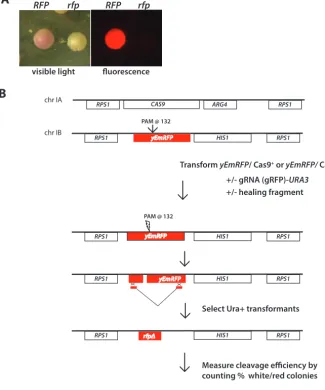
Assay system.To examine gRNA-dependent Cas9 nuclease activity, theC. albicans gene encoding codon-optimized enhanced monomeric red fluorescent protein (yEmRFP [henceforth referred to asRFP]) was targeted (15). C. albicansstrains expressingRFP display a distinct pink colony color phenotype as well as bright red fluorescence (16). Inactivation of RFP by mutation results in a reversal of the pink colony color, red fluorescence phenotype, so colonies derived fromrfpmutants could be easily distin-guished by their white color and absence of fluorescence (Fig. 1A).
We constructedRFPhemizygous strains in whichHIS1-markedRFPwas integrated at single copy at theRPS1locus (Fig. 1B). As a control for Cas9-dependentrfpmutations, we constructed RFP strains that do or do not also expressCAS9. C. albicans uses a noncanonical genetic code that reads the leucine CTG codon as serine. Thus, a synthetic Candida-optimized CAS9 gene (CaCAS9) was designed to alter each CTG serine codon to an AT-rich leucine codon. In addition, the codon bias of the entire gene was maximized toward AT-rich codons (see Materials and Methods). TheseRFP/CaCAS9
on September 8, 2020 by guest
http://msphere.asm.org/
strains were transformed withURA3-marked sgRNA plasmids (described below) that targetedRFP cleavage proximal to the PAM site at position ⫹132 of the RFPopen reading frame (ORF) (Fig. 1B). The efficiency of Cas9/sgRNA-dependent cleavage was measured by determining the percentage of white, nonfluorescentrfpmutant colonies in the population of transformants.
These transformations were performed in the presence or absence of a donor repair fragment designed to delete 370 bp of theRFP ORF after homology-directed repair. This repair fragment was made using overlap extension PCR and contained 285-bp arms of upstream and 308-bp downstream sequence homology to regions flanking the DSB (see Materials and Methods) (Fig. 2). To confirm thatRFPin white colonies was correctly deleted by recombination with the repair fragment,RFPwas amplified by PCR, analyzed by gel electrophoresis for the presence of the deleted allele, and also
+/- gRNA (gRFP)-URA3 +/- healing fragment
Analyze yEmRFP by PCR HIS1
yEmRFP yEmRFP
RPS1 RPS1
PAM @ 132
visible light fluorescence
Transform yEmRFP/ Cas9+ or yEmRFP/ Cas9
-A
RFP rfp RFP rfpB
Measure cleavage efficiency by counting % white/red colonies Select Ura+ transformants
HIS1
yEmRFP
RPS1 RPS1
PAM @ 132
HIS1
RPS1 rfpΔrfpΔ RPS1
yEmRFP
yEmRFP HIS1
RPS1 RPS1
X X
ARG4
yEmRFP yEmRFP
RPS1 CAS9 RPS1
chr IA
chr IB
FIG 1 CRISPR/Cas targeting of RFP inC. albicans. (A) Yeast colonies that express functionalRFPare pink and are fluorescent and can be easily distinguished from colonies that arise through CRISPR-mediated deletion of RFP, which are white and nonfluorescent. Panel B depicts the strategy for quantitating Cas9-and sgRNA-dependent cleavage of RFP. RFP (EPC1) or RFP CaCAS9 (EPC2) hemizygous strains were constructed as described in Materials and Methods. These strains were transformed with or without a donor healing fragment and a series ofURA3-marked plasmids that differ in expression of an RFP sgRNA (Fig. 3). The gRNA targets a 20-bp DNA sequence proximal to theRFPPAM site at position 132. The number of white and red colonies in each transformation was counted, and cleavage efficiency was calculated as the percentage of white colonies in the population.
on September 8, 2020 by guest
http://msphere.asm.org/
sequenced (see below). This screen allowed a simple and accurate way to measure the efficiency of Cas9-dependent cleavage and repair ofRFP.
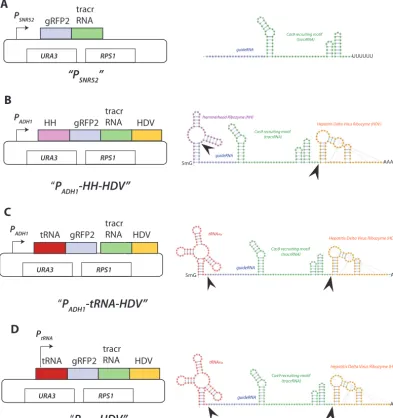
sgRNA delivery schemes.To optimize sgRNA expression, several parameters were varied, including the promoters used to drive transcription, as well as removable flanking sequences designed to be posttranscriptionally cleaved to produce transcripts with precise 5=and 3=ends. A schematic diagram of the different constructs and the predicted RNA transcripts is shown in Fig. 3, and their DNA sequences are listed in Fig. S1 in the supplemental material. Each construct had the same sgRNA sequence but differed in the promoters used to drive sgRNA transcription and/or flanking sequences that encode ribozymes or tRNAs that are posttranscriptionally cleaved.
The first construct used the Pol IIIPSNR52to drive sgRNA expression (PSNR52-sgRNA). TheC. albicans PSNR52promoter sequence and sgRNA junction were the same as those used in previous studies (Fig. 3A) (1).PSNR52Pol III transcripts are initiated at a purine, G or A, and are terminated by a poly(U) stretch (six in yeast) (13).
The second delivery scheme used the strong Pol IIADH1promoter (PADH1) to drive sgRNA transcription (Fig. 3B). Because PADH1 is a strong constitutive promoter, we reasoned thatPADH1may increase the levels of sgRNA. To prevent potential interference of sgRNA specificity by the 5=cap and 3=poly(A) tail associated with Pol II transcripts, self-cleaving hammerhead (HH) and hepatitis delta virus (HDV) ribozymes were added to the 5=and 3=ends of sgRNA. The presence of these ribozymes at the sgRNA ends may also protect it from nucleases and therefore further increase its intracellular levels. In the design of this cassette, the first six nucleotides of the HH ribozyme are
comple-301bp 321bp
604bp PCR
Anneal
Replication
PCR
+33 +403
-252 +711
yEmRFP
PAM+132
HR w/ yEmRFP
PAM+132
rfpΔ 33-403
FIG 2 Construction of the RFP donor repair fragment. The donor repair fragment used for repair of the Cas9-induced DSB was constructed by overlap PCR. Two fragments were amplified by PCR, one of which contains a 3=end that is homologous to the 5=end of the other. After the two fragments are mixed, these homologous regions anneal to one another, and then a round of DNA replication produces a single fragment with arms of homology to the 5=and 3=regions of RFP, but which is deleted for 370 bp of the ORF, including the PAM site at position 132. Homologous recombination of this rfp⌬33-403 fragment with chromosomalRFP can easily be detected by PCR amplification (Fig. 4).
on September 8, 2020 by guest
http://msphere.asm.org/
mentary to the first six nucleotides of the gRNA, thus allowing the formation of the stem structure required for HH self-cleavage at the gRNA-HH junction (17). The sites of the HH and HDV predicted cleavage sites are indicated by the arrowheads in Fig. 3B. To compare the efficiency of sgRNA maturation, the third delivery scheme used the same strong PADH1to transcribe sgRNA, but its 5= end was flanked with C. albicans tRNAAlainstead of the HH ribozyme (Fig. 3C). The rationale for this idea was 2-fold. First,
PADH1
HH gRFP2 HDV
URA3 RPS1
PADH1
tRNA gRFP2 HDV
URA3 RPS1
gRFP2 HDV
URA3 RPS1
tRNA
PSNR52
gRFP2 tracr RNA
URA3 RPS1
A
B
C
D
Hammerhead Ribozyme (HH)
Cas9 recruiting motif (tracrRNA)
guideRNA
Hepatitis Delta Virus Ribozyme (HDV)
5mG AAA
guideRNA
Cas9 recruiting motif (tracrRNA)
Hepatitis Delta Virus Ribozyme (HDV) tRNAAla
5mG AAA
Cas9 recruiting motif (tracrRNA)
guideRNA
UUUUUU
PtRNA
“P
SNR52”
“
P
ADH1-HH-HDV”
“
P
ADH1-tRNA-HDV”
“
P
tRNA-HDV”
tracr RNA
tracr RNA
tracr RNA
guideRNA
Hepatitis Delta Virus Ribozyme (HDV) tRNAAla
AAA Cas9 recruiting motif
(tracrRNA)
FIG 3 Schematic diagram of sgRNA expression cassettes and the structures of their predicted encoded RNA. The backbone of each of these plasmids is based on theURA3integrating CIP10 plasmid (35) (see Materials and Methods). RNA secondary structure visualization was performed using VARNY (http://varna.lri.fr/) (41). (A)PSNR52drives transcription of the sgRNA that consists of the 20-nucleotide gRFP (purple) fused to the 85-nucleotide Cas9 recruiting tracrRNA (green). Note that this sgRNA is identical in all four delivery schemes. The gRNA has the requisite 5=G and a 3=poly(U) tail. (B)PADH-HH-HDV.The sgRNA is flanked by the 5=hammerhead (HH [pink]) and 3=hepatitis delta virus (HDV [yellow]) ribozymes. HH-sgRNA-HDV transcription is driven by the strongADH1promoter. The stem structure formed between the 5=HH and 5=gRNA forms the structural motif recognized for autocleavage (depicted by arrowhead). The 3=cleavage relies on the autonomous pseudoknot structure of HDV (depicted by arrowhead). (C)PADH-tRNA(⫺HDV). This construct is exactly like that shown in panel B, but the hammerhead sequence is replaced by the 75-bpC. albicansalanine tRNA gene. In this scheme, the mature 5=end of the sgRNA is generated by endogenous RNase Z, which recognizes the stem structure formed by tRNA 5=and 3=sequences. 3=cleavage relies on the autonomous stem-loop structure of HDV (depicted by arrowhead). Transcription of the tRNA-sgRNA-HDV is driven by the strongADH1promoter. (D)PtRNA(⫺HDV). This construct is exactly like that of panel C, but the PADH1sequence is deleted. In this cassette, RNA Pol III transcription is driven by the internal A and B box elements of the tDNA promoter, and the mature 5=end of the sgRNA is generated by endogenous RNase Z, while 3=cleavage relies on the autonomous pseudoknot of HDV (depicted by arrowhead).
on September 8, 2020 by guest
http://msphere.asm.org/
endogenous RNase P and Z mediate the robust posttranscriptional cleavage of 5=and 3=ends of pre-tRNAs (18, 19). These endogenous RNase activities may be more efficient than HH autocatalysis and therefore lead to improved sgRNA maturation. Second, cleavage by RNase Z at the tRNA-sgRNA junction requires recognition of sequences that are only within the tRNA. Therefore, this architecture, if efficient, would provide a more portable platform for swapping out the 20-bp gRNA coding sequence with any another gRNA. This is not possible using HH ribozyme, whose unique 5=sequence is constrained by each different gRNA. The sequence of the sgRNA-tRNA junction was designed to yield the precise sgRNA 5=end after cleavage with RNase Z (11, 20). The sites of the tRNA and HDV predicted cleavage sites are indicated by the arrowheads in Fig. 3C.
As tRNAs are very abundant, we considered the possibility that the tRNA promoter itself may be efficient in directing sgRNA expression (11, 20). To test this, the fourth delivery scheme used the tRNAAlafused to sgRNA-HDV (Fig. 3D). Cleavage of tRNA at its 3=trailer by endogenous RNase Z (see arrows for cleavage site) allows maturation of sgRNA with a precise 5=end. The sites of the tRNA and HDV predicted cleavage sites are indicated by the arrowheads in Fig. 3D.
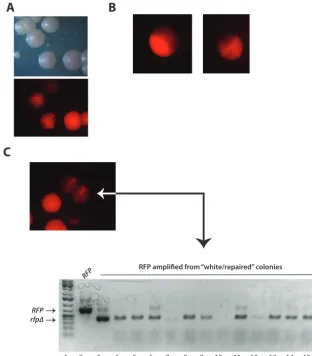
Measuring RFP mutation as a function of sgRNA delivery. To compare their relative activities, each of theURA3-marked CIp gRNA plasmids described above, or a negative (⫺) gRNA vector alone (⫺gRNA) was transformed side by side intoRFPstrains that did (EPC2) or did not (EPC1) express Cas9 (see Materials and Methods). Each transformation was performed in the presence or absence of a repair fragment (see Materials and Methods). After 2 days, colonies from each transformation were counted by fluorescence microscopy to determine the number of white and red colonies for each transformation. Unexpectedly, in addition to pure red and white colonies, under certain conditions, we observed red colonies with white sectors (Fig. 4). White or white-sectored colonies were seen at a frequency of less than 10⫺4in control experi-ments, in which the isogenic Cas9⫺EPC1 strain was transformed with gRNA, vector, and/or the donor repair fragment (data not shown) (Table 1). White or white-sectored colonies were also not observed in Cas9⫹EPC2 cells transformed with vector lacking gRNA with or without the donor repair fragment. These control experiments demon-strated that the high frequency of white or white-sectored colonies was not due to spontaneous looping out ofRFP, which is flanked byRPS1repeats, or by replacement of RFP with the CIp-gRNA plasmid during integration at RPS1. Instead, white and white-sectored colonies were dependent on the expression of both Cas9 and sgRNA (Fig. 5C; Table 1). Each white sector represented a Cas9-mediatedRFPcleavage event that occurred in a cell at the vertex of the white sector. The sizes and numbers of white sectors ranged from those that were 1/2 the colony, in which RFP cleavage likely occurred in one daughter cell of the first division, to those that appear mostly white but had a remaining sliver of red cells in a colony (Fig. 4A and B). Therfpmutation that gave rise to white sectors was stable, since restreaking a sectored colony on –Ura plates resulted in colonies that were almost completely white (not shown). This sectoring phenotype could explain why PCR analysis ofRFPamplified from genomic DNA from what appeared to be visually “white/healed” colonies occasionally yielded both full-length and deletedRFPproducts (Fig. 4C).
Thus, to more accurately quantitate the relative efficiency of sgRNA delivery, we counted the number of white, red, and sectored colonies produced after transforma-tion with each of the different plasmids, in the presence or absence of healing fragment. These results, shown graphically in Fig. 5A and B, demonstrated a clear hierarchy of cleavage efficiency as measured by the percentage of pure white rfp⌬ mutant colonies in the population, in the following order:PADH1-tRNA(~94% white)⬎ PADH-HH (~22% white)⬎PSNR52 (9% white)⫽PtRNA (~8% white). When sgRNA tran-scription was driven by the Pol IIADH1promoter but flanked by the 5=hammerhead ribozyme instead of the tRNA, the Cas9-directed mutation frequency was reduced by ~3.5-fold. When sgRNA transcription was driven by the Pol IIISNR52ortRNApromoters, the mutation frequency was reduced by ~10-fold. While the experiments shown in
on September 8, 2020 by guest
http://msphere.asm.org/
Fig. 5 were performed using CIp-based integration plasmids, the same trend was observed usingCaARS-containing plasmids (data not shown). Therefore, we inferred that the high efficiency observed when sgRNA was delivered using the PADH1-tRNA plasmid is due to the combination of (i) increased Pol II PADH1promoter strength,
A
B
C
RFP rfpΔ
RFP
1 2 3 4 5 6 7 8 9 10 11 12 13 14 15 RFP amplified from “white/repaired” colonies
FIG 4 Sectored colony phenotype ofRFPmutants. (A) Comparison of red, white, and sectored colony phenotype in visible and red fluorescent light. (B) Examples of various degrees of sectoring that range from mostly red to mostly white. (C) Red and white phenotypes in a sectored colony are genetically stable. A single sectored colony was restreaked on nonselective medium. Below is shown PCR analysis of full-length andrfp⌬33-403from white “repaired” colonies isolated after transformation in the presence of a donor repair fragment.
TABLE 1 RFPmutagenesis withPADH-tRNA-gRFP-HDV
Transformationa
Total no. of transformantsb
% of colonies: % of transformants:
Red White Sectored Hisⴙc Argⴙd
(⫺) Cas9 (EPC1), (⫹) vector (⫺gRFP) ~1,000 100 0 0 100 0 (⫺) Cas9 (EPC1), (⫹) gRFP ~1,000 100 0 0 99 0 (⫺) Cas9 (EPC1), (⫹) gRFP, (⫹) healing fragment ~1,000 100 0 0 100 0 (⫹) Cas9 (EPC2), (⫹) vector (⫺gRFP) ~1,000 100 0 0 100 80 (⫹) Cas9 (EPC2), (⫹) gRFP ~1,000 8 90 2 30 80 (⫹) Cas9 (EPC2), (⫹) gRFP, (⫹) healing fragment ~1,000 8 92 0 97 73
aTransformations were performed withURA3-markedP
ADH-tRNA-gRFP-HDVplasmid pND482 (⫹gRFP) or vector lacking gRFP (⫺gRFP). (⫺), donor repair fragment absent; (⫹), donor repair fragment present. The results shown represent an average of 5 separate experiments, in which the percentage of white colonies ranged from 90 to 98%.
bNumber of uracil prototrophic transformants.
cPercentage of uracil prototrophic transformants that were histidine prototrophs.
dPercentage of uracil prototrophic transformants that were arginine prototrophs.
on September 8, 2020 by guest
http://msphere.asm.org/
Percentage
0% 10% 20% 30% 40% 50% 60% 70% 80% 90% 100% White
Sectored
Red (-) Healing fragment
0% 10% 20% 30% 40% 50% 60% 70% 80% 90% 100%
Percentage
(+) Healing fragment
White
Sectored
Red
PtRNA-gRFP-HDV
PSNR52-gRFP
PADH1-HH-gRFP-HDV
PADH1-tRNA-gRFP-HDV PtRNA-gRFP-HDV
PSNR52-gRFP
PADH1-HH-gRFP-HDV
PADH1-tRNA-gRFP-HDV
A
PADH1
-HH-gRFP
-HD V
(- )C AS9
tRNA
A-gRFP
-HDV
PADH1
-tRNA-gRFP
-HD V
PSNR52
-gRFP
B
C
FIG 5 RFPCRISPR mutagenesis as a function of sgRNA delivery.RFP Cas9strain EPC2 was transformed with each of the plasmids depicted in Fig. 3. Shown are the percentages of white mutant (rfp⌬), red (RFP), and sectored colonies that arose after 2 days at 30°C. Transformations were performed in the presence of a donor homologous repair fragment (A) or in its absence (B). The data represent an average from three separate experiments in which all plasmids (plus or minus the repair fragment) were transformed side by side. Approximately 200 colonies per plate were counted and scored as red, white, or sectored. For each experiment, controls were included in which all plasmids were transformed in the isogenic strain that lacks Cas9 (not shown). (C) Light and red fluorescent images of colony phenotype as a function of different sgRNA delivery plasmids depicted in Fig. 3. Note the near absence of sectored colonies when sgRNA is efficiently delivered (PADH-tRNA-gRFP-HDV) compared to when poorly delivered (PtRNAorPSNR52).
on September 8, 2020 by guest
http://msphere.asm.org/
compared to the Pol III PSNR52 or PtRNA, and (ii) the presence of the tRNA flanking sequence. These results support the idea that the presence of the tRNA may promote sgRNA nuclear retention or stabilization and in addition is processed by endogenous RNase Z more efficiently than HH autocatalysis. An additional factor that may explain the reduced efficiency of transcripts driven byPSNR52is that the sgRNA is constrained by a 5=purine, which is the favored nucleotide for transcription initiation byPSNR52. A non-base-paired 5=G, which is built into the cloning site ofPSNR52CRISPR vectors, may result in 5= overhang in the sgRNA-target DNA complex that could impact sgRNA efficiency, although this has not been formally tested. Thus, of the sgRNA delivery schemes we tested, thePADH1-tRNA-driven sgRNA expression was the most efficient, by almost 10-fold.
Quantitation of sectored colonies demonstrated a strong correlation between the abundance of sectored colonies and the inefficiency of the sgRNA delivery. In a population ofPADH1-tRNAtransformants, over 90% of colonies were white, while less than 1% were sectored. Conversely, in a population ofPtRNAtransformants, less than 10% of colonies were white, while more than 50% were sectored (Fig. 5C). These results are shown quantitatively in Fig. 5. One interpretation of these results is that efficient Cas9-dependent cleavage requires a threshold level of sgRNA that is not met in founder transformants when sgRNA is poorly expressed. After one or more cell divisions, daughter cells may eventually accumulate sufficient levels of sgRNA to allow Cas9 DSB and repair.
RFP DSB repair.Surprisingly, we observed that the relative numbers of white, red, and sectored colonies for each of the different sgRNA plasmids were similar whether or not a donor repair fragment was included in the transformation (compare Fig. 5A and B). These results raised the question of how breaks inRFPwere repaired in the absence of homologous recombination with the repair fragment. The strain used for these experiments is hemizygous forRFP. Since this sequence is not repeated anywhere else in the genome, this DSB cannot be repaired by gene conversion. However, RFP is flanked by a duplication ofRPS1loci (see Materials and Methods) (Fig. 1 and Fig. 6A), and there are additional duplicatedRPS1loci that were introduced by integration of the gRNA plasmid, as well as CAS9. Thus, Cas9-mediated DSB inRFP could stimulate its deletion by a variety of homology-directed pathways that involve recombination between adjacentRPS1loci (i.e., by flip-out or single-strand annealing as depicted in Fig. 6A) (21) or evenRPS1on the homologous chromosome (Fig. 6A). These types of homology-directed repair pathways would lead to deletion of RFP sequence, which includes RFP andHIS1. An alternative means of DSB repair is nonhomologous end joining (NHEJ), in which the breaks are directly ligated, although this is usually accom-panied by short insertions or deletions (Fig. 6A) (22, 23).
To investigate how these DSB were repaired in the absence of donor healing fragment,RFPfrom these white colonies (~30) was amplified by PCR, analyzed by gel electrophoresis, and subjected to DNA sequencing. If DSBs atRFP were repaired by homologous recombination between adjacentRPS1loci, then both theRFPandHIS1 genes should be completely deleted. To test this, these colonies were also replica plated on⫺His plates to determine the presence or absence ofHIS1. The result of this experiment demonstrated that by PCR analysis, 70% of these white colonies lacked the RFPgene entirely and were also histidine auxotrophs, suggesting that in these colonies, RFPDSB repair occurred via a homology-directed repair pathway (Fig. 6A).
The remaining 30% of these white colonies containedRFPof a similar electropho-retic mobility as the full-length gene. As exemplified in Fig. 6B, the alignment of wild-type RFPwith one such mutant showed the presence of a 21-bp deletion that removes the PAM site and sgRNA targeting sequence (Fig. 6B [GGTGAAGGTAGACCAT ATGAA represents the gRNA sequence underlined in red]). The mutant DNA sequence (shown in Fig. 6C and Fig. S2 in the supplemental material) indicates that the Cas9 cut site occurred 3 bases from the PAM (AGG at position 132, depicted by blue asterisks in Fig. 6B). This result suggested that repair occurred via nonhomologous end joining,
on September 8, 2020 by guest
http://msphere.asm.org/
resulting in a short deletion. This was a surprising result because several studies have demonstrated that, in C. albicansas inS. cerevisiae, homologous recombination is a vastly preferred mechanism for repair of DSB since mutations that knock out homol-ogous recombination affect the sensitivity of strains to agents that produce DSB, while mutations in NHEJ do not (24, 25). Our results suggested that although homology-directed repair is the predominant pathway, DSBs can be repaired inC. albicans by NHEJ.
A
***
RPS1 yEmRFP HIS1 RPS1
SSA
RPS1 yEmRFP HIS1 RPS1
RPS1 HIS1 rfpΔ RPS1
(RFP deletion or insertions)
RPS1
B
RFP/HIS1 deletion
RPS1 CaCAS9 ARG4 RPS1
chr IA
chr IB
5’ HIS1
chr IB chr IB
chr IB
RPS1
5’
5’
5’ 3’
3’
3’ 3’
flip-out
NHEJ
homology-directed repair
RFP/HIS1 deletion
FIG 6 Models for DSB repair at the hemizygousRFPlocus by homology-mediated repair and NHEJ. (A) Schematic diagram of homology-mediated and NHEJ pathways of DSB repair inRFPin the absence of donor repair fragment. A variety of homology-directed repair pathways between duplicatedRPS1loci are possible. Both flip-out and single-strand annealing (SSA) are consistent with the observed simultaneous loss of bothRFPandHIS1when a DSB is introduced inRFP. (B) Alignment of the wild-typeRFPsequence with that of RFP amplified from a white colony isolated after CRISPR mutagenesis in the absence of a donor repair fragment. The sequence targeted by theRFPgRNA is underlined in red and precedes the PAM site (AGG, denoted with blue asterisks) atn⫽132. Note that the deletion begins 3 bases from the PAM, precisely at the predicted Cas9 cleavage site.
on September 8, 2020 by guest
http://msphere.asm.org/
Extension of system to endogenous genes.The results described above demon-strated a system for efficient targeting and repair ofRFP. However,RFPwas present in the chromosome as single copy and flanked by direct repeats, which may affect its mutability. Therefore, to confirm the utility of thePADH1-tRNAsgRNA delivery scheme for deletion of endogenous diploid genes, we constructed URA3-or recyclable ura3-dpl200 (26)-marked PADH-tRNA vectors (pND494 and pND501) to allow optimized expression of any gRNA. These plasmids allow ligation of short (23-bp) annealed oligonucleotides into a cloning cassette containing two nonpalindromic SapI sites at the tRNA-gRNA junction (see Materials and Methods and Fig. S1). This cassette was designed to maintain the RNase Z cleavage recognition site at the tRNA-gRNA junction as well as the seamless fusion of gRNA to tracrRNA after ligation of annealed gRNA oligonucleotides (Fig. S1).
As proof of principle, we targetedLEU2with a gRNA complementary to the region proximal to the PAM at position⫹123 of theLEU2ORF (Fig. 7). A Cas9⫹strain (HNY30) was transformed with a LEU2-specific gRNA plasmid marked with URA3 or vector lacking gLEU2 (Table 2). These transformations were performed in the absence or presence of a donor repair fragment designed to replace a 434-bp fragment within the LEU2 ORF with a unique EcoRI site (see Materials and Methods) (Fig. 7A). This repair fragment contained 47-bp arms of homology to regions flanking the break. As noted by Vyas et al. (1), we found that repair fragments with arms of longer homology (80, 250, or 500 bp) did not improve the efficiency of mutagenesis (not shown). Controls included the same transformations but of a Cas9⫺isogenic strain (BWP17). To quantify mutations in LEU2, Ura⫹transformants were patched on plates containing synthetic dropout medium without uracil [SD(⫺Ura)] and then replica plated on SD(⫺Ura) and SD(⫺Leu) to identify leucine auxotrophs (Table 2). LEU2 from both Ura⫹and Leu⫺ transformants was genotyped by PCR (Fig. 7B; Table 2).
The results of these experiments revealed some important differences between LEU2 and RFP mutagenesis. First, in contrast to what was observed with RFP, the number of Ura⫹gLEU2 transformants that were obtained in the absence of healing fragment was ~25-fold lower than in its presence. This reduction in transformation was dependent on the presence of both Cas9 andLEU2-specific gRNA, suggesting it was caused by DSBs (Table 2). Second, in the absence of healing fragment, none of the viable Ura⫹transformants were leucine auxotrophs (Table 2). Thus, a plausible expla-nation for this reduction is that donor repair fragment is required to repair breaks in LEU2, and that unrepaired breaks are lethal. This implies that other non-homology-directed repair pathways, including NHEJ, occur very rarely. Third, in the presence of healing fragment, ~80% of Ura⫹transformants were Leu⫺. PCR analyses of these Leu⫺ mutants suggest that all of them arose through homologous recombination with the donor repair fragment (Table 2; Fig. 7B). Finally, from random PCR analysis of Ura3⫹ transformants, we found no evidence for heterozygosity, since PCR amplification products from single colonies yielded either wild-type or truncated (EcoRI-sensitive) LEU2, but not both (Table 2; data not shown). The lack of heterozygosity was not specific forLEU2since similar results were obtained for other nonessential endogenous genes that were targeted for mutagenesis (data not shown), includingANP1,VAN1, and BMT1, whose further characterization will be described elsewhere.
These experiments demonstrate the applicability of this expression system for creating DSBs in endogenous diploid genes with high efficiency. This system has several advantages compared to others that have been described (1, 27). First, the higher mutation frequency, through use of theADH1promoter and tRNA instead of the SNR52Pol III promoter, means that fewer yeast colonies require screening in order to identify a desired mutation. Second, while the transient system described by Min et al. (12) is very simple, we found that even under optimal gRNA expression, the mutation frequency is too low for mutagenesis without selection of a marker-linked donor repair fragment. The expression system described in the present study facilitates “scarless” mutations, although it requires selection of marker-linked gRNA. gRNA can be linked to
on September 8, 2020 by guest
http://msphere.asm.org/
URA3as described here or nourseothricin resistance as described by Vyas et al. (1). The advantage of uracil selection is that it is faster and cheaper than Natr. Also, certain mutations—for instance those that strongly interfere with cell wall biosynthesis— display altered nourseothricin sensitivities (our unpublished observation), which can complicate their isolation using Natrselection. On the other hand, recyclingura-dpl200 requires counterselection with 5-fluoroorotic acid (FOA), which may bias toward selec-tion of aneuploidy (28). A basic protocol for the day-to-day timeline for a single-gene knockout using the vectors described in this study is outlined in Fig. S3 in the supplemental material.
Concluding remarks.Genetic analysis ofC. albicanshas been complicated because it is a diploid that does not readily undergo sexual reproduction. Without CRISPR,
LEU2 leu2Δ-1 leu2Δ-2
+ EcoR1 leu2Δ-1 leu2Δ-2 MW mar
ker
B
PAM +123
LEU2
+25 +71 +505 +551
HR w/LEU2
leu2Δ71-505
Anneal oligonucleotides
Fill in
EcoRI
60 bp 20 bp
40 bp
A
A
40 bp
FIG 7 Markerless deletion ofLEU2. (A) Schematic diagram of theLEU2locus, showing the PAM site at position 123. Sequences homologous to the repair fragment are colored in green and red. Each 60-mer oligonucleotide ends with a 20-bp sequence of complementarity, including a restriction site that is absent inLEU2(EcoRI), shown in blue. When annealed and extended, this repair fragment contains 47 bp of homology to sequence flanking the DSB. Homologous recombination (HR) results in a 434-bp deletion of LEU2, which is replaced by a unique EcoRI site. (B) PCR analysis of DNA fromLEU2andleu2⌬mutants isolated by CRISPR (see text). EcoRI digestion of PCR products verified theleu2deletion genotype. MW, molecular weight.
on September 8, 2020 by guest
http://msphere.asm.org/
genetic modifications, including knockouts, must be applied to both chromosomes, requiring sequential modification of each locus. The application of the CRISPR/Cas system as described by Vyas et al. (1) has enormous potential because it can circumvent these problems. However, as has been found in other systems, the efficiency of CRISPR/Cas can be frustratingly variable. Studies from other systems suggest that several factors influence efficacy of CRISPR/Cas, including (i) location and accessibility of gRNA target site, (ii) gRNA sequence, and (iii) sgRNA intracellular levels. Here, we systematically examined parameters hypothesized to alter sgRNA intracellular levels in order to optimize CRISPR/Cas in C. albicans. Our most important conclusion is that increased sgRNA expression and maturation dramatically improve efficiency of CRISPR/ Cas mutagenesis in C. albicans. Large-scale analyses of the sgRNA target site effects, chromatin structure, and gRNA sequence preferences have led to an increasing knowl-edge base, as well as online tools that help design gRNAs. Features of a “good” gRNA include guanines at the⫺1 and⫺2 positions (i.e., a 3=GG) and cytosine at the⫺3 DNA cleavage site and at⫹1 relative to the N0G0G0PAM site (29–32). Features of a good target position appear to be nucleosome-free locations upstream of transcriptional start sites (29–31, 33, 34). It is notable that neither the gRFP nor its target location used in the present study conforms to any of these predictive guides, yet when optimized for expression, it nevertheless resulted in an almost 100% mutation frequency. These results suggest that inC. albicans, sgRNA levels may in part compensate for a less than optimal gRNA design. Thus, we anticipate that the modifications described here will further advance the application of CRISPR/Cas for genome editing inC. albicans.
MATERIALS AND METHODS
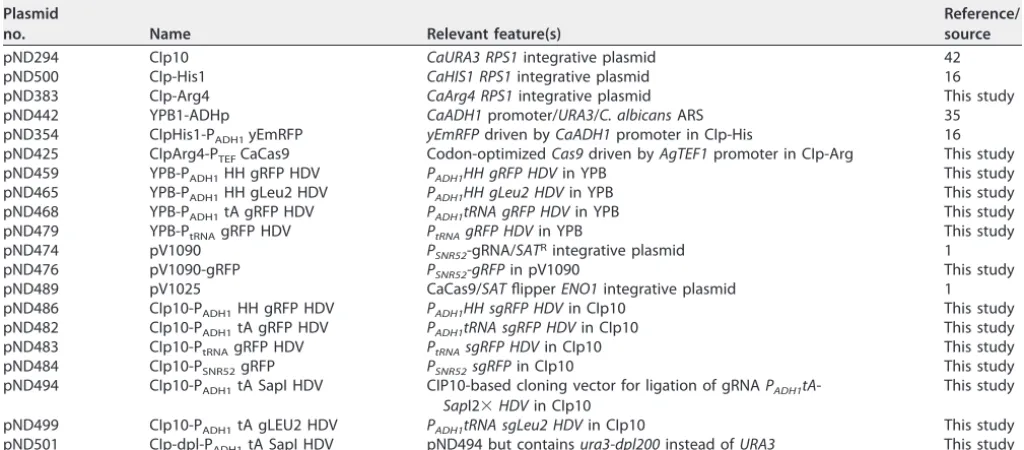
Plasmid construction. The plasmids and their relevant features are listed in Table 3, and the sequence of each relevant cassette and the oligonucleotides used for the construction are listed in Table S1 in the supplemental material. All DNA generated by PCR was verified by DNA sequence analysis. CIp-His1-PADH1yEmRFP (pND354) is aHIS1integration plasmid that contains theC. albicans
codon-optimizedyEmRFP(15). CIp-ARG4 (pND383) was constructed by replacing theURA3gene in CIp10 (35) with a 1-kb BamHI/SacI fragment containingC. albicans ARG4. Unless otherwise noted, CIp plasmids were linearized with StuI to target integration atRPS1.
AC. albicanscodon-optimizedCAS9gene, encoding CaCas9 endonuclease with a hemagglutinin (HA) epitope tag and nuclear localization signal at the C terminus and driven by the strongAshbya gossypii TEF1promoter, was synthesized (Genescript, NJ) and cloned into CIp-ARG4 as a KpnI/SacI fragment to produce CIp-ARG4-PTEFCaCAS9 (pND425). YPB1-ADHp (pND442) is a 2CaURA3 CaARSplasmid that
contains theADH1promoter and terminator (35).
YPB-PADH1HH gRFP HDV (pND459) contains an sgRNA that targets theRFPPAM at position⫹132.
sgRNA expression is driven by the RNA polymerase II (Pol II)ADH1promoter (PADH1); the 5=and 3=ends are flanked by the self-cleaving hammerhead (HH) (36) and hepatitis delta virus (HDV) (37) ribozymes, respectively. A 229-bp BglII/MluI fragment (Table S1) containing the HH-gRFP-HDV sequence was synthesized and cloned into the BglII/MluI fragment of YPB1-ADHp, downstream ofPADH1.
YPB-PADH1HH gLeu2 HDV (pND465) is identical to YPB-PADH1HH gRFP HDV but contains a gRNA that
targets theCaLEU2PAM site at position⫹123 and an HH sequence whose 6 nucleotides at the 5=end are complementary to the first 6 nucleotides of gLeu2 (Fig. S1). The HH-gLeu2-HDV cassette was synthesized (Genescript, NJ), and cloned into YPB1-ADHp vector as a BglII/MluI fragment.
YPB-PADH1tA gRFP HDV (pND468) contains the 75-bpC. albicans tRNAAlagene between theADH1
promoter and the sgRNA in YPB1-Adhp. ThetRNAgene was amplified by PCR from genomic DNA. Gibson assembly (38) was used to assemble the tRNA-sgRNA-HDV fragments and the YPB-ADHp vector.
TABLE 2 LEU2mutagenesis
Transformationa
No. of transformants: % of:
Uraⴙ Leuⴚb
LEU2/leu2 heterozygotesc
leu2⌬/leu2⌬
homozygotesd
(⫺) Cas9, (⫹) vector 620 0 0 0
(⫺) Cas9, (⫹) gLEU2 700 0 0 0
(⫺) Cas9, (⫹) gLEU2, (⫹) repair fragment 650 0 0 0
(⫹) Cas9, (⫹) gLEU2 28 0 0 0
(⫹) Cas9, (⫹) gLEU2, (⫹) repair fragment 760 608 0 80
aTransformations were performed with BWP17 (Cas9⫺) or HNY30 (Cas9⫹) withURA3-markedLEU2gRNA plasmid, p499 (⫹gLEU2), or the vector that lacks gRNA (p494). (⫺), donor repair fragment absent; (⫹), donor repair fragment present. The results shown represent the average from 3 experiments.
bThe number of Ura⫹transformants that were leucine auxotrophs.
cThe percentage ofLEU2/leu2⌬heterozygotes was based on PCR analysis ofLEU2using genomic DNA isolated from 40 random Ura⫹/Leu⫹transformants. dThe percentage ofleu2⌬/leu2⌬homozygotes was based on PCR analysis ofLEU2amplified from genomic DNA isolated from 60 random Ura⫹/Leu⫺transformants.
on September 8, 2020 by guest
http://msphere.asm.org/
YPB-PtRNAgRFP HDV (pND479) was generated by deleting theADH1promoter of YPB-PADH1tA gRFP HDV (pND468) by digestion with NotI and BglII, filling in overhangs with Klenow DNA polymerase and ligating.
To construct the CIp10 series of sgRNA delivery plasmids, each of the sgRNA cassettes described above (PADH1HH gRFP-HDV [1,113 bp], PADH1tA gRFP-HDV [1,147 bp], and PtRNAgRFP HDV [546 bp]) was
cloned into CIp10 as SalI/MluI fragments to produce pND486, pND482, and pND483, respectively. To construct CIp10-PSNR52gRFP, the gRFP gRNA was first cloned into pV1025 as described previously (1). The
1,112-bp PSNR52gRFP-tracr fragment was then amplified by PCR using primers with SalI and MluI sites and
inserted into CIp10 to produce CIp10-PSNR52gRFP (pND484).
CIp10-PADH1tA SapI HDV (pND494) is a vector that allows cloning and expression of any gRNA such
that the sgRNA transcript is flanked with 5=tRNA and 3=HDV and transcribed byPADH1. It was constructed by using site-directed mutagenesis to replace the RFP gRNA segment in CIp10-PADH1tA gRFP HDV with a cassette containing two SapI sites and 22 bp of intervening sequence, including a ClaI site (Fig. S2). In addition, site-directed mutagenesis replaced the unique SapI site at position 4381 of CIp10-PADH1tA gRFP
HDV with an NsiI site (Fig. S2). It should be noted that while constructing this plasmid, we discovered that the CIp10 sequence (GenBank accession no.AF181970) between KpnI and SacI (containing pBluescript KS⫹sequence) was incorrectly annotated and actually flipped, which places the T7 promoter adjacent toRPS1and the T3 promoter adjacent toCaURA3. To allow sequential introduction of additional gRNAs into the same strain, we also constructed a plasmid that is identical to pND494 but contains the recyclableura3-dpl200allele (26). ThisURA3is flanked by 200-bp repeats that facilitate its recycling by FOA selection.
Strains and growth conditions.C. albicansstrains were grown in standard rich YPAD medium (2% Bacto-peptone, 2% dextrose, 1% yeast extract, 20 mg/liter adenine) or synthetic dropout (SD) (2% dextrose, 2% Difco yeast nitrogen base with ammonium sulfate) supplemented with the appropriate nutritional requirements. Uridine (75 mg/liter) was added to all media except SD(⫺Ura).
TheC. albicansstrains used in this study are listed in Table 4 and were derived from BWP17. EPC1 contains a single integrated copy of theRFPgene (16) and was constructed by targeting StuI-linearized CIp-HIS-PADH-RFPtoRPS1. This integration results in a duplication ofRPS1flankingPADH1-RFP,HIS1and the intervening plasmid sequence. Single integration of PADH1-RFP atRPS1 was confirmed by Southern blotting (not shown). EPC2, which expresses both RFP andCaCAS9, was constructed by targeting
TABLE 3 Plasmids used in this study
Plasmid
no. Name Relevant feature(s)
Reference/ source
pND294 CIp10 CaURA3 RPS1integrative plasmid 42 pND500 CIp-His1 CaHIS1 RPS1integrative plasmid 16 pND383 CIp-Arg4 CaArg4 RPS1integrative plasmid This study pND442 YPB1-ADHp CaADH1promoter/URA3/C. albicansARS 35 pND354 CIpHis1-PADH1yEmRFP yEmRFPdriven byCaADH1promoter in CIp-His 16
pND425 CIpArg4-PTEFCaCas9 Codon-optimizedCas9driven byAgTEF1promoter in CIp-Arg This study
pND459 YPB-PADH1HH gRFP HDV PADH1HH gRFP HDVin YPB This study
pND465 YPB-PADH1HH gLeu2 HDV PADH1HH gLeu2 HDVin YPB This study
pND468 YPB-PADH1tA gRFP HDV PADH1tRNA gRFP HDVin YPB This study
pND479 YPB-PtRNAgRFP HDV PtRNAgRFP HDVin YPB This study
pND474 pV1090 PSNR52-gRNA/SATRintegrative plasmid 1
pND476 pV1090-gRFP PSNR52-gRFPin pV1090 This study
pND489 pV1025 CaCas9/SATflipperENO1integrative plasmid 1 pND486 CIp10-PADH1HH gRFP HDV PADH1HH sgRFP HDVin CIp10 This study
pND482 CIp10-PADH1tA gRFP HDV PADH1tRNA sgRFP HDVin CIp10 This study
pND483 CIp10-PtRNAgRFP HDV PtRNAsgRFP HDVin CIp10 This study
pND484 CIp10-PSNR52gRFP PSNR52sgRFPin CIp10 This study
pND494 CIp10-PADH1tA SapI HDV CIP10-based cloning vector for ligation of gRNAPADH1tA
-SapI2⫻HDVin CIp10
This study
pND499 CIp10-PADH1tA gLEU2 HDV PADH1tRNA sgLeu2 HDVin CIp10 This study
pND501 CIp-dpl-PADH1tA SapI HDV pND494 but containsura3-dpl200instead ofURA3 This study
TABLE 4 Strains used in this study
Strain Genotype Reference
BWP17 ura3⌬::imm434/ura3⌬::imm434 his1⌬::hisG/his1⌬::hisG arg4⌬::hisG/arg4⌬::hisG 27 EPC1 BWP17RPS1::PADH1RFP-HIS1 RPS1 This study
EPC2 BWP17RPS1::PADH1RFP-HIS1-RPS1::PTEF1CaCas9-HA-ARG4-RPS1 This study
RJY54 BWP17RPS1::PTEF1CaCas9-HA-ARG4-RPS1 This study
HNY25 BWP17 andleu2⌬/leu2⌬ This study
HNY30 BWP17eno1⌬::CaCas9 This study
HNY31 BWP17eno1⌬::CaCas9 leu2⌬/leu2⌬ This study
on September 8, 2020 by guest
http://msphere.asm.org/
CIp-ARG-PTEF1-CaCas9(see below) in a second round of integration into the secondRPS1allele in EPC1. An isogenic strain, RJY54 that expressesCaCAS9but notRFP, was constructed by targeting CIp-ARG-PTEF1-CaCas9(see below) toRPS1. HNY30 (eno1⌬::Cas9) was constructed by targeting integration of the KpnI/SacI Cas9/SAT-flipper cassette of pV1025 (1) in BWP17 and then platingSATRcolonies on YPAD to
screen forSATSstrains that lost theSAT-flipper cassette. HNY25 was constructed by knocking outLEU2
in RJY54 using theURA3-marked CRISPR/Cas gLEU2 plasmid p465. After confirming the homozygousleu2 mutation by PCR, uracil auxotrophs were selected on plates containing 5-fluoroorotic acid (FOA) and further screened for spontaneous loss ofCIp-ARG-PTEF1-CaCas9by arginine auxotrophy. HNY31 (leu2⌬/ leu2⌬eno1⌬::Cas9) was constructed by targeting integration of the KpnI/SacI Cas9/SAT-flipper cassette of pV1025 in HNY25 and screening forSATsensitivity.
Yeast transformation and quantitation ofRFPcleavage.Yeast transformations were performed by the lithium acetate protocol (39) with the following modifications. Fresh overnight cultures (12 to 16 h) were diluted 1:20 and incubated for ~5 h (optical density at 600 nm [OD600] of 5). Five milliliters was
harvested, washed once with H2O and once with 100 mM lithium acetate (LiOAc), and resuspended in
500l 100 mM LiOAc. The concentration of plasmid DNA was titrated to yield ~200 colonies per plate. Typically, transformations included 50l of the cell suspension (2.5 OD600units), ~2 to 4g of linearized
sgRNA plasmid (1 pmol), 1 to 2g of RFP donor repair DNA fragment (15 pmol), or annealed, filled-in repair oligonucleotides (200 pmol). After transformation, plates were incubated at 30°C for 2 days before being viewed by fluorescence microscopy with a Zeiss microscope equipped with low-power magnifi-cation (1.5 to⫻10). Visual detection of pink (RFP) and white (rfp) colonies required 3 days of incubation. The number of red, white, and sectored colonies per plate was counted to determine the efficiency of Cas9-mediated cleavage. Cleavage efficiency was calculated as the no. of white colonies/total no. of colonies per plate.
PCR analysis of Cas9-mediated cleavage.For analyses ofRFPmutagenesis, white colonies were patched and replica plated on selective media to test for prototrophy of selective markers (URA3,HIS1, andARG4). Genomic DNA from 20 white colonies per experiment was prepared and used as the template for PCR amplification using primers specific forRFP(Fig. S1). Colonies were inoculated into 0.5 ml medium and incubated at 30°C with shaking for 2 to 3 h. After harvesting of cells, pellets were suspended in 30l 0.2% SDS, heated for 3 min at 95°C, and centrifuged for 1 min at 14,000⫻g. Three microliters of the supernatant was used as genomic DNA template in a standard 25-l PCR.
For the analyses ofLEU2deletions, after transformation with various sgLEU2 gRNA plasmids or control vectors, and with or without donor repair fragments, colonies were patched onto to SD(⫺Ura) and replica plated onto SD(⫺Ura) and SD(⫺Leu) plates. PCR amplification of Leu2⫹and Leu2⫺colonies was performed, followed by digestion withEcoRI to determine the percentage of colonies that were heterozygous or homozygous for theleu2⌬allele.
Construction of donor healing fragments.Therfp⌬repair fragment targeted deletion of nucleo-tides 55 to 402 of theRFPORF, including the PAM site located at⫹132. It was generated by fusion PCR (40). PCR was used to amplify two fragments: one homologous to the 5=region ofRFPand the other homologous to the 3=region. The 5=fragment also contained a 3=20-bp tail that was homologous to the 5=end of the second fragment (Fig. 2A). These two fragments were mixed, annealed, and then extended. After extension, the full-length “fused” fragment was amplified by PCR. The resulting 593-bp fragment contains a 285-bp arm of upstream sequence homology and a 308-bp arm of downstream sequence homology to regions flanking the DSB. Approximately 1 to 2g of this DNA (~5 pmol) was used for transformation of yeast. Recombination withRFPresults in deletion of an internal 370 bp within theRFP ORF, including the PAM site to produce therfpΔ33-403allele.
TheLEU2donor repair fragment was made by annealing and filling in two 60-mer nucleotides that contained 20 bases of sequence complementarity at their 3=ends. This complementary region included an EcoRI recognition sequence (highlighted in blue in Fig. 7A). The resulting fragment contained 47 bp of homology to sequences flanking the DSB. Three microliters of each oligonucleotide (300 pmol) was annealed and then extended in a 25-l reaction mixture containing 0.2 mM deoxynucleoside triphos-phate (dNTP), buffer, andTaqDNA polymerase (Denville Scientific, Inc., United States) and subjected to 25 to 30 cycles of PCR with an extension time of 30 s. Twenty microliters of this reaction mixture was used per yeast transformation as a repair donor fragment (~240 pmol of repair fragment). Recombination with LEU2results in replacement of an internal 434-bp fragment within theLEU2ORF, including the PAM site, with an EcoRI site to produce theleu2Δ71-505allele.
SUPPLEMENTAL MATERIAL
Supplemental material for this article may be found at https://doi.org/10.1128/ mSphere.00385-16.
FIG S1,PDF file, 1.8 MB. FIG S2,PDF file, 0.2 MB. FIG S3,PDF file, 0.1 MB. TABLE S1,PDF file, 0.1 MB.
ACKNOWLEDGMENTS
We thank Eric Paullisen, Rachel Jones, and Katiuska Daniela Pulgar Prieto for their technical contributions to this study and Valmik Vyas for plasmids.
H.N. was supported in part by a URECA-Biology Alumni Research award. This
on September 8, 2020 by guest
http://msphere.asm.org/
research received no specific grant from any funding agency in the public, commercial, or not-for-profit sectors.
REFERENCES
1. Vyas VK, Barrasa MI, Fink GR. 2015. ACandida albicansCRISPR system permits genetic engineering of essential genes and gene families. Sci Adv 1:e1500248.https://doi.org/10.1126/sciadv.1500248.
2. Barrangou R, Fremaux C, Deveau H, Richards M, Boyaval P, Moineau S, Romero DA, Horvath P. 2007. CRISPR provides acquired resistance against viruses in prokaryotes. Science 315:1709 –1712.https://doi.org/ 10.1126/science.1138140.
3. Garneau JE, Dupuis MÈ, Villion M, Romero DA, Barrangou R, Boyaval P, Fremaux C, Horvath P, Magadán AH, Moineau S. 2010. The CRISPR/Cas bacterial immune system cleaves bacteriophage and plasmid DNA. Na-ture 468:67–71.https://doi.org/10.1038/nature09523.
4. Gasiunas G, Barrangou R, Horvath P, Siksnys V. 2012. Cas9-crRNA ribo-nucleoprotein complex mediates specific DNA cleavage for adaptive immunity in bacteria. Proc Natl Acad Sci U S A 109:E2579 –E2586.https:// doi.org/10.1073/pnas.1208507109.
5. Cong L, Ran FA, Cox D, Lin S, Barretto R, Habib N, Hsu PD, Wu X, Jiang W, Marraffini LA, Zhang F. 2013. Multiplex genome engineering using CRISPR/Cas systems. Science 339:819 – 823. https://doi.org/10.1126/ science.1231143.
6. Jinek M, Chylinski K, Fonfara I, Hauer M, Doudna JA, Charpentier E. 2012. A programmable dual-RNA-guided DNA endonuclease in adaptive bac-terial immunity. Science 337:816 – 821.https://doi.org/10.1126/science .1225829.
7. Mali P, Yang L, Esvelt KM, Aach J, Guell M, DiCarlo JE, Norville JE, Church GM. 2013. RNA-guided human genome engineering via Cas9. Science 339:823– 826.https://doi.org/10.1126/science.1232033.
8. Donoho G, Jasin M, Berg P. 1998. Analysis of gene targeting and intrachromosomal homologous recombination stimulated by genomic double-strand breaks in mouse embryonic stem cells. Mol Cell Biol 18:4070 – 4078.https://doi.org/10.1128/MCB.18.7.4070.
9. Storici F, Durham CL, Gordenin DA, Resnick MA. 2003. Chromosomal site-specific double-strand breaks are efficiently targeted for repair by oligonucleotides in yeast. Proc Natl Acad Sci U S A 100:14994 –14999.
https://doi.org/10.1073/pnas.2036296100.
10. Hsu PD, Scott DA, Weinstein JA, Ran FA, Konermann S, Agarwala V, Li Y, Fine EJ, Wu X, Shalem O, Cradick TJ, Marraffini LA, Bao G, Zhang F. 2013. DNA targeting specificity of RNA-guided Cas9 nucleases. Nat Biotechnol 31:827– 832.https://doi.org/10.1038/nbt.2647.
11. Ryan OW, Skerker JM, Maurer MJ, Li X, Tsai JC, Poddar S, Lee ME, DeLoache W, Dueber JE, Arkin AP, Cate JH. 2014. Selection of chromo-somal DNA libraries using a multiplex CRISPR system. Elife 3:e03703.
https://doi.org/10.7554/eLife.03703.
12. Min K, Ichikawa Y, Woolford CA, Mitchell AP. 2016. Candida albicans gene deletion with a transient CRISPR-Cas9 system. mSphere 1:e00130 -16.https://doi.org/10.1128/mSphere.00130-16.
13. Marck C, Kachouri-Lafond R, Lafontaine I, Westhof E, Dujon B, Grosjean H. 2006. The RNA polymerase III-dependent family of genes in hemiascomycetes: comparative RNomics, decoding strategies, transcrip-tion and evolutranscrip-tionary implicatranscrip-tions. Nucleic Acids Res 34:1816 –1835.
https://doi.org/10.1093/nar/gkl085.
14. DiCarlo JE, Norville JE, Mali P, Rios X, Aach J, Church GM. 2013. Genome engineering in Saccharomyces cerevisiae using CRISPR-Cas systems. Nucleic Acids Res 41:4336 – 4343.https://doi.org/10.1093/nar/gkt135. 15. Keppler-Ross S, Noffz C, Dean N. 2008. A new purple fluorescent color
marker for genetic studies in Saccharomyces cerevisiaeand Candida albicans. Genetics 179:705–710. https://doi.org/10.1534/genetics.108 .087080.
16. Keppler-Ross S, Douglas L, Konopka JB, Dean N. 2010. Recognition of yeast by murine macrophages requires mannan but not glucan. Eu-karyot Cell 9:1776 –1787.https://doi.org/10.1128/EC.00156-10. 17. Gao Y, Zhao Y. 2014. Self-processing of ribozyme-flanked RNAs into
guide RNAs in vitro and in vivo for CRISPR-mediated genome editing. J Integr Plant Biol 56:343–349.https://doi.org/10.1111/jipb.12152. 18. Guerrier-Takada C, Gardiner K, Marsh T, Pace N, Altman S. 1983. The RNA
moiety of ribonuclease P is the catalytic subunit of the enzyme. Cell 35:849 – 857.https://doi.org/10.1016/0092-8674(83)90117-4.
19. Schiffer S, Rösch S, Marchfelder A. 2002. Assigning a function to a
conserved group of proteins: the tRNA 3=-processing enzymes. EMBO J 21:2769 –2777.https://doi.org/10.1093/emboj/21.11.2769.
20. Xie K, Minkenberg B, Yang Y. 2015. Boosting CRISPR/Cas9 multiplex editing capability with the endogenous tRNA-processing system. Proc Natl Acad Sci U S A 112:3570 –3575. https://doi.org/10.1073/pnas .1420294112.
21. Sugawara N, Ira G, Haber JE. 2000. DNA length dependence of the single-strand annealing pathway and the role ofSaccharomyces cerevi-siae RAD59in double-strand break repair. Mol Cell Biol 20:5300 –5309.
https://doi.org/10.1128/MCB.20.14.5300-5309.2000.
22. Moore JK, Haber JE. 1996. Cell cycle and genetic requirements of two pathways of nonhomologous end-joining repair of double-strand breaks inSaccharomyces cerevisiae. Mol Cell Biol 16:2164 –2173.https://doi.org/ 10.1128/MCB.16.5.2164.
23. Roth DB, Wilson JH. 1986. Nonhomologous recombination in mamma-lian cells: role for short sequence homologies in the joining reaction. Mol Cell Biol 6:4295– 4304.https://doi.org/10.1128/MCB.6.12.4295. 24. Legrand M, Chan CL, Jauert PA, Kirkpatrick DT. 2007. Role of DNA
mismatch repair and double-strand break repair in genome stability and antifungal drug resistance in Candida albicans. Eukaryot Cell 6:2194 –2205.https://doi.org/10.1128/EC.00299-07.
25. Ciudad T, Andaluz E, Steinberg-Neifach O, Lue NF, Gow NA, Calderone RA, Larriba G. 2004. Homologous recombination inCandida albicans: role of CaRad52p in DNA repair, integration of linear DNA fragments and telomere length. Mol Microbiol 53:1177–1194.https://doi.org/10.1111/j .1365-2958.2004.04197.x.
26. Wilson RB, Davis D, Enloe BM, Mitchell AP. 2000. A recyclableCandida albicans URA3cassette for PCR product-directed gene disruptions. Yeast 16:65–70.https://doi.org/10.1002/(SICI)1097-0061(20000115)16:1⬍65::AID -YEA508⬎3.0.CO;2-M.
27. Wilson RB, Davis D, Mitchell AP. 1999. Rapid hypothesis testing with Candida albicansthrough gene disruption with short homology regions. J Bacteriol 181:1868 –1874.
28. Wellington M, Rustchenko E. 2005. 5-Fluoro-orotic acid induces chromo-some alterations inCandida albicans. Yeast 22:57–70.https://doi.org/10 .1002/yea.1191.
29. Doench JG, Hartenian E, Graham DB, Tothova Z, Hegde M, Smith I, Sullender M, Ebert BL, Xavier RJ, Root DE. 2014. Rational design of highly active sgRNAs for CRISPR-Cas9-mediated gene inactivation. Nat Biotech-nol 32:1262–1267.https://doi.org/10.1038/nbt.3026.
30. Xu H, Xiao T, Chen CH, Li W, Meyer CA, Wu Q, Wu D, Cong L, Zhang F, Liu JS, Brown M, Liu XS. 2015. Sequence determinants of improved CRISPR sgRNA design. Genome Res 25:1147–1157. https://doi.org/10 .1101/gr.191452.115.
31. Gilbert LA, Horlbeck MA, Adamson B, Villalta JE, Chen Y, Whitehead EH, Guimaraes C, Panning B, Ploegh HL, Bassik MC, Qi LS, Kampmann M, Weissman JS. 2014. Genome-scale CRISPR-mediated control of gene repression and activation. Cell 159:647– 661. https://doi.org/10.1016/j .cell.2014.09.029.
32. Farboud B, Meyer BJ. 2015. Dramatic enhancement of genome editing by CRISPR/Cas9 through improved guide RNA design. Genetics 199: 959 –971.https://doi.org/10.1534/genetics.115.175166.
33. Radzisheuskaya A, Shlyueva D, Müller I, Helin K. 2016. Optimizing sgRNA position markedly improves the efficiency of CRISPR/dCas9-mediated transcriptional repression. Nucleic Acids Res 44:e141.https://doi.org/10 .1093/nar/gkw583.
34. Smith JD, Suresh S, Schlecht U, Wu M, Wagih O, Peltz G, Davis RW, Steinmetz LM, Parts L, St Onge RP. 2016. Quantitative CRISPR interfer-ence screens in yeast identify chemical-genetic interactions and new rules for guide RNA design. Genome Biol 17:45.https://doi.org/10.1186/ s13059-016-0900-9.
35. Bertram G, Swoboda RK, Gooday GW, Gow NA, Brown AJ. 1996. Structure and regulation of theCandida albicans ADH1gene encoding an immu-nogenic alcohol dehydrogenase. Yeast 12:115–127.
36. Scott WG, Finch JT, Klug A. 1995. The crystal structure of an all-RNA hammerhead ribozyme: a proposed mechanism for RNA catalytic cleav-age. Cell 81:991–1002.https://doi.org/10.1016/S0092-8674(05)80004-2.
on September 8, 2020 by guest
http://msphere.asm.org/
37. Nakano S, Chadalavada DM, Bevilacqua PC. 2000. General acid-base catalysis in the mechanism of a hepatitis delta virus ribozyme. Science 287:1493–1497.https://doi.org/10.1126/science.287.5457.1493. 38. Gibson DG, Young L, Chuang RY, Venter JC, Hutchison CA, III, Smith
HO. 2009. Enzymatic assembly of DNA molecules up to several hundred kilobases. Nat Methods 6:343–345.https://doi.org/10.1038/ nmeth.1318.
39. Walther A, Wendland J. 2003. An improved transformation protocol for the human fungal pathogenCandida albicans. Curr Genet 42:339 –343.
https://doi.org/10.1007/s00294-002-0349-0.
40. Higuchi R, Krummel B, Saiki RK. 1988. A general method of in vitro preparation and specific mutagenesis of DNA fragments: study of pro-tein and DNA interactions. Nucleic Acids Res 16:7351–7367.https://doi .org/10.1093/nar/16.15.7351.
41. Darty K, Denise A, Ponty Y. 2009. Varna: interactive drawing and editing of the RNA secondary structure. Bioinformatics 25:1974 –1975.https:// doi.org/10.1093/bioinformatics/btp250.
42. Murad AM, Lee PR, Broadbent ID, Barelle CJ, Brown AJ. 2000. CIp10, an efficient and convenient integrating vector forCandida albicans. Yeast 16:325–327.