DOI: 10.30954/2249-6637.10.2018.13
©2018 New Delhi Publishers. All rights reserved
Learning Outcome Based Education Framework (LOCF):
Challenges and Implementation Issues in Context of
Indian Universities
Sundar Lal Tripathi
Department of Adult, Continuing and Extension Education, Dr RML Awadh University, Faizabad, India
Corresponding author: [email protected]
ABSTRACT
The University Grants Commission (UGC) has recently introduced LOCF for enhancing outcome-driven teaching and learning in Indian Universities. This study aims to identify the key issues that may pose challenges in effective implementation of LOCF in Indian context. The study, which is based on review of secondary sources and unstructured interviews with identified professors in the different academic subject-areas, traces the strategic issues that need to be addressed for implementation of LOCF. Based on the analysis, the study provides a conceptual model for implantation of LOCF in Universities.
Keywords: LOCF, Outcome Based Education, Higher Education Reforms, Indian Universities
Outcome Based Education (OBE), which originated in its’ current form from primary education context in United States, is now being introduced in higher education as well across different contexts. Initially, OBE was adopted in engineering education with the aim of establishing a comparable curriculum framework in international context. Gradually, some universities and institutions are adopting this philosophy in different academic disciplines. In Indian context, University Grants Commission (UGC) introduced Learning Outcome Based Curriculum Framework (LOCF) in 2018 (UGC, 2018). This can be considered as another qualitative reform in volume-driven higher education in India, which emerged within three years from introduction of Choice Based Education System (CBCS) in 2015 (UGC, 2015), which aimed towards offering opportunity for flexible curriculum planning.
While introduction of LOCF is in initial phase, it becomes important to study how the transition towards new
The first research question has been addressed on the basis of review of the secondary sources while other two questions have been answered on the basis of expert consultation. The purpose of the paper is to provide some light on issues, critical for implementation of LOCF in Indian universities and colleges.
Review of Literature
The philosophy of OBE is based on desired learning outcomes. Learning outcomes are the formal statements of what students are expected to learn (Suskie, 2004), which combine set of desired knowledge, skills and attitude. Boschee & Baron (1993) identifies five features of the outcomes: future-orientation; publicly defined, learner-focus, life-skill emphasis; and important of ‘context’.
OBE, as a process involves a number of activities in the different areas, including: identification of what student must be able to do upon completion of an educational programme; organization of curriculum-content and pedagogy; and alignment of assessment system in order to ensure the desired learning (Kudlas, 1994; Tucker, 2004). There is no uniform definition of the OBE. However, the definition given by Spady (1994) is found to be widely used. Spady (1993) considers OBE as a transformational way of imparting education rather one-time programme or project. Tavner (2005) considers OBE as a shift from teacher instruction to demonstration by student. Towers (1996) observes OBE as a results-oriented system which is based on strong belief that every student can learn.
Spady (1994) suggests four basic principles of OBE, which include: first, clarity in understanding what student must be able to do; second, curriculum design completely aligned to the desired outcomes; third, continuously evolving performance standards; and fourth, expanding to opportunity in terms of customized learning depending one’s learning capacity and learning style, in addition to other factors.
The OBE can be considered more as a philosophy than any standardized and prescriptive model. The OBE can be traditional, transitional or transformational (Spady and Mashall, 1991) based on the type of outcome
selected in the programme. While moving towards OBE focused curricula, one may adopt it according to the stakeholders’ needs. In the OBE evolution process, one may position those curricula at different levels, based on the depth and nature of desired outcome. In context of programmes in higher education, this is important to note that the ‘knowledge, skill and attitude (KSA)’ combination, as reflected in learning outcomes, would vary depending on nature of the discipline in light of the contextual requirements.
In OBE, one significant departure from the conventional teaching-learning process is the regarding the responsibility of accomplishment of the ‘outcomes’ i.e. instead of making the faculty-member responsible for accomplishment of desired ‘outcomes’, OBE emphasizes on students’ responsibility to ensure that the accomplish the outcome (Brandt, 1994). This implies that task of ‘faculty-member’ in OBE is to facilitate the learning process and monitor if the learning is happening in the desired manner. This also leads to the essential requirement for ‘clarity in communication’ with the students regarding what they are expected to accomplish in a programme or in a course.
Brandt suggests fours important aspects required for developing and implementing OBE focuses curriculum: first, involve Stakeholders including teachers, parents, citizens, students for identifying or establishing the desired outcomes; second; develop curriculum that reflect the outcomes, which students are expected to demonstrate upon completion of a certain programme; third, alignment of assessment process including identification of adequate performance assessment tools that suits the identified outcomes; fourth, making required changes in policies and operations of the institution that support the desired change towards OBE.
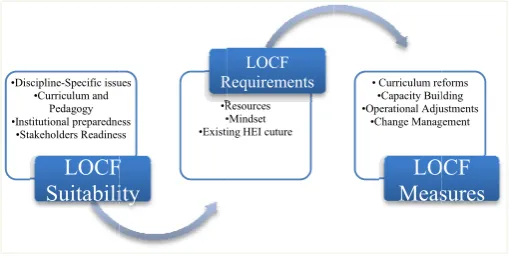
providing institution an objective reference points that will guide further improvements in curriculum design and delivery (UGC, 2018, p. 2). Implementation of LOCF would require complete change in approach of curriculum planning and delivery, and, therefore, the resource requirements will be one of the critical factors. In Indian context, most of the institutions, both in private sector as well as in public sector are facing severe resource constraints, particularly trained human resources, knowledge resources and financial resources to support the desired innovation. Based on the review of literature, the conceptual framework of the study is as given in Fig. 1.
• • •Discipline-Specific issu •Curriculum and Pedagogy •Institutional preparedne •Stakeholders Readines LOCF Suitabili ues ess ss F ity •R • •Existi R Resources •Mindset ing HEI cuture
LOCF
Requirements • Curriculum re •Capacity Buil •Operational Adju •Change Manag LO Meas eforms lding ustments gement OCF sures
Fig. 1: Conceptual Framework of the Study
Database and Methodology
The study follows qualitative design, comprising both primary and secondary data. The key requirements for LOCF implementation were identified on the basis of review of literature related to Outcome Based Education. Based on review of the literature, a conceptual framework for the study was developed (Fig. 1). At the next stage, expert consultation was done with 5 professors selected on the basis of judgment and convenience. These experts were working in Indian universities in different subject-areas: 2 in Management; and 1 each in Social Sciences, Humanities and Engineering. The issues of LOCF were discussed through unstructured informal interviews with emphasis on the main issues identified in the conceptual framework of the study. The responses were coded and then decoded and analysis is presented in next section. The study had limitation of time and limited sample. However, as the purpose of the study is to identify the qualitative issues and
perception regarding the preparedness of Indian HEIs, we do not aim at any generalization and, therefore, the methodology appears to justify the purpose of the study despite limitations. Based on the analysis and discussion of the findings, suggested measures are proposed for effective implementation of LOCF in Indian HEI context.
RESULTS AND DISCUSSION
The responses were mixed regarding the suitability of LOCF in context of HEIs. However, everyone appears to agree that LOCF should be adopted as a philosophy and the degree of outcome orientation should be left on the Universities, which understands the context better. India being a large country with high variation in education requirements across the different regions of the country, most of the experts feel that instead of an attempt to standardize the outcome and curriculum, suggestive guidelines can be introduced with provision for greater autonomy at university level. This is also required in view of high degree of variation across the type of institutions in the country like Central Universities, State Universities, Autonomous Colleges, Affiliated Colleges and Distance Learning institutions. Regarding the stakeholders’ readiness, it was felt that while outcome based education is required particularly for preparing students for the employment, an awareness regarding how OBE is going to make difference is key in accomplishing the real purpose of OBE. The major findings regarding the suitability of LOCF in Indian context can be summarized as (1) The university autonomy should be encouraged in adopting the philosophy of OBE in their respective context, (2) The generic guidelines should be suggested while discipline-specific outcomes must be decided by the Academic Councils and Board of Studies of the concerned subject in the given university context, (3) Large-scale awareness drives and stakeholder orientation sessions should be planned, (4) Purpose of OBE should be clearly communicated to important stakeholder groups and (5) The suitability of the LOCF curriculum should be determined at the university level.
appear to be most important area for implementing LOCF. In the conventional ‘teacher-oriented’ HEI context, particularly with Universities in the country, experts were of opinion that the appointment of qualified staff and creation of customized learning material would be two key requirements. Also, in order to prepare the existing staff for LOCF a lot of training and development interventions need to be undertaken, which implies requirement of good amount of financial resources. Further, the desired change towards LOCF requires changes in the stakeholders’ mindsets and, therefore, preparing the stakeholders for the new journey will be another critical area that would determine the success of the LOCF. More specifically, the key requirements for smooth implementation of LOCF are (1) Appointment of adequate number of qualified teaching staff in the institutions as the workload requirement would be different in LOCF depending on the degree of the LOCF adoption in the given context, (2) Additional emphasis on creating contextualized teaching-learning material, (3) Need for extra financial resources to meet the training and development cost as well as new knowledge resource acquisition, (4) Need for attitude change training on the part of teaching staff, students and parents as the new system would require more resources which implies higher cost of higher education, (5) A complete change management training at institutional level to meet the requirements of adopting the new philosophy.
The respondents suggested a number of measures both at the level of UGC as well as at the level of institutions. At the central regulatory level, the major changes were suggested in the area of policies related to faculty performance evaluation and workload distribution. The examination and evaluation reforms were another important area of intervention. Further, the participative curriculum development with collective identification of learning outcome was suggested by all irrespective of the subject-discipline. Also the entire transformation was suggested to be approached as a change management process, particularly by the professors in the area of Management. The main suggestions are (1) Participative approach of Outcome Identification and curriculum development should be encouraged, (2) Stakeholder communication should be improved at institutional
level, (3) UGC should encourage efforts toward reforms in examination, assessment and evaluation system through policy guidelines, (4) Workload distribution per week should be changed as LOCF would require more mentoring and one to one guidance and therefore, conventional 16 hours per week lecture type policies should be eliminated, (5) Changes to be made in faculty promotion and career development policies and regulations as the nature of the faculty activities would significantly change in LOCF and (6) Centralized change management guidelines should be introduced by the UGC, which should be aligned to Quality Assessment and Accreditation framework.
CONCLUSION
Based on this qualitative study, we identified that the LOCF implementation requires changes both in policy framework as well as in institutional functioning. Institutional willing to adopt the LOCF must prepare and organize resources before starting the process of implementation. While in principle, the idea appears to be good in terms of qualitative improvements, different areas must be addressed. These are (1) Changes in faculty workload policy, (2) Participative curriculum reforms, (3) Stakeholder awareness, (4) Resource allocation, (5) Examination and assessment reforms, (6) Knowledge content creation, (7) Faculty capacity building and (8) Change Management planning at institutional level. These findings are indicative in nature and set the direction for further preparation towards LOCF implementation. This should not be viewed as any generalized prescription.
REFERENCES
Brandt, R. 1994. “On Creating an Environment Where All Students Learn: A Conversation with Al Mamary.” Educational Leadership,51(5): 18–23.
Brandt, R. 1994. “An Overview of Outcome Based Educatio.” Curriculum Handbook, ASCD. Accessed http://www.ascd. org/publications/curriculum_handbook/413/chapters/An_ Overview_of_Outcome-Based_Education.aspx on 11/14/2018. CEI (n.d.), “OBE Principles and Process,” Centre for Education
EUHK (n.d.). “What is Outcome-Based Learning,” Outcome Based Learning Project (Webpage). Education University of Hong Kong. Accessed https://www.eduhk.hk/flanobl/view. php?secid=784 on 11/24/2018.
Spady, W. 1994. “Choosing Outcomes of Significance.” Educational Leadership 51, 5: 18–23.
Spady, W. and Marshall, K. 1991. “Beyond Traditional Outcome-Based Education.” Educational Leadership 49, 2: 67–72.
UGC. 2015. Choice Based Credit System Letter. Accessed https:// www.ugc.ac.in/ugc_notices.aspx?id=2096 on 12/26/2018 UGC. 2018. Learning Outcome Based Curriculum Framework