http://www.gjaets.com (C) Global Journal of Advance Engineering Technology and Sciences 1-5
Global Journal of Advance Engineering Technologies and Sciences
THE CASE STUDY ON ANALYSIS OF FORMABILITIES PROPERTIES
OF LOW CARBON STEEL SHEET ON CONVENTIONAL PRESS
Mr. Marlapalle Bapurao G.
1Student of PhD in Mechanical Engineering at JSPM, RSCOE, SPPU, Pune
Prof. Dr. R.S.Hingole
2Professor in Mechanical Engineering at JSPM, RSCOE, SPPU, Pune
Deogiri Institute of Engineering and Management Studies, Railway Station Road, In front of
Govt. ITI, Aurangabad,
[email protected]
ABSTRACT
In this paper the formability of Cold Rolled (CR) steel material metal sheets is experimentally analyzed and the sheet metal parts manufacturing industry are the minimization of costs and the improvement of products quality concerning all mechanical properties like weight, strength, and rigidity, etc. A sheet metal parts are manufacture in a number of stages due to these number of stages Geometric dimensioning and tolerances are not much precise and accurate parts cannot produced.
KEYWORDS: Cold Rolled, Quality, Sheet Metal
1. INTRODUCTION
The sheet metal forming component a blank of sheet metal is formed into a product between a male (Punch) and a female (Die). The procedure is based on sheet metal deformation caused by the relative movement between the punch tool and the sheet, an interaction that generates friction forces occurred. It is important to understand that able to control the friction generated in the forming process in order to produce good quality sheet metal products. Manufacturing defects like crack, shrinkage, springback, surface defects and tool wear can be reduced by controlling the above defects in the process. It is generally believed that the friction between two surfaces in contact varies with velocity, applied load and type of lubricant, according to the Stribeck curve. However, in a sheet stamping operation the friction cannot be considered as a static parameter due to the varying process conditions during the forming operation. It is observed that friction conditions between two surfaces in contact considering parameters such as materials, Cylindercity and roughness, etc. T he quality of the actual manufactured component shows variation in micron.
2. EXPERIMENTAL TEST
2.1 Material
The material was a low carbon steel designated as CR3. Its chemical composition is summarized in table1. The sheet metal was rectangular 0.5*20*200 mm supplied for testing.
Table1. Chemical Composition of Cold Rolled Steel Sheet
Alloys Content Observations DD Grade
% C 0.062 0.10 max
% Mn 0.28 0.45 max
% S 0.015 0.035 max
% P 0.007 0.035 max
2.2 Tensile Test
http://www.gjaets.com (C) Global Journal of Advance Engineering Technology and Sciences 1-5 Table2. Mechanical Properties of CR3 Material
Sr. No. Test Conducted Observations Specified for " DD " Grade
1 Hardness Hv 1 89 Hv1 -
2 Tensile Strength N/mm2 285.88 270 – 370
3 Yield Strength N/mm2 166.09 250 max
4 % Elongation 28.35
G.L =5.65 x sq. root of area - 26.0 min
Gauge Length = 80 mm - 32.0 min
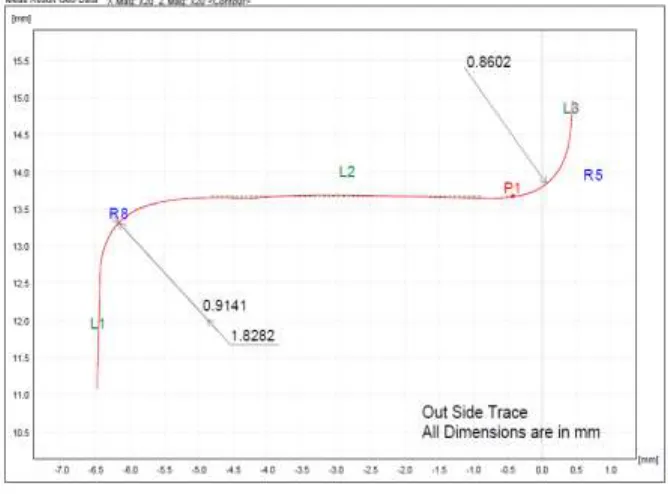
The manufacture surface was inspected on Contour Measurement Machine, the contour was measured on two different points and their radiuses are 0.9141 and 0.8602mm. The radius variation between two points is 0.0539mm.
Figure 1 Longitudinal Trace
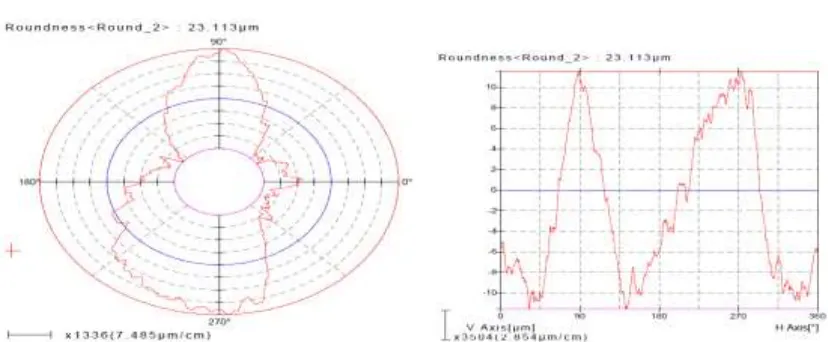
2.3 Roundness and Cylindercity Quality of draw
http://www.gjaets.com (C) Global Journal of Advance Engineering Technology and Sciences 1-5 Table3: Roundness Parameters value
Figure 3 Roundness at other point (1) Horizontal (2) Vertical
Table4: Roundness Value on second point
http://www.gjaets.com (C) Global Journal of Advance Engineering Technology and Sciences 1-5 Figure 5 Cylindicity along (1) Roundness (2) Weaviness
Table5: Cylindricity Parameters
3. METAL FORMING CALCULATIONS
3.1 Die Design Calculation
The material CR3 steel DD as per the grade IS513-1994 and the thickness of cup is 0.5mm. The developed blank diameter 80mm and for draw ratio is less than 1 it means draw is simple and it may required only one stage.
The draw force can calculate by using following Empirical relation. 𝐷𝑟𝑎𝑤 𝐹𝑜𝑟𝑐𝑒 (𝑇𝑜𝑛)
= 𝑃𝑖 ∗ 𝑃𝑢𝑛𝑐ℎ 𝑑𝑖𝑎𝑚𝑒𝑡𝑒𝑟 ∗ 𝑡ℎ𝑖𝑐𝑘𝑛𝑒𝑠𝑠 𝑜𝑓 𝑚𝑒𝑡𝑎𝑙 ∗ 𝑦𝑖𝑒𝑙𝑑 𝑠𝑡𝑟𝑒𝑛𝑔𝑡ℎ ∗ ((𝐵𝑙𝑎𝑛𝑘 𝐷𝑖𝑎 𝑃𝑢𝑛𝑐ℎ 𝐷𝑖𝑎) − 𝐶𝑜𝑛𝑠𝑡𝑎𝑛𝑡)
The factor of safety should be taken as 1.25 and then draw force can be calculated. The draw radius ranges will be from 4 to 10 times of Blank Thickness and punch radius ranges from 3 to 4 times of Blank thickness.
The Press tonnage capacity required for various thicknesses can be calculated as
𝑃𝑟𝑒𝑠𝑠 𝑇𝑜𝑛𝑛𝑎𝑔𝑒 = 𝐷𝑟𝑎𝑤 𝐹𝑜𝑟𝑐𝑒 + 𝐵𝑙𝑎𝑛𝑘 𝐻𝑜𝑙𝑑𝑖𝑛𝑔 𝐹𝑜𝑟𝑐𝑒 (𝐵𝐻𝐹) 𝑖. 𝑒. 𝐵𝐻𝐹 = 30% 𝑜𝑓 𝐷𝑟𝑎𝑤 𝐹𝑜𝑟𝑐𝑒
4. CONCLUSION
http://www.gjaets.com (C) Global Journal of Advance Engineering Technology and Sciences 1-5 required component. Finally, these components can be assembled and while assembly the tolerance variation does matter. The forming sheet component they are using oil for reducing the corrosion on final component.
REFERENCES
1. Kvsn Jawahar Babu, “A Study on Supply Chain Practices With Reference To Automobile Industry”, Vol.1 Issue 9, ISSN 2277 3622, pp 110-119 (Sep-2012).
2. By Abdulla Mohammad Gous Shaikh & Tippa Bhimasankara Rao, “Sheet Metal Forming Simulations for Heavy Commercial Vehicle Parts by LS-DYNA”, Volume 13 Issue 1 Version 1.0, pp 34-40 (2013). 3. Asghar Shamsi-Sarband, Sayyed Abolfazl Zahedi, Mohammad Bakhshi-Jouybari, “Optimizitation of the
Pressure Path in Sheet Metal Hydroforming,” Volume 13, Number 4, pp. 351–359 (2012).
4. L. Marretta, G. Ingarao, R. Di Lorenzo “Design of sheet stamping operations to control springback and thinning: A multi-objective stochastic optimization approach”, International Journal of Mechanical Sciences 52, pp 914–927 (2010).
5. Michael P.Pereira, MatthiasWeiss, BernardF.Rolfe, TimB.Hilditch, “The effect of the die radius profile accuracy on wear in sheet metal stamping ”, International Journal of Machine Tools & Manufacture 66, pp 44–53 (2013).
6. Gas per Gantar, Tomaz Pepelnjak, Karl Kuzman, “Optimization of sheet metal forming processes by the use of numerical simulations”, Journal of Materials Processing Technology 130–131, pp 54–59 (2002).
7. Hariharasudhan Palaniswamy, Gracious Ngaile, Taylan Altan, “Optimization of blank dimensions to reduce springback in the flexforming process”, Journal of Materials Processing Technology 146, pp 28–34 (2004). 8. Abhishek Kumar, Santosh Kumar, D. R. Yadav, “Review Of Rubber Based Sheet Hydro-Forming
Processes”,5th International & 26th All India Manufacturing Technology, Design and Research Conference (AIMTDR 2014).
9. R.S.Hingole & V.M.Nadedkar, “A study of spring back effect in bending component” , International Conference International Deep Drawing Research Group IIT Bombay, pp 25-30 (IDDRG 2012).