1692
A Design Of Government Enterprise Architecture
Framework Based On G-Cloud Services
Raden Ali Rakhman, Nina Anggraini, Nilo Legowo, Emil R. KabururuanAbstract— Government Enterprise Architecture (GEA) is an important factor for the success of all types, scales, and intensity of government programs whose main goal is to make government citizen-oriented and results-oriented. Cloud computing offers several potential benefits that many e-governments over the world are trying to obtain by adopting cloud solutions into their architecture and public services. This paper focuses on designing GEA using TOGAF ADM based on the G-cloud model. The conceptual relationship between cloud computing in government agencies and information architecture is provided to provide a better picture in the implementation of GEA. A mapping model for G-cloud implementation is presented, as well as services provided by the G-Vendor cloud to describe the objectives and potential requirements for conceptualization processes. The proposed framework is expected to increase the success rate of e-government implementation in Indonesia, which has declined significantly over the last 8 years. However, that does not rule out the possibility of being implemented in other countries so that e-government can provide the promised benefits to their citizens.
Index Terms— Enterprise architecture, government enterprise architecture, e-government, TOGAF, government cloud (g-cloud), Indonesia —————————— ——————————
1 INTRODUCTION
E-government is an activity related to the efforts of all government agencies in working together to utilize information and communication technology, to provide accurate information and electronic service for the internal institutions, individual communities, and the business world. In developing e-government, it is necessary to arrange system and work processes through the use of Enterprise Architecture (EA) [1]. EA is a strategic planning tool that effectively facilitates contacts and increases interoperability among agencies, improves internal operating processes and improves service delivery to the community [2]. Government EA (GEA) is a variation of EA that is specific to government agencies. GEA is an important factor for the success of all types, scale, and intensity of government programs. The main purpose of the GEA is to make e-government citizen-oriented and results-oriented [3].The United Nations (UN) uses connected government as the main criteria for evaluating and ranking national e-government programs. It defines connected e-government dimensions as citizen centricity, shared infrastructure and interoperability, collaborative service and business operation, public sector governance, networked organizational model, social inclusion, and transparent open government [4]. Based on the UN Global e-government survey 2016, the success rate of e-governance programs in Indonesia is ranked 116 out of 193 countries, decreasing significantly over the past eight years [5]. A study of Indonesian e-government ranking by ―Pemeringkatan e-Government Indonesia‖ (PeGI) in 2011, reported that there are five main components that must be improved in the implementation of e-government. These components are IT governance, government system,
e-government regulation, e-e-government management, and key operational applications [6]. Based on the report, we can conclude that the governance at the enterprise level and IT level plays an important role in the successful implementation of e-government, and GEA will help in managing data and information using IT. Presidential Directive number 3/2003 regarding National Policy and Strategy for e-Government Development stated that the use of IT includes two activities that are directly related so that public services can be accessed easily and cheaply by the community throughout the Republic of Indonesia. The first is related to data processing, information management, management systems, and electronic work processes, while the second one is related to the utilization of advances in IT [7]. Thus, it becomes important to have a strong and solid GEA that can manage the implementation of IT to support e-government programs. Sanchez, Rouhani and Mohamed [8, 9, 10] studies show FEAF and TOGAF are the best framework and have been adopted by many governments. However, TOGAF is better than FEAF in architecting process and architecture modeling [10]. Rouhani [9] states TOGAF ADM has the highest grade in concept, modeling and process aspects. TOGAF also provides semantic support to improve interoperability [8], and TOGAF partially supports the nationwide integration issues [10]. This study uses TOGAF as the baseline framework for promoting a modified EA development method. In the area of e-government, cloud computing technology has become a top priority for leaders of information technology. Cloud computing offers several potential benefits, such as cost savings, agility, efficiency, integration of resources, business opportunities, and reduction of complex work processes [11]. The utilization of cloud computing in government is generally called the government cloud (g-cloud). This initiative has been implemented and widely adopted by the government in many developed and developing countries [12, 13]. Neuza [14] recognizes the importance of cloud technology applications and estimate their distribution worldwide. The adoption of cloud technologies enables a reduction in capital and current operating costs and increases the level of equipment usage, ————————————————
Raden Ali Rakhman, Nina Anggraini, Nilo Legowo, Emil R. Kabururuan
Information Systems Management Department in BINUS Graduate
Program-Master of Information Systems Management, Bina Nusantara University, Indonesia.
E-mail: [email protected], [email protected],
which currently amounts to 10% in the public sector. It means that 90% of the equipment actually in an inactive condition, which in turn means its use is inefficient use [15]. As such, the general objective of developing a new government agency information service model is cost reduction for IT resources management; reducing costs for IT personnel, optimizing budget costs for IT equipment procurement, implementing a single pricing policy, improving service quality; improving IT infrastructure and information safety of government agency, and reducing risks related to data loss and corruption. Cloud computing helps break down the barriers of government agencies to enter a new phase of collaboration and partnership, service sharing, and resource gathering. It offers an effective way to share information between citizens, reducing efforts in providing services, budget management, and saving costs [16]. This paper focuses on the design of GEA for e-government implementation in Indonesia. However, the proposed model does not ruled out the possibility to be implemented in other countries. In this work, standard factors such as government systems and state bureaucracies will determine the EA Framework accordingly. Some indicators of non-functional requirement (such as interoperability, agility, integration, and reusability) and indicators of reusability and development issues (such as architectural processes, service-oriented, cloud empowerment, architectural modeling, evaluation and governance, and references model) can be considered when choosing the right EA Framework to be adopted in developing GEA [10]. Some changes may also be needed to get the appropriate model.
2 LITERATURE REVIEW
2.1 E-governmentAccording to the World Bank Group, e-government is an effort to utilize information and communication technology to improve efficiency, effectiveness, transparency, and accountability in providing better public services. E-government refers to the use by government agencies in information technology that can transform relations with citizen, businesses and other government agencies [17]. E-government is an effort to create an atmosphere of government administration with common goals of several interested communities. Therefore, the vision should also reflect the shared vision of the existing stakeholders [18], e.g. increase productivity and operational performance in serving its community; promoting clean and transparent government; improving the quality of people’s lives; and ensuring the creation of a democratic state [19, 20, 21, 22, 23]. The Office of Communication and Information of the Republic of Indonesia (Diskominfo) defines e-government as a public service that is hosted through a government website where the domain used indicates the Indonesian government domain (go.id) [24]. The Indonesian government is intensively implementing the e-government system, both among central and local governments [25, 26] to improve the quality of service for the public through online services. The Surabaya city government, for example, has implemented the Surabaya Smart Windows (SWS) system, which is a service that allows people to take care of licensing via smartphones. In fact, the public can print their own licensing documents. The Provincial Government of
DKI Jakarta, Bandung City and Pandeglang have also begun implementing e-government systems through the concept of the smart city. The positive impact of implementing e-government systems in Indonesia is that people can participate in controlling the work of government. Through the e-government system, the public can receive real and transparent government performance reports and access information about government performance freely. This e-government system does not only have an impact on society, but also the government itself. E-government systems can support government performance in the fields of government to business, government to citizens, government to government, and government to employees. E-government implementation that is easily accessible and transparent can lead to good and open governance in Indonesia.
2.2 Enterprise Architecture
Enterprise Architecture (EA) is an effort to carry out analysis, design, planning, and implementation of solutions for an organization to successfully achieve strategic objectives [27]. The benefits of EA include reducing IT cost, helping organizations control investment [25, 26]; increasing IT responsiveness [25, 27]; increasing management satisfaction by ensuring IT implementation meets the business needs [9, 25]; increasing IT outcome, including operational, customer intimacy, and leadership [25, 26]; and building the integration and standardization by creating reuseable components [25, 26, 28, 29]. An enterprise architecture framework can describe the underlying infrastructure, thus providing the foundation for the hardware, software, and networks to work together [33]. There are a number of architectures and architectural frameworks in use today. Though they may overlap or overcome similar views, each frameworks have been designed to address specific needs. These frameworks differ by the stakeholders they address and the issues that concern their world. These issues represent methods, common vocabulary, standards, and tools that provide a means to implement and integrate the building blocks.
2.3 TOGAF
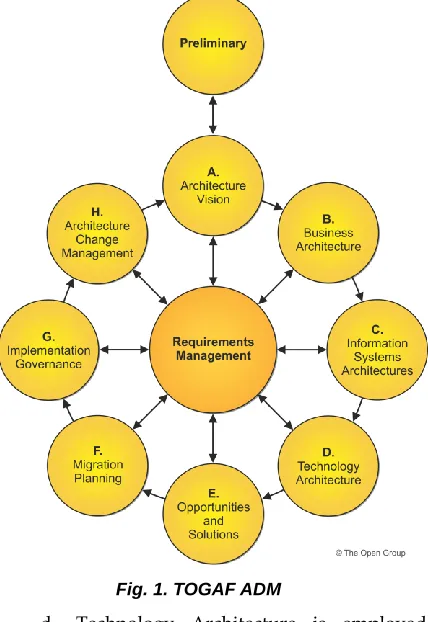
The Open Group of Architecture Framework (TOGAF) is the most widely used framework for developing EA [19]. The methodology used in the TOGAF is called the Architecture Development Method (ADM). TOGAF ADM is an iterative process in developing EA that allows companies to transform the architecture following business needs [19]. It starts from identifying the current conditions, developing the architecture, and managing the implementation of EA [9, 31, 32]. As Fig. 1, TOGAF ADM consists of three phases:
1. Preliminary – It clarify the current architecture in an organization by way of using framework and concepts of EA.
2. ADM cycle: it consists of the following phases: a. Architecture Vision consists of description of
current architecture and desired architecture of business and IT views.
b. Business Architecture depicts the current architecture of business and analyzes gaps between it and desired one.
1694 d. Technology Architecture is employed to
build up the basis implementation.
e. Opportunities and Solutions comprises of assessment and choice of implementing options.
f. Migration Planning concerns on prioritizing implementing projects in accordance with their dependencies.
g. Implementation Governance concerns on governing of EA project particularly on implementing and deploying.
h. Architecture Change Management concerns on future changes by using repeated surveillance process in business and IT which can cause new deployments.
3. Requirement Management – It identify the needs for the iterative ADM phases.
TOGAF supports 4 architecture domains :
1. Business Architecture - defines the business strategy, governance, organization, and main business processes.
2. Data architecture - describes the logical and physical structure of organizational data assets and manage data sources.
3. Application Architecture - provides a blueprint for
individual applications, their interactions, and their relationships with the organization's core business processes.
4. Technology Architecture - describes the logical software and hardware needed to support business, data, and applications; including IT infrastructure, middleware, networks, communications, processing, standards.
TOGAF has been widely used for designing EA in government agencies in Indonesia [19, 36, 37]. Cameron and McMillan [38] summarized the advantages of TOGAF compared to other EA Frameworks in Table 1.
Table 1 Comparison of EA Framework
Criteria Zachman TOGAF FEA Gartner
Business-IT alignment 1 3 1 4*
Taxonomy guidance 4* 2 3 1
Reference-model 1 3 4* 1
Process completeness 1 4* 2 3
Maturity assessment 1 2 3 3
Governance support 1 2 3 3
Interoperability 2 4* 3 2
Knowledge repository 2 4* 2 1
Standards 2 4* 3 1
Best fit 2 4* 3 1
Integration 3 4* 3 2
Vendor neutrality 2 4* 3 1
2.4 Cloud Computing
The National Institute of Standards and Technology (NIST) [39] published a definition of cloud computing as: "a model for enabling ubiquitous, convenient, on-demand network access to a shared pool of configurable computing resources that can be rapidly provisioned and released with minimal management effort or service provider interaction." There are three models of cloud service [40]:
1. Software as a Service or cloud application services – the most commonly utilized option for businesses in the cloud market. SaaS uses the internet to deliver applications, which are managed by the cloud vendor. The majority of SaaS applications are run directly through a web browser and do not require any download or installation on the client side. 2. Platform as a Service or cloud platform services –
provides cloud components for specific software used primarily in application development. PaaS provides a development framework where developers can build upon and use it to create customized applications. All servers, storage, and networking are managed by the cloud provider.
3. Infrastructure as a Service or cloud infrastructure services – provides highly scalable and automated computing resources. IaaS is fully self-service to access and monitor computers, networks, storage, and other services. It allows businesses to purchase resources on-demand and as needed, instead of having to buy the hardware outright.
Along with the development of cloud computing technology, there are currently several government agencies in Indonesia that have planned the use of cloud computing, and even there are also institutions that have begun to utilize this technology [41]. Among them are the Government Goods / Services Procurement Policy Agency (LKPP) that uses the cloud to handle Electronic Procurement Services (LPSE), the Geospatial Information Agency (BIG) utilizes to facilitate access and sharing of their spatial data, the Office of the Science and Technology Information Network Agency Technology Assessment and Application (IPTEKnet BPPT) with its Government Cloud Service, and the Ministry of Communication and Information Technology (Kominfo) used to support agency performance.
2.5 Government Cloud (G-Cloud)
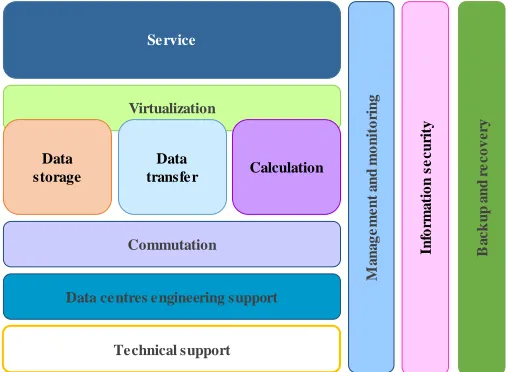
Government agencies have experienced a range of IT solutions over past years until the implementation of cloud computing. Government Cloud (G-Cloud) is an information and communication platform (hardware and software package) intended to provide services for government agencies with the application of cloud technology. It is a collection of services for leasing and allocating computing resources, providing software and also communication services where the services are operated. Some countries that have already adopted G-cloud are UK [42], Singapore [43], and Korea [44]. Aubakirov and Nikulchev [45] stated that the first phase of G-cloud implementation project should focuses on delivering IaaS.The main requirement for IaaS G-cloud is to follow best practices related to the development of virtual and cloud infrastructure. It must provide fast connections from government agencies to cloud data centers. G-cloud IaaS must offer possibilities such as high availability, data recovery, hot migration, hot resource inclusion, resilience, and automatic resource distribution. It should provide consolidation of existing infrastructure and optimization of government agencies’ IT equipment, ensure flexible scaling and reduce costs for solutions regarding the provision of services operation continuity and emergency recovery. It should ensure the possibility of expanding functionality through the installation of additional modules and to create an infrastructure with multiple tenants due to resources incorporation in virtual data centers. Only after the IaaS is settled, the project can focus on the second phase, to create fully automated interfaces as software services (SaaS) [45]. G-cloud SaaS provides users with access to various applications running on the cloud infrastructure. These applications can be of various types and available from all devices with different operating systems, including mobile platforms and web browser. Management and control over cloud infrastructure are executed by the cloud provider. G-cloud platforms are functionally contain the following subsystems [45]. Fig. 2 demonstrates the scheme of ICP
functional structure.
Subsystem of services provides key services (cloud
services) to the system users.
Subsystem of resources virtualization implements
software virtualization of physical computing resources.
Subsystem of computing platform provides the platform
of unified physical servers.
Subsystem of data transfer provides traffic transfer in virtual environment.
Subsystem of data storage provides equipment for data
storage and distribution. File and block access to data.
Subsystem of commutation provides physical computer
network.
Subsystem of data centers engineering assistance
provides data centers engineering subsystems.
Subsystem of management and monitoring provides
subsystems management and monitoring functionality.
Subsystem of information safety provision provides the
required information safety package.
Subsystem of backup and recovery provides the required
functionality for data backup and recovery.
Subsystem of technical assistance provides organizational
and technical support of the system operation.
2.6 Drivers & Barriers
Investigation of G-cloud implementations in different societies and cultures will have significant implications. The studies of many variations in organizational contexts, attitudes, and stakeholders can significantly impact the success of G-cloud implementation projects. Researchers have identified drivers and barriers of cloud computing adoption by government agencies. The driving forces of G-cloud implementation are summarized in Table 2. These may act on institutions’ leaders, prompt them to consider cloud computing and encourag them forward during the analysis of their IT options.
Service Virtualization Data storage Data transfer Calculation Commutation
Data centres engineering support
Technical support M a n a g e m e n t a n d m o n ito ri n g In fo rm a ti o n s e c u ri ty B a c k u p a n d r e c o v e ry
1696 Table 2 Drivers in G-cloud implementation
No. Driver Description References
1. Cost savings Reduced investment and
maintenance cost. [16, 42, 45, 46]
2. Flexibility & scalability
Resources can be purchased on-demand and as needed.
[16, 42, 45, 47, 48]
3. Availability and Accessibility
Citizens can use them at anytime and from anywhere.
[16, 49]
4. Economies of scale Reputable vendors offers
a reliable service. [42, 46]
5. Strategic focus
Enable the organization to focus on strategic goals.
[12, 42, 48, 50]
6. Green technology Good in energy
consumption. [16]
Although cloud computing offers a lot of advantages to E-government , several issues and challenges need to be targeted or to be met when applying cloud computing. The barriers of G-cloud implementation are summarized in Table 3.
Table 3 Barriers in G-cloud implementation
No. Barrier Description Reference
1. Data protection
and compliance
Regulations prevent the storage of sensitive data outside the teritory.
[12, 16, 50, 51, 52]
2. Security and
privacy
Security requirements must be fulfilled on several layers.
[16, 53]
3. Lack of trust in
cloud vendors
Service-level and
contract agreements. [12, 48, 52, 53]
4. Interoperability
and portability
Lack of standards of
cloud services. [16, 48, 54, 55]
5. Service quality
and availability
Connection problem /
speed of the internet. [16, 42, 56]
6. Auditing
Cloud providers do not offer detailed auditing possibilities.
[16]
7. Culture The reluctance to use the technology. [12, 55]
2.7 G-cloud Requirement
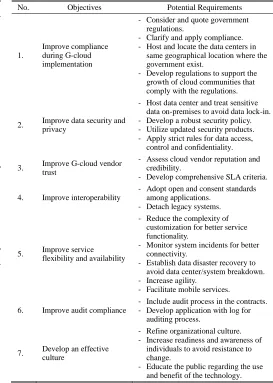
Tracking various drivers and barriers for G-cloud implementation is useful to support comprehensive efforts in identification of potential requirement. First, identify the key elements that describe new goals, capabilities and opportunities to successfully achieve objectives. Alghamdi [50] has developed the goal of G-cloud by considering drivers and barriers in Saudi Arabia, which are still relevant to the G-cloud context in Indonesia. The study recognized and classified the requirements for success then categorized the scope according to the strategic alignment model introduced by [57] and the TOGAF ADM best business scenario matrix. It provides the ability to meet the potential requirements to overcome the main obstacles identified in business architecture, information systems, and technology, and align with the organization goals.
Table 4. G-cloud objectives and potential requirements
No. Objectives Potential Requirements
1.
Improve compliance during G-cloud implementation
- Consider and quote government
regulations.
- Clarify and apply compliance.
- Host and locate the data centers in
same geographical location where the government exist.
- Develop regulations to support the
growth of cloud communities that comply with the regulations.
2. Improve data security and
privacy
- Host data center and treat sensitive
data on-premises to avoid data lock-in.
- Develop a robust security policy.
- Utilize updated security products.
- Apply strict rules for data access,
control and confidentiality.
3. Improve G-cloud vendor
trust
- Assess cloud vendor reputation and
credibility.
- Develop comprehensive SLA criteria.
4. Improve interoperability
- Adopt open and consent standards
among applications.
- Detach legacy systems.
5. Improve service flexibility and availability
- Reduce the complexity of
customization for better service functionality.
- Monitor system incidents for better
connectivity.
- Establish data disaster recovery to
avoid data center/system breakdown.
- Increase agility.
- Facilitate mobile services.
6. Improve audit compliance
- Include audit process in the contracts.
- Develop application with log for
auditing process.
7. Develop an effective culture
- Refine organizational culture.
- Increase readiness and awareness of
individuals to avoid resistance to change.
- Educate the public regarding the use
and benefit of the technology.
3 MODEL DEVELOPMENT
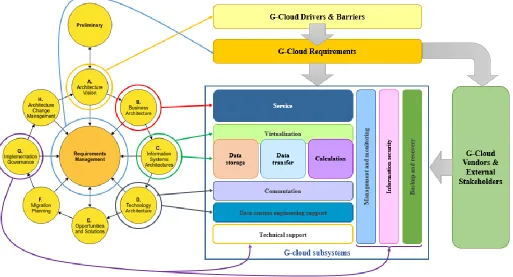
This research develops the model by mapping the TOGAF ADM and G-cloud services. The proposed model is shown in Figure 2.
First, we identified G-cloud drivers and barriers to obtain G-cloud objectives and requirements. This process is relevant and mapped to Architecture Vision Phase. In this phase, we analyze the current state, and where we want to be driven by organization objectives, and then what is the gap with the designed state.
After compiling the G-cloud requirements, the second step is to choose a cloud service model and cloud vendors. As mention earlier, the first phase of the project is IaaS and SaaS.
The agencies rent a set of resources in the cloud. This service model gives users a virtualized technology infrastructure that enables the deployment and execution of any software. Though the agency chose to transfer the responsibility of managing the infrastructure to the G-cloud vendor, the EA should depict the existence of a cloud server. Thus, this process is apart of and mapped to Technology Architecture Phase.
The management and control of physical infrastructure, including networks, servers, operating system, and storage, run by G-cloud providers. Thus, the process should follow the guidance and mapped to
Implementation Governance Phase.
SaaS provides access to various applications that run on cloud infrastructure. Applications can be of various types and are available on all devices with different operating systems. User access to applications can be granted via a mobile platform or through a web browser. SaaS covers all subsystems in the G-cloud service, especially the applications related subsystems because the management and control over the cloud infrastructure are run by the cloud provider.
Service subsystems provide key cloud services for system users. Functionally, services are built from a
Business Architecture Phase consisting of functions, business processes, users, and the goals of each service.
Resource virtualization subsystem implements physical computing software virtualization resources.
The calculation platform subsystem provides a unified physical server platform. Data transfer subsystem provides transfer of traffic in a virtual environment. Data storage subsystems provide equipment for data storage and distribution. All of these subsystems are mapped to the Information Systems Architecture Phase to define all the software needed to build the G-cloud.
All the subsystem in the G-cloud structure has been mapped perfectly to TOGAF ADM. However, not all TOGAF ADM Phases is related and supporting directly the G-cloud structure. Because TOGAF practically provides step-by-step guidance for EA implementation. The Opportunities and Solution Phase and Migration Planning Phase are not mapped to any subsystem in G-cloud, as these phases more related to the implementation of realizing the G-cloud. Such as managing the G-cloud project and migration from on-premise to cloud services. This also applied to Architecture Change Management Phase, as this phase will manage the necessary changes of the determined architecture.
4 CONCLUSION
This paper provides reasons for the widespread use of cloud computing technology in public organizations. Previous reviews offer detailed explanations for identifying significant drivers and barriers that influence government agencies, taking into account the perspective of G-cloud vendors and consumers. This paper identifies the relationship between cloud computing services for the government (G-cloud) and one of the most advanced EA frameworks, TOGAF. TOGAF has proven to be easily understood and interpreted by
1698 cloud stakeholders and is strong enough to support decisions
about the use of cloud technology. TOGAF can support and bring value to government agencies. On a largerer scale, this paper aims to facilitate the overall success of G-cloud implementation requirements by identifying G-cloud services and mapping them to TOGAF ADM process. Future studies need to assess the objectives and formulate potential requirements that include perceptions of G-cloud vendors. Then, implementation in institutions in the central and regional government needs to be done to test the model. Interviews with managers and practitioners who have successfully developed G-cloud can be carried out to complete information about the g-cloud utilities and best practices. This input can be used to review the proposed model in supporting the G-cloud requirements matrix in the context of implementation in Indonesia.
R
EFERENCES[1] A. Setiawan and E. Yulianto, ―E-Government Interoperability and Integration Architecture Modeling Using TOGAF Framework Based On Service Oriented Architecture,‖ The Asian Journal of Technology Management, vol. 11, no. 1, 2018, pp. 26–45.
[2] P. Saha, ―Enterprise architecture as platform for connected government: Understanding the impact of enterprise architecture on connected government,‖ National University of Singapore Institute of Systems Science, 2010.
[3] E. K. Budiardjo, G. Firmansyah, and Z. A. Hasibuan, ―Weighted Components of i-Government Enterprise Architecture,‖ in Journal of Physics: Conference Series, 2017, vol. 801, no. 1, p. 12025.
[4] A. A. Saiya and A. A. Arman, ―Indonesian Enterprise Architecture Framework: A Platform for Integrated and Connected Government,‖ in 2018 International Conference on ICT for Smart Society (ICISS), 2018, pp. 1– 6.
[5] United Nations, ―United Nations E-Government Survey 2016: E-Government in Support of Sustainable Development,‖ United Nations, 2016. .
[6] G. Firmansyah, Z. A. Hasibuan, and Y. G. Sucahyo, ―Indonesia e-Government components: A principal component analysis approach,‖ in 2014 International Conference on Information Technology Systems and Innovation (ICITSI), 2014, pp. 148–152.
[7] Government of Indonesia, ―Presidential Directive No. 3/2003 about National Policy and Strategy for e-Government Development,‖ Indonesian Republic Cabinet Secretariat. Jakarta, 2003.
[8] A. Sanchez, R. Basanya, T. Janowski, and A. Ojo, ―Enterprise architectures-enabling interoperability between organizations,‖ in Proceedings of the 36th Argentine Conference on Informatics 8th Argentinean Symposium on Software Engineering, ASSE 2007, Mar del Plata, Argentina, 2007, vol. 1, pp. 175–184.
[9] B. D. Rouhani, M. N. Mahrin, F. Nikpay, and P. Nikfard, ―A comparison enterprise architecture implementation methodologies,‖ in 2013 International Conference on
Informatics and Creative Multimedia, 2013, pp. 1–6. [10] M. A. Mohamed, G. H. Galal-Edeen, H. A. Hassan, and E.
E. Hasanien, ―An evaluation of enterprise architecture frameworks for e-government,‖ in 2012 Seventh International Conference on Computer Engineering & Systems (ICCES), 2012, pp. 255–260.
[11] V. Chang, R. J. Walters, and G. B. Wills, ―Cloud computing and frameworks for organisational cloud adoption,‖ in Web-Based Services: Concepts, Methodologies, Tools, and Applications, IGI Global, 2016, pp. 683–707.
[12] R. El-Gazzar, E. Hustad, and D. H. Olsen, ―Understanding cloud computing adoption issues: A Delphi study approach,‖ Journal of Systems and Software, vol. 118, 2016, pp. 64–84.
[13] A. P. Vumo, J. Spillner, and S. Köpsell, ―A Data Security Framework for Cloud Computing Adoption: Mozambican Government Cloud Computing,‖ in European Conference on Cyber Warfare and Security, 2019, pp. 720--XX.
[14] N. C. Ferreira, F. A. F. Ferreira, C. S. E. Marques, G. O. Pérez-Bustamante Ilander, and A. Çipi, ―Challenges in the implementation of public electronic services: lessons from a regional-based study,‖ Journal of Business Economics and Management, vol. 16, no. 5, 2015, pp. 962– 979.
[15] J. Liang, ―Government cloud: enhancing efficiency of e-government and providing better public services,‖ in 2012 International Joint Conference on Service Sciences, 2012, pp. 261–265.
[16] T. Almarabeh, Y. K. Majdalawi, and H. Mohammad, ―Cloud computing of e-government,‖ 2016.
[17] F. Suaedi and B. Wardiyanto, ―Revitalisasi Administrasi Negara: Reformasi Birokrasi dan e-Governance,‖ Yogyakarta: Graha Ilmu, 2010.
[18] E. R. Indrajit, A. Zainudin, and D. Rudianto, Electronic Government in action. Yogyakarta: Andi, 2005.
[19] I. Y. M. Edward, W. Shalannanda, A. Agusdian, and S. I. Lestariningati, ―E-Government Master Plan Design with TOGAF Framework,‖ in 2014 8th International Conference on Telecommunication Systems Services and Applications (TSSA), 2014, pp. 1–6.
[20] I. Arpacı and A. Arifoğlu, ―E-transformation and technological innovation in Turkey,‖ in Proceedings of the European and Mediterranean conference on information systems (EMCIS), 2009, pp. 1–9.
[21] G. Valdés, M. Solar, H. Astudillo, M. Iribarren, G. Concha, and M. Visconti, ―Conception, development and implementation of an e-Government maturity model in public agencies,‖ Government Information Quarterly, vol. 28, no. 2, 2011, pp. 176–187.
[22] S. Jayashree and G. Marthandan, ―Government to E-government to E-society,‖ Journal of Applied Sciences(Faisalabad), vol. 10, no. 19, 2010, pp. 2205–2210. [23] K. Huang, ―The relations and interactions of
[24] W. Samudra, Teori Kebijakan Publik, Proses Dan Analisis. Yogyakarta: Intermedia, 1992.
[25] A. Rokhman, ―e-Government adoption in developing countries; the case of Indonesia,‖ Journal of Emerging Trends in Computing and Information Sciences, vol. 2, no. 5, 2011, pp. 228–236.
[26] B. Pudjianto, H. Zo, A. P. Ciganek, and J. J. Rho, ―Determinants of e-government assimilation in Indonesia: An empirical investigation using a TOE framework,‖ Asia Pacific Journal of Information Systems, vol. 21, no. 1, 2011, pp. 49–80.
[27] N. B. Kurniawan and others, ―Enterprise Architecture design for ensuring strategic business IT alignment (integrating SAMM with TOGAF 9.1),‖ in 2013 Joint International Conference on Rural Information & Communication Technology and Electric-Vehicle Technology (rICT & ICeV-T), 2013, pp. 1–7.
[28] J. W. Ross, P. Weill, and D. Robertson, Enterprise architecture as strategy: Creating a foundation for business execution. Harvard Business Press, 2006.
[29] T. Obitz and K. M. Babu, ―Enterprise architecture expands its role in strategic business transformation,‖ Infosys Enterprise Architecture Survey 2008, 2009. [30] L. Kappelman, T. McGinnis, A. Pettite, and A. Sidorova,
―Enterprise architecture: Charting the territory for academic research,‖ AMCIS 2008 Proceedings, 2008, p. 162.
[31] P. Drews and I. Schirmer, ―From enterprise architecture to business ecosystem architecture: Stages and challenges for extending architectures beyond organizational boundaries,‖ in 2014 IEEE 18th International Enterprise Distributed Object Computing Conference Workshops and Demonstrations, 2014, pp. 13–22.
[32] Q. N. Bui, ―Making connections: A typological theory on enterprise architecture features and organizational outcomes,‖ AMCIS 2012 Proceedings., vol. 14, 2012. [33] L. Urbaczewski and S. Mrdalj, ―A comparison of
enterprise architecture frameworks,‖ Issues in Information Systems, vol. 7, no. 2, 2006, pp. 18–23. [34] A. A. Rais, R. Pecinovsky, and others, ―TOGAF usage in
outsourcing of software development,‖ Acta Informatica Pragensia, vol. 2, no. 2, 2014, pp. 68–76.
[35] T. Version, ―9.1, an Open Group Standard,‖ Published in the US by The Open Group, 2011.
[36] I. H. A. Wahab and A. Arief, ―An integrative framework of COBIT and TOGAF for designing IT governance in local government,‖ in 2015 2nd International Conference on Information Technology, Computer, and Electrical Engineering (ICITACEE), 2015, pp. 36–40.
[37] A. Hodijah, S. Sundari, and A. C. Nugraha, ―Applying TOGAF for e-government implementation based on service oriented architecture methodology towards good government governance,‖ in Journal of Physics: Conference Series, 2018, vol. 1013, no. 1, p. 12188.
[38] B. H. Cameron and E. McMillan, ―Analyzing the current trends in enterprise architecture frameworks,‖ Journal of Enterprise Architecture, vol. 9, no. 1, 2013, pp. 60–71. [39] P. Mell, T. Grance, and others, ―The NIST definition of
cloud computing,‖ 2011.
[40] T. Erdenebold, ―A Smart Government EA Framework for Mobile Application Services in Mongolia,‖ KAIST, 2016. [41] F. Wildana, ―Implementasi Cloud Computing di
Beberapa Instansi Pemerintahan,‖ Jurnal Masyarakat Telematika dan Informasi, vol. 8, no. 2, 2017, pp. 97–108. [42] J. Chang and M. Johnston, ―Approaches to Cloud
Computing in the Public Sector: Case Studies in UK Local Government,‖ in Cloud Security: Concepts, Methodologies, Tools, and Applications, IGI Global, 2019, pp. 188–209.
[43] K. Mustafa and I. Shabani, ―Mobile e-Governance in Cloud,‖ International Journal of Recent Contributions from Engineering, Science & IT (iJES), vol. 6, no. 2, 2018, pp. 46–60.
[44] S.-K. Yoo and B.-Y. Kim, ―The Effective Factors of Cloud Computing Adoption Success in Organization,‖ The Journal of Asian Finance, Economics and Business, vol. 6, 2018.
[45] M. Aubakirov and E. Nikulchev, ―Development of system architecture for e-government cloud platforms,‖ arXiv preprint arXiv:1603.08297, 2016.
[46] M. Janssen and A. Joha, ―Challenges for adopting cloud-based software as a service (SaaS) in the public sector,‖ 2011.
[47] P. Busch, S. Smith, A. Q. Gill, P. Harris, B. Fakieh, and Y. Blount, ―A study of government cloud adoption: The Australian context,‖ in Proceedings of the 25th Australasian Conference on Information Systems, ACIS 2014, 2014.
[48] S. Haag and A. Eckhardt, ―Organizational cloud service adoption: a scientometric and content-based literature analysis,‖ Journal of Business Economics, vol. 84, no. 3, 2014, pp. 407–440.
[49] S. Jones, ―Cloud computing procurement and implementation: Lessons learnt from a United Kingdom case study,‖ International journal of information management, vol. 35, no. 6, 2015, pp. 712–716.
[50] B. Alghamdi, L. E. Potter, and S. Drew, ―Desinge and implementation of government cloud computing requirements: TOGAF,‖ in 2017 11th International Conference on Telecommunication Systems Services and Applications (TSSA), 2017, pp. 1–6.
[51] K. Irion, ―Government cloud computing and national data sovereignty,‖ Policy & Internet, vol. 4, no. 3–4, 2012, pp. 40–71.
[52] S. Tweneboah-Koduah, B. Endicott-Popovsky, and A. Tsetse, ―Barriers to government cloud adoption,‖ International Journal of Managing Information Technology, vol. 6, no. 3, 2014, pp. 1–16.
[53] T. Oliveira, M. Thomas, and M. Espadanal, ―Assessing the determinants of cloud computing adoption: An analysis of the manufacturing and services sectors,‖ Information & Management, vol. 51, no. 5, 2014, pp. 497– 510.
1700 [55] A. Mukhametzhanova, R. Harvey, and D. Smith, ―Ahead
in the G-clouds: Policies, Deployment and Issues,‖ in International Conference on Electronic Government and the Information Systems Perspective, 2014, pp. 292–306. [56] E. O. Güner and E. Sneiders, ―Cloud Computing
Adoption Factors in Turkish Large Scale Enterprises.,‖ in PACIS, 2014, p. 353.