A COMPUTATIONAL FRAMEWORK FOR USING
BOTH RULES AND PREVIOUSLY-DECIDED CASES IN
A LEGAL DECISION MAKING PROCESS
UCL
KAMALENDU PAL
Department of Computer Science
University College London
Gower Street, London WCIE 6BT
A thesis submitted for the degree of Master of Philosophy
in the University of London
June 1997
/ B I b L . (l o n o i k.]
ProQuest Number: U642047
All rights reserved
INFORMATION TO ALL USERS
The quality of this reproduction is dependent upon the quality of the copy submitted.
In the unlikely event that the author did not send a complete manuscript
and there are missing pages, these will be noted. Also, if material had to be removed,
a note will indicate the deletion.
uest.
ProQuest U642047
Published by ProQuest LLC(2015). Copyright of the Dissertation is held by the Author.
All rights reserved.
This work is protected against unauthorized copying under Title 17, United States Code.
Microform Edition © ProQuest LLC.
ProQuest LLC
789 East Eisenhower Parkway
P.O. Box 1346
A b s tr a c t
A h y b rid know ledge-based sy ste m , A dvisory S u p p o rt for H om e S e ttle m e n t in D ivorce
(A S H S D ), w hich ex p lo its b o th g en e ral legal rules (for ru le-b ased re a so n in g or R B R ) an d
specific in fo rm a tio n ta k e n from p reviously-decided sim ilar cases (for ca se-b a se d reaso n in g
or C B R ), is d esc rib ed . Legal know ledge in th e sy ste m covers th re e a sp e c ts o f m a trim o n ia l
hom e s e ttle m e n t in divorce in E nglish law , n am ely ow ned hom e s e ttle m e n t, tra n s f e r of
ten an cy , an d in ju n c tio n s to p ro te c t a spo u se, o r a fam ily m e m b e r in th e c u sto d y o f a
spouse. T h e user ca n select e ith e r re aso n in g m e th o d (R B R o r C B R ), o r in d ic a te no
preference. A S H S D ’s rule b ase co n sists o f tw o ty p e s o f rule. T h e first ty p e of rules
d e te rm in e s w hich o p tio n s a re legally applicab le. T h e second ty p e in d ic a te s how th e c o u rts
are likely to a c t w ith in th e ra n g e o f o p tio n s available, w hich is d e te rm in e d by th e first
ty p e of rules.
W h en C B R is selected , th e sy stem uses th e fe a tu re s o f p rev io u sly -d ecid ed cases to
select th e m o st sim ilar cases to th e s itu a tio n t h a t is d esc rib ed in th e in p u t a n d disp lay s
th e ir d e ta ils o f decisions.
W h e n no p reference is in d ic a te d , th e sy stem applies each m e th o d se p a ra te ly , an d th e n
p re se n ts re su lts b ased on an a u to m a te d re la tiv e ra tin g o f th e q u a litie s o f th e R B R (based
A C K N O W L E D G E M E N T
It is a g re a t p leasu re to acknow ledge m y d e b t to m an y people involved, d ire c tly o r
indirectly, in th e co m p letio n o f th is th esis. I am p a rtic u la rly g ra te fu l to m y su p e rv iso rs,
P ro fe sso r J o h n C am p b ell an d D r M ark Levene, for e n c o u rag in g m e in th is w ork, offering
su g g estio n s an d p ru n in g m an y u n fru itfu l b ra n c h e s of research . I am g ra te fu l to J o h n for
his g u id an ce an d especially for th e tim e a n d effort he sp e n t r e s tr u c tu rin g a n d m ak in g
c o n stru c tiv e su g g estio n s on ea rly d ra fts o f th is thesis.
I am g ra te fu l to D r S te p h e n G u e st o f th e Law F aculty, U n iv ersity C ollege L o n d o n , for
ta k in g tim e from his b usy schedule in th e v alid atio n s tu d y o f th e im p le m e n te d sy ste m . I
am also th a n k fu l to D r D a n H u n te r o f th e Law School, U n iv ersity o f M e lb o u rn e , A u s tra lia ,
for p ro v id in g useful c o m m e n ts on th e im p le m e n ted softw are.
It is now m y p leasu rab le d u ty to reco rd m y in d e b te d n e ss to som e of m y frie n d s for th e
help th e y have given m e in p ro d u c in g th is th esis. F o rm o st a m o n g st th e m is S u k h d ev K heb-
bal w ho, over la s t th re e y ears, h a s given m e valu ab le in fo rm a tio n on so ftw a re. T ony B al-
lardie, S an ja y K a d a m , W illiam L an g d o n , J e n s D zikow ski, R afael S o rd in i, E liseo R e a te g u i,
W ilfred Ng, A rif Iq b a l and J o n a th a n P oo le have p rovided m e w ith th e ir e x p e rt o pinions
an d help.
C ontents
1 In tr o d u ctio n 1
1.1 B a c k g r o u n d ... 1
1.2 A rtificial Intelligence in C o n te x t o f L a w ... 2
1.3 T h e Legal T h e o re tic a l C o n c e p t s ... 3
1.3.1 T h e Legal P o s i t i v i s t s ... 4
1.3.2 Legal R e a l i s m ... 8
1.4 T h e Legal D ecision-M aking P r o c e s s ... 11
1.5 M odel fo r th e P re s e n t R e s e a r c h ... 18
1.5.1 Id e n tific atio n a n d A cqu isitio n of K n o w l e d g e ...20
1.5.2 R e p re se n ta tio n o f th e C ollected K n o w l e d g e ...23
1.5.3 R easo n in g on th e R ep re sen ted K n o w l e d g e ... 24
1.5.4 N o tio n o f R ule-B ased R e a s o n i n g ... 25
1.5.5 N otion o f C ase-B ased R e a s o n i n g ... 29
C o n te n ts iii
1.6.1 P r o je c t O rie n ta tio n ... 31
1.6.2 W h y a H y b rid S y stem ?... 32
1.6.3 O verview o f A S H S D ... 33
1.7 S tr u c tu re o f th e T h e s i s ... 37
2 P r e v io u s R ela ted R esea rch 39 2.1 I n t r o d u c t i o n ... 39
2.2 R u le-B ased R easo n in g S y s t e m s ... 40
2.2.1 T A X M A N I P r o j e c t ... 40
2.2.2 B ritish N a tio n a lity A c t ...41
2.2.3 T h e O xford P ro je c t ... 45
2.2.4 LDS an d SAL S y s te m s ... 46
2.2.5 T A X A D V I S O R ... 47
2.2.6 L a te n t D a m a g e S y stem ... ...47
2.2.7 T h e Use o f M e ta -ru le s in R ule-B ased Legal C o m p u te r S y ste m s . . . 48
2.2.8 C o m m e n ta ry on R B R S y s t e m s ... 48
2.3 C ase-B ased R easo n in g S y s t e m s ... 49
2.3.1 J U D G E ...49
2.3.2 H Y P O ... 51
C o n te n ts iv
2.3.4 C H A S E R ... 53
2.3.5 C o m m e n ta ry on C B R S y s t e m s ...54
2.4 H y b rid Legal K now ledge-B ased S y s t e m s ... 55
2.4.1 T A X M A N I I ... 55
2.4.2 G a r d n e r ’s S y s te m ... 56
2.4.3 G R E B E ... 57
2.4.4 C A B A R E T ...58
2.4.5 P R O L E X S ... 60
2.4.6 IK B A L S I I ... 61
2.4.7 H E L IC I I ...61
2.4.8 C o n c l u s io n s ... 62
3 F ram ew ork o f th e S y ste m 64 3.1 I n t r o d u c ti o n ... 64
3.2 C o n c e p ts b eh in d A SH SD ... 65
3.2.1 C h a r a c t e r i s a t i o n ... 65
3.2.2 O b je c tiv e s for th e S y s t e m ... 65
3.3 A S H S D ’s K now ledge B ase D e v e l o p m e n t ... 66
3.4 T h e D o m ain ; M a trim o n ia l-H o m e -R e la te d O r d e r s ... 66
C o n te n ts v
3.5.1 M odel B u i l d i n g ... 70
3.5.2 K now ledge A c q u is itio n ... 72
3.5.3 In c re m e n ta l D ev elo p m e n t o f Full S y s t e m ... 80
3.5.4 T estin g an d U ser T r i a l s ...82
3.6 T h e A S H S D H y b rid R easo n in g M o d e l ... 83
3.6.1 S y stem C o n tro l M e c h a n i s m ...83
4 K n o w led g e R ep resen ta tio n and O rganisation 86 4.1 I n t r o d u c ti o n ...86
4.1.1 Legal K now ledge in R ule F o r m ... 86
4.2 Legal K now ledge in C ase F o r m ... 88
4.2.1 A SH SD - C ase K now ledge R e p re se n ta tio n an d O r g a n i s a t i o n ...91
4.3 E x am p le: M a rtin (B .H .) v M a rtin ( D . ) ...95
4.3.1 Ju d ic ia l O pinion for M a rtin v M a r tin ... 96
4.3.2 K now ledge R e p re se n ta tio n an d O rg a n isa tio n for M a r tin v M a r tin case 99 4.3.3 M a trim o n ia l-H o m e H y p e rn o d e S tr u c tu r e a n d C o n t e n t s ... 102
4.3 .4 A p p e al H y p e rn o d e o f th e M a rtin v M a rtin c a s e ...103
4.3.5 D ecision H y p e rn o d e o f th e M a rtin v M a rtin c a s e ... 103
4.3.6 S u m m a r y ...104
C o n te n ts vi
5.1 K now ledge-B ased S y ste m an d F u z z i n e s s ... 105
5.1.1 O verview of F uzzy S et T h e o ry ... 106
5.1.2 W h a t is F uzziness ? ... 106
5.2 F uzzy S e ts - N o ta tio n , T erm in o lo g y an d B asic P r o p e r t i e s : ...108
5.2.1 C lassical S et o r C risp S e t ...108
5.2.2 C h a ra c te ris tic F u n c tio n of a C risp S e t ... 108
5.2.3 Fuzzy S et an d its C h a ra c te ris tic F u n c t i o n ... 109
5.2.4 F o rm al Fuzzy S et R e p r e s e n t a t i o n ... I l l 5.2.5 H edges o f F uzzy S e t s ...113
5.3 Fuzzy K now ledge R e p re se n ta tio n in A S H S D ... 115
6 O rganisation o f K n o w led g e B a se 119 6.1 I n t r o d u c t i o n ... 119
6.2 R ule B ase S t r u c t u r e ... 120
6.2.1 C o m p reh en siv e A d v i c e ... 122
6.3 C ase B ase M a n a g e m e n t an d C ase R e t r i e v a l ... 127
6.3.1 E x a m p le : E xclusion O rd e r F ro m a R e n te d M a trim o n ia l H om e . . . 130
6.3.2 Selection of S im ilar C ases for a New C a s e ...135
6.3.3 P a r tia l A dvice M e c h a n is m ... 141
C o n te n ts vii
6.3.5 S election of S im ilar C ases for a New C a s e ... 149
6.3.6 No R ule-B ased A d v i c e ...157
6.3.7 No S uggestion from R ule B ase a n d C ase B a s e ...157
6.4 A u to m a te d D ecision on th e Q u a litie s of th e R easo n in g M e t h o d s ...157
7 E m p irical O b servations and V a lid ation o f A S H S D 159 7.1 I n t r o d u c ti o n ...159
7.2 W h y E m p irical O b serv atio n ? ...160
7.2.1 E m p irical O b se rv a tio n s ... 160
7.2.2 E x am p le: T h e O verall S u ita b ility o f an y P a r tic u la r R easo n in g M e th o d 160 7.3 C o n c l u s i o n s ...174
7.4 O verview o f th e P ro je c t V a l i d a t i o n ... 175
7.4.1 V a lid atio n o f A S H S D ...175
7.4.2 S econd S te p of V a l i d a t i o n ...181
7.5 K now ledge B ase M a in te n a n c e A sp e c ts of A S H S D ... 182
8 C o n clu sion s 186 8.1 I n t r o d u c t i o n ...186
8.2 M o tiv a tio n ...186
8.3 S u m m a ry o f R e s u l t s ...187
C o n te n ts viii
8.5 L im ita tio n an d F u tu re R e s e a r c h ... 192
8.5.1 In te g ra tio n of A SH SD w ith a D a ta B ase M a n a g e m e n t S y ste m . . . . 192
8.5.2 In c o rp o ra tio n o f a B e tte r U ser I n t e r f a c e ...193
8.5.3 Inclusion o f a C ritic M o d u l e ... 193
8.5.4 E x te n sio n o f th e Scope of A SH SD ... ... 194
8.6 C o n clu d in g R e m a rk ... 194
A P r e v i o u s l y D e c i d e d C a s e s 1 9 5 B Q u e s t i o n n a i r e U s e d in t h e V a l i d a t i o n P r o c e s s 2 1 5 C Q u e s t i o n n a i r e U s e d in t h e C r i t i c a l I n s p e c t i o n o f A S H S D 2 1 8 C .l B ack g ro u n d In fo rm a tio n a b o u t th e S y stem ...219
C .2 D ifferen t R ule-B ased A d v i c e ... 223
C .2.1 C ase-B ased A d v i c e ... 223
C .2 .2 Q u e stio n n a ire for th e te s t c a s e s ...224
C .3 E x tr a Q u e stio n s ...227
List o f Figures
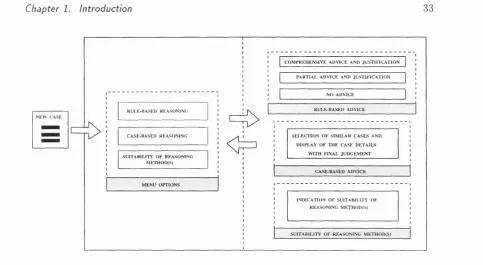
1.1 T h e c o m p u ta tio n a l f r a m e w o r k ... 33
1.2 D ifferen t ty p e s o f b e h a v io u r leading to ru le-b ased o u tp u t ... 36
3.1 D e co m p o sitio n o f legal an a ly sis b l o c k ... 71
3.2 D e co m p o sitio n o f ow ned m a trim o n ia l hom e b l o c k ... 72
3.3 D e co m p o sitio n o f offending b e h a v io u r ...74
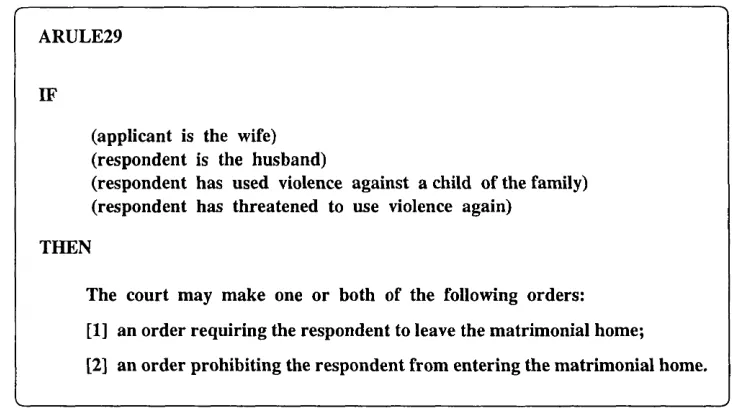
3.4 A n ‘a v a ila b le -a c tio n (s)’ rule for an in ju n c tio n -re la te d c a s e ... 76
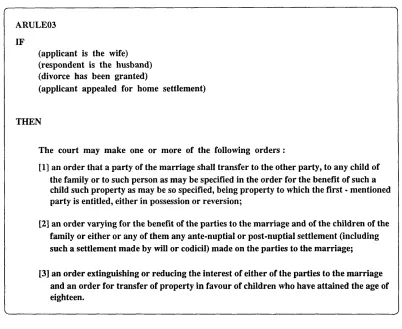
3.5 A n ^available-action(s)^ rule for an ow ned ho m e s e ttle m e n t c a s e ... 77
3.6 R u le-b ased ‘p re d ic tio n ’ in an exclusion o rd e r for p ro te c tin g a sp o u se . . . . 78
3.7 R u le-b ased ‘p re d ic tio n ’ in an exclusion o rd e r for p ro te c tin g a c h i l d ... 79
3.8 S y ste m l a y o u t ... 84
4.1 T h e g en e ral rule s tr u c tu r e a n d a te n a n c y tra n s f e r r u l e ...87
4.2 H y p e rn o d e c a s e b a s e ...91
4.3 A p o rtio n of th e ‘p a r tic ip a n ts ’ h y p e rn o d e ... 92
L ist o f F ig u r e s x
4.4 D ifferent ty p e s of re la tio n sh ip h y p e rn o d e s ... 93
4.5 D ifferent ty p e s o f m a trim o n ia l h o m e ... 94
4.6 D ifferent ty p e s o f m a trim o n ia l hom e h y p e rn o d e s ...95
4.7 T h e m ain case h y p e rn o d e for th e M a rtin v M a rtin c a s e ...96
4.8 In d ex h y p e rn o d e s for th e M a rtin v M a rtin c a s e ... 97
4.9 P a r tic ip a n ts a n d re la tio n h y p e rn o d e s for th e M a r tin v M a rtin c a s e ... 97
4.10 P a rtic ip a n t h y p e rn o d e s for th e M a rtin v M a rtin c a s e ... 98
4.11 A d u lt a n d children p a r tic ip a n t h y p e rn o d e s for th e M a rtin v M a rtin case . . 100
4.12 Legal an d g ro u p p a r tic ip a n ts for th e M a rtin v M a rtin c a s e ... 101
4.13 R e la tio n s am o n g th e p a rtic ip a n ts for th e M a rtin v M a rtin c a s e ... 101
4.14 F a c ts h y p e rn o d e for th e M a rtin v M a rtin c a s e ...102
4.15 D ifferen t c o u rt h y p e rn o d e s for th e M a rtin v M a rtin c a s e ... 102
4.16 M a trim o n ia l-h o m e h y p e rn o d e for th e M a rtin v M a rtin c a s e ...102
4.17 A p p e a l h y p e rn o d e fo r th e M a rtin v M a rtin c a s e ... 103
4.18 D ecision h y p e rn o d e for th e M a rtin v M a rtin c a s e ... 103
5.1 C h a ra c te ris tic fu n c tio n o f A ...109
5.2 A c h a ra c te ris tic fu n c tio n for fuzzy se t G O O D ...109
5.3 F uzzy se ts on len g th o f m a rria g e w ith ‘v e ry ’ h e d g e ...114
L ist o f F ig u r e s xi
5.5 T h e advice an d th e p re c o n d itio n s of B R U L E 1 9 ...118
6.1 rule bcLse s t r u c t u r e ...120
6.2 R e p re se n ta tio n of s te p s in th e sim ila rity c isse ssm e n t...128
6.3 D ia g ra m m a tic re p re s e n ta tio n of th e re la tiv e d ista n c e s b etw een cases . . . . 134
6.4 C lassification of p re co n d itio n s o f B R U L E 2 2 ... 144
7.1 T h e c o m p ariso n of R B R an d C B R effectiveness on te s t cases ...172
7.2 T h e d ifferen t decision ca te g o rie s in g ra p h ic a l fo rm ...173
C .l T h e c o m p u ta tio n a l fr a m e w o r k ...220
C .2 D ifferent ty p e s o f p re c o n d itio n s o f B R U L E 1 1 2 ... 221
List o f Tables
5.1 F uzzy te rm ‘g o o d ’ ...107
6.1 S om e o f th e p rev io u sly -d ecid ed in ju n c tio n -re la te d cases sto re d in th e case b a s e ...130
6.2 T h e re la tiv e sim ila rity d ista n c e for in ju n c tio n c a s e s ...132
6.3 T h e m u tu a l sim ilarity coefficients of th e abo v e in ju n c tio n -re la te d cases . . . 136
6.4 S om e o f th e p rev iously-decided ow ned hom e s e ttle m e n t cases s to re d in th e case b ase ...150
6.5 T h e re la tiv e sim ila rity d ista n c e for ow ned hom e s e ttle m e n t c a s e s ... 151
6.6 T h e m u tu a l sim ila rity coefficients fo r th e ab ove c a s e s ... 152
7.1 R eal te s t cases used in th e em p irical o b s e r v a t i o n s ...162
7.2 D erived (h y p o th e tic a l) te s t cases used in th e em p irical o b s e r v a tio n s ... 163
7.3 T h e scores an d th e a p p ro p ria te n e s s of ca te g o ries for som e te s t ca ses . . . .1 7 0 7.4 T h e re su lts of th e case base v a l i d a t i o n ... 179
7.5 G ra d in g s tr u c tu r e to assess th e case base v a li d a ti o n ... 180
L ist o f T a b le s 0
C hapter 1
In trod u ction
1.1
Background
C o m p u te r science, an d in p a rtic u la r A rtificial Intelligence (A I), is now m a k in g a n o ticea b le
im p ressio n on law - as w itn ess th e grow ing n u m b e r of jo u rn a ls a n d p u b lic a tio n s dealin g
w ith A I a n d law to g e th e r. F u rth e rm o re , th e legal d o m a in h a s becom e an a r e a in w hich
a p p lic a tio n s o f A I have grow n su b sta n tia lly . H ow ever, th e m a jo rity o f th e re searc h on
a p p lic a tio n s o f A I fo r th e legal profession an d th e c o n se q u en t tra c k reco rd o f re searc h on
legal re aso n in g have n o t y e t p ro d u c ed eflfective s u p p o rt sy ste m s a t a high level of legal
co m p e te n c e . A ty p ical opinion of th e s ta te of th e a r t is:
T hough co m p u te rs are used e x te n siv e ly by law yers f o r legal data storage a n d re trieva l purposes, th ey have n o t y e t been sa tisfa c to rily p rogram m ed to in te rp re t th is raw m a te ria l or to provide a ssista n c e in reasoning w ith, draw ing in fe r en ces fro m , a n d o fferin g advice on the basis of, the fo r m a l sources o f the law.
[(S usskind, 1987a), p p .3]
Chapter 1. Introduction 2
M an y a sp e c ts o f legal re aso n in g re q u ire fu r th e r s tu d y before th e s itu a tio n can b e im proved
q u a lita tiv e ly . In th is th esis, o u r p rim a ry concern is c o m p u te r science an d n o t law . B u t
even w ith o u t d e ta ile d or specialised know ledge of legal p ra c tic e s, we can id en tify one
a sp e c t o f legal re aso n in g w hich is also p re se n t fo r m an y o th e r k in d s o f ex p e rtise : rules
an d cases are used, an d so m etim e s to g e th e r. In research on k n ow ledge-based sy ste m s in
g en eral, using rules an d cases to g e th e r in tr e a tin g som e p ro b lem needs to be u n d e rsto o d
b e tte r . W e ex am in e one specific an d new a p p ro a c h to th is use o f know ledge in tw o different
re p re se n ta tio n s, w ith ex a m p les o f know ledge d ra w n from a specialised a r e a o f law .
1.2
A rtificial Intelligence in C ontext o f Law
T h e ad v a n ce o f in fo rm a tio n tech n o lo g y (IT ) an d its im p a c t on o u r d aily life c a n n o t be u n
d e re s tim a te d . H ow ever, legal professionals have been slow to ex p lo it th e im m en se p o te n tia l
of IT . In ste a d o f using IT to m axim ise p ro d u c tiv ity an d fee-earn in g cap acity , c o m p u te r
sy ste m s have been used m ainly for w ord p rocessing and ac c o u n tin g w ith in th e legal p ro
fession. IT hcLS y e t to be ex p lo ited as an effective tool by law yers.
T h e m o st v alu ab le reso u rces o f legal firm s are th e know ledge a n d e x p e rtise o f law yers.
B u t th e know ledge o f sen io r legal p ra c titio n e rs is n o t easily available to less ex p erien ced
law yers, s tu d e n ts , an d clients. C learly, re le v an t technologies in th is a re a are know ledge-
based sy ste m (K B S ): in p a rtic u la r, e x p e rt sy ste m s w hich w ould allow sca rce e x p e rtise and
know ledge to be m ore w idely available an d easily accessible. F o r law yers a n d clien ts to
have access to v aluable e x p e rtise a t th e to u c h o f a few keys could im p ro v e p ro d u c tiv ity ,
qu ality , an d p e rfo rm a n c e . In a d d itio n , th e use of th e se techn o lo g ies could give legal firm s
a c o m p e titiv e a d v a n ta g e over o th e rs t h a t a re slow er to a d o p t th e technology. T h e re fo re
th e c o n s tru c tio n o f a u to m a te d legal d é c isio n -su p p o rt sy ste m s is a v alu ab le exercise, from
th e p o in t o f view o f d e te rm in in g w h a t is feasible, d esira b le a n d /o r efficient. T h is view is
n o t u n u su al to find a m o n g th o se involved in research an d in th e p a r ts o f legal p ra c tic e
w here a s y m p a th e tic view of research exists.
In a u to m a tin g th e legal d é c isio n -su p p o rt sy ste m s, o ne h as to u n d e r s ta n d en o u g h of th e
Chapter 1. Introduction 3
w h a t is delivered p ro d u c es o u tp u t t h a t a legal sp ec ia list w ould re g a rd as helpful an d n o t
irre le v a n t o r m isleading. T h is u n d e rs ta n d in g includes th e o rie s a n d view s a b o u t w h a t law
is, w h a t are ty p ic a l legal p ro b lem s a n d how th e y are solved, w h a t are th e uses for legal
k now led g e-b ased sy ste m s, an d so fo rth . Since m o st o f th e se a s p e c ts refer in so m e way,
even in d ire c t, to th e th e o re tic a l fo u n d a tio n s of law a s a discipline, legal th e o ry should
be consid ered for its relevance to th e a u to m a tio n of a n y legal d é c isio n -su p p o rt sy stem .
In th e n e x t sec tio n , th ere fo re , we discuss several id eas from classical a u th o rs in legal
th e o ry fo r th e ir p o te n tia l relevance to o u r w ork. H ow ever, th is th e sis is n o t in te n d e d as a
c o n trib u tio n to legal th eo rie s; its significance is in c o m p u te r science, in co n n e c tio n w ith a
specific a u to m a te d d é c isio n -su p p o rt sy ste m t h a t uses m u ltip le know ledge re p re s e n ta tio n s .
1.3
T h e Legal T heoretical C oncepts
D ifferent re se a rc h e rs [e.g. (S usskind, 1987a), (G a rd n e r, 1987), (Zeleznikow & H u n te r,
1994)] of AI a n d law have arg u ed for th e relevance of ju risp ru d e n c e ^ to th e a u to m a tio n of
legal d ec isio n -m a k in g processes. S usskind w rites:
It is beyond a rgum ent, how ever, th a t all expert s y s te m s m u s t co n fo rm to so m e ju r isp r u d e n tia l theory because all expert sy s te m s in law n ecessa rily m a k e a s s u m p tio n s about the nature o f the law a n d legal reasoning. To be m ore specific, all expert s y s te m s m u st em body a theory o f stru ctu re a n d in d iv id u a tio n o f laws, a theory o f legal n o rm s, a theory o f d escrip tive legal science, a theory o f legal reasoning, a theory o f logic an d the law, a n d a th eo ry o f legal sy ste m s, as w ell as e le m e n ts o f a s e m a n tic theory, a sociology a n d a p sychology o f law (th eo ries th a t m u s t all th em se lv es rest on m ore basic p hilosophical fu n c tio n s ) . I f th is is so, it w ould see m p ru d e n t th a t the general th eo ry o f law im p lic it in expert sy s te m s should be explicitly articu la ted ... [(S usskind, 1987a), p p .20]
' Jurisprudence m eans legal philosophy (or legal theory). A m ong the topics included in legal philosophy
are theories o f law; the concepts o f law and legal institutions; legal reasoning and adjudication; and m any
Chapter 1. Introduction 4
T h e ab ove sp ecification m ak es som e d e m a n d s t h a t are u n ique to legal k n ow ledge-based
s y ste m s. In o th e r a re a s (e.g. engineering, m edical science, etc.) for w hich one w ould wish
to design a know ledge-based sy stem th e re is m uch m ore of a consen su s a b o u t th e n a tu r e of
th e th e o ry t h a t d escrib es th e discipline. A n en gineering or m edical school w ould g en erally
n o t c o n d u c t co u rses on th e n a tu r e o f en g in eerin g o r m edicine b e c au se th e p ra c tic e o f th e se
p rofessions h a rd ly ever raises th e kind o f fo u n d a tio n a l q u e stio n s t h a t d riv e o ne b ac k to
b asic th e o ry a b o u t th e discipline. Such concerns, how ever, o ften arise in legal p ra ctice;
hence, th e se are th e kinds of q u estio n t h a t a course in ju risp ru d e n c e ask s a b o u t law . In
law th e re is no single a g re e m e n t a b o u t w h a t law is, n o r a b o u t th e tr u e n a tu r e o f legal
reaso n in g , b u t som e a g re e m e n t is n ev e rth eless needed if legal ra tio n a lity is to b e self-
conscious. M oreover, legal p ra c titio n e rs have no b o d y o f scientific know ledge lying a t th e
h e a r t o f th e ir discipline, unlike e x p e rts in th e fields w here o th e r k now ledge-based sy ste m s
hav e been c re a te d successfully. In s te a d , law re sts u p o n se ts o f fu n d a m e n ta l values a b o u t
w hich th e re is a g re a t deal of d e b a te .
To clarify th e s itu a tio n , we shall in tro d u c e som e b ack g ro u n d to ju ris p ru d e n c e t h a t is
re le v an t to o u r re searc h . W e focus on w h a t is im p o r ta n t to u n d e rs ta n d w hen we discuss
‘m o d e llin g ’ law in th e sense t h a t is re le v an t for o u r ow n ap p lic a tio n . T h is in clu d es a p p re c ia tio n o f th e tw o m o st in flu en tial c a m p s in ju risp ru d e n c e : th e legal p o s itiv is ts an d th e legal realists. T h ese tw o c a m p s d is p u te over one highly re le v an t q u e stio n : is legal d ec isio n -m a k in g c o n stra in e d by rules ? W e look first a t th e a p p ro a c h of legal p o sitiv ists,
befo re e x a m in in g th e ap p ro a c h e s of th e legal re alists.
1 .3 .1 T h e L e g a l P o s it i v is t s
L egal p o sitiv ism em erged in its m o d e rn d re ss in th e w ork of J e re m y B e n th a m (H a rt,
1982) a n d his follow er J o h n A u stin (M orison, 1982). T h e c e n tra l claim o f legal p o sitiv ism
is t h a t law is s e p a ra te an d d is tin c t from m orality . P o sitiv ists claim t h a t law is b ase d u p o n
ex p licit rules an d w h e th e r som e rules are legal rules d ep e n d upo n w h e th e r th e y hav e been laid dow n in som e so u rce such as leg islatio n , codes, p rev iously-decided case re p o rts or
Chapter 1. Introduction 5
H ow ever, legal p o sitiv ists do n o t deny t h a t ju d g e s so m etim e s decide cases by reference
to m o ral values or social policy co n sid eratio n s. It is necessary for th e d ec isio n -m a k er to do
th is, ac co rd in g to th e p o sitiv ists, w henever th e ex istin g rules of law fail to give a clearly-
d e te rm in e d an sw er in a specific case. In claim in g t h a t law is s e p a ra te fro m m o rality , th e
p o sitiv ists are den y in g t h a t m o ral ju d g m e n ts are n ec essary to discover w h a t th e ex istin g
law is; b u t discovering th e ex istin g law is n o t alw ays en o u g h in itse lf t o decid e a case.
W h e re th e law d o es n o t give an answ er, th e d ec isio n -m ak er m u st e sta b lish , by his or her
decision, a new legal rule^ a n d th is will be done on th e basis of e x tra -le g a l c o n sid e ra tio n s of m o ra lity an d social policy. T h u s, th e legal p o sitiv ists seek to find a series o f legal rules
w hich ex p lain th e v arious laws.
T h e m ain th e m e of rule-b ased ju risp ru d e n c e is n o t a new one, th o u g h it h a s been
ac cep ted an d a c c o m m o d a te d freely d u rin g th is ce n tu ry . In th e ea rly p a r t o f th is c e n tu ry
th e re w as a school t h a t p re se n ts an ap p e a lin g e x a m p le to th o se in te re ste d in th e a p p lic a tio n
of c o m p u te r m e th o d s to law . A te rm ‘m echanical ju r is p r u d e n c e ’^ w hich gives a p ic tu re sq u e d e sc rip tio n of it, a p p e a re d a t le a st as early as 1908 w ith th e p u b lic a tio n of D e an R oscoe
P o u n d ’s a rtic le (P o u n d , 1908).
T h e m odel o f legal re aso n in g by P o u n d , w hich is b ase d on a logical d e d u c tio n , needs
to sa tisfy tw o s e p a ra te c rite ria for th is m odel to fu n c tio n . F ir s t, legal c o n c e p ts m u st
be specific, w ell-founded, clear an d inclusive o f all cases. Secondly, th e se legal c o n c e p ts
m u st be s u ita b le for re p re s e n ta tio n as e ith e r logical sta te m e n ts^ o r p ro d u ctio n rules^ w hich w ould ty p ically be o f th e form : I F < c o n d itio n (s)> T H E N < c o n c lu sio n > . T h e n logical d e d u c tio n is th e only form o f re aso n in g needed, if th e law can indeed be re p re se n te d in such
a sim ple way. H ow ever, for p ro p o n e n ts o f such an a p p ro a c h , w hich we can call m e chanical
^Form al logic \s used to represent th e know ledge cuid p r e p o s itio n a l calculus is usually th e representation schem e. For exam ple: p & q ^ r (mecining th at p and q togeth er im ply r) where p stan d s for ‘Tony is drunk’, q m eans ‘Tony is driving his car’, and r indicates that ‘T on y’s driving licence m ust be revoked by th e transport au th ority’. Therefore this exam ple represent the drink-driving legal rule in prepositional
calculus.
^Production rules, i.e. rules o f the sam e logical form but which are used to produce new inform ation.
T his involves basically a deductive reasoning process. For exam ple, if the know ledge base o f a system
Chapter 1. Introduction 6
jurisprudence^ law is n o t so sim ple. In ste a d th e m o d ern legal th e o ris ts hav e p ro p o se d w ays in w hich we can a d a p t th e p o sitiv ist th e o ry to c o n te m p la te th e real w orld m o re accu ra te ly .
T h e s ta rtin g -p o in t for th e m o d ern legal p o sitiv ists is th e w ork of H .L .A . H a rt. His
th e sis [e.g. (H a rt, 1961), (H a rt, 1983)] is t h a t law c o n sists o f ru les only. T h e se ru les can
be classified in to th e p r im a r y rules an d th e secondary rules. P rim a ry rules a re ru les a b o u t c o n d u c t, of th e kind w ith w hich we are all fam iliar: ‘do n o t bully \ ‘do n o t s te a l’, ‘alw ays obey y o u r p a ren ts etc. S eco n d a ry rules are rules a b o u t o th e r rules: a b o u t how to a lte r o th e r rules, how to in te rp re t th e m , how to e n a c t th e m , a n d how to recognise th e m as valid
rules. W h e n th e m ean in g of th e w ords of a rule m akes it ap p lica b le to a given fa c tu a l
s itu a tio n , he ag rees to a p p ly logical d e d u c tio n . B u t each rule hets a ‘p en u m b ra o f d o u b t’,
w here it is n o t know n w h e th e r th e rule applies o r n o t. T h is lead s to th e n o tio n s o f ‘easy case ’ an d ‘hard case ’.
T h e d istin c tio n betw een hard a n d easy cases is u su al in th e ja rg o n o f ju risp ru d e n c e . An easy case is one w here th e legal decision for th e issue is clear a n d basically u n d isp u te d .
O ne g en erally ta k e s in to c o n sid e ra tio n t h a t easy cases a re s e ttle d w h en ev er th e fa c ts are
clear. E a sy cases t h a t com e th e p o in t of litig a tio n do so only in o rd e r t h a t q u e stio n s of
fa c t ca n b e resolved ac co rd in g to th e legal ru les of proof. O nce th e c o u rt h a s esta b lish e d
th e fa c ts, th e legal decision sh o u ld th e n b e sim ple a n d easily achieved by th e use o f th e
law on th e fa c ts ac co rd in g to s ta n d a r d ty p e s of inference. Since easy cases by d efinition
do n o t raise difficult legal issues, th e y are h a rd ly ever ap p e a le d .
H a rd cases a re an u n av o id ab le fe a tu re of th e law . A h a rd case is one t h a t d o es n o t fall
u n d e r a s e ttle d ru le of law , or t h a t a p p e a rs to fall u n d e r tw o rules, th e use of w hich w ould
p ro d u c e differing o r o p p o sin g so lu tio n s, or is a case t h a t falls clearly u n d e r o n e legal rule,
b u t w here th e o u tc o m e w ould be an irra tio n a l re su lt. Since th e p o ssib ilities fo r h u m a n
in te ra c tio n a re so varied an d since we can never fully p re d ic t th e fu tu re , it is im p o ssib le to
fo re c a st a n d c re a te a useful rule w hich w ould a n tic ip a te a n d resolve every useful a sp e c t of
h u m an in te ra c tio n . W h e n th e v a ria tio n s o f life th ro w in to th e c e n tre o f th e legal sy stem
a u n iq u e kind o f d isp u te , arisin g from a new kind of ac tiv ity , a new technology, o r a new
p ersp ectiv e w hich c re a te s a case t h a t fails to fall c o m fo rta b ly u n d e r th e p rev ailin g rules,
Chapter 1. Introduction 7
we have a h a rd case for th e law.
F o r a easy case th e decision can be m a d e d eductively. B u t for cases b elo n g in g in th e
p e n u m b ra , i.e. h a rd cases, w hich c a n n o t be decided in a d e d u c tiv e way. H a r t believes t h a t
th e d ec isio n -m ak er m ay well decide th e case a t his ow n d isc re tio n . A s H a r t says:
W here the rules are vague, all we can do is to p redict w hat the ju d g e s w ill say
[(H a rt, 1983), p p .168].
W h en the area o f open texture"^ is reached very o fte n all we can pro fita b ly o ffe r in a n sw e r to the q uestion: ‘W h a t is the law o f the m a tte r ? ’ is a guarded p red ictio n o f w hat the courts w ill do. [(H a rt, 1961), pp. 143].
O ne o f th e c o n te m p o ra ry d efen d ers of legal positiv ism is R ic h a rd S u ssk in d , w ho h as
a d v o c a te d th e use o f legal know ledge so u rc es t h a t m ay red u ce th e vag u en ess o f th e original
la w -s ta te m e n t w hen one is co n sid erin g h a rd cases. S usskind claim s:
R u le s do a n d should p la y a cen tra l role in legal science, legal know ledge rep re se n ta tio n a n d legal reasoning. O v erw helm ing a u th o rity f o r th is p ro p o sitio n can be fo u n d in legal theory, a n d even a p h ilo so p h er such as D w orkin, who has q u estio n ed the su ffic ie n c y o f rules fo r legal d ecisio n -m a kin g , does n e v e rth e le ss h im s e lf seem to presuppose a p re d o m in a n t place f o r them , as M a c C o rm ic k has show n. I f this is so, an d rules have, as M a c C o rm ic k alleges, ‘logical p r im a c y ’, th e n surely it should be sought, in the fir s t in sta n ce, to rep resen t legal know ledge in rule fo r m . [(S usskind, 1987a), p p .78-79]
N ev erth eless, ac co rd in g to S u ssk in d ’s ow n an a ly sis (S usskind, 1987) th e re is a larg e
d iv ersity o f o pinions am o n g legal th e o ris ts a b o u t w h a t rules a c tu a lly a re . W h ile th e y
seem to ag ree t h a t rules have a n te c e d e n ts a n d co n se q u en ts, th e re are m a n y view s a b o u t
Chapter 1. Introduction 8
w h a t th e se are m ad e of. To follow th e m u p in d e ta il w ould be bey o n d th e sco p e of th is
th esis even if it w ere p rim arily a b o u t law an d n o t a b o u t c o m p u te r science. W e confine
o urselves to p re se n tin g th e ex a m p le w hich H a rt gave t h a t is used o ften in discu ssio n s of
ju risp ru d e n c e : th e rule t h a t p ro h ib its an yone from b rin g in g a n y vehicle in to a p a rk . His
an a ly sis is:
A law m ig h t say, ‘vehicles p rohibited in the p a r k ’. T h e c o n c e p ts o f ‘v ehicles’ m ig h t have h ad a clea r m ean in g w hen th e law was w ritte n , an d th e re fo re no d o u b t ap p lied to tr a n s p o r t
such cLS th e h orse an d c a r t o r ca rriag e . B u t new in v en tio n s in la te r tim e s m ay w iden th is
c o n c e p t to in clu d e such vehicles such as snow m obiles. Sim ilarly, in la y m a n ’s lan g u ag e , a
p e r a m b u la to r is a ‘vehicle’; how ever, a c o u rt case will n o t define it as a vehicle a p p r o p ria te
to th e p u rp o se s o f th is law. Legal d e b a te co n tin u es as to w h e th e r o p en te x tu r e sh o u ld be
h an d led as an a p p e a l to th e tr u e in te n t o f th e s t a t u t e o r by som e a lte r n a te m ean s. T h is
ex am p le th e n falls w ith in th e c a te g o ry of ‘hard c a s e ’, a n d c a n n o t be d e te rm in e d w ith o u t reference to som e e x te rn a l m a te ria l.
A case such as th is m ay effectively be a h a rd case, a n d like all h a rd cases p re se n ts
c o m p lic a tio n s for legal p o sitiv ists. P o sitiv ism can be seen to be a m ild fo rm o f rule
sce p tic ism . R ules fu n c tio n in easy cases, b u t n o t in th e h a rd cases. If th e p o sitiv ist view
o f legal re a so n in g is c o rre c t, th e n know ledge-based sy ste m s can only be b u ilt to h an d le
easy cases. If so, th e n know ledge-based sy ste m s have a so m e w h a t lim ited u tility in law
since it is h a rd cases t h a t are litig a te d an d re q u ire legal re searc h by th e p ra c titio n e r . As a
co nsequence o f th e se kinds of co n cern s a new ca m p of legal th e o ry arose. T h is new ca m p
a tte m p te d to an sw er a ra n g e of concerns a b o u t legal p o sitiv ism an d o th e r schools. Its
schem e o f th e o ry is know n as legal realism .
1 .3 .2 L e g a l R e a lis m
T h e tw o m o st im p o r ta n t fa cets of th e re a lists ’ id ea seem to be th e ir rule sc e p tic ism and th e ir c o n c e n tra tio n on the c o u r ts ’ role is s e ttlin g d isp u te s. R ealism a tte m p t s to b e b o th p ra c tic a l a n d p ra g m a tic . T h e essence o f th e a p p ro a c h is t h a t th e re is m o re to law th a n th e
Chapter 1. Introduction 9
value in th e logical ap p lica tio n of legal rules to fa c tu a l s itu a tio n s . T h e re a lis ts ’ a ttitu d e
prefers ru le an a ly sis plus a sociological a p p ro a c h . T h u s ac co rd in g to th e m : ‘Law is as law
d o e s’. A science o f law should be b u ilt u p o n a s tu d y o f th e law in a c tio n . T ru e id eas are
th o se t h a t w ork in p ra c tic e . Law is, essentially, ^W hat legal d e c isio n -m a k e rs d o \ It is n o t to be discovered j u s t in m ere rules. T h u s, a n o th e r n a m e for legal re a lists is th e te rm ‘rule
sc e p tic s’.
P e rh a p s th e m o st a u th o rita tiv e school of rule scep tics h as been th e A m eric an legal
realism m o v em en t. O liver W endell H olm es is one of th e em in en t figures in th is m o v em en t,
w ith his fa m o u s s ta te m e n t:
T h e life o f the law has n o t been logic: it has been experience. [ (H olm es, 1881), p p .l]
T h e A m eric an legal re alists have criticised legal positiv ism by p lead in g t h a t it:
1. F ails to co n sid er t h a t no tw o caaes can ever be iden tical;
2. F ails to assu m e t h a t th e id en tificatio n o f c o n c e p ts an d s itu a tio n s is n o n -d e d u ctiv e;
an d
3. F ails to recognise t h a t th e re c a n n o t be a n te c e d e n t legal ru les b in d in g on a ju d g e
(W a sse rstro m , 1961).
T h e legal re a lists p lead t h a t legal d ecisio n -m ak ers m ake decisions fo r a ra n g e of re aso n s
w hich c a n n o t b e ex p ressed o r a t le a st a re n o t clear on th e face of th e ju d g m e n t given. T h u s,
ac co rd in g to th e re a lists, it is p o in tle ss to claim t h a t a legal decision is re ach e d v ia th e
ex istin g rules; r a th e r, th e decision is m o re a reflection of th e d e c isio n -m a k e r’s biases. O nce
th e d ec isio n -m ak er h as reach ed a decision b ased on th e se biases, th e n he o r she is q u ite
likely to find a legal rule on w hich to ju stify th e decision.
O ne p o p u la r c o n te m p o ra ry an d m ore s o p h istic a te d view is t h a t o f R o n ald D w orkin,
Chapter 1. Introduction 10
T h e d ifference betw een legal p rin c ip le s an d legal rules is a logical d istin c tio n . B o th se ts p o in t to p a rticu la r d ec isio n s about legal obligation in p a rtic u la r c ir cu m sta n c es, but th ey d iffe r in the character o f the directio n th ey give. R u le s are applicable in an a ll-o r-n o th in g fa sh io n . I f the fa c ts a rule stip u la te s are given, th e n e ith e r the rule is valid, in w hich case the a n sw er it su p p lies m u s t be accepted, or it is not, in which case it co n trib u tes n o th in g to the d ecision.
[(D w orkin, 1967), p p .25]
He also a rg u es t h a t p rinciples an d policies, w hich (unlike rules) do n o t fu n c tio n in an
a ll-o r-n o th in g fash io n , m u st be w eighed an d b alan ced :
W h en p rin c ip le s in te rse c t ... o ne who m u s t resolve the c o n flic t has to take in to account the relative w eight o f each. T h is c a n n o t be, o f course, an exa ct m e a su re m en t, a n d the ju d g m e n t th a t a p a rtic u la r p rin c ip le o r p o licy is m ore im p o rta n t th a n a n o th er w ill o ften be a con tro versia l one. N eve rth e less, it is an integral p a rt o f the concept o f a p rin cip le th a t it has th is d im e n sio n , th a t it m a k es se n se to ask how im p o rta n t or how w eighty it is ... [(D w orkin, 1967), pp.27]
D w orkin believes t h a t every case h as a rig h t an sw er an d it is n o t alw ays n re ach e d by th e
ap p lic a tio n of rules. He also em p h asises t h a t in h a rd cases th e d ec isio n -m a k er sh o u ld weigh
an d b alan c e th e conflicting in te re sts t h a t are a t sta k e . B alan c in g o r w eighing in te re sts,
how ever, is an u n fo r tu n a te an d m isleading m e ta p h o r as it su g g ests th e ex isten c e o f an
o b je c tiv e scale o r c rite ria w here in p ra c tic e none m ay be fo u n d .
A s a m a tte r o f fa c t, th e d ev e lo p m e n t of a u to m a te d know ledge-based sy s te m s in law
could n o t be m o re d elica te . If we su p p o se t h a t th e legal p o sitiv ists are rig h t, th e n we have a
se ttle d b o d y o f rules. In fo rm a tio n tech n o lo g y h as long h a d th e to o ls to d e d u c e conclusions
based on th e se rules. If m ech an ical ju risp ru d e n c e w ere th e one an d only th e o ry to ta k e in to
a c c o u n t, th e n we could ap p ly lo g ic-p ro g ram m in g m e th o d s m ech an ically to th e exercise of m ak in g legal decisions.
Chapter 1. Introduction 11
we c a n n o t h ope to build legal know ledge-based sy stem s. Since each legal decision is m ad e
c o n siste n t w ith a series of fa c to rs n o t describ ed in th e ju d g m e n ts an d p e rh a p s n o t even
a c c o u n ta b le to m odelling, th e n we can never h ope to design a u to m a te d know ledge-based
sy stem s.
I t a p p e a rs t h a t in ju risp ru d e n c e th e re alistic an sw er lies b etw een th e tw o th e o re tic a l
e x tre m e s. Few w ould go along w ith th e su g g estio n in tro d u c e d by m ech an ical ju r is p r u
d ence t h a t all legal sy ste m s can be e n c a p su la te d in p ro d u c tio n rules. D e d u c tio n alone is
in a d e q u a te to describ e all a sp e c ts of legal decisio n -m ak in g . T h u s any sy ste m b ase d upon
d e d u c tiv e re a so n in g processes will be in co m p lete for ex p ressin g th e co m p lex ities p re se n t
in all legal d éc isio n -su p p o rt sy stem s.
Few w ould also a sse n t to th e id e a t h a t all decisions a re b ased on to ta lly in c o n siste n t
o r inaccessible c o n sid e ra tio n s an d b iases of legal d ec isio n -m ak ers. S urely so m e o f th e
decisions m ay b e am b ig u o u s, co m plex or illogical. B u t all of th e m ? T h is is a d o u b tfu l
o u tco m e, an d o ne t h a t m o st people w ould n o t ac cep t.
T h e e x tre m e view s are: [1] N o th in g in legal know ledge is rule-like (i,e, a ru le-scep tic
view ), a n d [2] E v e ry th in g re le v an t in legal know ledge is rule-like (i,e. a ru le-b ia sed view ).
B u t in te rm e d ia te view s re g a rd in g th is m a tte r seem to b e fa r m o re co m m o n . A c co rd in g to
c u rre n t th o u g h ts , rules a re c e n tra l in law b u t a re n o t th e exclusive m ed iu m for re p re se n tin g
legal know ledge. P e rh a p s th e n th e m a jo rity of cases sh o u ld be decided by so m e th in g n e a r
to a p o sitiv ist a p p ro a c h . B u t th is is a co n tro v e rsial an d difficult issue in th e a u to m a tio n o f
legal d éc isio n -su p p o rt sy stem s. T h is th esis ta k e s a m ore sim p le-m in d ed a p p ro a c h to th e
difficulties in bu ild in g legal d é c isio n -su p p o rt sy ste m s, as we sh all see la te r , b u t o ne t h a t
is te n a b le . I t p ay s a t le a st as m uch a tte n tio n to A I as to legal th e o re tic a l s ta n d p o in ts .
1.4
T he Legal D ecision-M aking P rocess
A fte r discu ssin g th e n a tu re o f law in th e lig h t o f th e tw o im p o r ta n t conflicting legal
th e o rie s, we com e to a n o th e r q u estio n o f ju risp ru d e n c e . T h e p re se n t q u e stio n is ‘How
Chapter 1. Introduction 12
It is n o t a t all u n u su al for th e law in ac tio n to ex h ib it little likeness to th e s tr u c tu r e
of rules fo u n d in p u blished p re se n ta tio n of s t a t u t e s a n d p rev io u sly -d ecid ed case re p o rts,
b u t w h a t is th e e x a c t n a tu r e o f th e p rocess t h a t gives rise to th is difference? It is in th e
ev e ry d ay b e h a v io u r o f legal p ra c titio n e rs t h a t th e legal sy ste m ta k e s s h a p e a n d g e ts th in g s
done. T h e a b s tr a c t an d o ften s h o rt s ta te m e n ts of le g isla tu re s are given fo rm an d p u rp o se
in th e choices legal p ra c titio n e rs m ake a b o u t th e reach a n d m e an in g o f th e ir id e a of th e
law.
T h e re is a s u b s ta n tia l a m o u n t o f lite ra tu re [e.g. (C ard o zo , 1921), (W ilson, 1982), (D yer
& F low ers, 1985), (W ah lg ren , 1990), (B ing, 1990), (W ah lg ren , 1992)] available on th e legal
d ec isio n -m ak in g process. T h e w rite rs o f th e se w orks have h ig h lig h ted a sig n ifican t n u m b er
o f elem e n ts gov ern in g th e legal decisio n -m ak in g process. F or ex a m p le , legal decision
m ak in g is to a g re a t e x te n t a d o m a in -d e p e n d e n t ta s k . T h a t is to say, th e legal decision
m ak in g pro cess an d its c o n s titu e n ts are influenced by th e s tr u c tu r e of th e a p p r o p ria te
su b s ta n tiv e law an d by th e m eth o d o lo g ical rules t h a t h av e evolved in its in te rp re ta tio n
an d use. T h u s, th e re is no u n ique legal d ecisio n -m ak in g m odel available fo r all a re a s of
law.
D e sp ite th is o b se rv a tio n , it is com m o n ly found t h a t a p r a c titio n e r ’s legal decision
m ak in g (reaso n in g ) process esta b lish e s a se t of fa c ts re p re se n tin g an a c tu a l case, an d
d e te rm in e s th e ca te g o ries w ith in th e fram ew o rk o f law in to w hich each o f th e fa c ts fits.
D ifferent k in d s o f a c tio n s m ay follow from th is c a te g o risa tio n . F o r exam ple:
• A clien t m ay be advised to ta k e a specific course o f ac tio n to ben efit fro m som e legal
rig h ts.
• S om e a rg u m e n t m ay be p u t fo rw ard before a c o u rt.
• A client m ay be advised to n e g o tia te a g reem en ts.
I t is n o t y e t clear in gen eral how a legal p ra c titio n e r a c tu a lly acco m p lish es th e processes
o f b rin g in g to g e th e r th e re le v an t se t o f fa c ts, a n d th e n selec tin g a re le v an t legal ca te g o ry ,
th o u g h som e p a s t stu d ie s have been m ad e to in v e stig a te th e se processes. O n e such s tu d y
Chapter 1. Introduction 13
Law School. S everal tech n iq u e s w ere used to ex a m in e his reaso n in g , including a protocol a nalysis^ in w hich th e p rofessor w as asked to solve p rev io u sly unseen cases a n d d escrib e a t each s te p th e fa c ts he w as con sid erin g an d th e goals to be fulfilled. T h e re searc h er
reco rd ed t h a t th e categorisation o f th e legal ac tio n a n d fa c t collection is a ‘relatively flu id p ro c e ss’. T h is p rocess n ev e rth eless allow s th e legal professio n al t o find th o s e rules an d fa c ts t h a t w ould help fram e th e d isp u te ac co rd in g to a co n v e n ie n t in te rp re ta tio n of th e
c lie n t’s story.
T h e re searc h er su m s u p t h a t an a u to m a te d ‘in te llig e n t’s y s te m for th is kind of a c tiv ity w ould need to form a d ju s ta b le m odels an d th eo rie s to clarify all know n fe a tu re s of th e
b e h a v io u r of th e p a rtie s, n o tice d iscrep an cies a n d g a p s in th e m odel for a d d itio n a l clarifi
c a tio n , a n d th e n find an d reason by a n a lo g y from sim ilar prev io u sly -d ecid ed case re p o rts.
In a n u tsh ell, th e se look like a sp ecificatio n s for th e a c tio n s o f a highly skilled h u m a n . B u t
th is e x p e rim e n t seem s to fail to pro v id e an y cle a r-c u t u n d e rs ta n d in g of th e finer d e ta ils of
how a legal p ra c titio n e r reasons.
N evertheless, th is is unlikely to u p se t A I re searc h ers excessively, becau se over larg e
n u m b e rs of o th e r specialised d o m ain s cog n itiv e sc ie n tists a n d p sy ch o lo g ists hav e n o t been
ab le to clarify ev e ry th in g a b o u t how e x p e rts reason a n d solve p ro b lem s. In fa c t, no
desig n ers o f know ledge-based sy ste m s d e m a n d o f th em selv es t h a t th e y sh o u ld re p lic a te
h u m an reaso n in g , w ith ev e ry th in g or a n y th in g t h a t it m ig h t be. All t h a t is d e m a n d e d is
t h a t som e a sp e c ts o f h u m an reaso n in g should be m odelled using sym bolic c o m p u ta tio n .
In ste a d of d e ta ile d re p lic atio n of h u m a n reaso n in g , th e aim is to e m b o d y in a c o m p u te r
sy ste m , w ith th e aid of sym bolic c o m p u ta tio n , th e co m p eten cies:
[a] to accom plish som e defined ta s k s to th e sam e level o f a d e q u a c y as an e x p e rt;
[b] to a c c o m m o d a te ju stific a tio n s for decisions m ad e.
D ifferent m e th o d s prevail by which a know ledge engineer^ can ex a m in e th e a c tio n o f an
technique for isolating the procedures used by a hum an problem -solver on the basis o f a record of
selected aspects o f his or her problem -solving behaviour for given specific problem s,
Chapter 1. Introduction 14
e x p e rt d u rin g th e ach iev em en t o f his ta sk s an d g e t him to g e n e ra te som e kind o f d e sc rip tio n
o f ex p e rt-lev el ac tiv ities. It m ay be im possible to ex a m in e d ire c tly th e p ro b lem -so lv in g
pro cess t h a t goes on in th e h ea d of an e x p e rt, b u t, by e x a m in a tio n of e x p e rt b e h a v io u r
w hen he o r she ask s q u estio n s a b o u t th e p ro b lem an d re ach e s co nclusions, it is possible
to c o n s tru c t a m odel o f th e reaso n in g process t h a t will d isp lay th e d esired b e h a v io u r
(W ielin g a & S chreiber, 1989).
M oreover, fo rm u la tio n an d a p p lic a tio n of law is a flexible p a r tn e rs h ip b etw e en legis
la to rs an d decisio n -m ak ers (e.g. ju d g e s, m a g is tra te s , re g is tra rs e tc .). In so m e cases, th e
leg islato rs play th e d o m in a n t role in th e p a r tn e rs h ip by sp ecify in g m o st o r all o f th e d e ta il
re le v an t to th e a p p lic a tio n o f th e law . In o th e r cases, th e leg islato rs specify a lim ited
a m o u n t o f d e ta il an d d eleg a te th e resp o n sib ility for th e re m a in in g d e ta il to th e decision
m ak ers. T h e se allow for a sign ifican t a m o u n t of ju d ic ia l d isc re tio n a ry behaviour on th e p a r t of legal d ecisio n -m ak ers in th e pro cess a t each decision p o in t.
Ju d ic ia l d iscre tio n is, for th e m o st p a r t, a m y ste ry - to th e g en e ral public, to th e com m u n ity o f law yers, to te a c h e rs o f law , an d to ju d g e s th em selv es (M iller, 1978). A m erican
J u d g e H a rry E d w a rd s referred to th is p h en o m en o n in th e follow ing te rm s :
O ne m ig h t expect th a t today, m ore than a h a lf-c e n tu ry a fte r the Legal R ea list m o v e m e n t, the p h e n o m e n o n o f the exercise o f ‘ju d ic ia l d isc r e tio n ’ w ould have been so ex h a u stiv ely stu d ied as to m e rit no m ore th a n a p a ssin g reference in prepa ra tio n fo r the e x a m in a tio n o f m ore co n tro ve rsia l m a tte rs. T h a t tu rn s ou t n o t to be true. N o t o n ly does the a c tiv ity o f ju d ic ia l law m a kin g rem a in m y ste rio u s, but a su rp risin g ly large n u m b e r o f people, both w ith in a n d w ith o u t the legal c o m m u n ity , q u estio n its leg itim a cy in a n y fo r m . [(E d w a rd s, 1984), p p .388]
W h ile d iscre tio n h as been th e s u b je c t o f th o ro u g h d iscu ssio n , th e re is really an in
significant a m o u n t o f research com bining th e A I an d law p o in ts of view c o n c ern in g how
d iscre tio n is a c tu a lly exercised by legal decisio n -m ak ers. T h e s tu d y o f th e n a tu r e of j u
dicial d isc re tio n , in th is p ersp ectiv e, m u st begin w ith its d e fin itio n . T h is is by no m ean s
C hapter 1. Introduction 15
d iffe ren t th in g s in different c o n te x ts. G allig an illu s tra te s th e difficulty by saying:
[T]he e x te n t to w hich officials, w h eth er th ey be ju d ic ia l or a d m in istra tiv e , m ake d ec isio n s in the absence o f p rev io u sly fixed, relatively clear, a n d b in d in g legal standards. F requently it appears th a t decisio n s are m ade a n d so p ow er exer cised according to co n sid era tio n s which vary fr o m one area o f sta te a c tiv ity to another, fr o m one type o f in s titu tio n to another, a n d even fr o m one se t o f c ir c u m sta n c e s to another, in the absence o f th a t p a tte rn o f n o rm a tiv e sta n d a rd s a n d p rin c ip le s w hich g en e ra lly is thought to be so central to the very n o tio n o f legal order. [(G alligan, 1986), p p .l]
T h e re fo re , ju d ic ia l d isc re tio n m ean s th e pow er th e law gives th e d ec isio n -m a k er to
choose a m o n g several a lte rn a tiv e s , each o f th e m being law ful. T h is defin itio n assum es,
o f course, t h a t th e d ec isio n -m a k er will n o t a c t m echanically, b u t will w eigh, reflect, gain
im p ressio n s, te s t, an d stu d y . H ow ever, th is self-conscious use of th e pow er o f th o u g h t
does n o t say w h a t th e re su lt o f ju d ic ia l d iscre tio n will be. It o nly p re scrib es how th e
d ec isio n -m a k er m u st a c t w ith in th e fram ew o rk o f his o r h er d isc re tio n . M oreover, ju d ic ia l
d isc re tio n , by d efin itio n , is n e ith e r an e m o tio n a l n o r a m e n ta l s ta te . It is, r a th e r, a legal
s itu a tio n in w hich th e d ec isio n -m a k er h a s th e lib e rty to choose a m o n g a n u m b e r o f o p tio n s.
T h u s, d iscre tio n assu m es a zone o f p ossibilities r a th e r th a n j u s t one p o in t. T h e zone of
law ful o p tio n s m ay be n a rro w , as w hen th e d ecisio n -m ak er is free to choose betw een only
tw o law ful a lte rn a tiv e s. O r th e ra n g e o f law ful o p tio n s m ay be co n sid erab le, as w hen th e
d ec isio n -m a k er faces m an y law ful a lte rn a tiv e s an d c o m b in a tio n s o f a lte rn a tiv e s . In th is
sense, legal so u rces d istin g u ish b etw een narrow an d broad d iscre tio n .
F u r th e r , as we know , legal d ec isio n -m a k ers c a n n o t m ak e law o u t o f a ir a n d th e y have
to ab id e by legal n o rm s. T h u s th e n a tu r a l q u estio n arises: W hat are the sources o f ju d ic ia l d isc re tio n ! T h e m ain so u rc es o f ju d ic ia l d iscre tio n are; s ta tu to ry n o rm s, p rin c ip le s and
case law (i.e. p reviously d ecided case d ecisions).
E v e ry s t a tu t o r y n o rm h a s a lin g u istic elem en t w hich is ex pressed in w ords. A s t a t u t e
m ay hav e a co m p lex s tr u c tu r e w ith n u m ero u s in te rtw in e d c o n d itio n a l clauses an d cross-
Chapter 1. Introduction 16
t h a t p a r t of th e leg islatio n . G iven a p a rtic u la r case, th e legal d ec isio n -m ak er in te rp re ts t h a t
case in th e lig h t o f th e s t a tu t e s in th e p a r tic u la r a r e a a n d uses th e freed o m in c o n s tru c tin g
ju s tific a tio n s fo r p o ssible decisions specific to t h a t case. In case law also, previously-
decided case decisions a re th e evidence o f th e law an d a p a r tic u la r o u tc o m e o f a d ju d ic a tio n .
T h e re aso n s fo r th e ex isten ce of ju d ic ia l d iscre tio n in case law are for th e m o st p a r t, and in
th e ir g en e ral sense, th e sa m e reaso n s t h a t p ro d u c e d iscre tio n in s ta t u to r y law - nam ely, th e
lack of c la rity in th e te rm s . T h e p roblem of p re c e d e n ts (i.e. previo u sly -d ecid ed cases) is
n o t ju s t in th e w o rd s th em selv es, b u t also th e co n c ep ts t h a t th e d ec isio n -m a k er w a n ts th e
w ords to c o m m u n ic a te to th e re ad er. T h e se co n c ep ts have clear im p lic a tio n s in o n e ty p e of
case, y e t th e y m a y lead to d o u b ts a b o u t th e ir im p lica tio n in a n o th e r ty p e o f case. Indeed,
case law , like s ta t u t o r y law , reflects principles, policies, a n d s ta n d a r d s . T h e u n c e rta in ty
t h a t ex ists in th e s t a tu to r y law also ex ists in case law , an d w ith g re a te r force, precisely
b ecau se th e re is no b in d in g te x t to guide th e d elin ea tio n o f th e b o rd e rs o f th e co n c ep ts.
P rin cip les a re rules o f b eh a v io u r t h a t are b ased on eth ica l values such as fairness,
ju stic e , a n d m o rals. P rin c ip le s serve v ario u s fu n c tio n s in th e law; th e d e te rm in a tio n as to
th e s itu a tio n s to w hich th e p rinciples will ap p ly is in th e h a n d s of th e d ecisio n -m ak er.
W e can say t h a t in som e sense d iscre tio n is a m a n ife sta tio n o f a m b ig u ity o r c o n te x t-
d ep e n d en ce o f w ords. A h u m a n e x p e rt can d e te rm in e w h e th e r a w ord h a s a n u m b e r of
m ean in g s. T h e re fo re it is re aso n ab le to a rg u e t h a t th e know ledge en g in eer sh o u ld ta k e
ac c o u n t o f th e se v ary in g m ean in g s in th e know ledge base design. T h is can be d o n e by
fra m in g a lte r n a tiv e rules from w hich th e user can choose, d e p e n d in g on th e u s e r’s opinion
re g a rd in g th e c o n te x t o f th e s itu a tio n .
T h is is n o t to say t h a t m odelling legal d ec isio n -m a k in g is so easy, n o r indeed to a rg u e
t h a t legal know led g e-b ased sy ste m s are ap p licab le in all cases. A t th e sam e tim e , ju d icial
d iscre tio n is an issue lu rk in g b eh in d th e design o f any legal d éc isio n -su p p o rt s y ste m . Even
if one ign o res it, o ne is in effect m ak in g a choice a b o u t how th e re su ltin g sy ste m s h an d le
discre tio n .
It is o fte n b o th difficult an d u n d esira b le to m ak e a legal ru le precise to th e e x te n t
Chapter 1. Introduction 17
are so clear t h a t th e y can be used like an on-ofF sw itch . T h e p erso n using th e rule c a n n o t
alw ays say w ith c e rta in ty ^yes, it a p p lie s’or Ht does n o t apply h e r e ’. T h is m e a n s t h a t legal p ra c titio n e rs m u st o ften re s o rt to th e ir own ju d g m e n t in d eciding w h e th e r a ru le ap p lies or
n o t. In a d d itio n , legal decisio n -m ak ers are a s su sce p tib le as an y o n e else to new or ch a n g in g
social a ttitu d e s to w a rd th e a u th o rity of rules. B ecause o f th e se co n sid e ra tio n s, n o b o d y
h a s given an y convincing sim ple s tra ig h tfo rw a rd m e th o d o f d e te rm in in g u n d e r a r b itr a r y
c o n d itio n s w h e th e r o r n o t a rule sho u ld apply.
In th in k in g a b o u t how th e law can b e st serve its p u rp o se s, legal d éc isio n -su p p o rt
s y ste m s desig n ers fre q u e n tly ru n in to w h a t m ay be d esc rib ed ro u g h ly as a conflict b etw een
p re ssu re to t r e a t rules as in a sim ple e x p e rt sy ste m , w here th e re is no c o n te x t in which
th e rules are in te rp re te d (i.e. th e rules th em selv es are th e c o n te x t), a n d p re ssu re to give
so m eone d iscre tio n in in te rp re ta tio n . In d esigning a ty p ic a l legal d é c isio n -su p p o rt sy stem
one h a s to give c e rta in a m o u n t o f d isc re tio n a ry pow er to its user. T h e w ay in w hich we do th is in th e sy stem A SH SD m ay look a little artificial or re s tric te d by c o m p a riso n w ith
th e free-ran g in g discussion above, b u t we tr y to com ply w ith as m uch of th e s p irit o f th e
discussion as is allow ed by th e k n o w led g e -re p resen ta tio n fo rm a ts (rules a n d cases) and
th e ir s ta n d a r d to o ls o f re aso n in g t h a t are available fro m c u rre n t c o m p u te r science. In
o u r ru le-b ase, for ex am p le, th e rules w ork in th e u su al sense of c o m p u te r science o r logic.
‘D is c re tio n ’ is so m e th in g for th e user to consider a t ju s t tw o sta g e s. F irstly , w h en A SH SD
en q u ire s for re le v an t fa c ts, th e user decides w h a t is re lev an t o r tru e , a n d p re se n ts th is
as in p u t. Secondly, a fte r A S H S D p ro d u c es o u tp u t from its ru le-b ased se c tio n , th e user
is free to decide if a su g g ested conclusion is a c c e p ta b le o r if som e e x te rn a l c o n sid e ra tio n
re q u ires it to be s e t aside. T h e sam e in te rp re ta tio n applies to A S H S D ’s ca se-b a se d side.
T h e sy ste m selects th e m o st sim ilar cases w ith re sp e c t to th e new case by a s ta n d a r d AI
a p p ro a c h , a n d th e n it is u p to th e user to in te rp re t th e decision p a r ts of th o s e cases in th e
lig h t o f th e p re se n t case.
W e do n o t believe t h a t ju d ic ia l d isc re tio n a ry pow er can be a u to m a te d . T h e m ain re aso n s are: [1] It is difficult to re p lic ate to ta lly a m u ltite x tu re d p ro cess such as legal
d ec isio n -m a k in g , an d [2] Legal decisio n -m ak in g is h u m a n istic r a th e r th a n m ech a n istic.
T h erefo re, m echanised d isc re tio n a ry pow er seem s possible only w ith in re s tric te d lim its.