Platinum-Enriched Superalloys
ENHANCED OXIDATION AND CORROSION RESISTANCE
FOR INDUSTRIAL AND AEROSPACE APPLICATIONS
By
C.
W.
Corti,
D.
R.
Coupland and
G.
L.
Selman
G r o u p Research Centre, Johnson M a t t h e y & C o Limited
4 t the International Conference on the Behaviour of High Temperature Alloys in Aggressive Environments, held in October at Petten in the Netherlands under the sponsorship of Bond voor Waterialenkennis,
YL,
the Commission of the European Communities Joint Research Centre, Petten Establishment, and the U . K . Metals Society, recent developments in the application of high temperature materials were reported. This paper is based upon a presentation made at the conference and describes the concept of using platinum group metals as alloying constituents in new nickel-based superalloys. The alloys developed have considerably enhanced resistance to oxidation and corrosion in aggressive environments at high temperatures, and also exhibit mechanical properties which are equal, and sometimes superior, to their conventional counterparts.Nickel-based superalloys are a class of structural materials that have been developed to operate at high stresses and at very high temperatures relative to their melting points. Their development has been closely associated with the gas turbine engine and its development
( I ) over the last few decades.
The continual demand for improved perfor- mance in the jet engine has likewise continually required improved alloys with better creep strength at elevated temperatures. This demand has been successfully met by careful alloy development. However, the major improve- ments achieved in mechanical properties have often been to the detriment of corrosion resistance, and adequate corrosion resistance of critical components such as turbine blades is often attained only through the use of corrosion-resistant coatings.
The opcrating environment of the gas turbine is a particularly aggressive one, since the combusted gases contain impurities such as sulphur and sodium chloride which are present
in the fuel and the air. This gives rise to severe
attack at low to intermediate temperatures, of
about 700 to 9oo0C, due to a sulphidation type
of attack (2, 3), also known as “hot corrosion”,
while at higher temperatures the attack is more akin to conventional oxidation.
The increasing desire for longer component lives and the use of dirtier fuels, particularly in industrial and marine applications, has placed increasing emphasis on the need for inherently
strong and corrosion resistant alloys. This is
not easily achieved since hot corrosion resistance is traditionally obtained by raising the chromium content; in modern complex alloys this can lead to microstructural instability and subsequent property degradation during service.
An alternative solution to this problem has
been developed as a result of research at the
Johnson Matthey Research Centre. This work has shown that enhanced corrosion resistance may be obtained in superalloys by alloying with the platinum group metals (PGMs). This
approach is known as the PGM Concept, and
and iron-base) superalloys to promote enhanced resistance to both oxidation and corrosion at elevated temperatures in various aggressive environments without detriment to creep strength and other important mechanical
properties (4).
Before describing some of the results of this
research into nickel-base alloys based on the
PGM Concept, it may be helpful to describe briefly the nature and constitution of nickel base superalloys as background.
Superalloys and Their Constitution
Superalloys are so called because they exhibit outstanding strength at high homologous temperatures. This stems from their austenitic matrix, a face centred cubic structure (f.c.c.), which has a high solubility for many other ele- ments, thus enabling substantial strengthening by solid solution and precipitation hardening mechanisms to be attained.
Reference to the compositions of most typical
superalloys, see Table I and References ( I ) and
( 5 )
for example, shows them to be very complexwith at least twelve or so carefully controlled
elemental constitutuents together with several more tramp and trace elements which must also be controlled for optimum properties. Most of these elements can be grouped according to
their effects on alloy constitution
(5).
The first group of elements comprises those which partition to the austenite matrix and impart solid solution strengthening. These include cobalt, iron, chromium, molybdenum,
vanadium and tungsten. A second group com-
prises aluminium and titanium, along with niobium and tantalum, and these partition pre- ferentially to the precipitate phase, known as
gamma prime (y') and based on the inter-
metallic Ni,Al which is also f.c.c. in structure.
This phase is most important since it imparts
substantial strengthening to most superalloys. Carbides are also found in superalloys and can
be of various types, compositions and
morphologies.
T h e last group of elements are those such as boron and zirconium which segregate to grain boundaries and aid ductility.
The composition of superalloys must be carefully controlled, not only to effect the optimum precipitation of gamma prime phase, but also to inhibit the precipitation, during
service, of close packed phases such as sigma
which are detrimental to the properties.
The Platinum Group Metals
as
Alloying
Constituents
Basic Strengthening Effects
The high temperature strength of modern
superalloys depends heavily on the use of
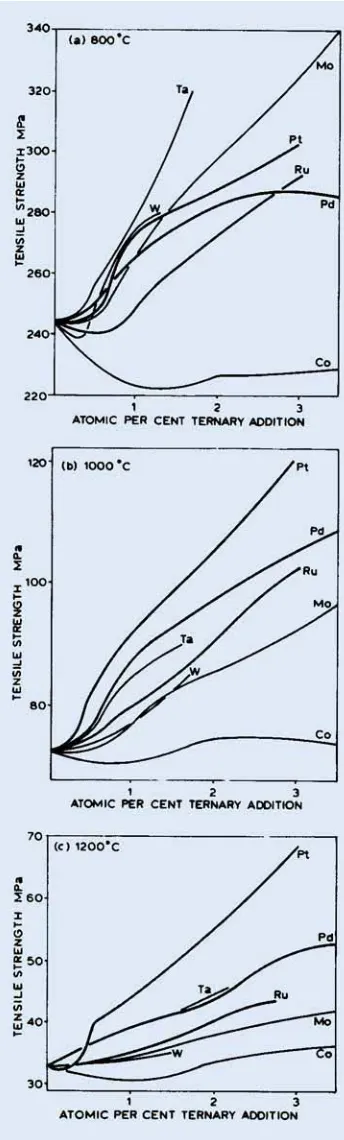
refractory alloying elements. As can be seen in
Figure I , the platinum group metals are also
very effective solid solution strengtheners to a basic nickel-20 weight per cent chromium austenite. It is worthy to note that, at the lower
temperature of 800"C, platinum is almost
equivalent, on an atomic percentage basis, to tungsten (which has a similar density) while molybdenum and tantalum are more effective.
However, at the higher temperatures of I ooo
and 12oo0C, the platinum group metals and particularly platinum show a clear advantage, even over tantalum and molybdenum. This superior strengthening effect also manifests itself in terms of creep strength, and our experience with the more complex vacuum casting alloys allows a general observation that platinum-enriched alloys tend to show superior
creep properties over their conventional
counterparts at the higher temperatures.
Oxidation Resistance
Our studies have shown that platinum group metal additions to superalloys do not greatly influence isothermal oxidation rates. However, under the more severe cyclic oxidation condi- tions, the improvement in oxide spallation
characteristics is considerable, Figure 2. In this
figure, alloys RJMrozo and R J M I o ~ o are 10
weight per cent platinum alloys compositionally similar to the conventional alloys Mar-Mzoo and Mar-Mo07, respectively. Data for Mar- Moo2 and IN738 are also given for comparison. Compositions of these commercial alloys are
given in Table I. The cyclic oxidation test con-
are at I I O O O C followed by rapid cooling to, and
maintaining at, room temperature for 20
minutes: then by rapidly re-inserting the test
coupons into the hot furnace another cycle is
commenced. The cycle is repeated as desired. As
Figure 2 demonstrates, the platinum alloys
RJMiozo and RJMio3o effect a considerable improvement in cyclic oxidation behaviour, even over an inherently good alloy such as Mar-
Moo7. Such behaviour is not a transient effect,
but is maintained even after long testing periods, as shown in Figure 3 for Mar-iMzoo and its platinum containing counterpart RJMrozo. This figure also illustrates another benefit af platinum additions, namely the useful reduction in experimental scatter.
The data presented in this section refers to
the influence of platinum in the so-called
form protective M,O, oxide scales. As will be seen later, similar effects are observed for the so-called “chromia-” forming alloys.
Corrosion Resistance
It is well recognised that the presence of con-
taminants in the combustion gases of gas tur-
bines, for example, considerably accelerate corrosive attack of superalloys, particularly in
the temperature range 650 to 950°C. The
alumina-forming alloys are particularly prone to this enhanced attack, but as shown in Figure
4, the platinum additions to RJMiozo and
R J M I 030 alloys dramatically promote
enhanced corrosion resistance over Mar-Mzoo
and Mar-Moo7 in crucible sulphidation tests at
925”C, where specimens are immersed in a
molten 10 per cent NaCl/go per cent Na,SO,
mixture. Such enhanced corrosion resistance occurs for both alumina- and chromia-forming alloys, and is not just a delayed incubation
effect, as Figure 5 shows. This figure shows,
again for Mar-M2oo and its platinum-enriched
conditions (6), that platinum considerably enhances corrosion resistance over the whole temperature range of hot sulphidation corro- sion and for long test durations. Assessment of the degree of corrosion in this test is by descaled weight loss measurement, and the apparent sinusoidal nature of the curves for the platinum enriched alloy, RJM1020, is an artifact due to incomplete descaling which is indicative of the good scale adhesion observed in these alloys.
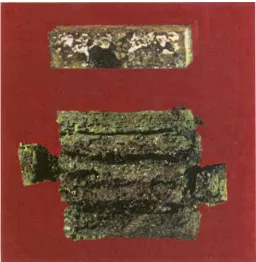
The salt shower test (6) is a laboratory test
designed to simulate the hot sulphidation condi- tions seen in gas turbine environments. The marked effect that platinum enrichment has in promoting decreased attack is illustrated in
Figure 6 which shows specimens of Mar-Mzoo
and RIM1020 after testing at 8ooOC.
The effect of platinum in promoting con-
siderably enhanced corrosion resistance is seen,
not only under sulphidation conditions typify- ing combustion gas environments, but also under other very aggressive high temperature environments where aggressive species other than sulphur are present. By careful alloy
design, it is possible to construct platinum con-
Fig. 6 Salt shower testing at
800°C drmorastraces the
superior corrosion resistance
of the platinuni-containing KJM1020 alloy ( t o p ) , com- pared to that of Mar-MZV0 (bottom), a conventional superalloy. The platinum- c o n t a i n i n g a l l o y w a s s u b j w t p d to the corrosivp environment ,for 300 hours
but testing of the conven- tional superalloy was termi- nated after 100 hours. Prior
tn testing both specimens were the same shapr and size
taining alloys that show not only excellent corrosion resistance in these difficult environ- ments, but also satisfactory creep strength at
temperatures as high as I I O O O C . At these
temperatures the useful alloys are those growing protective alumina-rich oxide scales.
The
Other Platinum Group MetalsT h e dramatic effect of platinum in promot- ing cyclic oxidation and hot corrosion resistance in nickel-base superalloys is not unique; our studies show that the other platinum group metals exhibit similar effects. Of particular interest for dynamically stressed applications such as turbine blades are the lower density platinum group metals, palladium, rhodium and ruthenium, since the centrifugal stress in
such components is directly related to alloy
density. These elements have densities of 12.0
to 12.45 compared to 21.45 for platinum.
Tables I1 and I11 show cyclic oxidation and
crucible sulphidation test results for a
5
weightper cent platinum group metal addition to a 12
weight per cent chromium cast nickel
E r g 8 The gamma prcmp prrccpitate In a
plati nun1 -cnrrc hcd R J If20 10
( u p p e r ) L P tnorc mundcd than in (I contmttonal
allo,. 12792 t Hf (lower)
5 uperalloy
.
IN792 + Hf. The results, Table 11, show that palladium is more effective in promoting cyclic oxidation resistance than platinum while rhodium and ruthenium are less effective, although compared to the conventional alloy, IN792 + Hf, even ruthenium effects a useful improvement.
In contrast, under crucible sulphidation con- ditions the opposite order of ranking is apparent, as shown in Table 111: ruthenium and rhodium are much superior to platinum while
palladium is inferior. All alloys, however, are
considerably better than IN792 + Hf. Overall, platinum is the most effective addition where optimum resistance to both cyclic oxidation and sulphidation is reqcired. This is also borne out in other corrosive environments. The degree of variation shown between the platinum group
metals in providing enhanced resistance
depends on the particular environment, as Tables I1 and I11 indicate, and also on the rela- tive size of the platinum group metal addition and alloy type.
Effect
of
Platinum Group Metals
on Microstructure and Stability
As might be expected, the addition of
platinum and the other platinum group metals
to superalloys influences the resulting
microstructure: our investigations show that platinum stabilises the gamma prime precipitate phase, to which it strongly partitions as indicated in Figure 7. This causes an increase in
both the lattice parameter, typically of the
order of 0.5 per cent, and the volume fraction
of gamma prime as well as raising the gamma prime solvus temperature. These effects should promote improved mechanical properties at the higher temperatures, as observed in practice. In comparison with conventional superalloys, the gamma prime precipitates tend t o be coarser and more rounded in the platinum-enriched alloys, although this can be modified through optimising the alloy heat treatment. An example
of gamma prime precipitates in the I
o
per centplatinum alloy RJMZOIO is shown in the
scanning transmission electron microscope
I
Ta
Mar-M200 Ma
r-M 002 Mar-MOO7 C B Zr Ni
I
Cr- 2.5 4.25 1.75 4.0
Balance
I
9.0 Balance I 9.0 0.15 0.015 0.05 0.15 0.015 0.05 0.10 0.015 0.075 0.17 0.01 0.10 0.15 0.015 0.1 IBalance Balance Balance
8.0
16.0 12.5
~ ~~ _____~ ~ ~ Table I Typical Compositions of Commercial Nickel Base Superalloys 2.6
I
3.4 4.01
4.0co
3.4 3.5
10.0 10.0 10.0 8.5 9.0
-
Addition Platinum Palladium Rhodium Ruthenium IN792
+
Hf Mo Weight change after 300 cycles, mg/cm’22 10 44 94 120
-
10.0 6.0 1.75 2.0
-
max
Nb 1.8 - 0.1 nax 0.9 -
-
Hf
-
- 1.5 1.3 - 3.8-
Fe -
].
1.o
-
0.5 nax-
-
--
naxmax
__
Table 111 Sulphidation at 800’C of a 12 Per Cent Chromium Cast Nickel Superalloy Containing a5
Per
Cent Platinum Group Metal Addition Specimens Immersed in a 10% NaC1/90% Na,SO, MixtureI
AdditionI
Descaled weight loss after 90 hours, rng/cm2Platinum Palladium Rhodium
I
Ruthenium
8.5
30.9 2.9 2.2
IN792
+
Hf 72.8I
Table II Cyclic Oxidation Behaviour at 1100°C
of
a12
Per Cent Chromium Cast Nickel Superalloy Containing a5
Weight Per Cent Addition of a Platinum Group MetalPlatinum Metals Rev., 1980, 24, (1) 8
the superalloy IN792
+
Hf, for comparison. Platinum is considered to have the sameelectron vacancy number as nickel and so,
logically, direct substitution for nickel in an alloy should not affect microstructural stability. However, a consequence of the strong partition- ing of platinum to gamma prime is that the partitioning of other elements to this phase is altered, causing their enrichment in the gamma matrix. This in turn alters the effective electron vacancy number of the enriched matrix, and can affect its microstructural stability if not taken into consideration during alloy design. Calphad phase computations o n simple ternary systems indicate that platinum does not increase the stability of the detrimental sigma phase, which is consistent with our experi- ment a1 observations.
Another consequence of the increased gamma prime stability is that the heat treat- ment temperatures for gamma prime solution- ing and precipitation stages tend to be a little higher than those for their conventional counterparts. However, the need for heat treat- ment t o develop and optimise mechanical
properties in the RJM series of alloys depends
upon the application; some alloys are intended for use in the as-cast condition.
Corrosion and Oxidation
Mechanisms
T h e dramatic role that platinum and the other platinum group metals have in promoting resistance to corrosion and cyclic oxidation at elevated temperatures has been shown; they appear to be particularly effective on alumina- scale forming alloys and the chromia-scale forming alloys with low chromium contents. At present, our understanding of how this is achieved is not complete.
The increased resistance t o oxide spallation shown by the platinum group metal containing alloys has a parallel with y t t r i u d r a r e earth- containing alloys and the oxide dispersion- strengthened alloys where oxide scale growth morphology is modified. In the platinum alloys, elemental platinum particles are found i n the scale, and there is some evidence that such
particles at the alloy/oxide interface assists in keying the scale. T h e role of platinum, however, is more complex; it appears to enhance diffusion rates and to promote forma- tion and healing of the protective oxides. X-ray diffractometry, indicates that the ratio of the protective aluminium- and chromium- rich oxides to the less-protective nickel oxide is increased.
In the case of hot corrosion resistance, as
shown by salt shower and crucible sulphidation testing, the experimental evidence again indicates that protective scale formation, and its resistance to degradation, is enhanced in the platinum group metal containing alloys, which suggests enhanced diffusion rates. Compared to their conventional superalloy counterparts, the platinum-containing alloys suffer less broad front attack and also less subscale and intergranular penetration which implies less loss of effective load bearing cross-section in components. The depth of the denuded zone, on the other hand, tends to be larger, again suggesting enhanced diffusion rates.
It is relevant, at this stage, to differentiate between the benefits of platinum (and other platinum group metal) additions to superalloys and those brought about in alloys by increasing the chromium level. Platinum additions not only increase hot sulphidation corrosion
resistance but also improve oxidation
resistance, particularly at the higher
temperatures. More importantly, oxide and
scale spallation resistance is enhanced.
Additionally, because of its low electron
vacancy number, the presence of platinum does not present problems in terms of sigma and other close packed phase formations which are deleterious to mechanical properties.
Development
of
a Gas
Turbine Alloy: R J M 2 0 1 2
-
Tabla I V
Hot Corrosion Behaviour" of Turbine
Alloy R J M 2 0 1 2
at 8OOOCAlloy
RJM2012 8.8
IN738 18.9
IN792 + Hf 97.0
Weight change rng/crn2 after 300h
Table V
Cyclic Oxidation Behaviour of Turbine
Alloy R J M 2 0 1 2
at1
1 0 0 ° C
t o hot corrosion imparted by platinum addi- tions. This alloy has been specifically developed for hot stage turbine components, such as blades in gas turbines, operating under environ- mentally arduous conditions such as those met in industrial and marine environments.
Currently, two alloys are in predominant use
in industrial and marine gas turbines, IN738
and IN792 (and its hafnium variants). The latter alloy has a higher strengthhemperature capability than the former, but has inferior hot corrosion resistance, particularly in severe con-
ditions. It was apparent that an alloy with the
strength capability of IN792, but with much
superior hot corrosion resistance was required
by the gas turbine industry and could, perhaps,
make the use of costly protective coatings unnecessary.
Our initial alloy development programme led to the generation of a platinum-enriched alloy,
designated R J M ~ o I o , containing 12 per cent
chromium and 7.5 per cent platinum which in
laboratory tests exhibited excellent hot corro- sion resistance, good cyclic oxidation behaviour and a creep rupture strength similar to that
of the conventional superalloy IN792
+
Hf.However, its relatively high platinum content was seen to be disadvantageous in terms
of its density (8.73) which is higher than is
generally acceptable for a blade alloy. A further alloy development programme was initiated
and this culminated in alloy R J M z o I ~ which
has an optimised platinum content of 4.6
weight per cent and an acceptable density
(8.54). This is a vacuum castable alloy.
The excellent hot sulphidation corrosion
resistance of this alloy is shown in Table IV
which gives the results of salt shower tests at 800°C for a test duration of 300 hours. Under these conditions it is clearly superior to IN738
alloy and shows an order of magnitude
improvement over IN792
+
Hf alloy. In cyclicoxidation tests, a similar situation prevails,
Table V, alloy R J M ~ o I z showing a much
reduced rate of oxide spallation compared to IN738 and IN792
+
Hf.The stress rupture properties of alloy
R J M ~ o I ~ in the heat treated condition have been measured at five temperatures in the range 760 to I roo0C for lives up to 1000 hours on investment cast specimens. At the lower
temperatures of 760 and 87ooC, R J M ~ o I ~
shows slightly poorer rupture lives compared to IN792
+
Hf, but at 980OC and above the situa-tion reverses and RJMzo I 2 becomes superior.
The long-term microstructural stability of
Fig. 9 4 f t r r nnnenling nt 850Y ,tor 2000 It thr slriicturp of thr plntinum-Pnrirhrd superulloy
RJ 112012 shvics no Pvidcnre o,f prcripitation
of'
s i g m u or othrr dplrterious phases x 1,500'Salt shower test 2 5 4 NaC117596 Na,SO, mixture showered at d
r a w of 1 59 in 5 minutes once per hour
Weight loss rng/crn2 after 400 cycles
RJM2012
in738
IN792
+
HfAlloy
41
156
alloy R J M z o n has been assessed and con-
firmed. No evidence of the precipitation of
deleterious close-packed phases such as sigma and eta has been found in long term annealing
studies. A typical photomicrograph of
RJMzo12 after annealing for 2000 hours at
8 ~ 0 ° C is shown as Figure 9.
It is considered that this alloy has consider- able potential for application in gas turbines operating in industrial and marine environ- ments and is currently undergoing evaluation with leading gas turbine manufacturers.
Economic Considerations
At first sight, the incorporation of platinum and the other platinum group metals in superalloys implies a substantial rise in intrinsic alloy cost. However, two aspects need to be con- sidered: first, the total component cost should
be viewed and the effect of the use of a
platinum alloy on this cost examined. I n the case of a turbine blade, for example, the total
cost is composed of intrinsic alloy
cost
+
processing cost+
coating cost. This lastfactor is significant with the current trend to
the use of expensive coating systems, such as
CoCrAlY, to provide adequate corrosion resistance. The additional cost of using
uncoated platinum superalloys in many
instances compares very favourably with the high cost of the complex coatings, but removes the inherent disadvantage of any coating system, that is, the vulnerability of the sub- strate to attack should the coating be damaged or penetrated. If the use of a coating on the platinum superalloy is considered desirable, for example, as a “first line” of defence, the relatively cheap pack cementation techniques may be used to some effect. The second aspect to be considered is that the precious metal content of the alloy, and hence its value, is not lost. After service, the scrapped component can be processed to recover the platinum, and the other elements, economically.
Thus the true cost is not the inherent platinum cost in the alloy but the refining costs plus the interest charges on the capital invest- ment in the platinum used.
Taking these factors into consideration, we calculate that use of platinum enriched superalloys is commercially competitive in
many instances. In some applications, use of
such alloys in production equipment allows considerable manufacturing cost savings which far outweigh the extra alloy cost involved.
Summary
The concept of the use of platinum, and the otber platinum group metals as alloying con- stituents has been described and shown to promote a considerable enhancement in oxida- tion and corrosion properties in nickel-based superalloys. We have now developed several platinum enriched superalloys for specific industrial and aerospace application through our ability to tailor alloys with specific com- binations of properties. Our experience to date leads us to believe that such alloys have much to offer in many other industrial applications where corrosion resistance in arduous high temperature environments is an important materials selection criterion. Application fields such as coal conversion and combustion and the
petrochemical areas, for example, suggest
themselves as candidates for platinum group metal-containing alloys.
Acknowledgements
The alloy names Mar-Mooz, Mar-Moo7 and Mar-Mzoo are trademarks of the Martin Marietta Corporation, and the alloy names IN792, IN738 are trademarks of Inco Limited.
References
For example, Chap. 2 in “The Nimonic Alloys”,
ed. W. Betteridge and J. Heslop, 2nd edn.
E. Arnold, London, 1974
J. Stringer and D. P. Whittle in “High
Temperature Materials in Gas Turbines”, ed.
P. R. Sahm and M. 0. Speidel, Elsevier, 1974
“High Temperature Alloys for Gas Turbines“, ed.
D. Coutsouradis, P. Felix, H. Fischmeister, L.
Harbraken, Y. Lindblom and IM. 0. Speidel,
Applied Science Publishers, I 978
G. L. Selman and R. J. Midgley, British Putenr
“The Superalloys”, ed. C. T. Sims and W‘. C .
Hagel, John Wiley and Sons, 1972
P. L. Nnrman and J. D. Harston, “Deposition and
Corrosion in Gas Turbines”, ed. A. B. Hart and
A. J . B. Cutler, Applied Science Publ., 1973, p. 260