1357
Utilization of Digital Technology for
Management Effectiveness Micro Small and
Medium Enterprises
Rahmatullah, Inanna, Sahade, Nurdiana, Fajriani Azis, Bahri
Abstract: The development of digital technology benefits business people and society as consumers in terms of accessing information, market opportunities, as well as the management of goods and business finance. The research objective is to find out how effective the management of Micro, Small and Medium Enterprises using digital applications. The ADDIE approach (Analysis, Design, Development, Implementation, and Evaluation) was used in this study. When compared with a manual system, the use of digital applications is more effective and efficient in business management. The results obtained that the use of accounting points of sale and inventory management are in the category of appropriate use in business management. This is based on the evaluation of the feasibility test, the results of expert validation and the assessment by MSME entrepreneurs.
Index Terms: Business Management; Digital Application; Market opportunity.
—————————— ——————————
1
INTRODUCTION
Transformation of digital technology, especially software (software) continues to experience developments in helping human economic life, including for business management. Technological developments support the availability of public goods [1]. Utilization of digital technology can give birth to various strategic, integrated, effective business opportunities in product service, and can respond to market conditions that continue to experience change [2]. Advances in digital technology can affect the way a person works, communicates, including influencing consumer behavior in making choices [3]. For this reason, an integrated system is needed so that business management can achieve good and competitive performance [4]. In business management, the development of digital technology that is rapidly changing one's business behavior in making various innovations to maximize business performance [5]. This has an impact on business management can be optimal, minimal risk, information and strategic decision making [6]. To be able to compete, the business world needs to make changes very quickly [7]. Thus the occurrence of digital transformation in business management must be followed by the ability to conduct digital innovations [8].
The development of digital technology based on software has caused companies in various forms of industry to undertake various initiatives to explore and exploit the
opportunities that exist [9]. Responding to this, business owners need to develop business strategies by integrating digital technology as innovation in their business, so they are able to face business competition in the era of globalization [10]. The use of digital technology in the business industry makes it easy for business people and consumers to access information, market opportunities and create business content so that it affects people's lives [11]. Rapid changes can occur in business because of the influence of technology. The existence of fast and practical services for consumers, and effective business management based on data is transformed in the form of digitalization [12]. To support this, a variety of policies, rules, facilities and resources are needed. Software application development can help company performance for long-term business management [13]. Including how digital-based business opportunities (software) can be applied to various forms of industries or businesses including MSMEs. Software-based digital technology can help MSME performance in the management and use of accounting applications. MYOB, Zahir Accounting, Quick Box, etc. are terms of commonly used software. When compared with the manual method, business management will be more effective and efficient when using digital applications. There was a rapid change in business management from a manual system to an integrated computerized system using internet services [14]. The process of inputting goods or transactions, business supervision, recording of general journals, cash journals, posting to ledgers, accounting account reports, profit and loss statements, and balance sheet reports can be completed accurately and neatly arranged using an application. Digital developments affect the field of accounting in relation to business management, cooperation and decision making [15]. One software application used in management and accounting programs is the Accounting Point of Sale. This application is focused on aspects of sales and transaction systems. The hardware of accounting points of sale applications such as scanners, printers, cash drawers, personal computers, and so on.
————————————————
Economic Education, UNM, Makassar Indonesia E-mail: [email protected]
Economic Education, UNM, Makassar Indonesia
E-mail: [email protected]
Accounting Education, UNM, Makassar Indonesia E-mail: [email protected]
Economic Education, UNM, Makassar Indonesia
E-mail: [email protected]
Accounting Education, UNM, Makassar Indonesia E-mail: [email protected]
1358
The software consists of inventory, reporting, putchasing, customer service, return process, and so on. transaction security, return processing). Each transaction utilizes both devices, including their use in the MSME business. Businesses can participate and manage their business by utilizing digital developments, because they are cheap and can be accessed by anyone [16]. The development of the MSME industry (micro, small and medium enterprises) in the Indonesian economy is able to contribute around 60.34% of the Total Gross Domestic Product and is able to absorb around 70.3% of the workforce [17]. When the economic crisis began in 1998, this effort persisted [18]. In order to be able to keep up with global developments marked by digital transformation (software), SMEs must continue to innovate to use software applications so that management, supervision and preparation of financial statements can be effective. The use of software consists of several interrelated elements. This is mentioned in detail by [19], [20]. that the development of digital technology consists of goods, software, infrastructure, services, retail, and content. This is presented in Picture 1 below:
Picture 1. Typology of ICT Sub-sektor
Utilization of digital technology in MSME businesses is to encourage the improvement of product quality and services to consumers, electronic transaction activities, as a tool to regulate and control business, inventory (stock management) as well as the preparation of financial statements. This is because business owners can control through the use of computer / laptop devices, gadgets that are connected to the internet network. For this reason, a software application that is integrated with the web is needed so that financial reporting, business operating systems, inventory management, and business data security can be done effectively and efficiently. The intended software application is point of sale (POS) and inventory management. Application of point of sale (POS) and inventory management is a system that is oriented to the transaction and sales process, especially related to accounting transaction data and inventory of goods from MSME activities. Inventory (stock management) consists of goods used for production, consumption, even for sale by
companies [21]. The use of these applications can facilitate customer orders, transaction tracking, simplify data recap and calculations, so work efficiency increases. This application is integrated with the website, so that business owners can at any time control or supervise the business as long as the internet network is available.
Accounting program is a system that produces financial information so that the assessment and decision making by its users can be carried out appropriately. Accounting programs can be in the form of applications. Application programs or application software are programs that can be implemented into business processes. To be applicable, an accounting application must have the following components:
a. Users consist of admin users and owners. For the replacement and addition of transaction data can only be done by the admin, while to enter the general ledger, transaction journal, graphs and financial reports can only be done by using the owner user.
b. Accounts can be used to classify accounts based on classification of transactions, such as accounts of assets, liabilities, capital, income and expenses. c. A journal is a place for recording every transaction into
a database, which consists of public journals, adjustments, closures, and reversals.
d. The general ledger is where all transactions are recorded and account changes are made for each transaction.
e. The financial statements prepared consist of income statements, balance sheets and capital changes which can be presented in the form of Ms. Excel.
f. The graph illustrates the state of the account balance at a certain time presented in the form of a pie chart to make it more interesting.
g. The application is a means or media for storing and processing data into a new form without changing the nature of the data [22]. Applications can be used for data analysis in various fields such as industry, accounting, science, medical and others. For this reason, the mindset and behavior of entrepreneurs must be in line with the progress of science and technology [23].
h. The website contains digital information consisting of several pages. This information can be in the form of animation, images, text and can be accessed through the internet network. In another concept, the web contains various information or data from various interconnected sources and is a new breakthrough in information technology [24].
1359
Smartphones supported by internet networks, business owners can find out and control their business conditions.
2
M
ETHODOLOGYTo produce and test the effectiveness of the product, the approach used is research and development. In the development of business organizations, research and development is oriented to the emergence of new strategies to be able to adapt to every change and challenge that exists for change towards a better direction [25]. The challenges faced by micro and small businesses in the form of using software applications are web-based accounting point of sale and inventory management programs in carrying out their business operations. The stages of research that were used followed the ADDIE model, namely Analysis, Design, Development or production, Implementation of delivery, and Evaluation. This model can be used in various forms of product development [26]. The data collection instruments included an expert validation instrument to determine whether the application was properly implemented and a field trial instrument to find out whether the application was effectively used in the management and supervision of MSMEs. The data generated in the form of quantitative data and then using a Likert scale is converted into qualitative data. Scores are awarded by category (1) strongly disagree, (2) disagree, (3) doubt, (4) agree, (5) strongly agree. The response characteristics of each instrument have characteristics ranging from very positive to very negative. The feasibility of the application
developed, through the following percentage equation:
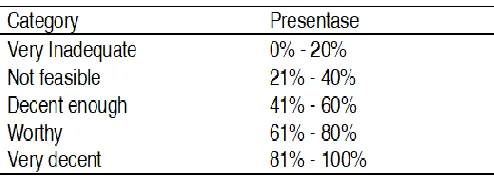
The percentage results are classified in the following five categories:
Table 1. Categories of Feasibility Percentage Results
3
RESULTS AND DISCUSSION
3.1 The Feasibility of a Web-Based Point of Sale and Inventory Management Accounting Program in Micro, Small and Medium Enterprises
The procedures for developing multimedia based Instructional design [27] are references in this study that have been adjusted to produce web-based programs. To produce a point of sale and inventory management accounting program, the steps include: Analysis,
Development, Implementation and Evaluation. In the Analysis Phase, it begins by making observations so that the conditions or characteristics of micro small and medium enterprises in Makassar are known. For application development, the analysis phase requires technological devices (hardware and software), materials, and task analysis. The software designed from this research is for use in retail stores that are included in the MSME category. This software can be used with two categories of users namely business owners and employees of the cashier (Admin). For the cashier application, it is equipped with a barcode scanning device to facilitate the input of product names into the system. The relationship between the owner, server and store cashier is described as follows:
Picture 2. Relationship between owner, server and store cashier
Based on this design, a Development program is then carried out to be integrated into the website, making it easier to access in areas connected to the internet. The next stage is implementation, which is implementing a program developed in the management of the MSME business system.
Evaluation is the final stage to find out whether the program being developed is appropriate. The application program developed has been assessed by experts to produce software applications that are ready to be tested. The results of the program validation were analyzed by media experts in the categories of visual communication, functionality and usability. The results of the assessment in table 2 follows:
Table 2. Media Expert Assessment Results
1360
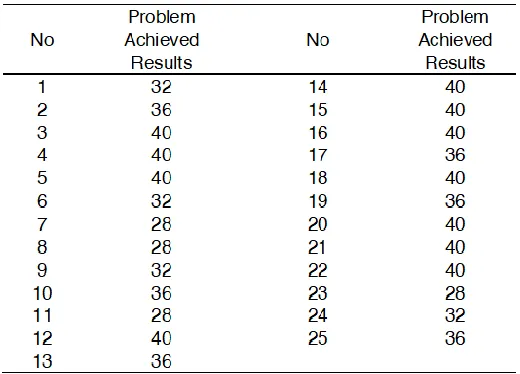
category, 95.78% functionality category, and 90% usability category. This means that applications developed under the "Very Eligible" eligibility criteria. The results of the field trials were carried out when MSME entrepreneurs used the program in managing their business systems, using a questionnaire consisting of 25 questions. The questionnaire was used in accordance with Computer Usability Satisfaction Questionnaires [28].This can be seen in table 3 below:
Table 3. Results obtained from field trials
From the Usability category, the results of a trial or user evaluation of a web-based accounting point of sale and inventory management program on the effectiveness of managing and supervising micro and small businesses is obtained a score of 896 or with an achievement percentage of 89.6% so that it can be categorized as "Very feasible". Thus, the use of a web-based accounting point of sale and invantory management program for the effectiveness of MSME management and supervision is feasible to use. The content of the results of the development of web-based accounting point of sale and invantory management programs.
Picture 3. Home page
Picture 4. Dashboard page
Picture 5. Interface Point of Sale
Picture 6. Touch Screen Support
1361
Picture 8. Income Statement
3.2 Utilization of Accounting Point of Sale and Inventory Management on the Effectiveness of Management and Supervision of Micro and Small and Medium Enterprises
The effectiveness of MSME management and supervision through four stages of feasibility testing. According to Pressman (2002), these stages include unit testing, integration testing, system testing, and acceptance testing. The unit testing stage in developing this program is done by trial and error. Testing in this stage goes well without any significant errors so that the development of the program and its utilization can be continued at the next stage. When a needs analysis is conducted, information is obtained about the functions that need to be developed in the program. For this reason, Integration testing is carried out so that these functions can be tested and analyzed so their eligibility can be determined. One of them is how accounting point of sale and inventory management programs can be integrated with the web and can be functioned through the internet network. Included in this case is the ability of the program to present the data needed by both the admin and owner when operated. The ability of the program to be operated to support MSME management and supervision can be tested using system testing. The part of the system testing includes stress testing and installation testing. Load Impact Webserver is an application that is used during stress testing. The indicator of the achievement of stress testing is whether the program is able or not to receive and exchange information at the same time. In this case the speed of internet access is very important other than the readiness of the program to be used in accordance with their respective functions. If the program can function properly then an installation testing is performed. This is to test whether the program can be opened via a website either by using a browser on a computer or in a mobile browser. The results obtained from this stage that the program developed can be applied to computer and mobile browsers. The acceptance testing is useful to see the level of feasibility of the program, which is done by beta testing and alpha testing. The assessment phase carried out by media experts is part of the Alpha testing process to measure whether the program to be developed is feasible to be continued at the implementation stage. Alpha testing results indicate that the program is worth continuing. Thus, the point of sale and inventory management accounting program is then tested on MSME owners in Makassar City to measure the feasibility and effectiveness of program use in terms of user
aspects. This is a stage in beta testing. Based on the feasibility test (expert and user assessment) the program can be concluded that the accounting point of sale and inventory management program that has been developed is feasible and effective in the management of MSME businesses (micro, small and medium businesses). As for its utilization, it can accelerate business processes and sources of accurate information to make quick and better business decisions.
4
CONCLUSION
The use of digital programs in the form of web-based accounting point of sale and inventory management in MSME management is very feasible and effective. In its use, it can facilitate business owners in managing, overseeing and reporting business finances. Product assessment consists of visual communication, functionality, and usability. From the test results, the overall program utilization can be categorized as feasible. Thus, fulfilling the element of effectiveness in the management and supervision of MSMEs (micro, small and medium enterprises). As a development of this research, it is suggested that business people continue to maximize their business management and services through various digital-based innovations to respond to the development of digital technology in the business world. In addition, the government needs to educate businesses to realize competitive business, especially in the use of digital technology in the business world.
5 REFERENCES
[1] J.Ngo dan A. Smith, “A public Good Game With technological Growth,” J. Behav. Exp. Econ., vol. 84, no. November 2019, hal. 101–487, 2020.
[2] I.M. Sebastian, J. W. Ross, dan C. Beath, “How Big Old Companies Navigate Digital Transformation,” no. September. hal. 197–213, 2017.
[3] S.Aral, C. Dellarocas, dan D. Godes, “Introduction to the special issue—social media and business transformation: a framework for research,” Inf. Syst. Res., vol. 24, no. 1, hal. 3–13, 2013.
[4] C.Atristain, “Internal Control Systems Leading to Family Business Performance in Mexico: A Framework Analysis,” J. Int. Bus. Res., vol. 16, no. 1, hal. 1–17, 2017.
[5] E.Henriette, M. Feki, dan I. Boughzala, “Association for Information Systems AIS Electronic Library (AISeL) The Shape of Digital Transformation: A Systematic Literature Review THE SHAPE OF DIGITAL TRANSFORMATION: A SYSTEMATIC LITERATURE REVIEW,” 2015.
[6] G.Giriūnienė dan L. Giriūnas, “Assessment of internal control system in Lithuania,” Econ. Manag., vol. 17, no. 4, hal. 1240–1244, 2012.
[7] R.L. Priem, J. E. Butler, dan S. Li, “Toward reimagining strategy research: retrospection and prospection on the 2011 AMR decade award article,” Acad. Manag. Rev., vol. 38, no. 4, hal. 471–489, 2013.
1362
hal. 1–20, 2015.
[9] M.Fitzgerald, N. Kruschwitz, D. Bonnet, dan M. Welch, “Embracing Digital Technology: A New Strategic Imperative | Capgemini Consulting Worldwide,” in MIT Sloan Management Review, vol. 55, no. 1, 2013, hal. 1–13.
[10]J.Reis, M. Amorim, N. Melao, dan P. Matos, “Digital Transformation : A Literature Review and Guidelines for Future Digital Transformation : A Literature Review and Guidelines for Future Research,” 10th Eur. Conf. Inf. Syst. Manag. Acad. Conf. Publ. Ltd., vol. 1, no. March, hal. 20–28, 2016.
[11]L.I. Labrecque, J. vor dem Esche, C. Mathwick, T. P. Novak, dan C. F. Hofacker, “Consumer power: Evolution in the digital age,” J. Interact. Mark., vol. 27, no. 4, hal. 257–269, 2013.
[12]D.Schallmo, “Digital Transformation Of Business Models-Best Practice, Enablers, And Roadmap,” vol. 21, no. 8, hal. 1–17, 2017.
[13]O.Moravcik, D. Petrik, T. Skripcak, dan P. Schreiber, “Elements of the Modern Application Software Development,” Int. J. Comput. Theory Eng., vol. 4, no. 6, hal. 891–896, 2012.
[14]A.E. R. K. El-Dalabeeh, “The impact of accounting information systems development on improving ecommerce in the Jordanian public shareholding industrial companies,” Acad. Account. Financ. Stud. J., vol. 23, no. 2, hal. 1–11, 2019.
[15]D.Knudsen, “Elusive boundaries, power relations, and knowledge production: A systematic review of the literature on digitalization in accounting,” Int. J. Account. Inf. Syst., no. Desember 2019, hal. 1–21, 2019.
[16]J.Räisänen dan T. Tuovinen, “Digital innovations in rural micro-enterprises,” J. Rural Stud., vol. 73, no. September 2019, hal. 56–67, 2020.
[17]OECD, “Survei Economi OECD Indonesia 2018,” 2018.
[18]Bank Indonesia, “PROFIL BISNIS USAHA MIKRO, KECIL DAN MENENGAH (UMKM) KERjASAMA LPPI DENGAN BANK INDONESIA TAHUN 2015,” 2015. [19]R.Heeks, “Researching ICT-based enterprise in
developing countries: analytical tools and models,” Dev. Informatics Work. Pap., no. 30, 2008.
[20]R.Bukht, Rumana, Heeks, “Development Informatics Working Paper Series Defining, Conceptualising and Measuring the Digital Economy RUMANA BUKHT & RICHARD HEEKS,” 2017.
[21]C.Amanda, J. Sondakh, dan S. Tangkuman, J, “Analisis Efektivitas Sistem Pengendalian Internal Atas Persediaan Barang Dagang Pada Grand Hardware Manado,” J. Ris. Ekon. Manajemen, Bisnis dan Akunt., vol. 3, no. 3, hal. 766–776, 2015.
[22]N.D. Rusida dan Z. M. Noer, “Perancangan perangkat lunak bantu sistem penjualan berbasis aplikasi dekstop pada cafe instamie pangandaran,” J. Jumantaka, vol. 1, no. 1, hal. 341–350, 2018.
[23]R.Sahabuddin, “Development of business values and behaviours: Takalar district, South Sulawesi (Indonesia) case study,” Actual Probl. Econ., vol. 176,
no. 2, hal. 440–449, 2016.
[24]P.Sutopo, D. Cahyadi, dan Z. Arifin, “SISTEM INFORMASI EKSEKUTIF SEBARAN PENJUALAN KENDARAAN BERMOTOR RODA 2 DI KALIMANTAN TIMUR BERBASIS WEB,” vol. 11, no. 1, 2016.
[25]R.C. Richey dan J. D. Klein, “Developmental research methods: Creating knowledge from instructional design and development practice,” J. Comput. High. Educ., vol. 16, no. 2, hal. 23–38, 2005.
[26]E.Mulyatiningsih, “Metode penelitian terapan bidang pendidikan.” Bandung: Alfabeta, 2012.
[27]W.W. Lee dan D. L. Owens, Multimedia-based instructional design: computer-based training, web-based training, distance broadcast training, performance-based solutions. John Wiley & Sons, 2004.