R E S E A R C H
Open Access
Co-occurrence simplicial complexes in
mathematics: identifying the holes of
knowledge
Vsevolod Salnikov
1, Daniele Cassese
1,2,3*, Renaud Lambiotte
3and Nick S. Jones
4*Correspondence: [email protected] 1University of Namur and NaXys,
Rempart de la Vierge, 5000 Namur, Belgium
2ICTEAM, University of Louvain, Av
Georges Lemaître, 1348 Louvain-la-Neuve, Belgium Full list of author information is available at the end of the article
Abstract
In the last years complex networks tools contributed to provide insights on the structure of research, through the study of collaboration, citation and co-occurrence networks. The network approach focuses on pairwise relationships, often compressing multidimensional data structures and inevitably losing information. In this paper we propose for the first time a simplicial complex approach to word co-occurrences, providing a natural framework for the study of higher-order relations in the space of scientific knowledge. Using topological methods we explore the conceptual landscape of mathematical research, focusing on homological holes, regions with low
connectivity in the simplicial structure. We find that homological holes are ubiquitous, which suggests that they capture some essential feature of research practice in mathematics.k-dimensional holes die when every concept in the hole appears in an article together with otherk+1 concepts in the hole, hence their death may be a sign of the creation of new knowledge, as we show with some examples. We find a positive relation between the size of a hole and the time it takes to be closed: larger holes may represent potential for important advances in the field because they separate
conceptually distant areas. We provide further description of the conceptual space by looking for the simplicial analogs of stars and explore the likelihood of edges in a star to be also part of a homological cycle. We also show that authors’ conceptual entropy is positively related with their contribution to homological holes, suggesting that polymathstend to be on the frontier of research.
Keywords: Co-occurrence, Topological data analysis, Persistent homology
Introduction
Co-occurrence networks capture relationships between words appearing in the same unit of text: each node is a word, or a group of words, and an edge is defined between two nodes if they appear in the same unit of text. Co-occurrence networks have been used, among other things, to study the structure of human languages (Ferrer-i-Cancho and Solé2001), to detect influential text segments (Garg and Kumar2018) and to iden-tify authorship signature in temporal evolving networks (Akimushkin et al.2017). Other applications include the study of co-citations of patents (Wang et al.2011), articles (Lazer et al.2009) and genes (Jenssen et al.2001; Mullen and et al.2014). Here we focus on the co-occurrences of concepts (theorems, lemmas, equations) in scientific articles to gain understanding in the structure of knowledge in Mathematics. Similar problems have been
considered in scientometrics, even if previous works have limited their analysis to key-words, or words appearing in abstracts (Radhakrishnan et al.2017; Zhang et al.2012; Su and Lee2010), and focused only on binary relations between words, as we clarify below.
The main novelty of our work is to study co-occurrences in a simplicial complex frame-work, using persistent homology to understand the conceptual landscape of mathematics. The adoption of a simplicial complex framework is motivated by the fact that concepts are inherently hierarchical, so simplicial complexes might seem a natural representa-tion: often elementary conceptual units connect together to form nested sequences of higher-order concepts. A simplicial complex approach to model the semantic space of concepts was already suggested by (Chiang2007), even if not in a topological data anal-ysis framework (Patania et al.2017b), while application of topological data analysis tools to visualisation of natural language can be found in (Jo et al.2011; Wagner and et al.2012; Sami and Farrahi2017). Several reasons motivate the use of higher-order methods in this context. First, co-occurrence networks tend to be extremely dense in practice and require additional tools to filter the relations and sparsify the network to extract information (Serrano et al.2009; Slater2009). Second, in the original dataset, interactions are not pair-wise and it is unclear if the constraints induced by a network framework, in terms of nodes and pairwise edges, do not obscure important structures in the system. By modelling co-occurrence relations as a simplicial complex, we thus go beyond the network description that reduces all the structural properties to pairwise interactions and their combinations, explicitly introducing higher-order relations. Note that this modelling approach, in partic-ular the use of simplicial persistent homology, has found uses when the data is inherently multidimensional (Petri et al.2013), with applications in neuroscience (Petri et al.2014; Stolz et al.2017), biology (Chan et al.2013; Mamuye et al.2016) to the study of contagion (Taylor and et al.2015) and to coauthorship networks (Patania et al.2017a; Carstens and Horadam2013).
A second contribution of our work is the analysis of the full text of a large corpus of articles, which allows us to bypass the high-level categorisation provided by keywords but also to identify the use of methodological tools and to gain insight into mathematical praxis. However, the main purpose of this article is to use the resulting dataset of concepts and articles as a testbed in which to apply methods from topological data analysis, and to go beyond a standard network analysis.
Dataset
Thus we wanted to have something either globally accepted by scientific community or at least created by a sufficiently large group of people. Another point in the selection of a good concepts list is the possibility to make a similar research for other disciplines, thus we chose to get it from some general, easily accessible source. Our strategy consisted in parsing a concepts list from Wikipedia, which includes 1612 equations, theorems, lem-mas. Clearly these concepts are not homogeneous, meaning that some of them might represent extremely specific theorems, while others can be very general, likedifferential equation, but similar holds for any text processing with different words having different frequencies. Our position on that is still to minimize the manually introduced bias: we consider that all concepts have similar weight and try to have as complete set as possible. Moreover it is possible that two different names represent for example the same theorem due to historical reasons. For the moment we consider such synonyms as distinct entities as the usage of one of them but not the other may reflect structural properties: for exam-ple a lemma might have different names depending on a (sub-)field of mathematics and manually merging them is not correct.
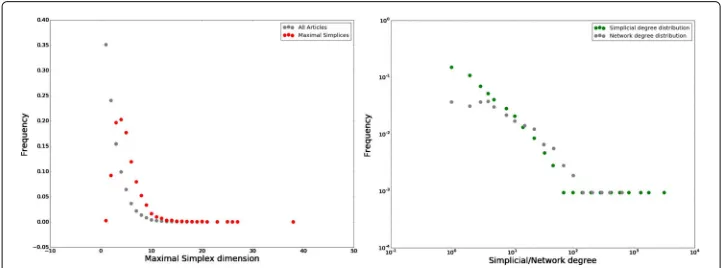
As a next step, we combine both datasets. Among the whole concepts list, 1067 find a match in at least one article. Among the 54177 articles, 35018 contain at least one of the concepts in our list (30369 for mathematics and 4649 for mathematical physics), and we also take the list of authors to analyse their contribution to the conceptual space. We construct the binary (non-weighted) co-occurrence simplicial complex (defined more for-mally below) over the 1067 nodes by including a(k−1)-simplex for each article containing kconcepts, provided its concept set is not fully included in the concept set of another arti-cle, that is we only keepfacetsof the simplicial complex. Whenever the concept sets of two articles intersect, their corresponding simplices share a face of dimension(n−1), where nis the dimension of the intersection. The corresponding network, namely the 1-skeleton of the co-occurrence simplicial complexes (that is we only look at faces of dimension 0 and 1) has 1067 nodes and 32707 unweighted edges. Figure1shows the network and simpli-cial (concept) degree distribution, where the simplisimpli-cial degree of a concept is the number offacets(articles) it belongs to. The sum of all simplicial degrees is 42009, which means there are 39.37 papers per concept on average.
Simplicial complexes
A simplicial complex is a space obtained as the union of simple elements (nodes, edges, triangles, tetrahedra and higher dimensional polytopes). Its elements are called simplices, where ak-simplex is a set ofk+1 distinct nodes and its subsets of cardinalityd≤kare called itsd-faces. We say that two simplices intersect if they share a common face. More formally:
DefinitionLet V be a set of vertices, then a n-dimensional simplex is a set of cardinality n+1of distinct elements of V,{v0,v1,. . .,vn}, vi ∈ V . A simplicial complex is a
collec-tion K of simplices such that ifσ ∈ K andτ ⊂ σ thenτ ∈ K , so for every simplex in K all its faces are also in K. The k-skeleton of K is the union of all simplices in K up to dimension k.
Simplicial complexes can be seen as generalisation of a network beyond pairwise inter-actions, that differ from hypergraphs as all subsets of a simplicial complex must also be simplices. As an illustrative example of how simplicial complexes capture higher-order interactions where networks fail to do so, consider that in a co-occurrence network it is not possible to distinguish between three concepts appearing in the same paper and three concepts appearing in three papers each containing two concepts: in a network both cases are represented by a triangle, while in a simplicial complex the first is a 2-simplex (a filled triangle) and the second is a cycle made of three 1-simplices (an empty triangle).
As for networks, also for simplicial complexes we can define simplicial measures that are the higher-order analogs of networks ones, for example (Estrada and Ross2018) defines several simplicial centrality measures, providing also the characterisation of some families of simplicial complexes. In this paper we use the simplicial analogs of stars to provide a further description of the concept space.
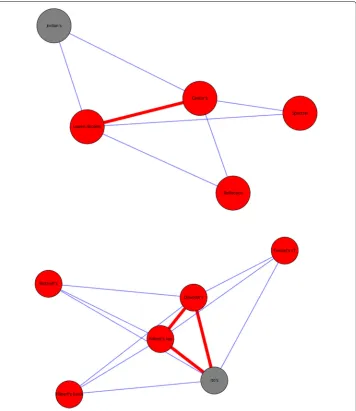
DefinitionA simplicial star Slkconsists of a central(k−1)-simplex that is a face of l k-simplices, and there is no other simplex but their subsimplices.
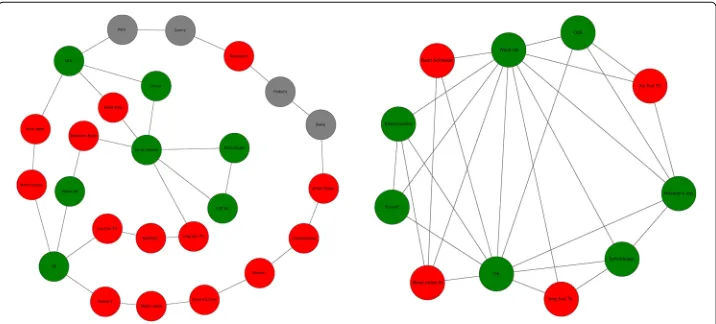
S51for example is the usual star, with a node in the core connected to 5 nodes, while forS53 the core is a triangle. Examples are reported in Fig.2.
Persistent homology
Persistent homology is a method in topological data analysis (Carlsson2009; Patania et al.
2017b) based on algebraic topology, that studies the shape of the data by finding holes of different dimensions in the dataset (Table1). Holes are topological invariants that can be seen as voids bounded by simplices of different dimension: in dimension 0 they are connected components, in dimension 1 loops (voids bounded by edges), in dimension 2 voids bounded by triangles and so on. Here we give a brief and intuitive explanation of the homology of simplicial complexes, for details on how to compute it we refer to (Edelsbrunner and Harer2008; Horak et al.2009; Otter et al.2017).
Fig. 2Simplicial stars. Example of aS23(top) and aS33(bottom) star. Red nodes are theorem, grey nodes lemmas, while red edges delimit the simplices in core of the star
the chain (for example a 1-chain is a formal sum of oriented edges). It is a common prac-tice to considerZorZnforRand negative coefficients change the orientation. Without any limitations and for the sake of simplicity one can imagineR=Z2as it permits us to eliminate questions of orientation: in this case−1S=Sfor any simplexS. If we consider ak-simplex, it is bounded by its(k−1)faces, and we call the corresponding(k−1)-chain, equal to the sum of these faces with coefficients 1 and coherent orientations, the bound-ary of that simplex. Again to make an illustrative example, the boundbound-ary of a 2-simplex (filled triangle) is then a formal sum of its 1-faces (edges). The boundary for a general
Table 1Dataset
Years Papers Concepts Authors
Total 1994 - 2007 35018 1612 23471
k-chain is defined as the sum of the boundaries of the simplices in the chain taken with corresponding coefficients. Consider the linear map on the space ofk-simplices, mapping eachk-simplex to its boundary, theboundary operator
∂k:Ck(K)→Ck−1(K)
defined on the vector space with basis given by the simplices ofK. Ak-cycle is defined as ak-chain without a boundary, hence it is an element of the kernel of∂k, and ak-boundary is ak-chain which is the boundary of a(k+1)-chain, so it is an element of the image of∂k+1, which is a subset of the kernel of∂k as the boundary of a boundary is empty, or
∂k∂k+1=0.
So we have defined two interesting subspaces: the collection ofk-cycles and the collec-tion ofk-boundaries, and we can also take the quotient space as the second is a subset of the first: what is left in the quotient space are thosek-cycles that do not bound(k+1) -subcomplexes, and these are thek-dimensional voids. More precisely, as there can be morek-cycles around the same hole, the elements of the quotient space can be divided in homological classes, each identifying a hole. This quotient space is thekth homology of the simplicial complex
Hk(K)= ker(∂k) Im(∂k+1) and its dimension
βk(K)=dim ker(∂k)−dim Im(∂k+1)
is the number ofhomology classesork-dimensional voids in the simplicial complex, the k-th Betti number of the homology. For example the zerothBetti number counts the number of connected components in the graph that constitutes the 1-skeleton of the simplicial complex, the first Betti number the number of loops, the second Betti number counts voids.
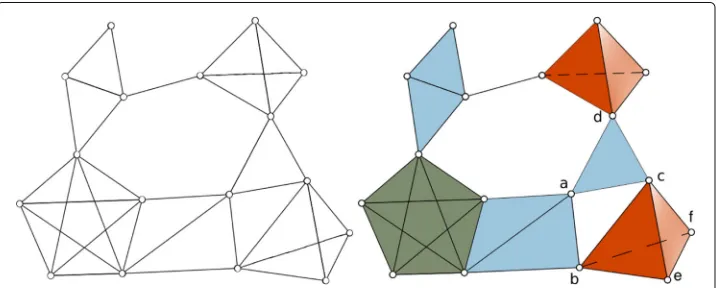
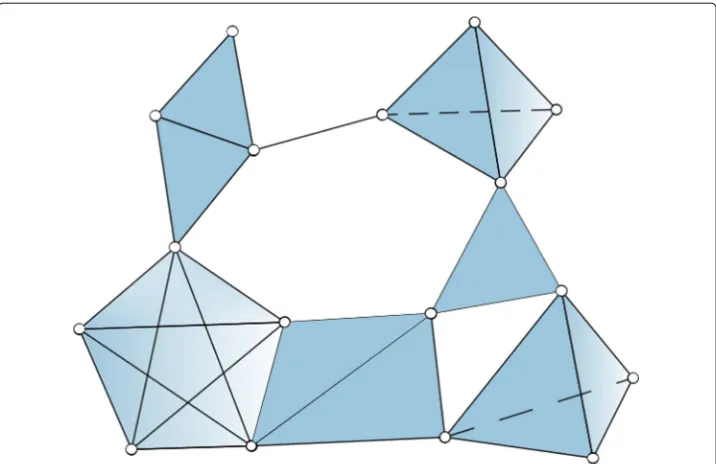
To gain some intuition, consider Fig.3:{ab,ac,bc}and{ac,ad,cd}are two 1-chains, of which{ac,ad,cd}is the boundary of the (filled) triangleacdwhile{ab,ac,bc}is not in the boundary of any 2-chain. So{ab,ac,bc}is a 1-dimensional homological cycleH1. On the other hand the 2-chain{bce,bcf,bef,cef}is the boundary of the (filled) tetrahedronbcef hence it is not a 2-dimensional cycle. In Fig.4the same 2-chain is a 2-dimensional homo-logical cycleH2as there the tetrahedronbcefis not in the simplicial complex anymore (as
Fig. 42-skeleton of a 4-complex in3. As can be seen 1-dimensional holes are preserved, while 2-dimensional holes are not, in particular there are 3H2-holes that were not in the original complex, namely those inside the two 3-simplices, and one inside the 4-simplex
we are now taking the 2-skeleton of the complex in Fig.3), so{bce,bcf,bef,cef}is not the boundary of any higher order chain and its triangular elements bound a void.
The homological features of complexes are usually studied on a filtration of the com-plex, that is a sequence of simplicial complexes starting at the empty complex and ending with the full complex, so that the complex at stepn<mis embedded in the complex atm for all the steps. In this way it is possible to focus on the persistency of homological fea-tures: as the filtration evolves the shape of data changes, sobirthanddeathof holes can be recorded. A hole is born at stepsif it appears for the first time in the corresponding step of the filtration, and dies attif after steptthe hole disappears. The difference between birth and death of homological features is calledpersistence, and can be recorded by abarcode, a multiset of intervals bounded below (Carlsson et al.2005) visualizing the lifetime of the feature and its location across the filtration: the endpoints of each interval are the steps of the filtration where the homological feature is born and dies (Horak et al.2009). An alternative visualisation is provided by thepersistence diagrams, which are built by con-structing a peak function for each barcode, proportional to its length (Edelsbrunner et al.
2002; Stolz et al.2017).
The way the filtration is built depends on the analysis that one wants to do on the data, a very common method on a weighted network is theweighted rank clique filtration (Petri et al.2013). This is done by filtering for weights: after listing all edge weightswtin descending order, at every steptone takes the graph obtained keeping all the edges which weight is greater than or equal towt. The simplicial complex at that step of the filtration is built by including all the maximalk-cliques of the graphs ask-simplices. The obtained simplicial complex is calledclique complex.
F0⊆F1⊆ · · · ⊆FT
where(0,T)are first and last date in our dataset (time step is one month) and fori < j and eachFico-occurrence complex contains simplices of concepts (articles) up to datei. As every article is a simplex we do not need to build a clique complex like in the weighted rank clique filtration.
Reducing the computational burden
Computing persistent homology is very costly if there are large simplices in the simplicial complex, as for each simplex the computation requires to list all the possible subsimplices. For instance in our (rather small) dataset, there are already simplices with 37 vertices and the number of its (k-1)-subsimplices is (3737!−k!)k!, making it impossible to finish the task in reasonable time with standard tools. In order to reduce the computational burden, we put an upper bound on the dimension of simplices, that is we take the subcomplex that only includes simplices up to a maximum dimensiondM=5. In other words, we compute the homology of thedM-skeletonof our simplicial complexK.
In thedM-skeleton ofKall simplices of dimensiond>dM are replaced by collections of theirdM-faces, that is a complex of dimensiondM made by glueing together
d+1 dM+1
dM-simplices along theirdM−1 faces, such that for eachdM−1 face there ared−dM simplices sharing that face. To make an illustrative example ifdM=2, the 2-skeleton of a 3-simplex is the collection of triangles in the boundary of the tetrahedron.
It is straightforward to show that thedM-skeleton ofK,KdMis(dM−1)-homologically equivalent toK, in the sense that they have the same homology groups up toH(dM−1).
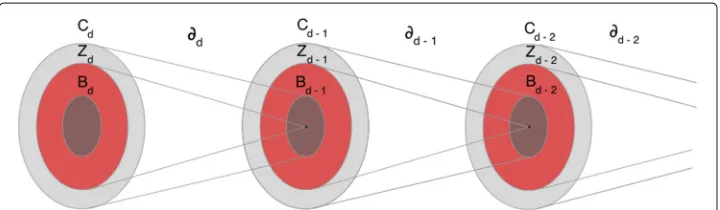
Moreover, ford≤dM, thed-chains group of thedM-skeleton coincides with thed-chains group ofK, as they have the samedM-simplices, hence it follows that alsod-cycles groups coincide (see Fig.5). This implies that any map∂dwithd≤dMis the same onKdMand
K, hence the set ofd-boundaries withd≤dM−1 is the same on the two complexes. So
Hd(K)= Imker(∂(∂d+1d)) =Hd(K
dM)ford≤d
M−1.
As a trivial example consider the 2-skeleton of the tetrahedron, this contains a homo-logical cycle of dimension 2, as there is a void bounded by triangles inside the tetrahedron. But no homological cycle of dimension 1 nor 0, as all its edges are in the bound-ary of some 2-simplex. An illustration of the 2-skeleton of a complex can be seen in Fig.4.
Fig. 5Chains, cycles and boundaries sets and their maps under the boundary operator for thed-skeleton of a complexK, withd=dM.Cd,ZdandBdrepresent the collections ofdchains, cycles and boundaries
respectively. Notice that inKwe may well haveCd+1and bigger dimensional chains with corresponding boundary operators, while inKdMwe start fromCd
Experimental results
We focus on homological cycles of dimension 1 and 2, respectively two dimensional holes bounded by edges and three dimensional holes bounded by triangles. Persistent homology is computed using javaplex (Adams et al.2014), and the algorithms implemented here are based on (Zomorodian and Carlsson2005). Without going into detail, the computation of persistent homology is formulated as a matrix decomposition problem: the boundary operator∂khas a standard matrix representation,Mk. The null space ofMkcorresponds to cycles Zk and its range-space to boundariesBk−1so births and deaths of holes are detected when the rank and nullity ofMkchange. In other words the algorithm allows to detect births and deaths of holes but not tolocalizethem precisely, and for each hole it computes a representative cycle that it is not necessarily the shortest cycle surrounding the hole. We use this cycle representatives for our analysis, so it is necessary to raise some caveats: when we refer to the size of the hole we are referring to the size of its representative, which can be safely considered as a proxy of the size of the hole, as the representative is a random cycle surrounding the hole. The analysis of holes killers is more problematic, as it may be that only some of the concepts in the representative cycle are actually part of the hole. Recall that a homological hole is a k-chain which is not the boundary of any higher-order structure, which means that the concepts in ak-cycle only appear together in sets of at mostk+1 elements (in thek-simplices making the cycle). Ak-dimensional hole dies when all of its concepts appear in an article together with otherk+1 concepts in the hole. Consider for example theH1cycle on the left of Fig.6, its concepts appear in the same paper in couples and at most in couples. Hence they are related but at the same time they are conceptually distant. This hole could be killed by an article including all of its concepts, or by a collection of articles that include at least 3 of its concepts, covering all concepts in the hole. Clearly these articles can appear at different steps of the filtration, so that the hole progressively “shrinks” until all of its concepts are covered, and that step of the filtration is registered as the death of the hole. We use this information to detect potential hole killers: we check all articles appearing in the filtration when the hole dies, and we select those having an intersection with the cycle representative which is at leastk+2. If there is more than one, we take the simplex with largest intersection with simplices in the cycle. So when we refer to a hole killer, we mean
the last simplex that closes the representative cycle. By using this approach we are able to find hole killers only for a subset of representative cycles, and these representative cycles are those more likely to have a large intersection with the shortest cycle surrounding the hole, so we can use these representative cycles and their killers to illustrate some examples.
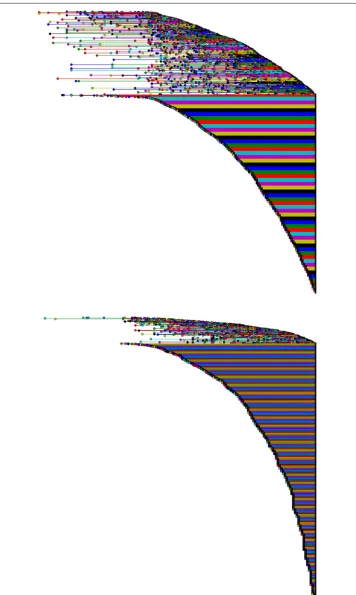
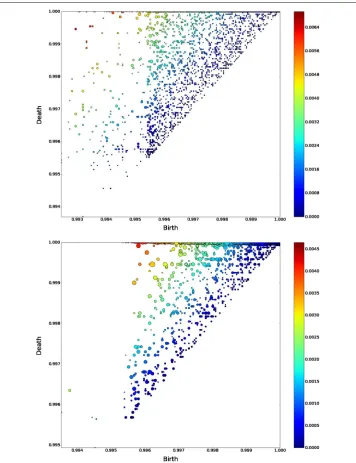
Figure7 reports the barcodes forH1andH2, where holes are ordered by their death time (that is the step of the filtration at which they disappear), and Fig.8holes persistence. The first thing to notice is that most holes persist up to the end of the filtration, that is up to 03/2007, meaning that there are several areas of low connectivity (both inH1and in H2) in the conceptual space, while this was not emerging from the network analysis of our data. Moreover new holes are born continuously, along all the steps of the filtration. The fact that holes continue to be born at every point in time, and most of them don’t die finds a possible interpretation in that the evolution of research in mathematics proceeds by connecting new conceptual areas in a cyclic way, and rarely these concepts contribute all together to the production of scientific advances (that would kill the hole). So this suggests that the death of conceptual holes may be a sign of important advances in mathematics as the emergence of a new subfield.
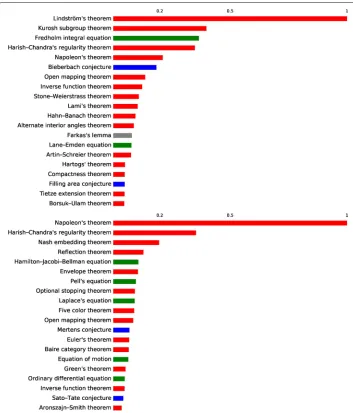
We investigate which are the most important concepts inH1andH2by counting the number of times each concept appears in a cycle, divided by the number of times it appears in different articles, to correct for the fact that very common concepts are also more likely to appear in cycles. The results are reported in Fig.9, notice that most of the concepts are theorems there are 5 concepts in common between the most important 20 ofH1andH2, even if their ordering is not preserved.
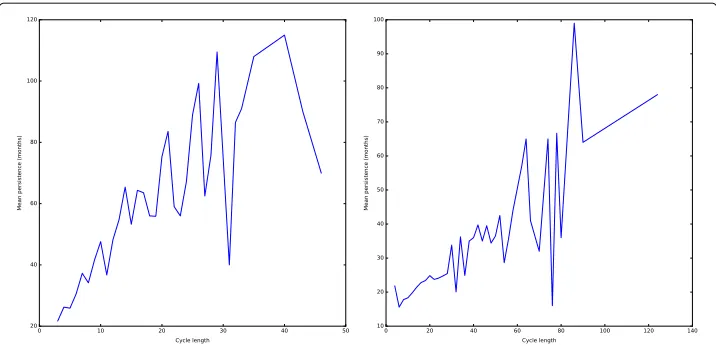
A clear feature emerging from bothH1andH2is that longer cycles are more difficult to break. Considering only those cycles that die before the end of the filtration (otherwise they have infinite persistence) we compute the average persistence among all cycles of given length. Figure10shows the plot of cycles length versus average persistence of cycles of the corresponding length: despite some noise, a positive trend appears clearly. This suggests that concepts appearing in a long cycle that are not successive elements of the k-chain (so that don’t appear in the same article) have a great distance among them in the conceptual space of mathematics compared to those appearing in shorter cycles. Notice that this relation is somehow natural, as the more concepts there are in ak-cycle, we need more articles (each including at leastk+2 of the concepts in the cycle) in order to kill the hole.
Looking at the distribution of killers’ size, the largest simplex inH0is made of 27 con-cepts, while both inH1andH2has 38 concepts (it is actually the same article in both). Interestingly and not surprisingly, these two articles are both surveys, the largest forH0 regards open questions in number theory (Waldschmidt2004) and the largest forH1is a survey on differential geometry (Yau2006). The most frequent killers’ sizes forH0,H1 andH2are respectively 4,7,11.
Fig. 8Persistence diagrams forH1andH2. Persistence diagrams report the same information of barcodes, where each barcode is mapped to a peak function that is proportional to the life of the homological feature. The heatmap reports information on the length of the cycle and the coordinates are birth and death times
Fig. 9Concept importance in cycles 20 most important concepts appearing inH1cycles (top) andH2cycles (bottom). The bars length corresponds to the number of appearances in cycles divided by the number of appearance in edges and triangles respectively
holes: a theoretical result that has several applications, hence bridges related areas and closes a homological cycle.
Fig. 10 Longer cycles live longer. The plots report cycle size on thex-axis and cycle mean persistence on the y-axis forH1(left) andH2(right). In both cases the trend shows that longer cycles are more difficult to break
far from the surface. Considering only those with at least two simplices we count 567S2 stars and 284S3stars. We do not check for higher-order stars for computational reasons. Figures11and12report the 20 most important concepts in the cores and peripheries of S3andS2respectively, adjusted for the number of times concepts appear in triangles (for cores) and tetrahedra (for peripheries). Notice that in both cases all except one concept are theorems/conjectures. Figure9reports the ranking of the first 20 concepts inH1and H2, where here we adjust for the frequency of appearance of a concept in the simplex that constitutes the cycles, hence edges and triangles respectively. Even in these two rankings the large majority of the concepts are theorems.
In order to check if edges that appear in cycles are also likely to appear in stars, we find the intersection between the set of concepts in stars (differentiating between edges in the core and edges in the periphery) and cycles and divide by the total numbers of edges in the corresponding cycle. As appearing in a star is a Bernoulli variable, we can easily compute the standard deviations for our estimated probabilities. Table2reports the results: it is interesting that edges in the cores of bothS2andS3are more likely to appear in cycles of all dimensions than edges in the peripheries. It is particularly striking that edges in the peripheries ofS3never appear in any cycle. Moreover edges in stars (both cores and peripheries) are more likely to appear in cycles than a random edge, except for one case: a random edge is more likely to be in aH3cycle than an edge in the periphery of aS2star.
Authors analysis
We use the conceptual content of articles to classify the activity of researchers, by constructing for each author an activity vector:
ai=
a1i,. . .,aNi
Fig. 11 Concept importance inS3stars 20 most important concepts appearing in the core (top) and the periphery (bottom) ofS3stars. The bars reports the number of appearances in cores or peripheries divided by the number of appearance in triangles and tetrahedra respectively
to map authors’ research activity on the basis of the broadness of their contribution to the concept space, as captured by the entropy:
λi= −
c
acilnaci
Fig. 12 Concept importance inS2stars 20 most important concepts appearing in the core (top) and the periphery (bottom) ofS2stars. The bars reports the number of appearances in cores or peripheries divided by the number of appearance in edges and triangles respectively
being apolymathin a strict sense. Of course we cannot disentangle which is each author’s contribution to a paper, but, provided we are clear on the information conveyed by this measure of specialisation, we can make use of it to capture the relation between concep-tual breadth of research (being it made by a single authors who really is apolymathor by a research group) and homological cycles.
one using conceptc3her total count will be 5). CallkMthe max of these counts across all authors, then fork ∈1,kM(kinteger), we extractkconcepts at random from the urn, and we compute the entropy of the extractedk-tuple, repeating the operation 1000 times for eachk and computing the average entropy over the 1000 extractions. To compare with authors, we group them according to the number of concepts used, and compute the average entropy for eachk. We estimate the relationeˆbetween number of conceptskand average entropy, using least squares, finding logarithmic relationˆenull=A+Blog(1+k) for the null model, while for the dataeˆdata=A+Blog(1+k)/kas can be seen in Fig.13. For the data(A,B)is(3.459,−5.257)and(0.170, 0.863)for the null model, showing how, for large enough values ofk, the fit for the data always lies below the null model, and more importantly, that the relation emerging from the data has a horizontal asymptote, while the null model does not. This is telling us that there is an upper bound on the conceptual entropy, and even very prolificpolymathsshow some degree of specialisation, in the sense that as the number of articles increases, they eventually stop broadening their research including new concepts, and tend to publish new research regarding concepts they already explored.
To understand if there is any relation between authors’ profile in terms of their special-isation and their contribution to homological cycles, we compute for authoria measure of hishomological importance
hi=
c∈Ci,k
1Hk(c)
whereCi is the set of concepts used by authori, and1Hk(c)is the indicator function,
giving 1 if concept c is in the homological cycleHk.
To correct for the fact that most frequent concepts tend to appear in cycles more often, we exclude the first 100 most frequent concepts from the computation of the homologi-cal importance. After removing the 100 most frequent concepts still the 86.5% of authors contribute at least once to a homological cycle. This confirms that homological cycles are ubiquitous, and really constitute a feature of mathematical research. Figure14shows the scatterplot of authors’ conceptual entropy and homological importance. It reveals a non-linear positive relation between the two, so more interdisciplinary authors contribute more to homological cycles, thus confirming the intuition that cycles are made by con-cepts that belong to different areas of mathematics, which are mostly unconnected among them.Polymathsare often found on the boundary of these voids surrounded by concepts belonging to different conceptual areas. In Fig.15we show the relationcˆbetween average entropy and average importance in cycles (least squares fit), and how it compares with the null model. The relation between average entropyλˆand average contribution to cycles is exponential both for the null model and for the data, withˆc=A+Bλˆ, and the null model
Table 2Probabilities and standard errors for edges in the cores and peripheries of stars and of a random edge to be inHk
H1 H2 H3
S2(cores) 0.794 (0.005) 0.806 (0.004) 0.785 (0.003)
S2(peripheries) 0.571 (0.006) 0.51 (0.005) 0.547 (0.003)
S3(cores) 0.743 (0.005) 0.905 (0.003) 0.91 (0.002)
S3(peripheries) 0.0 (0.0) 0.0 (0.0) 0.0 (0.0)
always lies above the data, with(A,B)=(3.04, 3.92)for the null model and(−4.50, 3.05) for the data.
Discussion
This work is a first attempt to explore the importance of homological holes in mathemat-ics, and it is important to issue certain caveats here. It seems clear that our observations would not have been possible within a classical network analysis of co-occurrences, and we also think that holes deaths can be informative in capturing advances in the discipline. However, we do not claim that we are describing the essence of mathematical practice here. If on one hand, by extracting concepts from the whole text of the article instead of just focusing on the keywords we avoid the bias of authors’ own classification of their work, on the other hand it is possible that for some articles the conceptual content is not well captured by our approach: we cannot exclude that the set of concepts that bet-ter identify the content of the article do not find an exact match in our list, while those finding a match are poorly representative of the article. We believe that such cases are a minority as our list is very comprehensive, still this is an aspect to take in consideration when analysing our results, even if this is an issue that is potentially arising every time one does text analysis, irrespective of the tools used to explore the data. In this direction, an
important step would be to assess the robustness of our observations by purposely intro-ducing errors in our data analysis, for instance by focusing only on a fraction of our list of identified concepts, and keeping the other unknown.
Overall, this paper suggests new directions for the study of co-occurrences by focusing on their higher-order properties and there is substantial space for further development. The first and most urgent point, in our opinion, regards the necessity to validate the find-ings from the data by having well-founded null models for comparison. Recently some null models for simplicial complexes have been developed (Young et al.2017; Courtney and Bianconi2016), which we did not use here for computational reasons, as produc-ing samples from our relatively large dataset proved too challengproduc-ing to manage with our resources. Another very important point is to devise methods and find algorithms to localise homological holes with precision, as this could be very useful for some specific applications, and it can still be considered an open problem. In this regard we think that it would be pivotal to unify the study of the geometry and the topology of the structure. A geometrical approach has been used in (Eckmann and Moses2002) where they find that curvature is a good measure of thematic cohesion in the WWW. More recently (Wu et al.2015; Bianconi and Rahmede2017) studied the emergence of geome-try in growing simplicial complexes, without a pre-existing embedding space and metric. This approach could be naturally extended to our case, as we have no natural embed-ding space for concepts, and also because the co-occurrence simplicial complex that we study is dynamic by nature, as new simplices appear at each time step eventually glueing to existing simplices. Embedding concepts in a space could facilitate the localisation of holes, in this regard (Bianconi and Rahmede2017) find that the natural embedding for their growing simplicial complexes is hyperbolic, and in their case the position of the incoming nodes depends on the position of the nodes of the face of the simplex to
Fig. 14 Author contribution to cycles. The plot shows that contribution to homological cycles inH1,H2and
Fig. 15 Authors’ contribution to cycles versus null model. Here we compare the contribution to homological cycles as a function of authors’ entropy in our dataset with average contribution over the null model, the latter being always above the fit for authors’ data
which the new simplex glues. Such a framework could be ideal to the purpose of pre-cise holes identification in our case. Moreover adopting a growing simplicial complex model (generalized to allow for simplices of different size at each time step) and fitting it to our data we could be able to predict the future evolution of the conceptual space of mathematics.
Conclusions
We also find that the higher the number of concepts in a hole, the longer it takes to die, hence the length of a hole is a good proxy of how distant these concepts are, in terms of their likelihood to appear together in an article. So in this sense large holes could be seen as potential spaces for important advances in mathematics. Moreover we further explore the structure of co-occurrences by looking at the simplicial analogs of stars in higher dimension, which represent groups of concept (those in the core of the star) that supports and connects many otherwise unrelated concepts, and we find that concepts appearing in stars tend also to appear in holes more often than they would do at random, suggesting that both structures lie at the frontier of mathematical research.
We also explore authors’ conceptual profile by ordering them on the basis of their con-ceptual entropy, so that we can differentiate between those authors who tend to specialise and publish mostly about few concepts, and others that do research on a broad range of topics, that we callpolymaths. Comparing authors’ profiles with a random model, we find that authors’ entropy as a function of how may concepts authors use across differ-ent publications, is bounded above, while in the null model, differ-entropy is always increasing for larger set of random concepts. This is reasonable, and means that even the more pro-lificpolymaths, even if they publish a large number of articles, will still tend to specialise to some extent, instead of doing research always on new topics. Moreover we find that polymathscontribute to homological holes more than specialists, sopolymathsare often at the frontier of research.
Further work could be done by using larger datasets, as it would be very interesting to explore the birth and death of holes in a larger time-span, and to study simplicial co-occurrences in other disciplines, in order to see if any difference appears in the way research evolves in different fields. Furthermore, conceptual spaces emerging from co-occurrences relations could be explored adding a further dimension to the filtration: in our case we focus on a temporal filtration, disregarding the weights of simplices, this could be extended by filtering along time and weight using multidimensional persistence (Carlsson and Zomorodian2009).
Acknowledgements
The authors thank two anonymous reviewers for their constructive comments and Henry Adams, Oliver Vipond and Alexey Medvedev for useful discussions and suggestions.
Funding
Daniele Cassese wishes to thank support from FNRS (Belgium).
Availability of data and materials
Data available upon request.
Authors’ contributions
All authors conceived the study; VS and DC performed the numerical simulations and created the Figures; All authors wrote and reviewed the manuscript. All authors read and approved the final manuscript.
Competing interests
The authors declare that they have no competing interests.
Publisher’s Note
Springer Nature remains neutral with regard to jurisdictional claims in published maps and institutional affiliations.
Author details
1University of Namur and NaXys, Rempart de la Vierge, 5000 Namur, Belgium.2ICTEAM, University of Louvain, Av Georges
Received: 19 March 2018 Accepted: 18 June 2018
References
Adams H, Tausz A, Vejdemo-Johansson M (2014) javaplex: A research software package for persistent (co)homology. In: Hong H, Yap C (eds). Mathematical Software – ICMS 2014. Springer, Berlin, Heidelberg. pp 129–136
Akimushkin C, Amancio DR, Oliveira ONJ (2017) Text authorship identified using the dynamics of word co-occurrence networks. PLos ONE 12(1):1-101
Bianconi G, Rahmede C (2017) Emergent hyperbolic network geometry. Sci Rep 7(41974).https://doi.org/10.1038/ srep41974
Carlsson G (2009) Topology and data. Bullettin AMS 46(2):255–308
Carlsson G, Zomorodian A (2009) The theory of multidimensional persistence. Discrete Comput Geom 42:71–93 Carlsson G, Zomorodian A, Collins A, Guibas LJ (2005) Persistence barcodes for shapes. Int J Shape Model 11:149–188 Carstens CJ, Horadam KJ (2013) Persistent homology of collaboration networks. Math Probl Eng 2013:85035.http://dx.
doi.org/10.1155/2013/815035
Chan JM, Carlsson G, Rabadan R (2013) Topology of viral evolution. PNAS 110(46):18566–18571 Chiang IJ (2007) Discover the semantic topology in high-dimensional data. Expert Syst Appl 33:256–262
Courtney O, Bianconi G (2016) Generalized network structures: The configuration model and the canonical ensemble of simplicial complexes. Phys Rev E 93:062311.https://doi.org/10.1103/PhysRevE.93.062311
Eckmann J-P, Moses E (2002) Curvature of co-links uncovers hidden thematic layers in the world wide web. PNAS 99(9):5825–5829
Edelsbrunner H, Harer J (2008) Persistent homology - a survey. Contemp Math 453(2):255–308
Edelsbrunner H, Letscher D, Zomorodian A (2002) Topological persistence and simplification. Discret Comput Geom 28(4):511–533
Estrada E, Ross G (2018) Centralities in simplicial complexes. applications to protein interaction networks. J Theor Biol 438:46–60
Ferrer-i-Cancho R, Solé RV (2001) The small world of human language. Proc R Soc Lond B 268:2261–2265.https://doi.org/ 10.1098/rspb.2001.1800
Garg M, Kumar M (2018) Identifying influential segments from word co-occurrence networks using ahp. Cogn Syst Res 47:23–41
Gottlieb AD (2000) Markov transitions and the propagation of chaos. ArXiv Math E-prints.math/0001076
Gurciullo S, et al. (2015) Complex politics: A quantitative semantic and topological analysis of uk house of commons debates. ArXiv E-prints.1510.03797
Horak D, Maletic S, Rajkovic M (2009) Persistent homology of complex networks. J Stat Mech Theory Exp 3:3–34 Jenssen T-K, Laegreid A, Komorowski J, Hovig E (2001) A literature network of human genes for high-throughput analysis
of gene expression. Nat Genet 28:21–28
Jo Y, Hopcroft JE, Lagoze C (2011) The web of topics: Discovering the topology of topic evolution in a corpus. In: Proceedings of the 20th International Conference on World Wide Web, March 28 - April 01, 2011, Hyberabad, India. ACM, New York. pp 256–266
Lazer D, Mergel I, Friedman A (2009) Co-citation of prominent social network articles in sociology journals: The evolving canon. Connections 29(1)
Mamuye AL, Rucco M, Tesei L, Merelli E (2016) Persistent homology analysis of rna. Mol Based Math Biol 4:14–25 Mantoiu M, Purice R, Richard S (2004) Twisted crossed products and magnetic pseudodifferential operators. ArXiv Math
Phys E-prints.math-ph/0403016
Mullen EK, et al. (2014) Gene co-citation networks associated with worker sterility in honey bees. BMC Syst Biol 8(38). https://doi.org/10.1186/1752-0509-8-38
Otter N, Porter MA, Tillmann U, Grindrod P, Harrington H (2017) A roadmap for the computation of persistent homology. EPJ Data Sci 6(17).https://doi.org/10.1140/epjds/s13688-017-0109-5
Pal S, Moore TJ, Ramanathan R, Swami A (2017) Comparative topological signatures of growing collaboration networks. In: Gonçalves B, Menezes RSR, Zlatic V (eds). Proceedings of the 8th Conference on Complex Networks CompleNet 2017. Stoneham: Butterworth-Heinemann, Cham. pp 16–27
Patania A, Petri G, Vaccarino F (2017a) The shape of collaborations. EPJ Data Sci 6(18).https://doi.org/10.1140/epjds/ s13688-017-0114-8
Patania A, Petri G, Vaccarino F (2017b) Topological analysis of data. EPJ Data Sci 6(7).https://doi.org/10.1140/epjds/ s13688-017-0104-x
Petri G, Expert P, Turkheimer F, Carhart-Harris R, Nutt D, Hellyer PJ, Vaccarino F (2014) Homological scaffolds of brain functional networks. J R Soc Interface 11(20140873).http://dx.doi.org/10.1098/rsif.2014.0873
Petri G, Scolamiero M, I D, F V (2013) Topological strata of weighted complex networks. PLoS ONE 8(6).https://doi.org/10. 1371/journal.pone.0066506
Radhakrishnan S, Erbis S, Isaacs JA, Kamarthi S (2017) Novel keyword co-occurrence network-based methods to foster systematic reviews of scientific literature. PLos ONE 12(3):23–41. e0172778.https://doi.org/10.1371/journal.pone. 0172778
Sami IR, Farrahi K (2017) A simplified topological representation of th text for local and global context. In: Proceedings of the 2017 ACM on Multimedia Conference, Mountain View, California, USA. ACM, New York. pp 1451–1456 Serrano MA, Boguña M, Vespignani A (2009) Extracting the multiscale backbone of complex weighted networks. PNAS
106:6483–6488
Slater PB (2009) A two-stage algorithm for extracting the multiscale backbone of complex weighted networks. PNAS 106(26).https://doi.org/10.1073/pnas.0904725106
Su H-N, Lee P-C (2010) Mapping knowledge structure by keyword co-occurrence: a first look at journal papers in technology foresight. Scientometrics 85:65–79.https://doi.org/10.1007/s11192-010-0259-8
Taylor D, et al. (2015) Topological data analysis of contagion maps for examining spreading processes on networks. Nat Commun 6(7723).https://doi.org/10.1038/ncomms8723
Wang X, Zhang X, Xu S (2011) Patent co-citation networks of fortune 500 companies. Scientometrics 88(3):761–770 Yau S-T (2006) Perspectives on geometric analysis. ArXiv Math e-prints.math/0602363
Young J-C, Petri G, Vaccarino F, Patania A (2017) Construction of and efficient sampling from the simplicial configuration model. Phys Rev E 96(3):032312.https://doi.org/10.1103/PhysRevE.96.032312
Wagner H, et al. (2012) Computational topology in text mining. In: Ferri M, Frosini P, Landi C, Cerri A, Di Fabio B (eds). Computational Topology in Image Context. Springer, Berlin, Heidelberg. pp 68–78
Waldschmidt M (2004) Open diophantine problems. Mosc Math J 4(1):245–305
Wu Z, Menichetti G, Rahmede C, Bianconi G (2015) Emergent complex network geometry. Sci Rep 5(10073).https://doi. org/10.1038/srep10073
Zhang J, Xie J, Hou W, Tu X, Xu J, et al (2012) Mapping the knowledge structure of research on patient ahderence: knowledge domain visualization based co-word analysis and social network analysis. PLoS ONE 7(4):34497.https:// doi.org/10.1371/journal.pone.0034497