R E V I E W
Open Access
Evaluating active roles of community
health workers in accelerating universal
access to health services for malaria in
Palawan, the Philippines
Emilie Louise Akiko Matsumoto-Takahashi and Shigeyuki Kano
*Abstract
Background:Palawan is the most malaria-endemic province in the Philippines. In an effort to confront malaria in areas with limited healthcare facilities, microscopists (community health workers) have been trained to diagnose malaria since 1999.
Methods:We reviewed the epidemiological data and related literature which analyzed the achievements of the
microscopists and their tasks in order to propose a strategy to strengthen community-based malaria control. Results:The epidemiological data showed that there had been a drastic decrease in malaria morbidity and mortality throughout the province following the launch of the strategy. Microscopists clearly enhanced the feasibility of early diagnosis and treatment throughout the province. However, it remained necessary to implement anti-malarial measures focusing on children under 5 years of age who live in the southern region of the province. The analysis of our published papers also enabled us to propose a new strategy to enhance activities by microscopists to raise malaria awareness in their respective communities.
Conclusions:These low-cost activities are expected to strengthen the preventive measures implemented by
the residents and to drive more people to seek appropriate treatment. Consequently, this new strategy could accelerate the efforts to eliminate malaria in the province of Palawan that will be adopted in the WHO’s Global Technical Strategy for Malaria 2016–2030, in order to achieve the Sustainable Development Goals by 2030.
Keywords: Universal health access, Malaria, Community health workers, Microscopist, Palawan, The Philippines
Background
Malaria is one of the most important parasitic infections in humans. In 2013, it accounted for approximately
584,000 deaths (range 367,000–755,000) worldwide [1].
Although malaria was once prevalent throughout much of the inhabited world, it has been eliminated in roughly half of the world’s countries and now is mostly restricted to rural tropical regions [2]. From 2000 to 2013, the number of malaria infections dropped by 26 % from 173 million to 128 million, while the worldwide mortality
rate decreased by 47 % [1]. This decrease occurred as a result of substantial increases in donor funding, im-proved control, and increased enthusiasm for malaria elimination [3, 4].
Improving the availability of effective health services has been an essential strategy for malaria elimination in all of the endemic regions [1]. At present, malaria mostly remains in remote and rural regions where essential pre-ventive measures are delivered to the populations that need them the most by poor health systems with insuffi-cient human resources [5, 6]. Thus, the targeting of resi-dents in these areas, including socially vulnerable groups such as ethnic minorities and migrants, is a key to mal-aria control [7, 8].
* Correspondence:[email protected]
Department of Tropical Medicine and Malaria, Research Institute, National Center for Global Health and Medicine, 1-21-1 Toyama, Shinjuku-ku, Tokyo 162-8655, Japan
To overcome these challenges in many malaria-endemic regions, the validity and usefulness of strategies that utilize community health workers (CHWs) has been proposed [9, 10]. According to the World Health Organization (WHO), CHWs should meet the following criteria: be members of the communities where they work; be se-lected by the communities; be answerable to the commu-nities for their activities; be supported by health systems, but not necessarily a part of their organization; and have shorter training than professional workers [11]. In rural areas, where there is a recognized paucity of human cap-acity and health systems, the utilization of CHWs is a po-tentially inexpensive, effective, and sustainable approach for bringing malaria diagnosis and treatment closer to households [11].
Although CHWs, such as barangay health workers (BHWs) or government-trained health volunteers, have been operating in rural villages in the Philippines since 1981, their involvement in malaria control has not been satisfactory [12]. This has largely been due to inadequate training, insufficient logistical support, poorly sustained motivational schemes, and a lack of community support. With this background, a community-based malaria con-trol program was established in Palawan, one of the most malaria-endemic provinces in the Philippines, in 1999
[13–16]. The program, which was called Kilusan Ligtas
Malaria(KLM) (Tagalog: Movement Against Malaria), in-volved training 344 CHWs as malaria microscopists (one microscopist per malaria-endemic village). The microsco-pists diagnose malaria in febrile patients via microscopy and prescribe first-line anti-malarial drugs to
malaria-infected patients. Microscopists also implement community awareness-raising activities that are aimed at preventing the transmission of malaria among their patients and their pa-tients’families. Since this program started, diagnostic tech-niques that allow for the early diagnosis of malaria have been extended to the entire province. This community-based malaria control program was partly maintained with the aid of the Japan International Cooperation Agency and the ongoing Global Fund Project through the Pilipinas Shell Foundation, Inc.
To accelerate the efforts to eliminate malaria in Palawan, this community-based malaria control program must be evaluated. The present study also aimed to find out the value of the capacity for microscopy and active roles of CHWs by reviewing the epidemiological data in Palawan and the related literature. The findings may also be used to enhance the performance of CHWs in other settings.
Methods
Study area
Palawan is the most malaria-endemic province in the Philippines. Eighteen out of the 23 legislated municipal-ities and the capital city of Puerto Princesa are consid-ered to be malarious [13–16]. The capital city is located in the center of this oblong island province and divides the island into the northern and southern regions. The island is mostly covered by tropical rainforests, which limit the residents’ access to affordable healthcare facil-ities. In 2010, the population of Palawan was 1,025,800. The residents lived in 367 villages in 23 municipalities [17]. The ethnicities of the residents include Tagalog (the
0 20 40 60 80 100 120 140 160 180 200
0 10,000 20,000 30,000 40,000 50,000 60,000
1995 1996 1997 1998 1999 2000 2001 2002 2003 2004 2005 2006 2007 2008 2009 2010
T
o
tal deaths
T
o
tal malaria cases
Year
Malaria cases confirmed through symptoms and signs only Malaria cases confirmed through microscopy
Death
predominant ethnic group in the Philippines), Cuyunon, Hiligaynon, Palawan, Cebuano, Ilocano, Bisaya, Kagayanan, and Tagbanwa.
Data collection
We reviewed the epidemiological data and related litera-ture which analyzed the achievements of the microsco-pists and their tasks. Available epidemiological data of malaria morbidity and mortality in Palawan were col-lected in the Provincial Health Office of Palawan and KLM main office in Puerto Princesa City, Palawan, the Philippines. Besides, we searched and reviewed related articles in PubMed which had been published since the earliest date up to December 2015.
Results
Malaria in the Philippines
Malaria has existed in the Philippines for centuries, and several malaria control strategies have been
imple-mented [18–20]. When the Spanish arrived and started
to occupy the Philippines in the 16th century, the coun-try was largely covered with extensive forests, which the local people avoided due to the risk of infection [18]. Forest exploitation using forced local labor contributed to several malaria epidemics and the persistence of mal-aria within the Philippines. After the Spanish-American War in 1898, the United States occupied the Philippines and programs were implemented to minimize the spread of several diseases including malaria, cholera, smallpox, dysentery, and tuberculosis. In 1931, there were approxi-mately 20,000 deaths due to malaria per year and the strategy for malaria control was to examine blood smears by microscope, to treat cases with quinine alone or with plasmochin, and to use screens and bed nets [19]. The start of World War II saw an increase in mal-aria morbidity and mortality throughout the Philippines.
After the end of World War II, malaria-vector control was achieved by dichloro-diphenyl-trichloroethane (DDT) spraying in the province of Mindanao, an island in the southeast of the Philippines [18, 20]. DDT spraying proved effective, and the spraying program was expanded to cover
Effective prevention
Appropriate treatment
Job satisfaction
Microscopists’ capacity
Service quality
Knowledge on malaria
Ability in malaria microscopy
Satisfaction with microscopist
Ethnicity (Tagalog)
Knowledge on vector species
Knowledge on symptoms
Severe symptoms Knowledge
on vector’s most active time
Living near microscopist Living near
drug seller Knowledge
on transmission
Community
awareness-raising activities by microscopist
Pass diagram
(Chi-squared=12.667, df=13, CFI=1.000, RMSEA=0.000)
Pass Diagram
(Chi-squared=5.842, df=10, CFI=1.000, RMSEA=0.000)
Pass diagram
(Chi-squared=10.5, df=11, CFI=1.000, RMSEA=0.000) Matsumoto-Takahashi et al. 2013
Matsumoto-Takahashi et al. 2014
Matsumoto-Takahashi et al. 2015 0.44*
0.37*
0.63* 0.52* 0.16
1.00*
1.26*
4.90*
2.48*
4.90* 2.45*
0.17**
-0.12* 0.36*** -0.10
-0.16* 0.36***
-0.15***
0.10
0.34***
-0.14* 0.04*
0.07*
0.05* 0.04*
0.03*
Living near private pharmacy
*Significant difference (0.01 <p< 0.05) **Significant difference (0.001< p< 0.01) ***Significant difference (p< 0.001)
0.03*
Field A
Field B
Field C
Table 1Trends in the leading causes of morbidity in Palawan from 2005 to 2009
Causes of morbidity 2005 2006 2007 2008 2009
Top 10
Number Ratea Top 10
Number Ratea Top 10
Number Ratea Top 10
Number Ratea Top 10
Number Ratea
URTI/ARI 1st 28,011 4303 1st 27,959 4201 1st 19,217 2392 1st 24,030 3457 1st 38,857 4964
Influenza 2nd 17,085 2625 2nd 16,091 2418 2nd 16,266 1477 2nd 16,719 2405 2nd 13,528 1728
Malariab 3rd 10,334 1588 3rd 12,640 1899 3rd 10,048 973 5th 5865 844 4th 6558 838
Diarrhea 4th 7038 1081 4th 8932 1342 4th 6617 831 4th 7061 1016 7th 3655 467
Bronchitis 5th 4800 737 5th 7908 1188 6th 4382 521 3rd 8303 1195 6th 3738 477
Hypertension 6th 3317 510 6th 4843 728 7th 3540 502 7th 3000 432 3rd 7335 937
Urinary tract infection 7th 2700 415 7th 2856 429 8th 3417 185 6th 5671 816 5th 4483 573
Pneumonia 8th 2260 347 8th 1470 221 5th 5652 644 8th 2994 431 10th 2471 316
Anemia 9th 1447 222 10th 858 129
Pulmonary tuberculosis
10th 1029 158 9th 949 143 10th 971 127
Skin disease 9th 1261 143
Gastritis 9th 1402 202 9th 2066 264
Accident/wound/ injury
10th 1130 163 8th 2834 362
The table was created by the author based on the annual provincial health report of the province of Palawan [15,16]
Abbreviations:URTIupper respiratory tract infection,ARIacute respiratory infection a
Rate per 100,000 population b
The number does not match that in Table1due to differences in the methods of data collection (the data for this table was only collected in provincial and private hospitals)
Table 2Trends in the leading causes of mortality in Palawan from 2005 to 2009
Causes of mortality 2005 2006 2007 2008 2009
Top 10
Number Ratea Top 10
Number Ratea Top 10
Number Ratea Top 10
Number Ratea Top 10
Number Ratea
Pneumonia 1st 239 37.0 1st 224 33.7 1st 313 46.0 1st 285 41.0 1st 337 43.1
Hypertension 2nd 155 24.0 5th 101 15.2 7th 78 11.5 4th 108 13.8
Pulmonary tuberculosis 3rd 128 20.0 3rd 122 18.3 4th 163 24.0 4th 97 14.0 6th 99 12.7
Unspecified natural cause
4th 123 19.0 9th 60 9.0 3rd 181 26.7 10th 57 8.2
Cancer 5th 105 16.0 4th 105 15.7 5th 137 20.1 2nd 107 15.4 2nd 123 15.8
Diarrhea 6th 95 15.0 8th 63 9.5 6th 125 18.4 8th 72 9.2
Myocardial infarction 7th 83 13.0 2nd 147 22.1 8th 59 8.5
Accident/wound/injury 8th 67 10.0
Stillbirth 9th 56 9.0 6th 63 9.1
Myocarditis 10th 54 8.0 8th 76 11.2 9th 59 8.5 9th 69 8.8
Congestive heart failure 6th 87 13.1
Renal failure 7th 80 12.0 9th 72 10.6 7th 63 9.1 7th 77 9.8
Peptic ulcer 10th 54 8.0
Cardiovascular disease 2nd 295 43.4 3rd 103 14.9 5th 101 12.9
Cerebrovascular accident
5th 85 12.2 3rd 111 14.2
Diabetes mellitus 10th 64 8.2
The table was created by the author based on the annual provincial health report of the province of Palawan [15,16] a
the rest of the Philippines in 1955; thereafter, there was a dramatic decrease in malaria morbidity. However, spray-ing alone was by no means a perfect tool for eliminatspray-ing malaria on the islands.
Evidence-based diagnoses and treatment by microscopists
KLM initiated its activities in 1999 [21]. Between 1990 and 1997, the incidence of malaria and malaria-related deaths actually increased in Palawan until 1997 and then began to decrease year by year (Fig. 1). After 2006, the total number of blood smears inspected remained at around 90,000 and the annual blood examination rate (the number of blood smears examined in a year/total popula-tion * 100) remained at around 10; however, there was a yearly decrease in the slide positivity rate (SPR) [13–16]. The number of deaths caused by malaria also began to decrease from a peak of 170 in 1997 to 9 in 2009.
In 1995, before KLM began its program of training microscopists, 76.1 % of malaria diagnoses were made through symptoms and signs (Fig. 1). The proportion of evidence-based diagnoses by the microscopists in-creased after 1999. Consequently, in 2005, only 500 out of 16,885 patients were diagnosed based on symp-toms and signs. Since 2006, all of the patients have reportedly been microscopically diagnosed.
Activities of community awareness-raising for prevention
As summarized in Fig. 2, the community awareness-raising activities of the microscopists strengthened the ef-fective prevention practices implemented by the residents of Palawan and increased the likelihood that they would seek appropriate treatment. Community awareness-raising activities that inform residents about transmission, vector species, and the times that vector species are most active were expected to be effective in strengthening malaria pre-vention practices (Fig. 2, Field A) [22]. Knowledge on transmission was statistically proven to be the most important factor in this regard (pass coefficient, 4.90). To increase the likelihood that residents would seek appropri-ate treatment, community awareness-raising activities that sought to improve knowledge on malaria symptoms were important to make inhabitants more aware of their symp-toms; this led to improved self-triage (Fig. 2, Field B) [23].
The study suggested that improving the residents’
recognition of malaria symptoms and making them aware of nearby microscopists would likely be the keys to accelerating universal access to effective mal-aria treatment in Palawan.
These activities would be enhanced by additional follow-up interventions to improve service quality and microscopic usage ability (Fig. 2, Field C) [24]. High-capacity microscopists could be expected to offer high service quality (active detection, diagnosis and treat-ment, prescription of anti-malarial, and follow-up) and to show a high level of ability in malaria microscopy (preparation and documentation, slide preparation and observation, safe handling and disposal, and knowledge on the morphology of infected red blood cells).
In addition, these activities should be intensively prac-ticed to strengthen the preventive measures implemented by indigenous residents and people who travel to mountain areas (Fig. 2, Field A) [22, 23]. In Palawan, most of the ethno-linguistic groups live in the forests, while other resi-dents must stay in the forest for subsistence (e.g., farming or mining). Because malaria transmission mainly occurs in the forests or adjacent areas, malaria control among those groups is the key to eliminating malaria [25–27].
Overall morbidity and mortality
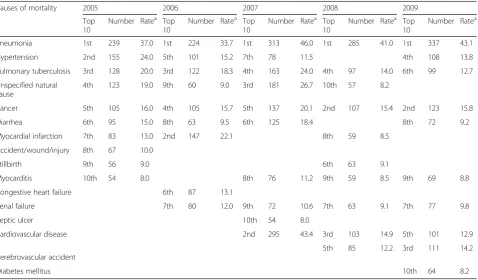
The trends in the leading causes of morbidity and mortal-ity in Palawan from 2005 to 2009 are shown in Tables 1 and 2. Prior to 2005, most of the leading causes of mor-bidity were infectious diseases such as malaria, respiratory infections, and urinary tract infections [14]. There were at least 170 malaria-related deaths in 1997 (Fig. 1).
From 2005, malaria was no longer a leading cause of death in the province, although the morbidity of malaria is still high (Tables 1, 2), and lifestyle-related diseases, such as hypertension and cardiovascular disease, were coming to be common causes of death among Palawan residents.
Coming up in 2009, total number of confirmed
mal-aria cases were 7606 including Plasmodium falciparum
(73.1 %), Plasmodium vivax (24.0 %), and Plasmodium
malariae (1.7 %); the rest were mixed infections (data not shown). Table 3 precisely shows that there were re-gional differences in the annual parasite index (API). More specifically, while the human populations of the
Table 3The population distribution and malaria incidence per region (2009)
Region Population Smear Confirmed malaria cases P. falciparum <5a(%) ABER SPR API
Total 872,390 89,290 7606 73.1 % 17.3 10.3 8.52 8.72
Northern region 334,392 23,626 488 66.0 % 11.1 7.07 2.07 1.46
Puerto Princesa City 207,119 8776 880 63.5 % 8.4 4.24 10.0 4.25
Southern region 330,879 56,888 6238 75.0 % 19.0 17.2 11.0 18.9
Abbreviations:ABERannual blood examination rate,SPRslide positivity rate,APIannual parasite index a
southern and northern regions were almost the same (334,392 and 330,879, respectively) in 2009, 2.4 times as many smears were inspected in the southern region. Furthermore, the SPR and API were, respectively, 5.3 times and 12.9 times higher than in the northern region. Regional differences were also found in the proportion of malaria infections in children younger than 5 years of age (Table 3). In the northern region, they accounted for 11.1 % of malaria infections. In contrast, 19.0 % of the malaria infections in the southern region were in chil-dren under 5 years of age. Thus, in the southern region, a greater percentage and a greater number of malaria in-fections occur in children under 5 years of age.
Discussion
Angluben et al. introduced KLM as a strategy with a focus on social mobilization in the implementation of malaria prevention and control [21]. Since the launch of KLM, microscopists had enhanced the feasibility of early diagnosis and treatment throughout the prov-ince. The achievements of KLM were reflected in the total number of malaria smears that were performed, the increase in microscopic confirmations of malaria, and the decline in clinical diagnoses between 2000 and 2006.
A novel malaria elimination strategy which aims to strengthen community awareness-raising activities by microscopists, with a focus on children under 5 years of age in the southern region of the province, indigenous people, and people who have to stay in the forest, is re-quired. The strategy should follow a simple, effective, and affordable approach to promote the implementation of effective malaria preventive measures and to encour-age residents to seek appropriate treatment. Conse-quently, this new strategy could accelerate the efforts to eliminate malaria in the province of Palawan, which will
be adopted in the WHO’s Global Technical Strategy for
Malaria 2016–2030 [28], with an aim of achieving the
Sustainable Development Goals by 2030 [29].
Improvements to diagnosis and treatment alone might not be sufficient to combat malaria in the southern region of the province of Palawan. Other strategies such as health promotion in schools and mother and infant medical checkups should be considered. Consideration is also needed for the geographic characteristics of the southern region which are responsible for the high rate of malaria.
As is the case in many developing nations, Palawan is facing a changing pattern of diseases. Morbidity and mortality due to infectious diseases are decreas-ing, while the incidence of lifestyle-related diseases or cancer is increasing. The time has come to consider whether microscopists should be given additional tasks or whether the tasks that they perform should be changed. Since Palawan has limited health facilities
and human resources, task-shifting strategies that ex-tend the mission of trained microscopists to fight these diseases should be considered.
Conclusion
The present study proposed a new strategy to enhance ac-tivities by microscopists to raise malaria awareness in their respective communities. These activities are expected to strengthen the preventive measures implemented by the residents and to drive more people to seek appropriate treatment. Consequently, this new strategy could acceler-ate the efforts to eliminacceler-ate malaria in the province of Palawan, the Philippines.
Ethics approval and consent to participate
The present study was approved by the Research Ethics Committee of the University of Tokyo (no. 3001) and up-held by the Provincial Health Office of Palawan. Before the epidemiological data collections, we asked informants to sign a consent form after being informed about the study purpose and told them that they could withdraw from the study during the data collection or even afterwards.
Abbreviations
ABER:annual blood examination rate (number of blood smears examined in a year/total population * 100); API: annual parasite index (number of malaria patients per year/total population * 1000); BHWs: barangay (village) health workers; CHWs: community health workers; DDT: dichloro-diphenyl-trichloroethane; KLM:Kilusan Ligtas Malaria(Tagalog: Movement Against Malaria); SPR: slide positivity rate (number of positive slides/total blood smears * 100); WHO: World Health Organization.
Competing interests
The authors declare that they have no competing interests.
Authors’contributions
ELAM-T and SK designed the present study, conducted the fieldwork, collected the data on the province, analyzed the data, and wrote the present paper. Both authors read and approved the final manuscript.
Acknowledgements
The authors were grateful to the Provincial Health Office of Palawan, the Municipal Health Offices, and the health centers of Palawan for their warm support. The authors would also like to thank Dr. Pilarita Tongol-Rivera, Ms. Elena A. Villacorte, Mr. Ray U. Angluben, and Dr. Masamine Jimba for their professional advice and encouragements.
Funding
The present study was supported by grants-in-aid from the Japanese Ministry of Health, Labour and Welfare (H21-Chikyukibo-Ippan-006) and the National Center for Global Health and Medicine (25A2). The funders had no role in the study design, data collection and analysis, decision to publish, or the preparation of this manuscript.
Received: 13 November 2015 Accepted: 29 December 2015
References
1. WHO | World Malaria Report 2014. 2014. http://www.who.int/malaria/ publications/world_malaria_report_2014/report/en/. Accessed 26 Nov 2015. 2. White NJ, Pukrittayakamee S, Hien TT, Faiz MA, Mokuolu OA, et al. Malaria.
3. Alonso PL, Brown G, Arevalo-Herrera M, Binka F, Chitnis C, et al. A research agenda to underpin malaria eradication. PLoS Med. 2011;8(1):e10000406. doi:10.1371/journal.pmed.1000406.
4. Feachem RG, Phillips AA, Targett GA, Snow RW. Call to action: priorities for malaria elimination. Lancet. 2010;376(9752):1517–21. doi:10.1016/ S0140-6736(10)61500-0.
5. World Bank. World Development Report 2004: making services work for poor people. 2004. https://openknowledge.worldbank.org/handle/10986/ 5986. Accessed 26 Nov 2015.
6. Mathauer I, Imhoff I. Health worker motivation in Africa: the role of non-financial incentives and human resource management tools. Hum Resour Health. 2006;4:24. doi:10.1186/1478-4491-4-24.
7. Moore SJ, Min X, Hill N, Jones C, Zaixing Z, et al. Border malaria in China: knowledge and use of personal protection by minority populations and implications for malaria control: a questionnaire-based survey. BMC Public Health. 2008;8:344. doi:10.1186/1471-2458-8-344.
8. Khamsiriwatchara A, Wangroongsarb P, Thwing J, Eliades J, Satimai W, et al. Respondent-driven sampling on the Thailand-Cambodia border. I. Can malaria cases be contained in mobile migrant workers? Malar J. 2011;10:120. doi:10.1186/1475-2875-10-120.
9. Christopher JB, Le May A, Lewin S, Ross DA. Thirty years after Alma-Ata: a systematic review of the impact of community health workers delivering curative interventions against malaria, pneumonia and diarrhoea on child mortality and morbidity in sub-Saharan Africa. Hum Resour Health. 2011;9: 27. doi:10.1186/1478-4491-9-27.
10. Smith Paintain L, Willey B, Kedenge S, Sharkey A, Kim J, et al. Community health workers and stand-alone or integrated case management of malaria: a systematic literature review. Am J Trop Med Hyg. 2014;91(3):461–70. doi: 10.4269/ajtmh.14-0094.
11. Lehmann U, Sanders D. Community health workers: what do we know about them? 2007. http://www.who.int/hrh/documents/community_health_ workers.pdf. Accessed 26 Nov 2015.
12. Lariosa TR. The role of community health workers in malaria control in the Philippines. Southeast Asian J Trop Med Public Health. 1992;23 Suppl 1:30–5.
13. Provincial Health Office of Palawan. Provincial health report, 1995. Palawan, Republic of the Philippines: Provincial Health Office of Palawan; 1995. 14. Provincial Health Office of Palawan. Provincial health report, 2000. Palawan,
Republic of the Philippines: Provincial Health Office of Palawan; 2000. 15. Provincial Health Office of Palawan. Provincial health report, 2005. Palawan,
Republic of the Philippines: Provincial Health Office of Palawan; 2005. 16. Provincial Health Office of Palawan. Provincial health report, 2010. Palawan,
Republic of the Philippines: Provincial Health Office of Palawan; 2010. 17. National Statistical Coordination Board. Population of the Philippines census
years 1799 to 2010. Manila, Republic of the Philippines: National Statistical Coordination Board; 2012.
18. Tongol-Rivera P. Milestones in the history of malaria research and its control in the Philippines. In: Kano S, Tongol-Rivera P, editors. Asian parasitology. Chiba, Japan: The Federation of Asian Parasitologists; 2005. p. 135–66. 19. The Rockefeller Foundation. The Rockefeller Foundation Annual Report.
New York: The Rockfeller Foundation; 1931.
20. Trigg PI, Kondrachine AV. Commentary: malaria control in the 1990s. Bull World Health Organ. 1998;76:11–6.
21. Angluben RU, Trudeau MR, Kano S, Tongol-Rivera P. Kilusan Ligtas Malaria: advancing social mobilization towards sustainable malaria control in the province of Palawan, the Philippines. Trop Med Health. 2008;36(1):45–9. doi: 10.2149/tmh.36.45.
22. Matsumoto-Takahashi EL, Tongol-Rivera P, Villacorte EA, Angluben RU, Yasuoka J, et al. Determining the impact of community awareness-raising activities on the prevention of malaria transmission in Palawan, the Philippines. Parasitol Int. 2014;63(3):519–26. doi:10.1016/j.parint.2014.01.008. 23. Matsumoto-Takahashi EL, Tongol-Rivera P, Villacorte EA, Angluben RU,
Jimba M, et al. Patient knowledge on malaria symptoms is a key to promoting universal access of patients to effective malaria treatment in Palawan, the Philippines. PLoS One. 2015;10(6):e0127858. doi:10.1371/ journal.pone.0127858.
24. Matsumoto-Takahashi EL, Tongol-Rivera P, Villacorte EA, Angluben RU, Yasuoka J, et al. Determining the active role of microscopists in community awareness-raising activities for malaria prevention: a cross-sectional study in Palawan, the Philippines. Malar J. 2013;12:384. doi:10.1186/1475-2875-12-38.
25. Incardona S, Vong S, Chiv L, Lim P, Nhem S, et al. Large-scale malaria survey in Cambodia: novel insights on species distribution and risk factors. Malar J. 2007;6:37.
26. Singh N, Mishra AK, Shukla MM, Chand SK. Forest malaria in Chhindwara, Madhya Pradesh, central India: a case study in a tribal community. Am J Trop Med Hyg. 2003;68:602–7.
27. Dysoley L, Kaneko A, Eto H, Mita T, Socheat D, et al. Changing patterns of forest malaria among the mobile adult male population in Chumkiri District, Cambodia. Acta Trop. 2008;106(3):207–12. doi:10.1016/j.actatropica.2007.01.007. 28. WHO. Global Technical Strategy for Malaria 2016–2030. 2015. http://www.
who.int/malaria/areas/global_technical_strategy/en/. Accessed 26 Nov 2015. 29. United Nations Sustainable Development Knowledge Platform.
Transforming our world: the 2030 agenda for sustainable development. 2015. https://sustainabledevelopment.un.org/post2015/
transformingourworld. Accessed 26 Nov 2015.
• We accept pre-submission inquiries
• Our selector tool helps you to find the most relevant journal
• We provide round the clock customer support
• Convenient online submission
• Thorough peer review
• Inclusion in PubMed and all major indexing services
• Maximum visibility for your research
Submit your manuscript at www.biomedcentral.com/submit
![Fig. 1 The malaria trends in Palawan. The figure was created by the authors based on the data of the Provincial Health Report, 1995–2010 [13–16]](https://thumb-us.123doks.com/thumbv2/123dok_us/802302.1577445/2.595.56.539.477.713/malaria-trends-palawan-created-authors-provincial-health-report.webp)