R E S E A R C H
Open Access
Evaluating CRoS-NDN: a comparative
performance analysis of a controller-based
routing scheme for named-data networking
João Vitor Torres
1, Igor Drummond Alvarenga
1, Raouf Boutaba
2and Otto Carlos Muniz Bandeira Duarte
1*Abstract
The huge amount of content names available in Named-Data Networking (NDN) challenges both the required routing table size and the techniques for locating and forwarding information. Content copies and content mobility exacerbate the scalability challenge to reach content in the new locations. We present and analyze the performance of a proposed Controller-based Routing Scheme, named CRoS-NDN, which preserves NDN features using the same interest and data packets. CRoS-NDN supports content mobility and provides fast content recovery from copies that do not belong to the consumer-producer path because it splits identity from location without incurring FIB size explosion or supposing prefix aggregation. It provides features similar to Content Distribution Networks (CDN) in NDN, and improves the routing efficiency. We compare our proposal with similar routing protocols and derive analytical expressions for lower-bound efficiency and upper-bound latency. We also conduct extensive simulations to evaluate results in data delivery efficiency and delay. The results show the robust behavior of the proposed scheme achieving the best efficiency and delay performance for a wide range of scenarios. Furthermore, CRoS-NDN results in low use of processing time and memory for a growing number of prefixes.
Keywords: Named-data, Content-centric, Information-centric, Networking, Software-defined, Routing protocols
1 Introduction
Named-Data Networking (NDN) applications refer directly to content names, instead of host network iden-tifiers for communication [1]. In this new paradigm, both host mobility/multihoming and content mobil-ity/multihoming do not concern applications because the NDN-network layer focuses on unique network-visible names that identify content. It forwards two types of packets: interest and data packets.
The interest packet is issued by the consumer, it con-tains the name of the requested content and routers for-ward the interest tofor-wards the closest known copy for this content. Each router, on the way from the consumer to the content copy, keeps a registry of the interest packet, such that the data packet containing the desired con-tent finds the return path back to the consumer. NDN
*Correspondence:[email protected]
1Grupo de Teleinformática e Automação - PEE/COPPE/UFRJ, Universidade Federal do Rio de Janeiro, Rio de Janeiro, Brazil
Full list of author information is available at the end of the article
ensures efficient communication, load balancing, energy efficiency, and flow control through popular content stor-age and data packet replies from any cached copy of the content [1–5]. Interest and data packets one-to-one cor-respondence avoids link congestion due to Distributed Denial-of-Service (DDoS) attacks [6,7]. Unlike IP Multi-cast [8], NDN flow control is receiver-oriented and adapts to the link capacity of each individual consumer.
Named-data routers find and deliver content based on its name and, therefore, NDN routing schemes announce named-data prefixes revealing their associated data loca-tion. Nonetheless, NDN routing schemes based on con-ventional routing protocols, such as Open Shortest Path First (OSPF) and Border Gateway Protocol (BGP), suf-fer from the high number of named-data prefixes. They inherit IP characteristics due to their focus on prefix dis-semination and routing. Additionally, with the intention of reaching content copies stored outside their original locations due to mobility, multihoming, and in-network caching, NDN routing schemes announces more routes with less-aggregated prefixes. Consequently, the routing
schemes must store more routes and exchange more control messages to announce all the addressable con-tents, which results in high control overhead and possible risk of Forwarding Information Base (FIB) explosion [9]. That risk, often mitigated by suppressing announcements of non-aggregated prefixes, is likely to limit the cache-hit opportunities to copies located along the path from consumer to producer. Nevertheless, caching along the path from consumer to producer requires cache sizes big enough to accommodate frequently accessed con-tents that last enough time to serve content to repeated requests. This is a technical and economical trade off con-sidering the large amount of available content and the long tail of content popularity distribution [10].
In a previous paper [11], we formally specified the Controller-based Routing Scheme for Named-Data Net-working (CRoS-NDN) using the Specification Description Language (SDL) to avoid ambiguity caused by specifica-tions in natural language. We formally validated CRoS-NDN to prove its correctness and also make a CRoS-CRoS-NDN proof of concepts of proposed features [12]. CRoS-NDN employs the separation of data and control planes in order to consolidate in the controller the information about network topology and content localization. We designed the CRoS-NDN controller to evaluate routes on demand and, then, return this information inside data packets in response to route requests in interest packets issued by routers, which preserves interest and data packets one-to-one correspondence in Named-Data Networking (NDN) communication model. Each router proactively informs the controller about the routing adjacency and reachable prefixes over the information encoded in interest names. Any updates from the routers trigger the controller that facilitates a consolidated view and enables free placement of content without ties between names and localization.
In this paper, we analyze the CRoS-NDN performance and compare the results with other known NDN rout-ing/forwarding schemes. We also introduce the CRoS-NDN Tunnel Extension that reduces the route-request rate perceived by the controller by encapsulating con-tent names with network segment identifiers and thereby reducing the FIB memory required at core routers due to multiple FIB entries aggregation with the common encapsulation prefix. Our evaluation focuses on the com-munication overhead and the data delivery latency of each scheme for a single administrative domain and one controller, but we also provide insights on extending the scheme to multi-controller and multi-domain scenarios, like the Internet. We present expressions derived from our analysis for lower bounds of the communication effi-ciency and upper bounds for the latency, worst-case sce-narios. We evaluate CRoS-NDN against other protocols for NDN in the ndnSIM simulator and perform extensive simulations and measurements to compare the different
approaches. The obtained results demonstrate that CRoS-NDN is robust and shows similar or superior efficiency, concerning the message overhead of data delivery, in most of the scenarios when compared to the evaluated schemes. CRoS-NDN also improves mobility efficiency of content producers. Furthermore, it achieves the CDN require-ment of lower delay from consumer to content and results in less messaging overhead.
The rest of this paper is organized as follows. Section2
discusses the related work, including the main NDN schemes used in the comparative analysis. Section 3
presents the CRoS-NDN proposal. Section 4 analyses the performance of the compared NDN schemes and Section5presents the simulation results. Section6 intro-duces the CRoS-NDN Tunnel Extension. Finally, Section7
concludes the paper and discusses future work.
2 Related work
Ghodsi et al. [13] question the Information Centric Net-work (ICN) concept due to the very long tail of content popularity distribution. It is important to note that pop-ular contents are the ones more frequently requested and a long tail implies the majority of content items have low popularity. They argue that pervasive caching at all routers is worthless for an approach that caches content responses from producer only in routers along the path to reach the consumer and that a single proxy cache would provide the same results. Nevertheless, a sin-gle proxy cache cannot mitigate and prevent server load from flash crowd events and Distributed Denial of-Service (DDoS) attacks contrary to NDN. In addition, they argue that locating content copies outside the path to producer requires a location resolution system that operates at the rate given by the ratio of packet speed to the mean object size. We note, however, that the very long tail stands for aggregated measures of content popularity distribu-tion taken for thousands of consumers employing large time windows. On the other hand, individual consumers present a much less flatter tail for popularity distribution measures of content prefixes taken for smaller time win-dows [14]. Thus, we can envision access routers to cache name-resolution data for local consumers. Moreover, the volume of video traffic dominates the total IP traffic today and keeps growing. We argue that locating content copies outside the path to the producer is worthy and more effi-cient because video traffic contributes to a lower rate of name resolution requests due to the typically large content size.
Several existing schemes propose a publish-subscribe architecture [23–25]. However, this approach is vulnera-ble to denial of service attacks, as it allows more than one data packet per content request, not preserving the flow balance provided by NDN approach. Other schemes focus on the mapping problem of content identifier to loca-tion [26–31]. For example, Baid et al. propose a two level indirection scheme that maps named-data prefixes to a reduced set of flat identifiers and, then, maps these identi-fiers to network addresses [29]. Baid et al. scheme employs a distributed hash table (DHT) to provide this indirec-tion, that way reducing the FIB memory requirement and control messages exchange. Similar to previously cited mapping schemes, however, it does not preserve content names on forwarding decisions. The mapping of content name to location identifiers should i) preserve content name on packet forwarding decisions rather than topol-ogy identifiers alone in order to aggregate unanswered requests for the same content, ii) cache response data, iii) reply to requests with local content copy, and iv) invalidate forwarding rules upon timeout of unanswered content requests.
Afanasyev et al. propose to use the Domain Name Sys-tem (DNS) for mapping and encapsulating data names into a reduced set of network names related to network domains [28], which consequently reduces the memory requirements and capacity needs. Domain Name Sys-tem (DNS) servers, however, do not know the request originator and, hence, DNS response contains multi-ple names and routers must execute multimulti-ple prefix-based lookups to find the shortest path for each con-tent. The authors also argue that name changes must be avoided due to complex implications on the name-based scheme, as stated before. Zhang et al. propose a tunnel-ing approach that changes content names and inherits the NDN benefits [32]. These two proposals are integrated into CRoS-NDN Tunnel Extension, and can be enabled to provide higher scalability in content location storage and retrieval.
Software Defined Networking (SDN) has been recently proposed as a means to consolidate routing decisions in a centralized controller. Shi et al. propose a data synchronization scheme for NDN that can replicate the controller information [33] and provide redundancy. Gao et al. propose a Scalable Area-based Hierarchi-cal architecture (SAHA) for intra-domain communi-cation to address the control plane scalability prob-lem [34]. Salsamo et al. propose an SDN-based archi-tecture for ICN, using OpenFlow protocol. OpenFlow works on top of the TCP/IP protocol stack to provide remote access to the forwarding plane of a router or switch and, therefore, suffers from the well-known IP restrictions, including, host mobility and multihoming [35].
Farinacci et al. propose the Locator/ID Separation Pro-tocol (LISP), which separates IP addresses into two dis-tinct numbering spaces, Endpoint Identifiers (EIDs) and Routing Locators (RLOCs) [36]. The egress tunnel router (ETR) for a site maps these two numbering spaces. ETR employs RLOCS to encapsulate traffic originated by end-points and then transport encapsulated packets across the site network infrastructure. In this regard, our CRoS-NDN approach is similar to LISP, using a centralized rout-ing database to answer routrout-ing requests, however, CRos-NDN addresses are mapped to content, instead of end-points. Furthermore, Raad et al. demonstrate that LISP still face challenges at mobility scenarios between differ-ent sites [37] resulting from endpoint mobility constraints. Hence, CRoS-NDN content-based approach offers advan-tages over LISP in mobility scenarios, as there are no constraints to content mobility and content is not tied to a specific endpoint. It is worth noting that the LISP database returns the final router address while the used controller database returns all router IDs in the path along the destination.
controller-based NDN forwarding scheme (CCFS) [45]. The gain of these proposals is strongly dependent of the content popularity with no benefit for content with low popularity. In this paper, we do not focus on sophisticate caching schemes. We consider that caching can improve our proposal performance and can be aggregate to our proposition in a future stage of development.
Albry et al. have proposed a SDN-based routing scheme for CCN [46]. Simulation results show that their proposal increases the cache-hit rate, assuming infinity memory size, and provides a reduced number of control messages, when compared with the worse diffusion procedure that does not learn with the received information. In a second paper, Albry et al. implement their proposal for a unique topology with only eleven routers and provides results for a few situations in a unique condition [47]. The two papers do consider the ideal condition of infinity FIB-memory size and they do not compare the obtained results with any other CCN routing protocol. Ascigil et al. [48] propose an On-Demand Routing (ODR) scheme, where routing information of each domain is collected and maintained by a local service of the domain. Their work is similar to our CRoS-NDN proposal that employs the controller to implement the routing service.
We present CRoS-NDN that natively splits content identity from content location, similar to NDN, enabling content mobility and multihoming. We define specific names and procedures for routers and controller efficient communication over NDN. CRoS-NDN preserves NDN features by keeping the named-data packet forwarding scheme of NDN. Our approach reduces control message flooding and router FIB memory requirement by lever-aging information such as global network view provided by SDN. These improvements can be achieved by storing in router FIB only active consumed prefixes instead of all published prefixes, which are orders of magnitude more than the actively consumed prefixes [49], and by replac-ing the oldest added forwardreplac-ing rules with recent ones. We also believe that on-demand route-request avoids the replication of routing information from controller to routers upon topology change or content mobility. In addition, the routers and the controller may sign the inter-ests for secure provenance and validity, as in Voice-over Content-Centric Network (VoCCN) [50]. Finally, tech-niques proposed for securing SDN controllers may be leveraged.
We analyze the performance and compare it with the main routing/forwarding schemes used for NDN in the literature: INFORM [51], OSPF Based Routing Protocol for Named Data Networking (OSPFN) [52], Named-Data Link State Routing (NLSR) [53], and Distance-based Con-tent Routing (DCR) protocol [54]. INFORM is an adaptive hop-by-hop forwarding algorithm that discovers routes towards temporary item replicas through exploration in
the data plane, which can be exploited later on for subse-quent requests for the same objects. OSPFN is an imple-mentation over IP network. It reuses IP OSPF to distribute NDN routing information using opaque Link State Adver-tisements (LSA). Our work evaluates only pure NDN protocols that are not IP dependent and, therefore, we do not evaluate OSPFN. Named-Data Link State Routing (NLSR) is a producer-oriented approach that avoids flood-ing procedure. NLSR replaces OSPF periodic floodflood-ing of prefix announcements with a hop-by-hop procedure for database synchronization. NLSR has been developed specifically for NDN and, therefore, each NLSR router maintains the full view of the network in a local database called Link State DataBase.
3 Proposed routing scheme: CRoS-NDN
In [12], we proposed, specified, and validated a Controller-based Routing Scheme for Named-Data Networking (CRoS-NDN). CRoS-NDN uses interest and data packets introduced in NDN and leverages the SDN paradigm to avoid control message flooding. Unlike routing schemes based on prefix announcements, CRoS-NDN does not impose hierarchically indexed prefixes tied to location in order to summarize routing information that must fit in the FIB size. In addition, unlike the name reso-lution1 approach of the Domain Name System (DNS), CRoS-NDN localization is topology aware. Furthermore, CRoS-NDN improves the mobility efficiency of content and content hosts because our scheme consolidates the routing information for content localization and router adjacencies. Unlike CRoS-NDN consolidation of pro-cessing and memory capacity for route-calculation func-tions in the controller, other name-based content rout-ing approaches require provisionrout-ing of routers with pro-cessing power capacity and storage space capable to handle peak-utilization of its local control plane opera-tions. However, most of the time, routers run with spare resources in distributed approaches [55].
The key idea of CRoS-NDN is to define specific names and procedures for an efficient communication over NDN of routers and controller, preserving NDN fea-tures for named-data packet forwarding. Unlike SDN-based solutions, our proposal forwards only named-data packets and removes the dependency on IP for routers communication while maintaining a consolidated con-trol plane. CRoS-NDN automates configuration man-agement to establish routers and controller communi-cation, thus, avoiding manual provisioning of network routers. Routers pro-actively register network informa-tion at the controller and reactively, on an on-demand
basis, request new routes from the controller for locally unknown name prefixes. Pending Interest Table (PIT) of routers keeps track of no-response interests up to their lifetime expiration. PIT expiration is native to NDN, but CRoS-NDN adds specific actions to remove invalid for-warding rules in the FIB upon PIT entries expiration. Furthermore, CRoS-NDN routers update the controller topology view upon failure to reach neighbor routers. Unlike CRoS-NDN, NDN does not have the means for the routing protocol to provide feedback based on PIT expiration.
The CRoS-NDN scheme involves two phases: Boot-strap and Named-Data Routing. The BootBoot-strap phase monitors the routers to establish the knowledge of the global network topology. The Named-Data Routing phase guarantees the localization and access to the requested content [12]. CRoS-NDN performs Controller Discov-ery, Hello, and Router Registration procedures in the
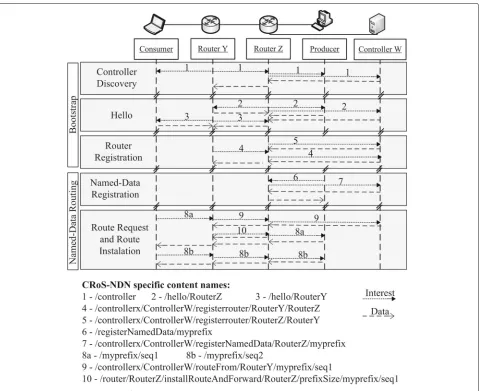
Bootstrap phase. In the Named-Data Routing phase, it performs the Named-Data Registration, Route Request, and Route Installation procedures. Figure 1 illustrates the interest and data packets sequence in CRoS-NDN. Accordingly, Hello and Controller Discovery procedures start simultaneously at the initialization. The Hello pro-cedure runs periodically. Topology changes detected by Hello, Controller Discovery data, and failure of Route Installation start the Route Registration procedure. Pro-ducers start the Named-Data Registration procedure at their access routers to register their available content. Consumers start the Route Request procedure upon FIB miss in routers. Route Request data and Route Instal-lation interests start the Route InstalInstal-lation procedure. The time expiration of interests for Controller Discovery, Route Registration, Named-Data Registration, and Route Requests from routers to controller starts the Controller Discovery procedure.
3.1 Bootstrap phase
Our scheme employs just named-data packets and does not depend on IP addresses and protocols for router and controller communications. Thus, we avoid IP issues related to multihoming and mobility. To this end, CRoS-NDN automates the discovery of router-controller paths, instead of pre-configuring routers with IP controller IP address as typically done in OpenFlow based SDN net-works. Routers flood the network to find initially the con-troller, during the Controller Discovery procedure. After-wards, the controller discovery only repeats upon no-response time expiration of router to controller interest. Furthermore, cache and interest aggregation reduce the discovery overhead. Therefore, CRoS-NDN wider broad-cast domain does not incur additional signaling overhead for controller discovery because our scheme restricts net-work interest flooding. Each router monitors its one-hop neighbors, using Hello packets, and the router registers any topology change informing router identified adjacen-cies to the controller, during Router Registration proce-dure. Routers also register in the controller the locally produced content name prefixes, using the Named-Data Registration procedure. The controller stores the received information from network routers and acquires knowl-edge of the network topology and that of content location.
3.2 Named-data routing phase
Unlike SDN-based solutions in which each router in the consumer-producer path requests a route from the con-troller, CRoS-NDN end-to-end route installation charges the controller with only one route request during Route Request procedure. The route-requesting router informs its identifier and the requested content name in the route request sent to the controller. Upon a route request, the controller identifies the requesting router and locates the content producer router. Afterwards, the controller com-putes the sequence of router identifiers in the path from consumer to producer and answers the route request. Upon the controller answer for the route-request, the router starts the Route Installation procedure, in which the requesting router uses source routing to build a spe-cific interest packet that installs the new FIB entry on each router in the path from consumer to content producer. The route-install interest name encodes the sequence of router identifiers in the calculated path. The interest packet is modified on a hop-by-hop basis by remov-ing the current hop and forwardremov-ing the new interest packet ahead. In this paper, we compute the shortest path, although the controller may also be configured to use other routing metrics, for instance, to achieve better overall quality of service [56,57].
CRoS-NDN preserves NDN id-locator split fea-ture, while existing NDN implementations employ prefix aggregation that ties together the location and
identification semantics. This feature of CRoS-NDN facilitates mobility and multihoming. The CRoS-NDN Named-Data Registration procedure provides content-copies reachability at any location. In addition, the Route-Request procedure jointly resolves the content location, determines the shortest path in hop count from consumer to each registered content copy, and chooses the path with the lowest cost. This way, content distri-bution servers store content copies and register content location in the controller. CRoS-NDN does not change the way NDN routers cache content. The CRoS-NDN Named-Data Registration procedure allows any host to register as a producer for a content prefix. Accordingly, a host registering a cached copy out of the path to producer can be closer to consumer than the original producer, which improves efficiency. An authorized host can decide to register in the controller to serve a content it has cached previously. The controller may block hosts from registering content copies and may require authorization. Host managers may apply specific policies to enforce the registration of copies for specific prefix names caching that content for longer times.
The decision of which content must be registered and when it must be registered is a policy question; each host may have its local policy. A policy, for instance, is to cache and register the content of specific producers, another example of police is to cache and register big content val-ues. The two-extreme polices are cache and register no content or all contents. When the consumer, which can be mobile, requests a content, the access router requests a route from controller. When a producer moves, a con-tent registration update is required. The old access router of the producer removes content registration upon fail-ure response for requests sent to the producer. The access router may monitor the connectivity with the directly attached producers to speed up the process. When a con-sumer moves, the new access router may need to request a new route from the controller.
Upon the next PIT expiry, the scheme removes the FIB entry. In the meantime, upon a successful data delivery for a PIT entry related to this FIB entry, the FIB entry moves to green state. This process avoids the FIB entry removal in core routers, which aggregate packets from many con-sumers for the same prefix. Consequently, the FIB entry removal moves to the edge/access router of the consumer. In addition to reducing the signaling overhead, CRoS-NDN lessens the requirement for router’s FIB memory to the scale of simultaneously consumed prefixes. It reuses FIB memory and replaces old entries with new ones. This is in contrast to supporting all content prefixes available in the network irrespectively of consumer pattern of content requests for different prefixes.
3.3 Multi-controller and multi-domain deployments CRoS-NDN extension to a multi-controller scenario for deployments in large-scale intra-domain networks can be envisioned as follows. Multiple controllers can share the named-data location storage task and each controller knows a subset of routers, henceforth called zone [58], and paths between routers in its own zone. Each controller must have the topological view of the adjacent zones, so it can calculate the next zone hop to any other zone in the network. The controllers may be organized in a dis-tributed hash table (DHT) using the hash of controller ID as the DHT node identifier, and the hash of named-data prefix as the DHT key. The DHT value is the router ID for the prefix. Key distribution in DHT nodes follows an index rule based on DHT node ID. Rendezvous hashing reduces disruption upon a controller failure or addition [59]. Furthermore, each controller stores a local copy of the information regarding its own zone to reduce sub-optimal name-based routing issues in content name to zone resolution.
CRos-NDN deployment in multi-domain scenarios can be approached in different possible ways. One approach is to employ a hierarchy of controllers with the root adminis-tered by an independent organization (similar to ICANN for DNS root servers). Each domain has autonomy on which information to announce to the root controllers. In an alternative approach, domains announce directly to each other the relevant information. The choice of approach will be dictated by the tradeoff between admin-istrative autonomy and the overhead of exchanging infor-mation directly with all domains. The evaluation of the efficiency of route request resolution for multi-domain scenarios is out of scope of this paper and will be consid-ered in a future work.
4 Performance analysis
We aim to evaluate and compare the performance of our proposal with the main routing/forwarding schemes used for NDN in the literature. In this section, we derive
mathematical expressions for the Data Delivery Efficiency (DDE) lower bound and the Data Delivery Delay (DDD) upper bound. The data delivery efficiency is the ratio of the consumer-received data packets to the number of interest packets sent on each network link. We define data delivery delay as the delay between consumer con-tent request and consumer concon-tent reception. Maximum efficiency equal to 1 and minimal delay equal to zero are only achieved when the desired content is cached on con-sumers. Otherwise, the efficiency decreases and the delay increases with the number of hops traveled to obtain the required data.
As we have mentioned before, the main NDN rout-ing/forwarding schemes are: INFORM [51], OSPF Based Routing Protocol for Named Data Networking (OSPFN) [52], Named-Data Link State Routing (NLSR) [53], and Distance-based Content Routing (DCR) protocol [54]. Unfortunately, we do not have the implementation codes of these protocols and a complete implementation of all these protocols requires unnecessary effort for our aims of performance comparison. Therefore, we implemented simplified versions of these protocols, omitting optimiza-tions and details that do not compromise the performance comparison. We add the term like to signalize our imple-mentation instead of the original proposal.
Instead of the complete implementation of INFORM, we implemented the flooding procedure used by INFORM for exploration and direct forwarding to exploit learned paths. We call this implementation ARPLike because it is similar to the Address Resolution Protocol (ARP) procedure used by IP networks. It employs a consumer-oriented approach that reacts to consumer content requests flooding the network with interests for contents that have unknown forwarding rules, i.e., when-ever the incoming interest does not match any FIB entry. Upon content response arrival,INFORMrouter updates its FIB adding a new entry with the content name prefix and directly forwards the subsequent interests with the same prefix.
We do not evaluate OSPFN because it is not a pure NDN protocol, actually, it is an implementation over IP net-work. Hence, for comparison purpose, instead of imple-menting OSPFN, we implement a proactive producer-oriented approach to announce content availability that follows Content Centric Network (CCN) original rout-ing concept [1,50]. In this approach, content-producers periodically flood the entire network with announcing prefixes carried out by interest packets. Hereafter, we call this implementationOSPFLike. A router does not monitor
prefixes. Moreover, sinceOSPFLikeand DCR consider the
same distance vector routing techniques, we concentrate our comparison on OSPFLike and we do not evaluate
specific details of DCR proposal.
As mentioned before, Named-Data Link State Routing (NLSR) is a producer-oriented approach that avoids flood-ing procedure. NLSR uses a hop-by-hop procedure for database synchronization. Each NLSR router maintains the full view of the network in a local database called Link State DataBase. We omit optimizations and details that do not compromise the performance comparison, and we call our implementation byNLSRLike.
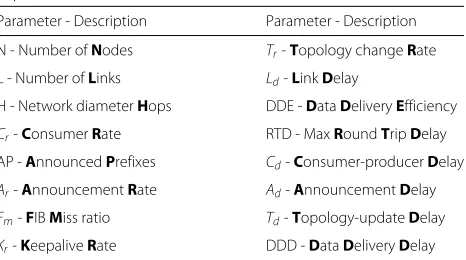
A cluster of machines runs the CRoS-NDN controller functions as a locally centralized entity. These machines share a database that stores both the named-data loca-tion and the routers adjacency informaloca-tion for a single controller. Table1presents the parameters used for deriv-ing the expressions for each scheme. Table2presents the lower bounds for data delivery efficiency of each routing scheme. The expressions consider that all network links have the sameLinkDelay,Ld, eachConsumer sends
inter-ests and receives data at a constantRate, Cr. Moreover,
we consider the worst case scenario, in which consumer to producer and also router to controller distance equals network diameterHops,H. Hence, without caching, the lower bound for the optimal efficiency equals 1/H.
In the next section, we derive expressions to discuss the limiting factors of the analyzed schemes, namelyARPLike,
OSPFLike,NLSRLike, and our own CRoS-NDN proposal.
4.1 Data delivery efficiency lower bounds 4.1.1 Address resolution protocol (ARP) like
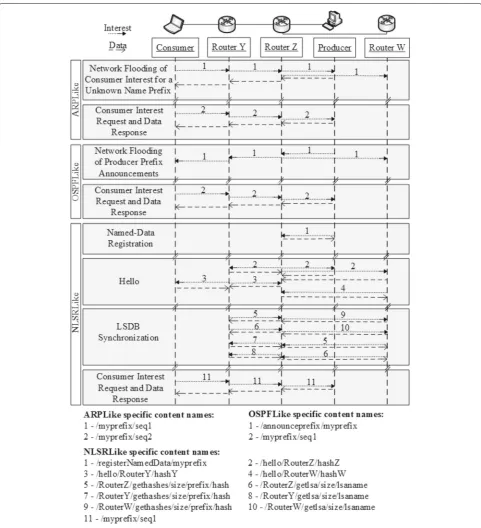
Figure2presents the interest time sequence forARPLike
procedures. InARPLike a PIT-entry timeout triggers the
removal of the associated FIB entry, as in CRoS-NDN procedure.ARPLikeefficiency depends on the fraction of
interests that hit an existing FIB entry, which is equal to the complementary probability of FIB-Miss fraction, 1 −Fm. ARPLike router straightly forwards to producer
interests with FIB hit. Otherwise, the router floods the
Table 1Parameters of the routing/forwarding scheme expressions
Parameter - Description Parameter - Description
N - Number ofNodes Tr-Topology changeRate
L - Number ofLinks Ld-LinkDelay
H - Network diameterHops DDE -DataDeliveryEfficiency
Cr-ConsumerRate RTD - MaxRoundTripDelay
AP -AnnouncedPrefixes Cd-Consumer-producerDelay
Ar-AnnouncementRate Ad-AnnouncementDelay
Fm-FIBMiss ratio Td-Topology-updateDelay
Kr-KeepaliveRate DDD -DataDeliveryDelay
Table 2Data delivery efficiency lower bound expressions
Scheme Data Delivery Efficiency (DDE)
ARPLike (Fm.L+(11−Fm)H)
OSPFLike (APCr.L(.1K−r+FCmr).H)
NLSRLike (L(2.Kr+4.Tr+5.CArr)+Cr.H(Fm+1))
CRoS−NDN Cr
(L(2.Kr+Tr)+H(N.Tr+Ar+Cr(Fm+1)))
interest on its links. The higher is the fraction of directly forwarded interests, 1−Fm, the closerARPLikeefficiency
becomes equal to 1/H, the worst case scenario without requiring flooding. The higher is the fraction of flooded interests,Fm, the lower is theARPLikeefficiency. In large
networks with restricted diameter (L >> H), if con-sumer traffic shows uncorrelated interest prefixes and router FIB has insufficient memory to support all con-tent prefixes simultaneously, then,ARPLikerouter
recur-rently floods interests and the efficiency tends to zero due to FIB entry replacement. Under router unbounded FIB-memory assumption and after enough time,ARPLike
routers store routes to all prefixes and FIB misses tend to zero, and in this case,ARPLikeefficiency tends to the
opti-mal value. Therefore, we express the lower bound of Data Delivered Efficiency byARPLike= (Fm.L+(11−Fm)H).
4.1.2 Open shortest path first (OSPF) like
Figure2presents the interest time sequence ofOSPFLike
procedures. Like our CRoS-NDN scheme, OSPFLike
routers have no knowledge of network topology, how-ever,OSPFLikeforwarding decisions follow the local view
of the received prefix announcements. If a router receives the same announcement from multiple interfaces, then, it ranks output interfaces according to hop distance to producer. Moreover, unlike CRoS-NDN,OSPFLikerouter
stores all available content prefixes simultaneously in its FIB memory. Thus, the number of interests in the network depends on the rate of consumer interests, Cr, the rate
of periodic content announcements, corresponding toKr
and the number of announced prefixes, AP. Consumer interests traverseHlinks to reach producer, expressed by Cr.Hdenominator factor.OSPFLikeperiodically floods all
announced prefixes,AP, on all network links,L, with rate Kr, given byAP.L.Krdenominator factor. The number of
content data received by the Consumer is equal to the fraction of consumer interest rate that hit a FIB entry and, thusCr.(1−Fm)is the numerator of the efficiency
expres-sion. Then, a OSPFLike lower bound of Data Delivered
Efficiency is expressed by Cr(1−Fm)
(AP.L.Kr+Cr.H). We can note that OSPFLikeefficiency decreases with the number of content
prefixes,AP, the rate of periodic prefix announcements, Kr, the number of networks links,L, the rate of consumer
Fig. 2Interest/Data sequences for studied routing/forwarding schemes
4.1.3 Named-data link state routing (NLSR) like
Figure2presents the interest sequence forNLSRLike
pro-cedures. NLSRLike employs a local database called Link
State DataBase (LSDB) that stores the network topology and the content producer locations using database entries called Link State Advertisements (LSAs). Each router computes the hash for each LSA name [53], builds a
LSDB with a prefix-LSA. Neighbor routers exchange periodic interests to identify router adjacency, verify local connectivity, and compare their LSDB hashes (Hello procedure). Each router registers its neighbors in its local LSDB with an adjacency-LSA. If LSDB hashes of two neighbor routers differ, these routers initiate the LSDB Synchronization procedure that recursively exchange the branch hashes of LSA name prefix with hash differences until the branch leaf is reached. Then, the LSA difference is updated. Each router builds the network topology and the content prefix to producer identifier map based on its local LSDB and, then, the router determines locally the output interface upon consumer interest reception. NLSRLike routers monitor their neighbors sending keep alive interests on all links, using the Hello procedure, corresponding to 2.L.Kr messages in the efficiency
denominator. The NLSR authors have defined prefix-LSA as /< router_name>/LsType.2/LsId.<ID>/< version> and adjacency-LSA as /< router_name>/LsType.1/< version>, four and three components, respectively. Each component results in an interest per link during LSDB synchro-nization to navigate from the root to the leaf of the LSDB hash tree, and one additional interest to update the new LSA, hence L(5.Ar + 4.Tr) denominator
fac-tor. Producers announce new prefixes with rate Ar and
topology changes with rate Tr. Furthermore, besides
the consumer to producer interest hops given by Cr.H,
NLSRLike FIB miss Fm takes one interest to control
plane per router in the path from consumer to pro-ducer expressed by Cr.H.Fm. Hence, an NLSRLike lower
bound of Data Delivered Efficiency is expressed by
Cr
(L(2.Kr+4.Tr+5.Ar)+Cr.H(Fm+1)).
4.1.4 Our proposal CRoS-NDN
The numerator of CRoS-NDN expression for efficiency lower bound corresponds to consumer received content rate and equals consumer interest request rate, Cr. The
denominator is composed of: i) 2.L.Kr factor that
corre-sponds to the Hello interests for router-neighbor moni-toring; ii)Tr.Lfactor that corresponds to Controller
Dis-covery procedure when controller-disDis-covery interests are flooded after each topology change; iii)H.N.Trthat
cor-responds to the Router-Registration procedure, when all nodes register in controller after each topology change; iv)H.Ar that corresponds to the Named-Data
Registra-tion procedure, when producers register available con-tent prefixes at the controller with Ar rate; v) H.Cr.Fm
that corresponds to the Route Request procedure when consumer sends to controller a route request upon con-sumer interest FIB miss; and vi) H.Cr that corresponds
to consumer to producer interests. A lower bound for Data Delivery Efficiency of our proposal CRoS-NDN is
Cr
(L(2.Kr+Tr)+H(N.Tr+Ar+Cr(Fm+1))).
4.2 Data delivery delay upper bounds
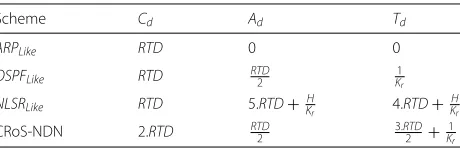
Data delivery delay (DDD) is another important perfor-mance indicator that corresponds to the delay between consumer content request and consumer content recep-tion.DDD, see Table3, sums three delay components:Cd
- delay between consumer interest dispatch and content reception;Ad- delay between producer announcement of
content prefix and network wide reach; and Td - delay
between a topology change and network forwarding rules convergence. In the worst case, the routing scheme con-verges upon any topology change addingTd, afterwards
producer can announce its content (Ad), and, finally,
con-sumer can ask for and receive the content (Cd). Not all
schemes, however, pass through these three phases and, consequently, someDDDcomponents equal zero in some cases. The maximum RoundTripDelay, RTD, between any pair of routers equals the diameter delay RTD = 2.H.Ld. In the scenario without caching, the optimalDDD
equalsRTD.
The Cd component considers the round trip delay
between consumer and producer for all schemes, except CRoS-NDN. In the worst case, CRoS-NDN consumer first asks the controller a new route to content producer, in which case this additional procedure adds the round trip delay between consumer and controller.
TheAdcomponent affects only the schemes where the
producer proa-ctively announces content prefixes and, therefore, forARPLikeAdequals zero.OSPFLikeand
CRoS-NDN prefix announcement adds toAd the one way pro-ducer to consumer delay and the one way propro-ducer to controller delay, respectively. NLSRLike prefix
announce-ment requires database synchronization. For each hop in the path from producer to consumer,NLSRLikeadds toAd
the LSDB hash exchange interval K1
r and the prefix-LSA
exchange delay. Prefix-LSA exchange requires five request and response sequential iterations and, then, sums the delay 5.RTD. Four iterations are required to exchange the branch hashes of the four components of LSA name and one additional iteration to exchange the LSA.
The Td component only affects schemes in which
routers monitor network topology changes.ARPLikedoes
not monitor topology changes and, consequently, Td
equals zero. Although OSPFLike routers do not monitor
topology, prefix-announcement periodic interval delays
Table 3Upper bound expressions for Data Delivery Delay (DDD) components
Scheme Cd Ad Td
ARPLike RTD 0 0
OSPFLike RTD RTD2 K1r
NLSRLike RTD 5.RTD+KHr 4.RTD+
H Kr
CRoS-NDN 2.RTD RTD2 3.RTD2 +K1
new paths convergence and adds K1
r to Td. NLSRLike
routers update their local LSDB with a new adjacency-LSA upon local topology change. The LSDB synchroniza-tion for adjacency-LSA is one iterasynchroniza-tion faster than for prefix-LSA, because adjacency-LSA name has three com-ponents, one less than prefix-LSA. CRoS-NDN router periodically monitors connectivity to its neighbors at intervalK1
r adding this value toTd. Additionally, topology
changes can incur changes in path from router to con-troller. In this case, CRoS-NDN router needs to discover a new path to the controller and re-register itself at the con-troller. Controller discovery adds the router to controller round trip delay and registration renewal adds another router to controller one-way delay toTd.
All simulation results obtained for Data Delivery Effi-ciency (DDE) are greater than the lower bound and all Data Delivery Delay (DDD) results are lower than the upper bound, validating the derived expressions.
4.3 Discussion
We observe that the higher is the number of announced prefixes (AP), the better is CRoS-NDN and NLSRLike
efficiency, whileOSPFLikebehavior is the contrary. CRoS-NDN and NLSRLike only announce new prefixes with rateArwhileOSPFLikeperiodically re-announces all
pre-fixes (AP) with keep alive rate (Kr). On the other hand,
thisOSPFLikecomparative disadvantage reduces with the
growth of topology change rate (Tr) because OSPFLike
routers do not monitor topology changes and, thus, it does not account for the topology change rate (Tr). CRoS-NDN
shows a better efficiency thanNLSRLikefor scenarios with
high number of prefix announcements. The CRoS-NDN efficiency decrease is proportional to the prefix announce-ment rate and to the network diameter in number of hops H.Ar, while NLSRLikeefficiency decrease is proportional
to prefix announcement rate and to the number of net-work links L.Ar. We can also observe that the higher is
the rate of interests for prefixes not installed in FIBCr.Fm,
the better is CRoS-NDN efficiency compared toARPLike. ARPLikefloods interests without FIB hit and the efficiency
decreases proportionally to the number of linksL.Cr.Fm.
UnlikeARPLike, CRoS-NDN efficiency decreases
propor-tionally to network diameter in number of hopsH.Ar+
H.Cr.Fm,H.Ar interest hops for the producer to register
the content at the controller andH.Cr.Fminterest hops for
the consumer to request new routes from the controller. In addition,OSPFLikeefficiency also decreases as FIB miss,
Cr.Fm, increases.
Concerning Data Delivery Delay DDD, the lower is the keep-alive rate,Kr, the greater isDDDforOSPFLike,
NLSRLike, and CRoS-NDN strategies. Particularly, for
1
Kr >> Ld, Ld factor becomes negligible. Then,ARPLike
delay tends to 0, OSPFLike delay tends to K1r, NLSRLike
delay tends to KH
r, and CRoS-NDN delay tends to 1
Kr.
Albeit smaller Kr value reduces signaling overhead, it
increasesDDDforOSPFLike, CRoS-NDN, and NLSRLike.
We simulated different scenarios and the obtained results stay under the bound values, validating the mathematical expressions.
5 Numerical results
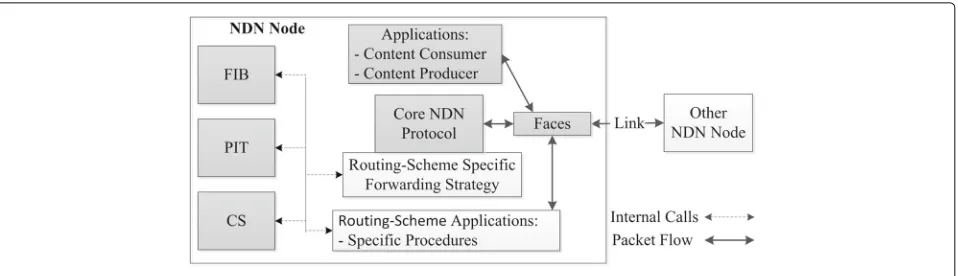
We implemented the NDN schemes in the ndnSIM [60] simulator that reproduces the NDN model with a cus-tomizable forwarding layer, which exposes cuscus-tomizable decisions on packet forwarding events. Accordingly, in our simulations, each scheme employs a specific for-warding strategy and specific applications to execute its procedures. Our results are for one controller randomly locate. Figure3shows the block diagram of our NDN node implementation on ndnSIM. We implemented2two node
modules to manipulate FIB and PIT entries based on data names: one executes specific forwarding strategy for each scheme and the other consumes/produces specific data packets related to each routing scheme. The two modules use internal calls to manipulate FIB, PIT, CS, and other state information.
The simulation data presents mean results with 95% confidence interval, and individual consumers perceive different values depending on its position in the network. Mean and maximum errors are specified or graphically represented for the sake of clarity. In each simulation round, controller position, consumers, and producers are randomly chosen. In addition, like other works [6, 61], the simulations employ ISP-like topologies based on the largest connected component of Rocketfuel’s topologies, a mapping technique that measures real router-level ISP topologies. Our simulations consider link bandwidth, link delay, queuing under congestion, packet drop under queue overflow, and zero switch delay values provided by the Rocketfuel’s topologies. When contrary is not stated, we use the AS 1755 topology with 163 nodes and 366 links. It is worth noting that the network mean distance is 7.36 hops, the diameter is 22 hops, and the respective refer-ence values for the data delivery efficiency are DDE = 1/7.36=0.14 for the mean case, andDDE=1/H =0.05 for the worst case. We choose the AS 1755 as the main topology because it presents a high number of links in comparison with diameter,L>>H, to stress the flooding negative effect on efficiency. Furthermore, the keep-alive rate valueKr is set to 0.1 for theOSPFLikeperiodic prefix
announcement, like in OSPF, and for theNLSRLike
/CRoS-NDN Hello procedure, like in NLSR [53]. We use equal Kr = 0.1 values in order to ensure a fair comparison and
we point that higher (lower)Krvalues decrease (increase)
the efficiency and increase (decrease) the data delivery
Fig. 3Customized ndnSIM node for all routing/forwarding schemes
delay for these three schemes; however, differentKrvalues
do not change the comparative behavior of the schemes with the increase in the number of prefixes. More impor-tantly, we set values for simulation parameters in order to exhibit specific comparative results that would be other-wise obfuscated. We would like to emphasize the purpose of these parameter values is to make explicit individ-ual limitation factors of each scheme and that all results consider the signaling overhead of each scheme.
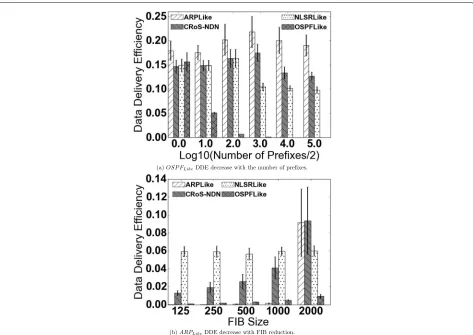
5.1 Number of prefixes increase for a restricted FIB size In the first set of simulations, we evaluate the perfor-mance behavior of Data Delivery Efficiency when the number of prefixes3 increases by five orders of
magni-tude, from 2 to 200,000, for a restricted FIB size. Figure4a shows thatOSPFLike does not scale well when the num-ber of prefixes increases, even when considering router with unlimited FIB memory, because it has to periodically announce all available prefixes.OSPFLikedata delivery
effi-ciency sharply decreases from 0.15 to zero. It is worth noting that smallerKr values reduce the factor by which
OSPFLike efficiency decreases with the number of
pre-fixes, but it does not change the trend. On the other hand, ARPLike,NLSRLike, and CRoS-NDN efficiency shows little
variation when the number of prefixes increase, because these schemes avoid the periodic network flooding. We note that the producer announces 20 new prefixes per second and, therefore, for a higher number of prefixes, CRoS-NDN andNLSRLikeefficiency decreases due to
pre-fix announcements running at the end of the simulated time of 500 s. The simulation considers two consumers and each one requests sequential data for one distinct prefix with rate of 40 interests per second.
Figure4b shows the Data Delivery Efficiency for con-strained FIB memory. The results illustrate howARPLike
does not scale well with the increase of the number of
3Consumed prefixesrefer to prefixes of content requested by consumers and announced prefixes, or simplyprefixes, refer to prefixes of content available at producers.
consumed prefixes beyond the FIB memory capacity. The simulation involves 2000 simultaneously consumed pre-fixes, each one with 1 interest per second, 2000 announced prefixes, and a growing number of FIB entries supported per router. We choose a number of announced pre-fixes that avoidsOSPFLikesharp efficiency decrease, while
showing the effect of FIB memory restriction. Under FIB memory restriction, all schemes replace the oldest installed entries with new ones according to a in first-out policy.ARPLikeefficiency suffers a lot from each FIB
entry removal because it recurrently floods the network and, thus, the efficiency decreases proportionally to the number of network links. UnlikeARPLike, no other scheme
floods consumer interests upon FIB miss.NLSRLike effi-ciency shows very little variation in the number of sup-ported FIB entries per router because NLSRLike router
relies on its local control plane to reinstall the forward-ing rules in the FIB. OSPFLike efficiency decreases due
to the lack of memory for part of the prefixes, namely from 0.01 to 0.001 when the FIB memory reduces from 2000 to 125 entries. CRoS-NDN efficiency also reduces from 0.09 to 0.01, due to two combined factors: first, the additional hop distance from consumer to controller for route requests, and second, additional interests due to the early removal of FIB and PIT entries following FIB entry replacement. It is worth noticing that CRoS-NDN and OSPFlike exhibit the best efficiency improvement as func-tion of FIB size, but CRoS-NDN outperforms OSPFlike by a factor of 10. This indicates that as routers memory size increases, CRoS-NDN efficiency will follow accordingly.
Fig. 4Data delivery efficiency as function of:anumber of announced prefixes for unlimited FIB memory andbFIB sizes for 2000 simultaneously consumed prefixes
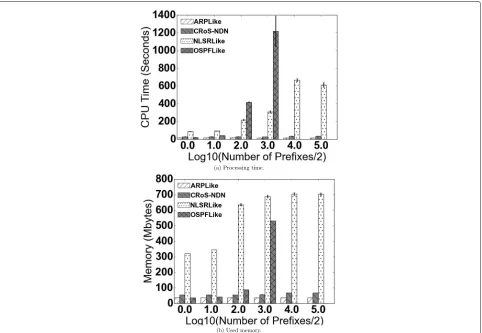
and OSPFLike show the highest resource consumption.
OSPFLike simulation did not finish in a reasonable time
for our hardware resources with more than 2000 prefixes. We note that controller and router-processing capacity is unlimited in our simulations, but memory capacity is restricted. CRoS-NDN shows less memory and time sim-ulation requirements than OSPFLike and NLSRLike, and
similar requirements toARPLikefor a growing number of
prefixes.
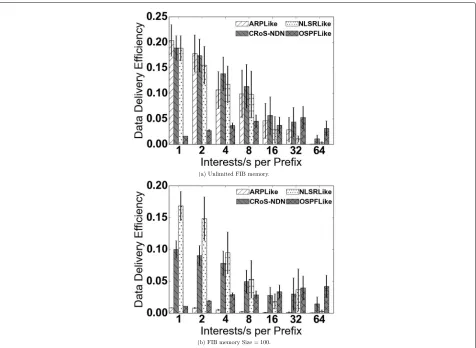
In order to evaluate the robustness of our proposal compared to the other schemes, we consider a scenario of FIB restriction in which memory size is less than the number of 150 consumed prefixes. Figure 6 shows the Data Delivery Efficiency for a growing rate of con-sumer interests per prefix. The efficiency decreases due to congestion caused by the excessive number of requests, which is above link capacity. The results confirm OSPFLike low efficiency for a number of
pre-fixes as low as 150. Additionally, Figure 6b shows an ARPLike low efficiency due to a FIB memory smaller than required for the number of simultaneously requested prefixes.
5.2 Content-producer mobility
Fig. 5Processing time and memory consumption for each simulation round.aProcessing time.bUsed memory
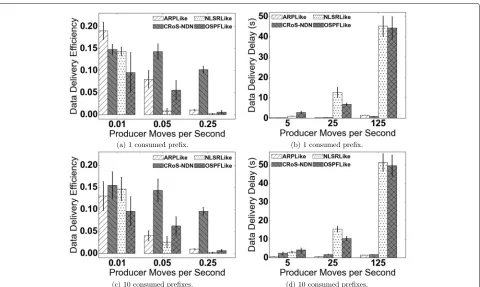
content that moved.ARPLikeincreases the interest
flood-ing,NLSRLikeincreases the signaling announcements, and
OSPFLike increases the failed requests. DDD increases
more sharply when mobility rate is too high above theKr
rate set to 0.1.Krrelates to the rate of Hello messages for
CRoS-NDN/NLSRLikeand to the rate of prefix
announce-ments forOSPFLike. Proactive schemesOSPFLike/NLSRLike
are more sensitive to mobility in DDD metric than reactive schemes CRoS-NDN/ARPLike. Unlike the DDE decrease
forARPLike , the growth of consumer-interest rate with
the number of prefixes does not decrease OSPFLike and NLSRLikeDDE. On the other hand, CRoS-NDN presents the best results with fast convergence and low over-head for producer location update, which corresponds to the best protocol for scenarios with content-producer mobility.
5.3 CRoS-NDN resiliency
We intuitively expect a fast convergence of our proposal at start up and after link failures. In the third set of experiments, we evaluate the resiliency characteristic of our proposal. The delay between the network events,
start up or link failure, and the convergence to con-sumer request fulfillment give an indirect measure of the data delivery delay (DDD) metric that equals the sum of delays to announce prefixes, install routes, and receive data.
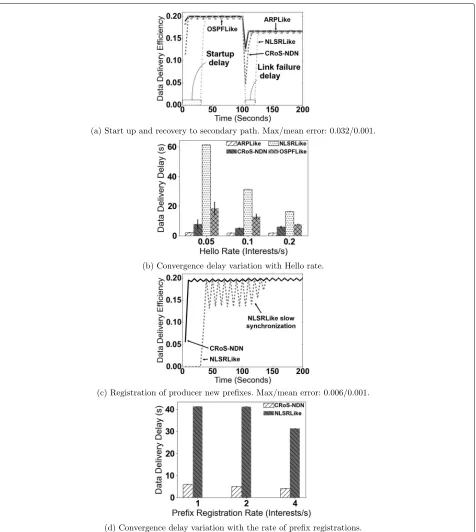
CRoS-NDN presents a faster convergence delay because it only depends on, first, the delay of routers to update their local information at the controller and, second, the delay of routers to receive new routes from the controller. Figure 8a shows the convergence delay at start up and at the recovery from a link failure to a secondary longer path. The slow convergence of NLSRLike is due to the hop-by-hop delay of database synchronization procedure, while the set up convergence takes even longer due to the great number of differences among the databases routers. ARPLikeandOSPFLike schemes, both of them, show
sim-ilar and small delay values becauseARPLikeimmediately
floods interests for unknown prefixes andOSPFLike
Fig. 6Data delivery efficiency as a function of consumer-interests per prefix rate for:aunlimited FIB size andbFIB size=100
direct measures for Data Delivery Delay,DDD, consider-ing a variation of the Hello rateKr. As expected from our analysis,NSLRLikedelay decrease is higher when the Hello
rate is increased.
CRoS-NDN shows a fast propagation of new rout-ing information when compared withNLSRLike, as
illus-trates Figure 8c. The producer announces one new prefix per second in the initial 100 s. The pre-fix announcement reduces NLSRLike efficiency due to the database synchronization packets and, additionally, NLSRLike shows a higher convergence delay. Figure 8d
shows direct measures of Data Delivery Delay, DDD, considering different rates for the registration of new prefixes.
NLSRLikeperformance can be improved through direct
flooding of new LSAs on the network, this way avoid-ing the slow convergence of the LSDB Synchroniza-tion procedure for new LSAs. UnlikeOSPFLike,NLSRLike
avoids the need to recurrently flood content pre-fixes because NLSRLike routers synchronize their local
LSDB databases, which avoids a similar OSPFLike
effi-ciency decrease with the number of prefixes. On the
other hand, the number of routers and the number of contents impose serious scalability limitations in terms of the amount of storage and processing power that each NLSRLike router must individually support,
because eachNLSRLike router must store locally the
lat-est version of each LSA-adjacency and LSA-prefix in its LSDB.
5.4 Content delivery network (CDN) support
We evaluate CRoS-NDN efficiency when providing CDN functionalities over NDN. In particular, we evaluate the impact on global efficiency and delay of consumers regis-tering cached copies of popular content. We restrict this evaluation to CRoS-NDN becauseNLSRLikeandOSPFLike
do not reach content copies outside the path to pro-ducer without additional prefix announcements which would cause an overhead too high, and ARPLike does
Fig. 7Producer mobility impact on efficiency and delay.a1 consumed prefix.b1 consumed prefix.c10 consumed prefixes.d10 consumed prefixes
Each consumer requests the same content sequence for 20 s and stops. A new consumer starts at every 20 s. In the scenario with consumer registration of content copies, when the consumer stops, it informs the con-troller about content it cached by registering the names of these content items. Therefore, the controller has a new content copy location to consider when serving a route to the next route request. In this experiment, routers also cache content copies, but they do not register in the controller the content they have cached. Therefore, only routers that are in the path to registered copies have cache hits.
The efficiency gain and the delay reduction with the consumer registration of content copies depends on the cache capacity of the router and on the amount of requested data. When routers have higher caching capac-ity than the requested data, registering content copies has no advantage. Otherwise, when routers have smaller caching capacity than the requested data, registering con-tent copies has a measurable efficiency gain and delay reduction. When routers have a small size capacity, the higher the consumer interest rate, the higher the number of requested content items and the higher the efficiency improvement. Figure 9a and b compare the mean delay perceived by all consumers for rates of 20 and 100 interests
per second, respectively. Figure 9c and d show the effi-ciency for the 25th consumer in the same simulation. Additionally, the efficiency increases with the consumer rate because the Hello rate is fixed at 0.1 interests per second.
Figure 10shows the improvement of the CRoS-NDN efficiency with registration of content copies stored on consumers when compared with no-copy registra-tion, when router cache size is insufficient for the requested data. Figure 10a shows that the highest effi-ciency gain occurs for the highest consumer rate (200) and a small cache size with 10 entries. Figure 10b shows no gain for consumer rate of 200 interests per second and a large cache size with 100,000 entries. Figures 10c and d show equivalent results in different topologies for cache sizes of 10 and 100,000 entries, respectively.
Announcing content copies location allows consumers to reach a closer copy that is outside the path to the producer. CRoS-NDN shows a low overhead for the reg-istration of content copies location. This is in contrast to OSPFLikeandNLSRLikethat show poor performance when
Fig. 8 aEfficiency behavior at start up and after a link failure.bDDDvariation with the Hello rateKr.cCRoS-NDN andNLSRLikeconvergence delay for a producer registering 100 new prefixes at 1 registration/s.dDDDvariation with the registration rate
not effective. We believe that the registration of content copies location is a potential solution for CDN over NDN. A router can proxy interest for specific prefixes and cache the respective data closer to potential consumers for longer time windows.
Fig. 9Consumer registration of content copies impact on efficiency and delay.aConsumer rate 20.bConsumer rate 100.cConsumer rate 20.dConsumer rate 100
et al. for the YouTube case [63]. We restrict this evaluation to CRoS-NDN because our computational resources can-not handle the NLSRLike and OSPFLike implementations
for these scenarios. We consider constrained FIB mem-ory, a growing rate of consumer interests, and short/long tail for the popularity distribution of content prefixes. We found that the efficiency decreases when the tail of the prefix popularity distribution increases and, at the same time, there is insufficient memory for most of the available prefixes. The efficiency decreases for three reasons. First, the higher rate of route requests to the controller halves the efficiency with one route request per consumer inter-est in the worst case. Second, an intrinsic characteristic of ndnSIM simulator erases PIT entries on removal of corre-sponding FIB entry resulting in additional repeated inter-ests from consumer for unanswered requinter-ests. Third, link congestion at higher consumer rates affects the controller-access link and causes additional interest retransmission in the worst case.
The longer is the tail of the prefix popularity distri-bution, i.e. lower α parameter of the Zipf distribution, the higher are both the rate of FIB misses and the rate of route requests to controller when the FIB memory is insufficient for all content prefixes. Therefore, the effi-ciency decreases. We choose the number of prefixes (3000), the FIB size (100, 1000, and 3000 entries), and the α values (0.7 and 1.4) in order to highlight this behavior. Figure 11a shows the efficiency with a single consumer and a growing rate of consumer interests per second. Figure 11b shows the efficiency with a growing number of consumers, each consumer with a fixed rate of 50 interests per second. Figure 11c and d show the rate of route requests received by the controller for sin-gle consumer and multiple consumers scenarios, respec-tively. The higher rate of consumer interests causes higher rates of route requests. Furthermore, a higher number of consumers with the same prefix popularity distribution causes an aggregated prefix popularity distribution with longer tail, and, therefore, decreases the efficiency due to a high rate of route requests. The aggregated rate of con-sumer interests is equal in Fig.11a, b, c and d. In addition, for small FIB size (100) and high rate of route requests, the FIB entry time in memory is lower than the round trip time and, thus, the early removal of a FIB entry and the associated PIT entries reduce the efficiency because of repeated route requests for the same prefix. For the sake of clarity, we omitted FIB size=3000 withα = 1.4 and FIB size=1000 with α = 1.4 curves to focus on worst cases.
Figure12shows CRoS-NDN scalability and efficiency for 3 orders of magnitude ratios of number of prefixes to FIB size. The results consider 4 orders of magnitude increase in the FIB size. In this scenario, a single con-sumer requests content with 100 interests per second.
The higher is the number of prefixes to FIB size ratio and higher is the Zipf α parameter, the lower is the efficiency. It is worth mentioning that the higher is the number of prefixes, the lower is the ratio of requested prefixes to all prefixes considering a fixed time window and a fixed rate of consumer interests. As such, the effi-ciency decreases (stabilizes) forα = 0.7 (α = 1.4) with higher number of prefixes due to the limited simulation time.
Figures 11and 12also point to CRoS-NDN potential bottleneck at the controller access link. The rate of route requests increases when there is insufficient FIB memory for most of the solicited prefixes due to the long tail of pre-fix popularity distribution at core routers. In this scenario, the controller access link congests and causes interests retransmissions. The additional interests further reduce the efficiency.
6 The CRoS-NDN tunnel extension
As discussed above, an insufficient FIB memory for most of the solicited prefixes and the long tail of prefix pop-ularity distribution at core routers increase the amount of FIB misses leading to a higher route request rate, and therefore decreases the performance. The increase of route requests causes congestion of the controller access link and, consequently, the number of required interest retransmissions increases. To mitigate this, we propose the CRoS-NDN Tunnel Extension, a tunneling approach [32], which reduces the FIB memory require-ment at core routers because the number of prefixes employed to identify the destination network segments [64] is much less than the number of content pre-fixes. The modified Route Installation procedure installs a route to network segments, and consumer access-router adds the identifier of the producer network segment as a prefix in interest names. Routers in the destina-tion segment remove this prefix and forward the interest to producer. Access-routers manipulate the data pack-ets names according to the backward direction to con-sumer. We present in this section the simulation results for the simplified case in which a segment identifies a single router that provides the worst prefix aggregation result.
Fig. 11CRoS-NDN data-delivery efficiency as function of consumer interests.banddconsider multiple consumers and a fixed rate of 50 interest/s per consumer.aSingle consumer. Max/mean error: 0.029/0.021.bMultiple consumers. Max/mean error: 0.025/0.018.cRoute requests received by the controller for single consumer. Max/mean error: 25/8.dRoute requests received by the controller for multiple consumers. Max/mean error: 69/16
efficiency. The data-delivery efficiency for CRoS-NDN Tunnel Extension, which curves are indicated by the suffix TE, is higher than 0.08 compared to 0.02 for CRoS-NDN. Figure13b shows a rate of route requests for CRoS-NDN Tunnel Extension lower than 70 compared to 900 for CRoS-NDN.
7 Conclusion
Fig. 13 aData delivery efficiency andbRoute request rate for CRoS-NDN and CRoS-NDN Tunnel Extension (TE) as function of number of consumers. The simulation employs a rate of 50 interests/s per consumer.
Routing phase. The controller stores the content names, calculates routes from the consumer to the producer, and leverages global view of the network in order to avoid unnecessary control messaging overhead. More-over, our scheme does not rely on prefix aggregation, enabling content placement/caching at in any loca-tion. This flexibility allows content copies placement closer to consumers, decreasing delivery latency and improving content mobility efficiency, analogous to CDN behavior. We derived lower-bound expressions for the efficiency and upper-bound expressions for the content delivery delay of our proposal and other known routing/forwarding schemes for NDN. Furthermore, we evaluated and compared these schemes using simulations.
The analysis and the simulation results show that CRoS-NDN presents superior performance compared to other schemes in terms of data delivery efficiency, robustness to FIB memory limitation, efficiency in han-dling producer mobility, and resiliency to link failure. Moreover, the results show that CRoS-NDN requires
low processing time and low memory, and the data-delivery efficiency increases when consumer registers in the controller that data is cached. In order to mitigate a potential bottleneck at the access link to the con-troller, we proposed and evaluated the CRoS-NDN Tun-nel Extension. The results show that the latter reduces the route requests to controller under FIB memory restriction.
For future work, we plan to evaluate the Afanasyev et al. proposal [28] combined with our CRoS-NDN scheme to avoid changes of content names introduced by the tunnel extension. In order to develop and evaluate our proposal in a real network environment with multiple controllers, we also plan to deploy our scheme in the Future Internet Testbed with Security (FITS) [65], employing the soft-ware distribution developed by Project CCNx (Content Centric Networking) and the Named-Data Networking Forwarding Daemon (NFD) distribution.
Abbreviations