DOI 10.1007/s13173-010-0022-2 O R I G I N A L PA P E R
A UPnP extension for enabling user authentication
and authorization in pervasive systems
Thiago Sales·Leandro Sales·Hyggo Almeida· Angelo Perkusich
Received: 6 April 2010 / Accepted: 14 September 2010 / Published online: 7 October 2010 © The Brazilian Computer Society 2010
Abstract The Universal Plug and Play (UPnP) specifica-tion defines a set of protocols for promoting pervasive net-work connectivity of computers and intelligent devices or appliances. Nowadays, the UPnP technology is becoming popular due to its robustness to connect devices and the large number of developed applications. One of the major drawbacks of UPnP is the lack of user authentication and authorization mechanisms. Thus, control points, those de-vices acting as clients on behalf of a user, and UPnP dede-vices cannot communicate based on user information. This pa-per introduces an extension of the UPnP specification called UPnP-UP, which allows user authentication and authoriza-tion mechanisms for UPnP devices and applicaauthoriza-tions. These mechanisms provide the basis to develop customized and se-cure UPnP pervasive services, maintaining backward com-patibility with previous versions of UPnP.
Keywords Pervasive computing·Universal Plug and Play·Authentication and authorization
T. Sales (
)·H. Almeida·A. PerkusichFederal University of Campina Grande, Aprigio Veloso Street, Campina Grande, Brazil
e-mail:[email protected]
H. Almeida
e-mail:[email protected]
A. Perkusich
e-mail:[email protected]
L. Sales
Federal University of Alagoas, Lourival Melo Mota Avenue, Maceió, Brazil
e-mail:[email protected]
1 Introduction
In recent years, the wide dissemination of mobile devices with wireless technologies has allowed the conception of pervasive computing solutions [2]. Technologies like Blue-tooth, Wi-Fi, and 3G allow people to migrate their tasks from desktop-based platforms to mobile ones, accessing ser-vices and information anytime, anywhere. The concept of pervasive computing is becoming practical, with computing systems more and more integrated in people’s daily lives, seamlessly interacting with devices and users in the envi-ronment [1].
Due to its robustness and still simple networking archi-tecture, the Universal Plug and Play (UPnP) technology [3] is a promising solution to provide pervasive services for a new generation of electronic devices. A UPnP network is a collection of interconnected computers, network appliances, and consumer electronic devices that use standard protocols to discover, advertise, and access network services. The goal is to provide an easy-to-use framework for creating tools to support the communication of network-based devices. UPnP supports communication between devices such ascell phones andinternet tablets, and conventional peripherals, such as printers and wireless household electronic gadgets for controlling appliances, lights, doors, and curtains.
Transmission Control Protocol (TCP) and User Datagram Protocol (UDP) stacks. In this way, besides supporting com-munication between consumer electronics devices, UPnP enables Internet-based services.
As a widely available and easy-to-implement stack of protocols, UPnP has been used in many open-source and proprietary projects available on the Internet. One worth-citing project is BRisa,1a UPnP framework implemented in Python, C++, and Java, developed by the Embedded System and Pervasive Computing Laboratory at UFCG, Brazil.
Despite the strong popularity and growth of manufac-tured UPnP-compatible devices, UPnP does not provide a standard for user authentication and authorization mech-anisms, limiting the development of customized and se-cure applications. Examples of these applications include: recommendation systems [8]; customized adjustment of environment appliances, such as fuzzy light level or air-conditioner temperature; and rule-based access control for UPnP devices, such as printers; among others. For these ap-plications, it is mandatory to identify the user and his pref-erences. By supporting these requirements, UPnP solutions would provide customized and secure UPnP services.
This paper introduces UPnP-UP (Universal Plug and Play—User Profile), an extension of the UPnP technology that enables user authentication and authorization for UPnP devices and applications, providing the basis to develop cus-tomized and secure UPnP services. Basically, the UPnP-UP extension provides a seamless connectivity model for man-aging user profiles to customize UPnP services and allowing access control to UPnP appliances based on user profile. As a consequence, future UPnP solutions can provide different behaviors by collecting user profiles and acting proactively. Moreover, UPnP-UP has been designed to modify the cur-rent UPnP specification as little as possible, still providing backward compatibility with the UPnP core stack.
After presenting some features of UPnP in Sect.2, some related works are discussed in Sect.3. Sections4and5 de-tail the specification of UPnP-UP and two case studies, re-spectively. Section6discusses the results of this work. Sec-tion7 describes the current and future work, while Sect.8 concludes by summarizing the major topics covered in this research.
2 Technology overview
This section presents an overview of the main technologies and concepts involved in the development of the UPnP-UP solution.
1http://brisa.garage.maemo.org/.
2.1 Universal Plug and Play (UPnP)
The UPnP protocol is defined as a set of different steps [3]. First, after attaching an IP address, a control point searches for available UPnP devices during the discovery mechanism (Step 1). After finding the available devices, the control point can use the description process (Step 2) to learn about the devices’ capabilities. In order to execute services from devices, the control point uses the control phase (Step 3) through the SOAP protocol. In the event process (Step 4), the control point keeps listening to state changes of hooked up devices, updating the graphical user interface accordingly in the presentation process (Step 5).
To discover UPnP devices, a control point sends a mul-ticast SSDP-based request message to a standard mulmul-ticast address and port. In addition, a control point may unicast a discovery message to a specific IP address on port 1900 (Listing1). When a new UPnP device is added to the net-work, it sends multicast messages to a standard address and port (Listing2) for each embedded device and service.
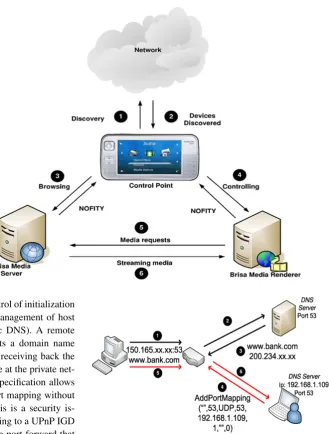
UPnP A/V [8] is the UPnP specification for audio and video, which is illustrated in Fig. 1. The control point browses multimedia items from a media server (Step 3) and these items can be rendered in the Media Renderer (Steps 5 and 6). This specification is focused on the UPnP tech-nology dedicated to distributing and executing digital con-tent (music, videos, and images) through the network. Some solid solutions that implement the UPnP A/V specification worth mentioning are BRisa [9] andGoogle Media Server, announced by Google for sharing local multimedia items among users.
Despite offering zero configuration and a flexible way of connectivity, the UPnP does not provide user authentication and authorization mechanisms. These requirements would allow customized UPnP applications by collecting user pref-erences and information from the environment. For instance, consider an application for recommending multimedia con-tents based on user preferences, such as music genresrock andblues.
Moreover, since the basic idea for UPnP is to support an open networking architecture, UPnP services do not cope with the user properties when accessing them. For exam-ple, there is no way tograntordenyaccess to a UPnP ser-vice based on user attributes and information from the en-vironment. A simple scenario is a UPnP Printer device that provides theCreateJob service for printing. In the current UPnP specification, anyone with access to the control point can request theCreateJobservice as many times as desired, without user authentication or authorization.
Listing 1 UPnP discovery message based on SSDP
Listing 2 Notify device and services through the SSDP NOTIFY message
Fig. 1 Basic communication scheme for UPnP A/V devices
status and events on connections, (2) control of initialization and tear drop of connections, and (3) management of host configuration services (DHCP, Dynamic DNS). A remote user, from an external network, requests a domain name translation forwww.bank.com(Step 1), receiving back the IP address from the DNS server available at the private net-work (Step 2). However, a UPnP IGD specification allows a user on the local LAN to request a port mapping without user authentication or authorization. This is a security is-sue. An attacker can request a port mapping to a UPnP IGD service, calledaddPortMapping, to add a port forward that redirects all the DNS traffic to a malicious DNS server. For example, a user requests a port mapping for port 53 (Step 4) to redirect to the IP192.168.1.109. As a result, all external subsequent requests to port 53 (Step 5) will be forwarded
Fig. 2 UPnP IGD attack
Nowadays many network administrators disable the UPnP support of the UPnP IGD devices. Nevertheless, by providing a port mapping with theaddPortMappingservice, a UPnP device behind IGD can enable Nat Traversal, al-lowing external applications to establish a connection with it.
The aforementioned scenarios can also be extended to other UPnP application domains. For example, intelligent appliances for home automation (IAHA) aims at connecting devices around residential environments, providing a way to control lights, curtains, air-conditioner, TVs, doors, etc. Due to the absence of an access control mechanism for pro-tecting resources in the UPnP network and the lack of user information to recognize each of them in the environment, these devices are unable to protect or provide customized behavior, allowing anyone to freely access them.
Mechanisms for authentication and authorization must be addressed to guarantee medium or high level security on the pervasive applications, due to the heterogeneity of de-vices, serde-vices, and users in pervasive environments. Re-cent advances in pervasive computing have brought new solutions which use UPnP as the technology for discover-ing devices and services. Nevertheless, such solutions use non-standard mechanisms for device and user authentica-tion and authorizaauthentica-tion processes. Since UPnP defines several standards (calledUPnP profiles) for devices and services, it would be important to provide a specification and an archi-tecture that leverage UPnP-based technologies for authen-tication and authorization to UPnP services, allowing better device-to-device interoperability in a scalable networked en-vironment.
2.2 Authentication and authorization in pervasive environments
In computer security, access control includes, among other features, the authentication and the authorization mecha-nisms. Identification and authentication are the processes of checking something (or someone) as authentic. In short, authentication is the basic building block of security. In the electronic world, the authentication of an entity can be processed by using shared secrets (including passwords), public key cryptography schemes, biometrics, and so forth. User identification and authentication in pervasive environ-ments are also important due to the range of devices and services to which users have access. Currently, many so-lutions use IP addressing identification and authentication, which are not enough in pervasive computing. This model works well for traditional deskbound personal computers, where the user usually works with a static IP address in the same machine. On the other hand, in a pervasive comput-ing environment, users have different devices and connect to different networks.
An authorization process can be seen as the mechanism to allow or deny an access to a set of available resources of a computational entity (calledobjects). If asubject(a user, a device, etc.) tries to get access to these resources, they will be allowed if they have some degrees of permissions. Ac-cess control models can be divided into two classes: those based on thecapabilityand those based on anaccess con-trol list(ACL). The former is a non-falsifiable reference (or capability) that a subject gains from an object to access it, which is analogous to having a password for a physical safe. The ACL-based access control allows a subject to gain ac-cess to an object if its identity is on a list associated with the object. The access control in pervasive computing should also take into account the context of the objects in the en-vironment, such as current time and user activities. These requirements bring new challenges into the computer se-curity domain due to the high heterogeneity of such ob-jects.
Computers are increasingly entering our environments, ubiquitously embedded into devices and appliances avail-able in people’s everyday lives. In addition, the diversity of people in a pervasive environment requires novel secu-rity solutions in order to protect available resources (e.g., files, devices, services) in the network. To protect the en-vironment from illegal accesses and a variety of threats, re-searchers have proposed many frameworks and architectures that can be used in pervasive applications [12–15]. However, these solutions provide non-standard technologies, which bring challenges to achieve interoperability with other so-lutions. In order to safely deploy UPnP services and appli-ances based on user profiles, it is required to build an ar-chitecture that uses UPnP-based technologies to be easily integrated with UPnP networks.
3 Related work
Within the context of this research, some important works have been proposed. Microsoft’s patent [16] for UPnP au-thentication and authorization proposes a secure handshake service based on digital signatures to provide authentication for devices. Devices allow control points to access a given service if the control point features match the requirements of the service, including device model, supported media for-mats, etc. User information is not defined or available during the handshake process.
enough in pervasive environments, where a proliferation of services are available all the time. Services access control also plays an important role in pervasive systems. A con-siderable drawback for those solutions is that the patents are protected by intellectual property laws, requiring fees in order to use them in third-party applications.
In the UPnP Forum solution, the devices enforce their own access control through the UPnP Device Security [18] and Security Console [19] specifications. Device Security provides services for authentication, authorization, replay prevention, and privacy of SOAP actions. In order to es-tablish and maintain the access control policies, a special control point called Security Console manages all security-aware devices, those that implement Security Device spec-ification, available in the entire network. In spite of being a standardized UPnP specification, no user-related informa-tion is required during the authenticainforma-tion and authorizainforma-tion sessions to provide access control.
The authentication and authorization mechanisms dis-cussed in previous works are not enough in pervasive envi-ronments. Pervasive applications require information about the users and the environment such as their current activ-ities, personal information, time, weather conditions, etc., in order to provide “anytime and anywhere customized ser-vices”. As new pervasive applications use UPnP as the main technology for devices and services discovery [20,21], it would be important to provide an architecture that lever-ages UPnP-based technologies to provide user authenti-cation and authorization mechanisms in UPnP networks. Nowadays, these applications use proprietary solutions to cope with user information, bringing new challenges to achieve device-to-device interoperability when dealing with user profiles.
4 An extension for the UPnP technology
This section presents UPnP-UP, an extension for providing user authentication and authorization for UPnP appliances. The user authentication and authorization mechanisms pro-vide the basis to develop customized UPnP services. UPnP-UP defines the User Profile Server and a set of UPnP-UPnP ser-vices and events in order to build customized and secure UPnP services.
4.1 The UPnP user profile server
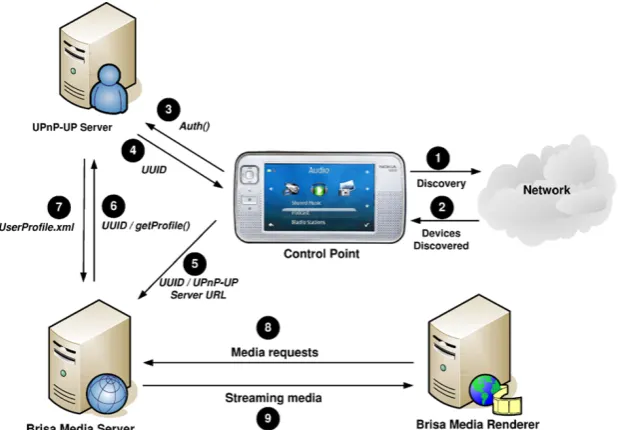
The User Profile Server is introduced as a new UPnP de-vice profile called UPServer. It is similar to the UPnP Media Server [8]; however, it is responsible for storing user profile information, such as full name, login, and password. More-over, specific information regarding any UPnP specification, such as preferences for UPnP Home Automation can also be stored. The UPServer also keeps authorization policies re-garding the available services in the local network, such as controlling access to UPnP Light devices [22]. Once the UP-Server is defined, Fig.1must be modified to insert the new UPnP device to the basic UPnP A/V solution. The result of this change is illustrated in Fig.3.
According to Fig.3, after discovering available UPnP de-vices (Steps 1 and 2), a control point invokes theauthweb service method (Step 3). Later, the control point sends the username and password to the UPServer. The control point receives back a user authentication token ID (UUID gen-erated by the UPServer). This identification will be used to identify the user after a successful authentication (Step 4). In this way the UPnP-UP enabled application will be capable of getting user profile and providing access control.
Listing 3 UPServer XML description
All UPnP devices expose an XML file that describes them and the services they provide. Listing3shows the UP-Server device description. From this information, the con-trol points can get access to the service description and invoke the respective service (see the values of the tags <SCDPURL>and<controlURL>). Besides the basic in-formation about the device, such as the device name and manufacturer (these tags were omitted), Lines 11, 24, and 37 of Listing3define the authentication-based services ( UP-Authentication), the authorization-based services ( UPAutho-rization), and services based on user profiles (UPProfile), respectively.
Besides the auth web service, UPServer also provides the getProfile,renewSession,andlogoutservices. The for-mer allows UPnP devices to retrieve the user profile, while the second one is invoked by control points to renew the
session with the UPServer every time this session expires. The UUIDs sent by the UPServer to the control points are valid for 300 seconds. In case of a timeout, the con-trol point must invoke the renewSessionmethod to renew its communication UUIDs. Additionally, this web service is also useful when the control points suddenly discon-nect from the network without invoking the logout ser-vice. It also adds a security level in case a user with-out authentication acquires a valid UUID. All UPServer services are described according to the UPnP services template, available athttp://upnp.org/resources/documents/ Service-Template-1.01_000.doc.
user over a given service, respectively. ACLs are described using XACML (eXtensible Access Control Markup Lan-guage) [23]. By exposing the user profile and the access con-trol policies through web services, the UPServer can store this information on any back-end the developer wishes to use. For the prototype developed and described in Sect.5, an LDAP back-end was used to store the user profiles.
Regarding the UPnP events for UPServer, the UPnP-UP extension provides three events:
• TheonChangeProfileevent occurs every time a user pro-file is changed. This event may be useful to the UPnP de-vices that want to cache user profile information to avoid retrieving the user profile from the UPServer every time it is necessary to be read;
• The onUserEnterevent is triggered when a new user is authenticated in the UPServer, allowing UPnP services and the control points to be aware of it;
• The onUserExit event indicates the exit (logout) of the current user from the UPnP network.
4.2 UPnP-UP design
The UPnP-UP extension was designed to provide backward compatibility with old versions of the UPnP technology. That is, the UPnP-UP extension must satisfy the require-ments for letting UPnP devices and UPnP-UP enabled de-vices communicate with each other.
Our proposal is based on different steps of customizing the UPnP stack. The first step is to modify the UPnP NO-TIFY message sent from the UPnP devices to the network. If the UPnP device is UPnP-UP compatible, this device must send a modified version of the NOTIFY message to the tar-get control point. The new version of this message must be one as illustrated in Listing4, Line 6. The proposed NO-TIFY message contains a new field named UP (User Pro-file), which indicates whether the remote UPnP end-point is UPnP-UP compatible or not. The absence of this field means the UPnP device is not compatible with the UPnP-UP exten-sion, allowing backward compatibility with the UPnP core stack. If a UPnP device is not UPnP-UP compatible, control points that are aware of the UPnP-UP extension must work properly and must not consider the authentication process. Older UPnP devices must be changed (new firmware, for in-stance) to provide customized services, setting the UP field
to the NOTIFY messages and providing new services im-plementations. If a control point is not UPnP-UP compati-ble but the UPnP device is aware of the UPnP-UP extension, then the UPnP device will just allow access to those services that are “free” (no access control) and do not need authenti-cation, blocking other service requests that need user identi-fication.
Once the control point has been notified with the UP field for UPnP-UP extension, it is able to invoke the remoteauth service to the UPServer. In Fig.3the control point invokes this service and receives back a random UUID (Steps 3 and 4), indicating that the authentication occurred success-fully. Next, the control point accesses a Media Server ser-vice, say the browseservice, which returns a list of avail-able multimedia items. When the control point invokes the browseweb service, it sends its UUID to the UPnP Media Server. The UPnP Media Server requests the user profile (Steps 6 and 7) to provide some kind of customized ser-vice, like recommending multimedia content based on the user profile (Steps 8 and 9). The idea behind the UPnP-UP extension can be used with other UPnP devices, such as to adjust autonomously a UPnP fuzzy light level or to adapt a desired environment temperature of the air conditioner ac-cording to the user preferences.
4.2.1 The new model of UPnP devices
After the user authentication process is finished, UPnP de-vices should interact between each other according to the UPnP-UP extension. To achieve this process, the control point must send the user identifier in every message trans-mitted and the other UPnP end-points should use the user identifier to adapt their responses according to the user pro-file. Also according to Fig.3, the mechanism may cache the user profile the first time the media server retrieves it. Hence, for the second time and so forth the media server retrieves the user profile from the cache, avoiding unnecessary data transfer in the network. In addition to caching the user pro-file, the control point should register to theonChangeProfile event to be notified if the user changes its profile.
The control point must use a SOAP Security exten-sion [24] to transport user UUID in the SOAP header. It is also highly recommended to use a digital signature and/or data encryption provided by W3C XML Encryption Rec-ommendation to transport the sensitive user information,
Listing 5 Access policy for controlling UPnP printer CreateJob service
such as passwords and UUIDs. By adopting this strategy, the UPnP-UP extension expects to provide a mechanism to avoid network attacks like data modification during trans-portation, UUID spoofing, and “man-in-the-middle” [25].
Considering our principle of providing backward com-patibility with non UPnP-UP enabled devices, adding a new type of UPnP device does not impact the UPnP current spec-ification. The unique point of the UPnP specification that must be changed is the original content of the UPnP NO-TIFY message by the addition of a new field called UP. This field is used by the control points and UPnP devices to deter-mine whether a certain UPnP device supports the UPnP-UP extension.
4.2.2 Access control for UPnP services
The UPnP-UP authorization mechanism is based on XACML. The XACML specification is a standard to sup-port authorization mechanisms based on XML (eXtensible Markup Language). The XACML provides a model for de-scribing policies to a target resource. It is also a protocol for requests and responses during an authorization process. XACML is maintained by the OASIS2consortium.
The security access policies and their respective rules can be stored by the local UPnP network manager, recovering available UPnP services from other devices and applying desired rules. For a better understanding of the UPnP-UP
2Organization for the Advancement of Structured Information Stan-dards.
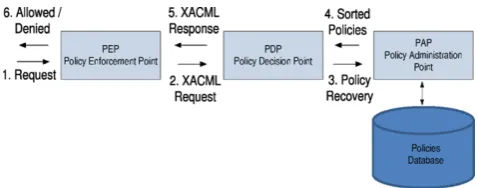
Fig. 4 Interactions between UPnP-UP authorization modules authorization process, Listing5 describes the security pol-icy based on XACML for the following rule:only graduate students and professors at the domain organization.org are allowed to print using the UPnP printer available on the network.
Listing 6 XACML request for accessing CreateJob service
Listing 7 Example of XACML response for Media Renderer Play service
the target resource (Lines between 7 and 11), and the action that the user wishes to access (Lines between 12 and 16).
The XACML request is forwarded to the Policy Deci-sion Point (PDP) module (Step 2, Fig.4). PDP retrieves the authorization policies from the Policy Administration Point (PAP) module (Steps 3 and 4) and decides to allow or deny the access to the specific resource. Then, the PDP module re-turns back an XACML response to the PEP module (Step 5), as described in Listing7. The resource identifier and the au-thorization process result are defined in Lines 2 and 3, re-spectively. The PEP module returns the final result of the authorization process, allowing or not allowing the access to the target resource.
4.2.3 User profile for UPnP-UP enabled devices
The user profile uses an XML format and it is divided into two types of profile descriptions: (1) the UPnP-UP Per-sonal User Profile, which aims at keeping user-related in-formation, such asid, username, email address, etc.; and (2) theUPnP-UP User Profile by Specificationwhere for each UPnP specification, such as UPnP A/V, UPnP Light, and Printer, users have their associated preferences divided into containers. The goal is to split the user profile into different containers to facilitate the process to retrieve user informa-tion, optimizing the user profile access and the transmission of useful profile information to the UPnP end-points. In this case, the UPnP devices access the preference container they
need to retrieve. For instance, the user profile of Listing8 shows some personal information and user preferences for multimedia applications.
The user profile described in Listing8shows some per-sonal information between Lines 4 and 9 (up:perper-sonal_data) and external user profiles information between Lines 11 and 15 (up:external_profiles). In addition, the user prefer-ences information is described between Lines 17 and 36 (up:preferences_data), which is divided into different con-tainers. For instance, container id equal to 0 defines the user preferences for multimedia contents. As previously dis-cussed, the UPnP technology defines the UPnP A/V specifi-cation for UPnP multimedia applispecifi-cations. Multimedia con-tents in UPnP A/V are described as DIDL (Digital Item Declaration Language) [26] digital information metadata. Therefore, multimedia contents in user profile preferences also have DIDL metadata attached to container id 0, as shown between Lines 20 and 29. This user gave 4 as the weight for the first<item>. The weight of each item means how much a user likes that item, and it can be used to pro-vide customized multimedia services.
Listing 8 A user profile example that describes personal and preferences information
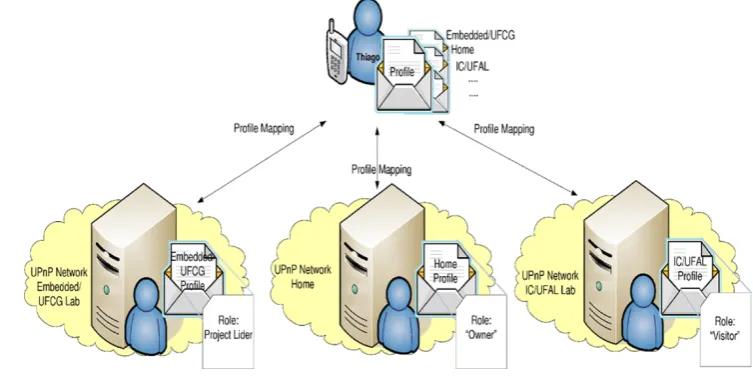
Fig. 5 UPnP-UP user profile architecture
must have other access privileges. Due to this requirement, the user profile for UPnP-UP extension has the concept of “external profiles”, which associates the user profile to other remote user profiles (described in Lines between 11 and 15) and depicted in Fig.5. Each local UPServer stores this pro-file and retrieves it when the user authenticates herself, ac-cording to the user UPnP-UP identification (up-idattribute). Finally, the proposed user profile was defined based on the
available set of UPnP specifications, which allows one to de-compose and to retrieve an appropriate user information as quickly and efficiently as possible.
4.2.4 Considerations for providing service customization with UPnP-UP
of the UPnP technology to search and discover devices in a network. For instance, suppose a UPnP system is capa-ble of sharing multimedia items such as music, movies, and images. According to the user profile obtained by the UPnP-UP, the system can offer songs based on the genre given by a user as the genre of his preference. In this way, it is possible to develop a more sophisticated system that can rate all the songs listened to by the user through the media renderer and then infer which genre he prefers, such as rock, jazz, etc.
Taking into account the availability of user authentication and authorization mechanisms in the UPnP network, many other new requirements can be developed in UPnP applica-tions, such as customized services on top of UPnP, since the proposed extension allows the user identification in this type of network. For instance, consider home automation appli-cations. Briefly, a UPnP-based application that adapts the fuzzy light level, according to the user preference, can be deployed in a living room, acting upon the user when he en-ters the environment. Furthermore, the mechanism of autho-rization also furnishes the entire application with a security high level service, like determining whether the user has per-mission to control the light or to change the air-conditioner temperature.
5 Case studies
In the case studies, the BRisa UPnP Media Server is used to run the experiments. The BRisa Media Server [9] is a UPnP end-point device developed in the Embedded Sys-tems and Pervasive Computing Laboratory, at Federal Uni-versity of Campina Grande, which implements the UPnP A/V specification. It has been written in Python using a plug-in based architecture. In order to compute the recom-mendation of multimedia items, the BRisa Media Server was modified to support UPnP-UP following the steps de-scribed in Sect. 4.2. It has a dynamic multi-thread plug-in loadplug-ing feature focusplug-ing on resource limited devices, mainly for the Nokia Maemo Platform. Additionally, it has a database scheme to avoid loading many objects into the main memory. BRisa can be freely downloaded from http://brisa.garage.maemo.org/, since it is distributed as an open source software under the MIT license. In what fol-lows, two case studies are presented, highlighting the main features of UPnP-UP.
5.1 Case study 1—multimedia content recommendation
Recommendation systems are capable of recommending items based on user profiles and by using information fil-tering techniques. In face of this type of scenario, the user profile is compared to a given multimedia content (content-based filtering [27])—which can be basically some tex-tual information, such asgenreandauthor—and compared
to the interests of other users, collecting user preferences (collaborative-based filtering [28]).
Neighborhood-based methods [29] are the most prevalent algorithms based in the collaborative approach. They create a subset of appropriate users (neighbors) based on their sim-ilarities to the current user. The cosine or Pearson correla-tion [30] can be used to achieve this goal. In (1), Wa,u is
the weight of the current userato a given useru,ra,i is the
rating of the userato the (multimedia) itemi, andr¯a is the
average of the ratings of the active usera.
Wa,u=
m
i=1(ra,i− ¯ra)∗(ru,i− ¯ru)
m
i=1(ra,i−¯ra)2∗
m
i=1(ru,i−¯ru)2
(Pearson correlation). (1)
After finding the similarities for all users, a weighted ag-gregate of neighbors ratings is used to generate predictions for the current user (2). This predicted value would be the evolution that the user would give to an item, if he consumes it.
Pa,i= ¯ra+
n
u=1(ru,i− ¯ru)∗Wa,u n
u=1|Wa,u|
(a weighted aggregate of neighbors ratings). (2) Another approach related to content filtering is called Content-Based Filtering. It is based on the information re-trieval (IR) field [31]. A user profile is composed of a set of keywords and associated weights that indicate the strength of the word in the filtering process. The user profile is matched against a collection of documents, and the most similar are recommended. There are many ways to compute the similarity between two strings. The most common ap-proach is theTF–IDF(Term Frequency–Inverse Document Frequency) algorithm [32], which is based on (3). The term frequency (TF) in the given document is the number of oc-currences of a given term in that document, and the Inverse Document Frequency is a measure of the general importance of the term in a set of documents (Dis the total number of documents in the collection andNp is the number of
docu-ments in which the term occurs). The more rare the term is, the greater will be its IDF.
idf(p)=lg D Np
(Inverse Document Frequency). (3)
The user profile and each document are represented by a vector containing the most relevant term. The cosine cor-relation computes the similarity between these two vectors. This correlation ranges between 0 and 1.
Fig. 6 The browsing process using the Recommendation Subsystem
a result, this process consists of building his user profile for music, videos, or audios of his preference. In this case study, the user profile is collected from a private website, available to users internally, at the Embedded Systems and Pervasive Computing Laboratory, at the Federal University of Camp-ina Grande. Future work will allow a user to associate his profile through the BRisa Control Point.
The first step in the BRisa Recommendation Subsystem is the collaborative filtering approach. For each multimedia consumed item, a listened-to song, a watched video clip, etc., the user specifies a weight to the consumed item con-sidering his preferences. The possible values can be speci-fied ranging from 0 to 10, which indicates the importance of the multimedia items to him. The collaborative filtering approach generates prediction values for those multimedia items that the user did not consume in the past.
Secondly, the content filtering approach is processed by selecting those items for which the calculated prediction value is higher than or equal to a previously given thresh-old, say 5. The idea is to find similar items with the TF-IDF algorithm. To achieve this last approach, the multimedia file metadata is obtained through a DIDL description.
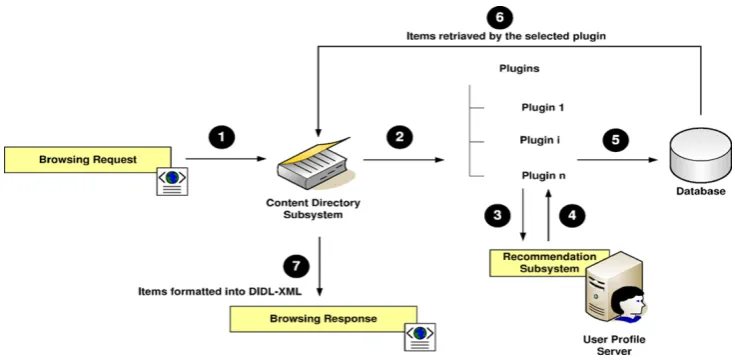
Another important feature of the BRisa Media Server implementation is the plug-in based architecture, which is shown in Fig.6. There was developed an extensible and flex-ible architecture which enables third-party developers to im-plement plug-ins. These plug-ins can share multimedia data from a particular source.
In the first step, a BRisa in developer creates a plug-in file and puts it plug-into the plug-plug-in directory. Then, the devel-oper implements a Python class assigning a plug-in name and implementing the methods load, unload,execute, and browse. In our case study, we developed a set of plug-ins that support browsing of multimedia contents.
Basically, three plug-ins have been developed: one to gather multimedia content from the local file system, a sec-ond to retrieve YouTube videos from a personal user ac-count, and a third for retrieval of pictures from a personal
FlickR user account. Each plug-in has its own data source. For instance, the file system plug-in data source is the disk, and for the YouTube plug-in its data source is the list of available videos from theyoutube.comwebsite. Regardless of the plug-in selected by the BRisa Media Server, as il-lustrated in Fig.6, the browser method invokes the Recom-mendation Subsystem at the UPServer. It recommends mul-timedia items to the user based on the user preferences. The whole process can be summarized as follows:
1. the BRisa Media Server receives a browsing request from the control point, also provided in the BRisa Applica-tion package. Listing9presents an example of the UPnP browseaction. Lines 6 and 7 specify the UPServer UDN and the user UUID, respectively;
2. the BRisa Media Server selects the proper plug-in to han-dle the request;
3. a plug-iniis selected to invoke the recommendation sub-system in order to determine which multimedia content will be retrieved from its specific repository;
4. the Recommendation Subsystem at the User Profile Server executes the recommendation mechanism as de-scribed before and sends back to plug-inithe results of the recommendation process;
5. the plug-iniaccesses its respective data source and col-lects the filtered items;
6. the selected items are sent back to the BRisa Media Server;
7. the set of items is formatted into a Browsing Response considering the UPnP A/V specification and it is returned to the user control point.
5.2 Case study 2—exploring UPnP-UP authorization
Listing 9 Browse Action Request. User UUID available in header tag allows UPnP end-points to identify who is requesting for multimedia items
Fig. 7 UPnP-UP authorization process for UPnP printer device access control
MacOS and other UNIX-like operating systems. We used the CUPS API to implement a UPnP module and driver. The CUPS API provides the convenience functions needed to support applications, filters, printer drivers, and back-ends that need to interface with the CUPS scheduler. Our UPnP module and driver for CUPS are responsible for some tasks such as:
1. advertise the printer as a UPnP device and handle Cre-ateJobservice;
2. find and connect to the UPServer, as well as retrieve user profiles and ACLs for a specific user and device; 3. handle CreateJob requests sent by the UPnP control
points and check whether the user is allowed to create a printing job.
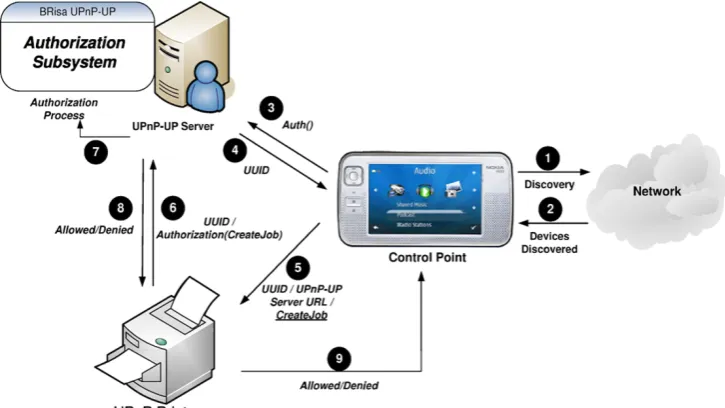
Figure 7 illustrates the basic interaction between the UPnP Control Point and the two UPnP devices used in our case study. The XACML messages used in this case were discussed in the previous section (Listings3,4, and5). Basi-cally, after authenticating in the UPServer, the control point tries to access thecreateJobservice (Step 5). Our UPnP-UP-compatible printer device invokes theauthorizationservice
of the UPServer to verify the current user access permis-sions and, finally, receives a response from the UP-Server. This response allows or denies the access to theCreateJob service (Steps 8 and 9).
6 Experiments and results
requests. Figure8depicts the number of UPnP actions for n=1 in both the UPnP and UPnP-UP startup processes.
After the startup process, UPnP-UP behaves in the same way as the current UPnP specification, although it adds new data to the UPnP requests in order to identify the current user. This extra data size is about 16 bytes for each UPnP action, which corresponds to the UUID size attached to the SOAP header, as described in Listing6. Moreover, to eval-uate our proposed UPnP-UP extension, a series of experi-ments has been performed. The first set of experiexperi-ments aims to observe the impact of the user authentication and autho-rization response time in UPnP networks. The experiments
Fig. 8 The number of UPnP-UP requests during startup
were performed by considering the number of UPnP con-trol points and devices in a local area network with traffic isolated to only the UPnP peers defined as follows: three desktop PCs (Intel Core 2 processor, E7400 2.8 GHz, and 1 GB of memory) running UPnP device instances; and three Nokia N810 mobile devices running UPnP control point in-stances.
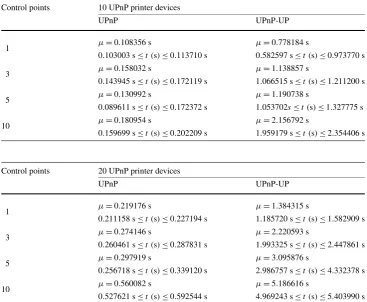
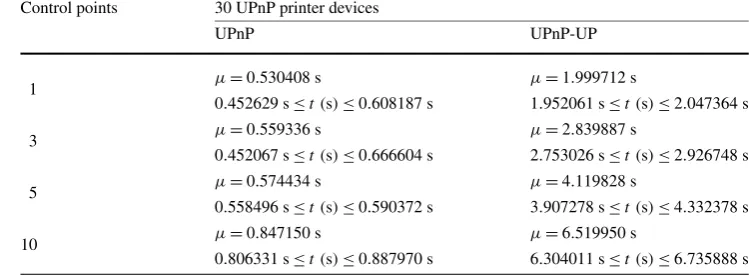
The results are described in Tables1,2, and3. Basically, we considered the scenario depicted in Fig.7, assuming 10, 20, and 30 UPnP printer devices and 1, 3, 5, and 10 UPnP control points. The tables describe the average times for con-trol points to authenticate a user in a UPServer and request theCreateJobservice available by the 10, 20, or 30 UPnP printer devices for the first time. In addition, the same num-ber of control points and UPnP printer devices was consid-ered when using the current UPnP specification, allowing observation of the impact on the time for providing user au-thentication and authorization in UPnP networks. The av-erage times are in seconds and, based on az-distribution, Tables1,2, and3also present the 95% confidence intervals for each set of collected samples.
As expected, due to the processing time and the network congestion, the average time increases when new control points and UPnP printer devices are available in the network. The growth of processing time is more evident in UPnP-UP architecture due to the XML processing of the user profiles and access control policies. Moreover, control points must
Table 1 Average time for UPnP-UP startup process with 10 UPnP printer devices
Control points 10 UPnP printer devices
UPnP UPnP-UP
1 μ=0.108356 s μ=0.778184 s
0.103003 s≤t (s)≤0.113710 s 0.582597 s≤t (s)≤0.973770 s
3 μ=0.158032 s μ=1.138857 s
0.143945 s≤t (s)≤0.172119 s 1.066515 s≤t (s)≤1.211200 s
5 μ=0.130992 s μ=1.190738 s
0.089611 s≤t (s)≤0.172372 s 1.053702s≤t (s)≤1.327775 s
10 μ=0.180954 s μ=2.156792 s
0.159699 s≤t (s)≤0.202209 s 1.959179 s≤t (s)≤2.354406 s
Table 2 Average time for UPnP-UP startup process with 20 UPnP printer devices
Control points 20 UPnP printer devices
UPnP UPnP-UP
1 μ=0.219176 s μ=1.384315 s
0.211158 s≤t (s)≤0.227194 s 1.185720 s≤t (s)≤1.582909 s
3 μ=0.274146 s μ=2.220593 s
0.260461 s≤t (s)≤0.287831 s 1.993325 s≤t (s)≤2.447861 s
5 μ=0.297919 s μ=3.095876 s
0.256718 s≤t (s)≤0.339120 s 2.986757 s≤t (s)≤4.332378 s
10 μ=0.560082 s μ=5.186616 s
Table 3 Average time for UPnP-UP startup process with 30 UPnP printer devices
Control points 30 UPnP printer devices
UPnP UPnP-UP
1 μ=0.530408 s μ=1.999712 s
0.452629 s≤t (s)≤0.608187 s 1.952061 s≤t (s)≤2.047364 s
3 μ=0.559336 s μ=2.839887 s
0.452067 s≤t (s)≤0.666604 s 2.753026 s≤t (s)≤2.926748 s
5 μ=0.574434 s μ=4.119828 s
0.558496 s≤t (s)≤0.590372 s 3.907278 s≤t (s)≤4.332378 s
10 μ=0.847150 s μ=6.519950 s
0.806331 s≤t (s)≤0.887970 s 6.304011 s≤t (s)≤6.735888 s
check if the target UPnP device is UPnP-UP compatible by checking theUPfield. From the user perspective, it is impor-tant to note that the average times using UPnP-UP are still very acceptable even when the average time hits 5 seconds above the current UPnP specification (10 control points and 30 UPnP printer devices).
7 Discussion and future work
Recently, UPnP has attained worldwide recognition by the International Organization for Standardization (ISO) and the International Electrotechnical Commission (IEC) due to the increasing number of new UPnP-based applications [33]. Both institutions have acknowledged the UPnP architecture position as the leading technology for devices and services discovery, and control of networked devices.
Pervasive applications require mechanisms to acquire and model user activities and profiles. In addition, infor-mation from the environment is also interesting for provid-ing context-aware applications. Before UPnP-UP, the UPnP technology had no user authentication and authorization specification. Thus, UPnP-based applications could not pro-vide user-based access control and customized services that leverage UPnP-based technologies. The UPnP support for security deals with device information, which is not enough to acquire user information.
In order to provide user authentication and authorization in UPnP networks, the UPnP-UP extension requires the ad-dition of a new UPnP device specification called UPServer. The UPServer is responsible for managing the authentica-tion and the authorizaauthentica-tion process, and also providing the services to store, update, delete, and remove access con-trol policies. For instance, the DNS Injection attack can be solved by creating a set of access control policies that estab-lish the range of allowed ports to be mapped (above 1024) by users. However, these policies are maintained in the server, requiring IGD devices to access them every time a user tries to request a port mapping. As a result, it is also required to
distribute these policies along the available devices. For in-stance, UPServer would provide a UPnP-based service for collecting policies based on the device type or service.
From a network infrastructure point of view, the UP-Server is a single point of failure. However, a distributed authentication and authorization mechanism is more com-plex and hard to manage and maintain due to the input and output of devices. To overcome such drawbacks, it is also possible to provide more than one UPServer in the network and provide load balance mechanisms using IPv6 anycast, for instance. Also, devices that will support UPnP-UP can be considered as “managed” or “unmanaged” devices. That is, if no UPServer device is found in the local network, it still can allow the access to a set of selected “free” services, if possible.
The proposed solution still has some problems. First, in spite of the possibility of changing the user UUID at a given time interval, an attacker can obtain other user UUIDs and renew the authentication session. We are currently investi-gating a solution to provide mechanisms to build a set of user token IDs (UUIDs). In this solution, each user has a set of identifiers that are generated based on a Lamport hash chain model [34]. Each identifier can be used only once, for each UPnP device to which the user has access. This mechanism avoids some kinds of attacks, such asUUID spoofing. In ad-dition, hash functions have low computational costs, which can be executed by resource-constrained devices, such as cellphones. Another important weakness of the current solu-tion is related to replay (or playback) attacks [35,36]; a net-work attacker is still allowed to maliciously or fraudulently resubmit a valid request. Within the context of the UPnP-UP network architecture, an access to a UPnP-UPnP printer device (which takes valid UUID) can be resent by another user, or attacker. As a result, the attacker can gain access to the de-vice on behalf of another user.
authors have also investigated its impact regarding perfor-mance, since UPnP devices can be resource-constrained and OWL requires high hardware performance. Another point of improvement concerns the authentication process, which has been evolved to provide different levels of security, data integrity, confidentiality, and prevention to replay attacks. Moreover, the authorization service is still being evaluated and more experiments must be performed. It is still respon-sible for 63% of the total time consumption presented in the experimental results.
8 Conclusion
This paper presented an extension of the UPnP technology to enable user authentication and authorization mechanisms for the UPnP connectivity architecture. The extension al-lows the development of customized UPnP applications and ensures access control for available resources for UPnP en-abled networks. Besides extending UPnP to support user au-thentication, a new UPnP device profile, calledUser Profile Server,has been introduced. As a proof of concept, we pre-sented two scenarios that show how the UPnP-UP extension can be applied in order to achieve customized and secure UPnP services. Moreover, some experimental results were presented in order to validate the UPnP-UP extension and show that, even with the addition of new UPnP devices (UP-Server) and UPnP actions, the average time that a control point takes to request for a UPnP job is still acceptable.
Nowadays, the available UPnP services that follow the UPnP specification cannot make use of user information. Because of this, UPnP devices are unable to dynamically adapt the services based on the user information. As a result, each service developer implements his own non-standard proprietary solution, making interoperability among avail-able UPnP services more difficult for providing customized services. On the other hand, UPnP-UP is a research contri-bution for user authentication and authorization mechanisms in the UPnP networks, keeping the specification compati-ble with the current UPnP implementations and enabling a new set of applications to be deployed over a UPnP network. UPnP-UP extension has become possible due to the flexible and extensible UPnP design offered by the UPnP Forum, allowing the addition of new devices and services through a definition of artifacts such as XML file descriptions and SOAP Web Services.
References
1. Loureiro E, Ferreira G, Almeida H, Perkusich A (2007) Perva-sive computing: what is it anyway? In: Lytras M, Naeve A (eds) Ubiquitous and pervasive knowledge and learning management: semantics, social networking and new media to their full poten-tial, pp 1–34
2. Weiser M (1999) The computer for the 21st century. SIGMOBILE Mob Comput Commun Rev 3(3):3–11. doi:10.1145/329124.329126
3. Presser A, Farrel L (2008) UPnP device architecture.http://upnp. org/specs/arch/UPnP-arch-DeviceArchitecture-v1.1.pdf. Last ac-cess on May, 2008
4. Kumaran I, Kumaran SI (2001) Jini technology: an overview. Prentice-Hall PTR, Upper Saddle River
5. Consortium S (1999) Salutation architecture specification.
ftp://ftp.salutation.org/salutesa20e1a21.ps
6. Guttman E, Perkins C, Veizades J, Day M (1999) Service location protocol, version 2. RFC.http://tools.ietf.org/html/rfc2608
7. W3C (2007) Simple object access protocol.http://www.w3.org/ TR/soap/
8. Langille G et al. (2008) Mediaserver:3 device template version 1.01. http://upnp.org/specs/av/UPnP-av-MediaServer-v3-Device. pdf. Last access on May, 2009
9. Guedes A, Santos D, do Nascimento J, Sales L, Perkusich A, Almeida H (2008) Set your multimedia application free with BRisa framework: an open source UPnP implementation for re-source limited devices. In: 5th IEEE consumer communications and networking conference, 2008. CCNC 2008, pp 1257–1258 (10–12 January 2008). doi:10.1109/ccnc08.2007.297
10. Lin JC, Chen JM, Liu CH (2008) An automatic mecha-nism for adjusting validation function. AINAW, pp 602–607. 10.1109/WAINA.2008.89
11. Prakash Iyer UW (2001) Internetgatewaydevice:1 device tem-plate version 1.01. http://upnp.org/standardizeddcps/documents/ UPnP_IGD_1.0.zip. Last access on May, 2009
12. Hengartner U, Steenkiste P (2004) Protecting access to peo-ple location information. In: Lecture notes in computer science, vol 2802. Springer, Berlin, pp 222–231
13. Robinson P, Beigl M (2004) Trust context spaces: an infrastructure for pervasive security in context-aware environments. In: Lecture notes in computer science, vol 2802. Springer, Berlin, pp 119–129 14. Kvarnstrom H, Hedbom H, Jonsson E (2004) Protecting security
policies in ubiquitous environments using one-way functions. In: Lecture notes in computer science, vol 2802. Springer, Berlin, pp 71–85
15. Creese S, Goldsmith M, Roscoe B, Zakiuddin I (2004) Authen-tication for pervasive computing. In: Lecture notes in computer science, vol 2802. Springer, Berlin, pp 439–488
16. Klemets A, Da Costa B (2008) UPnP authentication and authorization patent. http://www.freepatentsonline.com/y2008/ 0092211.html
17. Karl J (2010) UPnP CDS USER PROFILE.http://www.patents. com/UPnP-CDS-USER-PROFILE-20100125907.html
18. Ellison C (2003) DeviceSecurity: 1 Service Template.http://www. upnp.org/standardizeddcps/documents/DeviceSecurity_1.0cc_ 001.pdf. Last access on December, 2008
19. Ellison C (2003) SecurityConsole: 1 service template. http:// www.upnp.org/standardizeddcps/documents/SecurityConsole_ 1.0cc.pdf. Last access on December, 2008
20. Nakajima T (2003) Pervasive servers: a framework for creating a society of appliances. Pers Ubiquitous Comput 7(3–4):182–188. doi:10.1007/s00779-003-0222-2
21. Chen W, Kuo SY, Chao HC (2009) Service integration with UPnP agent for an ubiquitous home environment. Inf Syst Front 11(5):483–490. doi:10.1007/s10796-008-9122-3
22. Sahm C, Langels HJ (2003) Dimmable light device tem-plate. http://www.upnp.org/standardizeddcps/documents/ DimmableLight1.0cc.pdf. Last access on May, 2008
24. Rahaman MA, Schaad A, Rits M (2006) Towards secure SOAP message exchange in a SOA. In: SWS’06: proceedings of the 3rd ACM workshop on secure web services. ACM, New York, pp 77– 84. doi:10.1145/1180367.1180382
25. Snyder RM (2007) Security programming using python: min-the-middle attacks. In: InfoSecCD’07: proceedings of the 4th an-nual conference on information security curriculum development. ACM, New York, pp 1–6. doi:10.1145/1409908.1409911
26. Hashemipour S, Ali M (2004) MPEG-21 & DIDL: dawn of a new multimedia EVA. In: IEEE international symposium on consumer electronics, 2004, pp 91–95
27. Balabanovic M, Shoham Y (1997) FAB: content-based, collabo-rative recommendation. Commun ACM 40:66–72
28. Im I, Hars A (2007) Does a one-size recommendation system fit all? The effectiveness of collaborative filtering based recommen-dation systems across different domains and search modes. ACM Trans Inf Syst TOIS 26(1):4. doi:10.1145/1292591.1292595
29. Deshpande M, Karypis G (2004) Item-based top-n recom-mendation algorithms. ACM Trans Inf Syst 22(1):143–177. doi:10.1145/963770.963776
30. Benesty J, Chen J, Huang Y (2008) On the importance of the Pearson correlation coefficient in noise reduction. IEEE Trans Audio Speech Lang Process 16(4):757–765.
10.1109/TASL.2008.919072
31. Minker J (1977) Information storage and retrieval: a sur-vey and functional description. SIGIR Forum 12(2):12–108. doi:10.1145/1095515.1095516
32. Yantao Z, Jianbo T, Jiaqin W (2007) An improved TFIDF feature selection algorithm based on information entropy. In: Chinese control conference, 2007. CCC 2007, pp 312–315. doi:10.1109/CHICC.2006.4346845
33. Sherwin L (2009) UPnP specifications named international standard for device interoperability for IP-based network de-vices. innovation validated by record-breaking number of UPnP implementations in 2008. http://www.upnp.org/news/ documents/UPnPForum_02052009.pdf. Last access on Septem-ber, 2009
34. Lamport L (1981) Password authentication with inse-cure communication. Commun ACM 24(11):770–772. doi:10.1145/358790.358797
35. Malladi S, Alves-Foss J, Heckendorn RB (2002) On preventing replay attacks on security protocols. In: Proc international confer-ence on security and management. CSREA Press, pp 77–83 36. Syverson P (1994) A taxonomy of replay attacks. In: Proceedings
of the 7th IEEE computer security foundations workshop. Society Press, New York, pp 187–191