Cloud Computing: A new generation of IT
infrastructure for Knowledge Management
Sanasam Bimol#1, Masih Saikia*2, L. Sashikumar*3, L. Pushparani Devi #4
#
Research Scholar CMJ University Jorabat, Shillong, India
Abstract— Knowledge is now considered as an integral component of any organization and it played a significant role in how organisation is conducted and thus the need of innovative knowledge management (KM) grew. The budgetary constraints in education become a challenge for providing necessary information technology support for knowledge management activities development in the institutions. Many higher education institutions are facing the same problems with the growing need of IT infrastructure. The higher education institutions can now avail hosted services for major information technology (IT) activities including KM through Cloud Computing, which was beyond their budget before the advent of Cloud Computing. This short theoretical paper aims at identifying the limitations of current IT infrastructure for knowledge management and the article would encourage more effective handling the knowledge with the initiative of new information technology infrastructure and forming the knowledge management cloud.
Keywords — Knowledge, KM, IT, Cloud computing, Higher education
I. INTRODUCTION
In the current information age, knowledge to be seen as key defining elements in terms of an organisation‘s competitiveness, sustainability growth and performance. Knowledge management practices play a vital role in promoting teaching and learning at various levels of the academic organisation. The concept of comparative advantages has been redefined through the detection of possible sources of resources. Vilamová et al explain use of comparative advantages can be considered as a significant factor conditioning the success of firms operating in the business markets [1]. Knowledge becomes the final step coming through data -information – knowledge and it acts as development sequence accelerator of an organization for generating new opportunities towards fulfillment of organizational goal. According to Hirai et al knowledge has come to be considered an important and an essential resource for sustaining the competitiveness of an organization [2]. Knowledge has since received many definitions -According to the dictionary, knowledge is the sum of what is known, the body of truth, information and principles acquired by mankind. Knowledge is related to intellectual capacities, but it is also linked
to observation, experience, study and investigation. Dictionary definitions are still lacking a connection to what knowledge means in the term "knowledge management". Awad and Ghaziri [3] indicated that data. Knowledge is information or data, organised in a way that is useful to the organisation.
There are various views among the academicians, researchers and practitioners on the concepts and definitions of knowledge but central theme is still the same for all of them. There is single definition of KM not found till today. It has been defined in a number of ways, but in general the thought relates to unlocking and leveraging the knowledge of individuals so that this knowledge becomes available as an organizational resource. KM makes knowledge independent from the particular individuals. Duffy [4] defines Knowledge Management as a set of business practices and technologies used to assist an organization to obtain maximum advantage from one of its most important assets — knowledge. Sveiby [5] defined KM as, The art of creating value from an organisation is intangible assets.´ Davenport and Prusak [6] defined KM as, ³KM is concerned with the exploitation and development of the knowledge assets of an organisation with a view to furthering the knowledge objectives.´ Knowledge management is the systemic and organizationally specified process for acquiring, organizing and communicating knowledge of employees so that other employees may make use of it to be more effective and productive in their work [7].
II. IMPORTANCE OF KNOWLEDGE MANAGEMENT
HEI. Although management of knowledge in higher education is relatively less though the system of higher education is not precisely the place where the potentially future knowledge workers are trained but also a place where a significant knowledge resource centre. So that knowledge management and its range of successful in the world of education would be extended. Taking into consideration that this issue is fundamental for the present higher education, academician and education administrator needs to take immediate appropriate step to introduce KM in higher education and closer look at its benefits. Applications of KM in modern higher education will play a main role while in its creation so called future knowledge workers. According to Rowley [10], ―higher education institutions have significant level of knowledge management activities, and it is important to recognize these, and use them as a foundation for further development, rather than invent a whole new paradigm‖. Knowledge management is concerned with the exploitation and development of the knowledge assets of an organization with the view to furthering organisational objectives. Higher education institutions is ensure that knowledge is shared among lecturers, researchers and students and advocate the knowledge clearly fall within the realm of knowledge management. The 2002 World Bank [11] report titled Constructing Knowledge Societies: New Challenges for Tertiary Education, indicates two central issues which underline the importance of knowledge management in higher education. Firstly, tertiary education is necessary for effective creation, dissemination, and application of knowledge, as well as for building technical and professional capacity. Secondly, both developing countries, as well as those which are in transition, are at risk of being further marginalised in a highly competitive world economy, as their tertiary education systems are not adequately prepared to capitalise on the creation and use of knowledge. Rowley [10] argues that ―higher education institutions are [also] in the knowledge business, since they are involved in knowledge creation, knowledge dissemination and learning‖. Kidwell, et, al [12], who stress that using knowledge management techniques and technologies in higher education institutions is as vital as it is in the corporate sector, identify some of the benefits which might accrue to higher education institutions if they apply knowledge management techniques. Such benefits include enhanced decision-making capabilities, reduced production cycle development (such as curriculum development and research), and improved academic and administrative services and related costs.
III.KNOWLEDGE MANAGEMENT INFRASTRUCTURE
AND TECHNOLOGY
Realizing the importance of KM, academician shows the interest of implementation of KM in the
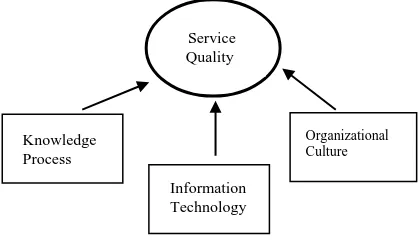
HEI. KM has become a precious property of achieving success of an organization in information age. As the academician and educational administrator aware the power of knowledge as the most valuable strategic resource in the knowledge economy, knowledge management infrastructure became widely recognized as essential for the success of organizations. Consequently, over the past 15 years, knowledge management infrastructure has progressed from an emergent concept to an increasingly common function in business organizations [13]. According to one estimate, 81% of the leading organizations in Europe and the U.S. are utilizing some form of knowledge management infrastructure [14]. Seyed et, al [15] investigates the effective knowledge management infrastructure and relationship with service quality and success factors as a measure of knowledge management infrastructure, and as measures of service quality. Author presented dimension of knowledge management infrastructure related to service quality as shown in figure 3.3.
Fig 1: Knowledge Management Infrastructure Source: http://dx.doi.org/10.6007/IJARBSS/v3-i12/469
Knowledge management infrastructure enablers have been recognized as important for successful knowledge management in an organization. As more and more knowledge is becoming available and knowledge itself is becoming more sophisticated, making knowledge management infrastructure is also becoming more complex. Essentially, KM infrastructure needs to ensure that the right knowledge gets to the right people at the right time, and share the knowledge to improve organizational performance. By nature HEI is a knowledge creation and service centre. Consequently, as educational organizations expected evidence of knowledge management infrastructure‘s in terms of intellectual indicators, this contribution is being progressively examined. Still, despite the commonness of knowledge management infrastructure in organizations, there is yet no standardized framework for measuring the contribution of knowledge management infrastructure to service quality [16], and connection between knowledge and performance [17]. This can partially be explained by the fact that
Service Quality
Knowledge Process
Information Technology
area of knowledge management infrastructure is still in its early stages in terms of developing its theoretical base [18], as well as by inadequately developed ways of measuring the knowledge management infrastructure practice in organizations. Gold et al, [19] had argued that knowledge management (KM) infrastructure is composed of three key dimensions - Cultural infrastructure, Structural infrastructure and Technological infrastructure.
Technology is the knowledge management scope. Applying technology aims to do an efficient job and help further to improve organization‗s innovations and competitiveness. Technology enables individuals to coordinate the logistics of face to face and virtual meetings. Likewise, IT facilitates the process of knowledge storing, sharing and transfer. IT improves the efficiency of organizational management processes and provides new ways of improving the capacity of response to environmental requirements. According to Olivera [20], those technology serve a variety of functions such as storing large amounts of information, making information accessible to individuals, providing means of communication, generating records of interactions and transactions, and automating processes. On the basis of the above reasoning, the influence of IT on knowledge management processes- knowledge generation, knowledge transfer, and knowledge codification and storage. According to Lambe [21] notes that knowledge and information technology infrastructure ―mean all the things that combine to facilitate the flow of information and knowledge in support of the myriad tasks and actions and decisions that comprise organizational activity. Hence information infrastructure does not mean just mean the technical IT infrastructure, although it includes that. It also encompasses human, social and organizational elements. IT infrastructure in higher education organisation is making opportunities and inspiration for managing organisational knowledge. Knowledge management technology infrastructures consist of technical components such as hardware and software system and organizational portal and knowledge repository.
IV.CLOUD COMPUTING AND KNOWLEDGE
MANAGEMENT
During the past decade, higher education faces many pressures and changes such as globalization, mass education, budget cuts, academic rivalry on large-scale, reforms, and compositeness; need to adapt to new technology requirements etc. More than that, as our society is transform into new generation so called ‗net-generation‘. Higher education institutes need to adapt technology advancement particularly in the field of communication and computer to meet the fundamental change in 21st century education. Cloud computing may have considerable potential in improving the IT application and infrastructure at
higher education institutions. Cloud computing will help the higher education institutions by reducing the expenditure with decreasing demand for new software and IT requires strong financial readiness and competent human resource. Cloud also promotes connectivity across institutions of higher learning and sharing of resources and access to faculty and students. Moving to cloud actually does not necessary installation of servers and physical computing information structure. Purchasing, hardware, software, installing, and maintaining extensive hardware contributes to some of higher budgets that Institution to allocate. In such case, new advance network technologies make the move to cloud computing a logical choice [22]. National Institute of Standards and Technology US define ―Cloud computing is a model for enabling ubiquitous, convenient, on-demand network access to a shared pool of configurable computing resources (e.g., networks, servers, storage, applications, and services) that can be rapidly provisioned and released with minimal management effort or service provider interaction.‖ [23]. Cloud Computing technology has recently emerged as a promising ICT approach to improve the way people and businesses see ICT as a service. This technology has a great influence on developing KMS. Cloud computing not only provides a central location to manage data/information and knowledge but also provides a platform to make them available on-demand, like other computing resources such as CPU, Storage, Memory and Bandwidth, etc. Among the benefits of integrating Cloud Computing with KMS are to cut costs, adopt new practices, and explore new business Knowledge models.
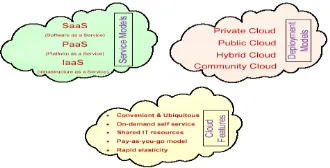
There are several implementation of cloud computing through the use of various cloud service and cloud deployments models. The three basic service models include provisioning of Infrastructure as a Service (IaaS), Platform as a Service (PaaS) and Software as a Service (SaaS). Deployment models deal with the manner in which the infrastructure of Cloud Computing system is deployed, owned and managed by the service providers & consumers. This leads to the concept of Private, Public, Community and Hybrid cloud architectures [24]. These basic concepts of Cloud Computing system are summarized in Fig. 1.
Source: Proceedings of the First ME14 DUBAI Conference Dubai 10-12 October 2014.
The Cloud Computing model provides various advantages as compared to the traditional IT setup. First and foremost is the saving in setup and maintenance costs. This computing technology allows the user to use the internet applications without installation and access their personal files at any computer, anywhere, anytime with internet access as a PAYGO basis [25]. Cloud Computing system has the feature of rapid elasticity which enables the services to be scaled up and down based on customer workload demands. Having seen the features and benefits of Cloud Computing to the domain of Knowledge Management, now we turn our attention to the research work which has been done in the application of Cloud Computing to the betterment of Knowledge Management Systems
V. CONCLUSIONS
One of the most prominent technologies within the IT has been the emergence of Cloud Computing that has significantly impacted the way IT services are provisioned. By taking a look at the high costs of IT infrastructure set up and utilizing in the higher education in particular and updating old knowledge management systems along with their related issues and problems, cloud based knowledge management systems become an obvious solution to share and effectively use organizational knowledge. It provides a next generation IT infrastructure platform which offers end-users unprecedented control and dynamism in real-time to help for service latency, availability, performance, security and knowledge management.
ACKNOWLEDGMENT
We thanks to all the article contributor which is referred here in our paper has got a great impact and contribution to come out our paper in this shape. We express our gratitude to all the authors that mentioned in reference and not mentioned but who has given a great resources needed to complete our work.
REFERENCES
[1] Vilamová,Š. et al.,(2011):‖Selected specific marketing
analysis and management in terms of
industrialenterprises”,.Paper presented at the Proceedings of [2] Hirai,C.,Uchida,Y. and Fujinami,T.,(2007): ―A knowledge
management system for dynamic rganizational knowledge
circulation‖. International Journal of Information
Technology and Decision Making,6(3),509 –522.ISSN 02196220.
[3] Awad, E.M. & Ghaziri, H.M., (2004‖, ―Knowledge Management‖, Prentice Hall, New York, USA
[4] Duffy, J., (2000), ―Knowledge Management: To Be or Not To Be?‖ In Chong Liu, ―Development of Student Centred Knowledge Management System Based in a Higher
Education‖ Master theis Dublin Institute of
Technology,2012.
[5] Mehmet Fatih Erkoç, Serhat Bahadir Kert. Cloud Computing for Distributed University Campus: A Prototype Suggestion,
PIXEL, International Conference the future of education.
Yildiz Technical University (Turkey)
[6] Davenport, Thomas H. & Prusak, Larry. (2005), ―Knowledge
mangement: Executive brief‖. In Knowledge management
and management learning: Extending the horizons of knowledge-based management, edited by Baets, Walter, 2nd Ed., Springer, USA,. pp. 69-70.
[7] Alavi, M., & Leidner, D. (1999). Knowledge Management systems: issues, challenges and benefits. Communications of the Association for Information Systems, 1 (7).
[8] Yang, W., & Lynch, B. P. (2006), ―On knowledge management and the role of the library in the process of knowledge
management,‖ Chinese Librarianship: An International
Electronic Journal, 21; Accessed April 2011: http://www.white-clouds.com/iclc/cliej/cl21YangLynch.htm. [9] Wang, H. (2006), From ‗user‘ to ‗customer‘: TQM in academic
libraries, Library Management, 27(9), 606-20.
[10] Rowley, J. (2000). Is Higher Education ready for Knowledge
Management?. The International Journal of Education
Management. Vol. 14, No.7. 325-333.
[11] World Bank, Task Force on Higher Education and Society (2000) ―Higher Education in Developing Countries: Peril and Promise‖, World Bank Publications Washington DC.
[12] Kidwell,J.,J. et al.―Applying Corporate Knowledge
Management Practices in Higher Education ‖, Educause Quaterly, 2000, pp. 28-33
[13] McKeen et al., (2006) In Seyed Reza Seyed Javadein, Mojtaba Ramazani and Shahram keshavarzi, ―The Effective Knowledge Management Infrastructure and Relationship
with Service Quality in Insurance Company‖ International
Journal of Academic Research in Business and Social Sciences, Vol. 3, No. 12, December 2013,
[14] Becerra-Fernandez, I., Gonzalez, A. & Sabherwal, R., (2004), Knowledge Management: Challenges, Solutions, and Technologies, Pearson Prentice Hall, New York, USA [15] Seyed Reza Seyed Javadein, Mojtaba Ramazani and Shahram
keshavarzi, (2013) ―The Effective Knowledge Management Infrastructure and Relationship with Service Quality in
Insurance Company‖ International Journal of Academic
Research in Business and Social Sciences, Vol. 3, No. 12, December,
[16] Kim, (2006) In Seyed Reza Seyed Javadein, Mojtaba Ramazani and Shahram keshavarzi, ―The Effective Knowledge Management Infrastructure and Relationship
with Service Quality in Insurance Company‖ International
Journal of Academic Research in Business and Social Sciences, Vol. 3, No. 12, December 2013,
[17] Kalling, (2003), pp. 67 In Seyed Reza Seyed Javadein, Mojtaba Ramazani and Shahram keshavarzi, ―The Effective Knowledge Management Infrastructure and Relationship
with Service Quality in Insurance Company‖ International
Journal of Academic Research in Business and Social Sciences, Vol. 3, No. 12, December 2013,
[18] Zaim et al., (2007), pp. 55 In Seyed Reza Seyed Javadein, Mojtaba Ramazani and Shahram keshavarzi, ―The Effective Knowledge Management Infrastructure and Relationship
with Service Quality in Insurance Company‖ International
Journal of Academic Research in Business and Social Sciences, Vol. 3, No. 12, December 2013,
[19] Gold, A.H., Malhotra, A., & Segars, A. (2001). Knowledge management: An organizational capabilities perspective. Journal of Management Information Systems, 18(1), 185-214.
[20] Olivera, F. (2000). Memory systems in organizations: An empirical investigation of mechanisms for knowledge
collection storage and access. Journal of Knowledge
Management 37(6): 811–832.
[21] Lambe (2006) [Available at
:http://www.tlu.ee/~sirvir/Information%20and%20Knowledg e%20Management/Knowledge%20Management%20Infrastru ctur/knowledge_management_infrastructure.html ]
[23] NIST., ―The NIST Definition of Cloud Computing : Recommendations of the National Institute of Standards and
Technology‖., September 2011. [Available at:
http://csrc.nist.gov/publicat
ions/nistpubs/800-145/SP800-145.pdf
[24] Zhang, Q., L. Cheng, and R. Boutaba, 2010, Cloud computing: state-of-the-art and research challenges, Journal of Internet Services and Applications, 1(1), 7-18.