Chapter 1
Introduction
Nanotechnology is of recent origin but nano materials exist ever since the creation of earth. All plants have the elementary nano constituent- cellulose. The basic raw materials used in papermaking- wood, non-wood, agro residue and recycled fibre are constituted of these cellulose molecules. Pulp and paper including writing, printing, board, newsprint, packaging and forest based products are all based on the elementary cellulose molecules. Cellulose is found in plants as micro fibrils of dimension, 2-20nm in diameter and 100- 40 000 nm in length.
Smaller the size of particle, more powerful it can be from the perspective of reactivity. Nano particle, tiniest of the particles known, has the potential to be the most powerful material (1). Production and handling of such particles are extremely difficult, requiring innovative systems. The pace of progress of this technology depends on our ability to systematically organize and manipulate matter at nano scale (2).
1.1 DEFINITION
The word,” Nano” is derived from the Greek word “nano” (or Latin “nanus”), meaning “Dwarf”. Nanotechnology is defined as the manipulation of materials measuring 100 nanometers or less in at least one dimension. It involves the design, manufacture and use of small particles and structures of materials having molecular size. 1 nanometer is about 10,000 times smaller than a softwood pulp fibre (3). One of the reasons as to why these materials can contribute in enhancement of physical and other properties is their high surface area.
Traditional manufacturing processes are based on converting big massive size to smaller size, termed as ”top down” while nanotechnology is based on “bottom up”, from smaller to bigger particles, allowing manipulating molecules to achieve precise and novel effects (3). With the ability to work at molecular level, atom by atom, using “bottom up” systems, new products can be created. The materials and systems based on the nano particles possess structures and components, exhibiting distinctly novel and improved physical, chemical and mechanical properties.
The objectives of future developments in paper manufacturing are to improve product quality, reduce cost of production and increase productivity as well as efficiency. Saving of energy, reducing raw material and fresh water consumption are also of vital importance to cause minimum damage to the environment. The environmental impact of the industrial production comes mainly from intensive energy and water consumption in the process. Reduction of greenhouse gas emissions is now mandatory for all. After the Kyoto protocol, the word, “sustainable development” is reverberating everywhere (4).
Nanotechnology has the potential to help paper industries meeting the criteria for sustainable development.
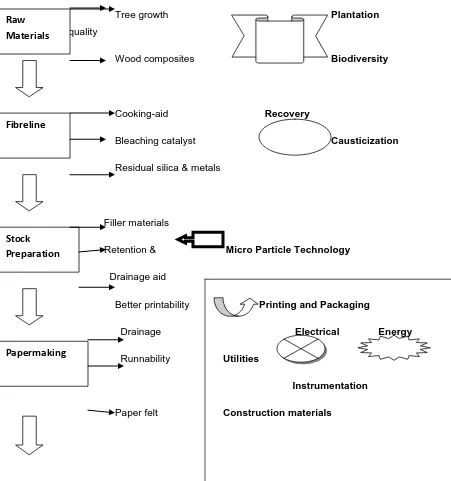
The processes and products in pulp, paper and allied industries where micro and nano systems (5, 6) exist or can be applied are shown in Fig1.1. Genetic manipulation of trees is one of the most promising areas of research in nanotechnology to solve the problem of not only raw materials but the whole manufacturing process of pulp and paper. Plantation programmes with the concept of nano trees have already been initiated by few Companies. Preservation of raw materials in the yard, making wood more thermal resistant and less amenable to microbial attack and wood composites have important bearing on the micro and nano systems. Pulping, bleaching and washing in the new generation fibreline could be improvised because of better understanding of fibre microstructure in the process.
Micro particle technology using montmorillonite, engineered fillers and pigments are slowly being introduced by many mills. Attempts are going on for enhancing properties of minerals, oxides, and synthetic fillers and chemicals such as starch, binders, thickeners, pulping and bleaching aids, wet end and dry strength additives and biochemical agents. Improvement in the metallic and ceramic construction materials with reduced corrosion problem has been possible because of better understanding of the microstructure. Effluent treatment and other areas including energy generation, environmental protection, health, hygiene, safety, medicine, leading up to climate change and many other aspects are also
discussed in this book with respect to nano technology. Parallel achievements of significance in some of the other industries are encompassed in this book because of their relevance to paper technology, namely in material science, metallurgy, ceramics, medicine, safety and environmental improvement. There is ample of scope in printing technology for benefiting from nanotechnology (7).
Radical transformation (8) of fibre-based paper and board packaging via R & D, innovation and nano engineering is apparently on the horizon. The future focus will be on the use of nano fibres, nano clays, nano composites, intelligent paper (9), 3D-paper structure (8) and composite packaging materials. The environmental protection strategies of paper industries may be modified or altered because of developments in nanotechnology for green house gas emission, cleaner technology, waste minimization and climate change. Antibacterial paper (10) and medicines based on nanotechnology will find
widespread applications. At the safety front, it is apprehended that there can be abuse of
Materials in this book are collected from various journal of not only wood, pulp and paper but also many other disciplines, such as Nanotechnology, Material Science, Composites, Particle
Characterization, Clay Minerals, Catalysis, Surface and Biotechnology. Knowledge of basic science and engineering including Physics, Chemistry, Biology, Chemical Engineering, Ceramics, Mineralogy and few others have been referred.
Selected information and photographs from many websites, available in the Internet, have also been included. Technical information received through personal correspondence from many pulp, paper and allied industries from many countries have been utilised in this book.
Figure 1.1: Applications of micro and nanotechnology in pulp and paper manufacturing.
Tree growth Plantation
Fibre quality Forestry
Wood composites Biodiversity
Cooking-aid Recovery
Bleaching catalyst Causticization
Residual silica & metals Filler materials
Retention & Micro Particle Technology Drainage aid
Better printability Printing and Packaging
Drainage Electrical Energy Runnability Utilities
Instrumentation Paper felt Construction materials
Raw
Materials
Fibreline
Stock
Preparation
& Pressing Metals, Alloys, Composite Energy cost Fibreline Paper machine
Bulk Yankee Dryer
Environmental Protection
Smoothness Water
GHG Emission Air
Cleaner technology
Pigment Waste Minimization
Formulation Climate change
Coater Health
Society
Medicine
Converting Safety
Packaging Logistics
It is with Atomic Force Microscope (AFM) that particles of nano dimensions can be observed in three dimensions, which is the basis of nanotechnology. Fig. 1.2 represents the AFM micrograph (11) of one coated paper sample, exhibiting the characteristics at nano level.
Drying &
Calendering
Coating
Figure 1.2: AFM micrograph of a coated paper.
We can observe the 3-dimensional images of paper with new structural features of fibres. It is for the first time that the nano pigment and binder particles can be observed to be bonded to the fibres (11). We can also observe the structural features in the fibre, which we were imagining earlier, namely bulging, constrictions, pores, collapsible nature etc. along with sites for filler particles in the vacant spaces. In order to enter into the era of nano technology, it may be necessary to understand firstly the microstructure and processes underlying the paper manufacturing.
References
1) Drexler K. E., Engines of creation: The coming era of Nanotechnology, Publ. Garden City, Anchor Press, New York (1986).
2) Atkinson W. I., Nanocosm, American Management Association, Washington (2003). 3) Doumanidis Haris, The nanomanufacturing programme at the National Science Foundation, Nanotechnology, 13, 248-252 (2002).
4) Jurgen Schulte, Nanotechnology-Global strategies, Industry trends and Applications, Wiley Interscience Publ. U.K. (2005).
5) Patel M., Minerals in Paper Manufacturing, Industrypaper Publ, New Delhi (2008).
6) Paper Technology, 49 (1), 3 (2008).
7) Zheng Li-Rong, Intelligent paper and packaging-integration of microelectronics technologies into paper and packaging products, ipw, 11, 56 (2007).
8) Kotik Ouliana, Simulation of tensile properties of paper in the z-direction, Nordic Pulp and Paper Res.J., 22 (1) 28 (2007).