The University of San Francisco The University of San Francisco
USF Scholarship: a digital repository @ Gleeson Library | Geschke
USF Scholarship: a digital repository @ Gleeson Library | Geschke
Center
Center
Doctoral Dissertations Theses, Dissertations, Capstones and Projects
2019
Civics Curriculum In French Accredited Education In Morocco:
Civics Curriculum In French Accredited Education In Morocco:
Case Of La Residence School
Case Of La Residence School
Khalid Hilal
University of San Francisco
FOREIGN CIVICS CURRICULUM IN PRIVATE MOROCCAN SCHOOLS: THE CASE OF LA RESIDENCE SCHOOL
A Dissertation Presented
to
The Faculty of the School of Education
Department of Leadership Studies: Organization and Leadership
In Partial Fulfillment
of the Requirement for the Degree
Doctor of Education
by
Khalid Hilal
ii
ABSTRACT
After more than 60 years of independence, the legacy of the French presence in
Morocco is still palpable in the education system. There are school that offer education
that was designed for French citizens living in France or overseas to Moroccan students.
Students attending such programs may not be exposed to a curriculum that is relevant to
their reality.
The present dissertation examines the impact of the continuing French colonial
legacy on the Moroccan education system through private schools that have adopted and
are accredited to teach the same French curriculum as that taught in France. This study
sheds light on the extent of exposure Moroccan students, who are attending these schools,
have to components of the civics curriculum and explores the different perspectives
civics notions are imparted to this category of students. The study adopted a document
analysis method with a quantitative approach, which helped determine the time allocated
to students in private schools using the French program and those in the Moroccan public
school system. Additionally, the study determined the proportions of students’ exposure
to materials in the French or Moroccan systems. More importantly, it qualitatively
analyzed how the content of the civics curriculum is presented to the student population,
and explores how particular students might receive it.
Students attending French accredited programs are less likely to learn about
Moroccan issues especially how these issue pertain to Morocco, from what perspective
they are provided to students,, how they are contextualized and the nature of the content
iii
yet these artifacts are presented as being part and parcel of students’ identity development
iv
This dissertation, written under the direction of the candidate’s committee and approved
by the members of the committee, has been presented to and accepted by the Faculty of
the School of Education in partial fulfillment of the requirements for the degree of Doctor
of Education. The content and research methodologies presented in this work represent
the work of the candidate alone.
Khalid Hilal April 18, 2019
Candidate
Dissertation Committee
Darrick Smith, Ph.D. April 18, 2019
Chairperson
Genevieve Negron-Gonzales, Ph.D. April 18, 2019
v
ACKNOWLEDGEMENTS
I started the journey of working on this dissertation after I was compelled to change my dissertation topics due to many operational and logistical hurdles. Restarting the entire process of finding a new topic, and defending a proposal was not the most exciting endeavor. However, the support, encouragement and flexibility that Dr. Smith provided made the entire task easier and helped navigate, for the second time, all the challenges of the process. For this I am extremely grateful to him.
The topic of this dissertation always sparked my interest, especially when I studied nationalism and the role the institution of the school played therein. Turning an idea and a lived experience into an academic endeavor was not evident. Thanks to input I received from Dr. Smith, Dr. Negron-Gonzalez and Dr. Mitchell, I was able to redirect and focus the initial loose ideas I had, and turn them into an academic research. Their input helped me understand the importance of my research topic and how I could make it attain its true potential: going beyond a mere comparison of curricula and studying the topic from the postcolonial prism.
Structuring my ideas into a dissertation topic not only made me more interested in the subject, but also tied it to two personal aspects: my academic background in international policy and security as well as my own experience growing up in Morocco and living the paradoxical situation where the language of the former colonial power wielded more social power than the native languages of the population.
I would also like to extend my gratitude to Ms. Thanh Ngoc Ly whose support helped me navigate the many years I spent at the school of education pursuing my doctorate degree.
vi
vii
TABLE OF CONTENTS
ABSTRACT ... II
SIGNATURE PAGE………...………....IV
ACKNOWLEDGMENTS………V
LIST OF TABLES... X
LIST OF FIGURES ... XI
CHAPTER I THE RESEARCH PROBLEM ... 1
Statement of the Problem ... 1
The Background of the Study ... 5
The Purpose of the Study ... 11
The Theoretical Framework... 13
Research Question ... 16
Research Hypothesis ... 16
Limitations ... 16
The Significance of the Study ... 17
CHAPTER II REVIEW OF LITERATURE ... 21
The Role of School in Developing National Identity ... 21
Postcolonial Education ... 25
The Nation-Building: Role of History ... 28
Civics and Schools in Morocco ... 34
The American and French Traditions ... 38
CHAPTER III METHODOLOGY ... 43
Restatement of the Purpose... 43
Design of the Study ... 43
Research Setting ... 48
Source of Material ... 49
Data Collection ... 50
Data Discussion ... 52
Instrumentation ... 54
Human-Subject Approval ... 58
Background of the Researcher ... 58
CHAPTER IV FINDINGS ... 60
Quantitative Data ... 62
Conceptual Categories ... 63
Context... 64
Relevancy ... 64
viii
Civics Education in the French and Moroccan Curricula... 66
Conceptual Categories ... 66
Contextualization ... 70
Perspective ... 73
Relevancy of Material to the Student Population in the French and Moroccan Systems ... 76
Quantitative Data Conclusions ... 80
Qualitative Data: Civics Education in French and Moroccan Curricula ... 80
Conceptual Categories in the Moroccan and French 6th Grades ... 80
Conceptual Categories in the Moroccan and French 7th Grades ... 82
Conceptual Categories in the Moroccan and French 8th Grades ... 84
Conceptual Categories in the Moroccan and French 9th Grades ... 86
Context... 87
Context in the Moroccan and French 6th Grades ... 87
Context in the Moroccan and French 7th Grades ... 88
Context in the Moroccan and French 8th Grades ... 88
Context in the Moroccan and French 9th Grades ... 89
Perspective ... 90
Perspective in the Moroccan and French 6th Grades ... 90
Perspective in the Moroccan and French 7th Grades ... 90
Perspective in the Moroccan and French 8th Grades ... 91
Perspective in the Moroccan and French 9th Grades ... 92
Relevancy to Student Populations in the Moroccan and French Systems . 94 Relevancy to Student Populations in the Moroccan and French 6th Grades ... 94
Relevancy to Student Populations in the Moroccan and French 7th Grades ... 94
Relevancy to Student Populations in the Moroccan and French 8th Grades ... 95
Relevancy to Student Populations in the Moroccan and French 9th Grades ... 96
Qualitative Data Conclusions ... 96
CHAPTER V DISCUSSION OF THE FINDINGS ... 98
Postcolonial legacy and Postindependence Education ... 103
Allocated Time ... 105
Connecting Global Issues to Local Contexts ... 108
Use of Artifacts ... 112
Social Issues ... 120
Religion ... 122
Politics ... 125
Imposing Western Views and Values ... 125
Curriculum and National Identity ... 128
Context... 135
Perspective ... 139
ix
CONCLUSION………..………..145
Allocated Time…. ... 146
Connecting Global Issues to Local Context ... 147
Use of Artifacts ... 147
Social Issues ... 148
Religion ... 148
Politics ... 148
Curriculum and National Identity ... 149
Context... 149
Perspective ... 150
RECOMMENDATIONS……….154
Policy Recommendations ... 154
Research Recommendations ... 155
REFERENCES ... 158
APPENDIX A: CURRICULAR MATERIALS: INVISIBILITY ... 169
x
LIST OF TABLES
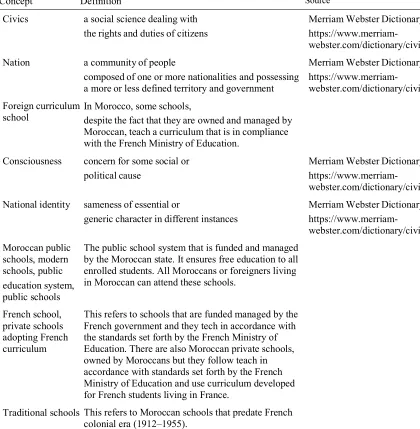
Table 1 Definitions of Terms ... 19
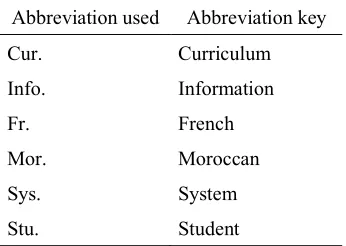
Table 2 Key to the Abbreviations Used in the Graphs ... 52
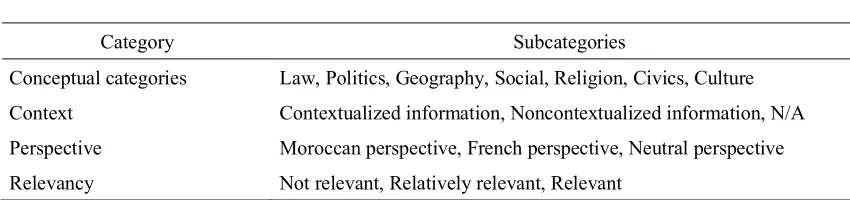
Table 3 Categories ... 53
Table 4 Incidence of Likert Scale Results ... 62
Table 5 French, Moroccan, and U.S. Appellations of Grades in Middle School ... 63
Table 6 Basic Statistics of the Curricula Components ... 66
xi
LIST OF FIGURES
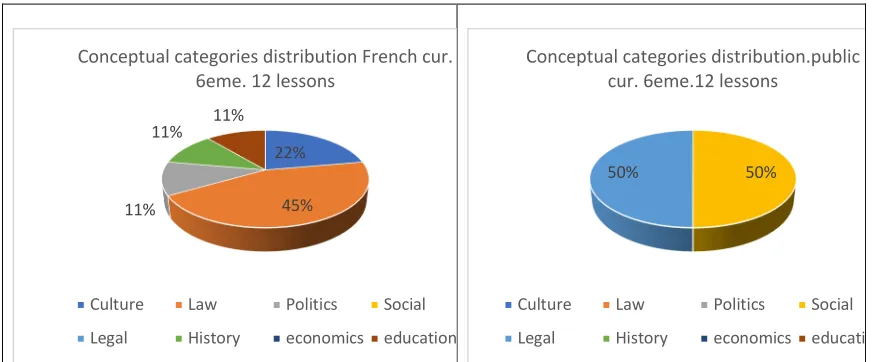
Figure 1. Conceptual categories in the Moroccan and French 6th grades. ... 67
Figure 2. Conceptual categories in the Moroccan and French 7th grades. ... 68
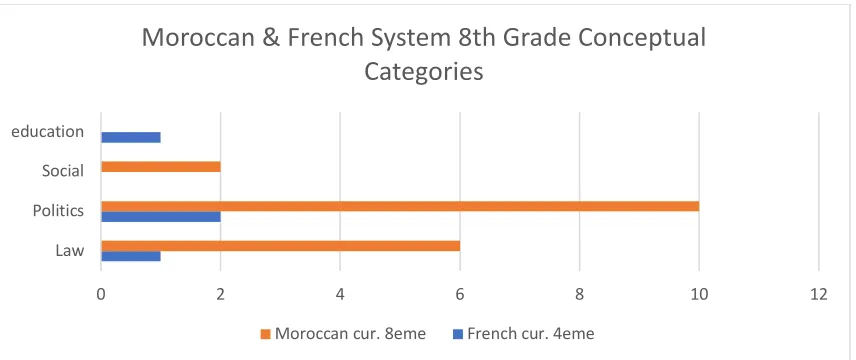
Figure 3. Conceptual categories in the Moroccan and French 8th grades. ... 69
Figure 4. Conceptual categories in the Moroccan and French 9th grades. ... 70
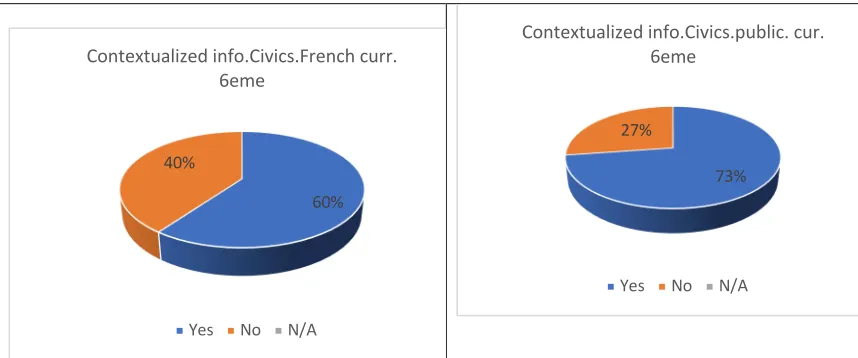
Figure 5. Contextualization in the Moroccan and French 6th grades. ... 71
Figure 6. Contextualization in the Moroccan and French 7th grades. ... 72
Figure 7. Contextualization in the Moroccan and French 8th grades. ... 72
Figure 8. Contextualization in the Moroccan and French 9th grades ... 73
Figure 9. Perspective in the French and Moroccan 6th grades. ... 74
Figure 10. Perspective in the French and Moroccan 7th grades. ... 75
Figure 11. Perspective in the French and Moroccan 8thgrades. ... 75
Figure 12. Perspective in the French and Moroccan 9thgrades. ... 76
Figure 13. Relevancy of material to the students population in the French and Moroccan 6th grades. ... 77
Figure 14. relevancy of material to the students population in the French and Moroccan 7th grades. ... 77
Figure 15. Relevancy of material to the students population in the French and Moroccan 8th grades. ... 78
CHAPTER I
THE RESEARCH PROBLEM
Statement of the Problem
Morocco as a developing country, has set as a goal to become an emerging
economy in its region. One challenge is the adequacy of its public education system to
achieve that goal. Private-sector education, local and international, has moved to fill
shortcomings in the present system and offers a perceived solution for Moroccan
families; thus, the country is increasingly facing a double-standard education system.
The private school system, especially that consisting of schools with programs
accredited by the French Ministry of Education, places its student population in a serious
dilemma. The education dispensed to these students offers them an educational narrative
anchored in French civics values that parallel but oppose the systems intrinsic to
Morocco, thereby producing two categories of citizens. One group is schooled in the
Moroccan “nationalist tradition,” whereas the other will attend school following the
French tradition. The latter causes marked difficulty for students working to cope with
the weight of French values.
This dichotomous system helps reproduce an elite that is halfway between French
and Moroccan national identities. For this elite, French is at least equally important as a
language of communication, and French national symbols are at least equally important
as Moroccan symbols. Members of this elite group bear Moroccan names and, in most
cases, have only Moroccan citizenship. At the same time, the public system helps
reproduce masses that have been inculcated with the Moroccan national narrative of
between the Arab-Islamic civilization and the local Amazigh civilizations. This
dichotomy is likely to produce an elite that does not have the same perceptions as those
of the masses in the country they share.
In the last 20 years, the Moroccan government has depicted itself as a rising tiger
in the same fashion as Southeast Asian economic powerhouses. Many economists in
Europe used the same label to describe Morocco. More importantly, as a new king came
to power in 1999, this expression of “rising economic tiger” has become more frequent in
local political discourse. Government officials and local economic experts, as well as
foreign entities with an economic interest in Morocco, have continuously stated that
Morocco has the potential to be a leading powerhouse. In their book, Hughes and Crum
stated that “Morocco in the 1990s has the potential to become a new tiger. Tough
problems exist that could preclude that advancement, Morocco is most likely to gradually
progress through the decade to become a new tiger” (McDonald, Hughes, & Crum, 2000,
p. 186). In the same vein, the Oxford Business Group (2019) reported,
in recent years Morocco has seen steady GDP growth and consistently low
inflation—in contrast to its neighbours to the north. The country’s economic
performance has both diversified and strengthened on the back of growth in the
secondary and tertiary sectors. (para. 1)
Aspiring for sustained growth, Southeast Asian countries’ governments, with no
exceptions, invested heavily in their population’s education. Following World War II
independence from the Japanese, they attempted to maintain the strength of the Japanese
system and introduced local cultural and educational traditions: for example, “the
proceeded to build a hybrid system that combined the traditional mainland Confucian
education with the more modern Japanese style” (Clark, 2010, p. 4). Maintaining
technical aspects of Japanese education proved vital for the newly liberated countries in
Southeast Asia.
The new leaders of these countries deemed the national and cultural identity
essential to developing a robust educational system that would unite all the constituencies
in these countries. In that vein, Bohr (1998) wrote in The Central Asian States as
Nationalizing Regimes that “to create unified and distinctive nations and impart a sense
of common destiny to their members, nation-builders unearth, appropriate and exploit the
ethnosymbolic resources at their disposal (e.g., customs, toponyms and ethnonyms,
national heroes, myths, state iconography)” (p. 144). The “customs, toponyms and
ethnonyms, heroes, myths, state iconography” helped develop the idea of shared destiny,
based on a bond rooted in a number of elements that are supposed to bring a group of
people together and contribute to making them a nation (Bohr, 1998, p. 144). It is
important to incorporate these elements in developing what is commonly known as
national identity. Having a national character is essential if not vital to nation building.
As Rousseau stated, “The first rule which we have to follow is that of national character:
every people has, or must have, a character; if it lacks one, we must start by endowing it
with one” (as cited in Smith, 1991, p. 75).
Nation building, especially the soft part of nation building (i.e., belief systems and
symbols) plays an integral role in minimizing the potential dissension that might appear
in a nation and leads to catastrophes similar to the civil wars that are currently taking
strong nations and countries. Although all nations have social classes based on income
and other factors, it is crucial that these social classes, despite stark discrepancies in
income and standards, share a common vision and sense of belonging to the same nation,
not only from the legal point of view—citizenship, identification cards—but from
personal-identity points of view. All nation members should feel and imagine they belong
to the same entity. It is this feeling that ensures synergy of forces in one nation and would
ultimately, under well-guided leadership, pave the way for sound economic-development
policies. This qualitative change in the destiny of a nation can only happen with a sound
education system has the trust and support of the population that entrusts its children’s
future to such a system.
With the abject and continuous failure of the public education system in Morocco,
many families, including those in the lower middle class, have opted to engage the
private sector in the education of their children. This choice created significant business
opportunities, as a population of 35 million strives to ensure decent education for its
children. Facing such a demand, many foreign educational institutions have opened
schools in Morocco. These private institutions consist of two major entities: local
institutions opened by Moroccan entrepreneurs and foreign institutions that have opened
branches in Morocco. These schools have adopted two different curriculums: one adopted
by the Moroccan Ministry of Education that parallels the curriculum used in the public
sector and one imported from the different countries of origin of these international
schools.
Today, in large Moroccan cities, especially Casablanca and Rabat, one can send
Spanish, and Belgian. In addition to the language of instruction, which varies from one
system to another, the curriculum teaches the civics content of the countries of origin of
these institutions. A case in point is a consistent reference to the notion of secularism
(separation of the state from church) in the French curriculum that is taught to Moroccan
students. These very students live in a legal environment where the state has an official
religion stipulated in the constitution
Teaching Moroccan children who would spend most of their formative years in
Morocco about the civics of other nations without addressing or marginally addressing
Moroccan civics education is likely to produce Moroccan citizens less versed in their
immediate environment. These citizens are likely to feel estranged from the majority of
the population. However, these children, given their privileged background, are likely to
end up leading major institutions in the country, especially private corporations, and will
be in positions to decide central issues without having a deep understanding of the vast
majority of Moroccan society.
The Background of the Study
As Morocco gained its independence from the French colonial power in 1956, it
embarked on an ambitious program to expand the education system to all walks of
society and ensure that the newly trained labor force could efficiently run the country. At
that time, Morocco was at the intersection of two well-established education traditions:
the centuries-old local tradition that developed around religious-based scholastic
traditions and the modern one established by the French protectorate. Ultimately, the
modern tradition prevailed and gained the upper hand as to what direction education
directions: one direction advocated maintaining the French-established process of
education, and adapting the state-of-the-art pedagogical approaches while revamping the
curriculum to inculcate Morocco-centered subjects such as history, geography, civics.
The other approach was to maintain the schooling system in the same tradition as that of
the colonial era, with marginal changes to the curriculum. In the second option, the
curriculum would still reflect France-oriented subjects.
The outcome of such conflict ended in a multipronged education system that
offered three distinct paths. First, the traditional option centered around the religious
scholastic tradition. Second is the modern option, directly managed by the Ministry of
Education and destined for the vast masses of the population. Third, the French mission
option, which was based on the French Catholic and French government-funded
institutions of the 1960s and was open to French citizens living in Morocco as well as to
children of elite families who could afford tuition. Even more important is that this type
of French school later served as a model for private-education entrepreneurs, who
structured their school around the mission education system.
Maintaining French-based schools ensured a sustained presence of the former
colonial culture and language in society. In many countries similar to Morocco, a sudden
break with the colonial education system accompanied the exclusion of all remnants of
the colonial era. Maintaining such an education system is a continuation of the notion of
interdependence that marked the independence of Morocco from France. In an April
1956 interview with the French monthly publication, Le Monde Diplomatique, Minister
Cherkaoui of the Moroccan cabinet shed light on this mutual dependence of Morocco and
between France and Morocco” (Westphal, 1956). Such a statement heralded the future of
the countries and more importantly the continued influence France had over Morocco.
The severance from colonial influence did not take place upon the independence of
Morocco.
As decades went by, Morocco, like many other Third World countries, faced
many economic hardships, especially as the result of drought and the war that took place
in the southern provinces of Morocco. The government reduced its spending on education
and started curtailing public-job hiring as a response to International Monetary Fund
requirements for assistance. This policy began a long process that ultimately contributed
to increasing challenges in the public system. With the increased influence of
market-driven ideologies and solutions pushing for limited or even a hands-off approach of the
state in education, these French or French-based schools, given their aura and perceived
high value of their education, attracted many sectors in the population.
French-based private schools provide two kinds of education: one that is
accredited by the Moroccan Ministry of Education, and the other accredited by foreign
ministries of education, depending on the origin of the program taught in the schools. The
public schooling system uses Arabic as the medium of instruction. Most subjects are
taught in Arabic. The foreign-accredited programs in the private sector use a variety of
languages based on the country origin of the program. The present study focuses on
French-accredited programs because the schools teaching them are the most prevalent in
Morocco.
A noticeable pattern has emerged in the growth of private education in Morocco.
for more than a decade the Moroccan government has been encouraging new
private schools, primarily through tax exemption. In the 2008 Manifesto of
education, the government, supported by organizations such as the African Bank
for Development, has set the objective of 25% of all age private schooling in
2024. (Kadiri, 2016, para. 9)
As a result, many families, including those from middle-class backgrounds, paid
for their children’s education in the hope that they would not have to face chronic
unemployment. The perceived a lack of credibility that the education system would
trickle down to all walks of life and social classes. Today, many parent with the financial
means believe their children ought to go to private institutions to prepare them for
success later in life. Even among the lower middle class, parents allocate a significant
proportion of their income in the hope of securing a “decent” education and a better
future for their children. The French newspaper, Le Monde, cited the example of Kenza, a
32-year-old single mother
who decided to remove her children from public school when she found out that
her eight-year-old daughter was wandering in the street during school hours.
Since then, she tightened the expense belt to be able to afford to pay school fees.
She added, “if I have to, I will not eat, but I have no choice.” Local NGO estimate
that many families allocate between 30 and 40% of their limited income to their
children’s education, while public school is free. (Kadiri, 2016, para. 4)
The proliferation of educational systems with their foreign languages of
instruction creates confusion among learners as to what language to use and when.
perceived to be of a lesser value, in this case, Arabic, as it is the language of the masses.
French language and culture wield more power and influence in the world today than
does Arabic. In multilingual societies, language choice reflects the social status that the
user of a given language tries to portray. In Language Contact, Arabization Policy and
Education in Morocco, Ennaji advanced the notion that “language attitudes in Morocco,
as in many multilingual societies, reflect a complex sociocultural piece of Moroccans at
the individual and societal levels, which accounts for hesitation and ambivalence in terms
of language choice and attitudes.” (Ennaji, 2002, p. 19)
The combination of historical and economic reasons provided a comparative
advantage to private schools following the French system. This advantage conflicts with
the general direction of the entire country, especially in the way it defines itself. The
newly adopted constitution of 2011 underscores the inherent diversity of the Moroccan
nation. The preamble of the constitution stipulates that Morocco is
a sovereign Muslim State, attached to its national unity and its territorial integrity,
the Kingdom of Morocco intends to preserve, in its plentitude and its diversity, its
one and indivisible national identity. Its unity is forged by the convergence of its
Arab-Islamist, Berber [amazighe] and Saharan-Hassanic [saharo-hassanie]
components, nourished and enriched by its African, Andalusian, Hebraic and
Mediterranean influences. The preeminence accorded to the Muslim religion in
the national reference is consistent with the attachment of the Moroccan people to
the values of openness, of moderation, of tolerance and dialog for mutual
understanding between all the cultures and the civilizations of the world.
The increased influence of French-based private schools will likely create a
society with many unequal segments in the population. The public system, in line with
the new constitution, promotes many dimensions of Moroccan national identity such as
the Berber Amazighe (Berber) and Saharan-Hassanic [saharo-hassanie], the African,
Andalusian, Hebraic, and Mediterranean influences. The French-based private schools
offer a curriculum closer to the older model of national identity, which uses the
monolithic model of national identity developed in the 18th century, albeit addressing
some diversity issues. Considering the curriculum that was the object of this study (6th
through 9th grade) one can easily notice a limited presence of multiculturalism that is
intrinsic to French society today. Pupponi, a parliament member from the Socialist Party
and mayor of Sarcelles (Val-d’Oise) stated
France, which has always been open to immigration, is becoming multicultural,
with a new trend of religious identity assertion in the public space. I noticed this
in my district of Sarcelles where significant Jewish, Muslim, and Christian
communities live together. In each community, I saw the assertion of religious
practice and wearing flashy signs that mark a break with the low-key previous
generations. This religious expression rattles a balance that was anchored in a
clear distinction of public vs. private space. However, France has not managed to
take into account this new situation. (as cited in Gorce, 2016, para. 8)
Despite multiculturalism in French society, the 6th through a 9th-grade
curriculum approved by the French Ministry of Education has limited reference to this
feature of France. Subject matter that has to do with “the other,” such as immigration or
in the very social fabric of the French nation. In this sense, the approach of the French
curriculum to national identity is rigid and still subservient to the tenet of nationalism as
developed in the 18th century.
Furthermore, this dual system portends a certain inequality among all Moroccan
graduates. As children from more affluent families attend the French-based schools, they
are more likely to integrate into large economic structures such as the banks and
multinational corporations after their graduation. Their professional ascendance is made
easier because of their mastery of French as a language and their knowledge of the
French culture, family networks, and the significant economic presence of French entities
in Morocco. Given the disparity of economic development and political influence
between Morocco and France, the children who attend French-based private schools have
a more extensive network of support that benefits from direct and indirect assistance from
the French government and other nongovernment institutions. Such support helps
students maintain a higher status than other Moroccan citizens who attend public or
private schools that follow the curriculum used in public schools. The multiplication of
schooling systems in Morocco constitutes one of the social and cultural legacies of the
colonial era that still prevails in postcolonial Morocco.
The Purpose of the Study
The purpose of the study was to examine how French accredited and Moroccan
public curriculums reflect values and principles pertaining to France or Morocco. it
explored whether or not both curriculums offer students content that replete with
elements, symbols, artifacts that could affect the development of their identity and
students, relevancy of the curriculums to the reality of students, and contextualization of
the information that is provided is part of the civics material. Civics education is a central
element in the role schools play in the development of national identity among their
students. As late as the mid-2000s, the British government made explicit efforts to
highlight the role of history in building a national identity. Berger wrote in 2007 that
Gordon Brown [British Prime Minister] has regularly spoken about the
importance of Britishness. The former-Chancellor and now Prime Minister has
reflected a general concern of the government, which last year ordered a review
on how British history could be inserted into the citizenship curriculum in schools
so as to strengthen notions of national identity and national unity. The central
place of history in strengthening national identity is neither peculiarly British nor
is it an invention of New Labour. (para 1)
The present study aimed to examine whether a demarcation emerged in the
curriculum taught in the schools following the French system from the colonial legacy by
focusing on the nature of the content it teaches and the perspectives from which the
content is cast to the learners as well as the content could be directly connected to the
realities of students. To this end, an analysis of the connection between civics on one end
and national identity on the other among some European and North American middle
school curriculums was conducted. This analysis argues that students are more likely to
be exposed to content designed and meant for French rather than Moroccan students.
In schools that offer a French accredited education, instruction follows the same
curriculum as that taught in France. Although this format can have a positive impact on
it also has the adverse effect of grooming potentially less well-versed individuals in their
civics traditions.
The Theoretical Framework
The present study used a compound theoretical framework anchored in two major
dimensions: the role of civics education in shaping national identity among students and
the legacy of colonialism in former colonies’ education. To this effect, the study built on
the modernist theory of nation building, which argues that nations are a construct and
imagined by a group of individuals who believe or imagine that some specific ties
connect them to other individuals they have never met. Modernists argue that nations are
modern constructs. Their history traces to the early 19th century, and such factors could
explain their existence as the erosion of monarchical societies and concurrent
industrialization, anticolonialism, the clash of traditionalism with modernism,
democratization, and quest for power and its benefits. “According to this approach,
nations and nationalism appeared in the last two centuries, in the wake of the French
Revolution, and they are the outcomes of the industrial revolution, capitalism, the
emergence of the modern state, urbanization and secularism” (Suleymanov, 2008. p. 5).
In this respect, the modernist approach fits perfectly with a former colony such as
Morocco. Morocco did exist as a country with a central government for many centuries
before the French colonial era in the 20th century. For the last 3 centuries, Morocco
experienced a long period of internal strife and upheaval. The French protectorate
relaunched Morocco as a country with a stable central government. During the early days
of Morocco’s independence in the mid-1950s, a strong need emerged for “nation
It is essential to bring to consciousness those elements shared by a given
population and that form the nomenclature of symbols and beliefs that tie the nation
together. Being aware of shared experience was important during the rise of nationalism
in Europe during the 17th and 18th centuries and more critical for newly independent
countries after the large postcolonial waves of Third World nationalism in the 20th
century. Anderson (2006) wrote,
for the paradox of official imperial nationalism was that it inevitably brought what
were increasingly thought of and written about as European national histories into
the consciousness of the colonized-not merely via occasional obtuse festivities,
but also through reading rooms and classrooms. (p. 32)
Although history shapes the narrative that gives meaning and serves as a tool of
interpretation to actual and sometimes imagined events, civics offers a structure in which
that narrative could exist and be protected through the different arms of the state. Civics
brings to light the institutions and organizations governing a given nation. Civics is an
objective and tangible reality that the people of a given nation experience in their
everyday life. Moreover, civics provides a set of institutions and processes to which the
nation could adhere and, from that place, develop a shared corpus of beliefs. Krop posited
that “school-based nationalism of the republic is channeled through civics education that
maintained the 1870 traumatism (defeat against the German) alive” (n.d., para. 2)
However, it is essential to keep in perspective the general context where this
inculcation of civics occurs: the postcolonial context. The legacy of the colonial era
marks this context and how it affected the education systems in former colonies. In the
traditional schools formed before the colonial education system in Morocco) were
established after the French occupied the country. Therefore, the very existence of the
modern schooling system is a direct consequence of French colonization. However, after
independence, the colonies were expected to develop their education systems. It is at this
level where the second component of the theoretical framework becomes important,
especially with the role education played in ensuring a continued and sometimes constant
connection between the former colonial power and its respective colonies. This
theoretical component, postcolonial theory,
deals with the reading and writing of literature written in previously or currently
colonized countries, or literature written in colonizing countries which deals with
colonization or colonized peoples. It focuses mainly on how literature by the
colonizing culture distorts the experience and realities and inscribes the
inferiority, of the colonized people on literature by colonized peoples which
attempts to articulate their identity and reclaim their past in the face of that past’s
inevitable otherness. It can also deal with the way in which literature in colonizing
countries appropriates the language, images, scenes, traditions and so forth of
colonized countries. (Lye, 1993. p. 1)
This theory is important for the present paper because it addresses the underlying
assumption of maintaining the relations of a formerly dominant power (France) and a
previously dominated colony (Morocco), even though Morocco gained its independence
in 1956. The education dispensed at schools that adopt a French-designed curriculum
serves to ensure the relation such that France is the country of knowledge and expertise,
Research Question
The following research question guided this study: To what extent is the type of
content of civics instruction in middle schools using French curriculum an extension of
the colonial legacy? How does the curriculum used by such schools compare with those
used in public schools?
Research Hypothesis
The present study builds on the hypothesis that students who attend schools that
follow the French system are more likely to be exposed to civics content about France
than those attending Moroccan public schools. The present study explored how a
curriculum developed outside the country where it is taught introduces civics education to
Moroccan students. The focus was be on civics education, which is a country-specific
subject. In fact, unlike literature or physics, civics is not interchangeable in the sense that
teaching a curriculum designed for Audience A was not have the same intended outcome
if it is taught to Audience B. Although the Residence school system (a school that teaches
French curriculum to Moroccan students) may be driven by a will to provide students
with an international education, it still could portend some failures in providing these
very students with knowledge that would help them develop a well-rounded education
easing their connection to the environment where they live. The Oxford English
Language Dictionary (2017) defines national identity as “A sense of a nation as a
cohesive whole, as represented by distinctive traditions, culture, and language” (para 1)
Limitations
The present study focused on one foreign school system in Morocco: La
can afford the tuition fees. This study specifically focused on how the curriculum taught
in this kind of school is likely to include civics education. With such a focus, the present
study was limited to the subjects of education and did not cover other subjects studied in
each grade of the school. It was also limited to this school. Being a private business, each
of these schools enjoys a large margin of freedom and can incorporate many additional
elements into their daily schedule. Also, this study did not compare schools using foreign
curriculums with the category of school that teaches based on the old religious scholastic
model. Its focus is schools using foreign curriculums versus the general public school
system. Another limitation of the study is that it exclusively probed middle school and
did not explore primary or high school levels.
Another limitation of the present research is the bias that the research brings. The
researcher is a product of elementary private schooling and public middle and high
schooling in Morocco. It should be noted that the private school attended by the
researcher was part of a project launched by the nationalist movement, especially, the
Istiqlal Party (Party of independence) to produce graduate fluent on both French and
Arabic. As such, half of instruction was conducted in Arabic and the other half in
French.
The Significance of the Study
The education offered to a population helps this population understand who they
are, their background, and their present and future. Morocco, despite a long history as a
nation as well as a state, still encounters some challenges as to the nature of the elite
running it. A pro-French social and economic elite continues to wield significant power.
and curriculum designed for non-Moroccans and imported to Morocco as part of the
foreign-school presence in the country. These children, after advanced education, return
to the country and gain higher level positions, thanks to family networks and their
education credentials. In such positions, whether in public or private sectors, they make
decisions affecting the general population that was schooled in a completely different
Table 1
Definitions of Terms
Concept Definition Source
Civics a social science dealing with the rights and duties of citizens
Merriam Webster Dictionary https://www.merriam- webster.com/dictionary/civics Nation a community of people
composed of one or more nationalities and possessing a more or less defined territory and government
Merriam Webster Dictionary https://www.merriam- webster.com/dictionary/civics Foreign curriculum
school In Morocco, some schools, despite the fact that they are owned and managed by Moroccan, teach a curriculum that is in compliance with the French Ministry of Education.
Consciousness concern for some social or political cause
Merriam Webster Dictionary https://www.merriam- webster.com/dictionary/civics National identity sameness of essential or
generic character in different instances
Merriam Webster Dictionary https://www.merriam- webster.com/dictionary/civics Moroccan public schools, modern schools, public education system, public schools
The public school system that is funded and managed by the Moroccan state. It ensures free education to all enrolled students. All Moroccans or foreigners living in Moroccan can attend these schools.
French school, private schools adopting French curriculum
This refers to schools that are funded managed by the French government and they tech in accordance with the standards set forth by the French Ministry of Education. There are also Moroccan private schools, owned by Moroccans but they follow teach in accordance with standards set forth by the French Ministry of Education and use curriculum developed for French students living in France.
Traditional schools This refers to Moroccan schools that predate French colonial era (1912–1955).
Understanding the way young children who are likely to hold influential positions
in Morocco as they grow into adult life are socialized to develop a sense of national
identity is essential if not vital for the long-term cohesion of the nation. Although
generation, irrespective of its belief system, ethnic, and socioeconomic background, is
bound together by certain ideas and principles. Since independence, and more intensely
in the last decade, a profound gap emerged in Morocco between how members of the
same nation are schooled and exposed to the tenets of national-identity. A case in point is
the great divide between those who tend to favor education in the French language and
those who want to maintain Arabic as the language of instruction and add Tamazight
(also known as Berber). This divide has and will have a significant impact on society and
social mobility. The next chapter, the review of the literature, describes in detail the
elements that come into play in shaping national identity based on the role of schools.
CHAPTER II
REVIEW OF LITERATURE
The review of the literature describes the role of education, and especially civics
education, plays in the development of national identity in the mind of students. It starts
by examining the role of schools in such a process. Then, it includes a historical overview
of post-independence school in Morocco and rebuilding the national identity. It also
addresses how civics instruction intersects with history in nation building and civics
instruction in Morocco. Finally, it discusses the U.S. and French traditions as they pertain
to the role of civics in the development of national identity.
The Role of School in Developing National Identity
Nationalism is a feeling or sentiment of belonging to the same group and sharing
the same destiny that a population shares. This feeling is transmitted from a generation to
another through a variety of means and tools. In European countries where modern
nationalism developed, many social and political institutions have ensured that future
generations would be aware of belonging to a specific group or nation. These institutions
were the media, the various branches of the government, the universities, and schools.
Historians and political scientists share universal agreement that the school has been one
of the significant tools through which this sentiment has been transmitted from one
generation to another. Maia (2012) posited that
education has played a prominent role in the awakening and fostering of
nationalism, which led to the autonomy and independence of many former
colonized countries around the world. This is also true with nation-building in
role as the unifying factor, the strengthening of social cohesion and the shaping of
national identity in the formation of the new “imagined communities.” (para. 1)
As will be discussed later, the same notion applied to Morocco where the
institution of the school played a central role in developing a common awareness of a
shared condition, thereby strengthening a feeling of shared history and destiny among the
population. In Europe, the school system served as a conduit of the rising nationalist
ideology, ensuring a systemic indoctrination of students. Reisner (1922) stated that
“nationalism calls for universal education in order that there may be a general
development of individual power – physical, mental and moral- so that the nation
composed of individuals may realize its full military and economic strength” (p. 2).
Numerous authors supported the idea that European governments saw in the
school system a way to spread the fast-growing ideas of nationalism and ensured that the
new generations were inculcated with the principles of the nation and its unity. Talking
about the importance of the school system in the consolidation of nationalism, Napoleon
Bonaparte declared during a Council of the State in 1807 that
of all our institutions, public education is the most important. Everything depends
on it, the present and the future. It is essential that the morals and political ideas of
the generation which is now growing up should no longer be dependent upon the
news of the day or the circumstances of the moment. Above all we must secure
unity: we must be able to cast a whole generation in the same mould. (as cited in
Markham, 2010, para. 28)
A similar line of thought has marked the school experience in Morocco during the
through the same mold, it did de facto shape their imagination. The French saw the role
of the school as a means to train the local population so it acquired sufficient skill to
work in lower level positions in the local government or corporations. One unintended
consequence of putting a significant number of Moroccan children through the same
experience is that it shaped their understanding of their conditions and federated their
self-perception as antonymic to the French.
Historians seems to agree that schools in modern Europe and later in other parts
of the world played an important role in spreading and consolidating the ideas of
nationalism. Schools served, in some cases, as a way to bring together a potentially
diverse set of principles and turn them into a narrative or shared history. Such endeavors
proved decisive, especially in colonies where schools played an essential role in shaping
the national consciousness. In the colonies, schools or education marked a deep
bifurcation of the colonized societies. The colonial power instauration of an education
system broke the colonized societies into those with access to education in colonial
schools and those that did not. Anderson (1983) advanced that
in the colonies, things were very different. Youth meant, above all, the first
generation in any significant numbers to have acquired a European education,
marking them off linguistically and culturally from their parents’ generation as
well as from the vast bulk of their colonized age mates. … this reminds us of the
unique role played by the colonial school systems in promoting colonial
nationalism. (pp. 119–120)
Irrespective of context—whether the nation developed “organically” through
factors such as in the colonies—schools played a crucial role in transmitting a set of ideas
that raised new generations with the firm belief in their shared history and, more
importantly, their shared destiny. A similar experience took place in Morocco where
schooling marked an apparent gap between older generations and new ones and between
the schooled and the unschooled. It is not a coincidence that the independence movement
included students who attended traditional as well as the French colonial schooling
system. However, the question arises, Which social institution had the most impact on
shaping perceptions of shared experience and shared history? Also, is it vital that
inculcating principles of national identity ties to the country where the school and
students live, or it is possible to transmit national identity principles and let students
explore their ramifications?
The role of the school is central to the present research. It is the venue through
which the information relevant to what constitutes national identity is transmitted to
students. As students spend most of their day in school learning about different topics, the
school has replaced the role family used to play in the socialization process. The
institution of school allows for a systematic inculcation of given narratives to students.
This inculcation has proven to be effective as a large swath of the population bear similar
or the same beliefs and perceptions of who they are as a community and a nation. The
Oxford English Language Dictionary defined national identity as “a sense of a nation as a
cohesive whole, as represented by distinctive traditions, culture, and language” (Oxford
English Language Dictionary, 2017, (para 1) In this sense, the school is a reliable tool at
the behest of the state or private actors to ensure sustainable cohesion of the nation. The
content of instruction is crucial to what students turn out to be. In particular, the content
of instruction in the school that are objects of this research rest on two different and, in
some historical events, dialectically opposed entities, such as in the case of the colonizer
and the colonized. The colonizer, France, originated the curriculum for the La Residence,
the school of interest her in considering Moroccan students of La Residence in Morocco.
This paradoxical mix brings to light an important question: could Moroccan national
identity build and develop through French historic events and civics principles?
Postcolonial Education
The French education system in Morocco represents a cultural legacy of the
colonial era. The schools that adopt the French curriculum and instructional content are a
reminder that although Morocco gained its political independence in 1956, substantial
and influential economic, social, and cultural ties between the two countries persist, and
specifically between the social elite in Morocco and the French. The ever-growing
influence of the French education system points to a bifurcation in the development of
society, especially with a significant part of its elite opting for an education system that
does not align with what the rest of the population receives. The continuation of the
colonial legacy paves the way to a two-fold education system: the one for the elite
ensures the perennity of their ties with France whereas the second system trains the rest
of the population following different ideals. With Morocco’s independence in the
mid-1950s, the continuity of French influence over its former colony remained in place. It was
French official government policy to encourage a cultural, political, economic anchorage
France strives to maintain its cultural legacy, with a significant portion of
development funding going towards education, scholarships, and cultural
institutes. Various inter-governmental organizations and conferences have
operated under the hub of the Agence de cooperation culturelle et technique to
institutionalize the linguistic, cultural and educational links between France and
francophone Africa (Martin, 1995, p. 8).
A concerted effort persists to maintain strong ties between colonial powers and former
colonies. Those ties were expected to ensure a particular connection and reliance on the
former colony for technical expertise, which also guaranteed markets for products of the
former colonial power.
This approach goes against the positions of Edward Said, Gayatri Spivak, and
Homi Bhabha in postcolonial theory. Three elements were highlighted as the backbone of
postcolonial education reform: “voice—who is speaking, for/with whom, which gender
and who is listening; context—from system to the context of private/public lives; [and]
theory—from modernity to postmodernity to critical post-coloniality” (Fox, 2003. p. 91).
The curriculum taught in the Residence School is bereft of a voice that speaks of the
cultural background and context of the students, instead showing French notions and
concepts in a completely foreign environment, devoid of a postcolonial approach that
could shed light on Morocco’s postindependence experience.
Teaching about French-centered topics serves to maintain the relationship that
prevailed during the colonial era with the colonial power as the center and the colonies as
the periphery. It inculcates in the mind of the Moroccan students a status of preeminence
dependency on France in many ways. Similar to other African countries, Morocco
experienced a legacy of colonialism that continued to affect its education well after its
independence. Shizha wrote,
the school curriculum in post-colonial Sub-Saharan Africa experiences challenges
that are a legacy of colonial education that remained in place decades after
political decolonization. The case for African school curriculum is contentious in
contemporary Africa because it negates the voices of indigenous African
populations. Despite the advent of decolonization that started in the 1960s,
African education systems mirror colonial education paradigms inherited from
former colonial governments. Colonial education was hegemonic and disruptive
to African cultural practices, indigenous knowledges (IKs) and ways of knowing.
(2013, p. 1)
Reading French novels, for example, serves to enhance the image of a self
“French” and Other “former colonies” among the student population. Reading text that
casts the other as being the self leads to a certain level of alienation of these students as
they are taught to be a self that they are not.
Literature is something that is immensely important in the formation of imperial
attitudes, references, and experiences. Stories are at the heart of what explorers
and novelists say about “strange” regions of the world; they also become the
method colonized people use to assert their own identity and existence of their
history. The primary battle in imperialism is over land, of course; but when it
came to who owned the land, who had the right to settle and work on it, who kept
reflected, contested and even for a time decided in narrative. The power to
narrate, or to block other narratives from forming and emerging, is significant to
culture and imperialism and constitutes one of the main connections between
them. Most importantly, are the grand narratives of emancipation and
enlightenment that mobilized people in the colonial world to rise and throw off
imperial subjection. (Said, 1993. p. 24)
Seeing things through the eye of the other brings a discursive understanding of the
self. The self is framed by what the other decides and wants it to be. This extremely
disarming power is an additional tool used to ensure eternal subordination to the former
colonial power and ensures its hegemony over the colonies, encompassing political and
economic interests.
Nation-Building: Role of History
Although the present paper focuses on the role of civics education, it is important
to discuss the role of history in shaping a given narrative through a selective reading of
historic events, especially that civics content is the cumulation of action undertaken by all
stakeholders in a state. These actions have a historic dimension in the sense that they
shape how the country/nation perceives itself and how these many seminal historic events
culminated in laws and regulations that form the core corpus of the legal environment,
which in turn defines civics in that specific country.
First, civics education or content is the cumulation of historic events that have
marked a nation. Second, as with all the corpora of knowledge, the learner retains a
students are likely to retain elements that would help construct a less than thorough
understanding of their immediate environment
Many scholars of history have underscored the centrality of history teaching in
nation building. History has been presented as the sine qua non condition for a nation to
come together around some specific and unique beliefs that eventually would form the
core of the nation. Mohammed saw the role of history in nation building as
the reconstruction of record of the activities of man on earth, his religion, politics,
economy, long existed inter group-relations, commercial contact and other aspects
of human life. To a large extent, it is concerned with the study and reconstruction
of the history of how and why change in the past, for the conscious transformation
of the present to secure a meaningful future, moreover, conceptualized as the
study of change for change. (2013, pp. 50–57)
Teaching history focused on many dimensions of the heritage of a group of the
population. It focused on belief systems, language, ethnicity, historical events, or
historical figures to emphasize the common thread among a group of people.
History, whether taught at school or transmitted through oral folk culture,
indicates to its audience their shared background. By stressing shared background and
experience, history as a subject sheds light not only on what brings a group of people
together but also on their inevitable shared future and shared destiny. In countries
colonized by European powers that gained their independence mid-20th century, schools,
despite the objectives set forth at their inception, served as a medium to inculcate basic
principles of a shared history and background, which metamorphosed with increased
the importance of teaching symbols of the nation, saying “to create unified and distinctive
nations and impart a sense of common destiny to their members, nation-builders exploit
the ethno-symbolic resources at their disposal (e.g., customs, toponyms and ethnonyms,
heroes, myths, state iconography)” (p. 153). The use of symbols brings to light the
cardinal issue of the gap between students who attend Moroccan government schools and
those who attend schools that teach French Ministry of Education-sanctioned curriculum
regarding the creation of “unified and distinctive nations” (Bohr, 1998, p. 159); and
imparting “a sense of common destiny to their members” (Bohr, 1998, p. 159). This gap
is likely to result in two different conceptions of the Moroccan nation. How can a nation
be unified and distinctive if its children are taught different histories with different
narratives?
It is a common finding among many research endeavors that the school system
was one of the tools used to build the nation. Throughout recent history, in many cases
nation building was promoted through education. A case in point is the process of
reconceptualization and recreation of a national identity that took place in Tajikistan upon
the dislocation of the Soviet Union. The new rulers of the country tried to revive an old
but extinct religion to cast the country as one political entity. Schools, curriculum, in
particular, played an essential role in transmitting given ideas and notions to new
generations, as Kim stated,
the modern school textbooks have it that eastern and western “Tajikland” were
united in a single religion Zoroastrianism to which all people adhered.
Zoroastrianism is re-interpreted as a unifying force connecting major Tajik
its legitimacy and claims over “lost: territories and alluding at its ethnic
superiority over the Uzbek minority and the more powerful Uzbek neighbor.
(2011, p. 52)
Learning such symbols is a potent tool that cements a given idea in the minds of
the audience, and paves the ground for the majority of this audience to be predisposed to
develop a sense of belonging to a larger imagined group. It is an imagined group
“because the members of even the smallest nation will never know most of their
fellow-members, meet them, or even hear of them, yet in the minds of each lives the image of
their communion” (Anderson, 1983, p. 6). Moreover, history serves to understand and
interpret the present in a more or less uniform way, which explains the similar reaction a
large group tends face with a specific event. Suleymanov (2008) posited,
since people often refer to history when tracing their national identity and
defining relation to the state, interpretation of historical data acquires a certain
level of significance and becomes politicized. There is no doubt that historical
facts in general and their interpretation, in particular, have a specific impact on
both the present and future of society. It has become common for people to look
back to history when either trying to understand modernity or attempting to
predict the future. (p. 7)
In the same vein, Uzbekistan chose an old “perceived” hero to use as a symbol of
national identity. Extensive efforts have been put forward to revive old empires and their
symbols to consolidate the idea that Uzbekistan as a state existed before the Soviet
more focus was put on an old empire that governed the lands where Uzbekistan sits
today.
One can notice that the study of the Timurid empire has been introduced at all
levels of public education and cultural life. It would not be wrong to assume that
an intensive study of this specific historical period has become a national policy
of the Uzbek Government. As Neil Melvin notes, “One of the most notable
elements of the reinvention of the past has been the program by the Uzbekistani
authorities to foster a cult around the figure of Amir Timur” who “has emerged as
the central icon of campaign to rewrite national history and as a part of the
broader movement toward an Uzbek ‘cultural renaissance.’” (as cited in
Suleymanov, 2008. p. 8)
This reinvention distances the newly established state of Uzbekistan from the
former dominant yet foreign power of Russia during the Soviet era. Textbooks defined
Uzbekistan in students’ minds as being opposite to the Soviet era.
It is with the help of the Uzbek Government, which tries to reject the Soviet past
and re-invent the history of the state, that Tamerlane has become an Uzbek
national hero. Indeed, one can notice that starting in the mid-1990s his personality
has been idealized and received much attention from the state and state-controlled
academia. For example, one Uzbek history professor answering the question
“Why is Tamerlane being praised and idealized in Uzbekistan?” replied that
“Tamerlane was a wise ruler, and there is nothing wrong with learning how to
In other instances, including those in countries perceived to have a long and well-
established democratic governance, government through the school system attempts to
ensure a constant nationalistic feeling among the new generation. A case in point is
Japan. Starkey posited that in
the early 1990s, the Japanese Ministry of Education stipulated that the flag and
anthem must be used in school ceremonies, despite some public resistance.
Renewed pressure was applied in the late 1990s, and now almost all schools
display the flag and sing the anthem. In Tokyo, teachers are disciplined for not
standing to sing the anthem at ceremonies, and a number of court cases are
ongoing as teachers see this as an infringement on the freedom of thought. (2010,
para. 11)
The reading of history and its interpretation is not comprehensive or holistic in the
sense that it covers every aspect of history. It is very selective and tends to stress and
highlight some event, sometimes turning events into seminal historic events while
overlooking others and treats them, at best, as little details of history. Renan stated that
“the essence of a nation is that all its people have something in common and also all have
forgotten many a thing” (1992, p.3).
With these examples where the school system focused on unifying threads to form
a certain perception of the nation, one cannot but ask the question, What impact would
teaching Moroccan children about the achievements of French national hero, Jeanne
D’Arc, to the exclusion of Moroccan heroes, have on the way they would perceive
and historical events perceive major Moroccan historical heroes and events that the
majority of the Moroccans attending public school hold in respect?
Civics and Schools in Morocco
To consolidate the idea of modern nationalism in the postcolonial era, the newly
independent state of Morocco, through its Ministry of Education, set in motion many
education programs that stressed a nationalistic feeling among the population. The idea
behind such an approach was to ensure the development of national identity through the
school system. For a long time, citizenship was almost always associated with sentiments
of belonging, loyalty, and shared beliefs to which all citizens, at least to a significant
proportion, ought to adhere. Civics education has sought to ensure social cohesion in
“closed” societies (societies constituting one national unit) through shared norms and
behavior conformity (McAndrew, Tessier, & Bourgeault, 1997, p. 58).
Schools around the world have played an important role in the construction of
national identity. As recently as 1988, the British Parliament passed a law, the 1988
Education Reform Act, that defined the framework of the national curriculum. The act
stipulated that national curriculum aimed to “promote the spiritual, moral, cultural,
mental and physical development of pupils, and to prepare pupils for the opportunities,
responsibilities, and experiences of adult life” (Elder, 2014, para. 4)
The teaching of civics in Morocco has contributed to the development of a
specific idea of what constitutes national identity in Morocco. Unlike modern nationalism
in Europe, Morocco focused on its diverse characteristics rather than on reducing its
identity to language or ethnic background. In an interview with the magazine Zamane,