J
INDY
: a Java library to support
invokedynamic
Patricia Conde and Francisco Ortin
University of Oviedo, Computer Science Department Calvo Sotelo s/n, 33007, Oviedo, Spain
{condepatricia,ortin}@uniovi.es
Abstract. Java 7 has included the newinvokedynamicopcode in the Java vir-tual machine. This new instruction allows the user to define method linkage at run-time. Once the link is established, the virtual machine performs its common opti-mizations, providing better runtime performance than reflection. However, this fea-ture has not been offered at the abstraction level of the Java programming language. Since the functionality of the new opcode is not provided as a library, the existing languages in the Java platform can only use it at the assembly level. For this reason, we have developed the JINDYlibrary that offersinvokedynamicto any program-ming language in the Java platform. JINDYsupports three modes of use, establishing a trade-off between runtime performance and flexibility. A runtime performance and memory consumption evaluation is presented. We analyze the efficiency of JINDY
compared to reflection, theMethodHandleclass in Java 7 and the Dynalink li-brary. The memory and performance costs compared to theinvokedynamic op-code are also measured.
Keywords:invokedynamic, Java Virtual Machine, dynamically generated classes, reflection, runtime performance.
1.
Introduction
The Java platform offers a set of features, such as platform independence and adaptive HotSpot JIT compilation, which has led to its widespread use and general acceptance. These features have contributed to the proliferation not only of libraries, frameworks or applications, but also of languages implemented on the Java platform. An existing re-search has identified more than 240 language implementations on this platform [28], in-cluding some well-known examples such as Scala, JRuby, Groovy, Jython and Clojure.
Until the inclusion of theinvokedynamic opcode, the dynamically typed lan-guages implemented on the Java platform had to simulate the dynamic features that the platform did not support. Reflection was the main feature to obtain dynamic method invo-cation. However, this simulation usually causes a runtime penalty [24]. The key difference betweeninvokedynamicand the reflection API is the runtime checks upon method ac-cess. Reflection performs these checks at every method call, whereasinvokedynamic
perform this check upon method handle creation [28]. Another difference is the possibility to avoid type conversions performed by the reflective approach (i.e., avoiding the use of
Object). These differences suggest thatinvokedynamiccan be used to improve the runtime performance of dynamic language implementations [33] and any library, frame-work or Java application that makes significant use of reflection.
Despite the expected benefits of the newinvokedynamicopcode, the Java pro-gramming language has not been changed to support this feature. Furthermore, the new
java.lang.invokepackage in Java 7 [22] does not provide a high-level mechanism to use invokedynamicfrom within the platform. The new bytecode is expected to be used mainly by compilers that generate binary code including the new JVM instruc-tion. However, this fact makes it difficult to access this functionality from any high-level language on the platform. A first use case from a high-level language could be as an alter-native mechanism to reflection. There could be some other scenarios, such as the dynamic separation of aspects [23] and the implementation of multi-methods [6].
The main contribution of this paper is the development of a Java library, called JINDY, to support theinvokedynamicopcode from any high-level language on the Java plat-form. Additionally, we assess its runtime performance, compared to the existing ap-proaches. We also measure the penalty introduced by our library in comparison with the direct use of theinvokedynamicopcode.
This paper is structured as follows. Section 2 describes theinvokedynamicopcode and the dynamic code generation technique used in the development of JINDY. The library is described in Section 3, and Section 4 evaluates its runtime performance and memory consumption. Section 5 discusses the related work and Section 6 concludes and presents the future work.
2.
Context
2.1. Theinvokedynamicinstruction
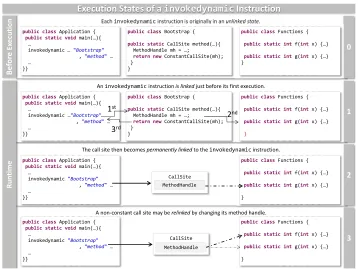
TheinvokedynamicJVM opcode provides a new user-defined dynamic linkage mech-anism, postponing type checking of method invocation until runtime. As shown in Fig-ure 1, aninvokedynamicinstruction is initially in anunlinked state (state 0 in Fig-ure 1). That means that each invokedynamic instruction (main method of the
Applicationclass in Figure 1) does not statically specify the method responsible for conducting the dynamic method selection. This method, in theinvokedynamic docu-mentation, is calledbootstrapmethod (methodof theBootstrapclass in Figure 1).
Each invokedynamicinstruction is originally in an unlinked state.
A non-constant call site may berelinkedby changing its method handle. The call site then becomes permanently linked to the invokedynamicinstruction.
An invokedynamicinstruction is linked just before its first execution.
CallSite R u n ti m e B e fo re E x e c u ti o n CallSite MethodHandle public classApplication {
public static voidmain(…){ …
invokedynamic …"Bootstrap" ,"method"… …
}}
public classFunctions {
public static intf(intx) {…}
public static intg(intx) {…} }
public classBootstrap {
public staticCallSite method(…){ MethodHandle mh = …;
return newConstantCallSite(mh); } } MethodHandle 0 1 2 3
Execution States of a invokedynamicInstruction
public classApplication { public static voidmain(…){
…
invokedynamic …"Bootstrap" ,"method"… …
}}
public classBootstrap {
public staticCallSite method(…){ MethodHandle mh = …;
return newConstantCallSite(mh); }
}
public classApplication { public static voidmain(…){
…
invokedynamic "Bootstrap" ,"method"… …
}}
public classFunctions {
public static intf(intx) {…}
public static intg(intx) {…}
}
public classFunctions {
public static intf(intx) {…}
public static intg(intx) {…}
} public classApplication {
public static voidmain(…){ …
invokedynamic "Bootstrap" ,"method"… …
}}
1st
2nd
public classFunctions {
public static intf(intx) {…}
public static intg(intx) {…}
} 3rd
Fig. 1.Runtime execution ofinvokedynamic.
holding theMethodHandlethat represents the selected method (gof theFunctions
class in Figure 1).
Aninvokedynamicinstruction is consideredpermanently linkedwhen the boot-strap method returns aCallSite(state 2 in Figure 1). From that time on, the following invocations simply call the method referenced by the returned MethodHandle. Be-sides, the JVM will apply the usual optimizations performed for common statically typed method invocations.
It could be necessary torelinkthe linked method, due to some event occurred at run-time (state 3 in Figure 1). After relinking, the MethodHandle will point to
Functions.finstead of to the originalFunctions.gmethod. For this purpose, the newinvokepackage [22] offers three implementations of theCallSiteabstract class: theConstantCallSite class for permanent method handles, and the Volatile-CallSiteandMutableCallSite classes for relinking a method handle with the same type descriptor (MethodType) –VolatileCallSitesupports multi-threading.
2.2. Dynamic code generation
Since invokedynamicis a JVM opcode, JINDY generates JVM code to provide its functionality. Moreover, the code generation process should be performed dynamically, because this opcode postpones linking until runtime.
ASM1[5] is a code generation framework used to implement dynamic languages such as JRuby [20], Jython [12] and Groovy [15]. It has also been used to implement other code transformation tools such as JooFlux [26] and Soot [4]. This framework can be used to modify existing classes and dynamically generate new ones, managing their binary rep-resentation. ASM 4.0 supports the newinvokedynamicopcode. For all these reasons, we selected ASM to dynamically generate JVM code in the implementation of JINDY.
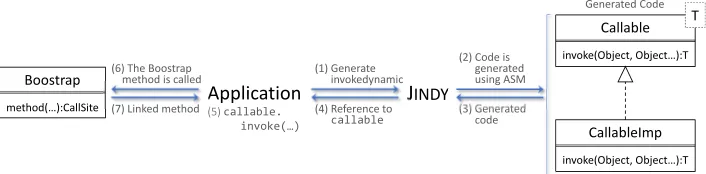
Figure 2 shows the process we follow to supportinvokedynamicfrom any high-level language on the Java platform. An application calls JINDY(1) that, in turn, uses ASM to generate JVM code at runtime (2). The generated code includes a class that implements theCallable<T>interface shown in Figure 2. The generatedinvokemethod consists in aninvokedynamicJVM instruction specifying a bootstrap method. The parameters JINDY passes to ASM to generate the appropriate invokedynamicstatement are: a
Stringwith the symbolic name of the method to be invoked; anotherStringwith its type descriptor; and a Handleto identify the bootstrap method (the names of the bootstrap class and method). More parameters can optionally be passed.
Once the binary class is generated, it is dynamically loaded and instantiated (3). To load the binary class, JINDYimplements aClassLoaderthat loads the class after gen-erating it. Once loaded, our library instantiates the class by calling its constructor (us-ing reflection), return(us-ing aCallable<T>object (4). When the programmer calls the
invokemethod of this interface (5), theinvokedynamicopcode will be finally ex-ecuted by the JVM (as described in Figure 1), since this opcode is the generated method body. The first parameter of invoke is the object the underlying method is invoked from, i.e.this(nullif the method isstatic), and the rest of optional parameters are the method arguments. As mentioned, an invokedynamicexecution of an unlinked method causes the execution of the bootstrap method (6), its linkage (7) and the final execution.
Application
J
INDYCallable
invoke(Object, Object…):T
CallableImp
invoke(Object, Object…):T
Boostrap
method(…):CallSite
T
(2) Code is generated using ASM
(3) Generated code
Generated Code
(5) callable. invoke(…)
(1) Generate invokedynamic
(4) Reference to callable (6) The Boostrap
method is called
(7) Linked method
Fig. 2.The dynamic code generation process implemented by JINDY.
The dynamic code generation mechanism shown in Figure 2 has been previously ap-plied in Groovy to perform dynamic method invocations [15]. Dynamic code generation
1
involves a runtime performance and memory consumption penalty, as discussed in Sec-tion 4.4. We have reduced this penalty by implementing a cache of instantiated classes, avoiding the generation existing classes.
3.
JINDY
The implemented library allows the programmer to use theinvokedynamicopcode from any language implemented on the Java platform. JINDY can be used in all the sce-narios whereinvokedynamicmay be useful. Programmers may create their own boot-strap methods to define how call sites must be dynamically linked. Besides, it also pro-vides specific routines as a more efficient alternative to the reflection API. This section shows examples of using JINDYin these scenarios.
The motivating example uses JINDY to implement a dynamically adaptable depen-dency injection system. Dependepen-dency injection is a software design pattern that allows removing hard-coded dependencies between software components (beans) [10]. Depen-dencies are described in a separate document that is processed by theinjector(sometimes called container, assembler or provider), which creates instances of the appropriate classes and interconnects them. We show how to perform this instantiation and interconnection with JINDY. Besides, we extend the injector to support the dynamic modification of ob-ject dependencies without changing the source code of the application, using invoke-dynamic.
3.1. JINDYas an alternative to the reflection API
We first use JINDYto implement a typical dependency injection system (in the following subsections we extend it to make it dynamically adaptable). This first scenario shows how our library provides a more efficient alternative to the reflection API (see the performance evaluation in Section 4). Both component instantiation and interconnection are done using JINDY.
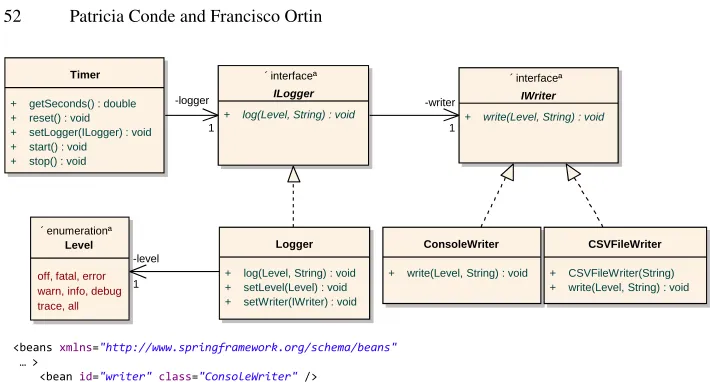
The top of Figure 3 shows an example class diagram, where aTimer class pro-vides a set of methods. When these methods are called, the timer logs information by using its associated logger. Similarly, an ILoggerinvokes the writemethod of the associatedIWritter(when thelevelof the message to be logged is greater or equal to thelevelfield of the logger [1]). Figure 3 presents two types ofIWriters:
ConsoleWriterto show messages on the console, andCSVFileWriteto write in-formation in comma-separated value text files.
We have used an XML document format similar to the Spring Framework to declare the dependencies between components [29]. The example document in the bottom of Figure 3 shows how aConsoleWriterinstance is assigned to thewriterfield of the
Loggerclass, and aLoggerinstance is also associated to aTimer. The dependency injector will instantiate these objects, associating them as stated in the XML document. Therefore, the object dependencies are not hard-coded in the application source code.
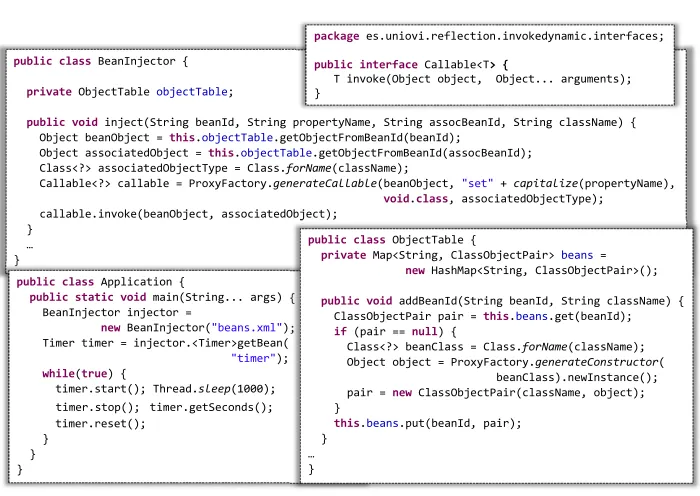
Figure 4 shows an excerpt of our first dependency injection system (the full source code is available for download2). The mainApplicationclass (bottom left corner)
2
<beans xmlns="http://www.springframework.org/schema/beans" … >
<bean id="writer"class="ConsoleWriter"/>
<bean id="logger"class="Logger"> <property name="writer"ref="writer"class="IWriter"/> </bean> <bean id="timer"class="Timer"> <property name="logger"ref="logger"class="ILogger"/> </bean> </beans>
Timer
+ getSeconds() : double + reset() : void + setLogger(ILogger) : void + start() : void + stop() : void
Logger
+ log(Level, String) : void + setLevel(Level) : void + setWriter(IWriter) : void
«interface» ILogger
+ log(Level, String) : void
«interface» IWriter
+ write(Level, String) : void
ConsoleWriter
+ write(Level, String) : void
CSVFileWriter
+ CSVFileWriter(String) + write(Level, String) : void
-writer
1 -logger
1
-level
1 «enumeration»
Level
off, fatal, error warn, info, debug trace, all
Fig. 3.Example application and its dependency injection XML document.
asks theBeanInjectorto process the XML document in order to create the class in-stances and inject their dependencies. Afterwards, thetimerbean is retrieved and used. TheBeanInjector(top left of Figure 4) contains anObjectTablecollecting all the bean instances. Upon construction, theBeanInjectorcalls theaddBeanIdmethod of thisObjectTable(bottom right) for eachbeanelement in the XML document. The
addBeanIdmethod shows the first example use of JINDY. TheProxyFactoryclass is provided to use theinvokedynamicopcode through a set of methods. The bean class is first loaded, and thegenerateConstructormethod dynamically generates a method that invokes the default constructor3usinginvokedynamic; additionally, the corresponding bootstrap method is also generated by JINDY.
TheBeanInjectoralso interconnects class instances with theinjectmethod (Figure 4, top left). This is a second example of using JINDYfor dynamic method invo-cation. Once the two associated objects and their classes are retrieved, our library is used to call the appropriatesettermethod (setter injection [10]). ThegenerateCallable
method generates a new class at runtime, implementing the genericCallable<T> inter-face provided by JINDY(Figure 4, top right). The generated class overrides theinvoke
method, calling the specified setter method (as described in Figure 2). The generic T
type of theCallableinterface corresponds to the return type of theinvokemethod. Generics are used to avoid casting the return value, on contrast to reflection.
These two examples shows how JINDYcan be used as an alternative to the reflection API. The main difference between JINDY and reflection is that JINDY uses invoke-dynamicby means of dynamic code generation, whereas reflection uses introspection. Besides, JINDY implements a cache of the instantiated classes, performing better than reflection (Section 4).
3In our dependency injection example system, bean classes must support a constructor without
public classBeanInjector { privateObjectTableobjectTable;
public voidinject(String beanId, String propertyName, String assocBeanId, String className) { Object beanObject = this.objectTable.getObjectFromBeanId(beanId);
Object associatedObject = this.objectTable.getObjectFromBeanId(assocBeanId); Class<?> associatedObjectType = Class.forName(className);
Callable<?> callable = ProxyFactory.generateCallable(beanObject, "set"+ capitalize(propertyName), void.class, associatedObjectType);
callable.invoke(beanObject, associatedObject); }
… }
public classApplication {
public static voidmain(String... args) { BeanInjector injector =
newBeanInjector("beans.xml"); Timer timer = injector.<Timer>getBean(
"timer"); while(true) {
timer.start(); Thread.sleep(1000);
timer.stop(); timer.getSeconds(); timer.reset();
} } }
packagees.uniovi.reflection.invokedynamic.interfaces; public interfaceCallable<T> {
T invoke(Object object, Object... arguments); }
public classObjectTable {
privateMap<String, ClassObjectPair> beans= newHashMap<String, ClassObjectPair>(); public voidaddBeanId(String beanId, String className) {
ClassObjectPair pair = this.beans.get(beanId); if(pair == null) {
Class<?> beanClass = Class.forName(className); Object object = ProxyFactory.generateConstructor(
beanClass).newInstance(); pair = newClassObjectPair(className, object); }
this.beans.put(beanId, pair); }
… }
Fig. 4.Dynamic method invocation using JINDY.
3.2. Avoiding type conversions
In the previous section, the Callable JINDY interface receives Object type argu-ments, similar to the reflection methods. This produces many runtime type conversions that involve a runtime performance penalty. However, there are scenarios in which the pa-rameter and return types can be known at compile time. For these cases, JINDYoffers a set of services to avoid type conversions, improving code robustness (static type checking) and runtime performance (Section 4).
In the previous version of the dependency injection system, instances were created and interconnected at startup, but changing the XML document at runtime did not im-ply changing the running application. We now extend the example to allow the dynamic modification of the application, permitting the user to instantiate new beans and changing their interconnections at runtime without changing the application source code. Therefore,
invokedynamicis used torelinkthe method associated to specificCallSites. In particular, we modify the meaning of field accesses (i.e., this.logger and
this.writer) changing the returned objects depending on the contents of the XML dependency injection document.
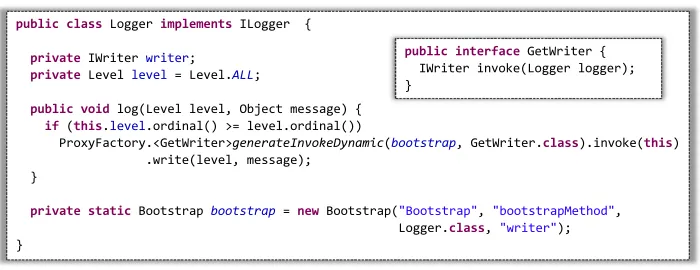
Figure 5 shows the newLoggerclass4. JINDY returns aGetWriterobject that implements the access to thewriterfield (i.e.,this.writer) as a method. The de-veloper defines theGetWriterinterface declaring a method (invoke) with the same signature as the getter method of thewriterfield. JINDYdynamically generates a class implementingGetWriter, which usesinvokedynamicto access thewriterfield.
4
Since no type conversion is performed at runtime, our library performs significantly better than reflection (see Section 4).
public classLogger implements ILogger {
privateIWriterwriter;
privateLevel level = Level.ALL;
public voidlog(Level level, Object message) {
if (this.level.ordinal() >= level.ordinal())
ProxyFactory.<GetWriter>generateInvokeDynamic(bootstrap, GetWriter.class).invoke(this) .write(level, message);
}
private staticBootstrap bootstrap= new Bootstrap("Bootstrap", "bootstrapMethod", Logger.class, "writer"); }
public interfaceGetWriter { IWriter invoke(Logger logger); }
Fig. 5.Avoiding type conversions in JINDY.
Notice how theLogger class provides no setter method. With this new approach of dependency injection, neither setter methods no parameterized constructors need to be implemented (i.e., setter and construction injection). The bean injector modifies the semantics of field access, injecting the dependencies transparently depending on the XML document, and considering its runtime changes.
3.3. Providing a custom bootstrap method
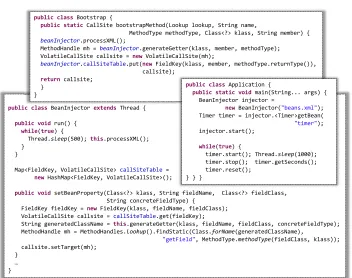
As shown in Figure 5, the programmer provides a bootstrap method to define how method (or field access) linkage must be performed. Figure 6 details the implementation of the bootstrap method. First, the XML document is read and loaded into the object table (Sec-tion 3.1). Second, a getter method implementa(Sec-tion is dynamically generated. This getter method will be used to define the new semantics of field access, considering the depen-dencies declared in the XML document. Third, aVolatileCallSitewrapping this method is created; it is volatile because its wrapped method will be asynchronously mod-ified at runtime. Finally, the call site is stored in acallSiteTableto allow the subse-quent access, and returned.
In Figure 6, the newApplicationruns the bean injector as a daemon thread, while the application keeps running. TheBeanInjectorthread (i.e., itsrunmethod) ana-lyzes the XML document each 500 milliseconds (processXML), only if its modification date has been changed. If one of the dependencies is modified, thesetBeanProperty
method will be called byprocessXML.setBeanProperty gets the
ILoggercan be added and injected at runtime, without stopping the application execu-tion. For instance, the example source code provided5adds a newHtmlTextWriter implementation of IWriterat runtime, and injects one instance as the new writer
property of theloggerbean.
public classBeanInjectorextendsThread {
public void run() {
while(true) {
Thread.sleep(500); this.processXML(); }
}
Map<FieldKey, VolatileCallSite> callSiteTable=
newHashMap<FieldKey, VolatileCallSite>();
public void setBeanProperty(Class<?> klass, String fieldName, Class<?> fieldClass, String concreteFieldType) {
FieldKey fieldKey = newFieldKey(klass, fieldName, fieldClass); VolatileCallSite callsite = callSiteTable.get(fieldKey);
String generatedClassName = this.generateGetter(klass, fieldName, fieldClass, concreteFieldType); MethodHandle mh = MethodHandles.lookup().findStatic(Class.forName(generatedClassName),
"getField", MethodType.methodType(fieldClass, klass)); callsite.setTarget(mh);
} … }
public classBootstrap {
public staticCallSite bootstrapMethod(Lookup lookup, String name,
MethodType methodType, Class<?> klass, String member) { beanInjector.processXML();
MethodHandle mh = beanInjector.generateGetter(klass, member, methodType); VolatileCallSite callsite = newVolatileCallSite(mh);
beanInjector.callSiteTable.put(newFieldKey(klass, member, methodType.returnType()), callsite);
returncallsite; }
}
public classApplication {
public static voidmain(String... args) { BeanInjector injector =
newBeanInjector("beans.xml"); Timer timer = injector.<Timer>getBean( "timer"); injector.start();
while(true) {
timer.start(); Thread.sleep(1000); timer.stop(); timer.getSeconds(); timer.reset();
} } }
Fig. 6.Using JINDYwith a custom bootstrap method.
We have seen how the JINDY library provides high-level support for
invokedynamic. The library allows postponing until runtime class and instance method invocations, constructor calls, and instance and static field accesses. It also supports user-defined bootstrap methods to allow customized linkage. We have also shown how JINDY can be used to dynamically relink methods, permitting the asynchronous adaptation of call sites. A more detailed documentation of the library can be consulted in [7].
4.
Evaluation
We have evaluated JINDYin the three use cases described in Section 3: as an alternative to reflection, avoiding type conversions, and providing custom bootstrap methods (using constant call sites). We measure the runtime performance and memory consumption of
5
JINDY compared to reflection, MethodHandleand the Dynalink library [32]. Addi-tionally, we have measured the performance penalty of JINDYcompared to the direct use ofinvokedynamic, as well as the comparison of this new opcode to the corresponding statically typed JVM instructions.
4.1. Methodology
A synthetic micro-benchmark has been developed to evaluate the above mentioned use cases. This micro-benchmark takes into account the following scenarios:
1. The invokedynamic opcode. We compare the performance of the
invokedynamicopcode with JINDY, its corresponding statically typed opcode, re-flection, theinvokeExactmethod ofMethodHandle, and Dynalink. Dynalink is Java library that allows performing dynamic operations on objects without knowing their static types [32]. It uses the services of the new Java 7java.lang.invoke
package, includinginvokedynamic(a more detailed description is presented in Section 5).
2. JINDY, as an alternative to the reflection API. In this case, we compare different types of reflective scenarios. We measure the execution time used to obtain classes and methods using introspection, apart from its invocation. JINDYis also used to optimize a real third-party application, measuring the performance improvement obtained. 3. Performance and memory cost. We measure the increase of the memory consumption
and runtime performance of JINDY, compared to the direct use of the invoke-dynamicopcode.
The developed synthetic micro-benchmark evaluates instance, class and interface method invocations (one single parameter), as well as instance and class field accesses (get and set). The methods simply increment a field value (receiving another value as a parameter) and return the value of the incremented field. The return values of methods and fields are assigned to local variables.
These scenarios have been implemented in JINDY following the three different use cases described in Section 3. Firstly, as an alternative to the reflection API, performing type conversions (JINDY TC in Figures 7, 8, 9 and 10). The second use case utilizes customized interfaces to avoid type conversions, without providing a bootstrap (JINDY I). The last scenario (JINDY BI) provides a custom bootstrap method, equivalent to those used in the other two scenarios (i.e., returning constant call sites).
Regarding the data analysis, we have followed the methodology proposed in [11] to evaluate the runtime performance of applications, including those executed on virtual ma-chines that provide JIT compilation. In this methodology, two approaches are considered: 1) start-upperformance is how quickly a system can run a relatively short-running ap-plication; 2)steady-stateperformance concerns long-running applications, where start-up JIT compilation does not involve a significant variability in the total running time, and Hotspot dynamic optimizations have been applied.
To measure start-up performance, a two-step methodology is used:
2. The confidence interval for a given confidence level (95%) is computed to eliminate measurement errors that may introduce a bias in the evaluation. The confidence in-terval is computed using theStudent’st-distribution because we tookp = 30[17]. Therefore, we compute the confidence interval[c1, c2]as:
c1=x−t1−α/2;p−1√sp c2=x+t1−α/2;p−1√sp
Wherexis the arithmetic mean of thexi measurements,α = 0.05(95%),sis the standard deviation of thexi measurements, and t1−α/2;p−1 is defined such that a random variableT, that follows the Student’st-distribution withp−1degrees of freedom, obeysP r[T ≤t1−α/2;p−1] = 1−α/2.
The data provided is the mean of the confidence interval plus a percentage indicating the width of the confidence interval relative to the mean.
The steady-state methodology comprises four steps:
1. Each application (program) is executedptimes (p = 30), and each execution per-forms at leastk(k = 10) different iterations of benchmark invocations, measuring each invocation separately. We referxij as the measurement of thejthbenchmark iteration of theithapplication execution.
2. For eachiinvocation of the benchmark, we determine thesiiteration where steady-state performance is reached. The execution reaches this steady-state when the coefficient of variation (CoV, defined as the standard deviation divided by the mean) of the last k+ 1iterations (fromsi−ktosi) falls below a threshold (2%).
3. For each application execution, we compute the meanxi of the k+ 1benchmark iterations under steady state:
xi=
si
X
j=si−k
xij
k+1
4. Finally, we compute the confidence interval for a given confidence level (95%) across the computed means from the different application invocations using theStudent’st -statistic described above. The overall mean is computed asx = Pp
i=1xi/p. The confidence interval is computer over theximeasurements.
To measure execution time of each benchmark invocation (in the steady-state method-ology) we have instrumented the applications with code that registers the value of high-precision time counters provided by the Windows operating system. This instrumenta-tion calls the native funcinstrumenta-tionQueryPerformanceCounterof thekernel32.dll
library. This function returns the execution time measured by the operating system Per-formance and Reliability Monitor [37]. We measure the difference between the beginning and the end of each benchmark invocation to obtain the execution time of each benchmark run.
The memory consumption has been measured following the start-up methodology to determine the memory used by the whole process. For that purpose, we have used the maximum size of working set memory employed by the process since it was started (the
currently visible to the process in physical RAM memory. These pages are resident and available for an application to be used without triggering a page fault. The working set includes both shared and private data. The shared data comprises the pages that contain all the instructions that the process executes, including those from the process modules and the system libraries. ThePeakWorkingSethas been measured with explicit calls to the services of the Windows Management Instrumentation infrastructure [18].
All the tests were carried out on a lightly loaded 2.40 GHz Intel Core i5 2430M system with 4 GB of RAM running an updated 64-bit version of Windows 7 Home Premium SP1. We have used the Java Standard Edition 1.7 update 9 for 64 bits.
4.2. Evaluation of theinvokedynamicopcode
We have evaluated the performance ofinvokedynamic, JINDYin the 3 use cases de-fined (JINDY I, JINDY TC and JINDY BI), the corresponding statically typed opcodes, reflection,invokeExactofMethodHandleand Dynalink. The 7 operations of the synthetic micro-benchmark (instance, class and interface method; and class and instance get and set field) have been executed in loops from 1 to 10,000 million iterations.
Since the test that usesinvokedynamic cannot be directly written in Java, the following method has been followed to implement it. We first take the statically typed approach that measures the 7 operations mentioned above. This program is then dis-assembled with the ASMifier tool of ASM, replacing the 7 statically typed opcodes (invoke{virtual, interface, static} and {get, set}{field,static}) with the appropriateinvokedynamicinstruction. We implement 7 bootstrap methods for the 7 types ofinvokedynamicoperations. Finally, ASM is used to convert the new assembly code into the JVM.classfiles.
102 103 104 105 106 107 108 109 1010
1 10 100 1,000 10,000
Dynalink Statically typed invokedynamic JINDY_I JINDY_BI JINDY_TC Reflection MethodHandle
E
x
e
cu
ti
o
n
t
im
e
(
m
ic
ro
se
co
n
d
s
in
l
o
g
a
ri
th
m
ic
s
ca
le
)
Million iterations
start-up steady-state
1 10 100 1,000 10,000
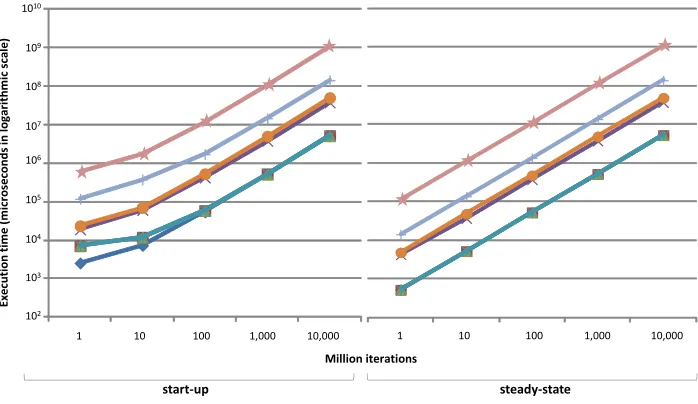
Figure 7 shows the average execution time obtained for the 7 operations. The re-sults for short-running (start-up) applications indicate that, for 1 million iterations, the newinvokedynamicopcode is 181.2% slower than the corresponding statically typed opcode. The penalty of using JINDY I compared toinvokedynamicis 2.49%, being 0.54% and 61.28% faster than JINDY BI and JINDY TC, respectively. Compared to re-flection,MethodHandleand Dynalink, JINDY I is 2.22, 15.11 and 83.36 times faster, respectively.
Figure 7, start-up, also shows how the performance of JINDYandinvokedynamic
improves as the number of iterations increases. When reaching 100 million iterations, the benefit of JINDY I and invokedynamicregarding reflection, MethodHandle
and Dynalink grows to 8.03, 27.88 and 197 factors, respectively. For the same number of iterations, statically typed opcodes performs 0.51% and 8.57% better than invoke-dynamicand JINDY I, respectively.
For long-running applications (steady-state in Figure 7), runtime performance shows lower dependence on the number of iterations. For 1 million iterations, the smallest dif-ference between JINDY I, JINDY BI,invokedynamicand the statically typed invo-cations is lower than 2.5%. As the number of iterations increases, the differences lightly decreases, reaching values lower than 0.5% for 10,000 million iterations. In the start-up methodology, the JVM reaches its steady state with 1,000 million iterations. At this state, the results for short-running applications are very similar to those obtained for server applications (Figure 7).
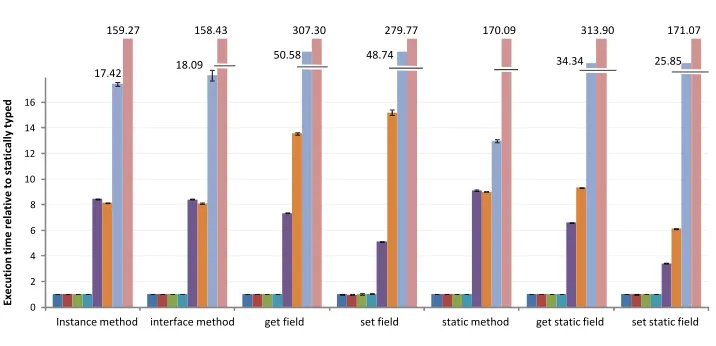
Figure 8 shows the execution times of the seven operations for 1,000 million iter-ations, running long-running applications (steady-state). Performance values have been divided by those obtained by the corresponding statically typed opcode. For all the op-erations, differences among invocations using the statically typed opcode, invoke-dynamic, JINDY I, and JINDY BI are barely appreciable. Average penalties of JINDY I and JINDY BI compared to invokedynamicare 0.48% and 0.79%, with a standard deviation of 1.45% and 0.68%, respectively.
When using reflection, the worst results are obtained getting and setting field val-ues. For example, setting the value of instance fields using reflection is 13.72 and 1.97 times slower than JINDY I and JINDY TC, respectively. A similar behavior is seen with
invokeExact of MethodHandle, where reading an instance field is 50.58 times slower than the staticopcode. The smallest difference between JINDY and the rest of approaches is exhibited in the invocation ofstaticmethods. In this case, JINDY TC and reflection obtain practically the same performance, and JINDY TC is 370.53% and 1,763% faster than MethodHandle and Dynalink. In this scenario, JINDY I and JINDY BI are 824.20% and 821.34% faster than reflection; perform 25 and 24.92 times better thanMethodHandle; and are 168 factors faster than Dynanlink.
17.42
0 2 4 6 8 10 12 14 16
Instance method interface method get field set field static method get static field set static field
E
x
e
cu
ti
o
n
t
im
e
r
e
la
ti
v
e
t
o
s
ta
ti
ca
ll
y
t
y
p
e
d
1,000 Million Iterations (steady-state)
Statically typed invokedynamic Reflection MethodHandle Dynalink
18.09 50.58 48.74 34.34 25.85
159.27 158.43 307.30 279.77 170.09 313.90 171.07
JINDY_I JINDY_BI JINDY_TC
Fig. 8.Execution time per primitive operation relative to statically typed opcodes.
4.3. JINDYevaluation as an alternative to the reflection API
In the previous subsection, reflective method invocations have been measured considering the execution time of theinvokemethod in theMethodclass. However, the execution time of obtaining the class and the appropriate method using reflection have not been mea-sured. Similarly, we have not evaluated the execution time of the dynamic class generation performed by JINDY. Therefore, in this section we consider the cost of these operations. Prior to theinvokedynamicexecution, we obtain an instance of the class that supports this invocation, using the JINDYProxyFactoryfactory methods defined in Figure 4. These operations are now included in the micro-benchmark, for the three use cases of JINDY (JINDY I, JINDY TC and JINDY BI) and reflection. TheMethodHandleand Dynalink approaches are not considered here because of their low runtime performance.
Figure 9 shows the average execution time obtained for the 7 operations. Iterations have been reduced to 1,000 million due to the high execution times obtained. Execution times are computed as the arithmetic mean of the 7 operations described in Section 4.1. As in the previous subsection, runtime performance of short- (start-up) and long-running (steady-state) applications show a different dependence on the number of iterations. Long-running applications do not show a significant difference when increasing the number of iterations. For 1 million iterations JINDY I, JINDY TC and JINDY BI are 23.02, 16.55 and 6.29 times faster than reflection, respectively. JINDY BI is the scenario where the lowest benefit is obtained, because of the penalty caused by the use of custom bootstrap methods.
104 105 106 107 108 109
1 10 100 1,000
JINDY_I JINDY_BI JINDY_TC Reflection
1 10 100 1,000
start-up steady-state Million iterations E x e cu ti o n t im e ( m ic ro se co n d s in l o g a ri th m ic s ca le )
Fig. 9.Average execution time for reflective scenarios (microseconds in logarithmic scale).
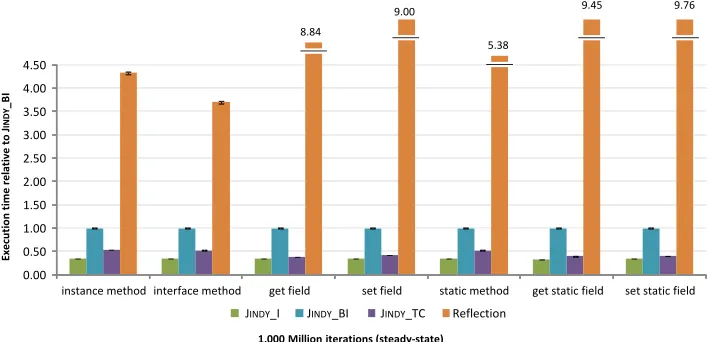
Figure 10 shows the results per operation for 1,000 million iterations, when the ap-plication has reached a steady state. The results have been divided by the execution time of JINDY BI. The major benefits of using JINDY, as an alternative to reflection, are ob-tained when getting field values of both instances (JINDY I, JINDY BI and JINDY TC are 24.76, 7.75 and 21.75 times faster than reflection) and classes (27.05, 8.34 and 23.78 times faster than reflection). The lowest performance benefit is obtained when invoking interface methods, being JINDY I, JINDY BI and JINDY TC 9.62, 2.67 and 6.01 times faster than reflection.
0.00 0.50 1.00 1.50 2.00 2.50 3.00 3.50 4.00 4.50
instance method interface method get field set field static method get static field set static field
E x e cu ti o n t im e r e la ti v e t o J IN D Y _ B I
1,000 Million iterations (steady-state)
Reflection
5.38 8.84
9.00 9.45 9.76
JINDY_I JINDY_BI JINDY_TC
Fig. 10.Execution time per primitive operation relative to JINDY BI, for reflective scenarios.
average, 807.23% greater than those in the previous subsection. Therefore, the cost of generating theinvokedynamicopcode seems to be lower than the reflective retrieval of a method and its class.
Evaluation of a real application
We have also evaluated the performance improvement of JINDY when applied to a real application that makes extensive use of reflection. In the previous synthetic micro-benchmark, only the execution time of reflective operations were measured. In this case, a real application executes both reflective and statically typed code. Therefore, we assess how JINDYcan optimize the overall application execution.
The application we have selected for this test is OVal, a pragmatic and extensible validation framework for any kind of Java objects (not only JavaBeans) [35]. OVal al-lows defining dynamic constraints on Java properties, methods and constructors. The constraints can be defined with Java annotations or XML files. Constraint validation is performed by OVal at runtime, using the reflection API.
Analyzing the source code of OVal, we identified 16 reflective method invocations. We modified the OVal implementation, replacing these reflective operations with the appro-priate invocations to the JINDYlibrary. Besides, we created a third version using Dynalink instead of JINDY. The three different versions were executed, and their execution times were measured following the methodology described in Section 4.1.
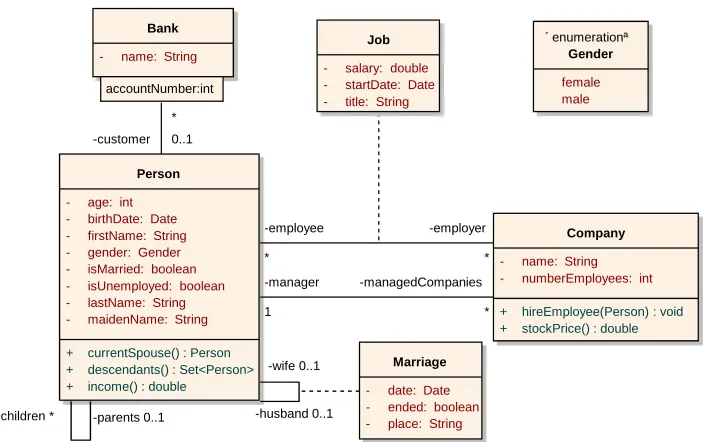
The entity model of the example application is shown in Figure 11. The application creates three instances ofPerson, twoBanks, and one instance ofCompany,Joband
Marriage. We defined 28 constraints on properties and methods, using Java annota-tions. Example constraints areparents of one person can be neither descendants nor his or her spouse, anda person cannot have two different jobs in the same company6. OVal is programmatically called to check if the set of constraints are fulfilled at a specific point of execution (i.e.,on demandvalidation). This validation is performed an increasing number of times.
Table 1 presents the execution times and error percentages of the three approaches, from 1 to 1 million invocations in the steady-state methodology (start-up showed high per-centage errors). For 1 and 10 invocations, the difference between reflection and JINDYis lower than the error percentage (they cannot be considered to differ). For 100 invocations JINDY is 7.14% faster than reflection, and this benefit grows to 75.07% for 1,000 invo-cations. The benefit of JINDYcompared to reflection seems to converge towards 79.18% (the benefit difference between 100,000 and 1 million invocations is 0.9%).
Table 1 also shows the execution time of OVal, when reflective invocations have been replaced with Dynalink. JINDY performs 324% better than Dynalink for one single in-vocation. This benefit grows up to 296 factors for one million invocations. Therefore, the dynamic generation ofinvokedynamicopcodes (the JINDY approach) compared to the use ofMethodHandles(using Dynalink from Java) involves a significant per-formance benefit. In the execution of this test, JINDY has required 15% more memory resources than reflection, but 29.92% less memory than Dynalink.
6
Bank
- name: String
Person
- age: int - birthDate: Date - firstName: String - gender: Gender - isMarried: boolean - isUnemployed: boolean - lastName: String - maidenName: String
+ currentSpouse() : Person + descendants() : Set<Person> + income() : double
Job
- salary: double - startDate: Date - title: String
Marriage
- date: Date - ended: boolean - place: String
Company
- name: String - numberEmployees: int
+ hireEmployee(Person) : void + stockPrice() : double
«enumeration»
Gender
female male
-parents 0..1 -children *
-wife 0..1
-husband 0..1 -manager
1
-managedCompanies
* -employee
*
-employer
* accountNumber:int
*
-customer 0..1
Fig. 11.Entity model used in the evaluation of the OVal framework.
4.4. Performance and memory cost
The dynamic generation of classes performed by JINDY(Section 2.2) produces a runtime performance and memory consumption penalty compared to the direct use of invoke-dynamic. To evaluate this penalty, we have measured the average execution time of the 7 common operations. In the computer used, the constant average execution time is 22,068.38 microseconds. However, as discussed in the previous subsections, the relative cost of JINDYcompared toinvokedynamicdecreases as the number of invocations increases, becoming 2.59% for 1,000 invocations and 0.69% for 10 million invocations.
Using the developed micro-benchmark, we have also evaluated the memory consump-tion of our library. The average memory consumpconsump-tion of JINDY, when using custom inter-faces (JINDY I), is 2.55% higher thaninvokedynamic. Comparing it with the
corre-Invocations JINDY Reflection Dynalink
1 8,342±5.2% 8,141±6.6% 35,358±6.6% 10 14,160±4.2% 13,653±3.8% 58,480±3.3% 100 25,207±5.9% 27,008±7.6% 314,659±1.9% 1,000 77,103±1.9% 134,985±1.9% 3,468,511±1.8% 10,000 876,993±1.6% 1,453,619±1.9% 147,744,785±2.1% 100,000 6,502,597±1.6% 11,592,832±2.4% 1,895,077,469±2.6% 1,000,000 63,674,864±1.7% 114,093,201±1.9% 18,950,774,685±3.6%
sponding statically typed opcode, reflection andMethodHandle, these increments are 8.31%, 7.47% and 5.94%, respectively; Dynalink requires 27.37% more memory than JINDY I. Using our library in scenarios that require type conversions (JINDY TC) and providing a custom bootstrap method (JINDY BI), JINDY requires 0.057% and 1.30% more memory, respectively, than JINDY I. These results were calculated with a 95% con-fidence level and error intervals lower than 2%.
5.
Related Work
Dynalink is aninvokedynamic-based high-level linking and meta-object protocol li-brary [32]. Dynalink allows performing dynamic operations on objects without know-ing their static types. It can be used from Java to facilitate the creation of Method-Handlesthat the programmer later invokes to perform the dynamic operations. It can also be used from a JVM assembler (e.g., ASM) to make the generation of invoke-dynamicinstructions easier. Dynalink provides a set of bootstrap method implementa-tions, and a set of conventions for common dynamic operations on objects. For instance, the"dyn:getProp:color"string represents the dynamic access to thecolor prop-erty (i.e., both the colorfield and the getColormethod). Therefore, it provides a form of duck typing [27]. In its current version 0.6, Dynalink does not generate invoke-dynamicopcodes when used from Java;MethodHandlesshould be invoked instead. It provides services to facilitate the use ofinvokedynamicwhen used from a JVM assembler.
The Da Vinci Machine (or MLVM, Multi-Language Virtual Machine) [31] is an Open-JDK project aimed at extending the JVM with first-class architectural support for lan-guages other than Java, especially dynamic ones. This project prototypes a number of ex-tensions to the JVM, so that it can run non-Java languages efficiently, with a performance level comparable to that of Java itself. The Da Vinci project has several subprojects such as the JSR 292, aimed at supporting dynamically typed languages on the Java platform [30], including the newinvokedynamicopcode. In 2010, Chanwit Kaewkasi conducted a preliminary study of the efficiency ofinvokedynamicin MLVM. He presented the results of running aninvokedynamicversion of the SciMark2 benchmark compared to a refactored version of the original program. The experimental results showed that the execution of method handles in the server VM was 2-5 times slower than native Java invocations [14].
Theinvokedynamicopcode has been used in different language implementations to improve their runtime performance, avoiding the use of reflection. Since its publica-tion in July 2011, there are languages such as JRuby and Groovy that have included the new opcode; others, such as Jython and Rhino [19], are still in process of includ-ing it. JRuby is the Ruby implementation for the Java platform. Its version 1.7 sup-portsinvokedynamic, obtaining a significant performance improvement [34]. How-ever, current released versions of OpenJDK 7 sometimes error out or fail to optimize code as expected [34]. In order to provide a consistent JRuby experience, the use of invoke-dynamicis disabled by default in Java 7. However, the use of invokedynamicis enabled by default when running on OpenJDK 8 builds.
new opcode, giving the user the possibility to activate it. Groovy conducted some tests on version 2.0. The results indicated that runtime performance was increased in some scenarios, while other programs shower slower execution [16].
Jython is an implementation of the Python language for the Java platform. Although this language does not offer full support of theinvokedynamicopcode, developers are working on restructuring its code to improve its runtime performance using invoke-dynamic[2]. Shashank Bharadwaj presented a preliminary assessment of the opcode performed on the latest version of Jython. This evaluation showed a 4% improvement across the suite of the evaluated benchmarks [3].
invokedynamicis also being applied to newly created dynamic languages such as Nashorn, a project to be launch for the Java 8 platform. Nashorn is a new implementation of JavaScript [8] that uses theinvokedynamicopcode. Nashorn is intended to replace Rhino (the Mozilla implementation of JavaScript for Java platform), which requires a significant rewrite to take advantage of the JSR-292invokedynamicopcode [36].
Apart from dynamic languages, there are other tools that allow the use of the JVM
invokedynamicinstruction for different purposes. JooFlux is a JVM agent that pro-vides the dynamic replacement of application aspects and method implementations [26].
invokedynamicallows relinking the method associated to a call site at runtime, a be-havior that can be used to implement dynamic aspect-oriented weavers [25]. JooFlux has been compared with Clojure, JRuby, Groovy, JavaScript and Jython, obtaining significant runtime performance benefits [26].
Dynamate is a framework designed to allow the Java implementation of different types of method dispatch, such as multiple dispatch (multi-methods) and the late binding dis-patch implemented by dynamic languages [9]. They useinvokedynamicto separate method invocation from method dispatch, mapping a different method dispatch technique when a method is called, depending on the desired behavior. Dynamate has been used to prototypically reimplement the JRuby, Jython and Groovy dynamic languages, and the MultiJava, JCop and JastAdd systems [9].
Soot is a Java optimization framework for static analysis and transformation of Java programs, which has been recently extended to support theinvokedynamicopcode [4]. Soot provides the Jimple intermediate representation of JVM applications, includinginvokedynamic. Therefore, Jimple can be used to perform bytecode anal-ysis and optimizations, transforming existing code toinvokedynamic; it can also be used to generate invokedynamicinstructions with an abstraction level higher than code manipulation tools such as ASM [4].
jDart is a compiler that takes Dart [13] programs and generates binary JVM code to be executed in the Java 7 platform [13]. jDart generates aninvokedynamic instruc-tion for every method invocainstruc-tion (except constructors), postponing the method linkage until runtime. A bootstrap included in the language runtime searches for the appropriate method and, once it is linked, the JVM applies the usual optimizations performed for com-mon statically typed code. This language implementation shows the simplicity of using
6.
Conclusions
Dynamic code generation is a suitable technique to build an efficient library that supports the new JVMinvokedynamicopcode from any high-level language running on the Java platform. In those scenarios whereinvokedynamicmay be appropriate, JINDY frees the programmer from generating code that uses this new opcode. A typical use is as an alternative to the reflection API. For this task, JINDYprovides a set of services similar to the reflection library. The average performance benefit obtained for this scenario is 14.83 factors for long-running applications, and 9.73 for short-running programs. The library also offers the possibility of avoiding type conversions, reducing the type casts performed with the reflective approach. In this case, the performance benefit increases to 19.97 and 11.97 factors for long- and short-running applications, respectively.
JINDYalso allows the developer to provide a custom mechanism to select the method to be invoked, and replaced it at runtime. This alternative is more versatile, making JINDY suitable for in any scenario where theinvokedynamicopcode can be employed. Com-pared to reflection, this alternative has an average benefit of 618.53% for long-running applications and 565.42% for short-running programs.
We have also used JINDY to optimize a real application. The OVal validation frame-work has been re-implemented using our library instead of reflection. For the first con-straint validation, our library performs the same as reflection. However, if the number of validations is increased, the performance benefit of the overall application grows up to 79%.
The dynamic code generation technique implemented by JINDY involves a runtime performance and memory consumption penalty. In our computer, we have measured a constant runtime performance cost of 22,068.38 microseconds. When the number of invo-cations increases, the runtime performance penalty is lower than 1%. The average memory consumption is 3.02%, comparing JINDYwithinvokedynamic.
We plan to use JINDYfor the optimization of more real applications that make exten-sive use of reflection. We will replace the reflective calls with invocations to the JINDY services, and measure runtime performance and memory consumption. We are also con-sidering using JINDYto optimize the implementation of existing dynamic languages that use reflection to provide its dynamically typed services.
The JINDY library, its source code, documentation, and the examples and bench-marks included in this paper can be downloaded from:http://www.reflection. uniovi.es/invokedynamic/Jindy
Acknowledgments.This work was funded by the Department of Science and Innovation (Spain) under the National Program for Research, Development and Innovation: project TIN2011-25978, entitled Obtaining Adaptable, Robust and Efficient Software by Including Structural Reflection in Statically Typed Programming Languages.
References
1. Apache: Log4j, Logging Services (2013),http://logging.apache.org/log4j
3. Bharadwaj, S.: Invokedynamic Jython. JVM Language Summit (2011), http://wiki. jvmlangsummit.com/Invokedynamic_Jython
4. Bodden, E.: InvokeDynamic support in Soot. In: Proceedings of the ACM SIGPLAN Interna-tional Workshop on State of the Art in Java Program analysis. pp. 51–55. SOAP ’12, ACM, New York, NY, USA (2012)
5. Bruneton, E.: ASM 4.0 A Java bytecode engineering library (September 2011),http:// download.forge.objectweb.org/asm/asm4-guide.pdf
6. Chambers, C.: Object-Oriented Multi-Methods in Cecil. In: In ECOOP ’92 Conference Pro-ceedings. pp. 33–56. Springer-Verlag (1992)
7. Conde, P., Ortin, F.: The JINDY reference documentation (2012), http://www. reflection.uniovi.es/invokedynamic/doc
8. ECMA-262: ECMAScript Language Specification 5th Edition. European Computer Manufac-turers Association (2009)
9. Erhard, K.: Dynamate: A Framework for Method Dispatch using invokedynamic. Master’s the-sis, Technische Universitat Darmstadt, Mornewegstrabe 30, 64293 Darmstadt, Germany (2012) 10. Fowler, M.: Inversion of control containers and the dependency injection pattern (2004),
http://www.martinfowler.com/articles/injection.html
11. Georges, A., Buytaert, D., Eeckhout, L.: Statistically rigorous Java performance evaluation. In: Proceedings of the 22nd annual ACM SIGPLAN conference on Object-oriented programming systems and applications. pp. 57–76. OOPSLA ’07, ACM, New York, NY, USA (2007) 12. Hugunin, J.: The Jython Project (2012),http://www.jython.org
13. jDart: A Dart to JVM bytecode compiler,http://code.google.com/p/jdart
14. Kaewkasi, C.: Towards performance measurements for the Java Virtual Machine’s invokedy-namic. In: Virtual Machines and Intermediate Languages. pp. 3:1–3:6. VMIL ’10, ACM, New York, NY, USA (2010)
15. Koenig, D., Glover, A., King, P., Laforge, G., Skeet, J.: Groovy in Action. Manning Publica-tions Co., Greenwich, CT, USA (2007)
16. Laforge, G.: What’s new in Groovy 2.0? (Jun 2012), http://www.infoq.com/ articles/new-groovy-20
17. Lilja, D.J.: Measuring computer performance: a practitioner’s guide. Cambridge University Press, Cambridge, New York, Merlbourne (2000)
18. Microsoft: Windows management instrumentation. Microsoft Developer Network (MSDN) (2012),http://openjdk.java.net/projects/mlvm
19. Mozilla Foundation: Rhino: JavaScript for Java (2012), http://www.mozilla.org/ rhino
20. Nutter, C.: The JRuby Community (2012),http://jruby.org
21. Oracle: Java virtual machine support for non-Java languages. Java SE Documentation (2012), http://docs.oracle.com/javase/7/docs/technotes/guides/vm/ multiple-language-support.htm
22. Oracle: package java.lang.invoke. Java Platform Standard Edition 1.7 (2012),
http://docs.oracle.com/javase/7/docs/api/java/lang/invoke/ package-summary.html
23. Ortin, F., Cueva, J.M.: Dynamic adaptation of application aspects. Journal of Systems and Software 71(3), 229–243 (May 2004)
24. Ortin, F., Redondo, J.M., Garc´ıa Perez-Schofield, J.B.: Efficient virtual machine support of runtime structural reflection. Science of Computer Programming 74(10), 836–860 (Aug 2009) 25. Ortin, F., Vinuesa, L., Felix, J.M.: The DSAW Aspect-Oriented Software Development Plat-form. International Journal of Software Engineering and Knowledge Engineering 21(7), 891– 929 (2011)
27. Redondo, J.M., Ortin, F.: Efficient support of dynamic inheritance for class- and prototype-based languages. Journal of Systems and Software 86(2), 278–301 (Feb 2013)
28. Rose, J.R.: Bytecodes meet combinators: invokedynamic on the JVM. In: Proceedings of the Third Workshop on Virtual Machines and Intermediate Languages. pp. 2:1–2:11. VMIL ’09, ACM, New York, NY, USA (2009)
29. Spring Framework: XML Schema-based configuration (2013), http://static. springsource.org/spring/docs/2.5.3/reference/xsd-config.html
30. Sun Microsystems Inc.: JSR 292: Supporting Dynamically Typed Languages on the Java Plat-form (August 2008),http://jcp.org/en/jsr/detail?id=292
31. Sun Microsystems, Inc.: The Da Vinci Machine Project: a multi-language renaissance for the Java Virtual Machine architecture (2008), http://openjdk.java.net/projects/ mlvm/
32. Szegedi, A.: Dynalink, an invokedynamic-based high-level linking and metaobject protocol library (2013),https://github.com/szegedi/dynalink
33. Thalinger, C., Rose, J.: Optimizing invokedynamic. In: Proceedings of the 8th International Conference on the Principles and Practice of Programming in Java. pp. 1–9. PPPJ ’10, ACM, New York, NY, USA (2010)
34. The JRuby Community: Performance tuning (2012), https://github.com/jruby/ jruby/wiki/PerformanceTuning
35. The OVal Development Team: OVal, object validation framework for Java (2013),http:// oval.sourceforge.net
36. Traversat, B.: HTML5/JavaScript and Java: The Facts and the Myths. Oracle. JavaOne (2011),
http://www.oracle.com/javaone/lad-en/session-presentations/ clientside/24821-enok-1439095.pdf
37. Windows Server Techcenter: Windows performance monitor. MicrosoftTechnet (2012),
http://technet.microsoft.com/en-us/library/cc749249.aspx
Patricia Condeis a PhD student in cognitive computing and computing with perceptions, at the European Centre for Soft Computing. She is an Engineer in Computer Science and MSc in Web Engineering from the University of Oviedo. Her main research interests are the application of soft computing techniques in the areas of language and cognition applied to control systems. Contact her at [email protected]
Francisco Ortinis an associate professor of the Department of Computer Science at the University of Oviedo, Spain. He is a Computer Science Engineer, and in 2002 he was awarded his PhD. His main research interests include dynamic languages, type systems, computational reflection, and runtime adaptable applications. He is the head of the Com-putational Reflection research group. Contact him at http://www.di.uniovi.es/˜ortin