© 2015 IJSRSET | Volume 1 | Issue 6 | Print ISSN : 2395-1990 | Online ISSN : 2394-4099 Themed Section: Engineering and Technology
Experimental Analysis and Optimization of Process Parameters of
EDM for EN-47 – A Review Article
Patel Parth Kumar S*, Krunal Shah, S. J. Thanki
Mechanical Engineering Department, VICT, Gandhinagar, Gujarat, IndiaABSTRACT
The aims of this research work to identify parameters of EN47 spring steel material on EDM machine by applying Copper & Graphite electrodes. And pursue the influence of four design factors pulse on (Ton), pulse off (Ton) , current (I), voltage (V), and duty factor (ƞ), which are the most connected parameters to be controlled by the EDM process over machining specifications such as material removal rate (MRR) and tool wear rate(TWR) and characteristics of surface integrity such as average surface roughness (Ra) and also to quantify them. In this paper the experiments have been conducted by using Taguchi Methodology with the DOE techniques and developed a mathematical model to predict material removal rate & average surface roughness using input parameters such as pulse on(Ton),pulse off (Toff) , current (I), voltage (V).
Keywords: Electric Discharge Machining, Taguchi Method, Overcut, Electrode.
I.
INTRODUCTION
Now - a - days due to need for high strength materials in sophisticated industries and patronaged by the advances in the field of Materials science, there has been an increase in the availability and use of different machining of materials. EDM is one such process which is widely used to machine electrically conductive materials. EDM is a thermo-electric process in which material remotion takes place through the process of controlled spark generation. It is one of the most popular non-traditional machining processes being used in the industries.[1]
EDM is a thermo-electric process in which material removal takes place through the process of controlled spark generation. It is one of the most popular non-traditional machining processes being used in the industries. EDM is generally used for mould and Die making industry and in manufacturing automotive, aerospace and surgical components. Since there is no mechanical contact between the tool and work piece, therefore frail components can be machined without the risk of damage.[1]
The Surface Roughness plays a very important role for any manufacturing work in order to identify the extent
of the surface finish with reference to time and cost. A number of experimental works has been carried out till date for the investigation of the effect of the different parameters over the surface roughness value for different materials.[2]
PRINCIPLE OF EDM
Figure 1: Set up of Electric discharge machining
The tool is of cathode and work piece is anode. When the voltage across the gap becomes sufficiently high it discharges through the gap in the form of the spark in interval of from 10 of micro seconds. The moment spark occurs sufficiently pressure developed between work and tool as a result of which a very high temperature is reached and at such high pressure and temperature that some metal is melted and eroded.
II.
METHODS AND MATERIAL
Taguchi Methodology
Grey Taguchi Approach is generally an advanced form of the Taguchi method, which emphasizes on the optimization of more than one output parameters, rather than optimizing a single output parameter as in case of the Taguchi method. The Taguchi method developed by Genichi Taguchi (1990) was the most important statistical tool for the optimization of the single output parameter. It considers a set of different number of input parameters, may it be an L27 orthogonal array or an L9 orthogonal array depending upon the degree of accuracy needed. The number of experiments chosen in the article is a L27 orthogonal array comprising of the different combinations of the input parameters.
Material Selection:
It is capable of machining geometrically complex or hard material components, super alloys, ceramics, carbides, heat resistant steels etc. There are different types of tool material are using the EDM method. And the tool steel contains carbon and alloy steels that are particularly well-suited to be made into tools.
Electrode Materials:- Copper – Cu , Graphite
Work-piece Material:- EN-47 Spring Steel
Specifications OF EDM:
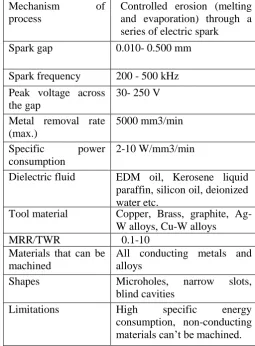
EDM specification by mechanism of process, metal removal rate and other function that shown in this table no.
Table 1:
Specifications on EDM
Mechanism of
process
Controlled erosion (melting and evaporation) through a series of electric spark
Spark gap 0.010- 0.500 mm
Spark frequency 200 - 500 kHz Peak voltage across
the gap
30- 250 V
Metal removal rate (max.)
5000 mm3/min
Specific power consumption
2-10 W/mm3/min
Dielectric fluid EDM oil, Kerosene liquid paraffin, silicon oil, deionized water etc.
Tool material Copper, Brass, graphite, Ag-W alloys, Cu-Ag-W alloys
MRR/TWR 0.1-10
Materials that can be machined
All conducting metals and alloys
Shapes Microholes, narrow slots,
blind cavities
Limitations High specific energy
consumption, non-conducting materials can’t be machined.
Design Variable:
Design parameter, process parameter and constant
parameter are following ones,
Table 2 : Design Variable
Design Parameters Constant
Parameter
Machining
Parameter
Material removal rate (MRR)
Duty cycle Discharge current (Ip)
Gap Voltage Tool wear ratio (TWR) Flushing
pressure
Pulse on time (Ton)
Pulse off time (Toff)
Surface Roughness
(SR) Polarity
LITERATURE REVIEW
The entire experiment was carried out in a CNC Die sinking EDM (EMT 43 Electronica Machine Tools) machine, which used paraffin oil as the dielectric medium. Moreover, a rectangular shaped tool made of copper material of size 25 X 25 mm size was taken to perform the experiment. Copper because of its high electrical conductivity was considered as most suitable material for carrying out the experiment. The work piece on which the surface roughness was calculated was a cylindrical EN41 material of dimension φ25mm X 15mm. The chemical composition of the work-piece i.e. EN41 material and the tool material i.e. Copper was obtained by EDX (JSM 63901v, Resolution=3nm at 30kV at high vacuum mode and 4nm at 40 kV low vacuum mode).[2]
For optimization, both single and multi-objective responses (MRR and surface roughness: Ra) are considered. From ABC analysis, the optimum combinations of process parameters are obtained and corresponding values of maximum MRR and minimum Ra are found out. Confirmation tests are carried out to validate the analyses and it is seen that the predicated values show good agreement with the experimental results. This study also investigates the influence of the machining parameters on machining performances.[3]
The EN8 and D3 steels are again machined by using Sintered Powder metallurgy Copper electrode. The Copper powder was compacted in a die cavity by applying 22 Tons load to get cylindrical shape of 15mm diameter. After compacting, green compacts were subjected to sintering after applying the ceramic coating so as to avoid oxidation and dried for 12 hours. Furthermore sintering was carried out on green compacts to 900 0C for 60 min and allowed to cool slowly in the furnace. These sintered electrodes were taken from the furnace, cleaned by acetone and used for machining the EN8 and D3 steel work pieces. The output responses are calculated again according to the design matrix. Grace – EDM machine has been used to machine the work piece.[4]
A kind of moderate volume fraction (40%) of SiC particle reinforced Al matrix composites (SiCp/Al) to research how the surface properties are affected in
conventional EDM (EDM) and powder-mixed EDM (PMEDM). By means of environment scanning electron microscope (ESEM) and HIT friction and wear tester, surface micro-topography, elements and wear resistance were analyzed. Experiments and researches indicate that compared with EDM, the surface properties machined by using PMEDM are improved greatly. The PMEDM surface roughness decreases about 31.5%; corrosion resistance is better too; and wear resistance is twice of EDM. Powder-mixed EDM has promising applications in metal matrix composites machining field.[5]
The experiments were conducted on a standard sinking EDM machine (Sodick C32). In the experiments, thin copper foil was used as the tool electrode and it was fixed by a precise vice which can keep the flatness of the foil electrode and servo fed to cut the workpiece. In order to reduce the vibration of the thin foil electrodes during feeding, the length of the foil electrode was limited to 5mm and a slit with depth of around 2.5mm was machined in dielectric oil. Jump motion was applied to remove the EDM debris in the gap for a stable machining process.[6]
The current study, grey-fuzzy logic-based hybrid optimization technique is utilized to determine the optimal settings of EDM process parameters with an aim to improve surface integrity aspects after EDM of AISI P20 tool steel. The experiment is designed using response surface methodology (RSM) considering discharge current (Ip), pulse-on time (Ton), tool-work time (Tw) and tool-lift time (Tup) as process parameters.The work piece material was AISI P20 tool steel with semicircular shape (100 mm diameter and 10 mm thickness). The composition of AISI P20 tool steel includes 0.4% C, 1% Mn, 0.4% Si, 1.2% Cr, 0.35% Mo, 0.25% Cu, 0.03% P 0.03% S and rest Fe. A cylindrical shaped commercially pure copper with a diameter of 12 mm was used as a tool. The workpiece (þve polarity) and the tool (_ve polarity).[19]
micro-EDM is found out. Compared with the electrode made from homogeneous material, the high frequency electromagnetic properties of NieTiN composite layer can be used effectively to inhibit the effect of high frequency pulse on the electrode and improve the distribution trend of current density.[20]
III.
CONCLUSION
Literature study reveals that the researchers have carried out most of the work to control the tool wear rate at the same time to improve material removal rate to achieve efficient Electro Discharge Machining.
I. Investigation has been carried out by various researchers to improve the material removal rate and reduce electrode wear rate of electro discharge machining process.
II. Reported work has been performed using tool materials such as, copper, brass, graphite, aluminium; copper-tungsten etc. and their effect of processing parameters on the machine responses are studied.
III. Researchers have also studied the effect of various modes of flushing (pressure, suction, rotary, orbiting, vertical and jet) which play a vital role in improving the responses.
IV. Number of experiments have been performed by various researchers using powder suspended in dielectric of EDM and their effect on machine responses have been analyzed.
IV.
ACKNOWLEDGEMENT
I acknowledge to Prof. Krunal Shah And Prof. S.J. Thanki for giving me a valuable guidance. I also thanks to VICT College, Gandhinagar, Gujarat, India for provide me a better library facility.
V.
REFERENCES
[1] M.Dastagiria, A.Hemantha Kumar “Experimental
Investigation of EDM Parameters on Stainless Steel&En41b” in 2014,1551-1564.
[2] Shailesh Dewangan, Soumya Gangopadhyay,
Chandan Kumar Biswas “Multi-response
optimization of surface integrity characteristics of EDM process using grey-fuzzy logic-based hybrid approach”in Engineering Science and Technology, an International Journal xxx (2015) 1e8
[3] Ravindranadh Bobbili, V. Madhu, A.K.
Gogia[3]“Modelling and analysis of material removal rate and surface roughnessin wire-cut EDM of armour materials” Engineering Science and Technology, an International Journal xxx (2015) 1e5
[4] Periyakgounder Suresh– Rajamanickam
Venkatesan, Tamilperruvalathan Sekar – Natarajan
Elango – Varatharajan
Sathiyamoorthy“Optimization of Intervening
Variables in Microedm of SS 316L using a Genetic Algorithm and Response-Surface Methodology” Journal of Mechanical Engineering 60(2014)10, 656-664
[5] Harjot Singh Panag, Harsimran Singh Sodhi, Harjot
Singh “Optimization of Surface Roughness in EDM For AISI M2 High Speed Steel Using Response Surface Methodology” IJRMET Vol. 4, Issue 2, Spl - 2 May - October 2014
[6] Jun li, Shangyo Shi & shiping Zhao 2013
“Modeling and Analysis of Micro-hole in Die-sinking EDM Process through Response Surface method based on central composite design” Vol.6 No. 6(2013), pp.351-364
[7] Thiruppathi K, Panneerselvam T , Santosh S
“optimization of edm parameters using taguchi method and grey relational analysis for mild steel is 2026”.
[8] Pratik A. Patil, C.A. Waghmare “Optimization Of
Process Parameters In Wire-Edm Using Rsm” ISBN: 978-93-84209-23-0
[9] R.A. Mahdavinejad (2009) “EDM process
optimisation via predicting a controller model” Received 6-05-2008.
[10] Dragan Rodic, Marin Gostimirovic, Pavel Kovac,
Ildiko Mankova and Vladimir Pucovsky (2014) “Predicting Of Machining Quality In Electric
Discharge Machining Using Intelligent
Optimization Techniques” IJMECH) Vol.3, No.2, May 2014
[11] Saurav Datta, Siba Sankar Mahapatra (2010)
“Modeling, simulation and parametric optimization of wire EDM process using response surface
methodology coupled with grey-Taguchi
Science & Technolgy, Vol -2 No. 5, 2010, pp. 162-183
[12] M.Dastagiri and A.Hemantha Kumar define
“Experimental Investigation of EDM Parameters on Stainless Steel&En41b”,
[13] Vikas, Apurba Kumar Roy and Kaushik Kumar
“Effect and Optimization of various Machine Process Parameters on the Surface Roughness in EDM for an EN41 Material using Grey- Taguchi” Procedia Materials Science 6 ( 2014 ) 383 – 390
[14] Milan Kumar Das , Kaushik Kumar, Tapan Kr.
Barman and Prasanta Sahoo “Application of Artificial bee Colony Algorithm for Optimization of MRR and Surface Roughness in EDM of EN31 tool steel” Procedia Materials Science 6 ( 2014 ) 741 – 751
[15] P. Balasubramaniana, T. Senthilvelan
“Optimization of Machining Parameters in EDM
process using Cast and Sintered Copper
Electrodes” Procedia Materials Science 6 ( 2014 ) 1292 – 1302
[16] F.Q. Hu, F.Y. Cao, B.Y. Songa, P.J. Houa, Y.
Zhanga, K. Chena, J.Q. Weia “Surface properties of SiCp/Al composite by powder-mixed EDM” Procedia CIRP 6 ( 2013 ) 101 – 106
[17] Y. Zhao, M. Kuniedaa, K. Abe “Experimental
investigations into EDM behaviors of single crystal silicon carbide”, Procedia CIRP 6 ( 2013 ) 135 – 139
[18] Schuberta,, H. Zeidlera, M. Hahna, M.
Hackert-Oschätzchena, J. Schneider “Micro-EDM milling of electrically nonconducting zirconia ceramics”
[19] Pardeep Singh, Naveen Beri, Anil Mahajan
“Determination of best parameter setting for overcut during electrical discharge machining of H-13 tool steel using taguchi method”
[20] J.A. Sáncheza, S. Plazaa, R. Gila, J.M. Ramosb, B.
Izquierdoa, N. Ortegaa, I. Pombo “Electrode set-up for EDM-drilling of large aspect-ratio microholes” Procedia CIRP 6 ( 2013 ) 274 – 279013, 274-279
[21] Shailesh Dewangan, Soumya Gangopadhyay,
Chandan Kumar Biswas “Multi-response
optimization of surface integrity characteristics of EDM process using grey-fuzzy logic-based hybrid approach” Engineering Science and Technology, an International Journal xxx (2015) 1e8
[22] Xiao-peng LI, Yuan-gang WANG, Fu-ling ZHAO,