The Perception Process: Its Application to Work Settings
Maka Bughulashvili*Abstract
Understanding the perception process and being aware of its complexities can help develop insights about ourselves and may help in reading others. Perceived reality, not actual reality, is the key to understanding behavior. How we perceive others and ourselves is at the root of our actions and intentions. The words we use, the way we look and the body language we display communicates our view of the world. The key to understand-ing perception is to recognize that it is a unique interpretation of the situation, not an exact recordunderstand-ing of it. In short, perception is a very complex cognitive process that yields a unique picture of the world, a picture that may be different from reality.
The importance of perception and communications in guiding our behavior needs to be understood for effective relationships with others. In other words, people’s individual differences and uniqueness are largely the result of the cognitive processes. The cognitive processes suggest that, like computers, humans are information processors. However, today’s complex computers are very simple information processing units when compared with human information processing.
This article focuses on the nature and importance of the perception process and how this process can be applied by managers to understand and manage employees’ behavior in the work setting.
Keywords: background, closure, cognitive processes, foreground, novelty, perception, personality, sensation, stimuli
JEL: M19
1. Introduction
People’s individual differences and uniqueness are largely the result of the cognitive processes. Although there are a num-ber of cognitive processes (imagination, perception, and even thinking), it is generally recognized that the perceptual process is a very important one that takes place between the situation and the behavior and is most relevant to the study of peoples’ behavior in organizations.
The key to understand perception is to recognize that it is a unique interpretation of the situation, not an exact record-ing of it. For example, the observation that a department head and a subordinate may react quite differently to the same top management directive can be better understood and explained by the perceptual process (Luthans, 1998.) To survive, humans must become aware of what is ‘out there’. We all see things in different ways. We all have our own, unique picture or image of how we see the ‘real’ world and this is a complex and dynamic process. A situation may be the same but the interpretation of that situation by two individuals may be vastly different. For example: one person may see a product as user-friendly but an-other person may feel that it is far too simplistic and basic. The physical properties may be identical, but they are perceived quite differently because each individual has imposed upon the object/environment/person their own interpretations, their own judgment and evaluation.
There are a vast range of stimuli (sensations or pieces of information) impacting upon human senses all the time, even when we sleep. Because of the volume and range involved, it is not possible for anyone to pay attention to every stimulus (Martin, 2007). We do not passively receive information from
the world; we analyze and judge it. We may place significance
on some information and regard other information as
worth-less; and we may be influenced by our expectations so that we
‘see’ what we expect to see or ‘hear’ what we expect to hear. This is the basis of perception process. Most of the time peo-ple are not aware of the things going around them that attract
their attention. The process is generally subconscious. The fol-lowing list contains some of the main senses representing the detection systems for external stimuli which impact on people and in which some form of perception occurs: vision, tempera-ture, sound, taste, pain, touch, and smell.
Also, age can affect the perceptions of employee com-mitment to the organization. One study even found (Feingold, 2004) that a merger largely failed because one company’s
for-ty-year-old executives and the other company’s sixty-five-old
executives differed over which group was better able to make decisions. It was a matter of differing age perception.
2. Perception versus Sensation
There is usually a great deal of misunderstanding about the relationship between sensation and perception. Behavioral sci-entists generally agree that people’s “reality” (the world around them) depends on their senses. The way in which we categorize and organize this sensory information is based on a range of factors including the present situations, our emotional state and any experiences of the same or a similar event. Some informa-tion may be considered highly important to us and may result in immediate action or speech; in other instances, the informa-tion may be simply ‘parked’ or assimilated in other ideas and thoughts. However the raw sensory limit is not enough. Yes, it is not possible to have an understanding of perception without taking into account its sensory basis. We are not able to at-tend everything in our environment; our sensory systems have limits. The physical limits therefore insist that we are selective in our attention and perception. Therefore, one of the critical
points in the study of perception is clarification of the relation -ship between perception and sensation. Perception process is more complex and much broader than sensation. Although the perception process as visualized in Figure 1 largely depends upon the sensory bases for raw data, the cognitive process may
filter, modify and completely filter these data. The following
are some organizational examples that point out the difference between sensation and perception:
1. The purchasing agent buys a part that she thinks is best, not the part that the engineer says is best.
2. A subordinate’s answer to a question is based on what he heard the boss says, not on what the boss actually said.
3. The same workers can be viewed by one supervisor as a very good worker and by another supervisor as a very poor worker.
4. The same widget may be viewed by the inspector to be high quality and by a customer to be of low quality.
The significance of perception within organizations is the
basis for action that it provides for the people involved. Within organizations, as in life, there is no certainty that any two peo-ple (or groups of peopeo-ple) will perceive the same stimulus in exactly the same way. The power of perception indicates that people who have positive perceptions and handle work situa-tions with emotional maturity may have better performance. In particular, many researchers suggest that emotional matu-rity may be just as important (if not more so) than intelligence. Simply put, how a person perceives and then emotionally han-dles a situation is often a more critical factor in determining the outcome of a situation than is the individual’s intelligence, or IQ. Some business psychologists are now referring to this abil-ity as “emotional intelligence,” or EQ. This concept led some organizations to screen their job applicants and use “correct perception” or “positive thinking” as a hiring criteria. Positive thinking and hence correct perception is often associated with positive actions and outcomes. You’re drawn to, and you focus on, the positive aspects of a situation. You have hope and faith in yourself and others and you work and invest hard to prove that your optimism is warranted. You’ll enthuse others, and they may well “pitch in” to help you. This makes constructive outcomes all the more likely (MindTools, 2013). For exam-ple, some companies, The Metropolitan Life Insurance among them, found that individuals with positive perception tend to do better jobs than those with neutral or negative perceptions. Other companies are using the idea of positive perception to
help their people set difficult goals – and then attain them.
Companies such as Motorola and United Airlines report that they are now allowing their people to set what might seem to be impossible goals, such as 70 percent reduction in the time needed to complete a particular job, and then give them the freedom and support to pursue these objectives. Result: the positive perception that they can make these major changes is leading to dramatic results. On the other hand, incorrect per-ceptions of the world around them can lead to problems for
personnel. For example, rising corporate stars that flame out
often do so because they fail to read situations properly and act accordingly. They develop poor working relationships, are
too authoritarian, or have conflicts with upper management. As
a result their career comes to a screeching termination. This could have been avoided, however, if they had been able to cor-rectly perceive what they should be doing – and had emotional maturity and ability to make the necessary changes.
3.
The Perception Process in an Organizational
Context
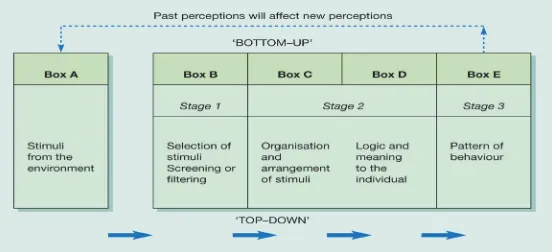
Perception as a process can be described as a sequence of events from the receipt of a stimulus to the response to it. It is common to see the stages of perception described as an Infor-mation Processing System.
Figure 1 Perception as information processing
Source: Mullins, L. (2007). Management and Organizational Behavior. Pearson/Prentice Hall. P.210
It is important to note that such a model simplifies the pro -cess and also it makes it easy to understand the stages of
per-cepion. So, according to above given figure perception process
consists of :
1. Stimuli from the environment (receipt of a stimulus ) (Box A)
2. Selection of stimulus for attention, screening or filter -ing (Box B)
3. Organization and arrangement of stimuli into mean-ingful pattern (Box C)
4. Logic and interpretation of the significance of the
stimulus to the individual(Box D) 5. Response behavior (Box E)
The first important sub process of perception is the receipt
of the stimulus or situation that is present. Perception begins when a person is confronted with a stimulus or a situation. This confrontation may be with the immediate sensual stimulation or with the total physical or socio-cultural environment. An exam-ple is the employee who is confronted with his or her supervi-sor or with the total formal organizational environment. Either one or both may initiate the employee’s perceptual process. In other words, this represents the stimulus situation interacting with the person (Luthans, 1998). In certain circumstances, we may select information out of the environment because of the way we categorize the world. For instance, if a manager has been advised by colleagues that a particular trainee has
mana-gerial potential, the manager may be specifically looking for confirmation that those views are correct. This process has
been known as ‘top down’ because the cognitive processes are
influencing the perceptual readiness of the individual to select
certain information. This emphasizes the active nature of the perceptual process. We do not passively digest the information from our sense, but we actively attend and indeed, at times, seek out certain information (Mullins, 2007).
function of three main elements:
• the circumstances
• factors external to the individual • factors internal to the individual
Circumstances can have a direct impact on the selection of the stimuli to which attention will be directed. For example,
senior managers of a company experiencing financial difficul -ties would pay more attention to every item of expenditure than
when a healthy profit was being made. Also, people in expen
-sive business suits walking around a factory floor can create a
wide variety of rumors because they stand out as different from the people usually found in the context. By comparison in a
head office environment it would be people walking about in
boiler suits who would attract attention.
External factors – There are a number of factors external to the individual that impact on the selection of a stimulus for attention. Certain features of a particular stimulus might make it more likely to stand out from those around it and therefore attract attention, including:
• Repetition – the repetition principle states that a repeated external stimulus is more attention-getting than a single one. Thus, a worker will generally “hear” better when directions for a dull task are given more than once. This principle partially explains why supervisors have to give directions over and over again for even the simplest tasks (Luthans, 1998). Advertis-ing and public relations often apply repetition principle to in-crease awareness of a particular product of brand name. So, the more often something is repeated the more likely it is that the message gets through to the level of consciousness. However, repetition can also lead to the sense turning off from the aware-ness of the presence of a stimulus. This is called habituation. This can create hazards in a working environment if individu-als frequently ignore warning signs that are always present for example.
• Size – the larger a particular stimulus is, the more likely it is that it will attract attention. For example, the maintenance engineering staff may pay more attention to a big machine than to a smaller one, even though the smaller one costs as much and is as important to the operation. In advertising, a full-page spread is more attention-getting than a few lines in the
classi-fied section.
• Contrast - the contrast principle states that external stimuli which stand out against the background or which are not what people expecting will receive their attention. For in-stance, a worker with many years of experience hardly notices
the deafening noise on the factory floor of a typical manufac -turing operation. However, if one more of the machinery sud-denly stops, the person would immediately notice the differ-ence in noise level.
• Novelty and Familiarity – the novelty and familiarity principle states that either a novel or a familiar external situa-tion can serve as an attensitua-tion-getter. New objects or events in a familiar setting or familiar objects or events in a new setting will draw the attention of the perceiver. For example humans
find it very easy to spot a familiar face among a crowd of stran -gers, or vice versa, to spot a new face in the crowed of familiar faces. Job rotation is another example of this principle. Recent research indicates that job rotation not only increased atten-tion but also improved employees’ acquisiatten-tion of new skills at a large company. Changing workers’ jobs from time to time will tend to increase the attention they give to the task.
Market-ing specialists in designMarket-ing advertisMarket-ing campaigns also use the aspect of novelty.
• Intensity – the intensity principle of attention states that the more intense the external stimulus, the more likely it is to be perceived. A loud noise, strong odor or bright light will be noticed more than soft sound, weak odor or dim light. Advertis-ers use intensity to gain customAdvertis-ers’ attention.
• Motion- people will pay more attention to moving
objects in their field of vision than they will to stationary ob -jects. Workers will notice materials moving by them on a con-veyor belt, but they may fail to give proper attention to the maintenance needs of the stationary machine next to them. Advertisers capitalize on this principle by creating signs that incorporate moving parts. Las Vegas at night is an example of advertisement in motion.
Any number of these factors may be present at a given time or in a given situation.
Internal Factors – there are a range of factors internal to
the individual that influence which stimuli are likely to be at -tended. As individuals we may differ in terms of the amount of sensory information we need to reach out the comfortable
equilibrium. Some individuals would find loud music at a party
uncomfortable and unpleasant, whereas for others the intensity of the music is part of the total enjoyment. Likewise, if we are deprived of sensory information for too long this can lead to feelings of discomfort and fatigue. Indeed, research has shown that if the brain is deprived of sensory information then it will manufacture its own and subjects will hallucinate. (Bexton, Heron, & Scott, 1985) It is possible to conclude therefore that the perceptual process is rooted in the sensory limitation of the individual.
Psychological factors will also affect what is perceived. These internal psychological factors are called an individual’s perceptual set. This set can be thought of as an internal form of attention-getting and is based largely on the individual’s complex psychological makeup. Simply put, an individual’s
perceptual set includes those internal factors which influence
stimulus selection and has many direct implications for organi-zational behavior. According to John Martin (2007) an indi-vidual’s perceptual set includes:
• Personality – the personality characteristics of
indi-viduals influence the way that they predispose themselves to
seek information from the environment. Differences in the ways individuals acquire information have been used as one of four scales in the Myer-Briggs Type Indicator. They distinguish individuals who ‘tend to accept and work with what is given in the here-and-now and thus become realistic and practical’ (sensing types) from others who go beyond the information from the senses and look at the possible patterns, meanings and relationships. These ‘intuitive types’ grow expert at seeing new possibilities and new ways of doing things’. These both types of perceiving stimuli (information) are complementary skills and are equally important for successful enterprise and rela-tionship.
percep-tion and attitude. Of course, there is a debate about the extent to which employee perceptions and attitudes are actually shaped by these processes. Employees may be simply complying with the requirements of the job.
• Motivation – Both the physical and social needs that
influence an individual at any point in time will influence
which stimuli attract attention. For example, an employee paid a bonus on the number of units is likely to pay much closer at-tention to events that impact on the volume of output. Another example is a person who has a relatively high need for power,
affiliation, or achievement will be more attentive to the relevant
situational variables. Or a worker who has a strong need for
af-filiation. When such a worker walks into the lunchroom, the
table where several coworkers are sitting tends to be perceived and the empty table where a single person is sitting tends to get no attention. Although very simple, these examples point out that perception may have an important impact on motivation, and vice versa (Luthans, 1998).
• Goals and objectives- people seek out those things and situations which are of value to them. Individuals have goals, intelligence and ability, which they utilize to their advantage in interacting with their environment. Consequently, stimuli which may be relevant within that framework will be scanned for relevance before being rejected or processed further. For example, an individual with shares in a particular company may well scan the newspapers for any piece of information which might suggest a potential change in the share price.
• Language – our language plays an important role in the way we perceive the world. Our language not only labels and distinguishes the environment for us but also structures
and guides our thinking patterns. It influences our relationships
with others and with the environment.
• Cultural differences – the ways people interact are also subject to cultural differences. The ways in which words are used and the assumptions made about shared understanding are dependent upon an individual’s culture and upbringing. There are cultures where it is normal to explain all details clearly, explicitly and directly (such as the USA) and such cultures are called low-context cultures (direct, explicit communications) and on the other hand there are cultures where ‘spelling out’ of all details are regarded as unnecessary and embarrassing, such cultures are called as high-context cultures (meaning assumed
and non-verbal signs significant).
Intelligence, ability, training, interests and expectations are also factors internal to the individual.
The discussion of perceptual selectivity was considered with the external and internal variables that gain an individual’s attention. The third step of Perceptual organization takes place after the information from the situation is received. In other words, the person’s perceptual process organizes the incom-ing information into a meanincom-ingful whole. The Gestalt School of Psychology claimed that the brain can act like a dynamic,
physical field in which interaction among elements is an intrin -sic part. (Stevenson, 2010) The Gestalt School of Psychology produced a series of principles, which are still readily
applica-ble today. Some of the most significant ones include the follow
-ing: the figure-ground principle, the grouping principle and the
principle of closure. Each principle is discussed below.
The Figure- Ground Principle - this principle is usually considered to be the most basic form of perceptual
organiza-tion. The figure-ground principle means simply that perceived
objects stand out as separable from their general background
(Luthans, 1998). These relationships are often reversible, as in the popular example shown in Figure 2.
Figure 2. The Gastlat school: Figure -Ground Principle Source: Mullins, L. (2007). Management and Organizational Behavior. Pearson/Prentice Hall. P.216
What do you see? Do you se a white chalice or two faces in
profile? Which you perceive depends on what you identify as background and what as foreground. The figure-ground
principel has applications in all occupational situations.It is important that employees know and are able to attend to the
significant aspects (the figure) and treat other elements of the
job as context (background). Stress could certainly occur for those employees who are uncertain about their priorities and
are unable to distinguish between significant and less signifi -cant tasks.
The Grouping Principles – the grouping principle of perceptu-al organizations states that there is a tendency to group severperceptu-al stimuli together into a recognizable and meaningful groupings or patterns on the basis of their:
• Continuity – this relates to the tendency to detect
continious patterns in groups of individual stimuli.
• Proximity – the princile of proximity, or nearness,
states that a group of stimuli that are close together will be perceived as a whole pattern of parts belonging together. For example, several employees in an organization may be
identi-fied as a single group because of physical proximity. As teams
become more and more common in today’s organizations, this principle of proximity will help identify them as a single entity.
• Closure – there is a tendency to complete an incom
-plete figure –to (mentally) fill in the gaps and to perceive the figure as a whole.
Figure 3. The Gastalt School: Closure
In the example in Figure 3 most people are likely to see the blobs as either the letter B or the number 13, possibly depend-ing on whether at the time they had been more concerned with written material or dealing in numbers. However, for some
peo-ple, the figure may remain just a series of 11 discrete blobs or
may be perceived as some other meaningful pattern/object. In other words, the person’s perceptual process will close the gaps
that are unfilled from sensory input. In the formal organization,
employees may either see a whole where none exists or not be able to put the pieces together into a whole that does exist. An
example of the first case is the department head who perceived
Figure 3. The Gastalt School: Closure
a given project when, in fact, there was opposition from several members. The department head in this situation closed the ex-isting gap and perceived complete agreement when, in fact, it did not exist. High degrees of specialization have often resulted in functionally oriented managers’ losing sight of the whole organization’s objectives. Specialists may get so caught up in their own little area of interest and responsibility that they may lose sight of the overall goal. It is because of this problem that some organizations nowadays have promoted inter-functional structures by emphasizing horizontal rather than traditional vertical, hierarchical structural arrangements.
4. Conclusion
Perception is an important mediating cognitive process. Through this complex process, people make interpretations of the stimulus or situation they are faced with. Both selectivity and organization go into perceptual interpretations. Externally, selectivity is affected by intensity, size, contrast, repetition,
motion and novelty. Internally, perceptual selectivity is influ -enced by the individual’s motivation, learning, and personal-ity. All these factors make perception process the key aspects of management. The way managers see employees, the habits they have formed, the associations they have made and the as-sumptions managers make are all parts of perception process and all of them have essential impact on the management and development of people at work. Perception is the process that involves every individual in the organization and this is a con-tinual and dynamic process. A manager’s perception of the
workplace will influence attitudes in dealing with people and
the style of managerial behavior adopted. Executives should know that in making judgments about other people it is impor-tant to try to perceive their underlying intent and motivation, not just the resultant behavior or actions. The challenge of the manager is to use positive use of these concepts and realize that the application of perception process can be an important strategy not only in getting selected for a position in an organi-zation but also in becoming successful in life or in different
work settings.
References:
Mullins, L. (2007). Management and Organizational Be-havior. Pearson/Prentice Hall..
Martin, J. (2007). Organizational Behavior and Manage-ment. CENGAGE learning.
Luthans, F. (1998). Organizational Behavior. Thomson Press.
Feingold, A. (2004).Gender Differences in Personality: A Meta Analysis, psychological Bulletin, 116(3).
Stevenson, H. (2010). Emergence: The Gestlat Approach to Change. Retrieved from http://www.clevelandconsulting-group.com/articles/emergence-gestalt-approach-to-change.php
MindTools. (2013). Are you a positive or negative think-er. Retrieved form http://www.mindtools.com/pages/article/ newTCS_89.htm
King, R. (1996). Introduction to Psychology (3rd ed.). McGraw-Hill.