I
I
n
n
t
t
e
e
r
r
n
n
a
a
t
t
i
i
o
o
n
n
a
a
l
l
J
J
o
o
u
u
r
r
n
n
a
a
l
l
o
o
f
f
B
B
i
i
o
o
l
l
o
o
g
g
i
i
c
c
a
a
l
l
S
S
c
c
i
i
e
e
n
n
c
c
e
e
s
s
2015; 11(7): 737-751. doi: 10.7150/ijbs.11786 Research Paper
Identification and Expression Analysis of Putative
Chemosensory Receptor Genes in Microplitis mediator
by Antennal Transcriptome Screening
Shan-Ning Wang1, Yong Peng 2, Zi-Yun Lu3, Khalid Hussain Dhiloo1,5, Shao-Hua Gu1, Rui-Jun Li2, Jing-Jiang Zhou4, Yong-Jun Zhang1, , Yu-Yuan Guo1
1. State Key Laboratory for Biology of Plant Diseases and Insect Pests, Institute of Plant Protection, Chinese Academy of Agricultural Sciences, Beijing, 100193, China
2. College of Plant Protection, Agricultural University of Hebei, Baoding 071000, China
3. IPM Center of Hebei Province, Key Laboratory of Integrated Pest Management on Crops in Northern Region of North China, Ministry of Agriculture, Plant Protection Institute, Hebei Academy of Agricultural and Forestry Sciences, Baoding, Hebei 071000, China
4. Department of Biological Chemistry and Crop Protection, Rothamsted Research, Harpenden, AL5 2JQ, UK 5. Department of Entomology, Faculty of Crop Protection, Sindh Agricultural University Tandojam, Pakistan
Corresponding author: Yong-Jun Zhang, PhD. State Key Laboratory for Biology of Plant Diseases and Insect Pests, Institute of Plant Protection, Chinese Academy of Agricultural Sciences, Beijing, 100193, China. Email: [email protected]; Tel.:+86 10 62815929; Fax: +86 10 62816631.
© 2015 Ivyspring International Publisher. Reproduction is permitted for personal, noncommercial use, provided that the article is in whole, unmodified, and properly cited. See http://ivyspring.com/terms for terms and conditions.
Received: 2015.02.04; Accepted: 2015.04.07; Published: 2015.05.16
Abstract
Host-seeking, ovipositional behavior and mating of insects are controlled mainly by odor per-ception through sensory organs such as antennae. Antennal chemoreper-ception is extremely im-portant for insect survival. Several antennal chemosensory receptors are involved in mediating the odor detection in insects, especially the odorant receptors (ORs) and ionotropic receptors (IRs), to ensure the specificity of the olfactory sensory neuron responses. In the present study, we identified the chemosensory receptor gene repertoire of the parasitoid wasp Microplitis mediator,a generalist endoparasitoid that infests more than 40 types of Lepidopterous larvae and is widely distributed in the Palaearctic region. By transcriptome sequencing of male and female antennae we identified 60 candidate odorant receptors, six candidate ionotropic receptors and two gustatory receptors in M. mediator. The full-length sequences of these putative chemosensory receptor genes were obtained by using the rapid amplification of cDNA ends PCR (RACE-PCR) method. We also conducted reverse transcription PCR (RT-PCR) combined with real-time quantitative PCR (qPCR) for investigating the expression profiles of these chemosensory receptor genes in olfactory and non-olfactory tissues. The tissue- and sex-biased expression patterns may provide insights into the roles of the chemosensory receptor in M. mediator. Our findings support possible future study of the chemosensory behavior of M. mediator at the molecular level.
Key words: Microplitis mediator;chemosensory receptor gene;odorant receptor;ionotropic receptor; gustatory receptor; expression profile
Introduction
Parasitic wasps (parasitoids) serve as important natural agents, effectively control major crop pests in the agricultural ecosystem [1]. The success of parasitic wasps in suppressing pest populations depends on
their ability to locate hosts in the complex chemical environment [1, 2]. Like most of the insects, parasitic wasps can also find their hosts in the foraging envi-ronments and reproduction occurs through a series of
behavioral activities, regulated mainly by semio-chemicals [2-5].
It is likely that the semiochemicals are perceived by different types of chemosensory (olfaction and taste) sensilla, which are mostly present on the an-tennae of parasitic wasps [1, 6, 7]. The chemosensory sensilla house olfactory sensory neurons (OSNs) that project their sensory dendrites into sensilla [7-9]. On the outer dendrite membrane of OSNs, different chemoreceptors are expressed and form specific re-ceptor binding sites for chemicals [7, 9]. Chemore-ceptors expressed in insect OSNs are composed to three large and divergent families: the odorant re-ceptors (ORs), gustatory rere-ceptors (GRs) and iono-tropic receptors (IRs) [10-17].
Insect ORs were the first family of chemosensory receptors discovered in the olfactory organs [12-14]. They are seven-transmembrane domain receptors with an inverted membrane topology with an intra-cellular N-terminus and an extraintra-cellular C-terminus compared with vertebrate ORs, which are G protein coupled receptors [18-20]. The ORs respond to a vari-ety of volatile chemicals, including pheromones and general odorants [9, 21]. The supposed function of insect ORs depends on the presence of a well-conserved odorant receptor coreceptor (Orco), which forms an odorant-gated ion channel with tun-ing ORs [22-24].
Subsets of OSNs in insect antennae can also ex-press proteins from the GR family [25-27], which share a common ancestor with ORs and encode sev-en-transmembrane domain receptors [11]. However, most GRs are expressed in gustatory organs [15, 25, 28]. These GRs mainly sense non-volatile compounds that the insects directly contact with gustatory sensil-la. These include sugars, bitter compounds, salts and some gustatory pheromones [8, 29, 30]. In addition, one sub-group of the GR family (DmGr21a and DmGr63a) responds to carbon dioxide (CO2) [8, 26].
A large number of OSNs neither express OR genes nor the GR genes [8, 31], but they express IRs that form a third class of chemoreceptors [10, 16, 32]. IRs belong to an ancient family of chemosensory ceptors that are relatives of ionotropic glutamate re-ceptors (iGluR) and are divided into two subfamilies, the conserved “antennal” IRs and the species-specific “divergent” IRs [10, 17]. The antennal IRs, expressed in the antennae of Drosophila melanogaster, are consid-ered to be ligand-gated ion channels that mediate the response of OSNs to a variety of organic acids, amines and aldehydes compounds [17, 33-35]. Two IRs, IR8a and IR25a are most closely related to iGluRs, con-taining a divergent extracellular amino-terminal do-main (ATD) and they appear to act as co-receptors. They form complexes with different sets of IRs, which
are necessary and sufficient for odor-evoked neuronal responses [10, 17, 33].
The identification of ORs, GRs and IRs in para-sitoid wasps is of considerable interest and signifi-cance, both to address the mechanisms controlling intraspecific or interspecific chemical communication and for potential applications for the genetic manip-ulation of parasitoids’ behavioral responses to chem-ical cues used in biologchem-ical control strategies. The parasitoid wasp Microplitis mediator (Haliday) (Hy-menoptera: Braconidae) is a generalist endoparasitoid that is reported to attack approximately 40 different lepidopteran larvae [36] and is widely distributed in the Palaearctic region [37]. In China, it has been suc-cessfully mass-reared in the laboratory and used as biological control agent [38]. Like most parasitoid wasps, M. mediator uses volatile chemicals as olfactory cues for the purpose of foraging for oviposition. It has been shown that the volatile chemicals released by caterpillar-damaged cotton plants can be attractive to M. mediator [39].
In our recent study, 14 OR genes were cloned from M. mediator [40], while additional receptors are remaining to be identified. Following to our previous work on M. mediator chemosensory gene identifica-tion, using next-generation sequencing of antennae of both male and female M. mediator, we have identified and annotated large sets of chemoreceptors (ORs, GRs and IRs). By using RACE-PCR, we were able to verify all of the chemoreceptor genes as unique genes. Using reverse transcription PCR (RT-PCR) and real-time quantitative-PCR (qPCR), we analyzed expression profiles of the chemoreceptors. Our results reveal that a number of chemoreceptor genes have specific or enriched expression in the antennae, which may play important functions in the chemoreception system of M. mediator.
Methods
Insect material and RNA extraction
The M. mediator cocoons were obtained from the
(mixture of heads, thoraxes, abdomens, legs, wings) were also collected. All collected tissues were imme-diately stored in -80 °C for further process. Total RNA was extracted from the antennae or other tissues us-ing the Trizol reagent (Invitrogen, Carlsbad, CA, USA). The quantity of RNA samples was checked by using 1.1% agarose gel electrophoresis and a NanoDrop 2000 spectrophotometer (NanoDrop, Wilmington, DE, USA).
Antennal transcriptome sequencing, assembly and functional annotation
The cDNA library was generated by using a combination of the SMART cDNA Amplification Kit (Clontech, Mountain View, CA, USA) and Ion Xpress™ Plus gDNA Fragment Library Kit (Life Technology) following the manufacturer’s protocol. The cDNA with appropriate length (300~400 bp) was purified using the MinElute Gel Recovery Kit (Qi-agen, Valencia, CA, USA) and sequenced using the Ion Proton™ System (Life Technology). After remov-ing short or low quality sequences and adaptor se-quences using the programs TagDust [41], LUCY [42] and SeqClean [43], male and female reads were as-sembled separately, and all reads from male and fe-male antennae were also assembled using MIRA3 [44] and CAP3 [45]. The sequence homology search was conducted with BLASTx and BLASTn programs against the Nr (non-redundant protein database) and Nt (non-redundant nucleotide sequence database) in NCBI with an E-value cut-off of 1.0E-5. Gene Ontol-ogy terms were extracted from the best hits obtained from the BLASTx against the Nr using the Blast2GO program [46].
Chemosensory receptor identification
A FASTA file of the non-redundant contigs was created from a local nucleotide database file using the BioEdit Sequence Alignment Editor 7.1.3.0 [47]. The local tBLASTn program was performed, using avail-able sequences of OR, GR and IR proteins from Na-sonia vitripennis and Apis mellifera as “query” [10, 48, 49] to identify candidate genes encoding putative ORs, GRs and IRs in M. mediator.
RACE-PCR
The unigene from the transcriptome did not al-ways represent full-length transcripts. Some non-full-length transcripts may be parts of inde-pendent genes or parts of the same genes. To verify the unigene status and for better resolution of phylo-genetic analyses, most of the candidate chemosensory receptor genes were extended using RACE-PCR. The 5’ and 3’ RACE-Ready cDNAs were synthesized from the adult antennae RNA by using the SMARTer™ RACE cDNA amplification kit (Clontech, Mountain
View, CA, USA) following the manufacturer’s in-structions. Primers were designed manually and fur-ther adjusted using the Primer Premier software (PREMIER Biosoft International) (see Supplementary Material: Table S1).
The PCR was done with AdvantageTM 2
poly-merase mix (Clontech, Mountain View, CA, USA) under the following conditions: denaturation at 95 °C for 2 min, 40 cycles of denaturation at 94 °C for 30 s, annealing at 66-68 °C, depending on primer pairs, for 30 s and extension at 72 °C for 2 min. The final exten-sion step was at 72 °C for 5 min. The RACE-PCR products were subcloned into the pEasy-T3 vector (TransGen, Beijing, China) and were sequenced. Sequence and phylogenetic analysis
The OR, IR and GR phylogenetic trees were built based on Hymenoptera data sets. The OR data set contained 54 amino acid sequences from M. mediator, together with a selected subset from N. vitripennis and
A. mellifera, representing major subfamilies within the
Hymenoptera ORs [48-50]. The GR data set contained 2 amino acid sequences from M. mediator, together with sequences from N. vitripennis and A. mellifera [48, 49]. The IR data set contained 6 amino acid sequences from M. mediator, together with sequences from N. vitripennis and A. mellifera [10]. Because D.
melano-gaster IRs were well annotated and putative IRs could
be distinguished from iGluRs, IR and iGluR sequenc-es from D. melanogaster were also included in the data set [10].
Amino acid sequences were aligned using the program ClustalW [51] and further edited using the BioEdit Sequence Alignment Editor 7.1.3.0 [47]. The neighbor-joining tree was constructed using the MEGA 5.0 program [52]. Bootstrapping was per-formed by re-sampling amino acid positions of 1000 replicates.
RT-PCR analysis
(GenBank accession number: KC193266) of M. media-tor was employed to assess the cDNA integrity. The PCR products were checked by using 1.2% agarose gels and the target genes were further confirmed by direct DNA sequence analysis. Amplification of each target gene was performed three times with three biological samples.
qPCR measurement
The relative transcript abundance of chemosen-sory receptor genes in male antennae, female anten-nae and other body parts (mixture of heads, thoraxes, abdomens, legs and wings) were further explored by qPCR using the ABI Prism 7500 Fast Detection System (Applied Biosystems, Carlsbad, CA, USA). cDNAs from male antennae, female antennae and the body parts were synthesized using the Fast Quant RT kit (TIANGEN, Beijing, China). The reference gene β-actinwas used for normalization. The primers of the target and reference genes were designed with the Primer 3 program (http://frodo.wi.mit.edu/) and listed in Supplementary Material: Table S2. The spec-ificity of each primer set was validated by melt-curve analysis and efficiency was calculated by analyzing standard curves with a five-fold cDNA dilution series. The qPCR reaction was conducted in a 20 μL mixture containing 10 μL of 2 × SuperReal PreMix Plus (TianGen, Beijing, China), 0.6 μL of each primer (10 μM), 0.4μL of 50 × RoxReference Dye, 1 μL of sample cDNA, 7.4 μL of sterilized H2O. The qPCR cycling
parameters consisted of 95 °C for 15 min, followed by 40 cycles of 95 °C for 10 s and 60 °C for 30 s, melt curves stages at 95 °C for 15 s, 60 °C for 1 min, and 95 °C for 15 s. Negative controls without either template were included in each experiment. Each reaction was performed with three biological replicates and each biological replicate was assessed three times. The comparative 2-ΔΔCT method [53] was used to calculate
the relative transcript levels in each tissue. Data anal-ysis was performed using SPSS Statistics 18.0 software (SPSS Inc., Chicago, IL, USA). An ANOVA and Dun-can’s new multiple range test (P < 0.05) were used to compare the expression of each target gene among various tissues.
Results
An overview of the antennal transcriptome To identify chemosensory receptor genes from
M. mediator, two transcriptomes of the male and
fe-male M. mediator antennae were created by high-throughput pyrophosphate sequencing of an-tennal cDNA libraries. A total of 19388952 (mean length 129 bp) and 11012901 clean reads (mean length 114 bp) were produced from the female and male an-tennae samples, respectively, and assembled into
48015 (mean length 551 bp) and 44428 (mean length 570 bp) transcripts, respectively. Furthermore, we assembled all clean reads from male and female an-tennae together and generated 48075 transcripts with 545 bp average length.
Through annotation by BLASTx and BLASTn program with the E-value cut-off of 1.0E-5, 17440 of the 48075 transcripts (36.3%) had BLASTx hits in the Nr databases and 9235 (19.2%) had BLASTn hits in the Nt databases. Among the annotated unigenes, 15044 of the 17440 Nr-hit unigenes (86.3%) had a best blast match to Hymenopteran sequences, primarily
Cam-ponotus floridanus (21.9%), Harpegnathos saltator
(21.9%), A. mellifera (21.5%) and N. vitripennis (18.9%) (Figure 1A).
With the GO classification, 8274 female antennal unigenes and 7923 male antennal unigenes were clas-sified into 3 functional categories: molecular function, biological process and cellular component (Figure 1B). GO analyses showed that the numbers of each GO category were highly similar between the male and female antennal transcriptomes. In molecular func-tion, the genes expressed in the antennae were mostly linked to binding (3614 female antennal unigenes and 3460 male antennal unigenes) and catalytic activity (3651 female antennal unigenes and 3473 male an-tennal unigenes). In terms of the biological process, the most represented biological processes were cellu-lar processes (4487 female antennal unigenes and 4299 male antennal unigenes) and metabolic processes (3547 female antennal unigenes and 3387 male an-tennal unigenes). In the cellular component terms, cell (4843 female antennal unigenes and 4628 male an-tennal unigenes) and cell part (4476 female anan-tennal unigenes and 4378 male antennal unigenes) constitute the most abundant categories (Figure 1B).
Identification of OR, GR and IR genes
sequence assembly as well as multiple sequence alignment. We named these genes using the conven-tions followed by Ma et al. (MmedOR14~MmedOR61) [40]. MmedOR14~53 encodes complete or nearly complete ORs (260 residues or larger). The complete-ness of MmedOR14~53 was judged by amino acid alignment with our previously identified OR se-quences (Supplementary Material: Figure S1). All of them showed complete sequences except OR24 and OR39. The predicted translations of the complete OR transcripts ranged from 423 (MmedOR46) to 369 amino acids (MmedOR22). All of these proteins ex-hibited the presence of predicted multiple trans-membrane domains with an inside or outside N-terminus, as usually observed for insect ORs (Table 1). MmedOR14~53 were analyzed in a subsequent
experiment and submitted to GenBank with the ac-cession numbers listed in Table 1, while other se-quences (MmedOR54~61) are provided in Supple-mentary Material: Table S3.
The partial sequences of two candidate GRs were also identified in M. mediator antennae transcriptomes. Both candidates were cloned as full-length coding sequences by using RACE-PCR and deposited in the GenBank database with accession numbers KM979270 and KM979271. We compared the candidate full-length GRs (MmedGR6 and MmedGR64f) against the Nr database at NCBI using BLASTp and revealed a 41 % and 60 % identity with GR6 of N. vitripennis and GR64f of H. saltator, respectively. Then we con-firmed that all candidate GRs belonged GR family (Table 2).
Table 1.Odorant receptors in M. mediator antennae.
Gene name Acc.
num-ber Length (bp) ORF (aa) Completeness Tm nb Blast P hit E-value % Identify
MmedOR14 KM979230 1690 411 Complete 7i gb|AGS43050.1| odorant receptor Or2a [Cephus cinctus] 9e-83 34% MmedOR15 KM979231 1381 385 Complete 7i gb|AGG17939.1| olfactory receptor 6 [Microplitis mediator] 2e-68 34% MmedOR16 KM979232 1293 378 Complete 8o ref|NP_001177491.1| odorant receptor 44 [Nasonia vitripennis] 4e-69 36% MmedOR17 KM979233 1720 402 Complete 8o gb|AGG17945.1| olfactory receptor 12 [Microplitis mediator] 3e-84 36% MmedOR18 KM979234 1930 390 Complete 7i ref|NP_001164394.1| odorant receptor 81 [Nasonia vitripennis] 2e-76 35% MmedOR19 KM979235 1352 396 Complete 7i gb|AGG17940.1| olfactory receptor 7 [Microplitis mediator] 3e-165 57% MmedOR20 KM979236 1556 392 Complete 7i ref|NP_001177576.1| odorant receptor 204 [Nasonia vitripennis] 2e-77 35% MmedOR21 KM979237 1443 372 Complete 7i gb|AGG17945.1| olfactory receptor 12 [Microplitis mediator] 1e-75 38% MmedOR22 KM979238 1281 369 Complete 5i ref|XP_003696363.1| putative odorant receptor 13a-like [Apis florea] 3e-59 34% MmedOR23 KM979239 1408 373 Complete 7i ref|NP_001177491.1| odorant receptor 44 [Nasonia vitripennis] 2e-76 36% MmedOR24 KM979240 1109 260 Internal exon
missing 4o gb|EGI68890.1| Odorant receptor 46a, isoform A [Acromyrmex echi-natior] 4e-81 51% MmedOR25 KM979241 1416 376 Complete 8o ref|NP_001177491.1| odorant receptor 44 [Nasonia vitripennis] 5e-67 33% MmedOR26 KM979242 1349 397 Complete 7i gb|AGG17940.1| olfactory receptor 7 [Microplitis mediator] 7e-165 55% MmedOR27 KM979243 1329 403 Complete 5i gb|AGG17936.1| olfactory receptor 3 [Microplitis mediator] 3e-154 54% MmedOR28 KM979244 1521 402 Complete 7i gb|AGS43067.1| odorant receptor Or3h, partial [Cephus cinctus] 0 61% MmedOR29 KM979245 1551 413 Complete 6i gb|AGG17935.1| olfactory receptor 2 [Microplitis mediator] 1e-168 56% MmedOR30 KM979246 1295 383 Complete 6i ref|NP_001177491.1| odorant receptor 44 [Nasonia vitripennis] 3e-64 33% MmedOR31 KM979247 1602 375 Complete 7i gb|EGI65843.1| Odorant receptor 49b [Acromyrmex echinatior] 5e-67 36% MmedOR32 KM979248 1474 420 Complete 8o gb|AEQ62577.1| odorant receptor 1 [Apis cerana] 2e-159 58% MmedOR33 KM979249 1384 384 Complete 7i gb|AGG17939.1| olfactory receptor 6 [Microplitis mediator] 2e-67 33% MmedOR34 KM979250 1394 395 Complete 5i gb|AGG17946.1| olfactory receptor 13 [Microplitis mediator] 1e-170 60% MmedOR35 KM979251 1295 377 Complete 7i gb|AGG17941.1| olfactory receptor 8 [Microplitis mediator] 3e-75 35% MmedOR36 KM979252 1350 382 Complete 7i gb|AGG17939.1| olfactory receptor 6 [Microplitis mediator] 2e-82 36% MmedOR37 KM979253 1322 384 Complete 7i gb|AGG17939.1| olfactory receptor 6 [Microplitis mediator] 7e-73 34% MmedOR38 KM979254 1299 388 Complete 7i ref|NP_001164395.1| odorant receptor 82 [Nasonia vitripennis] 5e-75 35% MmedOR39 KM979255 1725 349 N-terminus
Table 2. Gustatory receptors and ionotropic receptors in M. mediator antennae.
Gene name Acc.
num-ber Length (bp) ORF (aa) Tm nb Blast P hit E-value % Identify
MmedGR6 KM979270 1598 410 7i ref|NP_001177425.1| gustatory receptor 6 [Nasonia vitripennis] 1e-82 41% MmedGR64f KM979271 1517 452 8o gb|EFN77950.1| Putative gustatory receptor 64f [Harpegnathos saltator] 1e-180 60% MmedIR8a KM979274 3116 898 4i ref|XP_003697873.1| glutamate receptor, ionotropic kainate 2-like [Apis florea] 0 59% MmedIR25a.1 KM979275 3072 938 3o ref|XP_008206981.1| glutamate receptor 2-like [Nasonia vitripennis] 0 59% MmedIR25a.2 KM979277 3219 899 5o ref|XP_003703813.1| glutamate receptor, ionotropic kainate 1-like [Megachile rotundata] 0 45% MmedIR64a KM979276 2133 650 4i ref|XP_008208508.1| glutamate receptor ionotropic, kainate 2-like [Nasonia vitripennis] 0 49% MmedIR75u KM979272 2039 586 3o gb|EGI70316.1| Glutamate receptor delta-2 subunit [Acromyrmex echinatior] 0 52% MmedIR76b KM979273 2414 577 2o ref|XP_003400706.1| glutamate receptor, ionotropic kainate 2-like isoform 2 [Bombus
terrestris] 4e-131 40%
Note: Transmembrane domains(Tm) were predicted using HMMTop (http://www.enzim.hu/hmmtop/), iN-terminus inside and oN-terminus outside.
Figure 1. Summary for the annotation of M. mediator antenna transcripts. (A) Species distribution of best BLASTx hits of M. mediator antenna transcripts. (B) Distribution and comparison of the female and male M. mediator antennal transcripts annotated at GO level 2.
Six putative IR genes in the M. mediator antennal transcriptome were identified according to their sim-ilarity to IR sequences of other insects. By using RACE-PCR, full length sequences of these MmedIRs
N. vitripennis and A. mellifera [10]. The predicted translations of the complete MmedIR transcripts ranged from 577 (MmedIR76b) to 938 amino acids (MmedIR25a.1). All the MmedIR genes with GenBank accession numbers were listed in Table 2. By using HMMTop prediction program we found that there were two or more transmembrane domains presented in all of these genes (Table 2). The protein secondary structure analysis showed that all the putative MmedIRs had similar structures as insect IRs, com-prising an extracellular N terminus, one ion channel pore (P), a bipartite ligand-binding domain with two lobes (S1 and S2) and a short cytoplasmic C terminus (data not shown). However, there was a lack of one or several key amino acids in the predicted glutamate binding domains (Figure 2). In the S1 lobe, the argi-nine (R) residue was conserved in all putative MmedIRs except MmedIR76b. In the first half of the S2 domain, the threonine (T) residue was not con-served in any putative MmedIRs. In the second half of the S2 domain, an aspartate (D) or glutamate (E) was only conserved in the coreceptor IR25a /8a orthologues.
Sequence similarity and phylogenetic analysis As illustrated in a phylogenetic tree constructed with sequences from three Hymenoptera insects, ORs are extremely divergent between species and most ORs from the same species formed monophyletic groups (Figure 3). In the phylogenetic tree, seven MmedORs (OR3, OR4, OR7, OR9, OR19, OR26 and OR27) and nine other MmedORs (OR6, OR8, OR15, OR33, OR35, OR36, OR37, OR42 and OR53) clustered in a species-specific subgroup, respectively. In addi-tion, several other MmedORs did not cluster in spe-cies-specific clades. They grouped with the N.
vit-ripennis or A. mellifera ORs. MmedOR24 clusters with
AmelOR116 and MmedOR32 is most closely related to NvitOR2. Interestingly, MmedOR1 clusters with AmelOR161 and NvitOR296, which have been classi-fied as I subfamily in the Hymenoptera OR family [50]. This I subfamily showed a limited number of genes, two in N. vitripennis and one in A. mellifera [50]. There is no suspense that the olfactory Orco subfamily is highly conserved and clustered in one branch with clear orthologous relationships in three species.
In the GR phylogeny (Figure 4), MmedGR64f was classified into the N. vitripennis GR1 orthologue subgroup, which has orthologue of the knownsugar receptors (GR1 and GR2) [49, 54, 55]. Another is similar to a member of GR6 family (MmedGR6).
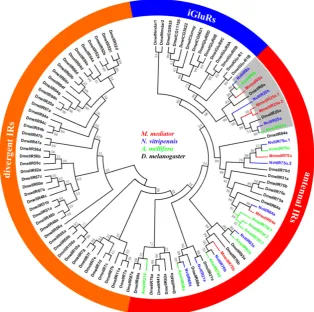
The neighbor-joining tree of IRs suggests that the putative MmedIR sequences did not cluster with iGluRs, and they generally tend to group with other IRs (Figure 5). All of the MmedIRs show clear homology to antennal IRs in N. vitripennis. Among the six antennal IRs, three putative MmedIRs (MmedIR8a, MmedIR25a.1 and MmedIR25a.2) clustered in the highly conserved IR8a and IR25a subfam-ilies. Comparative analysis revealed that the amino acid identity of the IR8a is between 38.0 % and 56.6 %. Likewise, the pair-wise se-quence identity of the IR25 ranged from 35.3 % to 54.6 % among the species (NvitIR25b, which has a short N-terminus, was not in-cluded). Additionally, MmedIR25a.1 and MmedIR25a.2 share 54.6 % of their amino acids. Alignment of MmedIR8a and MmedIR25a amino acid sequences with re-lated proteins in the other species are shown in Figure 6 and Figure 7.
Figure 3. Phylogenetic rela-tionship of candidate odorant receptor (OR) genes from M. mediator and other Hymenop-tera insects. A neighbour-joining tree was constructed using MEGA5 which was made based on a sequence alignment using ClustalW, the same as below. Amel, A. melifera; Mmed, M. mediator; Nvit, N. vitripennis.
Figure 5. Phylogenetic relationship of candidate ionotropic receptor (IR) genes from M. mediator and other insects. Amel, A. melifera;Dmel, D. melanogaster; Mmed, M. mediator; Nvit, N. vitripennis.
Figure 7. Amino acid Alignment of the MmedIR25a.1/25a.2 with IR25a sequences in other insects. Black shadings indicate amino acids which show at least 75% identity between sequences. Positions of the amino-terminal domain (ATD), the ligand-binding domain lobes (S1 and S2), the pore loop (P) and the transmembrane segments (M1, M2, M3) are marked with different colors bars according to their position in DmelIR25a. Amel, A. melifera; Dmel, D. melanogaster;Mmed, M. mediator; Nvit, N. vitripennis.
Tissue- and sex-specificity of the chemosen-sory receptor transcripts
We explored the expression profiles of chemosensory receptors (ORs, GRs and IRs) in dif-ferent tissues of M. mediator byusing RT-PCR. The OR transcripts display different patterns in various tis-sues (Figure 8). The results showed that the tran-scripts of MmedOR24, MmedOR26, MmedOR28,
MmedOR29, MmedOR31, MmedOR32, MmedOR34,
MmedOR36-OR43, MmedOR45, MmedOR46,
MmedOR48, MmedOR49, MmedOR50, MmedOR52 and
MmedOR53 were only expressed in male and female
antennae. MmedOR33 was only presented in the fe-male antennae and head. However, the remaining ORs showed a wide range of expression patterns. Among them, the MmedOR25, MmedOR35,
MmedOR44 and MmedOR47 were predominantly
The qPCR measurement was performed to in-vestigate the chemosensory receptor transcript abundances in the female antennae, male antennae and body tissues. By comparing expression levels in female antennae, male antennae and body tissues, we found all of the 40 putative OR genes were mainly expressed in the antennae. In addition, 25 OR genes (OR15, OR16, OR18, OR20, OR21, OR22, OR23, OR24, OR25, OR29, OR30, OR31, OR33, OR34, OR35, OR36, OR37, OR41, OR43, OR45, OR47, OR48, OR49, OR50, OR52) were more highly expressed in female anten-nae, whereas two ORs, OR19 and OR26, were more highly expressed in male antennae. The remaining 13
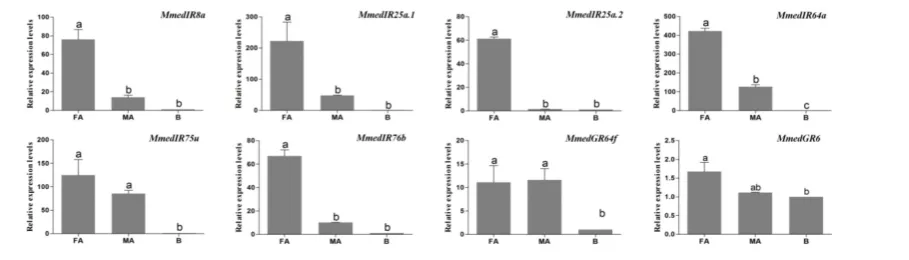
OR genes (OR14, OR17, OR27, OR28, OR32, OR38, OR39, OR40, OR42, OR44, OR46, OR51, OR53) had similar expression levels between the antennae of two sexes (Figure 9). MmedGR64f was highly expressed in the female antennae, whereas MmedGR6 was ex-pressed at a similar level in all three tested tissues. Six IR genes had higher expression levels in antennae than that in body parts. The MmedIR8a, MmedIR25a.1,
MmedIR25a.2, MmedIR64a and MmedIR76b showed
higher expression levels in female antennae than those in male antennae. In addition, MmedIR75u had similar expression levels between the antennae of both sexes (Figure 10).
Figure 9. Transcript abundances of M. mediator OR genes. FA: female antennae, MA: male antennae, B: body. Transcription levels of OR genes were normalized by
Figure 10. Transcript abundances of M. mediator IR and GR genes. FA: female antennae, MA: male antennae, B: body.
Discussion
In the present study, we focused on three crucial families of chemosensory receptor (ORs, GRs and IRs) due to their significance as potential target genes for manipulating parasitoid wasps in order to improve biological pest control. From our transcriptome re-sults, we identified 68 chemosensory receptor genes, including 60 ORs, two GRs and six IRs. Now, a total of 62 ORs (one co-receptor, Orco, and 61 odor-specific ORs) were identified in the antennaeof M. mediator combined with our previous work [40]. The amount of identified ORs in M. mediator is less than in A. mel-lifera and N. vitripennis, which have a total of 170 and 301 OR genes, respectively [48, 49]. In this work, OR genes were identified only from the antennae tran-scriptome. The ORs expressed in other tissues might be difficult to identify from the antennae. Moreover, the lab-reared wasps have no opportunity to exposure to the odors from host insects or related plants in surroundings. Hence, we speculated that there was difficult to identify the additional ORs with low ex-pression level or without exposing to the odors from host insects or related plants. In our previous study, we found that some OR genes of M. mediator were up-regulated after contacted with host odors (un-published data). A recent study demonstrated that the olfactory receptor gene expression in A. mellifera was modulated by scent conditioning [56]. Moreover, the factors of physiology-dependent expression may also affect the amount of identified ORs in the antennae of
M. mediator. One of the putative Anopheles gambiae
odorant receptors (AgOr1) was down-regulated after blood feeding and the transcript of AgOr1 was not detectable in antennae after blood feeding [57]. Over-all, all of the factors mentioned above may influence the identification of the repertoires of ORs in M.
me-diator by antennae transcriptome sequencing.
Most ORs in insects are extensively expressed in the antennae [14]. In our study, some ORs showed obviously antennal-specific expression profile, others demonstrated ubiquitous expression characteristic
but were predominantly expressed in antennae. The ORs with antennal-specific or dominant expression profiles may play crucial roles in olfactory chemore-ception of wasps. Similar to the present study, it was reported that some ORs could be expressed in a vari-ety of tissues apart the olfactory organs [58-60]. Our previous work also suggests a divergent expression profile of ORs in M. mediator [40]. The expression of ORs in non-olfactory tissues suggests that they may have physiological functions in other organs. In A.
gambiae, the Orco expressed in the testes is involved in
mediating activation of spermatozoa [59]. In M. medi-ator, there are differences in OR genes expression between the antennae of males and females. Twenty five of 40 OR genes are much highly expressed in fe-male antennae, which may be involved in the percep-tion of volatile semiochemicals during host locapercep-tion process.
Because GR expression levels are very low and mainly expressed in gustatory organs [25, 28], only a small number of putative GR-encoding transcripts were identified from the antennae of M. mediator. To our knowledge, this is the first report on the GR genes in wasp antennae, although some studies described the distribution of some gustatory sensilla in wasp antennae [1, 2, 6]. The identified GRs included a GR64f orthologue, which clusters with the sugar re-ceptor GR1 subfamily in Hymenoptera, suggesting that the antennae of M. mediator participate in sugar detection. In addition, the high expression level of MmedGR64f in the antennae also indicated a gusta-tory function of the antennae.
In D. melanogaster, 15 of the 66 IR genes were
However, there is no any suggestion about divergent function of IR25a orthologues to date. Compared with Diptera insects, there were very few IR genes identi-fied in Hymenoptera insects. There were only ten IR genes identified in A. mellifera and N. vitripennis, however, there were 66 IRs in D. melanogaster [10]. In our work, six IR genes were identified in M. mediator, a number that is close to the amount of AmelIRs or NvitIRs. Most of the IR genes were expressed higher in the female antennae than in male antennae indi-cating that IR-mediated signaling may play more important roles in host recognition behavior. How-ever, the ubiquitous expression feature of MmedIRs revealed that these genes may be involved in other physiological functions in non-olfactory organs.
Female M. mediator uses different types of host-related volatile cues for foraging and host loca-tion. Host-plant volatiles (green leaf volatiles and herbivore-induced plant volatiles) play an important role in the initial searching behavior of female wasps [2]. The high expression of ORs in female antennae may be important in recognition of host volatile chemicals, which provide a starting point for the po-tential use of ORs as targets to manipulate wasp host location behavior and develop novel crop protection strategies. In further study, we will investigate the binding function of candidate ORs with known host-plant volatiles, such as 3, 7-dimethyl-1, 3, 6-octatriene, (Z)-3-hexenyl acetate and nonanal, which have significant electrophysiological and taxis be-havioral effects on M. mediator [39]. The findings in this work may help to shed light on the chemorecep-tion mechanisms of M. mediator.
Supplementary Material
Figures S1, Tables S1-S3.
http://www.ijbs.com/v11p0737s1.pdf
Acknowledgments
This work was supported by the China National Basic Research Program (2012CB114104) and the Na-tional Natural Science Foundation of China (31171858, 31272048 and 31321004). YJ Zhang and JJ Zhou acknowledge the financial support from the interna-tional joint project between China and the UK (31111130203; JP100849). This manuscript has been edited by the native English-speaking experts of Elsevier Language Editing Services.
Competing Interests
The authors have declared that no competing interest exists.
References
1. Quicke DL. Parasitic wasps. Chapman & Hall Ltd; 1997.
2. Godfray HCJ. Parasitoids: Behavioral and Evolutionary Ecology. Princeton University Press; 1994.
3. Vet LEM, Dicke M. Ecology of Infochemical Use by Natural Enemies in a Tritrophic Context. Annual review of entomology. 1992; 37: 141-72.
4. Turlings TC, Tumlinson JH, Lewis WJ. Exploitation of herbivore-induced plant odors by host-seeking parasitic wasps. Science. 1990; 250: 1251-3. 5. De Moraes CM, Lewis WJ, Pare PW, Alborn HT, Tumlinson JH.
Herbivore-infested plants selectively attract parasitoids. Nature. 1998; 393: 570-3.
6. Barbarossa IT, Muroni P, Dardani M, Casula P, Angioy AM. New insight into the antennal chemosensory function of Opius concolor (Hymenoptera, Braconidae). Ital J Zool. 1998; 65: 367-70.
7. Su CY, Menuz K, Carlson JR. Olfactory perception: receptors, cells, and circuits. Cell. 2009; 139: 45-59.
8. Vosshall LB, Stocker RF. Molecular architecture of smell and taste in
Drosophila. Annu Rev Neurosci. 2007; 30: 505-33.
9. Touhara K, Vosshall LB. Sensing odorants and pheromones with chemosensory receptors. Annual review of physiology. 2009; 71: 307-32. 10. Croset V, Rytz R, Cummins SF, Budd A, Brawand D, Kaessmann H, et al.
Ancient protostome origin of chemosensory ionotropic glutamate receptors and the evolution of insect taste and olfaction. Plos Genet. 2010; 6: e1001064. 11. Robertson HM, Warr CG, Carlson JR. Molecular evolution of the insect
chemoreceptor gene superfamily in Drosophila melanogaster. Proceedings of the National Academy of Sciences of the United States of America. 2003; 100 Suppl 2: 14537-42.
12. Gao Q, Chess A. Identification of candidate Drosophila olfactory receptors from genomic DNA sequence. Genomics. 1999; 60: 31-9.
13. Clyne PJ, Warr CG, Freeman MR, Lessing D, Kim J, Carlson JR. A novel family of divergent seven-transmembrane proteins: candidate odorant receptors in
Drosophila. Neuron. 1999; 22: 327-38.
14. Vosshall LB, Amrein H, Morozov PS, Rzhetsky A, Axel R. A spatial map of olfactory receptor expression in the Drosophila antenna. Cell. 1999; 96: 725-36. 15. Dunipace L, Meister S, McNealy C, Amrein H. Spatially restricted expression
of candidate taste receptors in the Drosophila gustatory system. Current biology : CB. 2001; 11: 822-35.
16. Benton R, Vannice KS, Gomez-Diaz C, Vosshall LB. Variant ionotropic glutamate receptors as chemosensory receptors in Drosophila. Cell. 2009; 136: 149-62.
17. Abuin L, Bargeton B, Ulbrich MH, Isacoff EY, Kellenberger S, Benton R. Functional architecture of olfactory ionotropic glutamate receptors. Neuron. 2011; 69: 44-60.
18. Benton R, Sachse S, Michnick SW, Vosshall LB. Atypical membrane topology and heteromeric function of Drosophila odorant receptors in vivo. Plos Biol. 2006; 4: e20.
19. Lundin C, Kall L, Kreher SA, Kapp K, Sonnhammer EL, Carlson JR, et al. Membrane topology of the Drosophila OR83b odorant receptor. Febs Lett. 2007; 581: 5601-4.
20. Smart R, Kiely A, Beale M, Vargas E, Carraher C, Kralicek AV, et al. Drosophila
odorant receptors are novel seven transmembrane domain proteins that can signal independently of heterotrimeric G proteins. Insect biochemistry and molecular biology. 2008; 38: 770-80.
21. Dahanukar A, Hallem EA, Carlson JR. Insect chemoreception. Current opinion in neurobiology. 2005; 15: 423-30.
22. Sato K, Pellegrino M, Nakagawa T, Vosshall LB, Touhara K. Insect olfactory receptors are heteromeric ligand-gated ion channels. Nature. 2008; 452: 1002-6. 23. Wicher D, Schafer R, Bauernfeind R, Stensmyr MC, Heller R, Heinemann SH, et al. Drosophila odorant receptors are both ligand-gated and cyclic-nucleotide-activated cation channels. Nature. 2008; 452: 1007-11. 24. Stengl M, Funk NW. The role of the coreceptor Orco in insect olfactory
transduction. Journal of comparative physiology A, Neuroethology, sensory, neural, and behavioral physiology. 2013; 199: 897-909.
25. Scott K, Brady R, Jr., Cravchik A, Morozov P, Rzhetsky A, Zuker C, et al. A chemosensory gene family encoding candidate gustatory and olfactory receptors in Drosophila. Cell. 2001; 104: 661-73.
26. Jones WD, Cayirlioglu P, Kadow IG, Vosshall LB. Two chemosensory receptors together mediate carbon dioxide detection in Drosophila. Nature. 2007; 445: 86-90.
27. Popescu A, Couton L, Almaas TJ, Rospars JP, Wright GA, Marion-Poll F, et al. Function and central projections of gustatory receptor neurons on the antenna of the noctuid moth Spodoptera littoralis. J Comp Physiol A. 2013; 199: 403-16. 28. Clyne PJ, Warr CG, Carlson JR. Candidate taste receptors in Drosophila.
Science. 2000; 287: 1830-4.
29. Thorne N, Chromey C, Bray S, Amrein H. Taste perception and coding in
Drosophila. Current biology : CB. 2004; 14: 1065-79.
30. Freeman EG, Wisotsky Z, Dahanukar A. Detection of sweet tastants by a conserved group of insect gustatory receptors. Proceedings of the National Academy of Sciences of the United States of America. 2014; 111: 1598-603. 31. Montell C. A taste of the Drosophila gustatory receptors. Current opinion in
neurobiology. 2009; 19: 345-53.
32. Rytz R, Croset V, Benton R. Ionotropic receptors (IRs): chemosensory ionotropic glutamate receptors in Drosophila and beyond. Insect biochemistry and molecular biology. 2013; 43: 888-97.
34. Yao CA, Ignell R, Carlson JR. Chemosensory coding by neurons in the coeloconic sensilla of the Drosophila antenna. J Neurosci. 2005; 25: 8359-67. 35. Silbering AF, Rytz R, Grosjean Y, Abuin L, Ramdya P, Jefferis GS, et al.
Complementary function and integrated wiring of the evolutionarily distinct
Drosophila olfactory subsystems. J Neurosci. 2011; 31: 13357-75.
36. Mir Khan S: Effectiveness of Microplitis mediator (HYM. : Braconidae) against its hosts Agrotis segetum and A. ipsilon (Lepidoptera: Noctuidae). Pakistan Journal of Biological Sciences 1999, 2(2):344-346.
37. Mason PGE, M A Youngs, B J. Effects of Parasitism by Banchus flavescens
(Hymenoptera: Ichneumonidae) and Microplitis mediator (Hymenoptera: Braconidae) on the Bertha Armyworm, Mamestra configurata (Lepidoptera: Noctuidae)1. Journal of Hymenoptera Research. 2001; 10.
38. Li JC, Yan FM, Coudron TA, Pan WL, Zhang XF, Liu XX, et al. Field release of the parasitoid Microplitis mediator (Hymenoptera : Braconidae) for control of
Helicoverpa armigera (Lepidoptera : Noctuidae) in cotton fields in Northwestern China's Xinjiang Province. Environmental Entomology. 2006; 35: 694-9. 39. Yu H, Zhang Y, Wyckhuys KA, Wu K, Gao X, Guo Y. Electrophysiological and
behavioral responses of Microplitis mediator (Hymenoptera: Braconidae) to caterpillar-induced volatiles from cotton. Environ Entomol. 2010; 39: 600-9. 40. Ma L, Gu SH, Liu ZW, Wang SN, Guo YY, Zhou JJ, et al. Molecular
characterization and expression profiles of olfactory receptor genes in the parasitic wasp, Microplitis mediator (Hymenoptera: Braconidae). Journal of insect physiology. 2014; 60: 118-26.
41. Lassmann T, Hayashizaki Y, Daub CO. TagDust--a program to eliminate artifacts from next generation sequencing data. Bioinformatics. 2009; 25: 2839-40.
42. Chou HH, Holmes MH. DNA sequence quality trimming and vector removal. Bioinformatics. 2001; 17: 1093-104.
43. Chen YA, Lin CC, Wang CD, Wu HB, Hwang PI. An optimized procedure greatly improves EST vector contamination removal. Bmc Genomics. 2007; 8: 416.
44. Chevreux B, Pfisterer T, Drescher B, Driesel AJ, Muller WE, Wetter T, et al. Using the miraEST assembler for reliable and automated mRNA transcript assembly and SNP detection in sequenced ESTs. Genome Res. 2004; 14: 1147-59.
45. Huang X, Madan A. CAP3: A DNA sequence assembly program. Genome Res. 1999; 9: 868-77.
46. Conesa A, Götz S, García-Gómez JM, Terol J, Talón M, Robles M. Blast2GO: a universal tool for annotation, visualization and analysis in functional genomics research. Bioinformatics. 2005; 21: 3674-6.
47. Hall TA. BioEdit: a user-friendly biological sequence alignment editor and analysis program for Windows 95/98/NT. Nucleic Acids Symposium Series. 1999; 41: 95-8.
48. Robertson HM, Gadau J, Wanner KW. The insect chemoreceptor superfamily of the parasitoid jewel wasp Nasonia vitripennis. Insect Mol Biol. 2010; 19 Suppl 1: 121-36.
49. Robertson HM, Wanner KW. The chemoreceptor superfamily in the honey bee, Apis mellifera: expansion of the odorant, but not gustatory, receptor family. Genome Res. 2006; 16: 1395-403.
50. Zhou X, Slone JD, Rokas A, Berger SL, Liebig J, Ray A, et al. Phylogenetic and transcriptomic analysis of chemosensory receptors in a pair of divergent ant species reveals sex-specific signatures of odor coding. Plos Genet. 2012; 8: e1002930.
51. Thompson JD, Higgins DG, Gibson TJ. CLUSTAL W: improving the sensitivity of progressive multiple sequence alignment through sequence weighting, position-specific gap penalties and weight matrix choice. Nucleic Acids Res. 1994; 22: 4673-80.
52. Tamura K, Peterson D, Peterson N, Stecher G, Nei M, Kumar S. MEGA5: molecular evolutionary genetics analysis using maximum likelihood, evolutionary distance, and maximum parsimony methods. Mol Biol Evol. 2011; 28: 2731-9.
53. Livak KJ, Schmittgen TD. Analysis of relative gene expression data using real-time quantitative PCR and the 2(-Delta Delta C(T)) Method. Methods (San Diego, Calif). 2001; 25: 402-8.
54. Kent LB, Robertson HM. Evolution of the sugar receptors in insects. Bmc Evol Biol. 2009; 9: 41.
55. Dahanukar A, Lei YT, Kwon JY, Carlson JR. Two Gr genes underlie sugar reception in Drosophila. Neuron. 2007; 56: 503-16.
56. Claudianos C, Lim J, Young M, Yan S, Cristino AS, Newcomb RD, et al. Odor memories regulate olfactory receptor expression in the sensory periphery. Eur J Neurosci. 2014; 39: 1642-54.
57. Fox AN, Pitts RJ, Robertson HM, Carlson JR, Zwiebel LJ. Candidate odorant receptors from the malaria vector mosquito Anopheles gambiae and evidence of down-regulation in response to blood feeding. Proceedings of the National Academy of Sciences of the United States of America. 2001; 98: 14693-7. 58. Gu SH, Sun L, Yang RN, Wu KM, Guo YY, Li XC, et al. Molecular
Characterization and Differential Expression of Olfactory Genes in the Antennae of the Black Cutworm Moth Agrotis ipsilon. PloS one. 2014; 9: e103420.
59. Pitts RJ, Liu C, Zhou X, Malpartida JC, Zwiebel LJ. Odorant receptor-mediated sperm activation in disease vector mosquitoes. Proceedings of the National Academy of Sciences of the United States of America. 2014; 111: 2566-71. 60. Andersson MN, Videvall E, Walden KK, Harris MO, Robertson HM, Lofstedt
C. Sex- and tissue-specific profiles of chemosensory gene expression in a